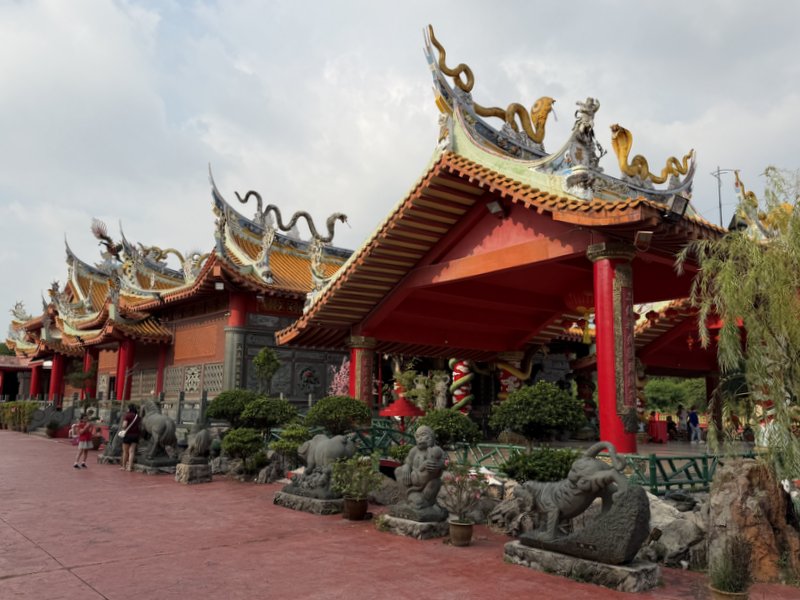
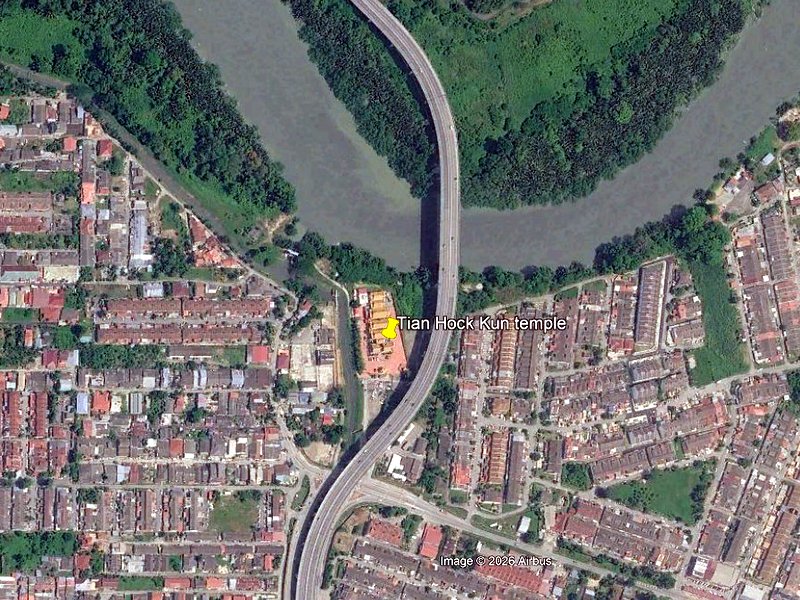
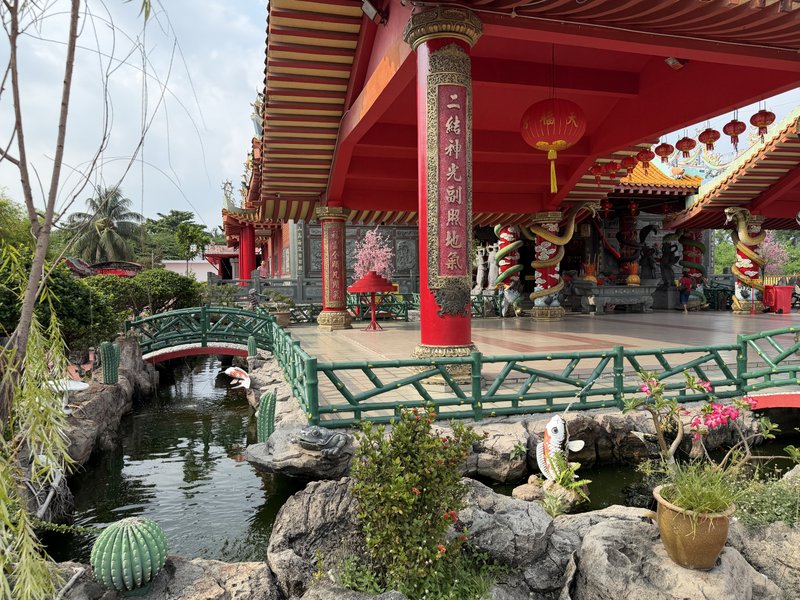
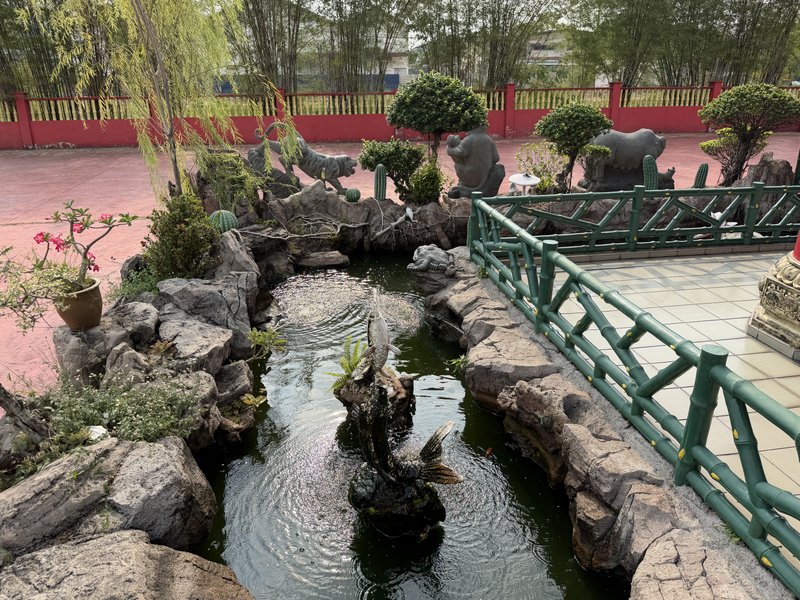
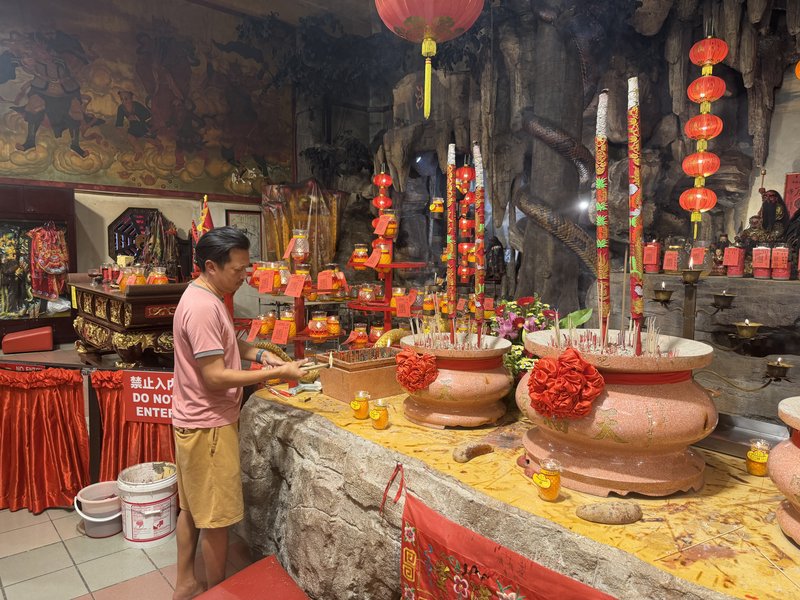
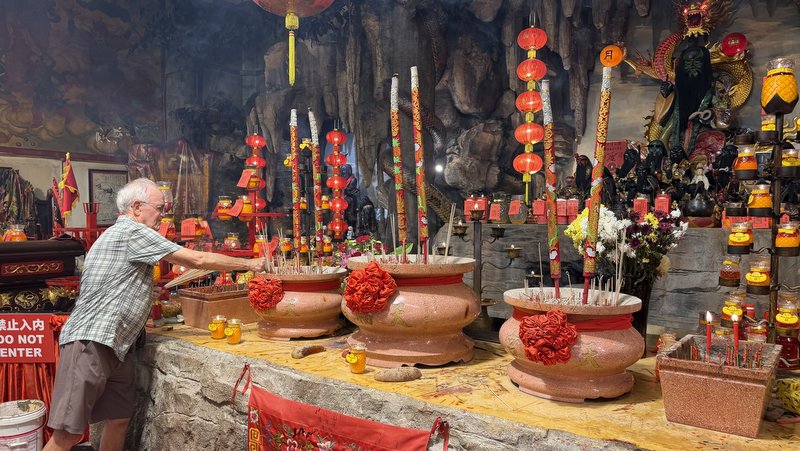
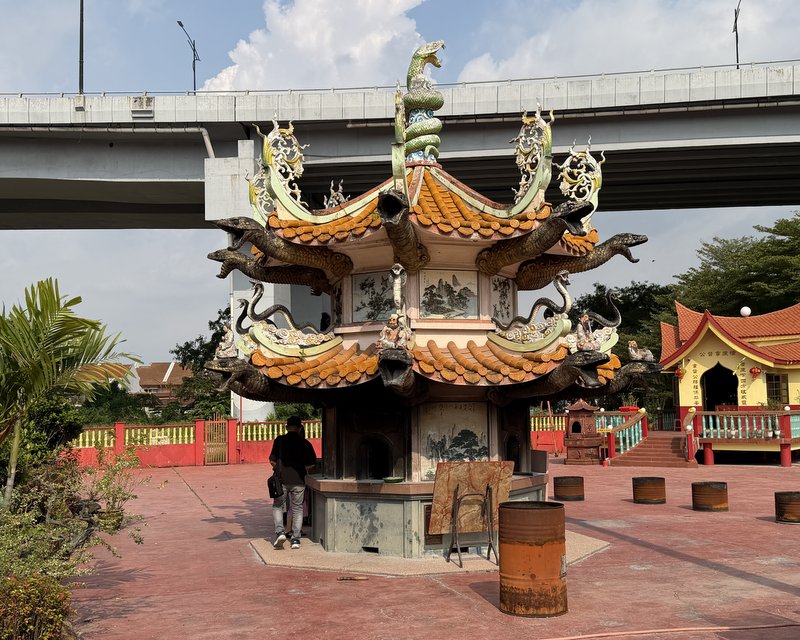
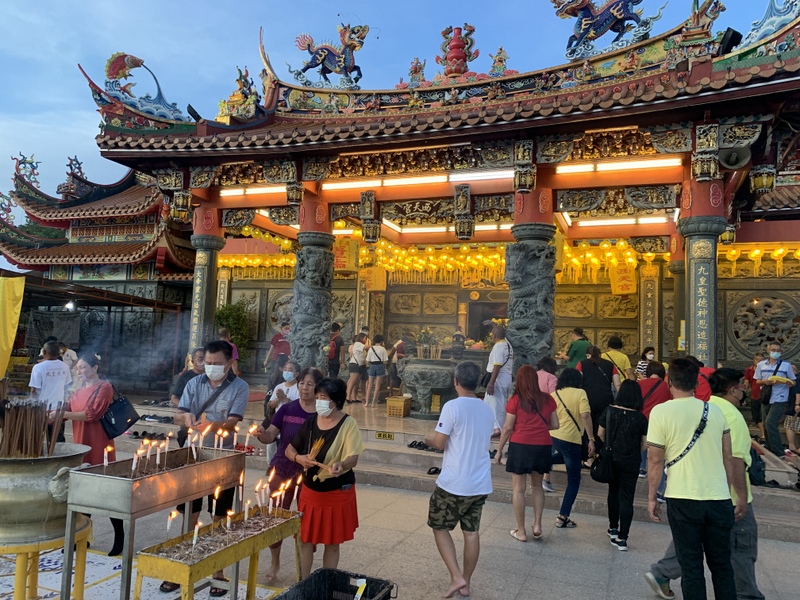
When Aric said, Let’s go to Klang and visit a temple there. It will be a surprise for you, I immediately accepted. One afternoon, we drove to Klang and used Waze to find the Tian Hock Keng temple (Temple of Heavenly Bliss). Here is the temple, when you look at the roof, you may already guess what makes it special. On Google Earth, you see its location. beside the Klang river, and next to a highway.
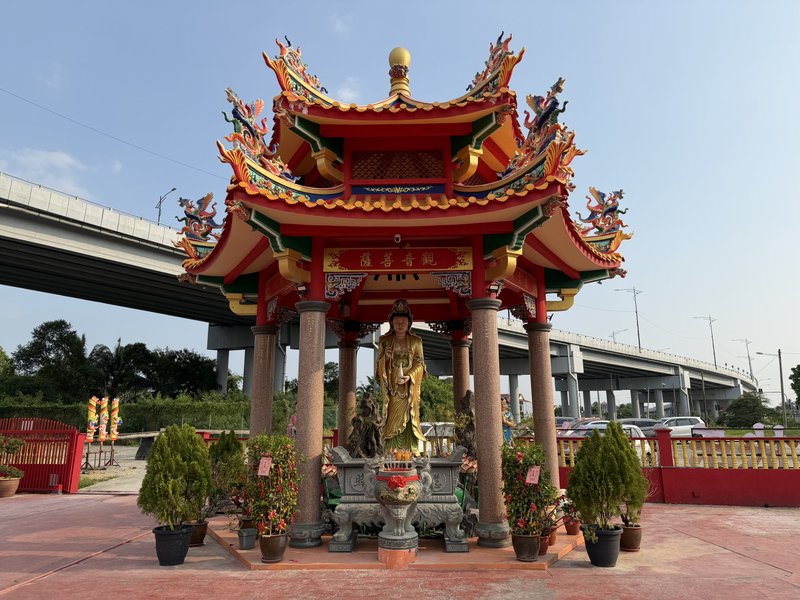
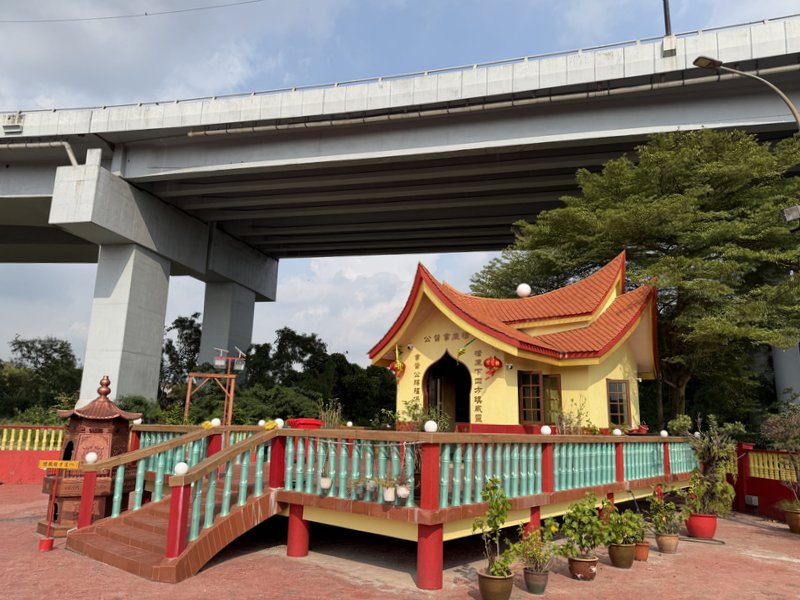
The temple is relatively new, built in the 1980s. In 2017, the Klang Third Bridge was opened, and the access road is dominating the temple. It is a typical Chinese temple, mainly Taoist, but with elements of Buddhism (an impressive shrine for Guan Yin) and folk religion (a Datuk Kong shrine).
You enter the main hall by crossing a bridge.
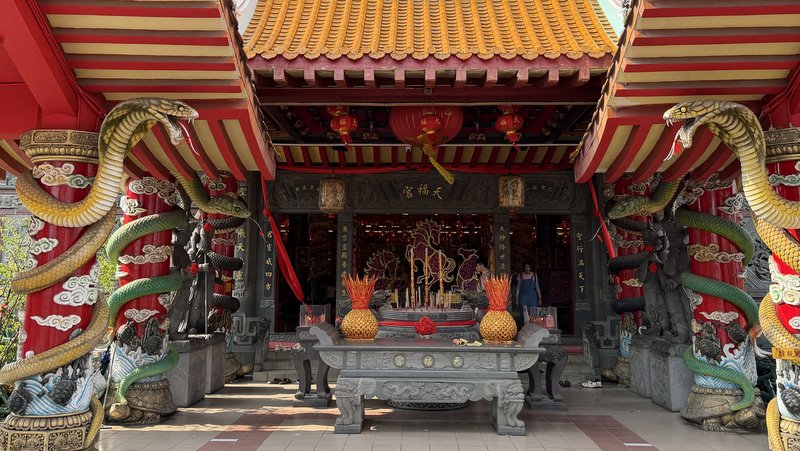
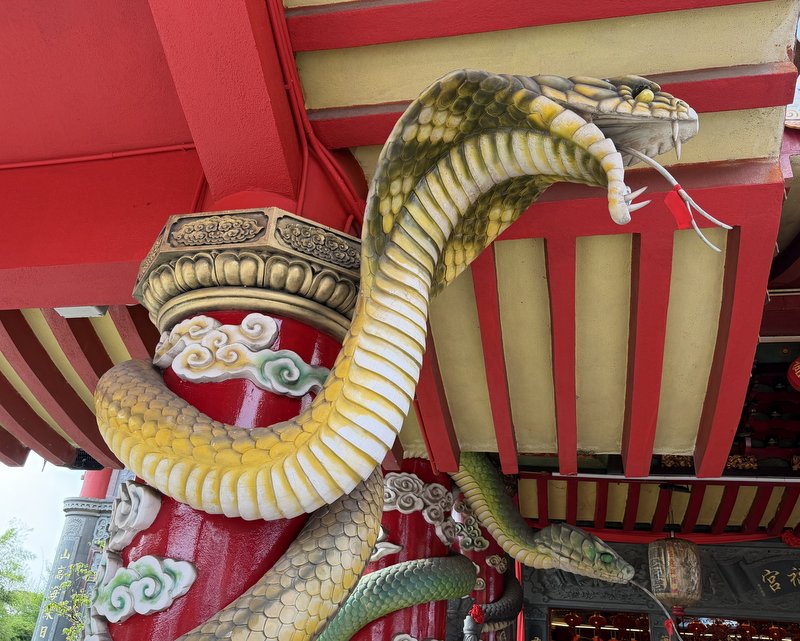
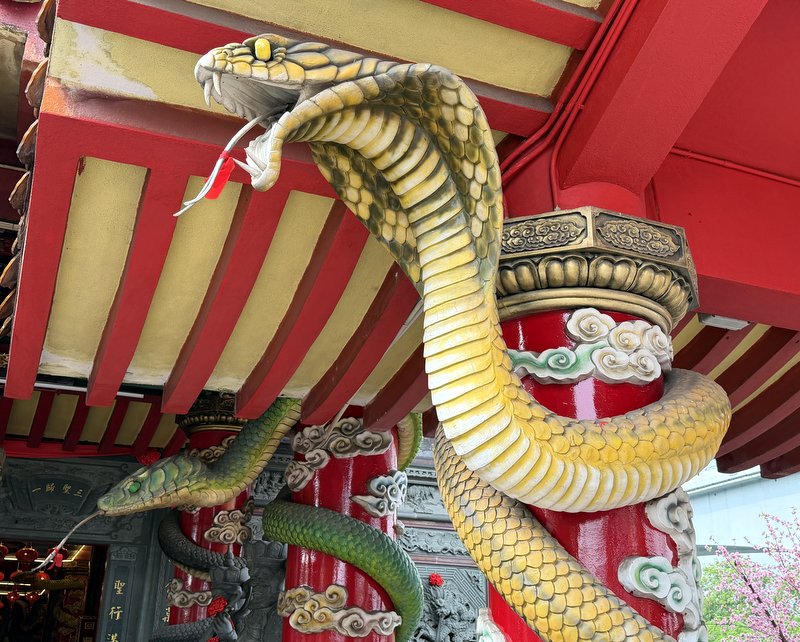
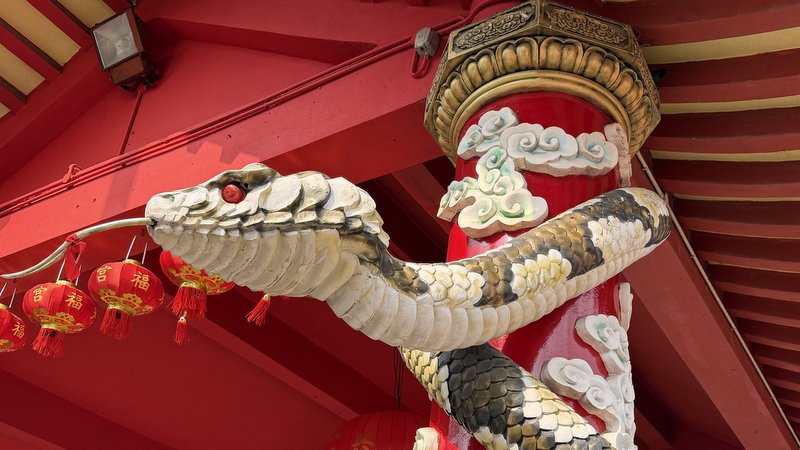
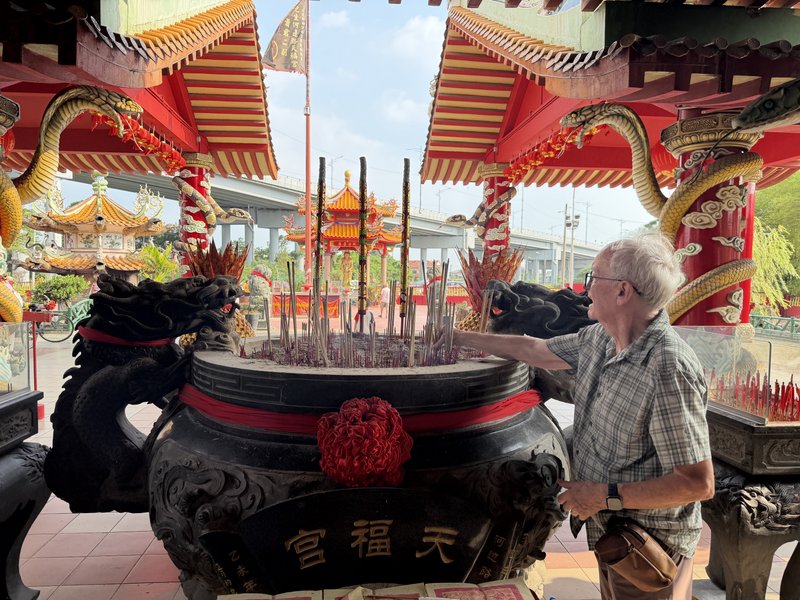
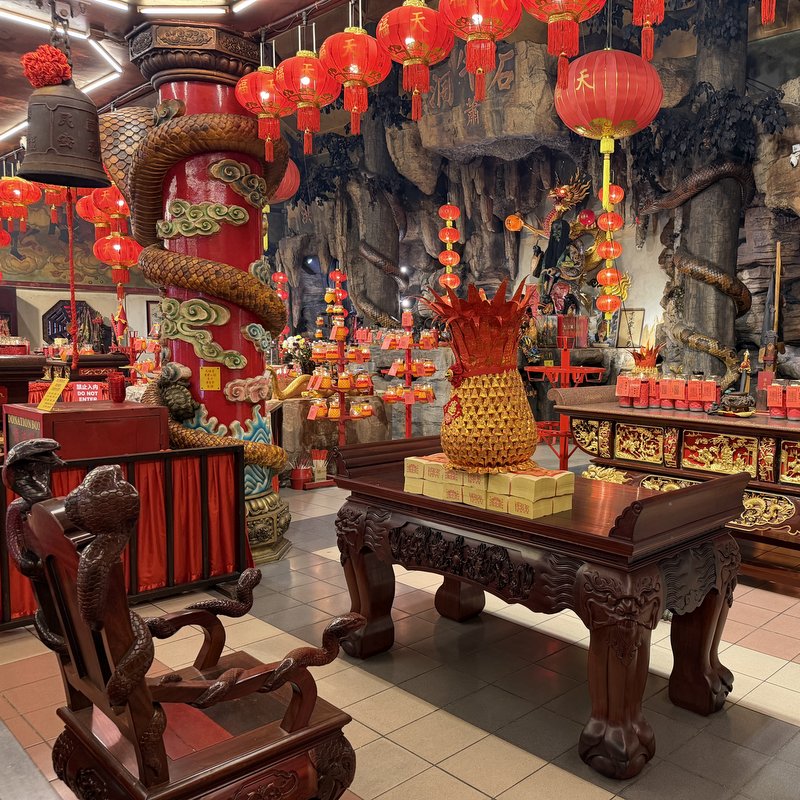
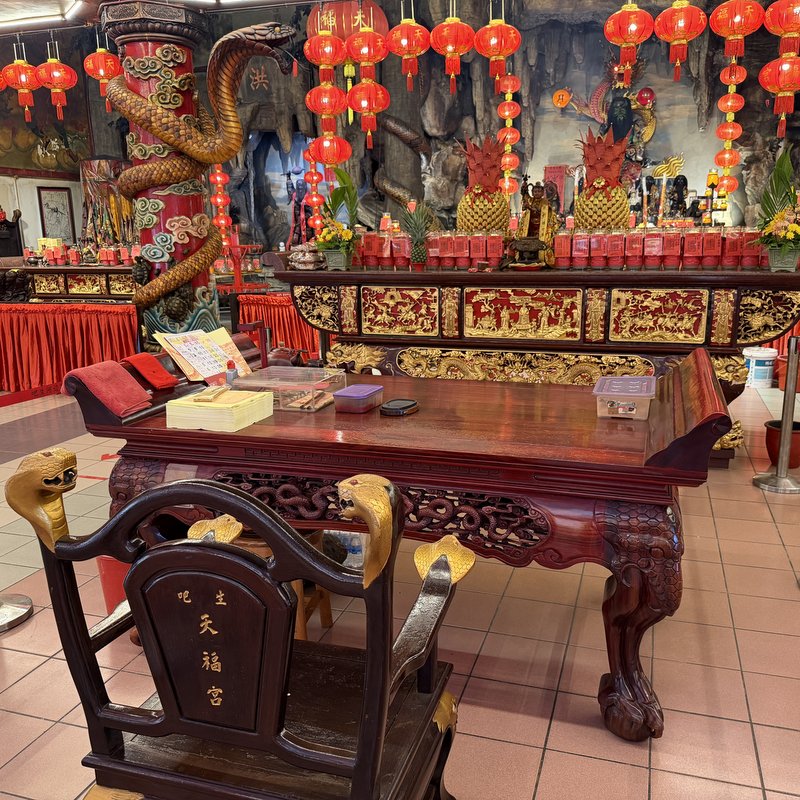
The entrance to the main hall makes clear why the temple is named the snake temple. No dragons here, but snakes. Everywhere, decorating the pillars, on the roof, apparently more than 60 sculptures.
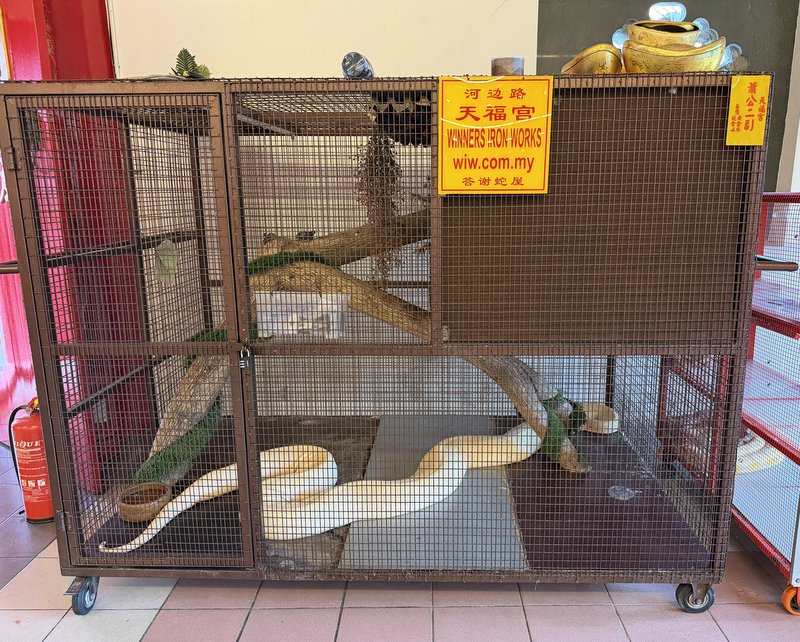
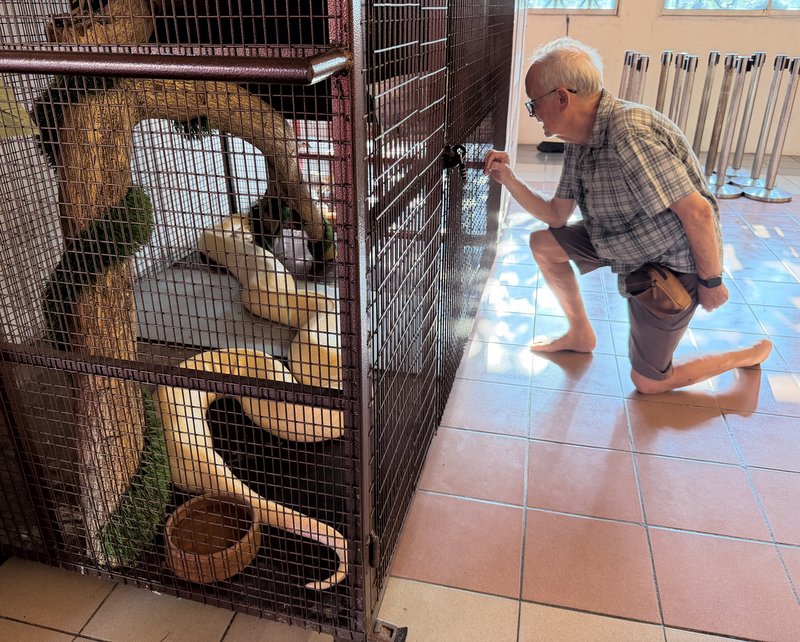
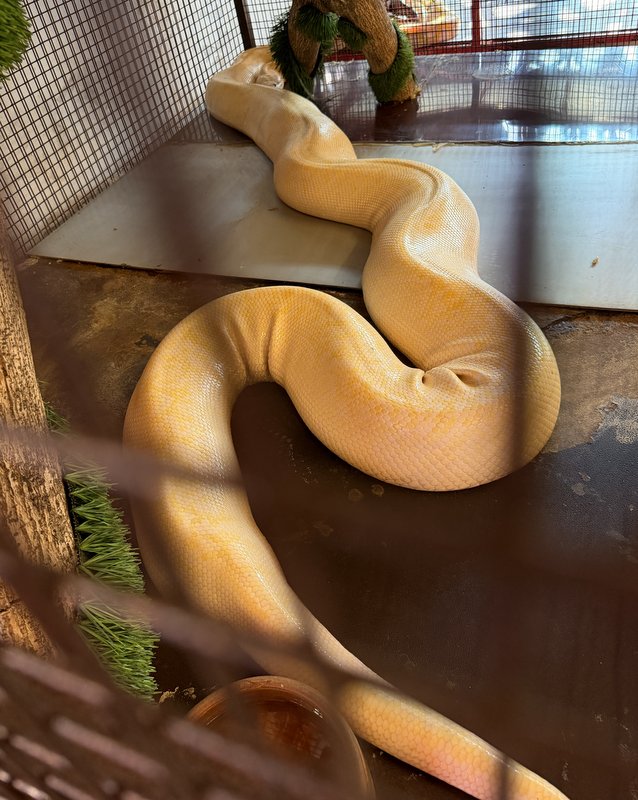
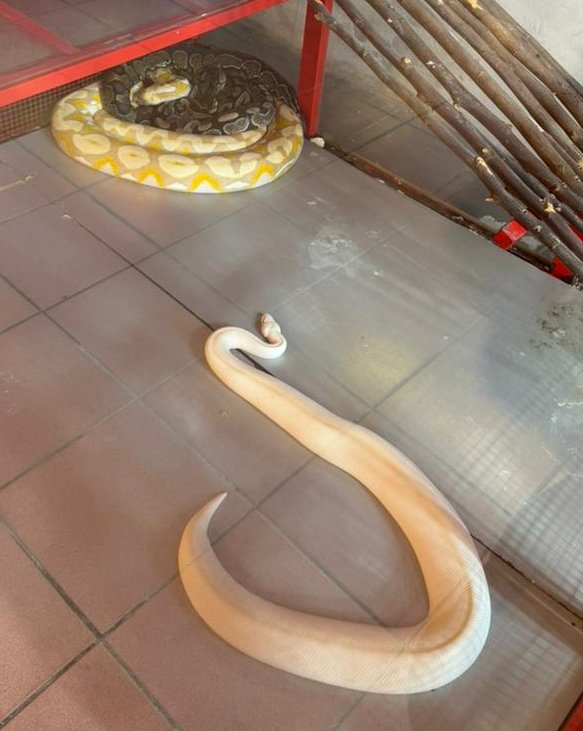
The temple also has a few real snakes. In cages. The albino python is very impressive/
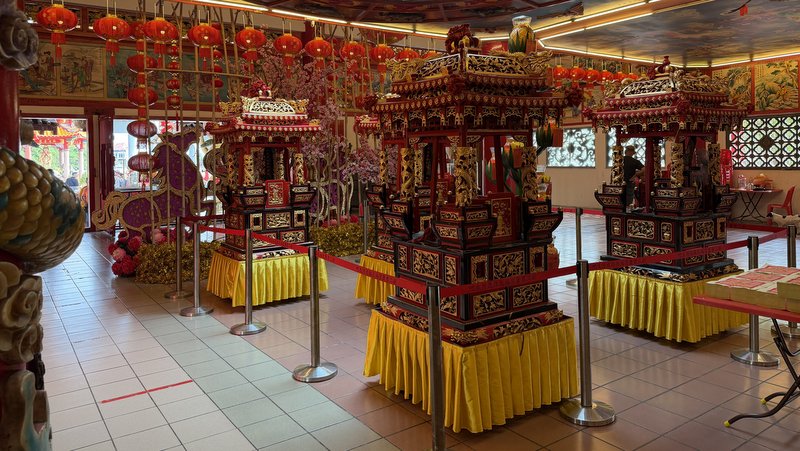
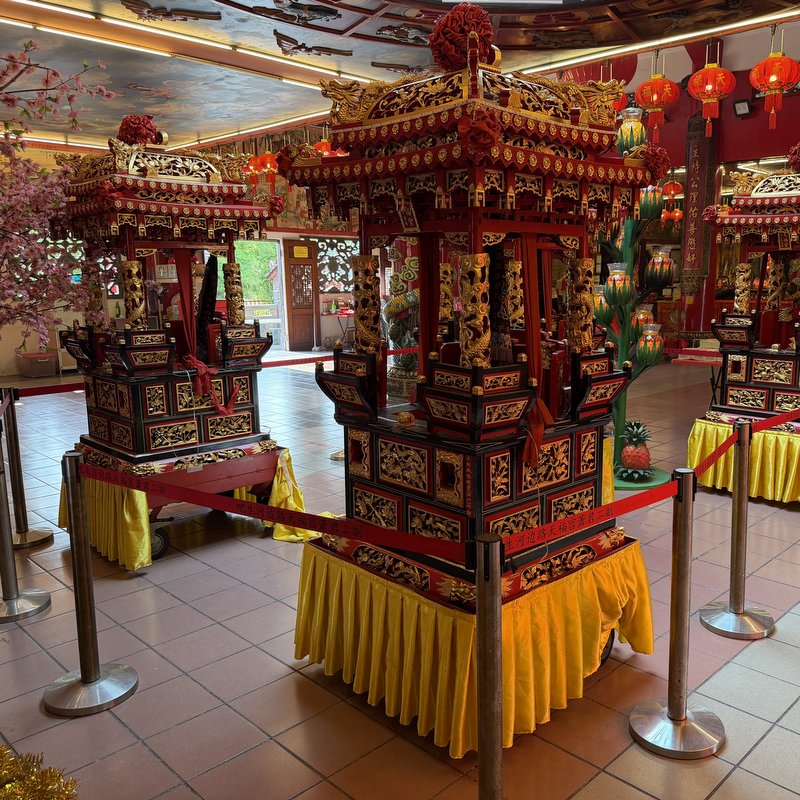
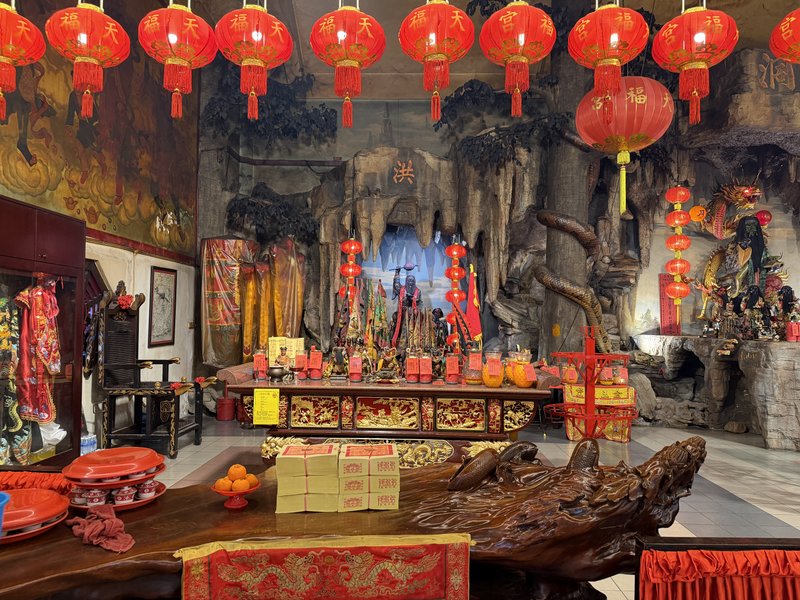
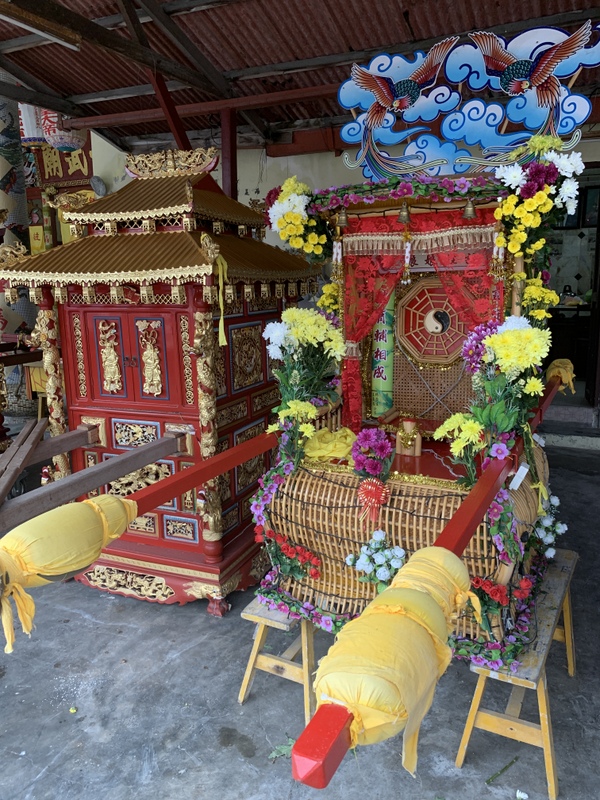
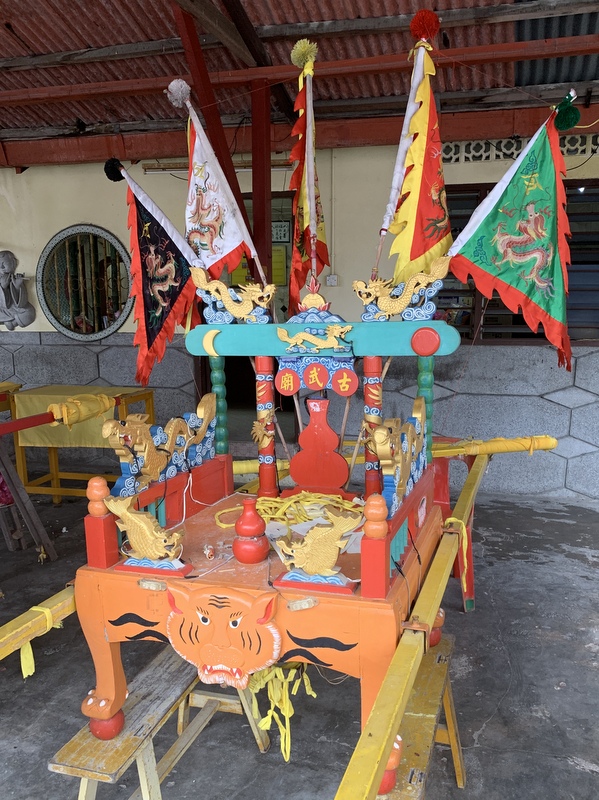
Entering the main hall, you will find several beautiful small wooden shrines. Maybe they are used to carry deities out during processions.
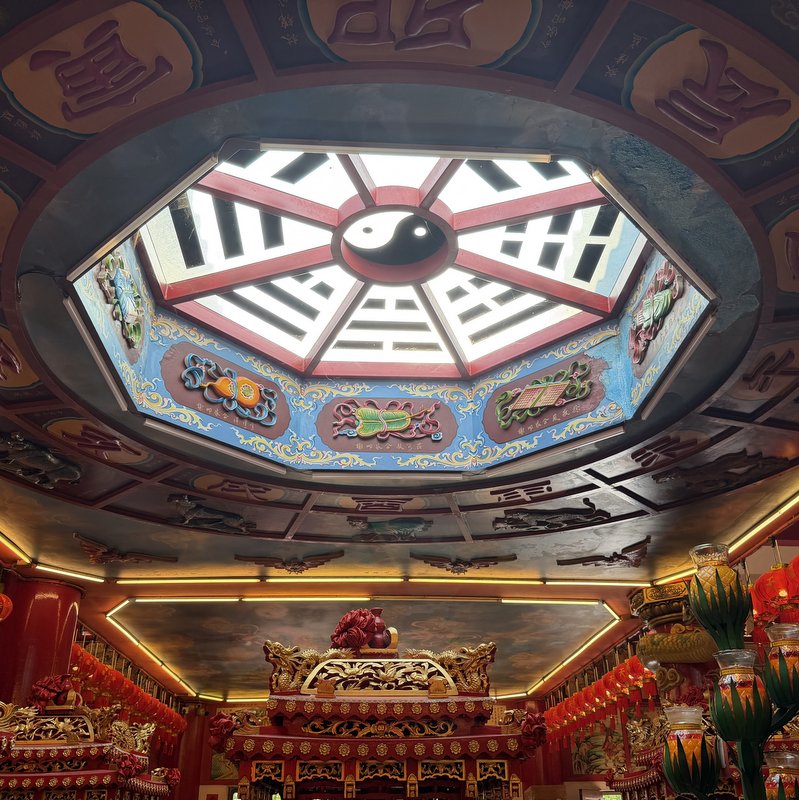
Should you still have any doubts, the octagonal window in the ceiling with the eight trigrams and the Yin Yang symbol proves that this is a Taoist temple.
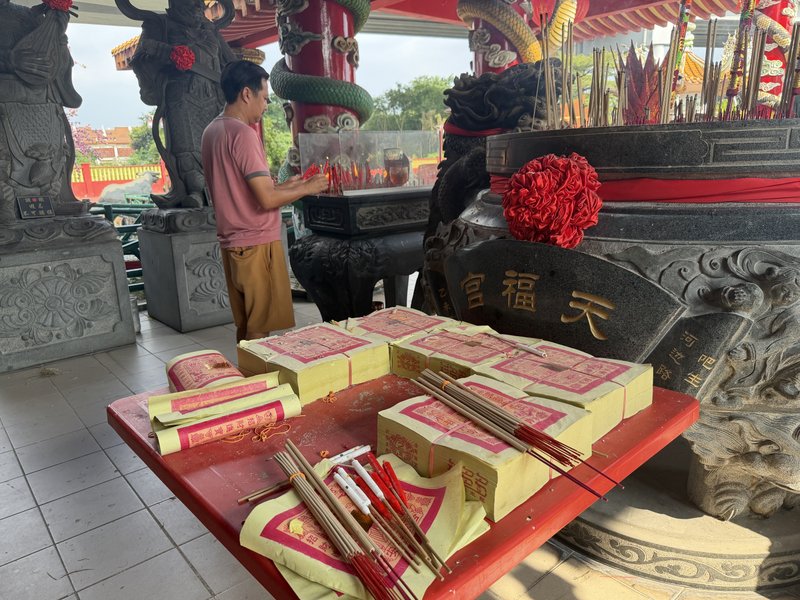
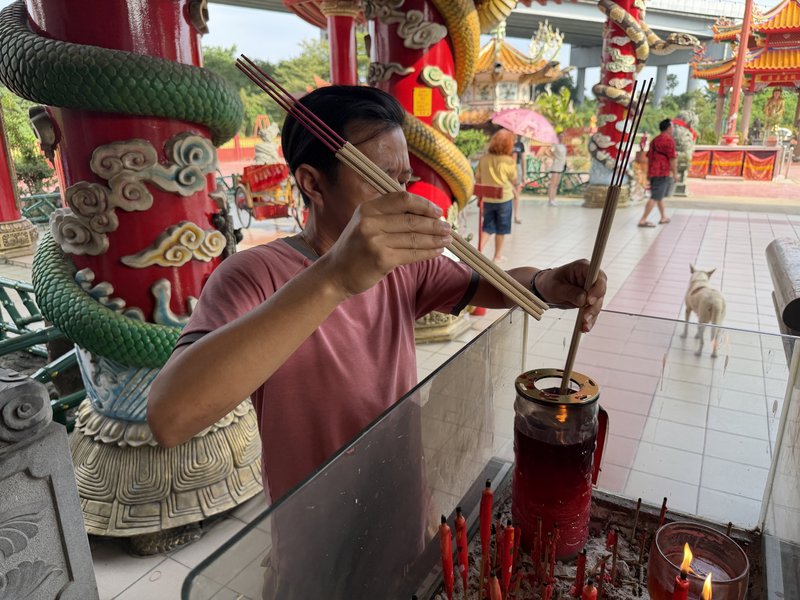
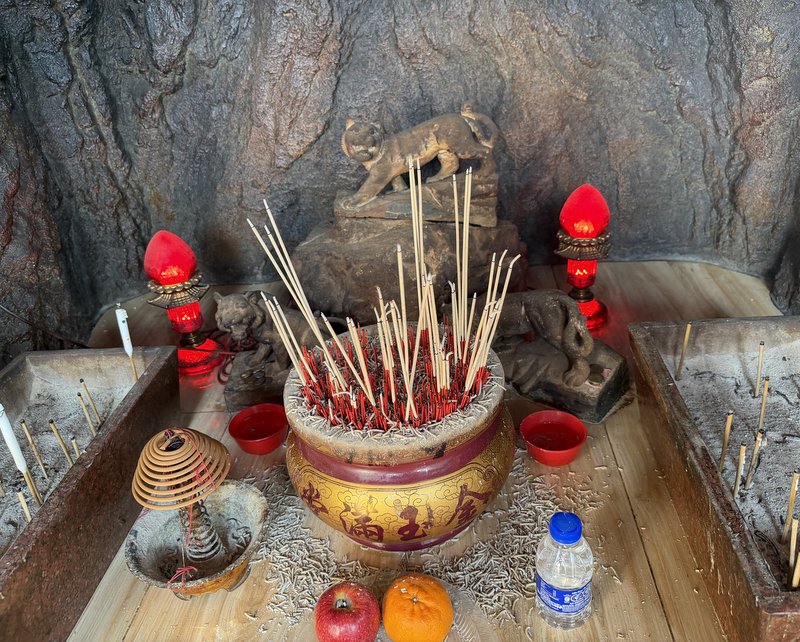
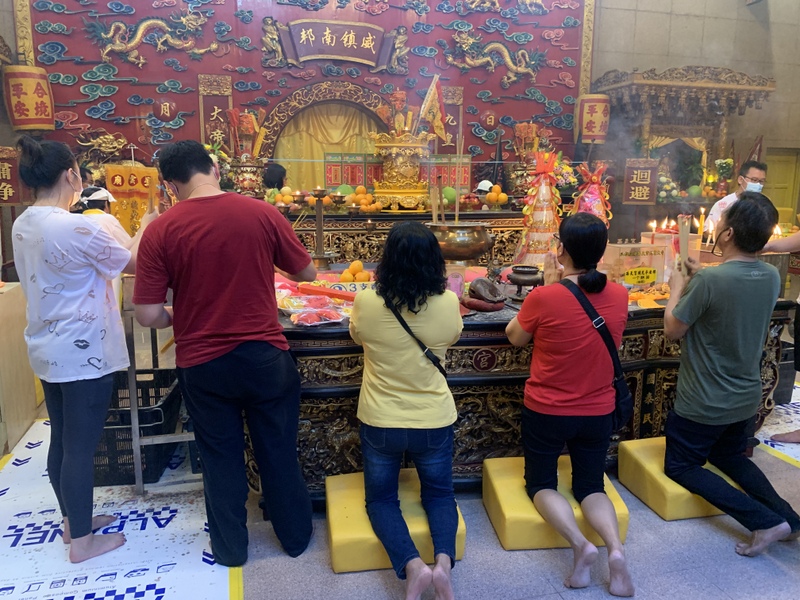
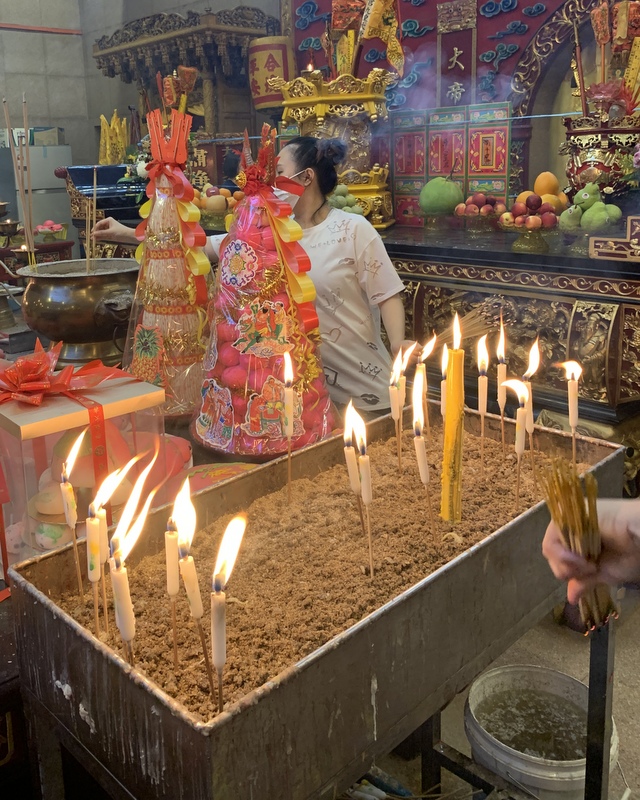
We bought a set of 24(?) joss sticks, 6 candles, and a pack of “hell money”. A signboard showed where and in which order the sticks and candles had to be placed. Took quite some time 😉
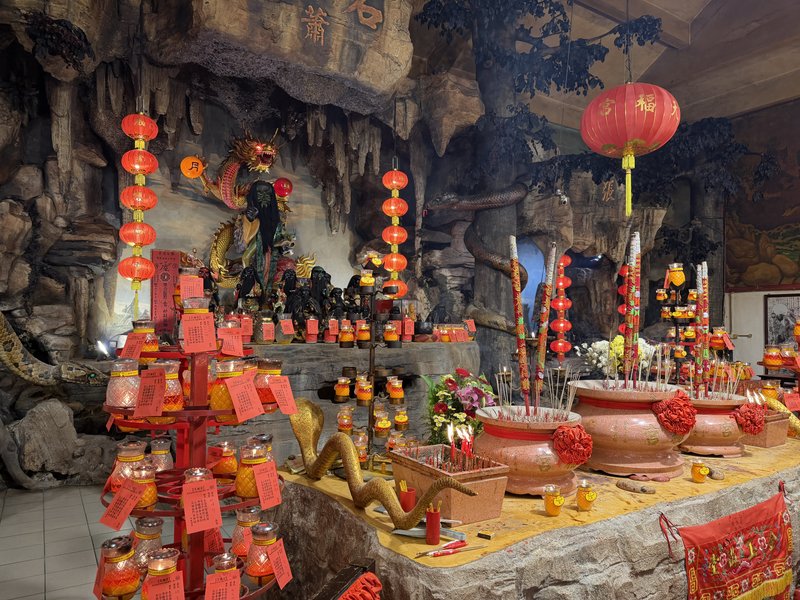
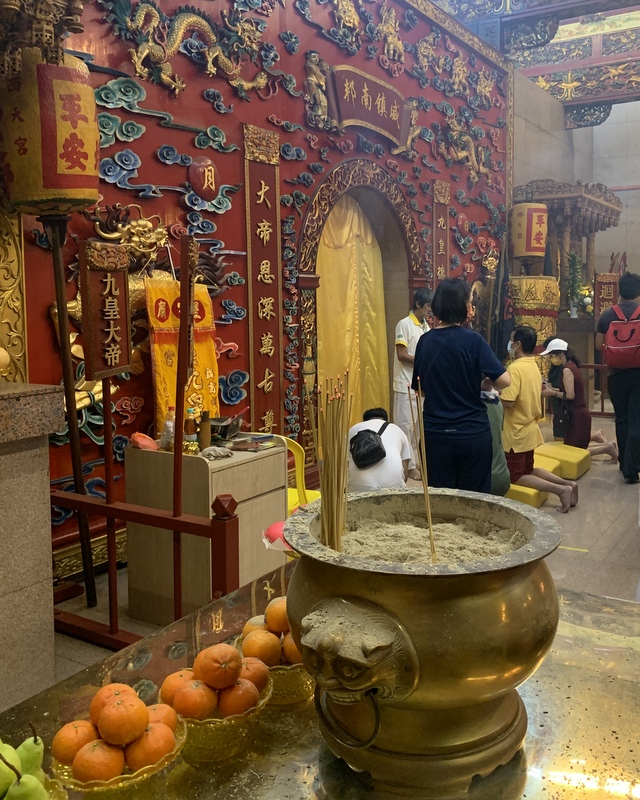
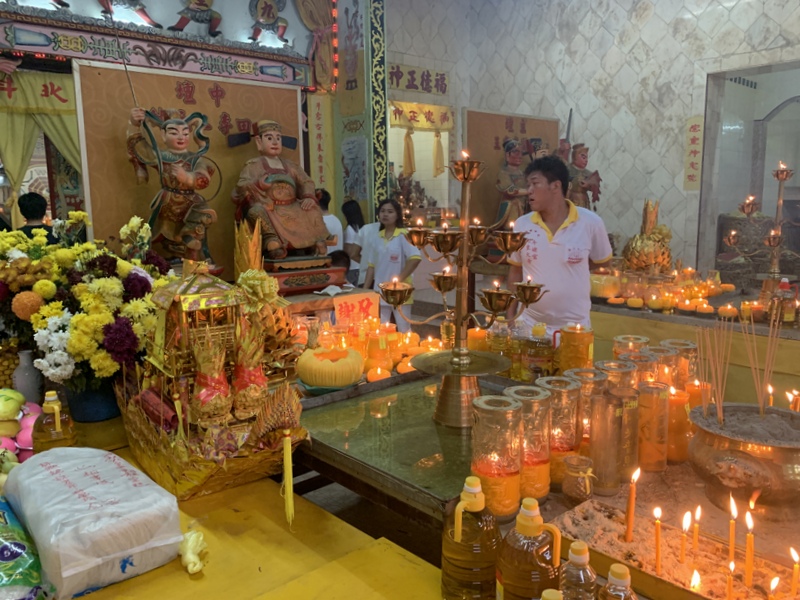
This is the main altar. The temple is dedicated to Xiao Jun Er Fu, a Taoist deity. According to legend, he was one of three brothers who defeated an evil serpent during the Song dynasty (960-1279), and was later deified.
He is generally depicted with a green face (left picture, with a snake curled around him)
There were a few ornamental tables and chairs. Perhaps they are used when a medium enters a trance and can answer questions from devotees.
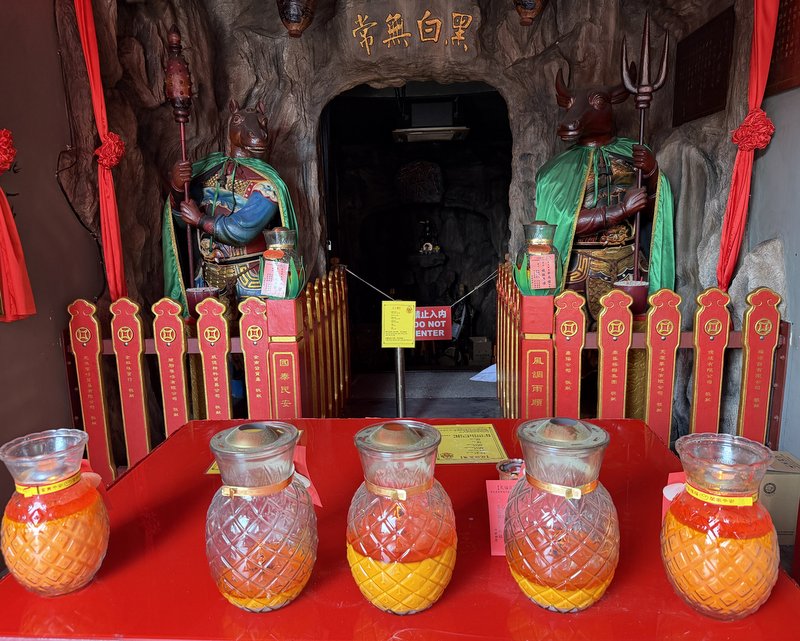
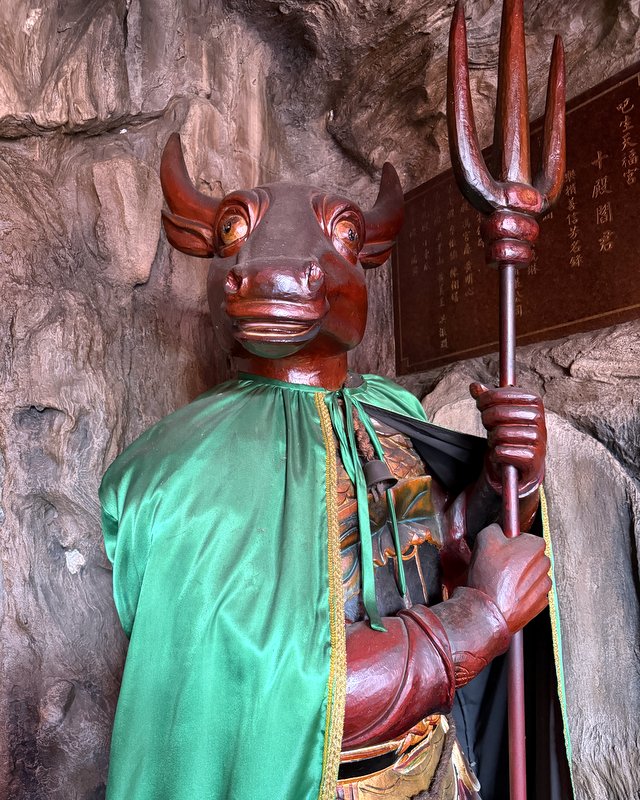
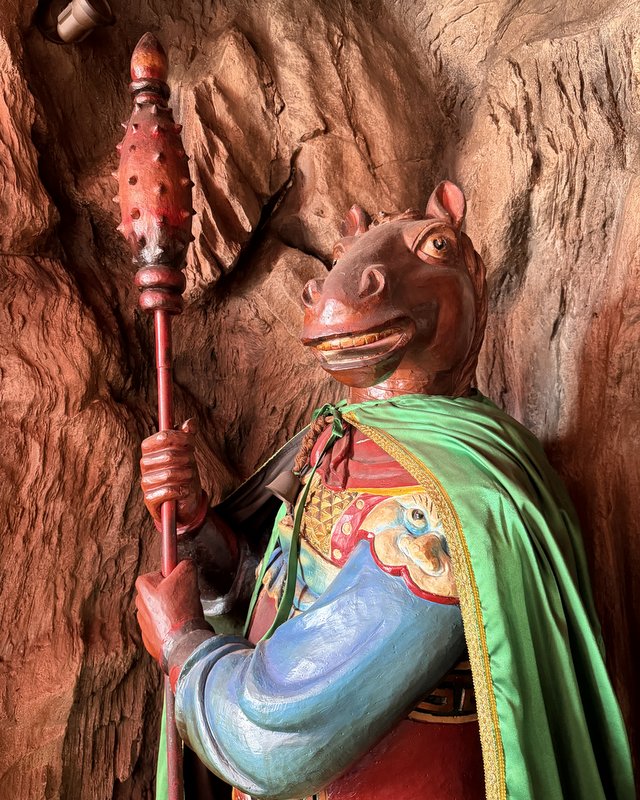
On the left side of the main hall, there is an entrance to the underworld!, guarded by Ox-Head and Horse-Face. Note that you can not enter the underworld, there is a modern sign Do Not Enter. But I could take a picture 😉
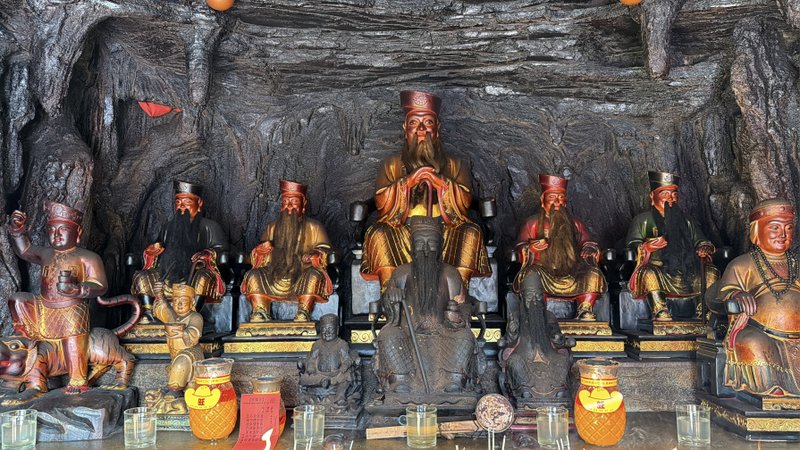
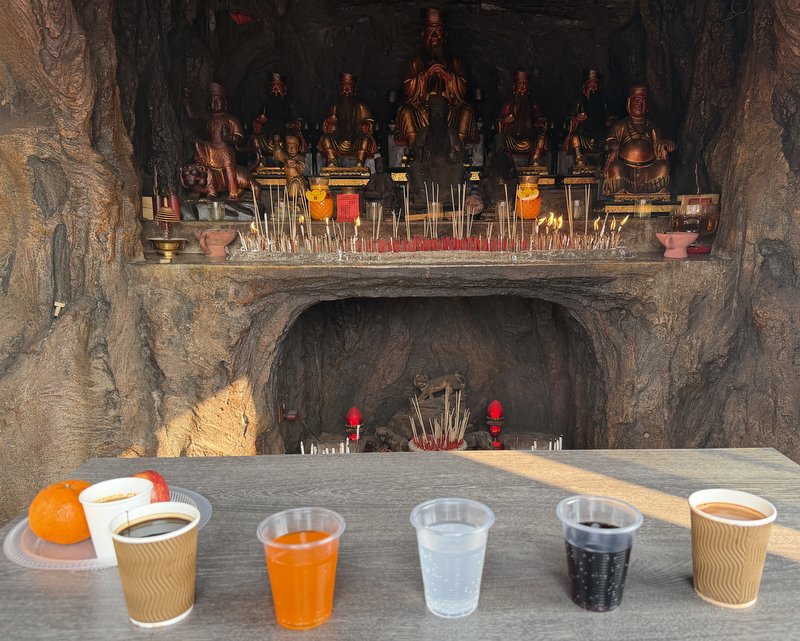
The Datuk Kong shrine is very beautiful and much more elaborate than the usual Datuk Kong shrines I have seen. All the figures are Datuk Kong, with a lot of symbolism. For example, the one in the center is dressed in yellow and represents balance and well-being. Their headgear looks like a tengkolok, worn by sultans and royals. The three in front are wearing songkoks. The walking stick is a common attribute and offerings can not contain pork.
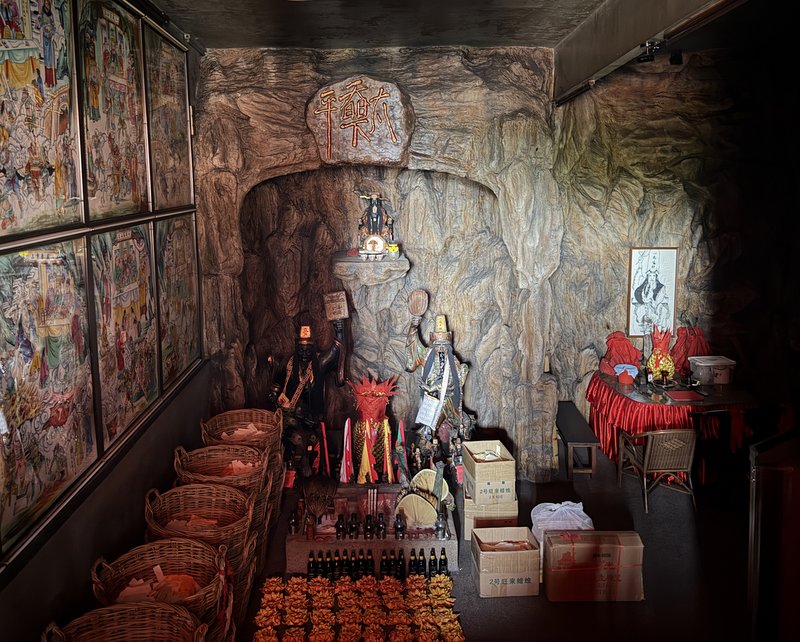
Below the main shrine, there is a small shrine dedicated to Hu Ye, the Tiger god, also a protector deity.
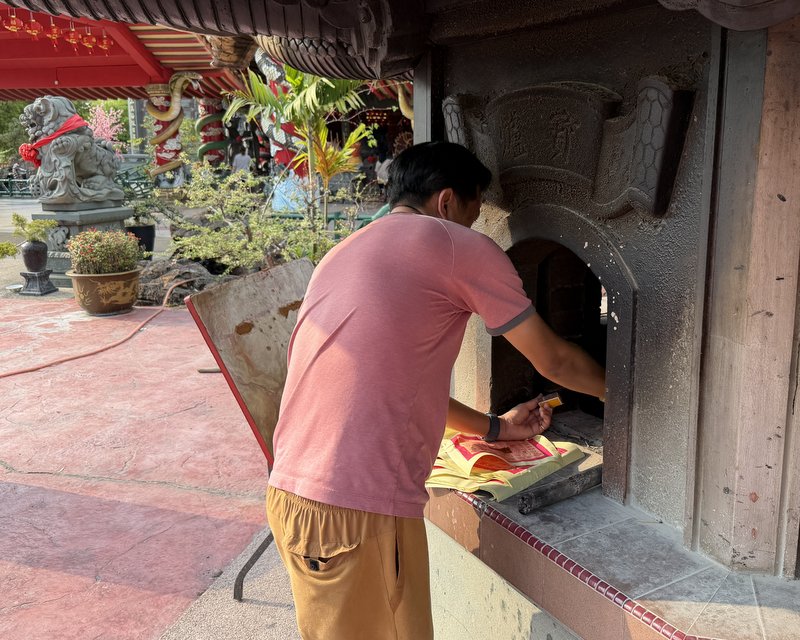
At the end of our visit, Aric burned the josspapers.
A very interesting temple. Not much information is available on the Internet, but this FMT article is quite informative.
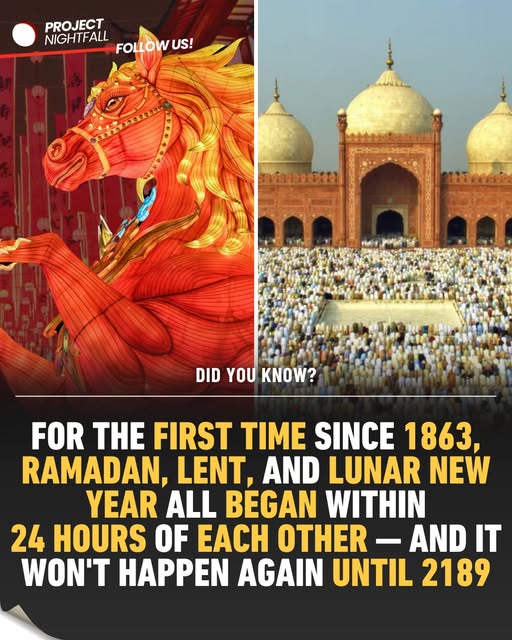
On Tuesday, 17 February 2026, the Chinese Year of the Fire Horse started. The next day, Wednesday 18 February, was Ash Wednesday, the start of the Christian Lenten fasting. And on 19 February, in Malaysia, the fasting month of Ramadan started. A remarkable coincidence? On 19 February, a Facebook article was posted. If you have FB, you can read the article by clicking on the screenshot.
The article states that this coincidence happened the first time since 1863 and will not happen again until 2189 It is rare because three calendars are involved: the Muslim calendar, the Chinese calendar and the Christian calendar.
I am interested in calendars and have written several times about it (here and here and here), so I was interested and decided to check the statement. First, some information about the various calendars.
The Gregorian calendar
Introduced by Pope Gregorius XIII in 1582, it is the globally accepted civil calendar. It is a solar calendar, 365 days with a leap day on 29 February if the year is divisible by 4 (except for century years not divisible by 400).
The Islamic calendar+
The Islamic calendar is lunar, a lunar year equals 12 lunar months of 29 or 30 days, and is 11-12 days shorter than a solar year. So the lunar year moves forward through the seasons. After 33 years, it has made a complete cycle. All Islamic celebrations, like Hari Raya, Muharram, etc/ are movable feasts.
In 2026 the first day of Ramadan fell on Thursday, 19 February. In the table, dates for a few more years are given. The first day of Ramadan moves forward 11-12 days each year, and in 2059, 33 years later, it falls again in February.
Year
Start of Ramadan
Commnet
2026
Thursday,19 February
2027
Monday, 8 February
11 days earler
2028
Friday 28 January
11 days earlier
2029
Tuesday, 16 January
12 days earlier
…..
2059
Friday, 14 February
33 years later
The Chinese calendar
This calendar is lunisolar, to avoid the drifting through the seasons, every few years an extra lunar month is added. As a result the Chinese New Year is still a movable feast but with a limited range (the earliest date is 21 January, the latest date is 20 February).
In 2026 the Chinese New Year started on 17 February. The table shows the same years as the Ramadan table. Note that in 2026, 2027 and 2028, CNY and the start of Ramadan use the same New Moon. The 2-day difference occurs because CNY uses the astronomical New Moon, whereas in Islam, a New Moon must be SIGHTED. More in the appendix. Also note that in 2059 the start of Ramadan and CNY “coincide” again!
Year
Chinese New Year
Comment
2026
Tuesday, 17 February
2027
Saturday, 6 February
11 days earlier
2028
Wednesday 26 Janaury
11 days earlier
2029
Tuesday, 13 February
2028 was a leap year
…..
2059
Wednesday, 12 February
The Christian Calendar
The Christian calendar is often identified with the solar Gregorian calendar, but that is a bit confusing. Yes, Christmas and related events like Advent and Epiphany are celebrated on fixed dates, but Easter and related events like Lent, Pentecost, are movable feasts related to the moon cycle in a complicated way. Easter falls on the Sundayafter the first full moon on or after the Spring equinox. This leads to a window for Easter (22March-25 April) and also for the beginning of Lent, 46 days earlier, Ash Wednesday (4 February-10 March). Comparing the windows for CNY and Ash Wednesday, note that there is a partial overlap,
Here is the table for Ash Wednesday. In 2026 it fell on 18 February and again a few more years are shown. Because of the complicated procedure to determine the date for Easter, date for Ash Wednesday looks quite irregular. But note that in 2059 it falls on the same day as CNY!
Year
Ash Wednesday
Comment
2026
Wednesday, 18 February
2027
Wednesday, 10 February
8 days earlier
2028
Wednesday, 1 March
12 days later
2029
Wednesday, 14 February
15 days earlier
……
2059
Wednesday, 14 February
Combining the three calendars, we see that indeed, 2026 is special, because CNY (17 February), Ash Wednesday (18 February) and the start of Ramadan (19 February) occur within two days. According to the FB article, this is extremely rare; the next time it will happen is, according to “calendar experts”, after 163 years, in 2189. The FB message was copied many times, for example, on Instagram.
But is it true? Look at the year 2059 in the three calendar tables. n 2059, after 33 years, CNY (12 February), Ash Wednesday (12 February), and the start of Ramadan (14 February) will occur within 2 days.
The claim that the next occurrence will be in 2189 is FALSE. It will happen again in 2059.
What about 2092, another cycle of 33 years later? I checked the data, and the answer is NO. CNY falls on Thursday, 7 February, and Ramadan starts on Saturday, 9 February. But Ash Wednesday is one week later, 13 February. The “calendar experts” may be right that there is another occurrence in 2189, but they have overlooked 2059.
Appendix
The Islamic and Chinese calendars can have celebrations at the Same New Moon, but never at the same date; there is always a difference of 1 or 2 days. The reason is that both calendars define the start of a lunar month in different ways.
The astronomical New Moon is not a day, but a specific time on that day. For example, the New Moon occurred on 17 February 20:01 Malaysia time.
The Chinese calendar uses this time. there fore, 17 February was the first day of the Year of the Horse.
The Islamic calendar states that a new day starts at sunset and that a new lunar month starts when the new moon is visually sighted. But on 17 February at sunset, the new moon has not yet occurred, so the first sighting can only take place at sunset on 18 February, and the first day of Ramadan will be 19 February, two days later
It takes about 10-15 hours after the new moon for an observer to spot the first sliver of the new moon
I will illustrate this using data for an occurrence of CNY and Hari Raya. As Hari Raya is a major celebration for Muslims, as CNY is for the Chinese, a coincidence of the two is so special that it got its own name, Kongi Raya. It will happen in 2029, 2030 and 2031
Here is the table, with the times of the new moon added.
Year
New Moon
Chinese New Year
Hari Rya
2029
18:31
13 February
15 February
2030
00:07
3 February
4 February
2031
12:31
23 January
25 January
In 2029, the new moon occurs on 13 February at 18:31. Impossible to sight the moon, Hari Raya start two days later. One year later the new moon occurs at 00:07. That same eveing the new moon can be sighted, so Hari Ray starts at 4 Fevruary. In 2032, the new moon occurs at 12:31. Not enough time to sight the new moon at susnet, Hari Raya 25 January
The Hindu calendar is also lunisolar, their main festival Deepavali can also occur together with Hari Raya. This is called DeepaRaya and will happen again in 2037-2039
When Aric suggested to go on an overnight trip to Kulai, I didn’t even know the location of that town. Actually, it is in Johore, near Johor Bharu, a 4-5 hour drive from where we live! He said that we would visit the Putuo Village, which features an interesting Chinese temple.
It is not really a village, located in a bamboo forest, quite far from Kulai town. There was a cafe where we had coffee and some snacks.
The temple is next to the cafe.
To enter the temple, we had to cross a bridge over a canal, decorated with lanterns in rainbow colors.
There are two guardians at the entrance, one male and one female. See if you can spot the difference.
A big surprise for me. A huge dragon made of bamboo hung from the ceiling in the entrance hall. No surprise for Aric, as this was why he wanted to visit the temple in the first place, his zodiac sign being a dragon.
Later, I read on the Internet that this work of art was only placed here during the CNY 2024, a Year of the Dragon. Made by an Indonesian craftsman who worked on it for six months. An amazing creation.
Entering the main hall, there were more surprises. The temple is dedicated to Guan Yin, the goddess of compassion in Mahayana Buddhism, but here she is shown as the female manifestation of the bodhisattva Avalokiteśvara. The other surprise was the bamboo architecture, which reminded me of Gothic cathedrals in Europe. Fascinating.
The beautiful statue, with eighteen arms, is the largest in Malaysia. At the back of the hall, there is another statue with even more arms.
`
We bought a candle, and I offered it to the goddess. Out of respect, although I am not a Buddhist.
In the court, there was a wishing tree. You have to throw the red ribbon up and hope that it will get caught in one of the branches.
–
We bought one, and Aric managed to get it stuck, after several tries.
It was a pleasure to walk around and enjoy the serene atmosphere. Everywhere colorful rainbow flags. There was also a gallery with prayer wheels.
We found a traditional statue of Guan- Yin. Aric is bathing the (baby) Buddha, a traditional ritual during Wesak, the Buddha’s birthday.
A separate shrine for the God of Wealth, -important for Chinese devotees. The dragon looks fierce and unfriendly.
After spending quite some time in the temple, we went to the second attraction of Putuo Village, the Purple Bamboo Valley. In a picturesque bamboo forest, several attractions have been constructed, often utilizing bamboo, making them perfect for taking pictures. We paid a small entrance fee,
Sun and Moon in the bamboo forest.
Very attractive and peaceful.
Concrete steps allow you to climb several attractions. The snake statue is probably a new addition, because this year is the Year of the Snake. We visited the valley on a weekday, and there were not many visitors. Of course, we took many pictures.
+
The forest also has some shrines. The decoration is about the Mid-Autumn festival and may be temporary.
The temple is only a few hundred meters away and connected via a walkway, decorated with rainbow flags.
After spending many hours in the Putuo Village, we were a bit dehydrated. Before going to our hotel in Kulai, we went to a cafe for an ABD and a rojak
Our hotel was in a new part of the town, a very small room, but clean.
Using the WIFI in our hotel, I searched for more information about the Putuo Village. It began around 2005 as a small Buddhist site dedicated to Guan Yin. Around 2015, a major renovation started, using local bamboo. This renovation is continuing. The name Putuo comes from Mount Putuo, a sacred mountain in China, the “residence” of Guan Yin. Many temples there, and also a famous Purple Bamboo Forest.
We decided to visit the temple again the next morning, after breakfast in Kulai.
We were curious about the bamboo architecture and about how the dragon was made from bamboo.
Here are two details of the dragon. The whole creature has been “woven” from bamboo! Absolutely amazing.
About the architecture, it looks like the roof of the temple is supported by bamboo. But when you look carefully, you will see that behind the bamboo there is a metal structure. And the fanlike “pillars” may have been filled with cement, for strength.
We found a scale model of the temple in the entrance hall. Aric managed to take a picture inside this model.
–
In a Chinese temple, you will often find divination tools to gain insight, guidance, or answers about the future. This Mahayana Buddhist temple is no exception. On a table, we found two examples, Poe blocks and Chinese Fortune sticks. The Poe blocks have a flat and a curved side. When you throw a pair on the floor, while making a wish, it matters how they fall, flat side up or curved side up. One flat, the other one curved, is positive. The fortune sticks are numbered, you shake the container until one stick falls out. Then you read the message.
Another interesting shrine is the Datok Kong shrine in the temple grounds.
We walked around the temple to admire the architecture. Notice the Datok Kong shrine, next to the temple. Those shrines, dedicated to a local deity, were built before the construction of the main temple started.
After this second visit, we left a bit reluctantly for the long drive back home. Altogether, we drove more than 700 km in two days, but it was worth the effort.
My fourth visit to Taping this year! The main reason was the 9 Emperor Gods Festival. But it so happened that my friend Lay Chun celebrated her birthday, and she invited me to her birthday dinner. On Monday, 27 October, I took the MRT and ETS to Taiping. The train was fully booked. And freezing cold.
From the station I took a Grab to Hotel Furama; I always have the same room; it feels like my second home.
I went out for my lunch and walked to the Peace Hotel, where I had my Char Kway Teow. After Lay Chun introduced me to this stall, I became a regular visitor.
A few days earlier, there had been heavy rain with flooding and evacuations in several regions around Taiping, but now the weather was splendid, so I decided to walk around a bit. One of the reasons I love Taiping is the mixture of beauty and decay. Here are two examples. The beautiful Peranakan house on Jalan Stesen and a ruin, which also has its charm..
I passed the former Perak Railway Headquarters (later the PWD department), which was recently destroyed by fire. The third fire in a heritage-related, abandoned building in the last three years. Very suspicious, in my opinion. More about the “Shame of Taiping” later in this post.
PWD building 2025Rest House 2023Majestic Cinema 2025
Before returning to my hotel, I relaxed for a while at the Lake Gardens.
One month ago, Siang Malam reopened after the rebuilding. I was interested to have a look and when I mentioned it to my friends, they liked to join. Pleasant atmosphere, quite a big crowd. I had Wantan Mee, not bed.
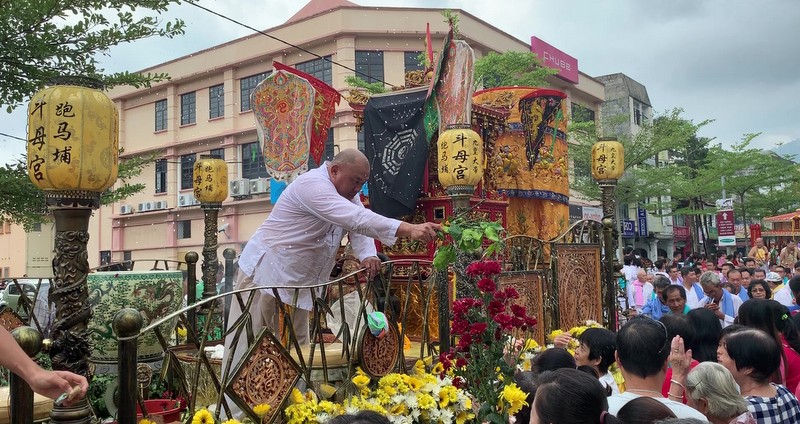
The 9 Emperor Gods Festival is held during the first 9 days of the ninth lunar month. The main procession is on day 8, and the firewalking is on the final night. In 2019, I watched the procession for the first time. Click here for a report. I found it so spectacular that I came back in 2023 (report here), so this was my third time. Again, I was the guest of Ng Teng Hin and Bok Kin, in the townhouse of Ng Boo Bee, Teng Hin’s ancestor..
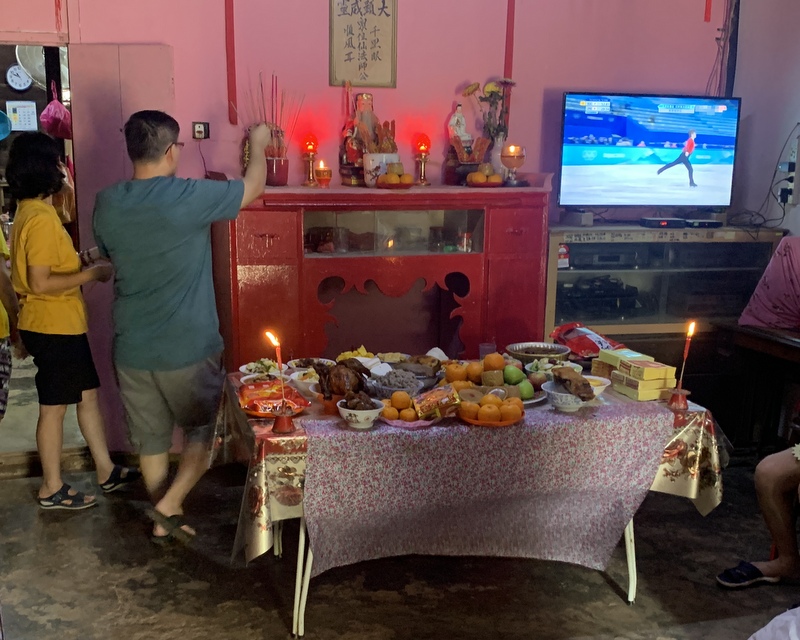
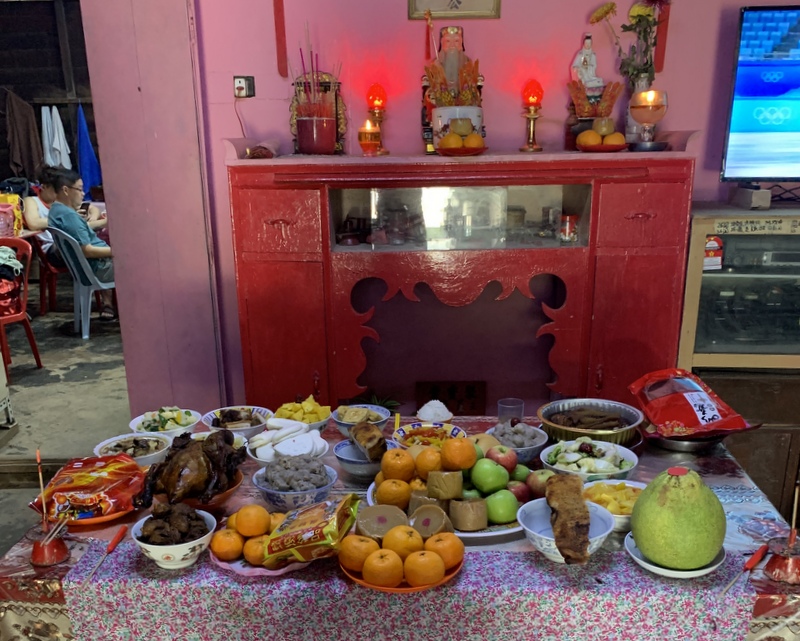
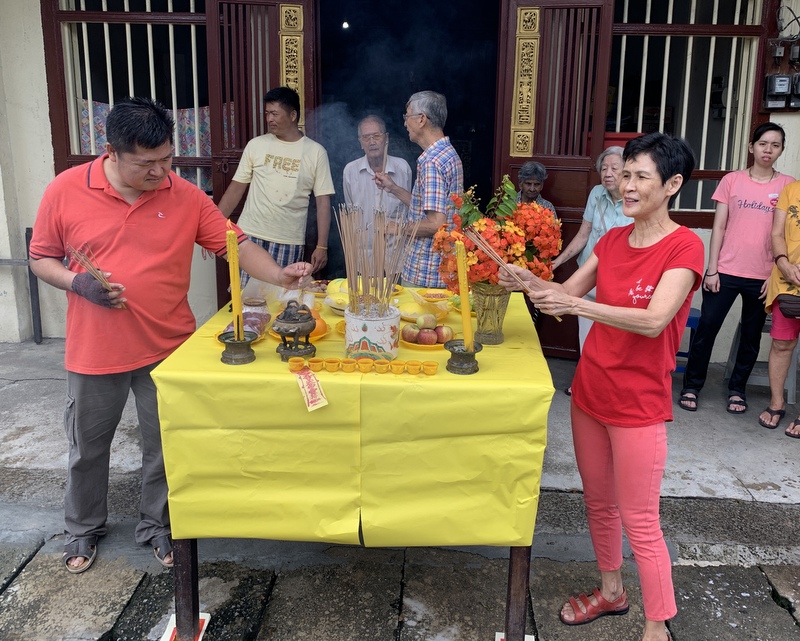
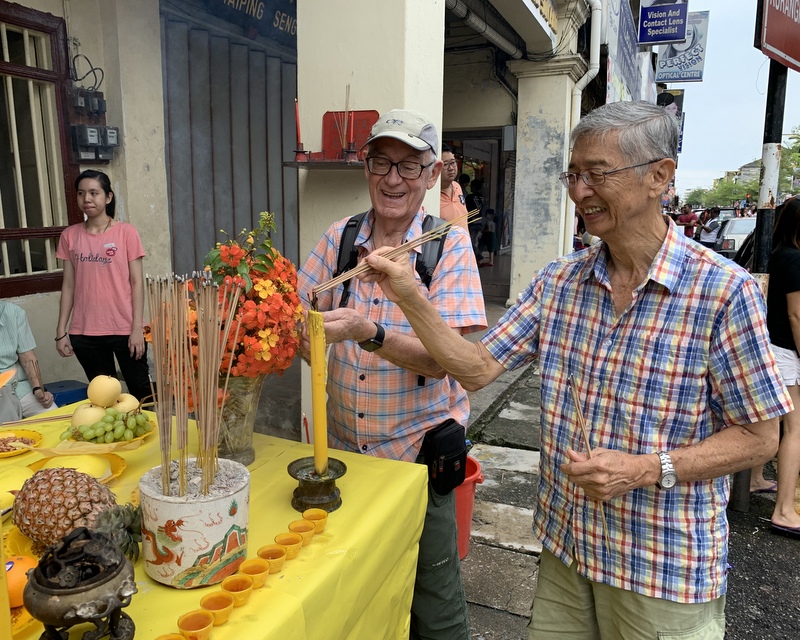
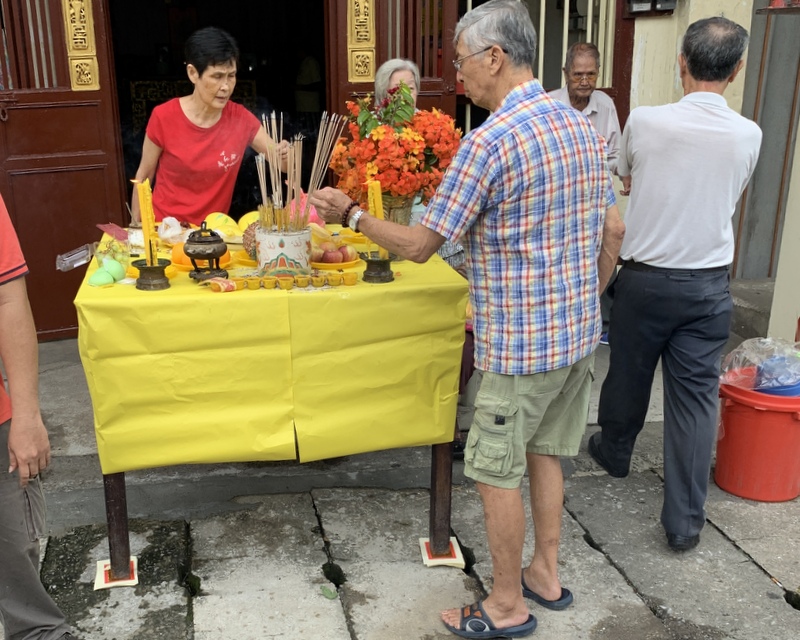
The Ng family always prepares an offering table. When the procession passes the house, they stop for a while and perform rituals.
Here are two short videos about the procession..
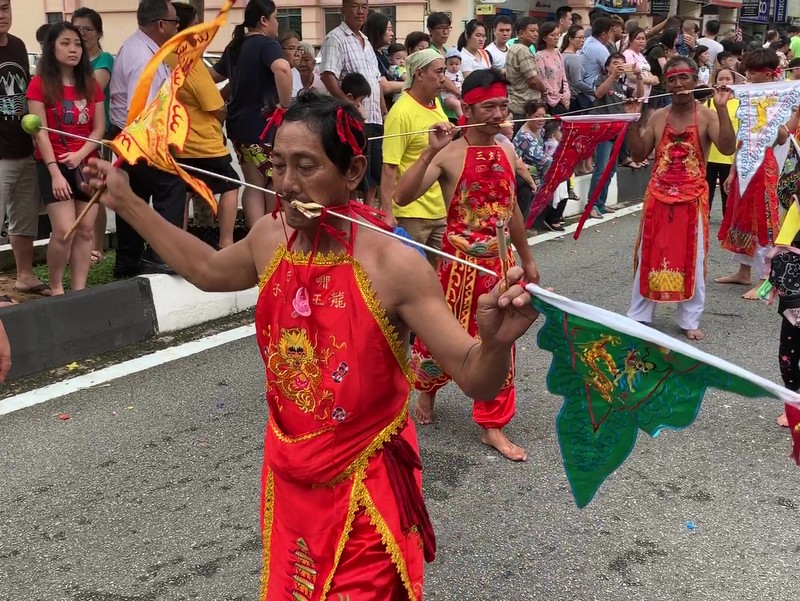
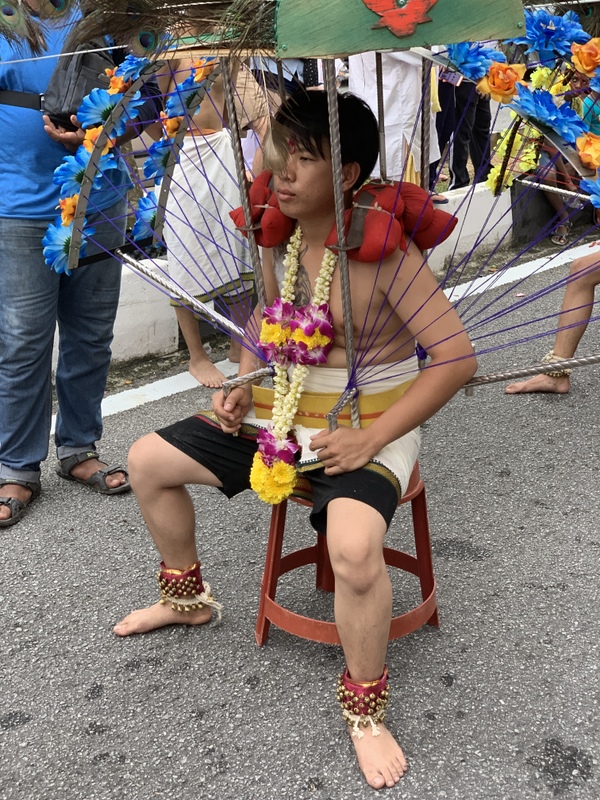
A few more pictures. The piercings were less extreme than in 2019 and 2023 but still fascinating. Mostly tongue and cheek piercings
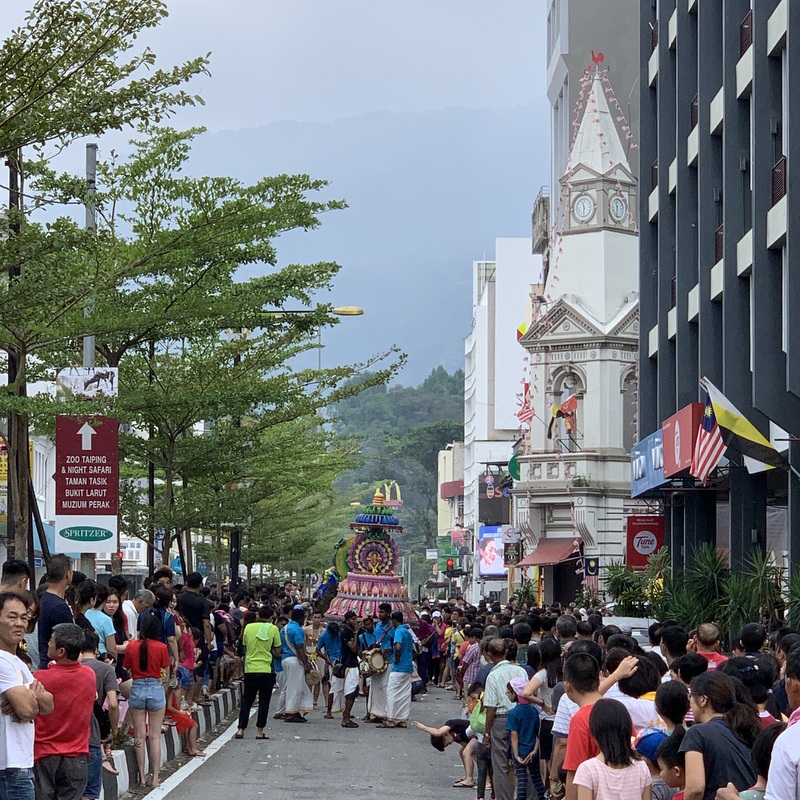
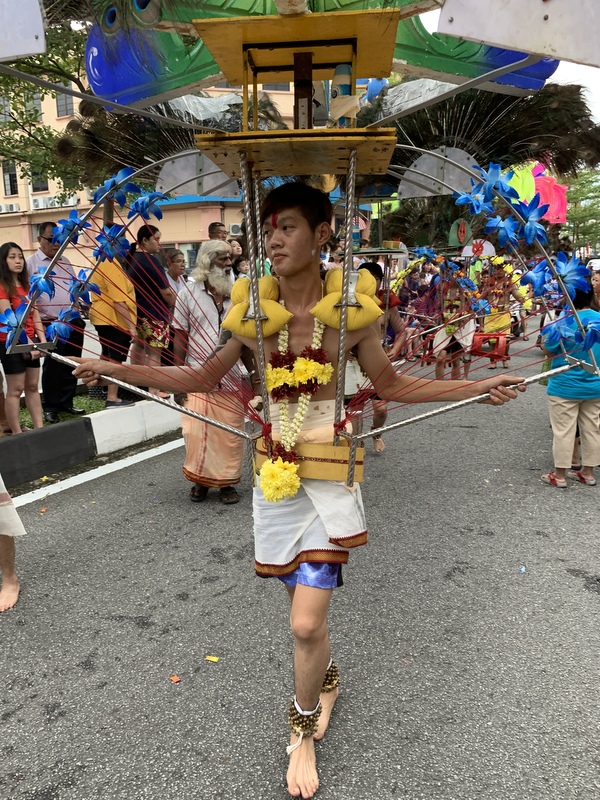
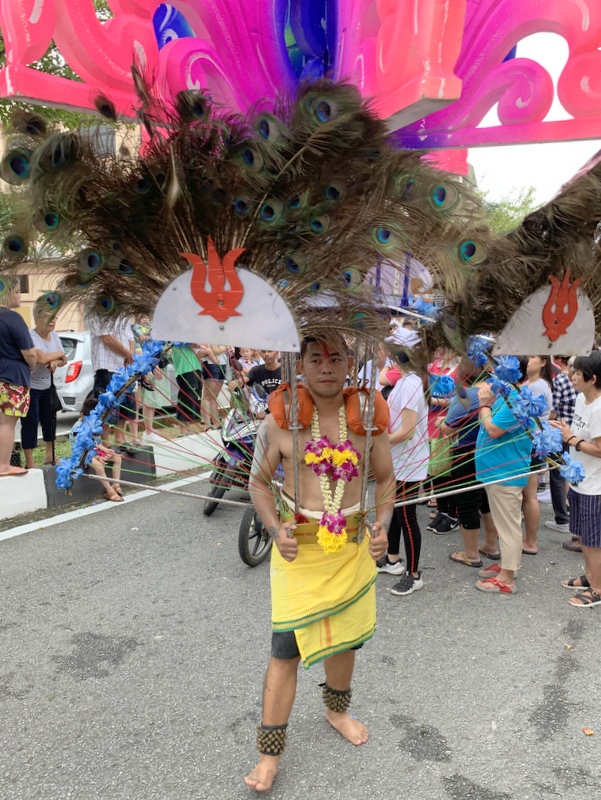
After the floats and devotees had passed the house, I walked slowly back, again encountering the procession. Here, a float is passing the clock tower. The other picture shows Kavadi carriers taking a rest. The Hindu Navaratri festival takes place in the same period as the 9 Emperor Gods festival, and the procession has devotees from both religions.
Devotees are always supported by helpers, who carry a stool if they need to rest.
The floats can be large and are often impressive.
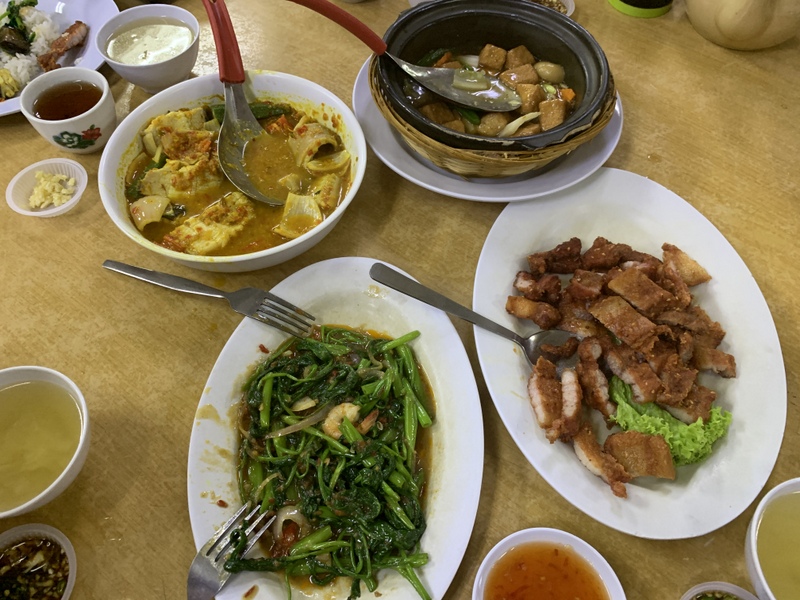
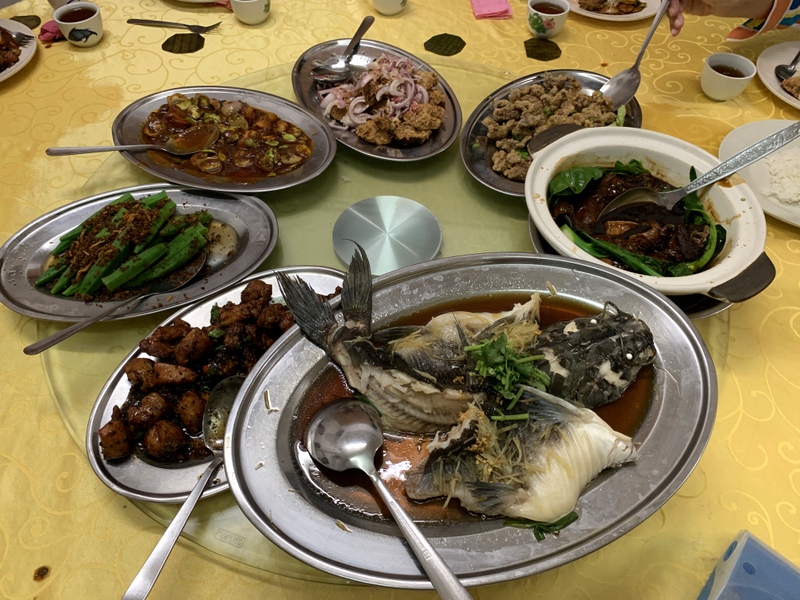
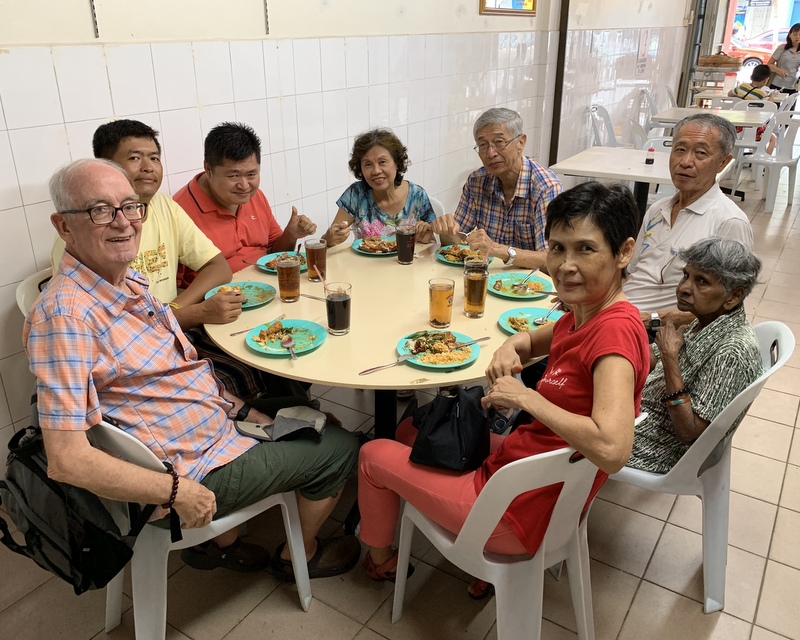
Later that evening, I was picked up from Furama by my friend Goh for the birthday dinner. Lay Chun had invited 17 guests and booked two tables. A delicious mix of Chinese dishes, the picture shows six of the eight courses
At the end of the dinner, of course, there was the traditional birthday cake.
The next morning, I had breakfast with Yeap and his wife. Indian food/
I was interested to (re)visit the old New Club Swimming Pool and asked Yeap if he would like to join me. The last time I visited the pool was with my friend Halim in 2019. The path starts near the Indian temple, just before the bridge. It’s an easy path that, in a few hundred meters, brings you to the pool.
After a few more steps, we reached the swimming pool. It was built in the early 19th century exclusively for New Club members. After the New Club built a new swimming pool near the club building, the old swimming pool was abandoned, but Yeap told me that in the seventies, as a teenager, he. had still been swimming here, organised by his school/
The pool was heavily silted, and the buildings (changing rooms, a canteen, etc) were long gone, but as a memory from the past, the pool could become an interesting heritage attraction..
In 2019, my friend Halim posed as a diver, and I did the same this time. In 2019, the pool was not yet silted!
Small steps lead to an upper terrace. We did not explore further and walked back to the road.
The Indian temple and the romantic footbridge
Next, we had a look at the Kempe Club, visited by me in 2019 (report here) when it was still used by old-timers. Now locked, but still in good condition. Yeap, a Rotarian, told me that the Rotary Taiping had used this club for their weekly meetings.
In the afternoon, I went out for lunch at Ansari Cendol, taking a different route. Again the charm of Taiping, a mixture of beauty and decay.
I like this kind of mural better than the huge “official” ones.
On my way, I passed the replica of the Pasar. At the moment an empty shell. Will it ever become a market again?
At Ansari, this time I had not only a cendol, but also a pasembor.
I walked back along Jalan Stesen. Two years ago, an ambitious plan was launched to transform the Rest House and the adjoining buildings (Perak Railway building) into a boutique hotel. Click here for the Facebook page. But until now nothing happened; it seems that there is a permission issue, with possibly racial undertones.
Officially, both buildings have been fenced off, but access was still possible, as I have shown in several earlier blog posts. As a result, homeless people have been staying in both buildings. Since earlier this year, the Rest House has even a real entrance gate. I went inside and noticed that the resident had parked his motorbike inside the compound..
The complex next to the Rest House, the former Railway Headquarters, consists actually of two buildings. A two-story timber structure, dated to 1885, and a two-story brick building, added later. It is this brick building that has been damaged by fire. The timber structure, shown below, had its own resident, access via a small opening in the fence.
No sign of a resident this time. I sneaked in to have a look at the murals.
No fire in this building, but for many years it has been a ruin, the courtyard has become a jungle. At the back, you can see the facade of the brick building..
Here is the brick building, where the fire raged. Too dangerous to enter, but I could take some photos from the outside. Left the Cross Street facade, right the main facade at Jalan Stesen.
The brick structure is still solid, but the roof is destroyed. Inside, it was vandalized years ago, and the wooden flooring was stolen. That’s why I assumed that no resident would live in this building.
But there is one location, outside the building, near the counter, familiar to many Taiping folks, that shows traces of human presence. Notice that there is a suitcase, a mattress. and some clothes.
I walked back to my hotel. Again, the charm of Taiping, the mixture of beauty and decay.
The beautiful Larut, Matang & Selama Land and District Office, a design by Caulfield, completed in 1897. One of the few heritage buildings maintained by the authorities, most of the other heritage buildings are preserved by private initiative.
On the other side of the road, the Kwangtung Association building, with a huge mural on its side facade.
The FMS restaurant (on the site of the former Raja Rest House) and the Silver Jubilee Jetty. Walking around in Taiping is always a pleasure.
In the evening, I went with Yeap and his wife to the 9 Emperor Gods Temple in Tupai for the firewalking ceremony. Waiting for them, I walked to the nearby Peng Loong kampong. The kampong had a bad reputation, but it is now peaceful.
The Tupai Temple is the oldest 9 Emperor Gods temple in Taiping, and attracts a crowd of devotees and other visitors during the festival.
During the nine days of the festival, devotees eat vegetarian food. In and around the temple compound, there are many eateries. We had dinner there, the traditional fare, nee rebus, curry mee, all vegetarian..
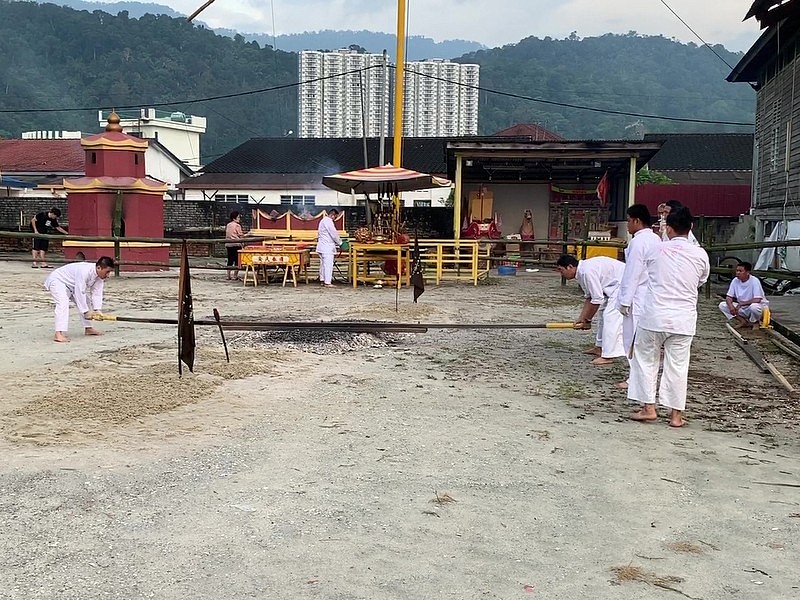
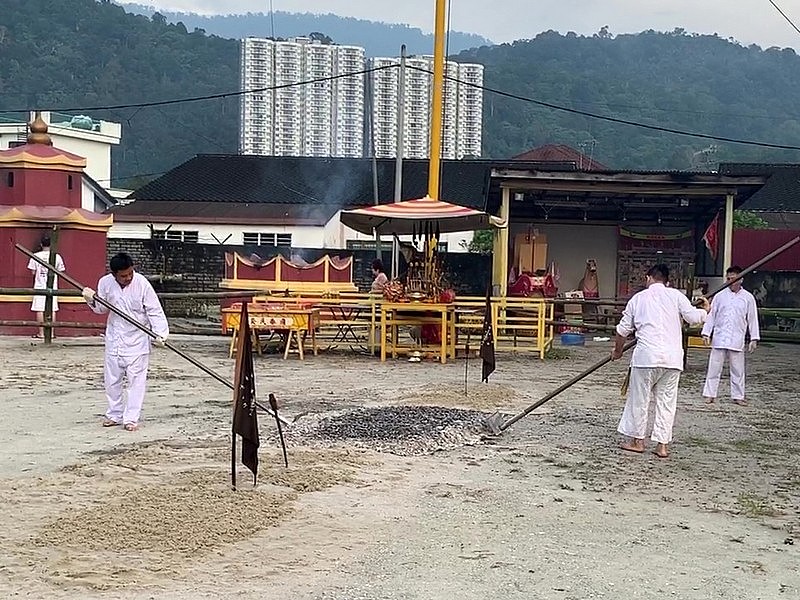
I had a look at the firewalking place, where they were busy preparing the embers. It is a small stretch, between the two black flags, where the devotees will walk..
I also visited the temple.
There are many rituals in preparation for the actual firewalking. Here is a video.
Preparing for the actual firewalking. The guy with the yellow “apron” is the leader and the caretaker of the temple. Notice the red glowing of the embers!
A video shows better what firewalking is. Some devotees walk slowly, even carrying a kid. Others run as fast as they can.
Teap told me that many devotees stay in the temple during the nine days and showed me the dormitories, with people going home
After the firewalking. preparations are made to send off the Emperor Gods.
A fascinating ceremony! Before I went to sleep, I needed to relax a bit at the Lake Gardens.
The next morning, I had breakfast with my friend Foo, Chee Cheong Fun at the Circus Grounds, , one of our traditions.
Later, he picked me up from Furama and dropped me at the station. I am fortunate to have good friends in Taiping!
Broga Hill is a popular hiking destination, but I had never heard about a Sak Dato temple in Broga , until Aric suggested to visit this temple, as it was famous for its monumental statue of the Monkey King.
It’s about a one hour drive from KL Broga Hill is located in Selangor, but the village and the temple are situated in Negri Sembilan.
The temple is a Datuk Kong temple, where Chinese devotees worship not a Taoist deity, but the “spirit of the land”. The tradition started in the 19th century when Chinese settlers arrived in the country. Often Datuks were once humans who were greatly respected by society. After their passing away, people started to worship their spirits for protection. Often they were Muslim Malays. Interesting about this temple is that Sak Dato was an Orang Asli. He supported the Chenese tin miners in the 1860s and probably became a Taoist himself. See also the appendix
Here is the entrance of the temple. Most Datuk Kong temples are smaller, often even just shrines. This is a large complex , apparently very popular, although it was quiet during our visit.
Climbing the steps, we soon reached the statue of Guan Yin, the goddess of Mercy.
A large hall is dedicated to her.
Climbing further we arrived at the Sak Dato hall.
The interior is simple without images. Inside the hall we noticed a picture of the former PM Mahathir, handing over a National Temple Beautification Award.
There is another Sak Dato shrine in a cave next to the hall. Probably the original one. There is also the grave of the Sak Dato. It was originally located inside the cave, but has been relocated to its present position..
Climbing highere there is a split.To the right leads to a hanging bridge, we first explored the left side which took us to a kind of park with an intriguing collection of art works and statues. A very enjoyable place.
A dragon-turtle is pulling a cart with treasures and a bit further on there are the animals of the Chinese Zodiac.
Of course we had to take pictures with our Zodiac signs,
The park must be a popularr destination for families. There is a wishing tree but you can also hang your wishes here. Everywhere benches donated by devotees. There is also a stall, but it was closed during our visit.
Finally we went to the suspension bridge and walked to the hill qwhere the statue of the Monkey King is located. Quite a steep climb up.
A warning sign for dogs, but the dogs we met were peaceful and sleepy.
I am sure all Chinese know about the Monkey King, one of the main characters in the 16th century novel Journey to the West. For those who don’t know this wonderful folk tale, you can download it here .The statue of the Monkey KIng is mentioned in the Guinness Book of Recirds as the tallest one in Malaysia. It is quite impressive. The other picture shows the monk Tripitaka and his other helpers.
Aric had brought his drone to take video and pictures. Here are a few.
In the hall inderneath the statue, walking around three times is supposed to bring luck.
After visiting the Monkey King, we had to walk down and cross the bridge again.
After our visit (about 1.5 hour) we drove to Semenyih for dinner.
Nice food, steamed cuttlefish with lemon and garlic, paku belacan and deep fried tilapia
Nice, relaxed atmosphere
And a beautiful sunset
A perfect outing.
Appendix
Although the Sak Dato temple in Broga is a popular destination, with numerous hits when you Google for it, it was not easy to find background information.
The Temuan, an Orang Asli group, were the earliest inhabitants of Broga. Because of rich tin ore, Broga was settled in the 1850s by Hakka miners from Huizhou, China.
Broga became prosperous, first because of tin, later rubber.
During the Japanese Occupation (1941–45), many shops in Broga were burned by the Japanese and many villagers fled. In 1950, the British colonial government resettled the Chinese in the area in Broga New Village.
The Sak Dato Temple in Broga is one of the oldest Datuk Gong temples in Malaysia. The temple still holds many old plaques; the oldest one was offered by a devotee Li Yuchang to Sak Dato in 1904
Since 1910 , the Sak Dato procession at Broga has been held annually, even during the Malayan Emergency. After the establishment of Broga New Village in 1950,entry and exit were strictly controlled, so the villagers brought the spirit tablet of Sak Dato to a small new shrine in the New Village. Following the end of the Emergency, the villagers returned the spirit tablet, and renovated the old temple in 1965. In 1991, the temple was renovated again, at a cost of MYR700,000.
Also useful is the inscription next to the grave of Sak Dato
.So the original shrine in the cave is old, the worship of Sak Dato started in 1868. His bones were relocated a few times (?) after the temple was rebuilt in 1991 and finally put in the present grave only last year (?)
Finally here is a very readable travelogue, written in 2013, where renovation of the Guan Yin timple is still going on.
So the Sak Datu temple is old , but the enlargement and extension are recent.
I found confirmation by looking at the historic imagery of Google Earth, This screenshot shows the sutuation in 2010. I have marked the places where I took pictures. There is not yet a park, and there is no suspension bridge. They are working on the Monkey King
Here the situation in 2022
The Sak Dato temple committee has been very successful in developing the temple to attract more visitors.
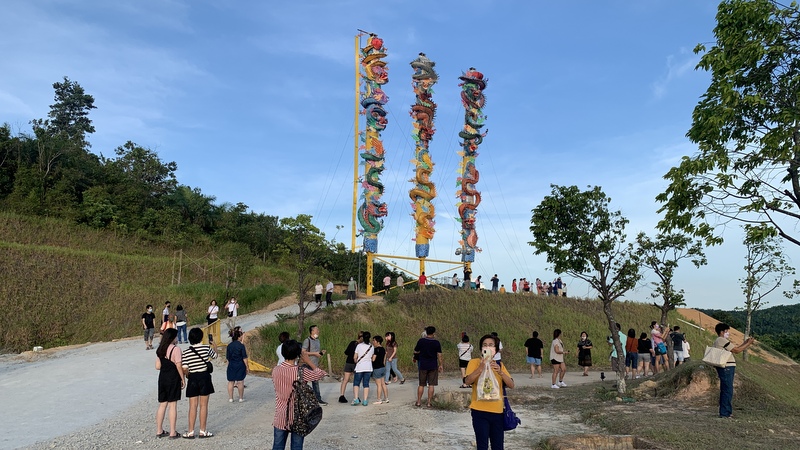
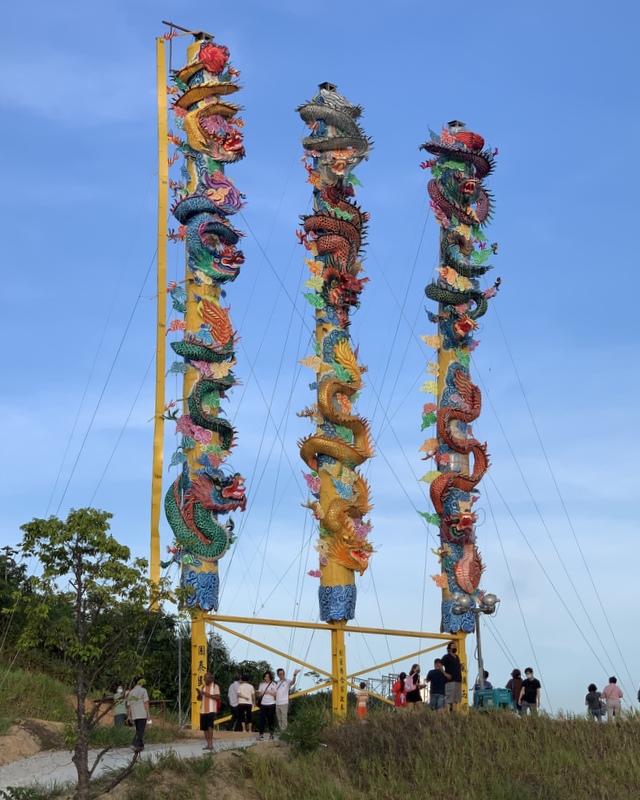
After Aric had heard that a temple near Kuala Pilah had built three giant joss sticks for an upcoming festival., he suggested that we should go there and have a look. Kuala Pilah, in Negeri Sembilan is quite far from KL and it took us almost two hours to reach the temple. The temple is located about 7 km sount of Kuala Pilah, along the road to Tampin. We were not the only visitors, there was a massive crowd. Well organised, we followed instructions to find a parking place.
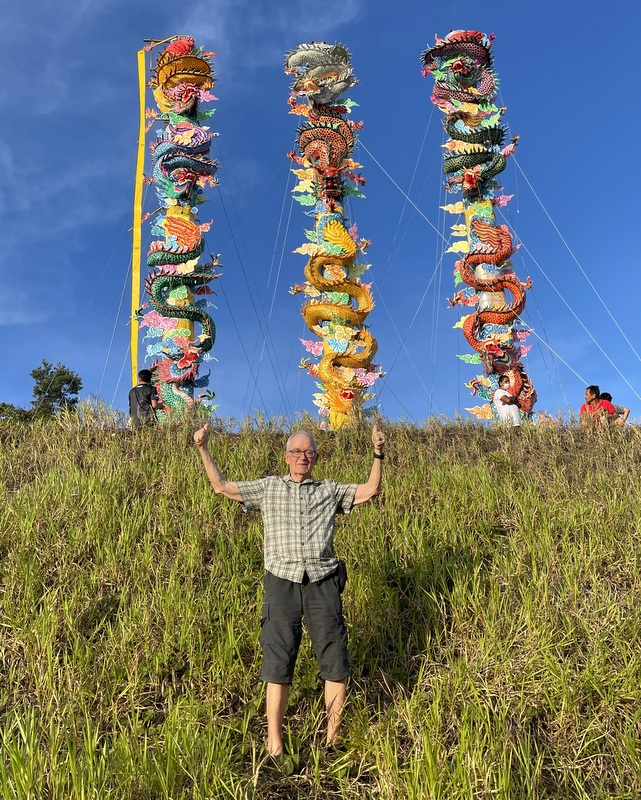
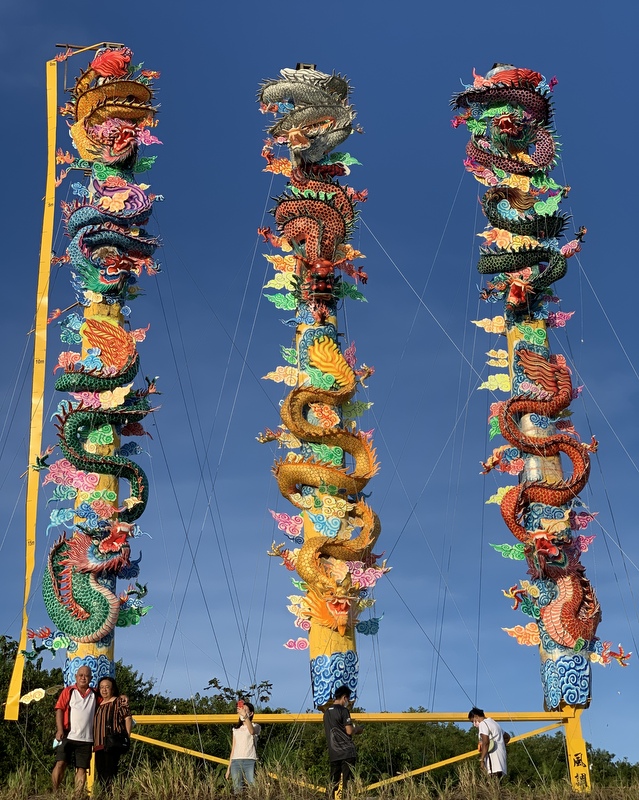
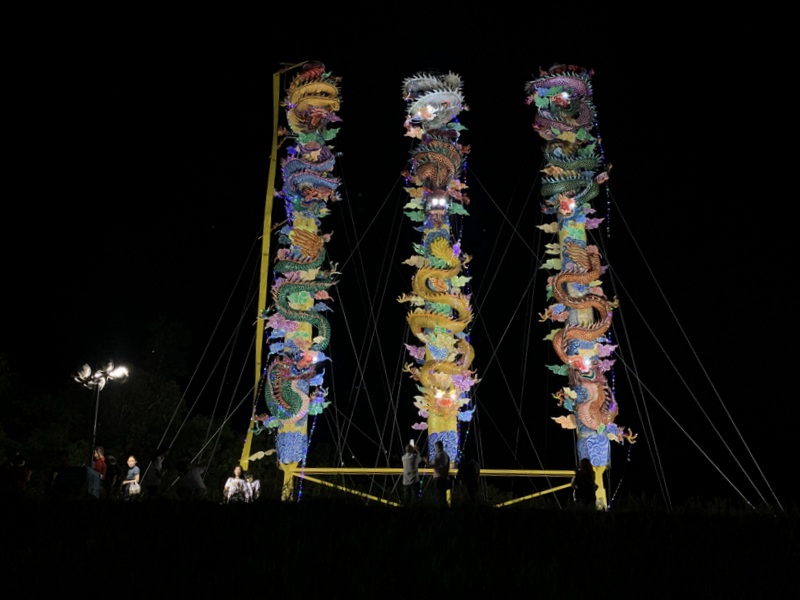
We started our visit with the giant joss sticks. And huge they are, almost 20 meter tall. Visible from far away.
.The yellow ribbon left is a tape measure. Starting from 0 m at the top until almost 20 m at the bottom.
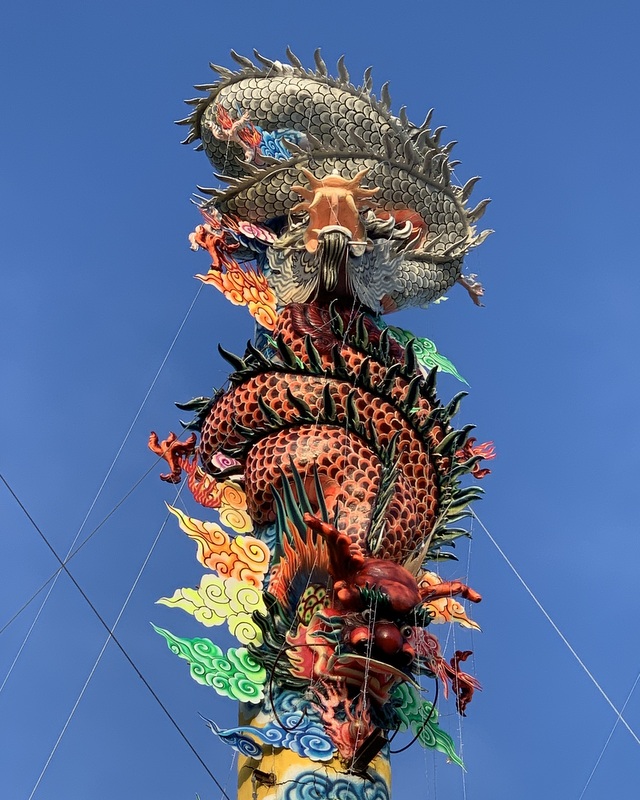
Beautifully decorated with dragons. Here are details from the three sticks
Left the top part of the center joss stick. Notice the many supporting cables in the right picture.
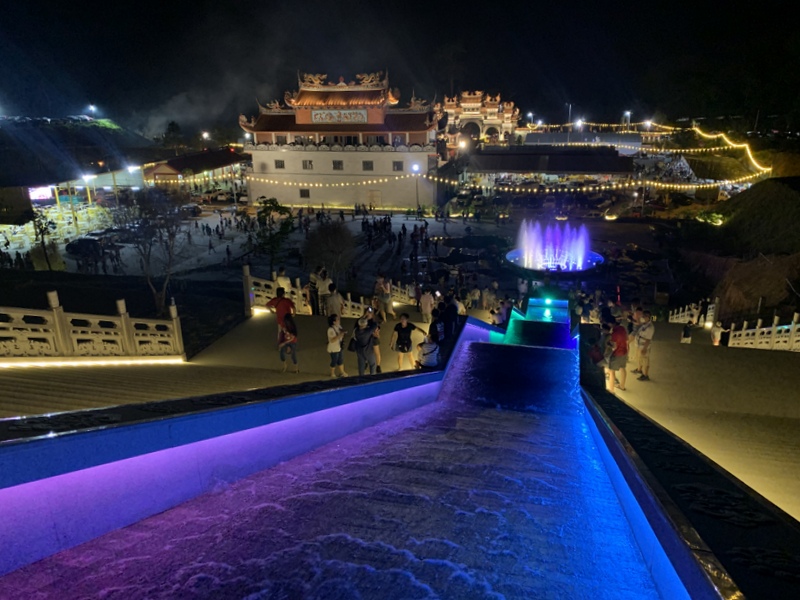
There is a lot more to see in this Si Thean Kong temple. It is a Taoist temple, dedicated to the Nine Emperor Gods. Originally it was located in the center of Kuala Pilah, but moved to this new location in 2015. Still not yet completely finished, there are plans to add a pagoda, but already quite spectacular.
The Nine Emperor Gods festival takes place in the beginning of the ninth lunar month, culminating on the ninth day. This year that will be on 4 October and that explains the huge crowd of devotees. On that day the crowd will be much larger. Usually the temple will be more quiet, see this YouTube video.
Here is a drone video of the temple complex, taken by Aric.
We walked down from the joss sticks to the main temple.
The main temple
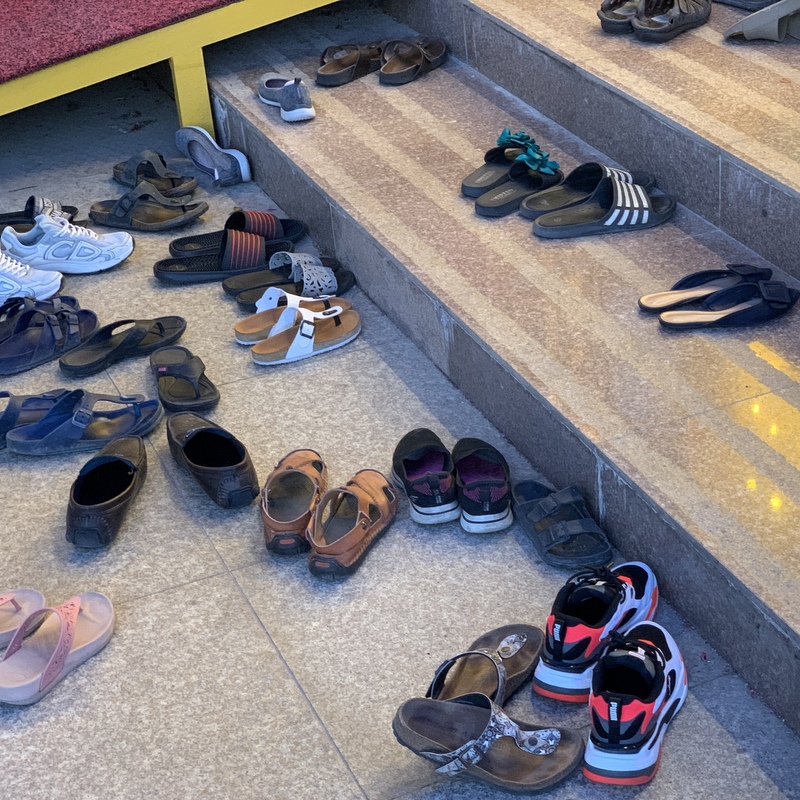
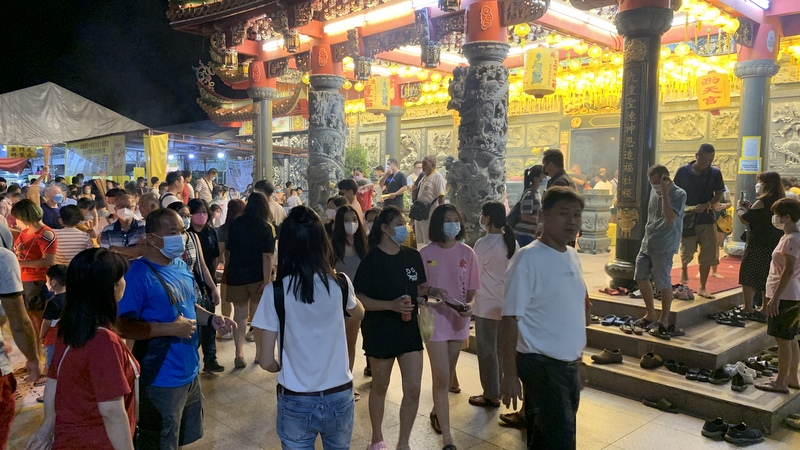
Inside the temple you have to take off your shoes. Better remember where you left them, with this crowd it might be not easy to find them back. You can give a donation for the ongoing construction.
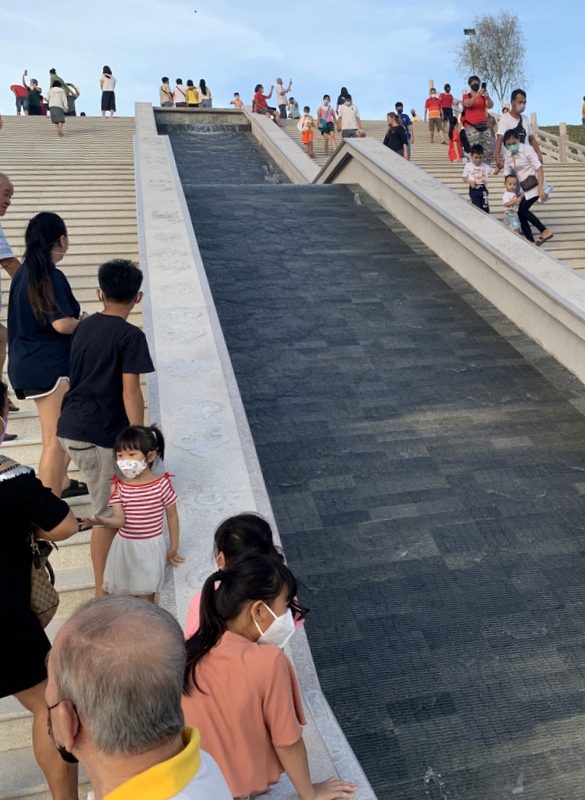
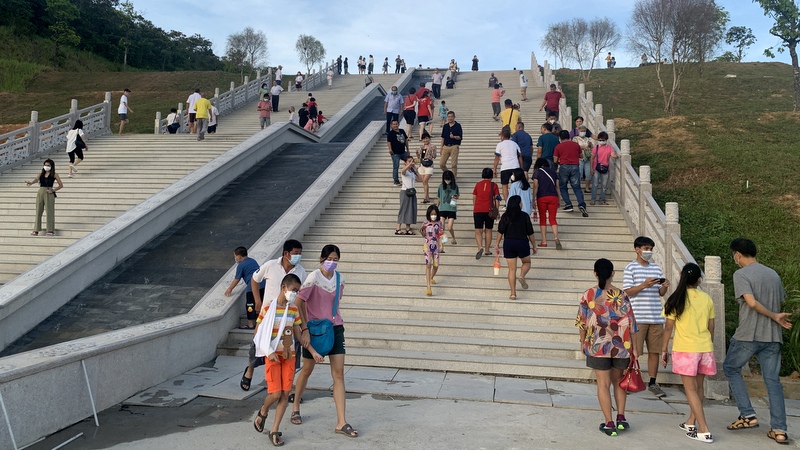
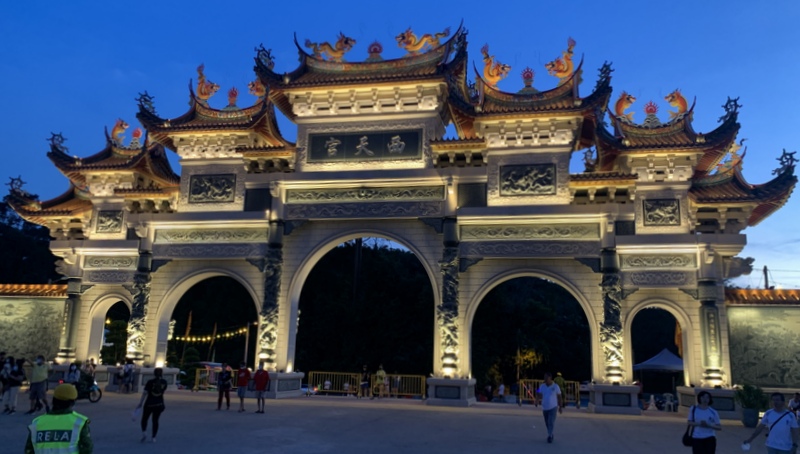
After visiting the temple we walked around. Well organised. Here a view of the monumental entrance arch. Tables and chairs for the visitors to rest.
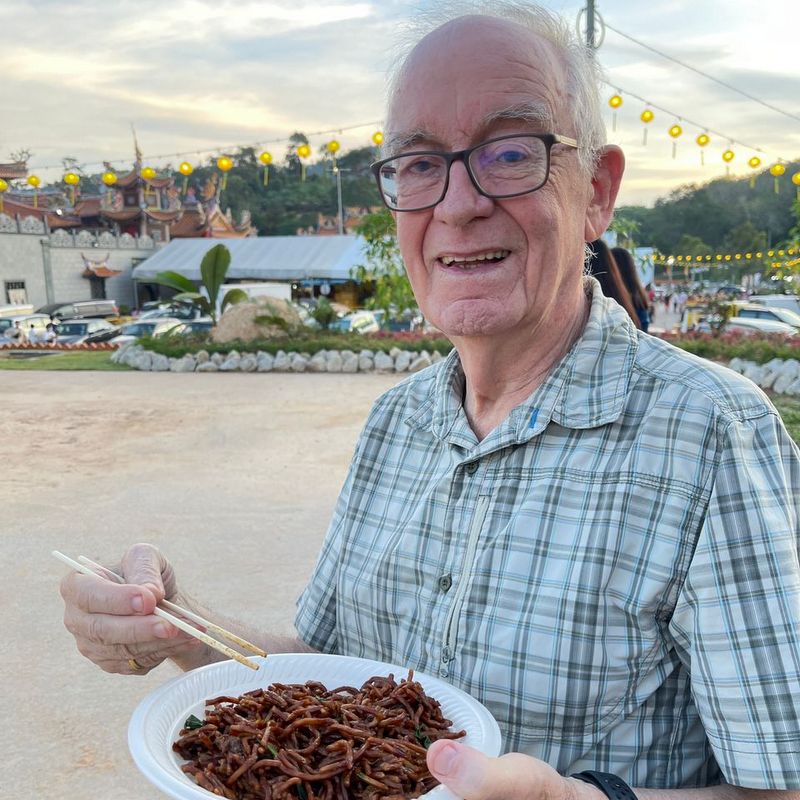
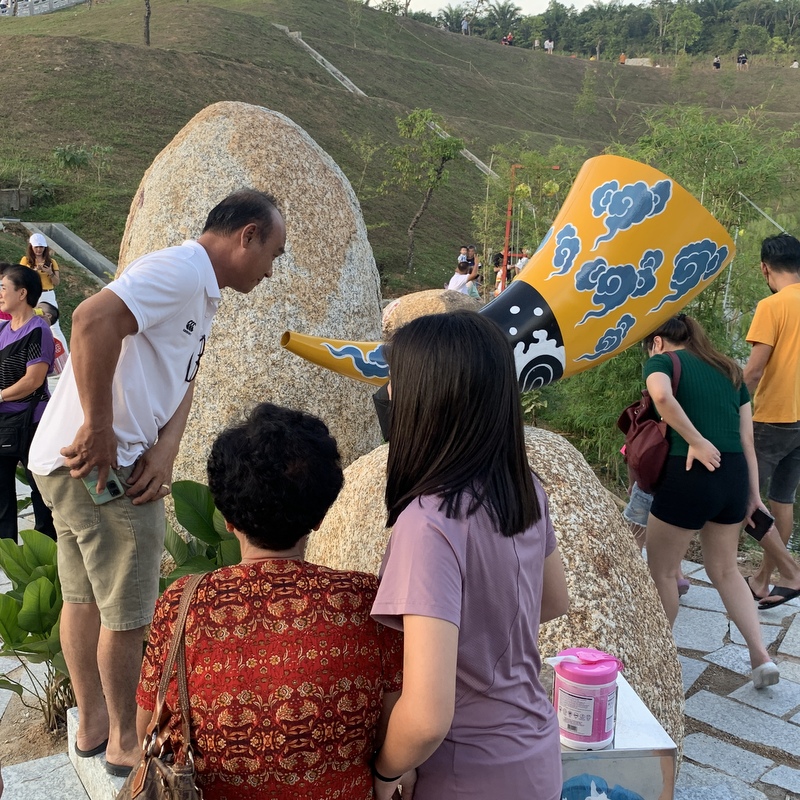
And eat! There was a hall were free food was served, I had a plate of mee goreng , while Aric was busy droning. The right picture shows a contraption, where a waterspout would rise in the air when you blew in the horn. Not related to the Nine Emperor Gods, just fun for young and old.
I took a short video of the horn blowing.
Here is the monumental stone arch, the biggest in Malaysia and already in the Malaysia book of records.
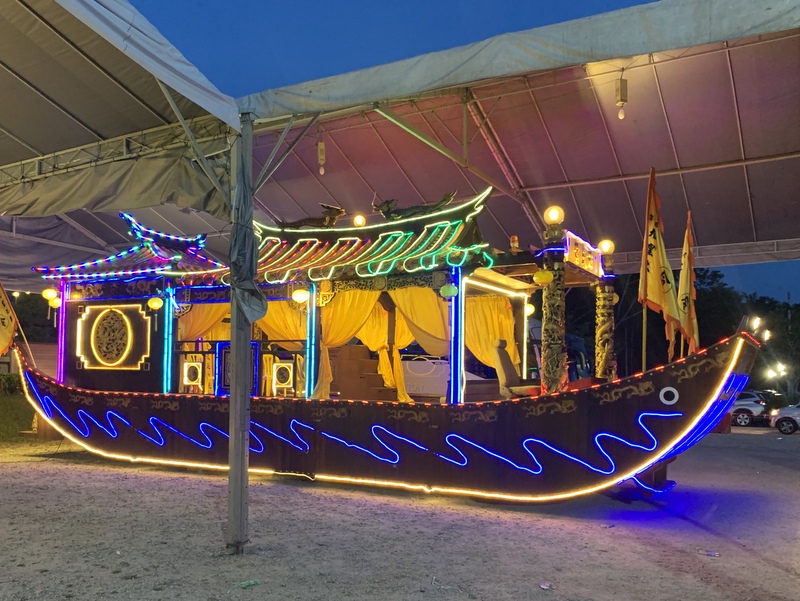
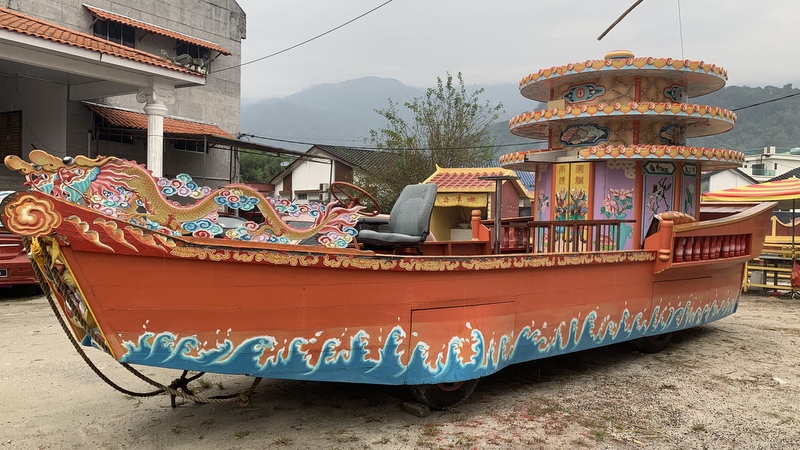
View from the roadside. At the main event on 4 October, there will be a big procession, where the “boat” in the right picture will take part.
We made another round, climbing up to the joss sticks and down again to the crowd
Aric took another video of the temple complex.
The crowd had grown a lot
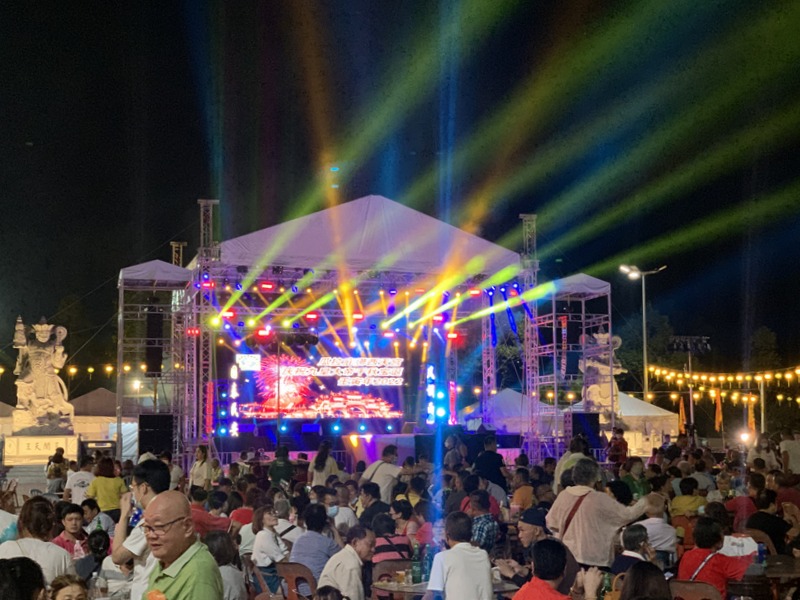
There was entertainment, left a traditional Chinese opera, right a modern light show.
There were also many food stalls, but with very long queues, so we gave up, walked back to our car and had a late dinner at a Malay stall in Kuala Pilah.
This temple will become a major tourist attraction in Negeri Sembilan and even in Malaysia. Many of my friends are not yet aware of this place.
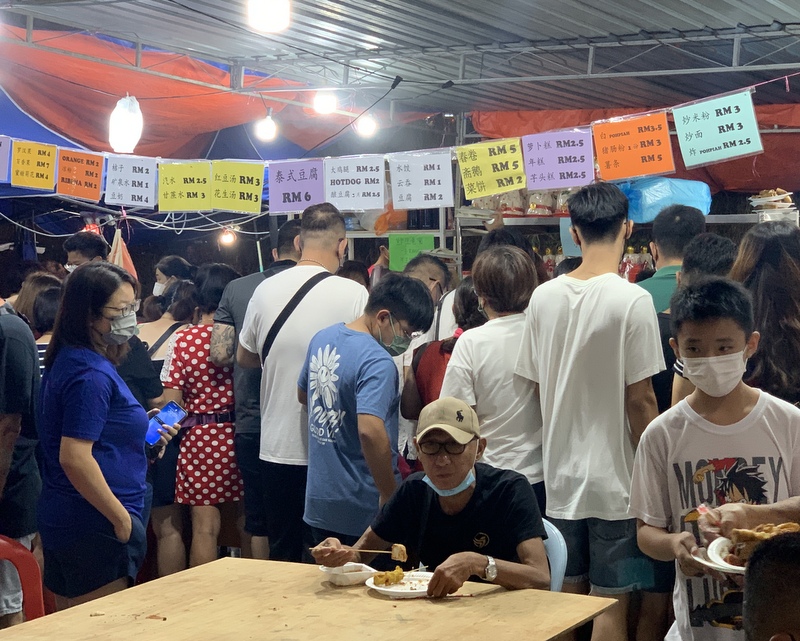
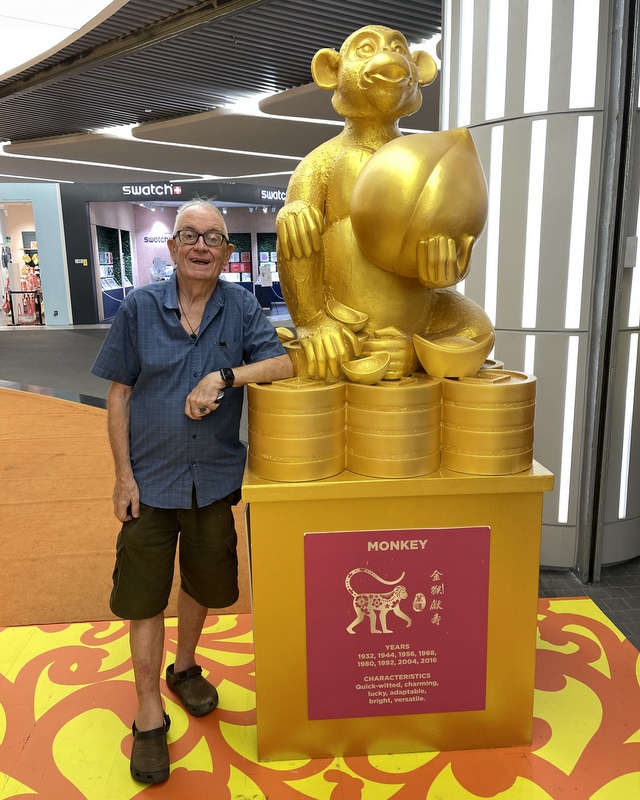
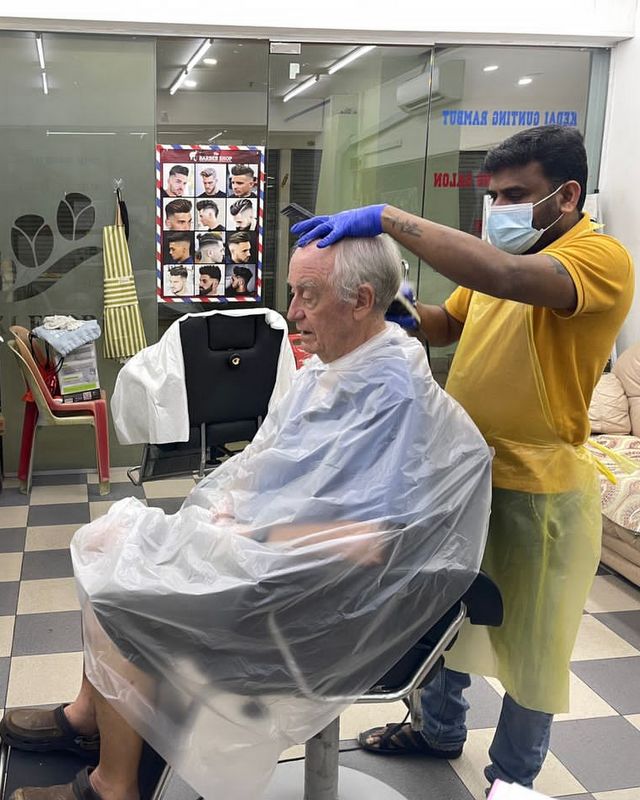
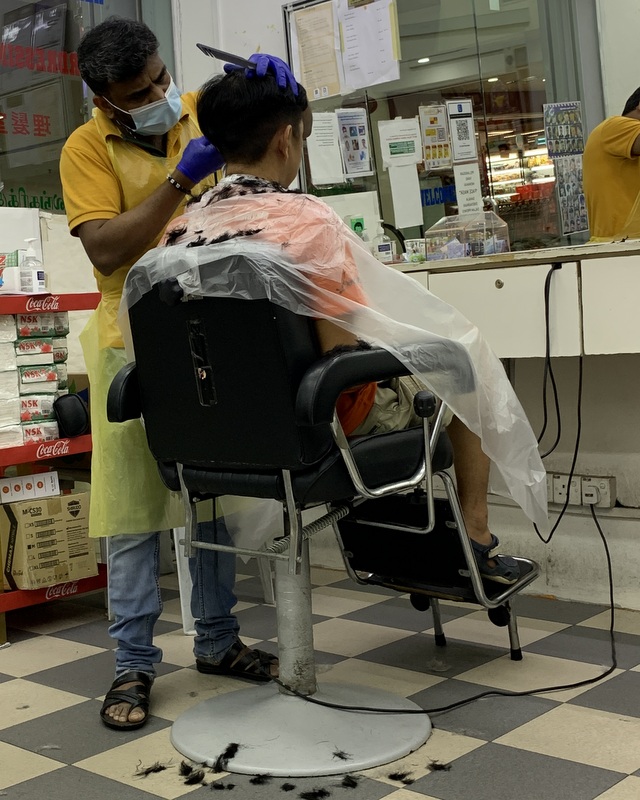
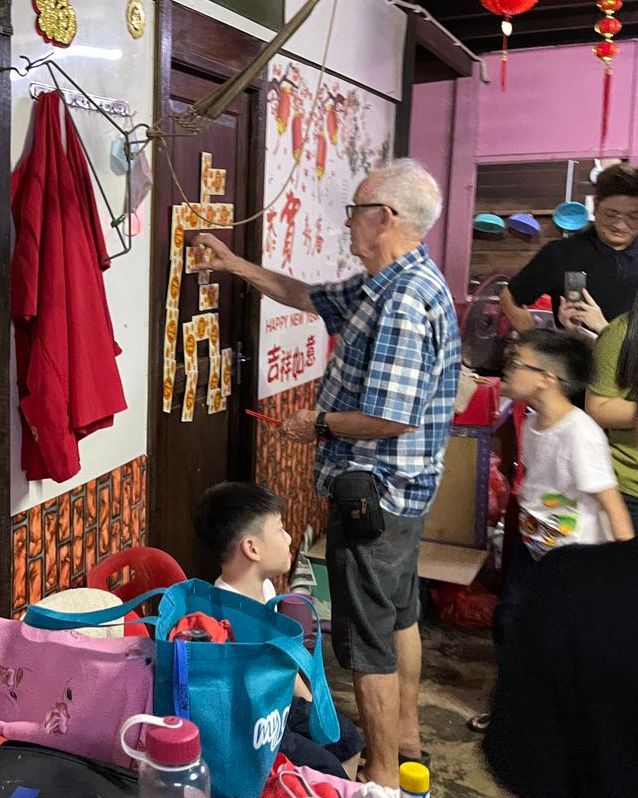
On 1 February the Chinese year of the Tiger started. As a preparation for a New Year, Chinese buy new clothes and have a haircut. We did the same, in the left picture I am standing in a shopping center next to my own zodiac sign.
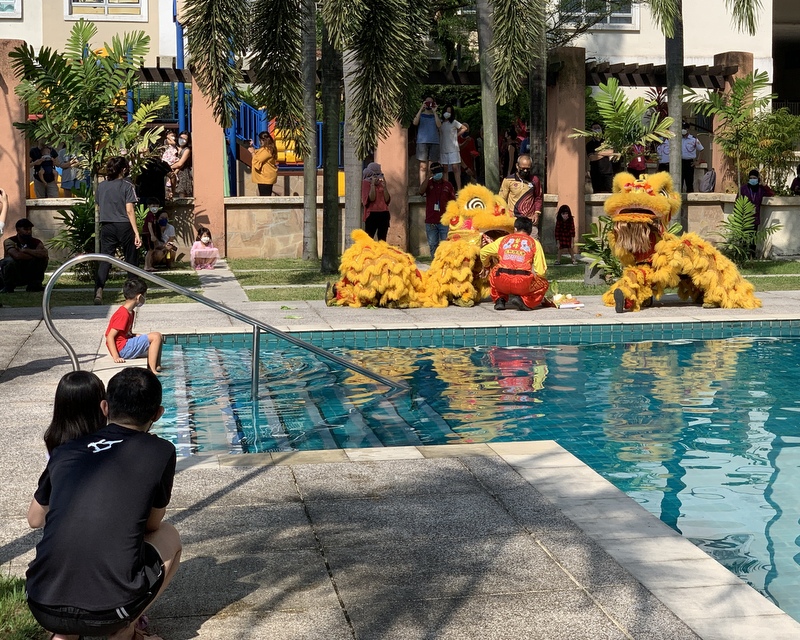
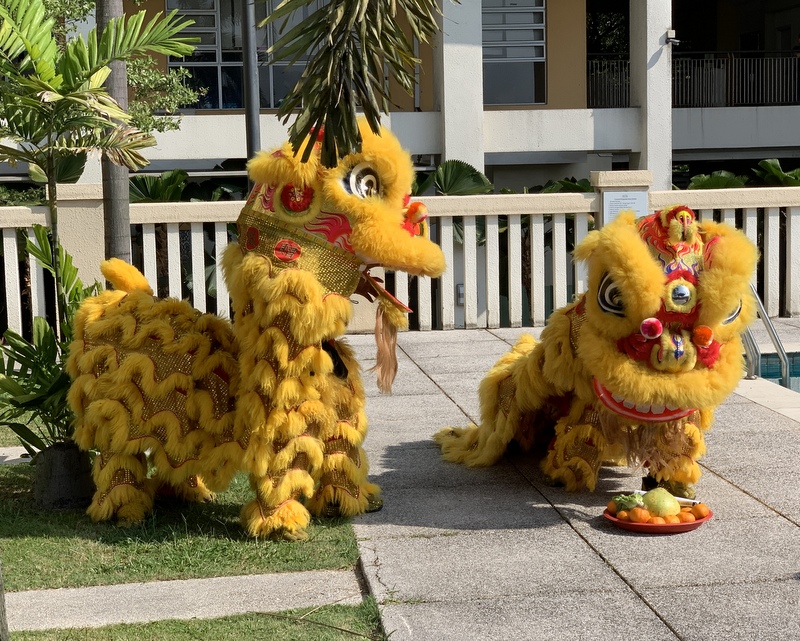
A 29 January the management of our condo had organised a simple Lion Dance.at our swimming pool. Fun for the kids.
The traditional wish for CNY is Gong Xi Fa Cai (in Mandarin, “Congratulations and may you be prosperous”). Here is my CNY wish, from our new penthouse.
On CNY-eve, 31 January, we went back to Parit Baru, Aric’s hometown. That is a yearly tradition, but last year it was impossible because of the Covid 19 pandemic and travel was very limited. Click here for a report about CNY 2020. .
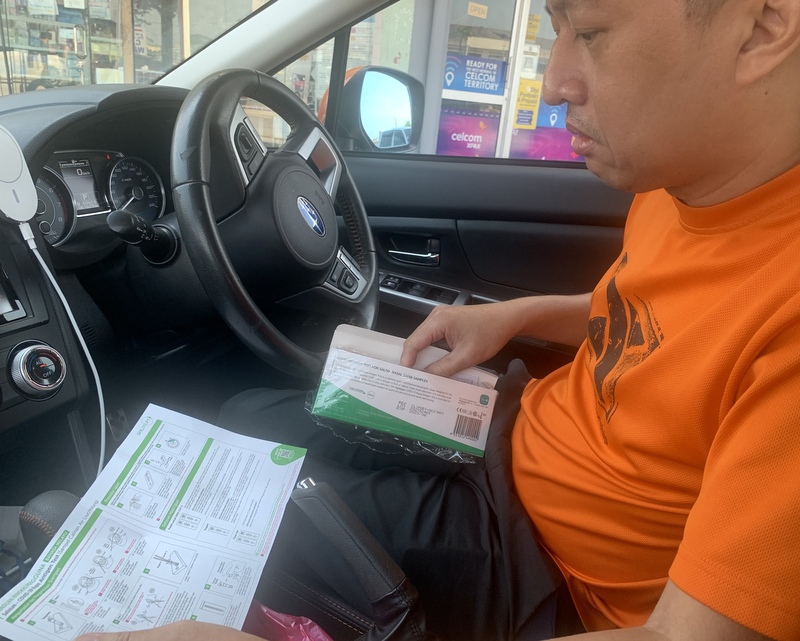
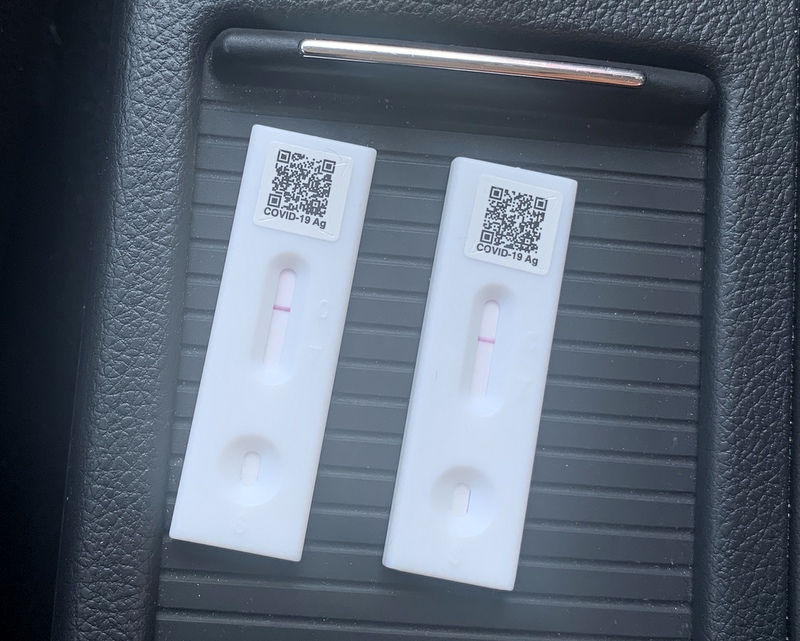
This year travel was allowed again and we were fully vaccinated, but it was still advised anyway to take a Covid antigen test. Already on our way, we heard that one of Aric’s brothers had tested positive, although vaccinated. So we decided also to take a test and started looking for a pharmacy. Many were closed, but we found one in Tanjung Karang. Aric bought two test kits and we took the test in our parked car. ;-). Fortunately we were both negative.
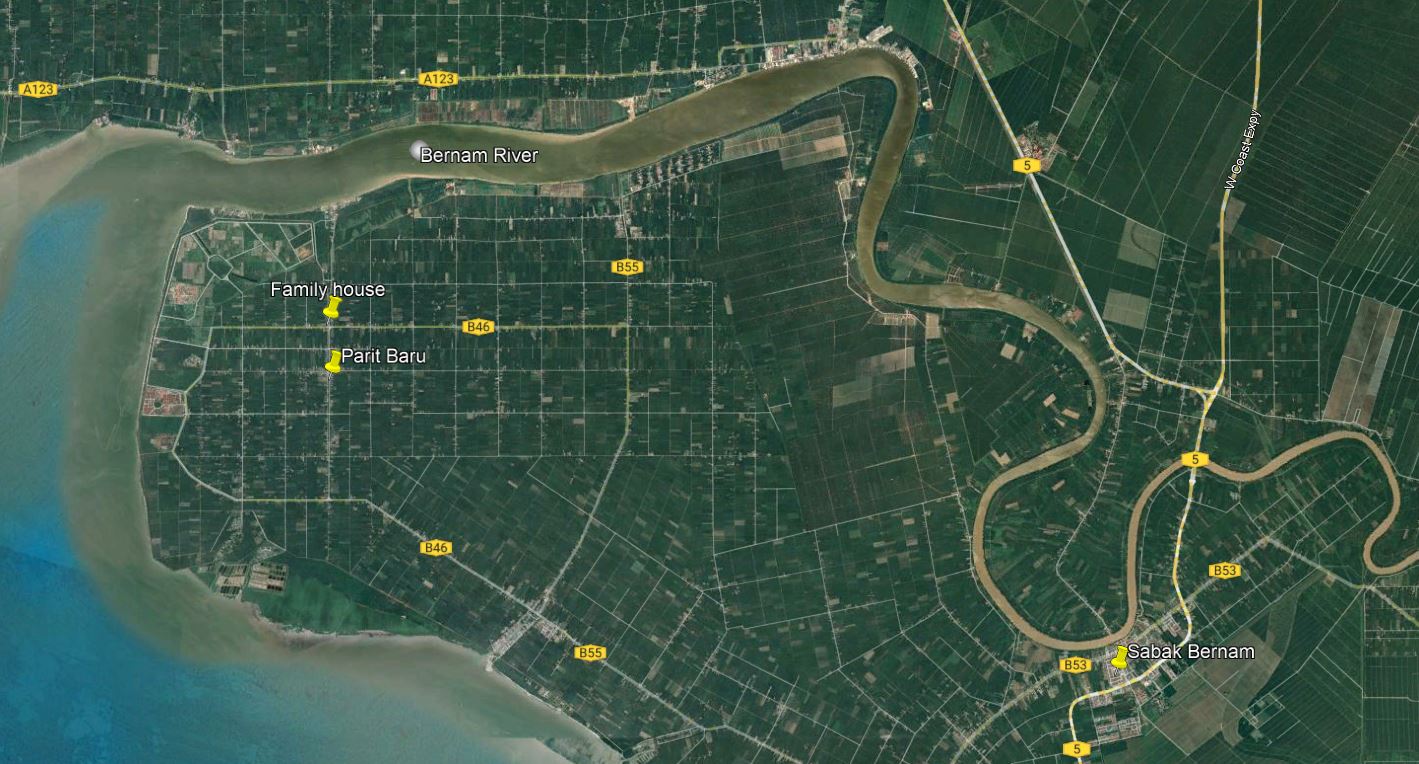
We arrived in Parit Baru in the afternoon.. Here is a Google Earh map of the village and its location in the most northern part of Selangor. . The Bernam River forms the boundary with Perak. Parit Baru is surrounded by fishing villages.
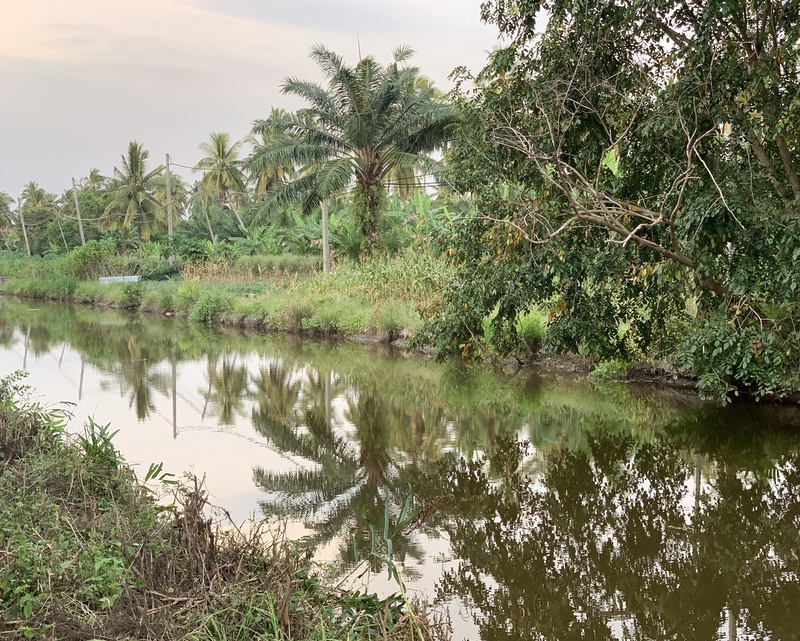
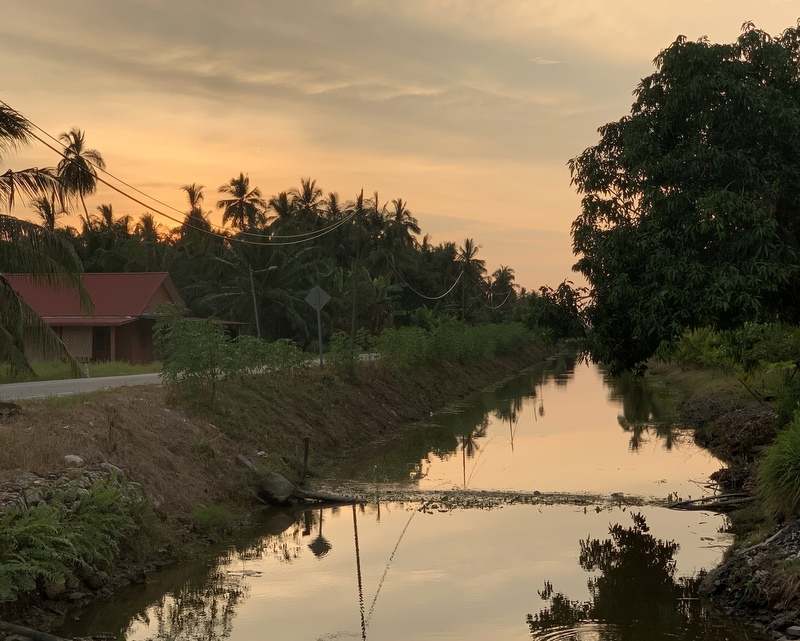
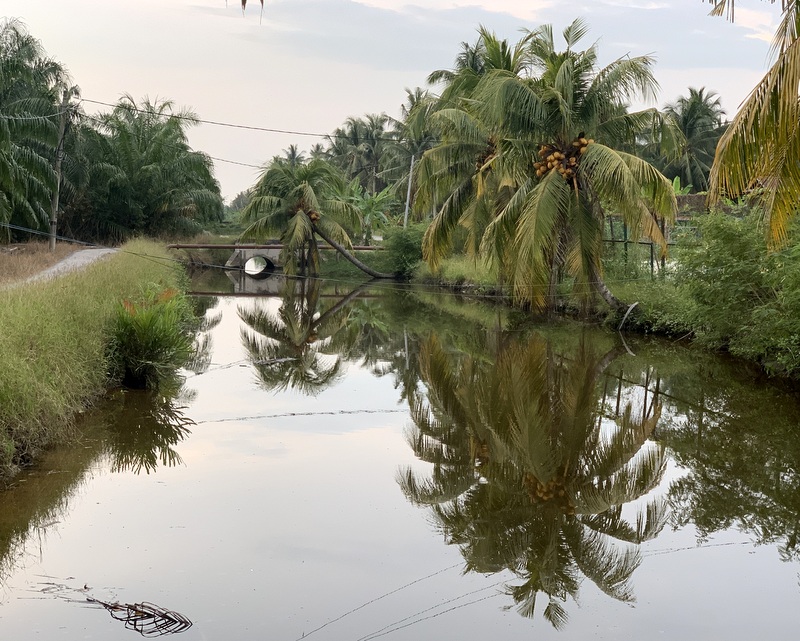
There was time to take some photos of the surroundings. Nothing spectacular, just quiet agricultural countryside.
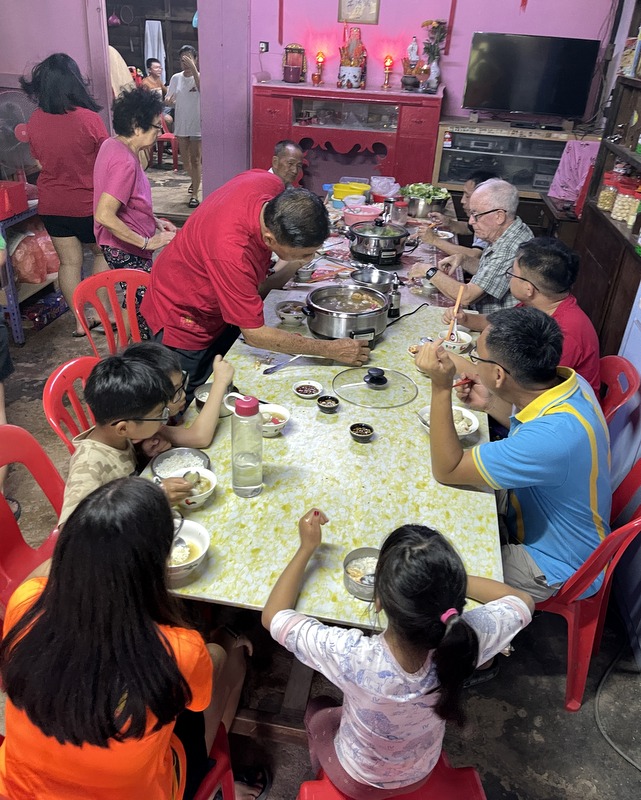
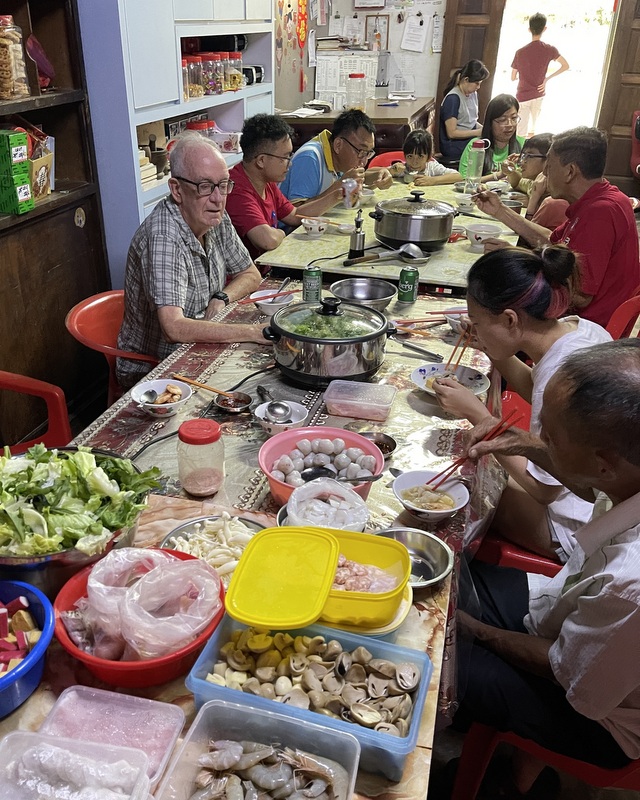
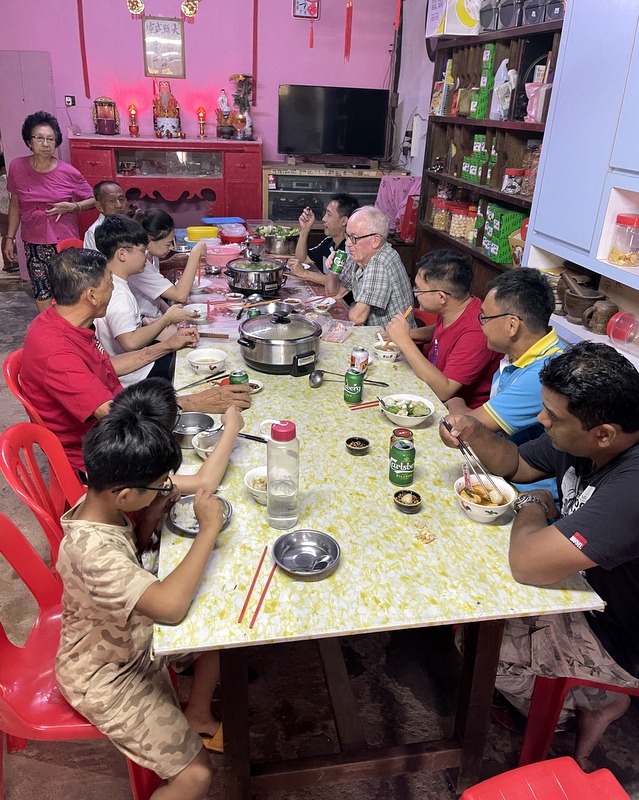
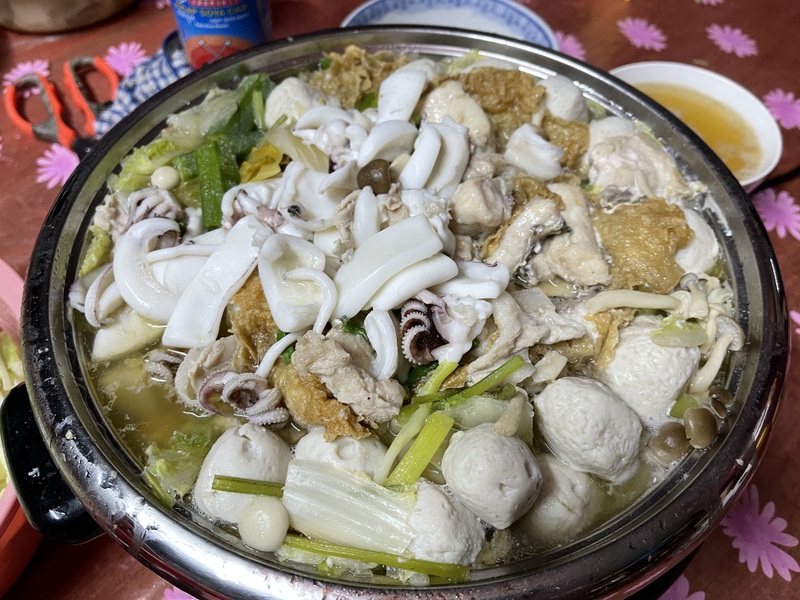
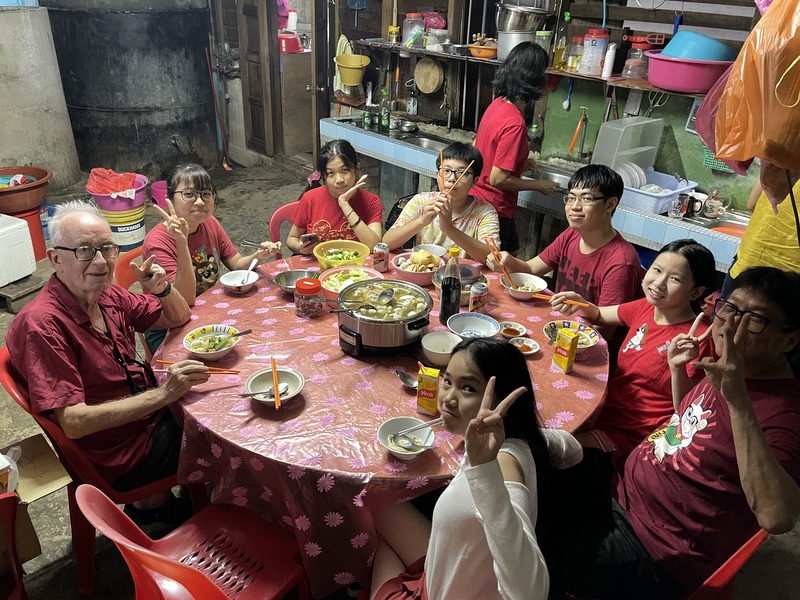
Then it was time for the CNY-eve dinner, traditional steamboat. Three families live in the kampung house, so dinner was in several sessions.
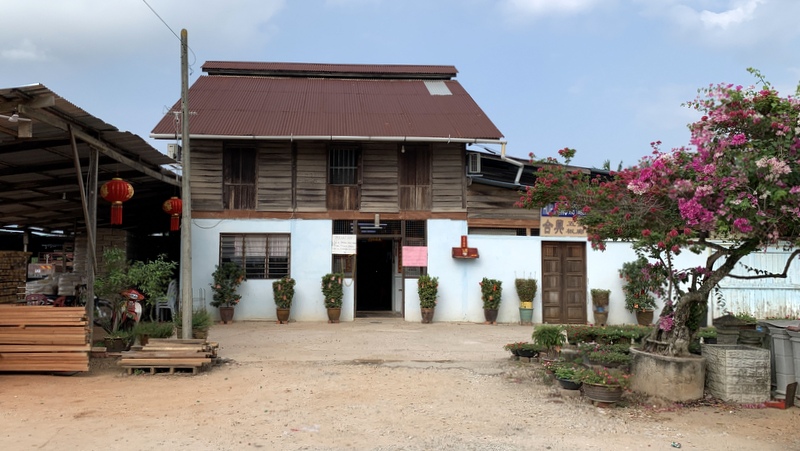
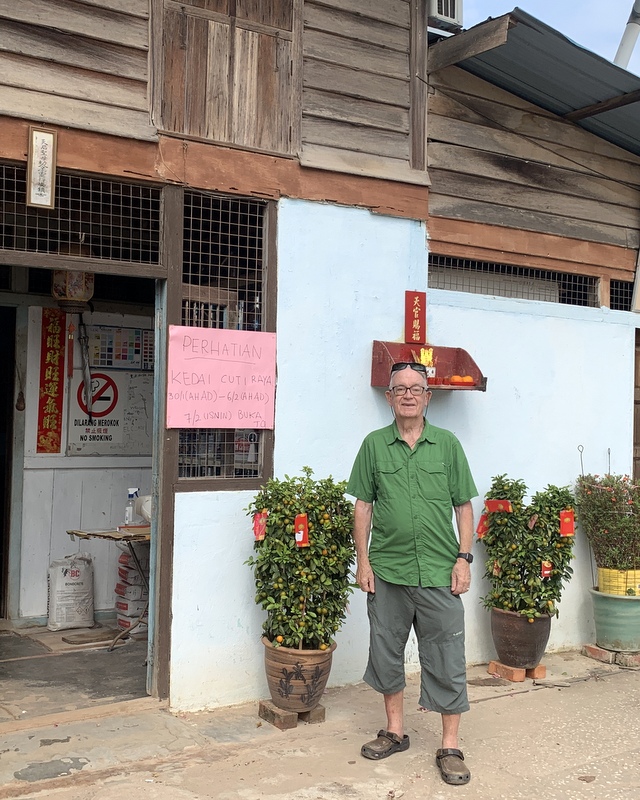
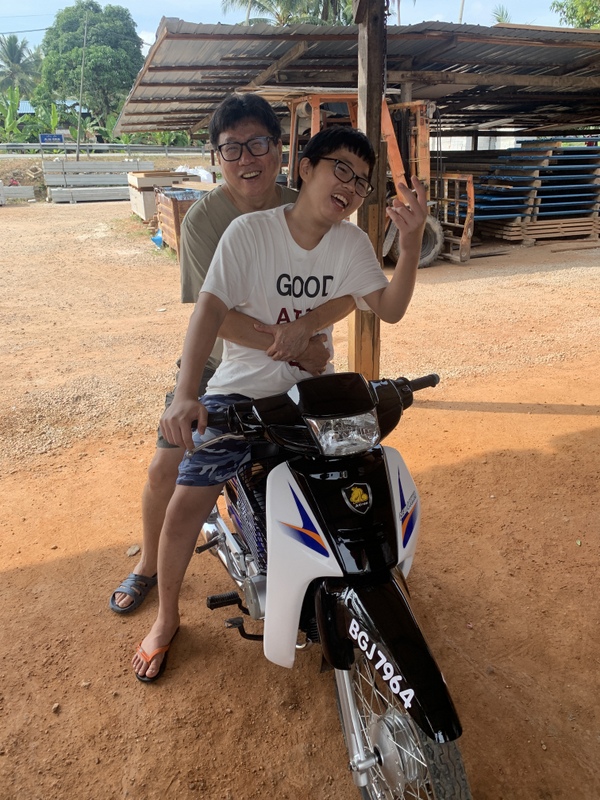
.Here is the kampong house. It may be about 70 years old. The families run a successful hardware and timber store. It is basically a wooden house, only the front façade and a few other parts are in stone.
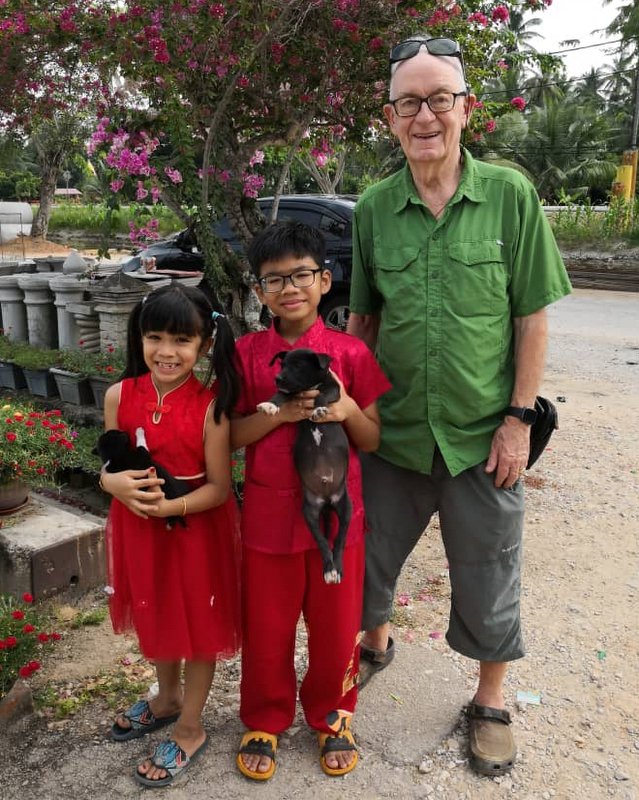
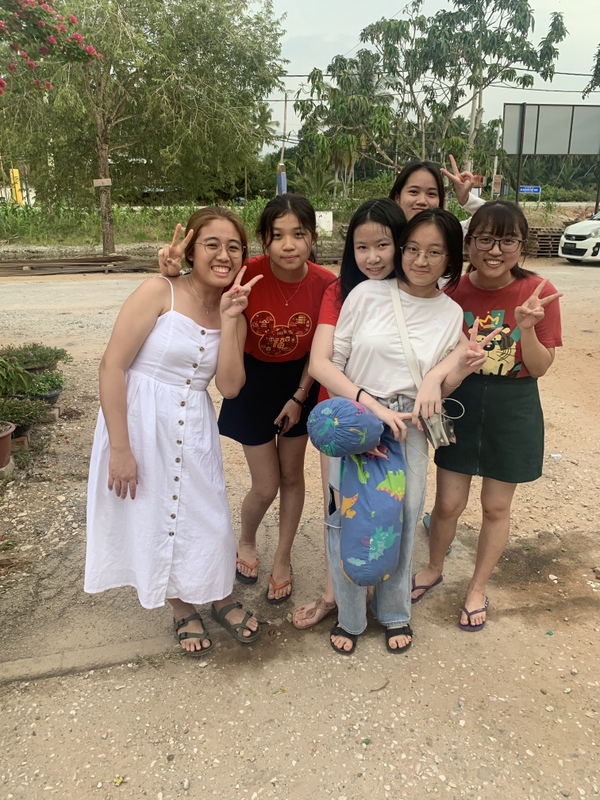
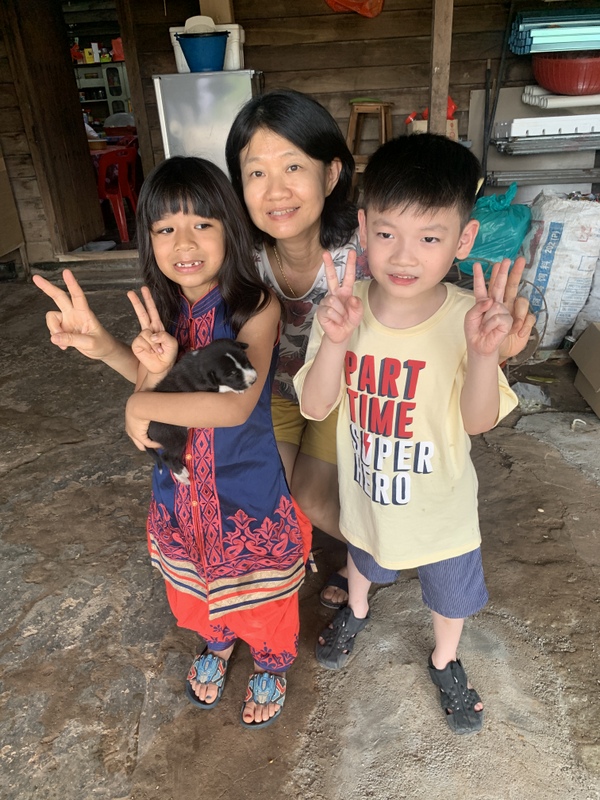
Posing in front of the house. Alone and with the children of one of Aric’s cousins. Notice how they hold puppies, the one held by the girl has just opened it eyes.
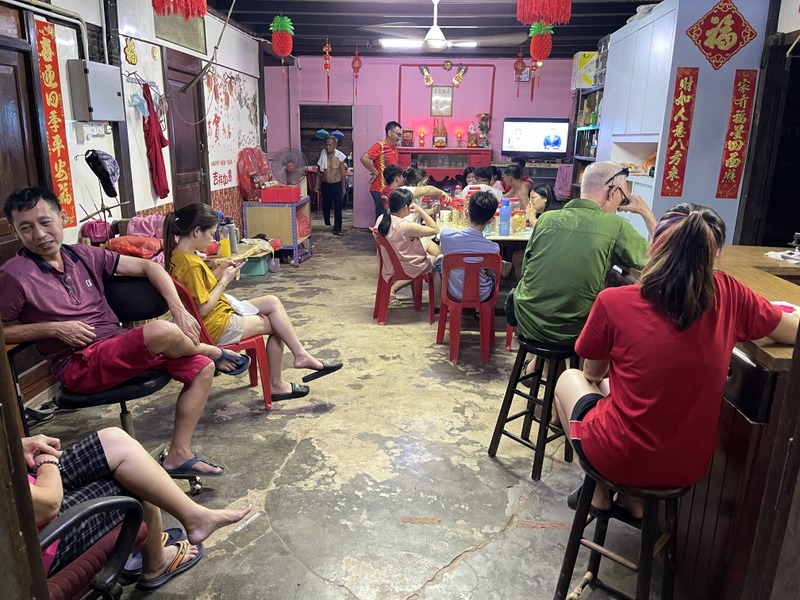
The three families have their own rooms, but share the common living room and the kitchen. Even after Aric’s parents passed away, a couple of years ago, the setup is still the same.
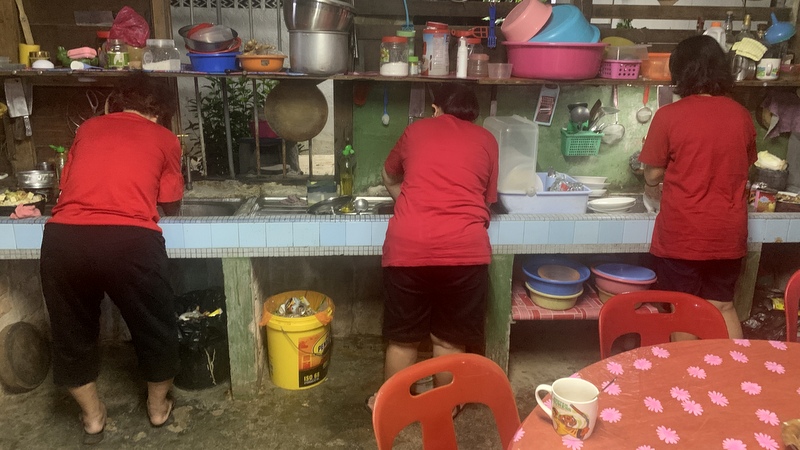
Common living roomShared kitchen
Although the families share the kitchen, they have their own sink, fridge, washing machine. It might be a unique construction. In this photo, Aric’s aunties to the left and Aei Ling, his sister to the right.
The house is surrounded by a big garden, with fruit trees and flower bushes.
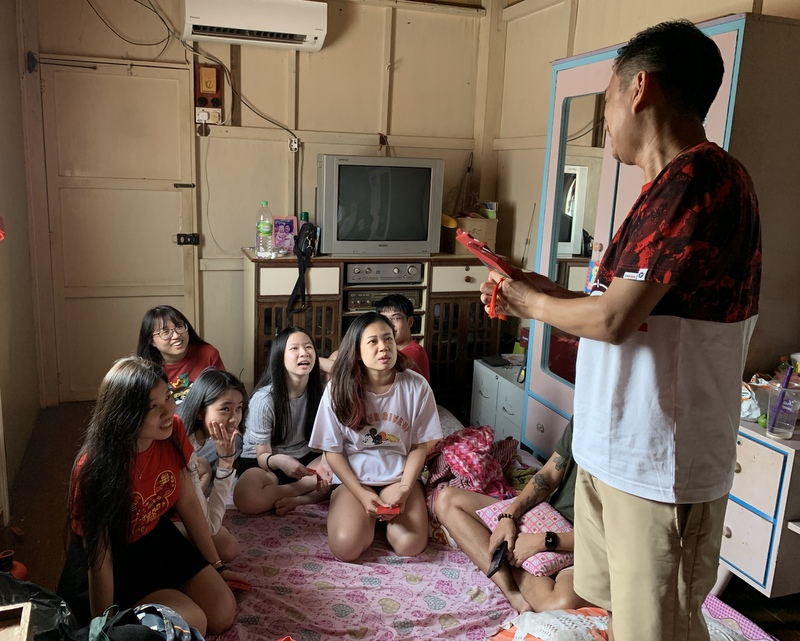
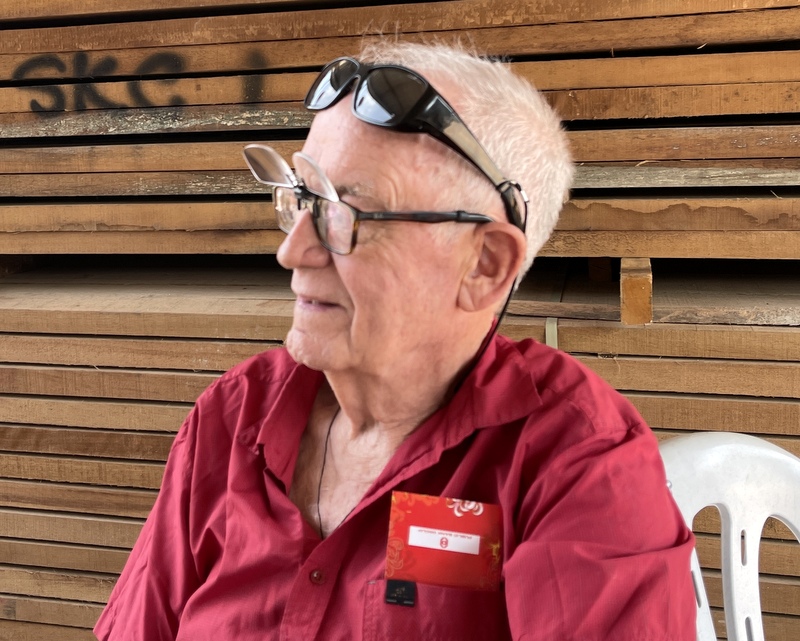
It is a tradition that people give ang pow to relatives and friends. This time we also did it. I received myself several red envelopes with money inside 😉 The picture at the right shows that I am getting old. Sunglasses to protect my eyes and clip-on reading glasses.
In the afternoon we drove around a bit, to take pictures
Another steamboat dinner, this time with Ong (Aric’s brother in law) and nephews and nieces. Seafood can not be more fresh than here!
A curious visitor.
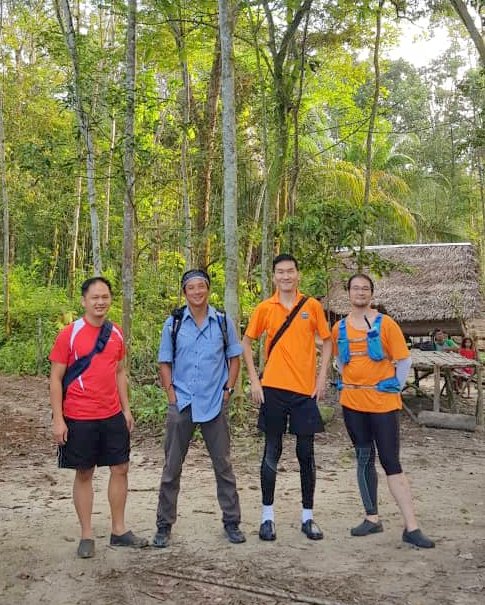
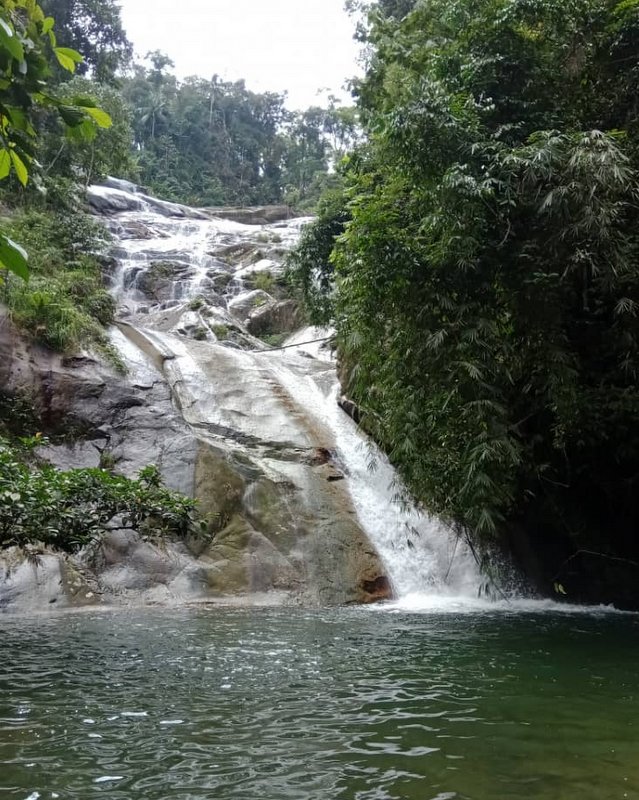
A few of my waterfall friends go back with CNY to their hometown Teluk Intan and several times we have used day three of the CNY to make a trip to a new/remote waterfall in the region. I decided not to join this year, feeling less confident in the jungle nowadays. Our last trip was in 2017 and not successful, here is the report : An unsuccessful waterfall trip so it was decided to give this Lata Jala another try. This time my gang reached the fall.
The first picture shows my “gang”, from left to right Siang Hui, Teoh, Nick and Joshua (a new member). Lata Jala,, in the middle, is an impressive unspoiled waterfall. The right picture shows an aerial photo of the fall, taken by Joshua’s drone.
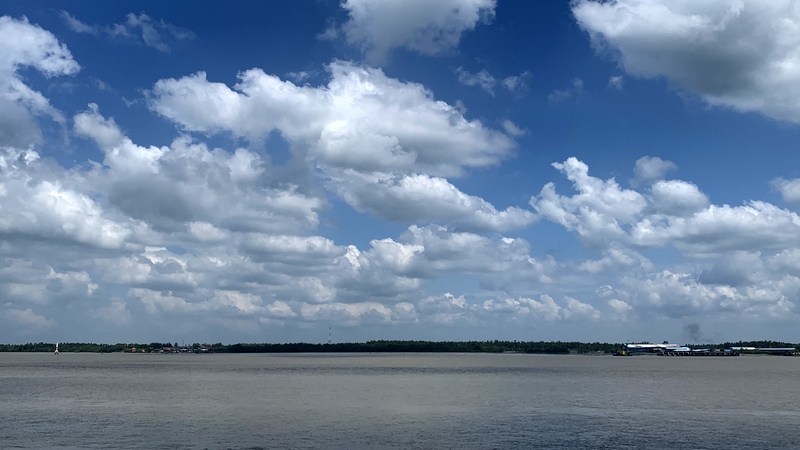
Aric and I explore a bit more the countryside around Parit Baru. This is the Bernam river. Across the river is Perak.
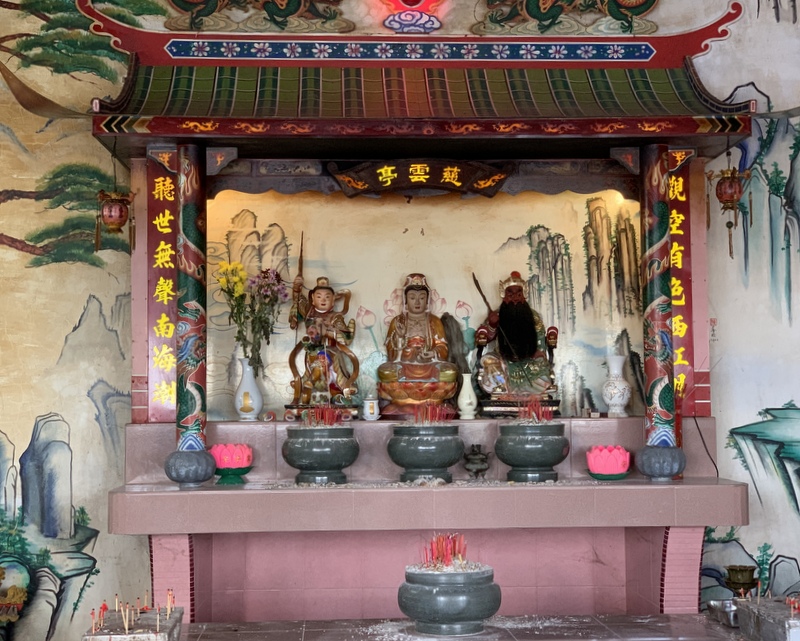
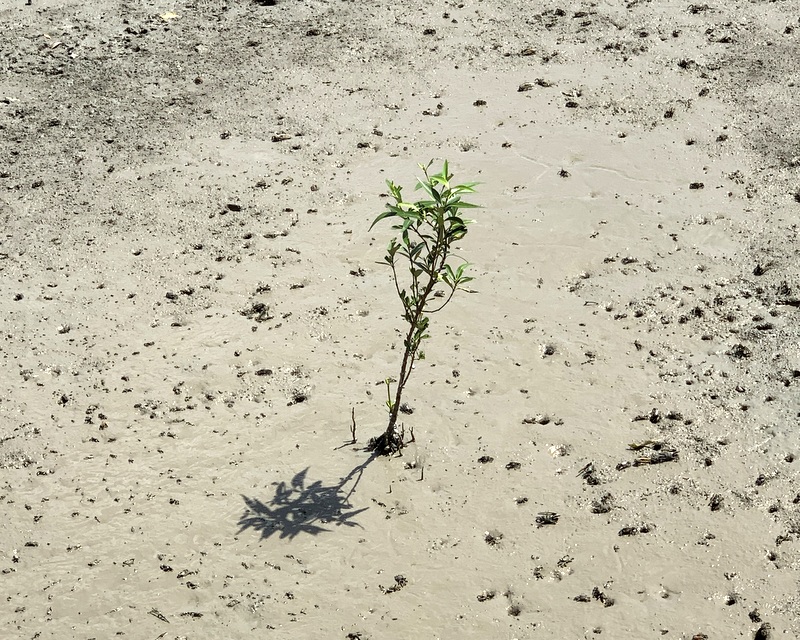
Left a Taoist temple in Sg Lang, one of the Chinese fishing villages. Right a young mangrove seedling, trying to survive. Notice the numerous holes, made by tiny crabs
Back in Parit Baru, a few more family photos. A group of young ladies, Aei Ling with two cute young kids and Ong teaching his son how to ride a bike.
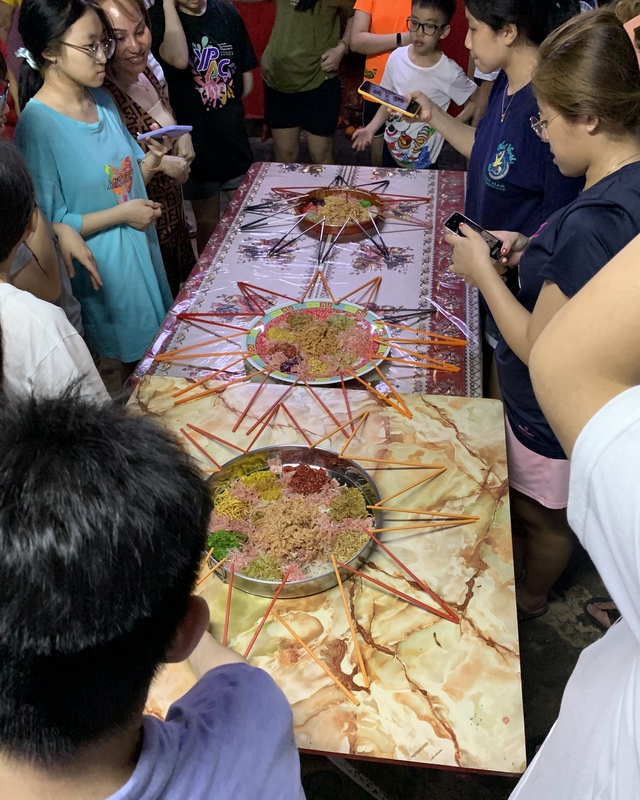
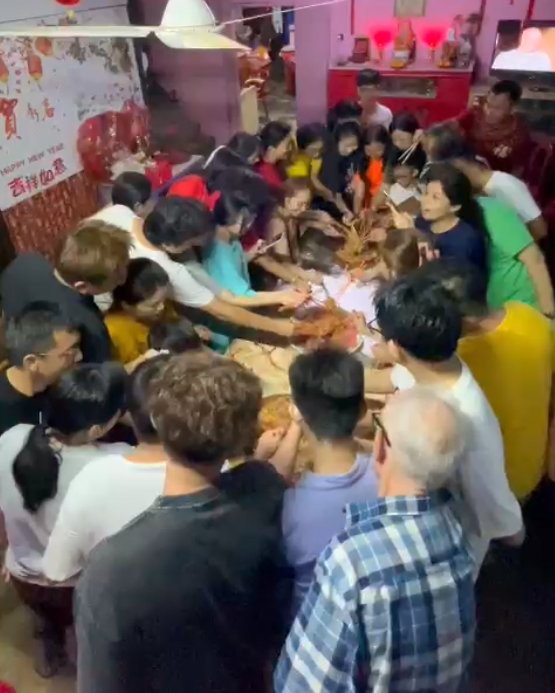
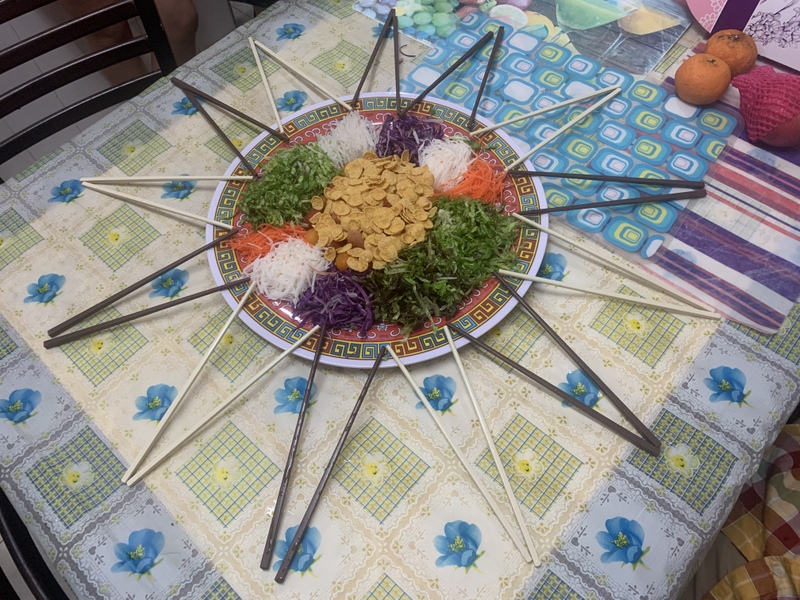
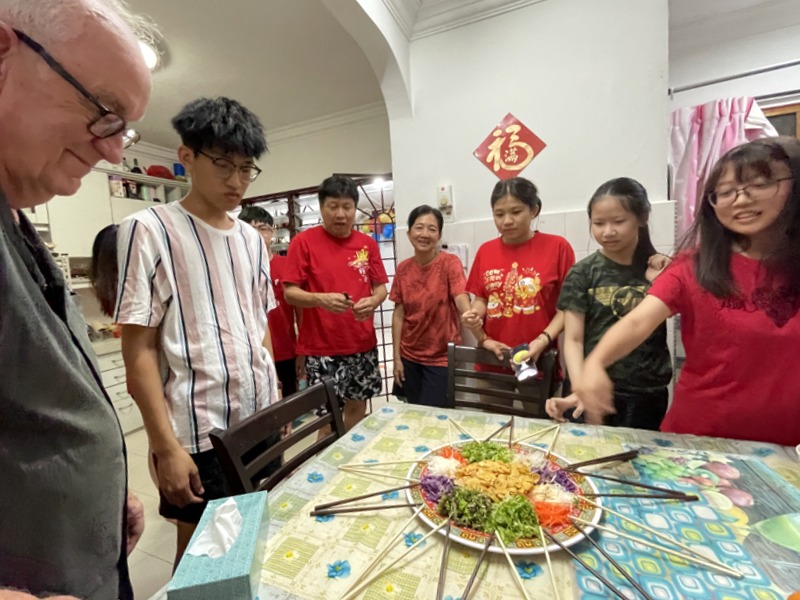
In the evening there was a party with yee sang and a lucky draw,
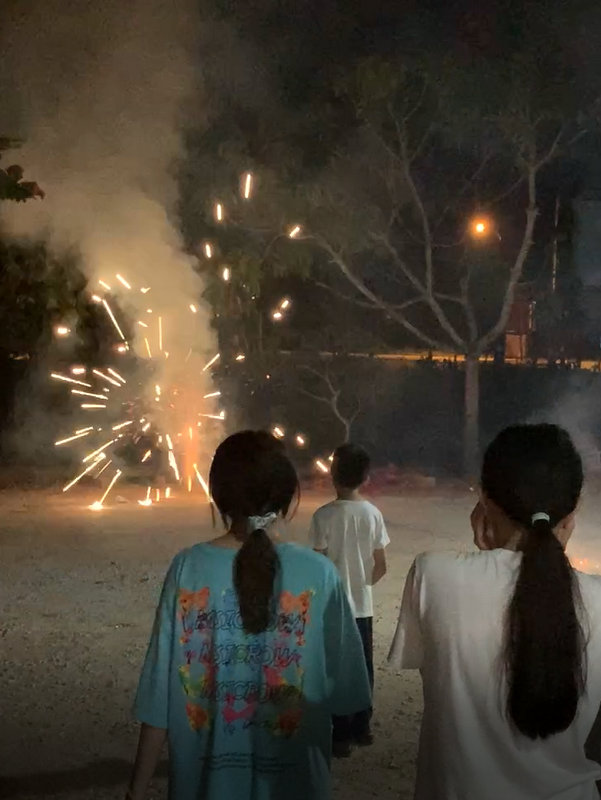
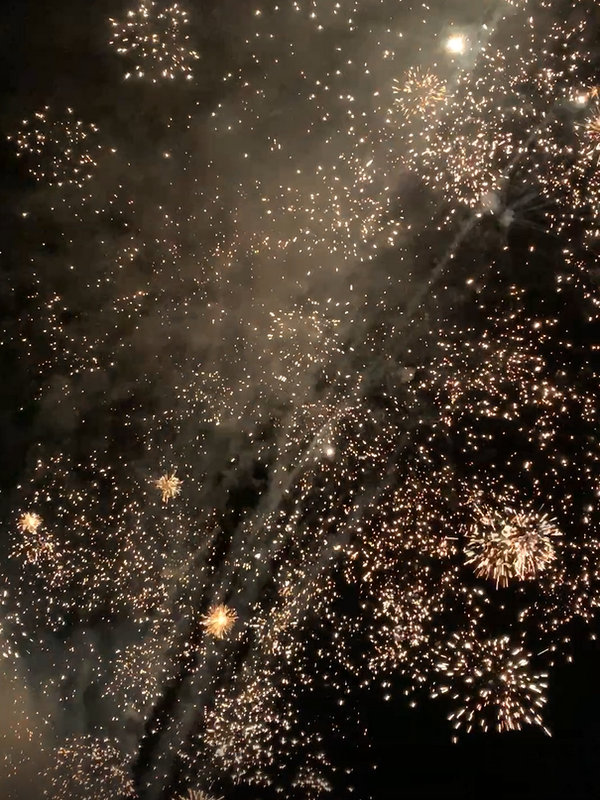
And of course there were lots of firework.
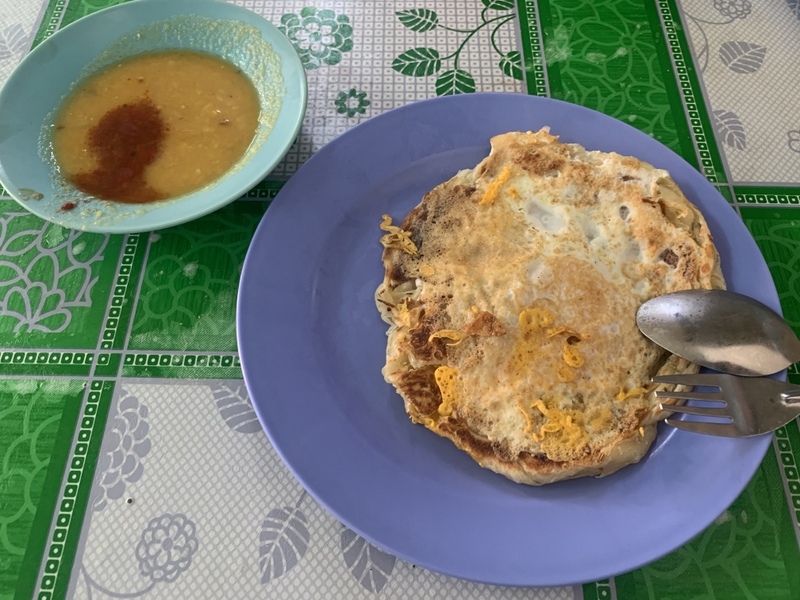
The next morning I went to the village with Ong for breakfast with Roti Tampal. I knew about Roti Telur but this was new for me. Egg on top, not inside
Before we left there was another praying session..
A few days later, there was another celebration, in Puchong with Ong and his family, He is Hokkien and for the Hokkien community day 9 of the CNY is an important date. It is the birthday of the Jade Emperor, the God of Heaven. Again there was yee sang.
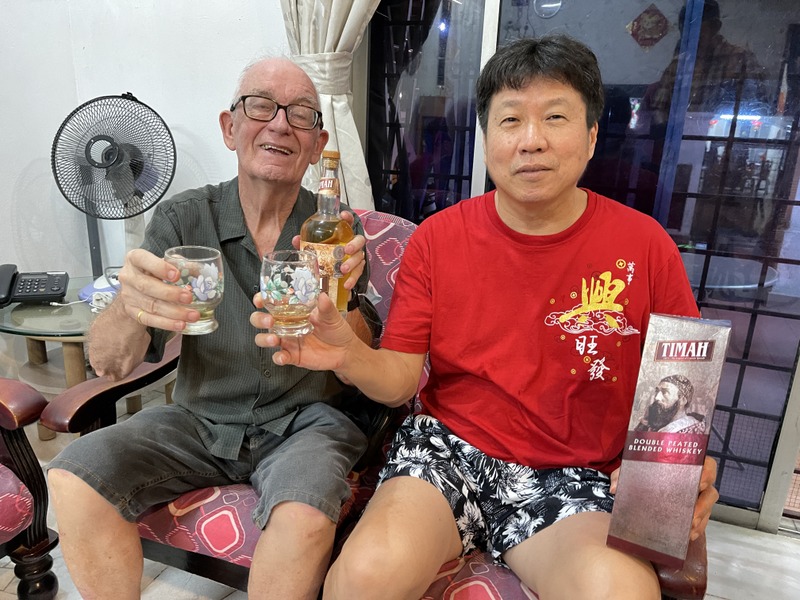
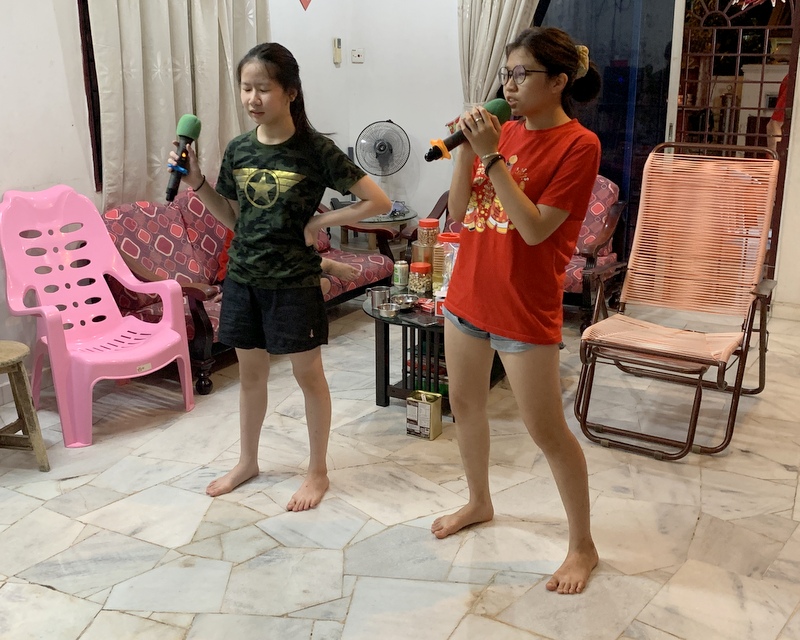
And there were drinks too 😉 Ong and have a drink of the (in)famous Timah whisky and the younger generation shares a bottle of wine. Playing cards, singing karaoke, a very nice evening.
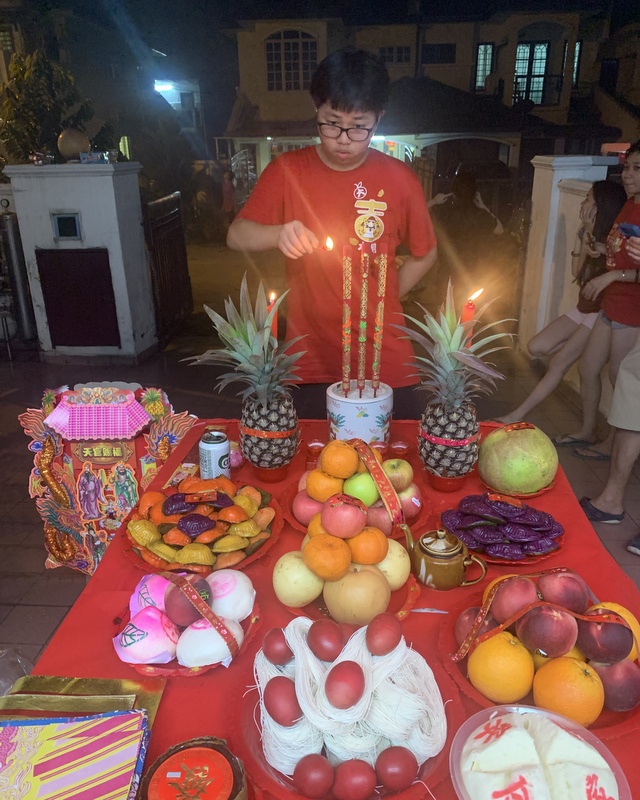
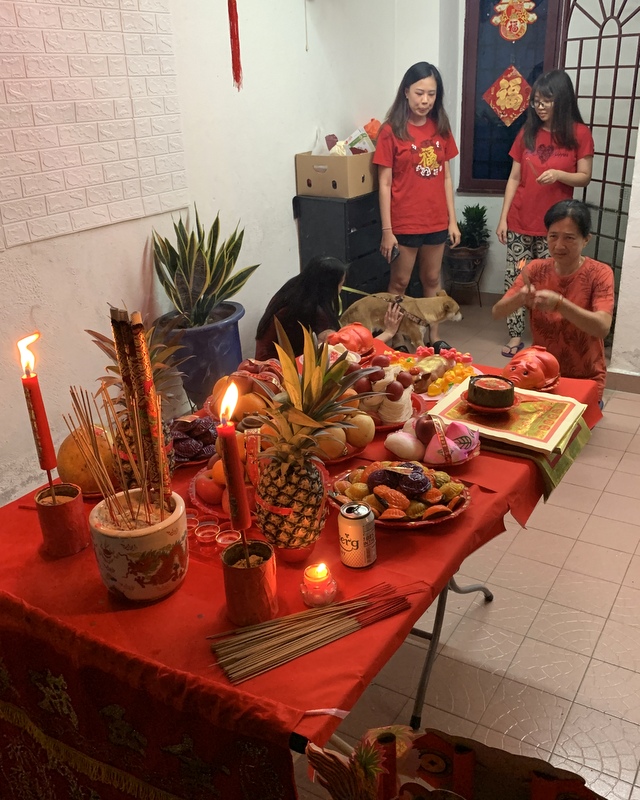
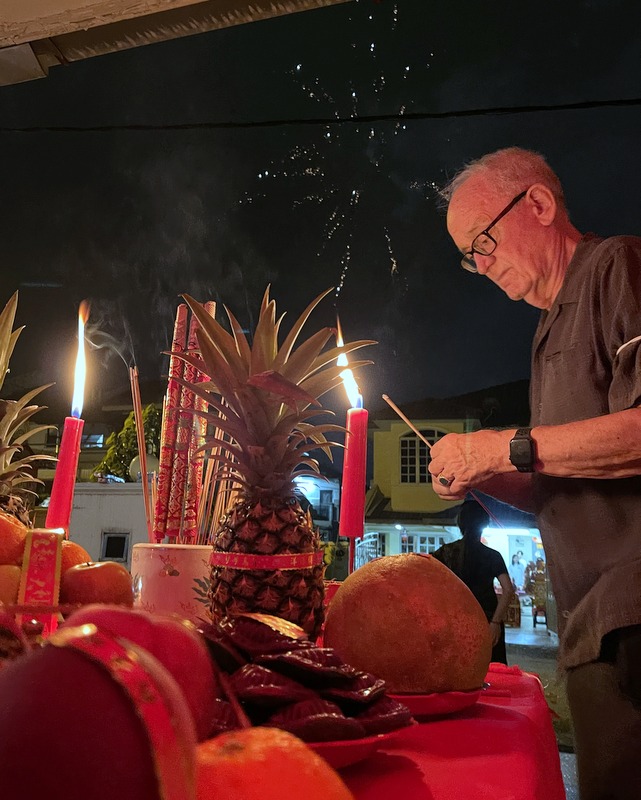
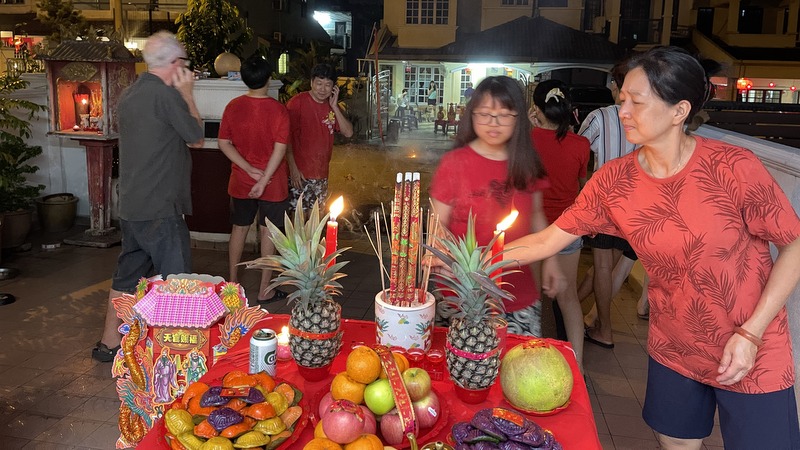
An offering table is prepared for the God of Heaven, and joss sticks are lit.
At midnight there is a lot of firework. Note how I am protecting my ears.
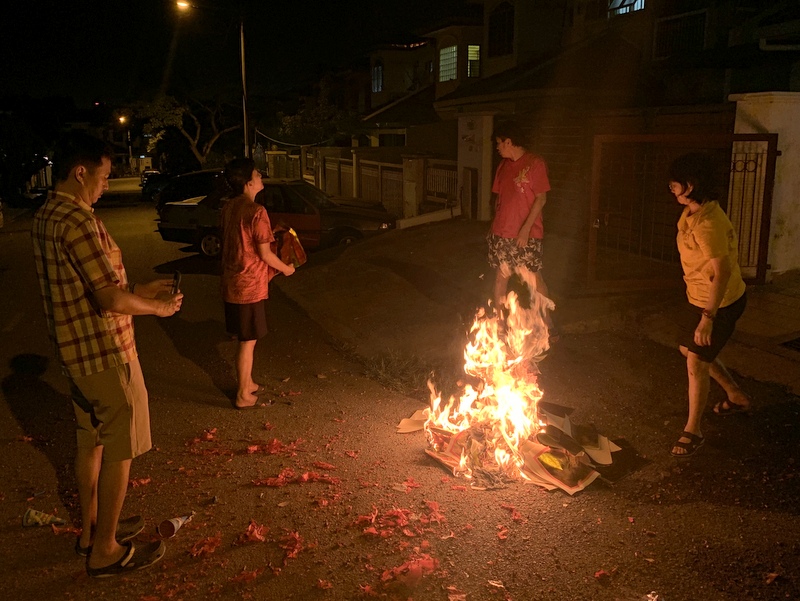
The ceremony ends with the burning of Joss papers.
Last month one of our friends told us that he would have vegetarian food during the Nine Emperor Gods Festival. This Taoist festival is yearly held during the first nine days of the ninth lunar month. The largest celebration takes place in Ampang, but there is also one in Taiping, which I had always wanted to see, but never had 😉 .
I asked my Taiping friends about details, and they told me that the main procession would be held on Sunday 6 October, and the fire walking on the last evening, Monday 7 October. So I booked my usual hotel Furama and arrived by train Saturday 5 October afternoon.
Taiping has become a warm nest for me, friends were already waiting at the station, and before sending me to my hotel, we had lunch in restaurant YES.
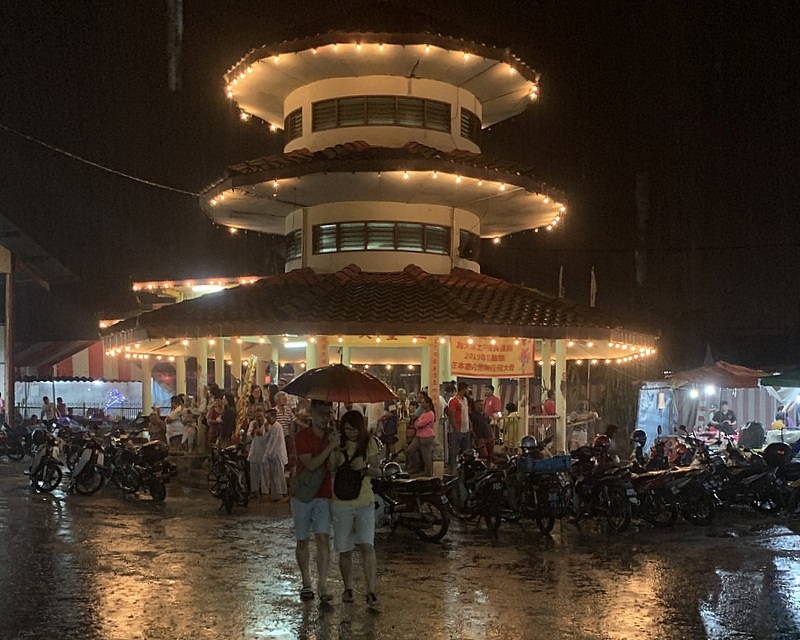
After a short rest in my hotel, and in spite of the drizzle, I decided to have a look at the Nine Emperor Gods Temple. There are three Kew Ong Yah (Nine Emperor) temples in Taiping, the original one is in Tupai, on walking distance from my hotel.
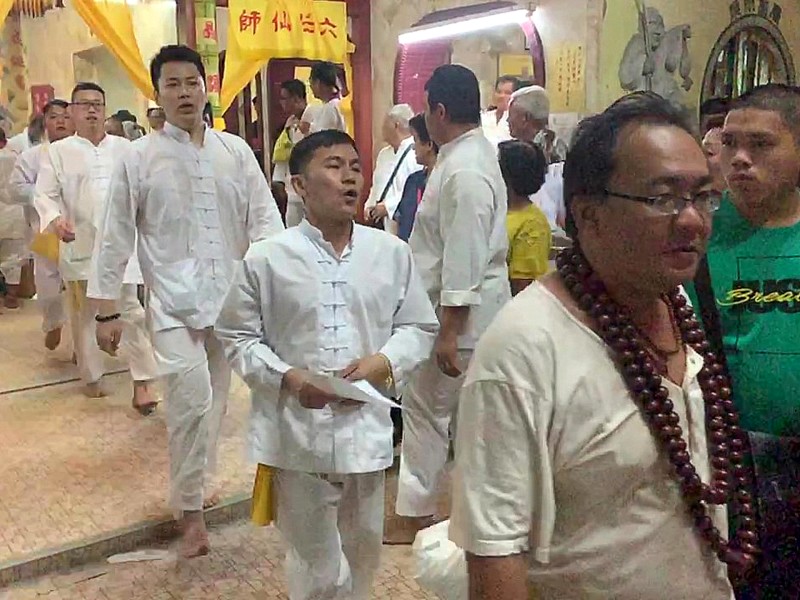
A lot of activity was going on. Devotees were praying in the temple and having (free) vegetarian food. Many of them were wearing traditional white clothes.
In the temple compound I saw already the floats and chariots that were going to be used during the procession.
That evening I had dinner again with my friends, this time in restaurant 8383 in Pokok Assam. As I said, Taiping is a warm nest for me. The food was delicious and really value for money.
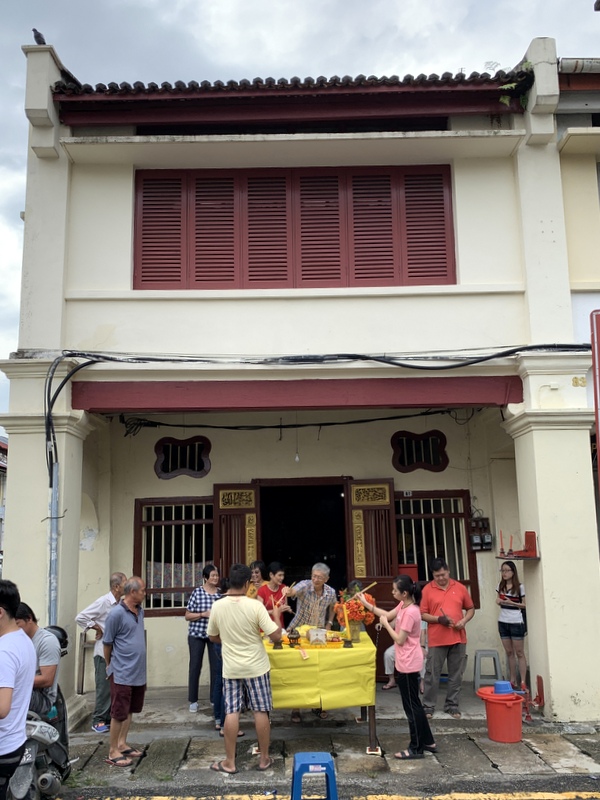
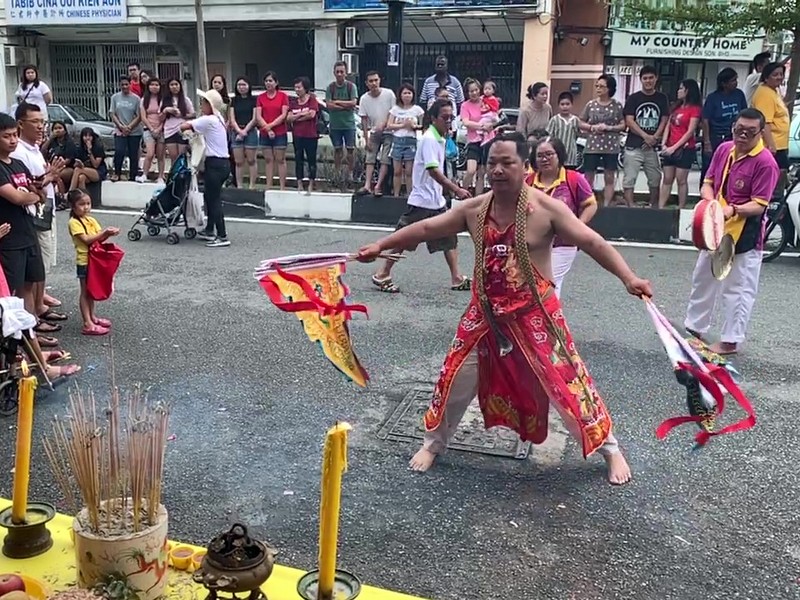
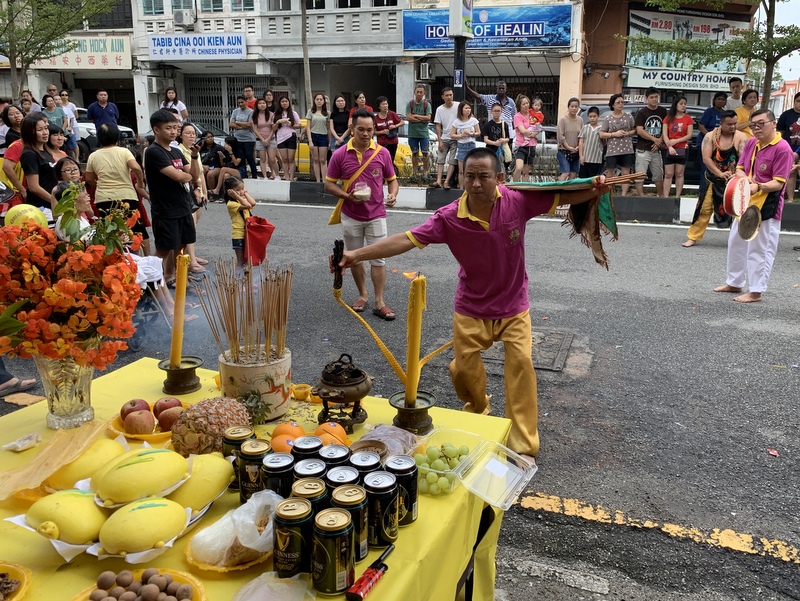
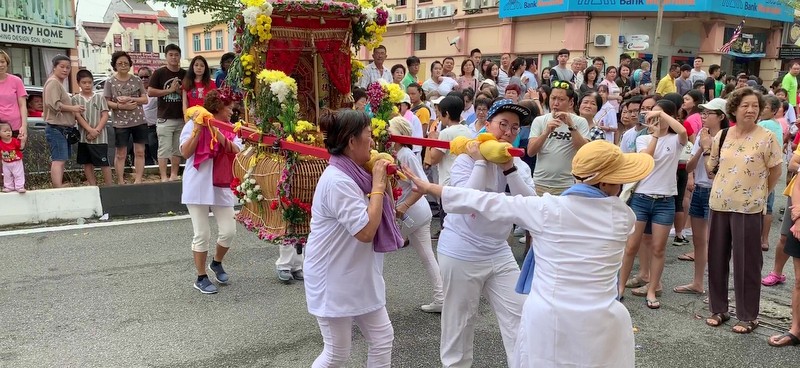
The next morning was the procession. The husband of my friend Bok Kin is a descendant of Ng Boo Bee, the famous tycoon. In April they had taken me to Ng Boo Bee’s tomb, click here for the report. Ng Boo Bee’s town house is in Kota Road., the procession is always passing by there and it is a tradition that the family prepares an offering table in front of the house. Bok Kin invited me to watch the parade from there and of course I accepted her invitation.
81, Kota Road
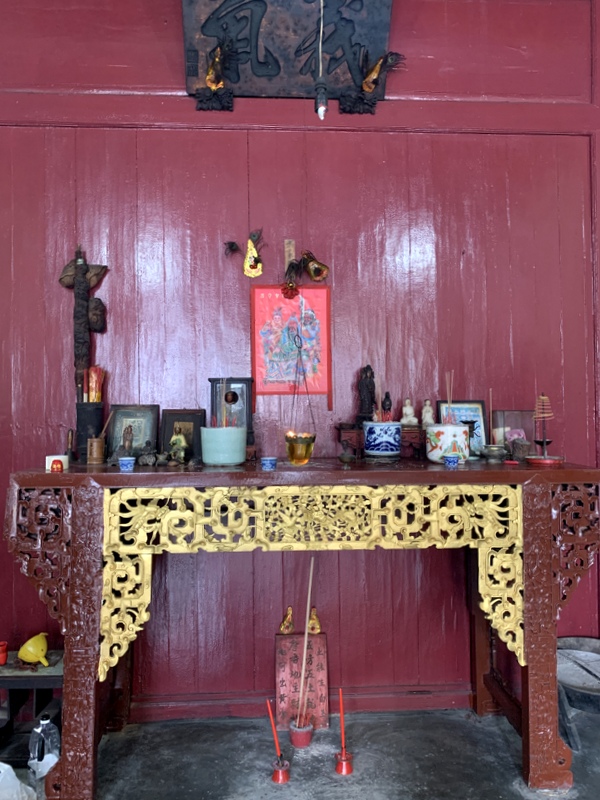
The house altar
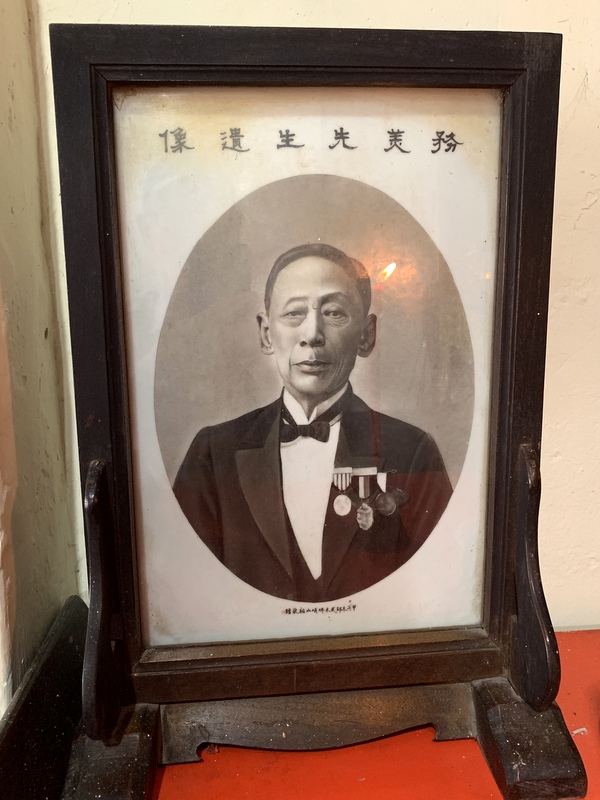
Ng Boo Bee
Before the procession started, I joined the family in burning joss sticks, not surprisingly nine sticks this time 🙂
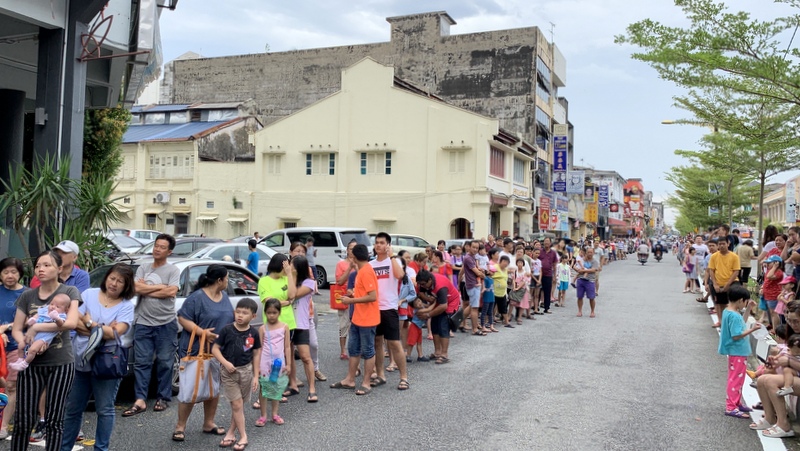
Many people were waiting for the arrival of the parade. The cream-colored building is Ng Boo Bee’s townhouse
Start of the procession. In the background the iconic Taiping clock tower.
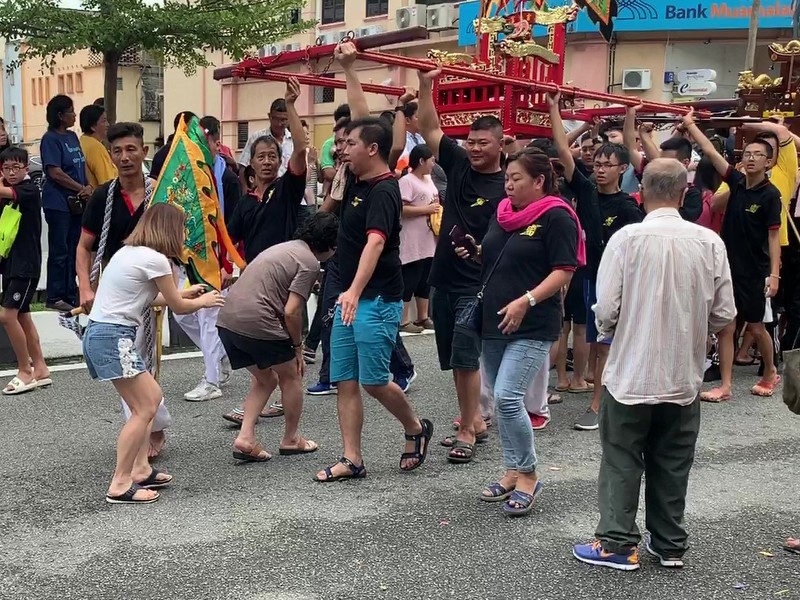
When the chariots were close to the house and the offering table, they made a left turn and almost ran to the table, stopping just in time.
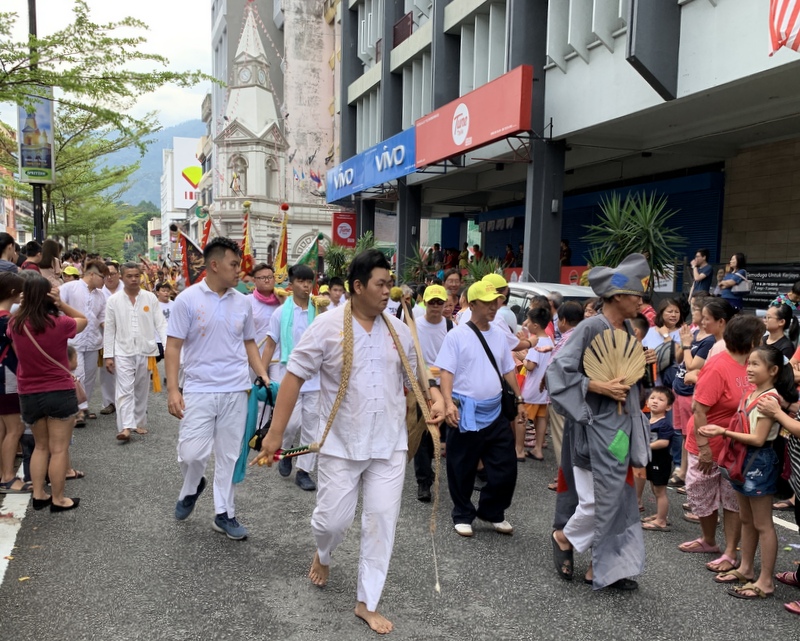
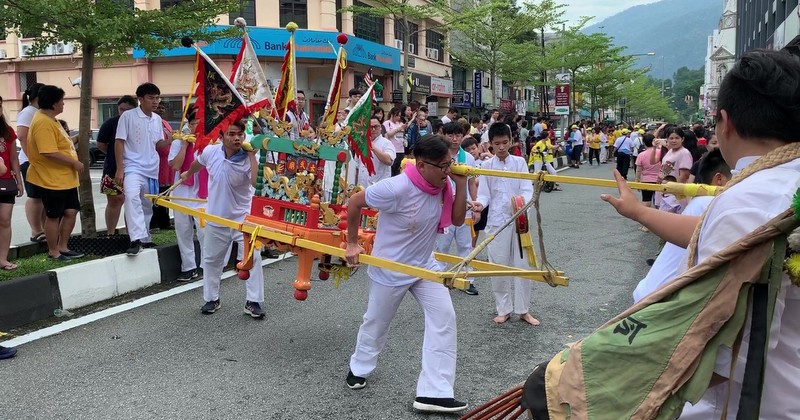
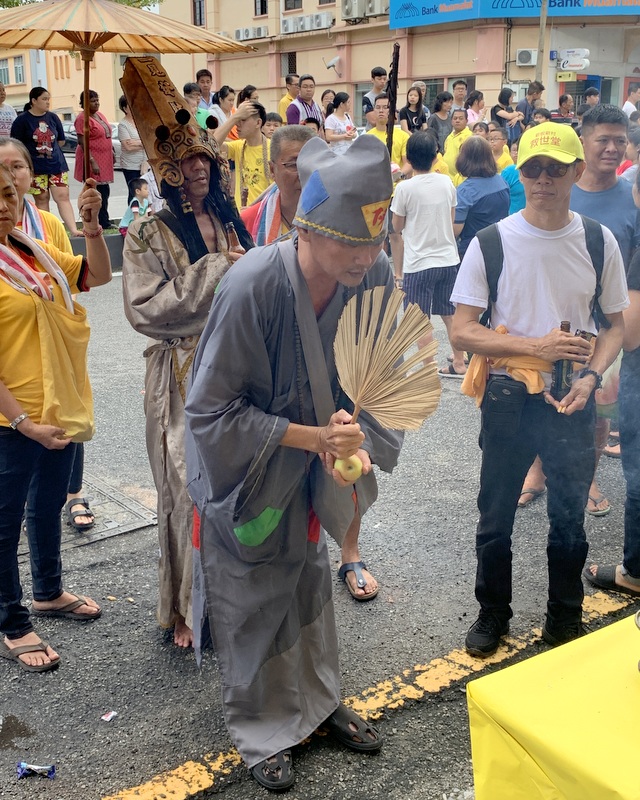
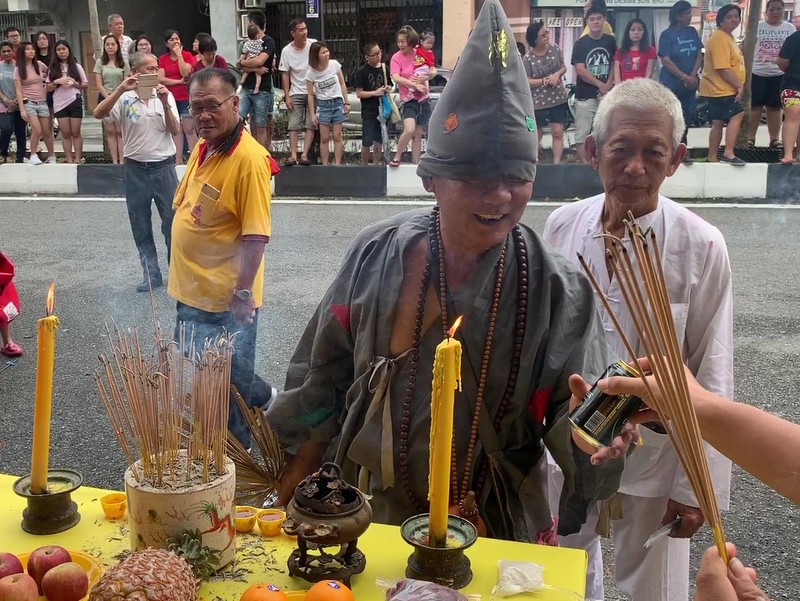
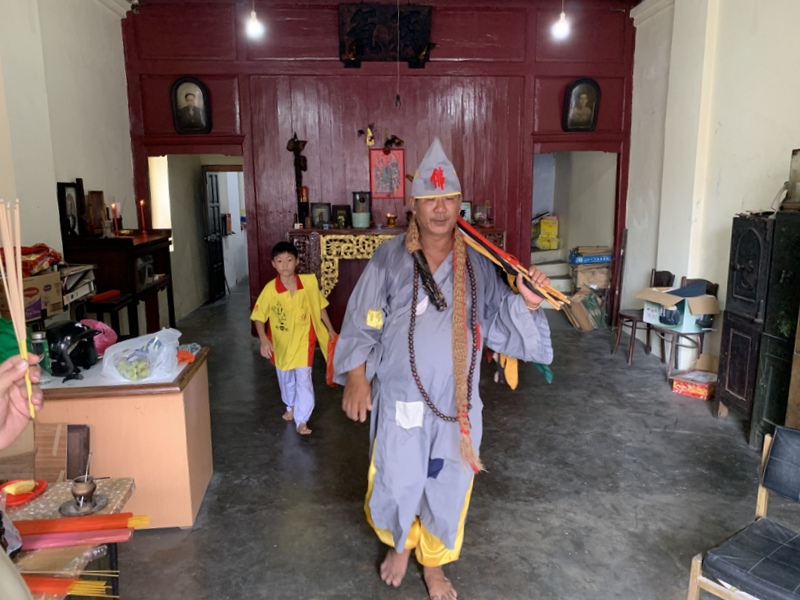
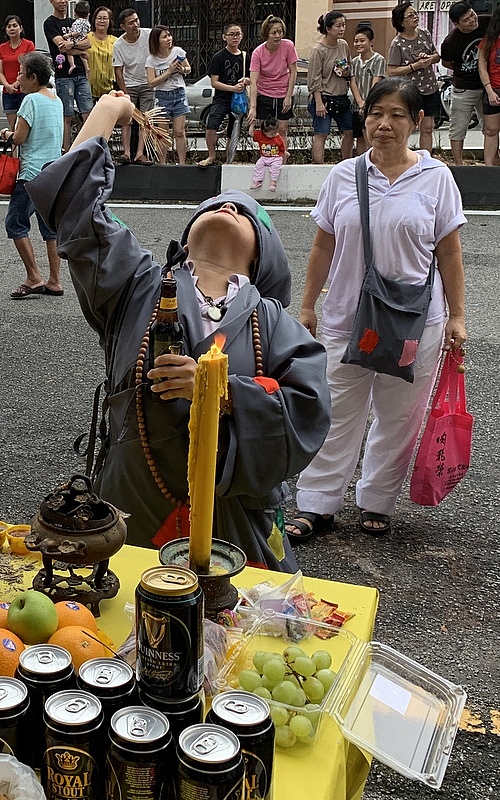
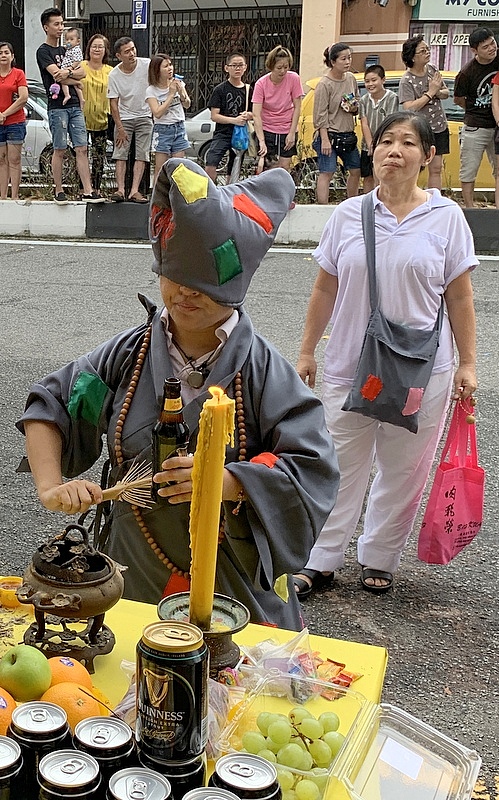
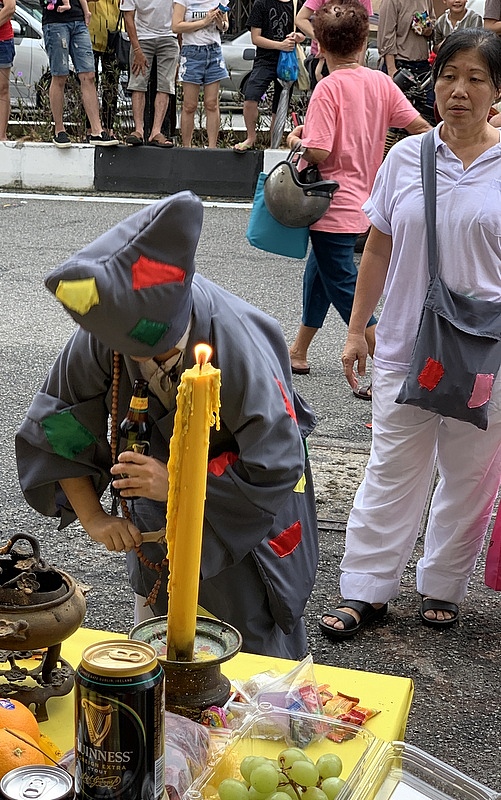
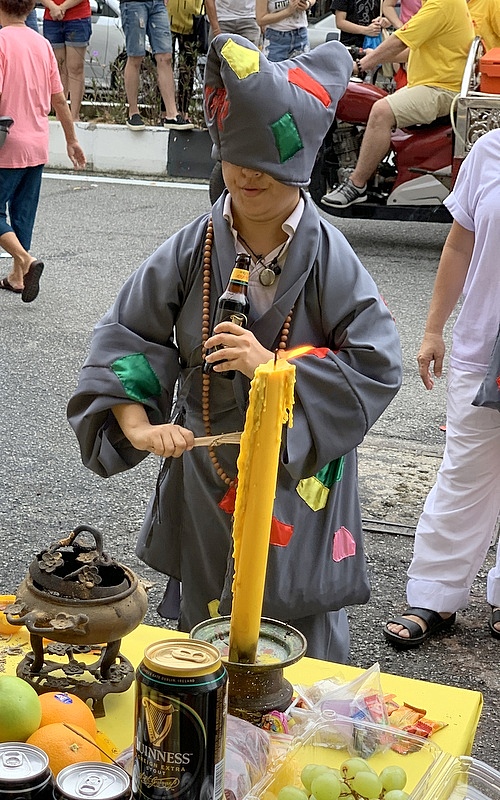
Many participants were carrying whips, using them to make a cracking sound. There were also quite a few devotees, dressed in tattered monk robes, a fan in one hand and often a bottle of beer in the other. They personify Ji Gong. Fascinating to watch.
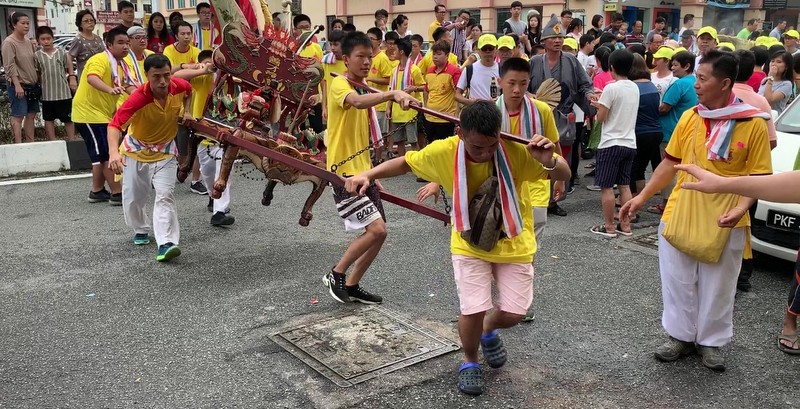
Rocking the chariot is a common practice. I had seen it before at the Chengay festival in Johor Baru.
I kept taking pictures 🙂 .
Passing under the raised chariot
Waving the flags
Cracking his whip. Notice the many beers
Ji Gong getting a beer
Most of the chariots were carried by men. This one was an exception.
This Ji Gong entered the house to pay his respect to the house altar and wrote something on a piece of paper before he continued.
Another Ji Gong. His robe is tattered. His cap is covering his eyes. Holding a bottle of beer in one hand and a fan in the other. The original Ji Gong (1130-1209) ate meat, drank alcohol and did not care about his clothing… 🙂
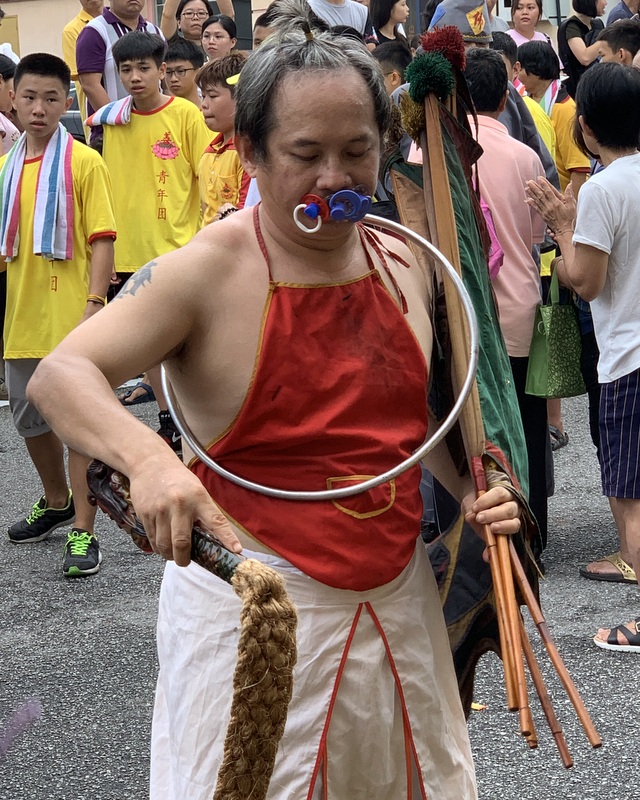
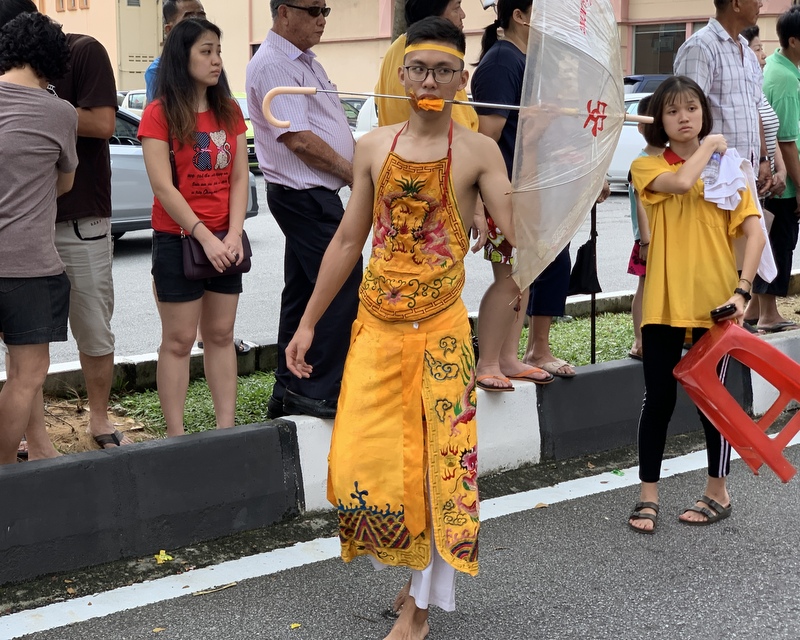
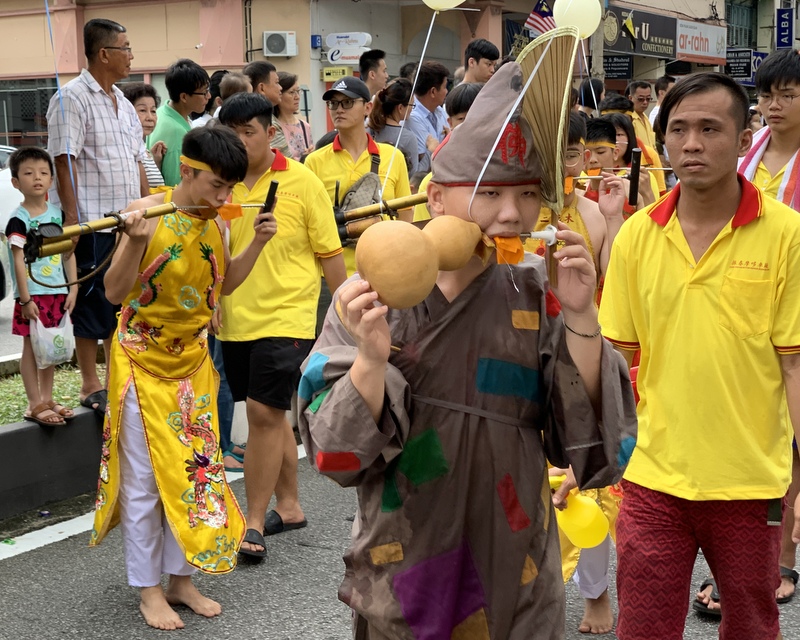
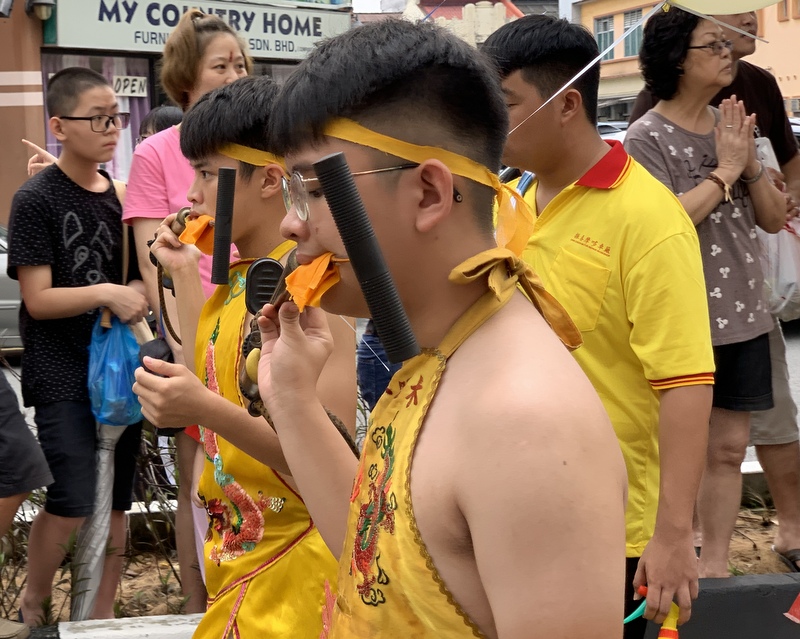
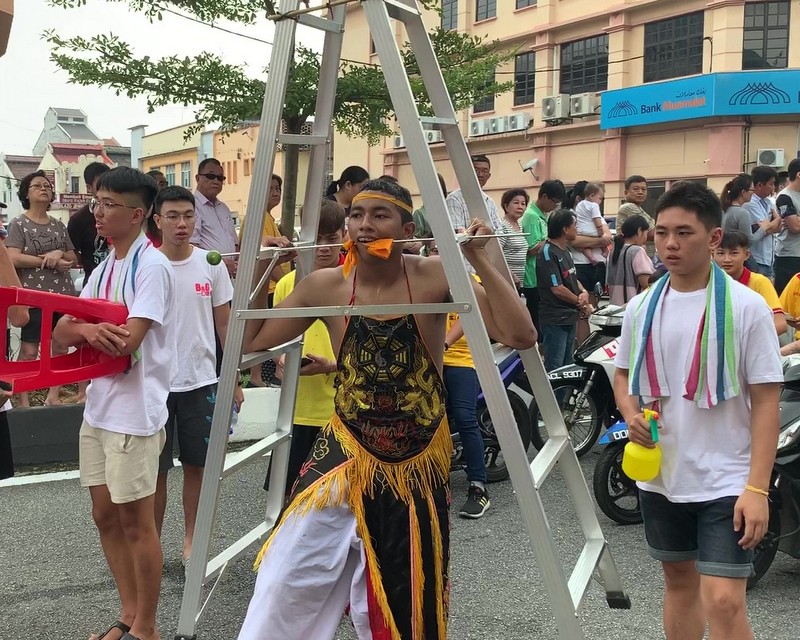
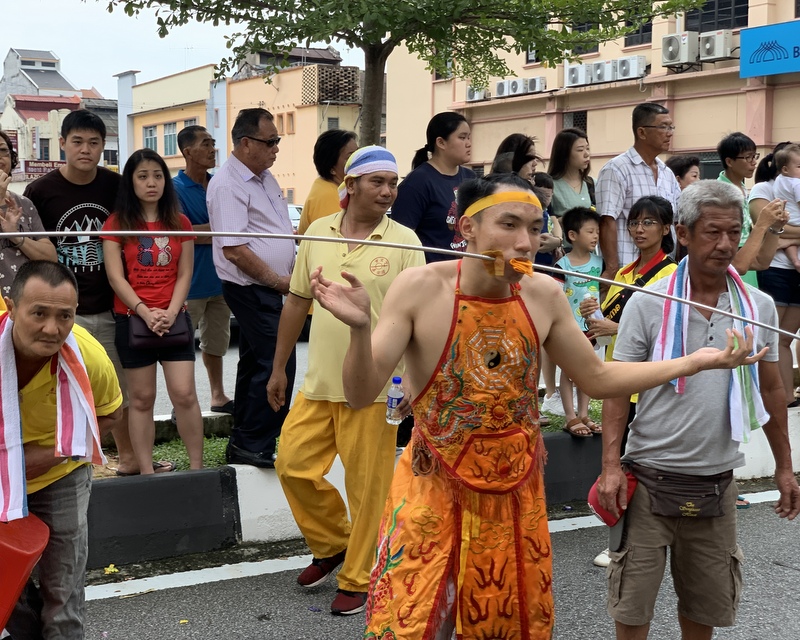
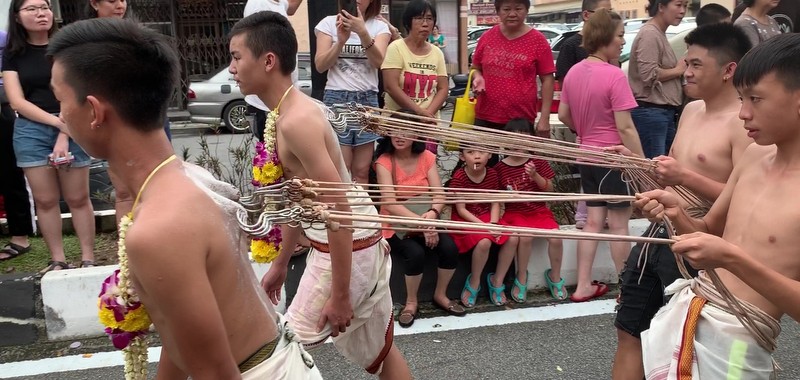
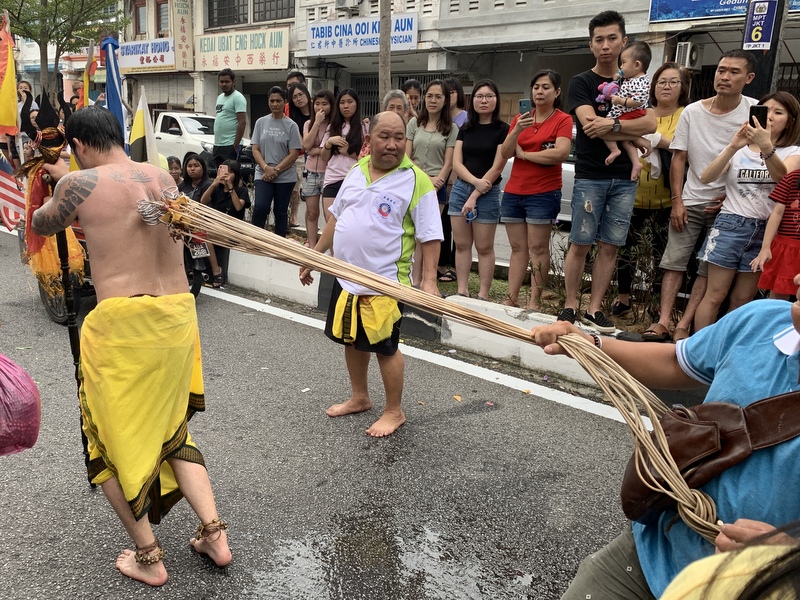
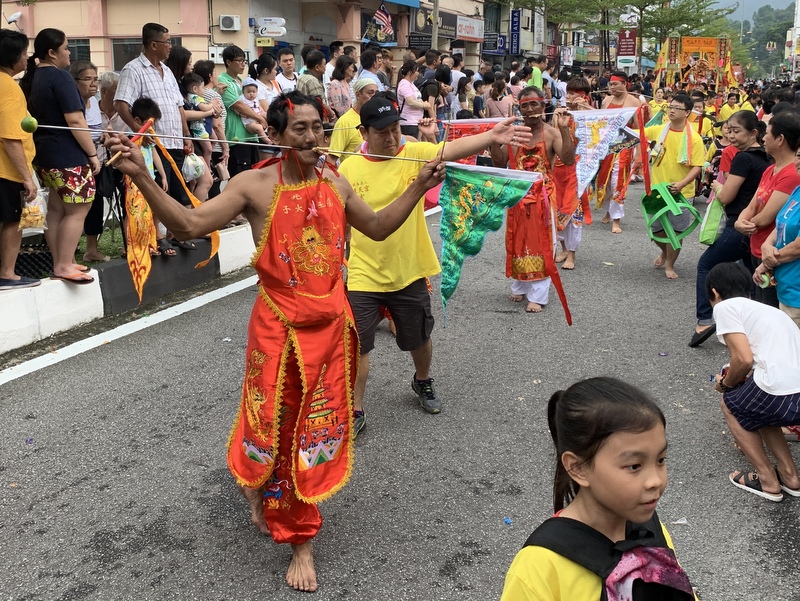
The most fascinating part of the procession are the many men, often still teenagers, who have been piercing their cheeks, walk with hooks in their backs etc. They are called masong. Most piercing is done with long, thin, metal poles, but there were a few devotees who had used heavier stuff, like this guy who was using two swords, and the guy to the right, using a gun. Can not imagine how that can heal easily.
Here are more pictures. One guy using an umbrella, another one a tyre pump, even one carrying a ladder! Notice how all of them have one or two helpers, carrying a stool. Understandably, sometimes they have to sit down for a while 🙂
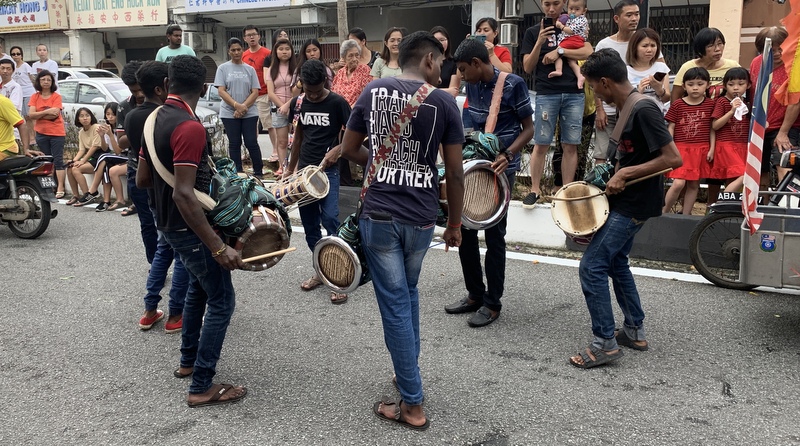
An Indian drum band added to the festive atmosphere. My friends said that this year the procession was longer than before. Several temple are contributing, and also Indians take part in the parade.
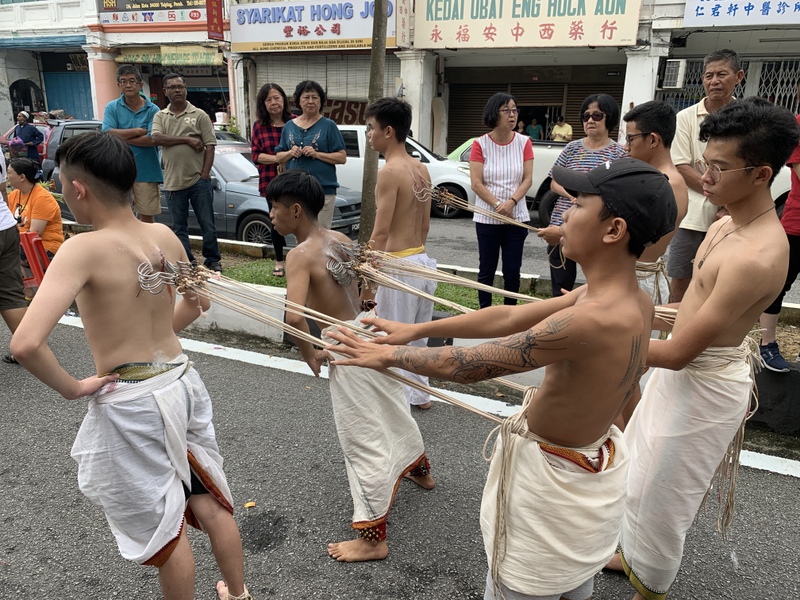
Here is another way of self-mortification , similar to what I have seen at Thaipusam, where devotees pull a chariot with ropes attached by hooks to their back. No chariot here, but other boys, pulling back, while the masong are more or less hanging forward.
More piercing of cheeks.
The last part of the procession. Devotees are carrying kavadis. Both the kavadis and the piercing have their origin in the Hindu Thaipusam tradition. Actually, there is a Hindu festival, Navaratri, during the same nine days of the ninth lunar month, but not related, as far as I know.
Heavy stuff, no wonder they sometimes have to sit down for some rest.
One of the last floats. Sprinkling (holy?) water on the crowd.
The whole parade took around 1.5 hour. After cleaning the offering table, the family invited me for lunch. Vegetarian of course 🙂
The fire walking took place on the evening of the next day, so I had plenty of time to walk around in Taiping, meet other friends, enjoy (non-vegetarian) food, etc. I have written a separate post about it, Taiping, October 2019, and will continue here with the fire walking.
The next day around 7pm, my friend Yeap picked me up from my hotel and we found a parking place not too far from the Tupai temple, where the fire walking was going to take place. We were early, a big space had been cordoned off, and people were preparing the bed of ashes. It was shorter than I had seen in Sri Lanka, many years ago.
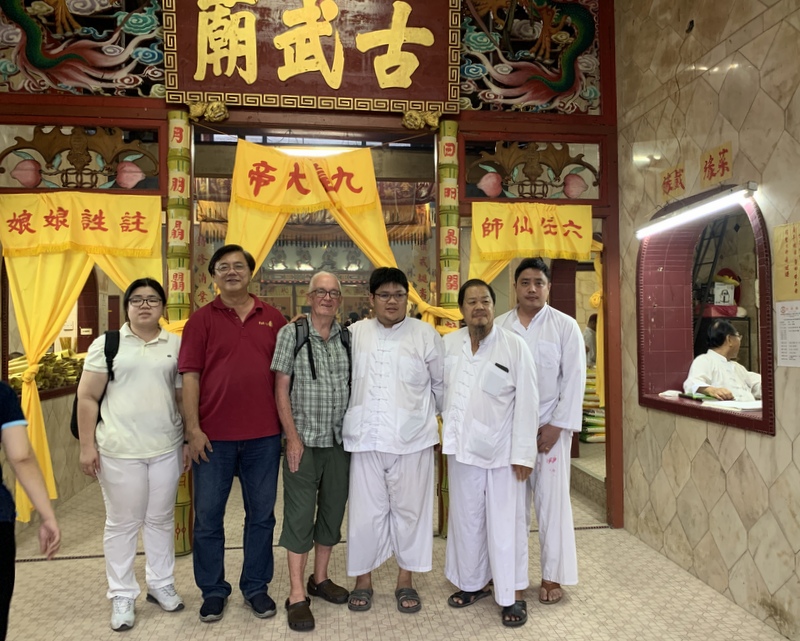
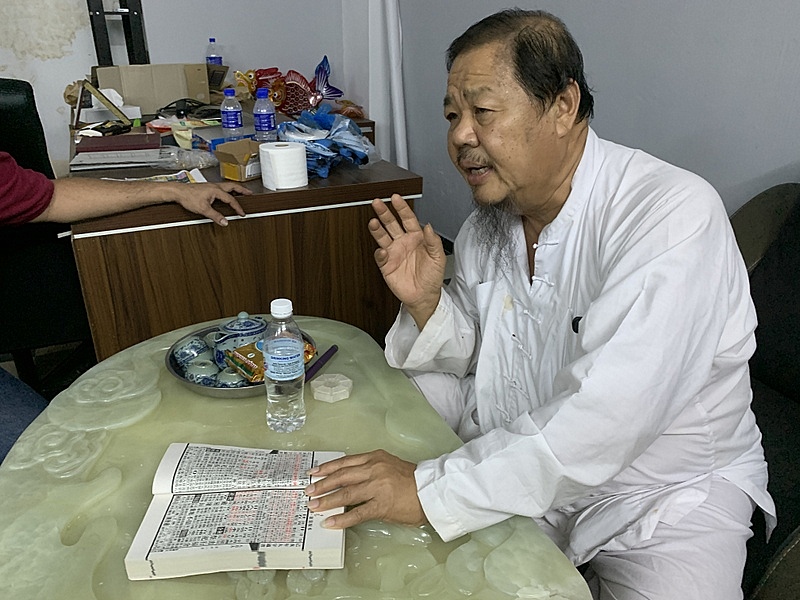
We had a look inside the temple, where Yeap introduced me to Ong Hean Hai, the caretaker. He is standing second from right, with his children . Later he invited us to his office, where he gave an explanation about the Nine Emperor Gods festival.
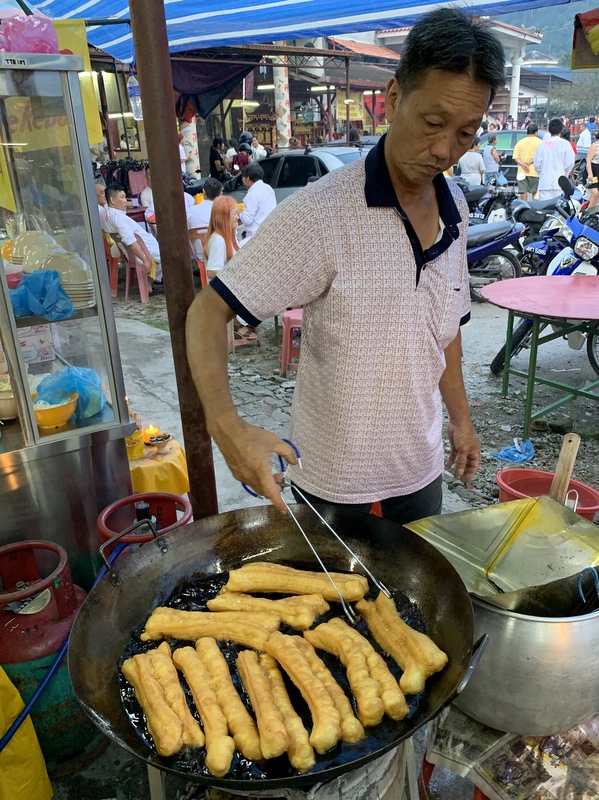
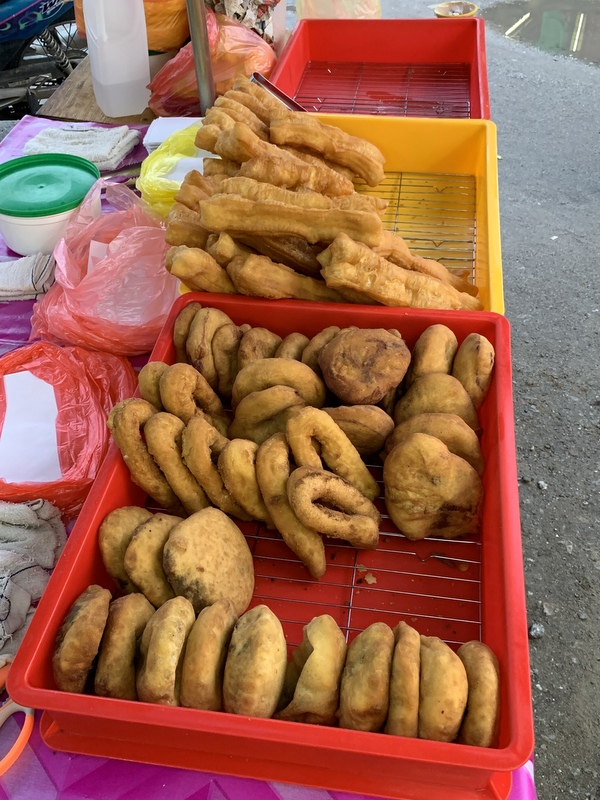
There were many food stalls in and around the temple compound. In one of them they were making Yeow Char Kwai, a favorite of mine, specially when freshly fried. The name translates as Oil Fried Devils and here is the explanation for that strange name 🙂
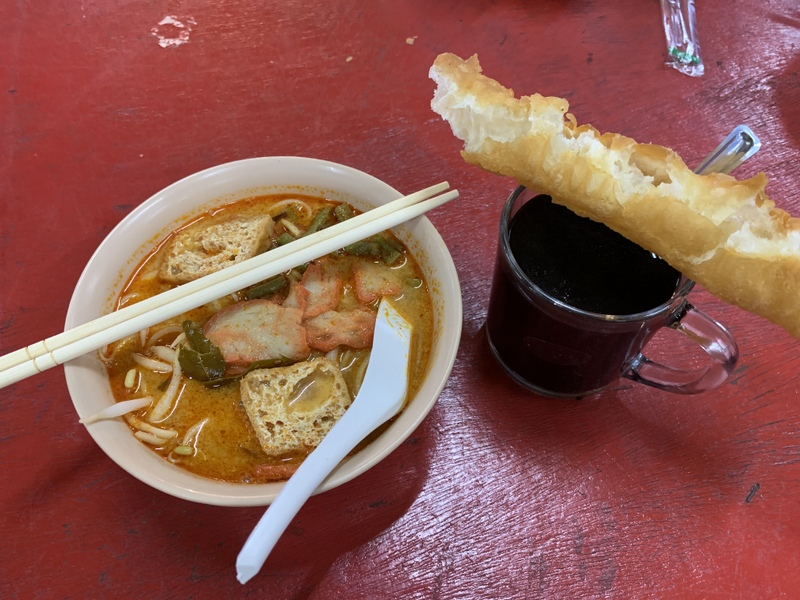
As we were early, we had dinner there. Vegetarian curry mee, very nice. And black coffee with Yeow Char Kwai, delicious when you soak them in the coffee. In the meantime Bok Kin and Teng Hin had also joined.
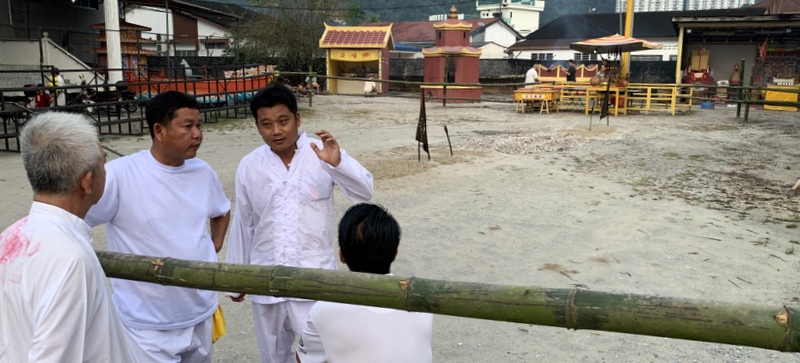
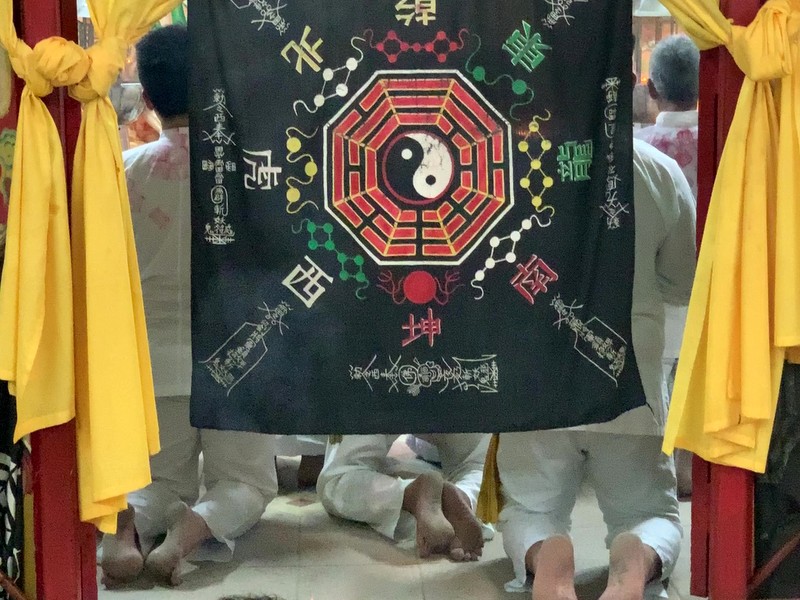
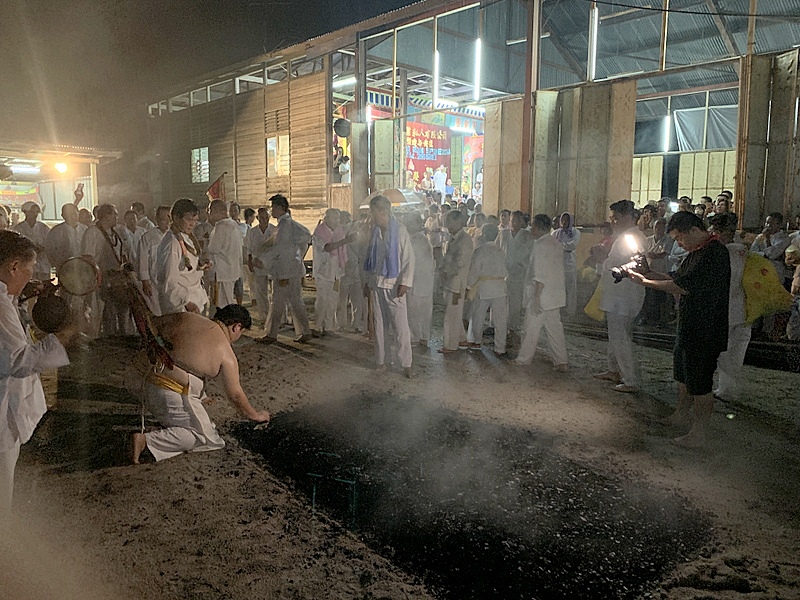
Preparing for the fire walking, the devotees, dressed in white, perform several rituals. They enter the inner temple, where other people are not allowed. They walk back and forth several times to the fire walking compound, chanting.
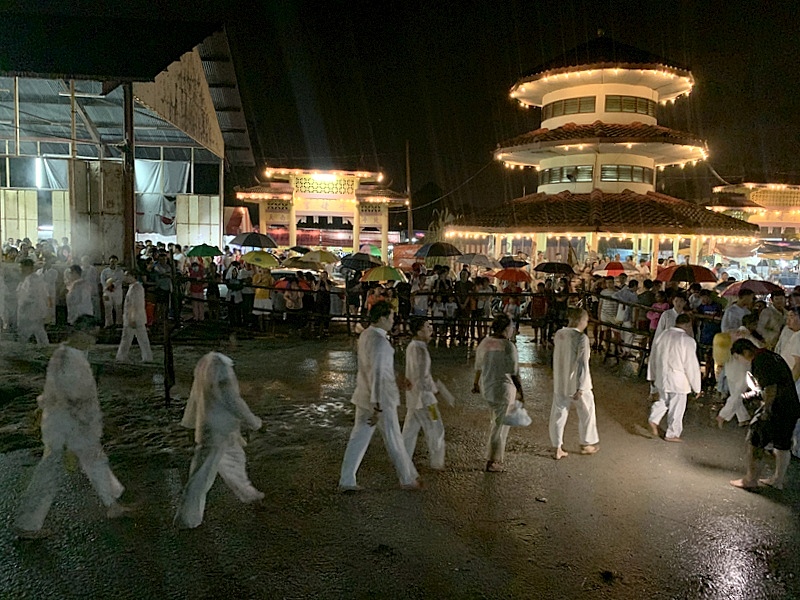
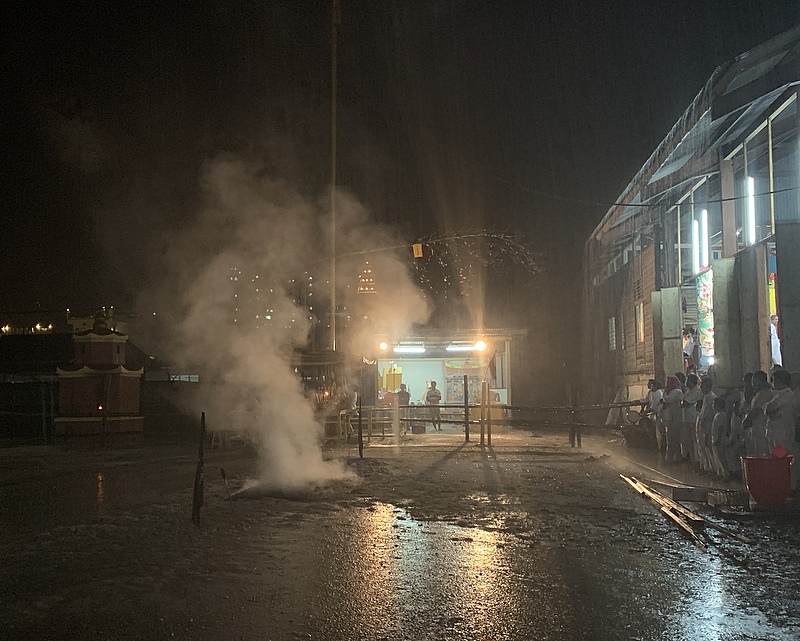
The Nine Emperor Gods Festival is associated with rain, and this time was no exception. When the fire walking was beginning around 9pm, it had also started to rain. Maybe easier for the devotees to walk on the ashes? For us onlookers, we needed an umbrella.
The lighting was not very bright, so it was difficult to take good pictures. Here are two videos I took. The devotees are circling a few times around the ashes, before they walk.
It is interesting to watch the fire walkers. Some of them walk slowly, others almost run. Some carry a child or a bundle of clothes. Because of the rain, you could not see any glowing ashes, but it still must have been burning hot. After the first group of devotees, also others try. It is said that you can only do it if you have been vegetarian during the nine days of the festival , but I doubt if that is true
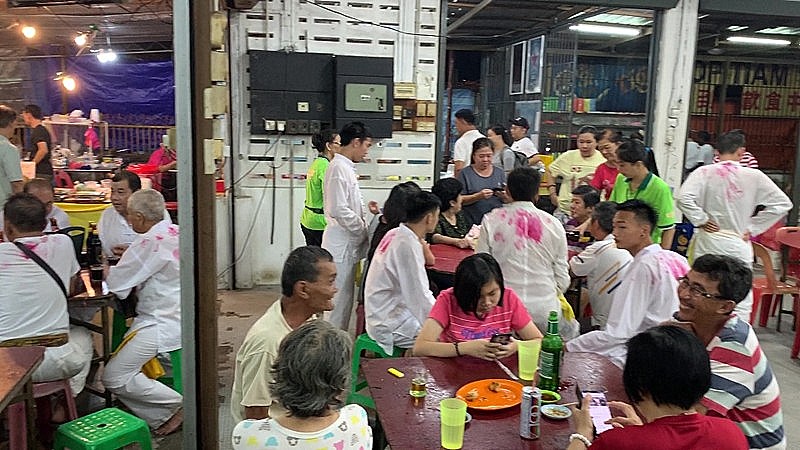
AFter the fire walking was finished, we went back to the restaurant, where also many of the fire walkers were enjoying a drink, food and company.
The festival was a memorable experience for me. I took many videos dring the procession and the fire walking. Here is a collage.
In a few weeks time it will be Easter, always a time of the year that I get in the mood to listen to Passion music. See for example my posts St Matthew Passion and Stabat Mater . In this post I will write about another masterpiece of religious music, the Seven Last Words of Christ, written in 1786 by Joseph Haydn.
For those readers who are not familiar with the Christian religion, some information. Christians believe that Jesus was the Son of God and that he came to Earth to save mankind by carrying the burden of their sins. His sufferings culminated in his crucifixion and his death. On the third day he resurrected from his grave and fourty days later he ascended to heaven.
The resurrection is celebrated on Easter Sunday (this year on 21 April). On the Friday before in some churches a devotion is held from noon till 3 o’clock , the Three Hours’ Agony, commemorating the three hours of Christ’s hanging at the cross. This devotion was devised in the 17th century in Peru by Jesuit missionaries and soon became popular in Europe. It consisted of sermons and meditation about the seven “words” uttered by Jesus when he was hanging at the cross.
In 1786 Joseph Haydn was requested by the clergy of the Cádiz Cathedral to compose seven instrumental adagios, to be played after each of the “words” and meditations. Not an easy job, as Haydn wrote himself: ” …. it was no easy task to compose seven adagios lasting ten minutes each, and to succeed one another without fatiguing the listeners ..“. Haydn added an Introduction and a Finale.
The work became a success immediately and the next year Haydn wrote a version for string quartet. It is this version which is usually performed nowadays. In 1801 he published a choral version.
For this blog I have used the orchestral version, recorded in 1965 in Barcelona.
I decided that it would be interesting to split the work into its separate pieces and combine them with the corresponding utterances by Jesus. The seven last words come from different gospels. Here is the introduction.
Introduzione in D minor
Luke 23:34: Father, forgive them, for they know not what they do
While Jesus is hanging at the cross, he is being mocked by the Jewish rulers, the soldiers and many of the spectators.
Sonata I in B-flat major
Luke 23:43: Truly, I say to you, today you will be with me in paradise.
Two criminals are crucified at the same time, one at Jesus’ left side, one at his right side. One of them also mocks Jesus, but the other one rebukes him, saying: we are punished for our crimes, but this man didn’t do anything wrong. And he says to Jesus: Lord, remember me when you arrive in your kingdom.
Sonata II in C minor, ending in C major
John 19:26–27: Woman, behold your son. Son, behold your mother
Of course Jesus’ followers are also there, among them John, the writer of this gospel. Jesus says this when he sees his mother Mary, and the “disciple whom he loved” (i.e John) standing nearby.
Sonata III in E major
Matthew 27:46 & Mark 15:34: My God, My God, why have you forsaken me?
Jesus says this in the Aramaic language: Eli, Eli, lema sabachthani and the crowd thinks that he is calling the prophet Elijah.When somebody wants to give Jesus something to drink, they say, don’t, let’s see if Elijah will come
Sonata IV in F minor
John 19:28: I thirst
As John explains in his gospel, Jesus says this because he knows that everything has now been fulfilled.
Sonata V in A major
John 19:30: It is finished
In Bach’s St John Passion, this is one of the emotional peak moments, listen to Es ist vollbracht
Sonata VI in G minor, ending in G majorLuke 23:46: Father, into thy hands I commit my spirit.After Jesus calls this with loud voice, he breathes his last.
Sonata VII in in E-flat major
Matthew 27:51: And, behold, the veil of the temple was rent in twain from the top to the bottom; and the earth did quake, and the rocks rent
This is the description given by the gospel of St Matthew. Haydn uses it for the finale, no adagio for this part, but “Presto e con tutta la forza”!
Il terremoto (Earthquake) in C minor
When you listen to this masterwork, put the volume on loud! And when you are interested, search YouTube for The Seven Last Words of Christ. You will find many recordings.
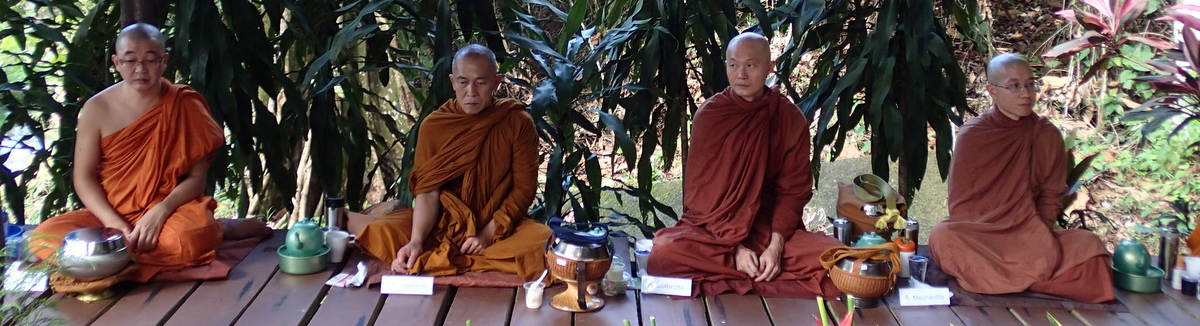
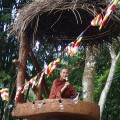
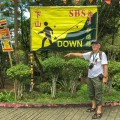
The Kathina festival in Taiping was held this year on 8 November. About the background of this Buddhist festival you can read more in an earlier blog The Kathina Festival 2013 . This time Aric joined me. The Sasanarakkha Buddhist Sanctuary (SBS) where the festival is held, is located high up the slopes of Bukit Larut. You have to park your car at the Chinese cemetery, from where volunteers with pick-up trucks and 4WD’s bring you to the sanctuary. Perfect organisation!
Waiting at the cemetery
Well organised transport
Arrival at the sanctuary
Kathina 2015
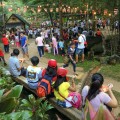
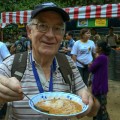
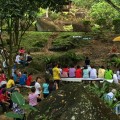
When we arrived, around 7am(!), there was already a big crowd, enjoying the large variety of food, prepared by volunteers and free of charge. A very nice, friendly atmosphere. Our friends Mary, Jenny and George had arrived early and were busy distributing mineral water.
Many food stalls
Devotees enjoying breakfast
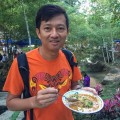
Enjoying the food
Another devotee..:-)
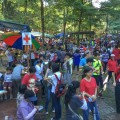
More and more people
Free distribution of mineral water
By volunteers Mary and Jenny
George also helping
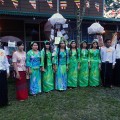
There was a remarkable number of Myanmar devotees. I understood that many of them had been helping SBS preparing for Kathina. Another reason could be that Myanmar is Theravada Buddhist, like SBS. Do you know the difference between Theravada and Mahayana Buddhism? Maybe I should write a separate blog about it..:-)
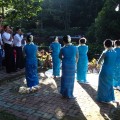
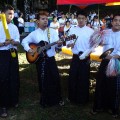
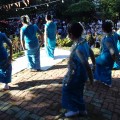
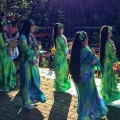
The Myanmar people carried a lot of gifts for the monks and they also performed a very nice musical show, with songs and dancing.
Carrying gifts for the monks
What they brought
No luxury stuff, household items!
One for the album
Dances with Music
The musicians
One group of dancers
Another group
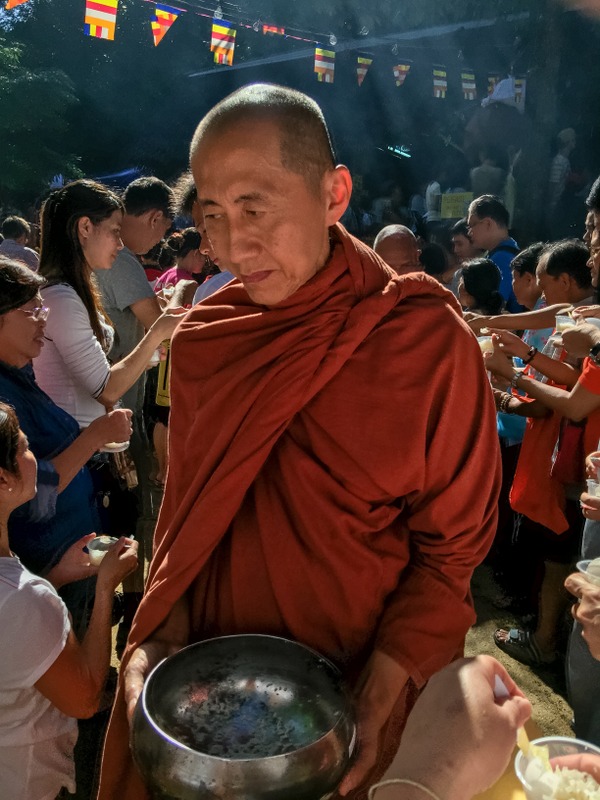
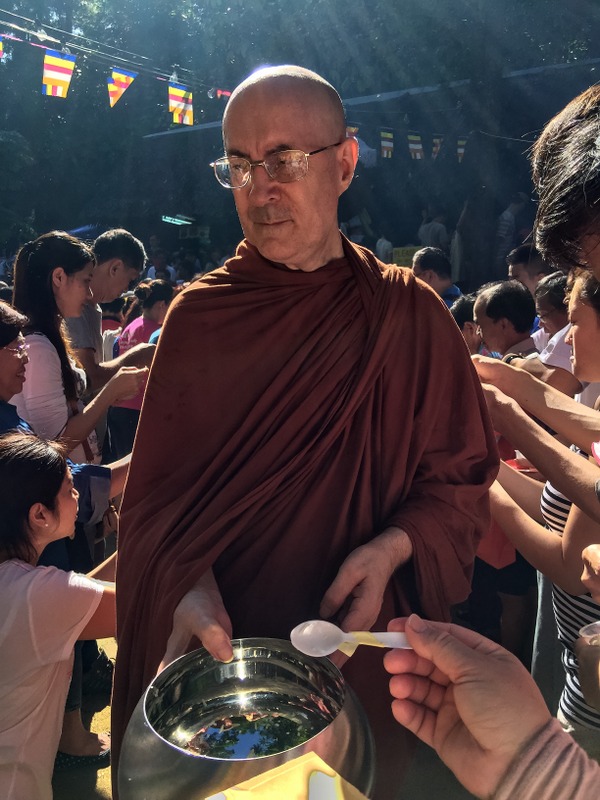
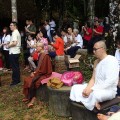
Around 10 am the alms giving ritual started. Very symbolic and impressive. The food stalls closed and everybody received a plastic cup with some rice in it and a small spoon. When the monks were passing you put a little bit of rice in the alms bowl they were carrying.
The food stalls closed
Plastic cups with rice
Waiting for the monks
Alms giving
The atmosphere was solemn. Here are two nice pictures taken by Aric.
And here is a (too) short video clip
After the alms giving the monks walked to platforms where they sat down to receive gifts from the devotees.
I thought that the monks received here their new robes, but that is not true, the devotees present gifts. A friend explained that actually only one piece of cloth is presented to the Sangha (the monk community). This is done early morning and during the day this cloth is used to make one robe. Which monk will receive this robe? During the Vassa (the period that monks don’t travel but stay in the monastery) they have to follow many rules and precepts. There are so many rules, that you can easily forget one or two..:-). My friend told me that the monk with the best “precept keeping record” gets the robe. Don’t know if it is true, it doesn’t sound very Buddhist, but it is a nice story.
The last part of the festival is a talk/lecture by the monks. We listened for a while to the English talk by the head monk (?) before we walked down. This path down had been upgraded by the Myanmar volunteers and was really a pleasure walk, back to the car.
Lecture by the head monk
Listening full of attention
Lecture in another language
Starting our walk down
I hope to attend Kathina again in the coming years.