
While planning our Europe trip, Aric suggested that we could go to Germany for a couple of days. He would like to visit Görlitz. I had never heard of that name, so he explained that it was a town on the border between Germany and Poland, with a pedestrian bridge between the two countries. To get there, we had to fly to Dresden and then take a train. Of course I had heard of world-famous Dresden, but never had the chance to visit. it. We decided to make it a 6D5N trip, with the first 3 nights in Dresden and then two nights in Görlitz.
There were no direct flights from Amsterdam to Dresden, so we took Lufthansa, with a stopover in Frankfurt.


Aric had booked a room with a view, within walking distance from the Innere Altstadt. This inner old town dates back to around 1200 and was full of Renaissance and Baroque heritage monuments. In February 1945, at the end of WWII, it was firebombed and destroyed by the Allied Forces, killing more than 20000 civilians and refugees. A controversial action, called a war crime by many.


After a short rest, we walked to the Inner Old Town to have a look at the Frauenkirche, the iconic landmark of Dresden. Completely destroyed in February 1945, it has remained a ruin for almost fifty years, until it was rebuilt between 1994 and 2005..

We were actually looking for a restaurant with traditional local food, but could not find any that we fancied; all were very touristy. So we gave up and went to McDonald’s. A hamburger has at least German roots 😉 .


Back in our hotel, we enjoyed the view from our room. The floodlit dome of the Frauenkirche is on the left.

The next day, we first visited Dresden Neustadt on the other bank of the Elbe River. This “New Town” is actually quite old. After a devastating fire in 1685, it was rebuilt in Baroque style and named Neustadt. Our first destination was a dairy shop, the Pfunds Molkerei. it was founded in 1880, and the entire interior is completely covered in beautiful ceramic tiles.


That has made it a tourist attraction with busloads of tourists visiting the shop and having a glass of fresh buttermilk.


We stayed a bit longer and had our breakfast with a cheese platter and another glass of the delicious buttermilk.-


After this nice start of the day, we explored Neustadt a bit. We had a look at the Martin Luther Church, built in the 1880s. Martin Luther was one of the founders of the Protestant Reformation and visited Dresden in 1517. At the back of the church, we noticed a war memorial for the soldiers who died during World War I. Germany played a central role in both World Wars.


Our second destination in Neustadt was the Kunsthof Passage, a charming collection of courtyards dedicated to art, architecture, and urban living. Created in the 1990s, after the reunification of West and East Germany on 3 October 1990. Here is the entrance of the courtyards.

The courtyard of the elements has facades that represent light and water. Other courtyards are decorated with images of animals.


We had our lunch in one of the courtyards. Restaurant Lila Soße is highly rated and has a creative presentation of “German Tapas”.


Before crossing over to the Old Town, we sat down in the grass and enjoyed the view. The undeveloped grassy plain along the river has an important function; it serves as an overflow when the Elbe has too much water.


View of the Elbe from the Augustus Bridge, named after its builder, King Augustus II the Strong

We spent the afternoon exploring the Innere Altstadt, taking many photos, but not entering any museum or building. I have provided the pictures with captions that give the names of the buildings. Clicking on a caption will link to a webpage with more information (sometimes in German).


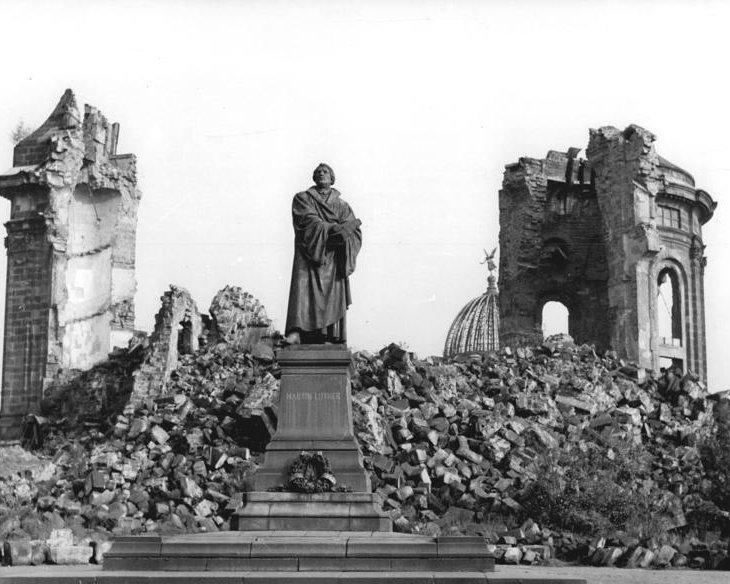
The Frauenkirche after the Allied bombing in 1945. Only the statue of Martin Luther has survived. After the war, Germany was split into two parts, West Germany and communist East Germany. East Germany left the ruins untouched and officially declared it an anti-war memorial. After the reunification, a monumental project started to rebuild this Baroque masterpiece. The rubble was meticulously searched for usable sandstone bricks, and the rebuilding took more than ten years. The church was reopened in October 2005 and now stands as a symbol of reconciliation and peace.

In the rebuilding, old blackened sandstone bricks from the old church were used where possible, with striking effect.


We visited the interior and admired the new organ and the amazing sandstone dome.


We walked back to our hotel and enjoyed the night view.

The next day, we could (should?) have explored the Old Town more, climbed the Hausmannsturm, and visited museums. But instead, we made a day trip to the Bastei Bridge, a tourist attraction for over 200 years. Easy access from Dresden: first a 40-minute train ride, along the river Elbe, then a ferry crossing to a small resort.


From the resort, a clear but sometimes steep path brings you in less than an hour to the bridge, about 200 meters above the river. The sandstone rocks, eroded over a million years by water, are a favorite spot for rock climbing.


In 1824, a wooden bridge was built for visitors, in 1851 replaced by the present sandstone bridge. Painters visited this region; click here for a famous work by Romantic painter Caspar David Friedrich.


We spent quite a long time at the Bastei, enjoying the views of the bridge, the Elbe River, deep down, visiting several viewpoints, and having lunch at a hilltop restaurant.-


A view from the top, before walking down. A day well spent.

Back in town, we looked again for a restaurant serving local fare, that was not overly touristy. We found one, ordered the Sächsischer Sauerbraten and the Leberkäse mit Spiegelei. And of course, local beer.

Friendly service, but we were not impressed by these local specialties.


Later that evening, Aric had enough energy to walk again to the viewpoint near the river, which we had visited the day before. He took this beautiful shot of the illuminated Altstadt.

The next day, before taking the train toGörlitz, we had breakfast with coffee and cheesecake.


On our way to the station, we passed a 7-seater party bicycle. The train ride took about one and a half hours. In Görlitz, we took a tram and walked the last part to our homestay. I have marked it with a yellow cross.


It was a perfect accommodation, the interior as well as the location. From our balcony, we could see the bridge connecting Germany and Poland.


The Altstadtbrücke has an interesting history. I had never heard about Görlitz, but it is older than Amsterdam or Dresden, documented for the first time in 1071. It was a key trading town on the Via Regia route linking Western and Eastern Europe, with a bridge crossing the Neisse River. The bridge was destroyed by the retreating German army in 1945. After Germany surrendered, the Neisse became the borderline between East Germany and Poland, splitting Görlitzz in two. It was only after the reunification of Germany and the accession of Poland to the European Union that a new bridge was built in 2004, for pedestrians and cyclists only.
Here I am standing between Germany and Poland. As both countries are in the Schengen area, there is no passport control. The quiet Neisse River is part of the Oder/Neisse line


We walked over to Poland for a drink, a snack, and some shopping. Poland has kept its own currency (the zloty), but we paid digitally 😉


View of Görlitz and the iconic St. Peter’s Church from the Polish side.

The next day, we started by visiting the church. It is a Gothic hall church, the twin towers were added much later. The church has a famous organ.


Next we walked around in the Old Town. The many Renaissance and Baroque buildings in the town have been so well preserved that several movies have been filmed here, giving the town its nickname, Gorliwood.
The. Marienplatz is a popular and lively square. The Dicker Turm (Thick Tower) was part pf the fortifications and erected in 1250. The building on the other side of the square is Kaufhaus Görlitz, built in 1913 in Jugendstil style. The interior must have been spectacular, but it is now unfortunately closed. The interior was used for the movie The Grand Budapest Hotel


The Obermarkt is the center of the old town. The church is the Dreifaltigkeitskirche (Hp;u Trinity Church), built between 1234 and 1245.


The Reichenbach Tower, built in the 13th century was also part of the fortification of Görlitz


The Old Town Hall , fist mentioned in1369.


It is a pleasant town, we could (should?) have stayed more days. Here are a few fountains we notice during our walk. From left to right, an angel, two humans and a devil.


We ended the day by visiting a museum, the Barockhaus. The house was built between 1726 and 1729 as a residential and commercial building for a textile merchant and ranks among the most magnificent merchant houses in the Old Town.


A section of the museum displays the civic culture of the Baroque.


In 1801, the building became the property of the Upper Lusatian Academy of Sciences. They housed their library and their collection of scientific instruments there.


What a fascinating museum.

The owner of our homestay advised a nearby Italian restaurant to have dinner.


The next day we had a long travel day, first by train to Dresden, then a flight to Munich, and from there to Amsterdam. It was an exciting trip, and we reached our destination. Here is the image Aric created to share with family and friends.

Looks like you guys really enjoyed very much. I was thinking if my lovely wife is still around we would have join you.
Weer veel mooie en interessante foto’s van een trip, deze keer door Duitsland.
Dank. Het is een stukje Duitsland dat ik nog niet kende.
Another well written journal. I wish I can write like that for my China trip. Good record of all the beautiful moments for memories