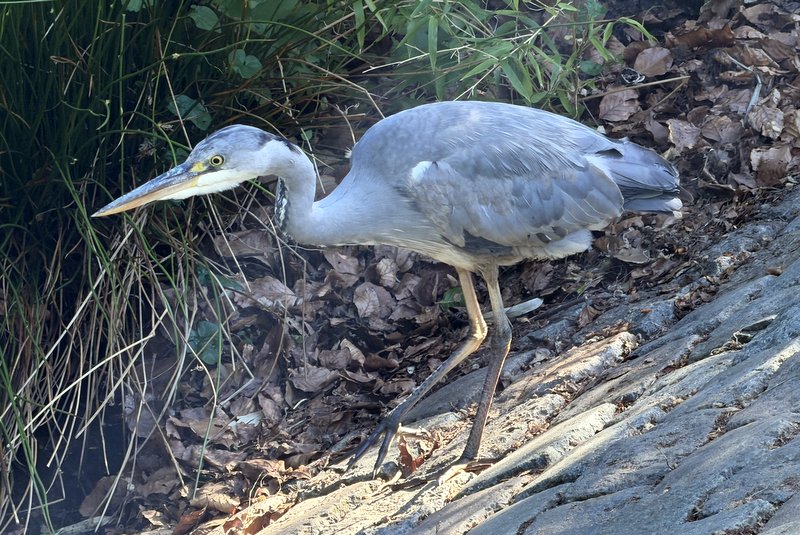
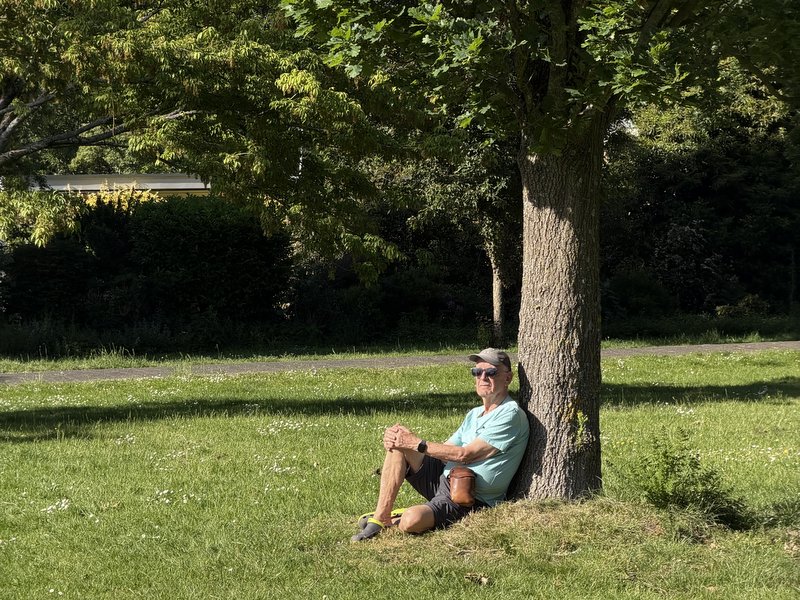
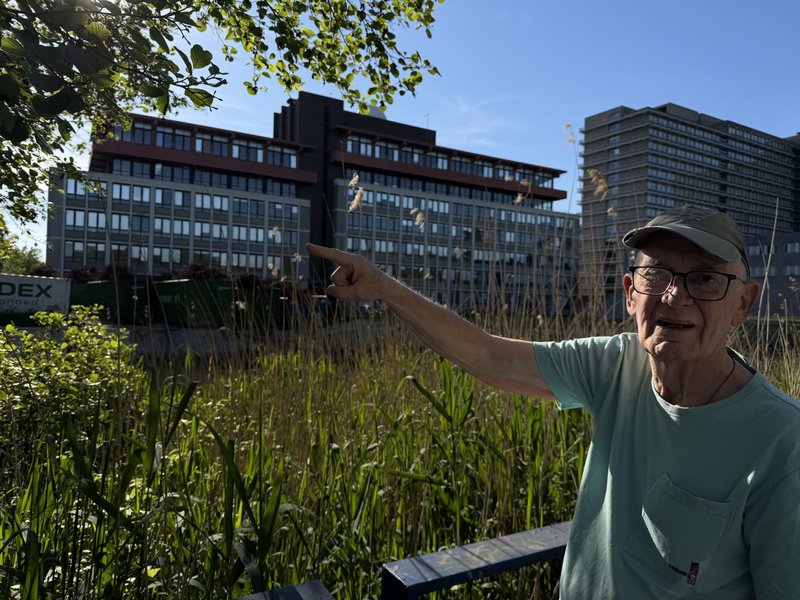
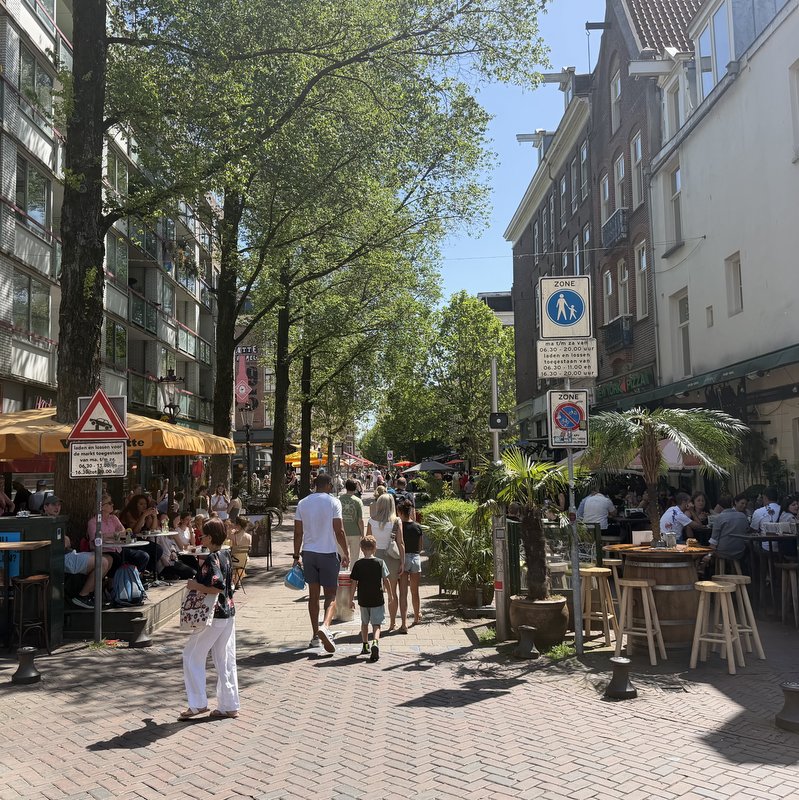
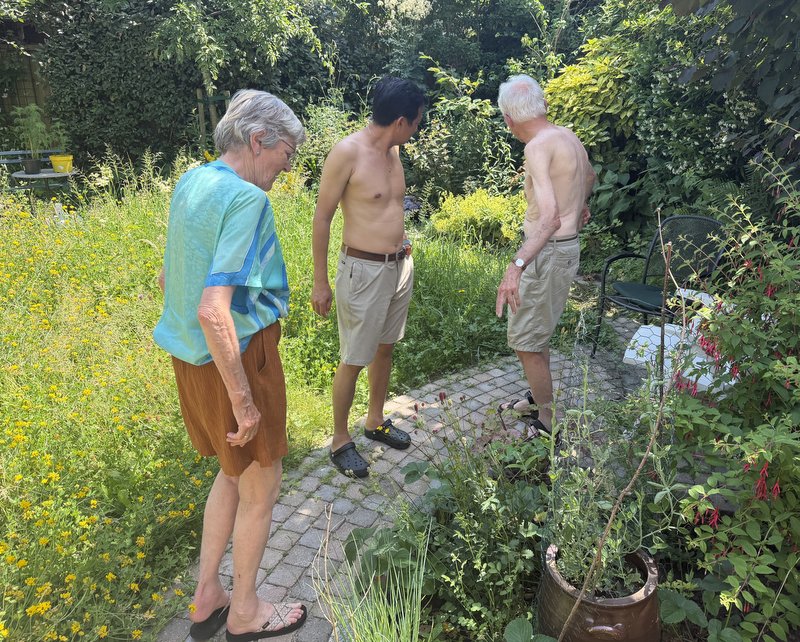
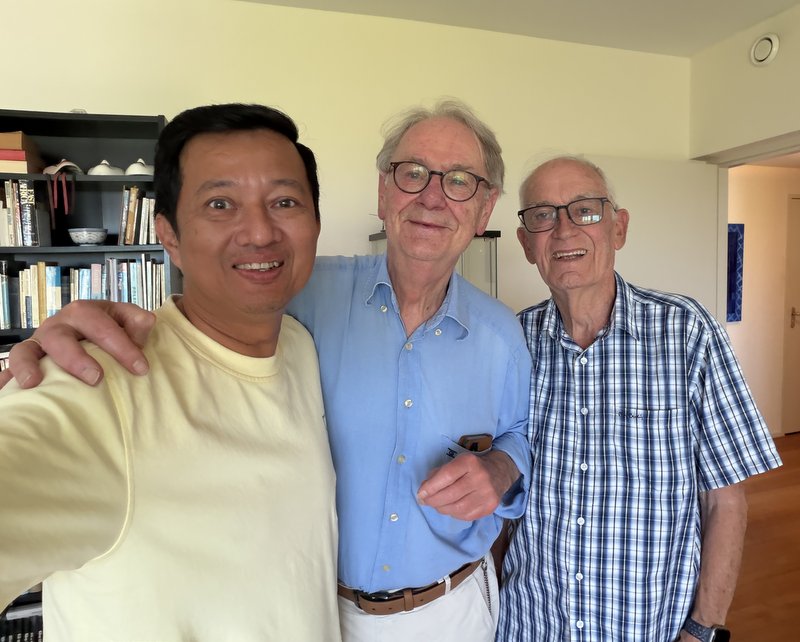
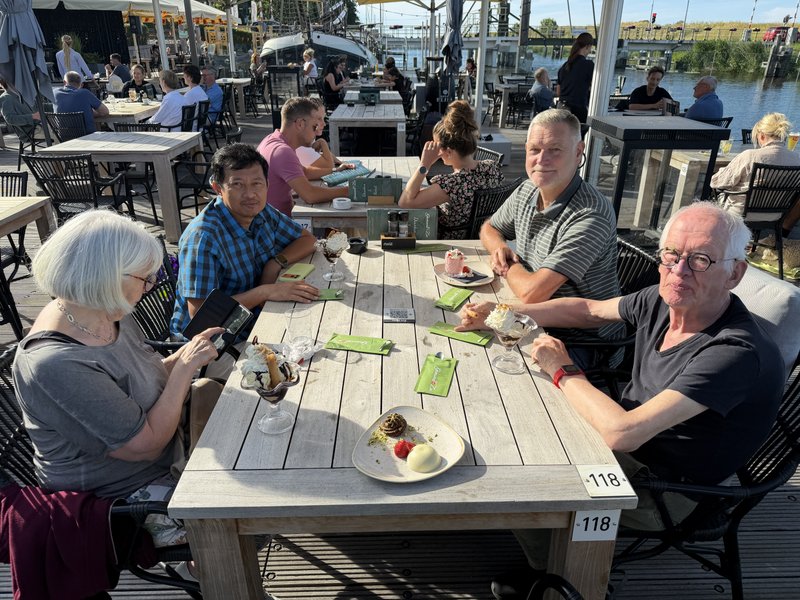
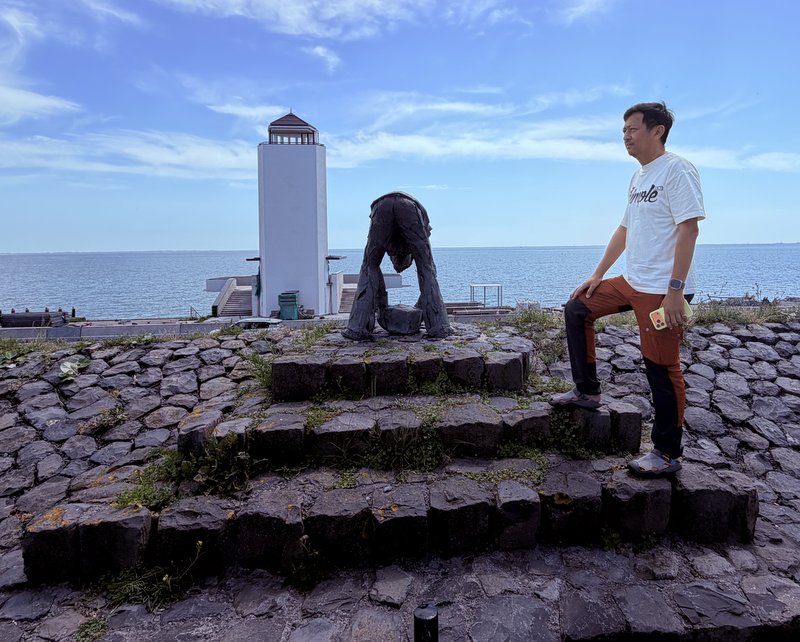
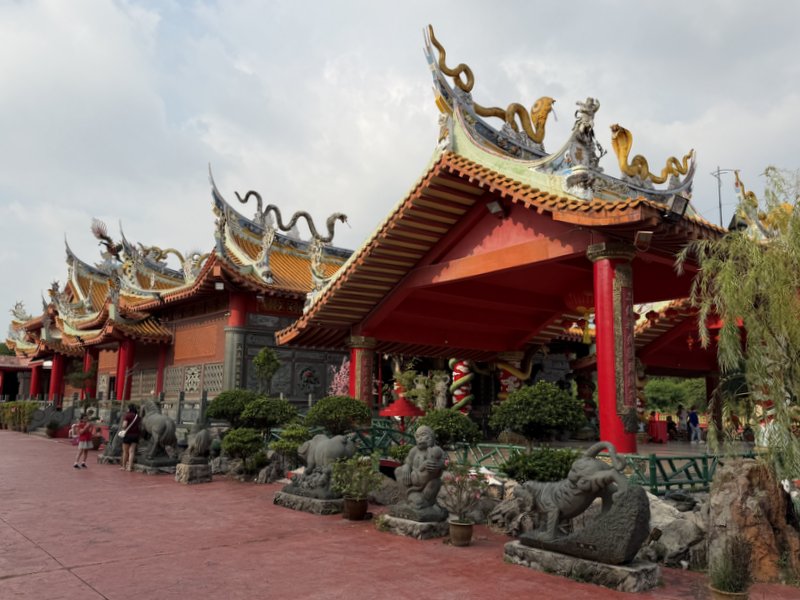
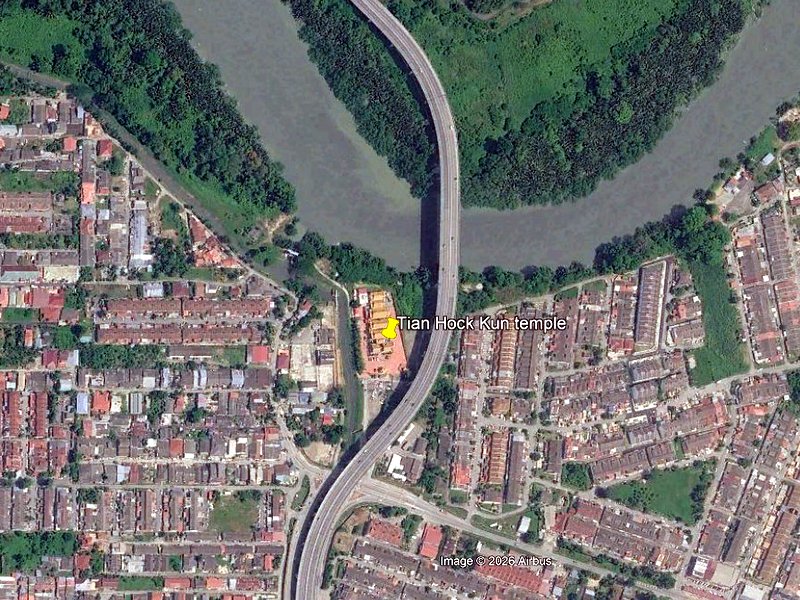
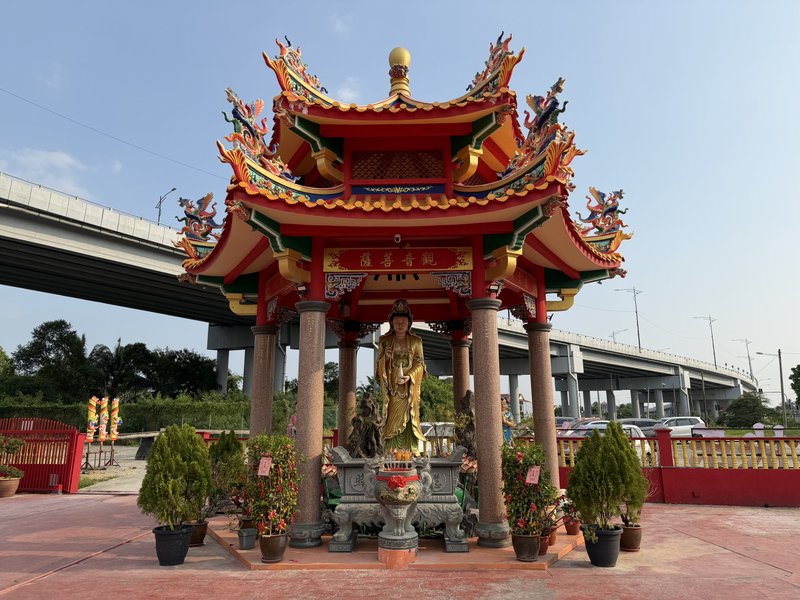
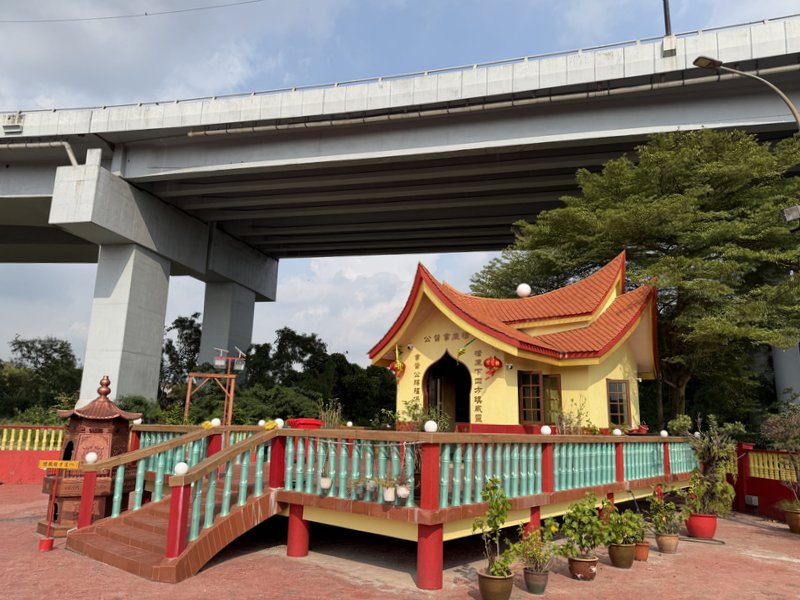
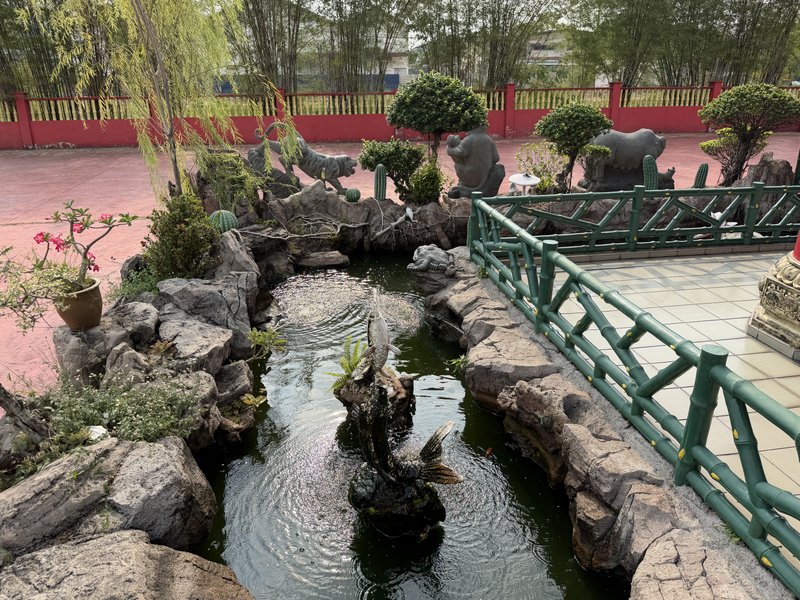
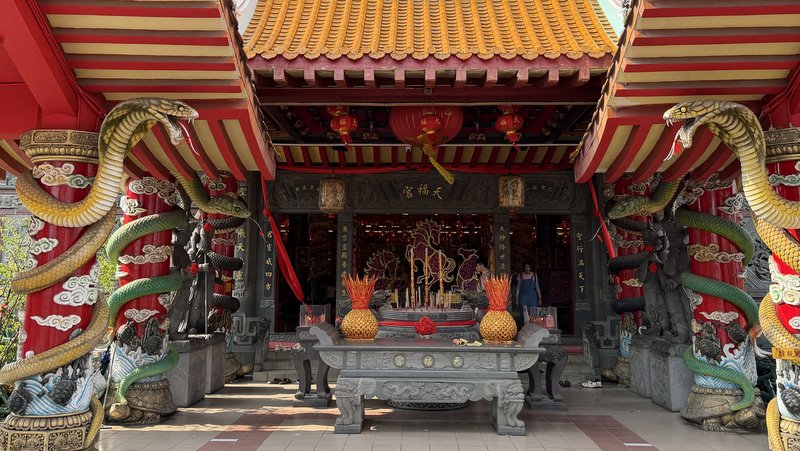
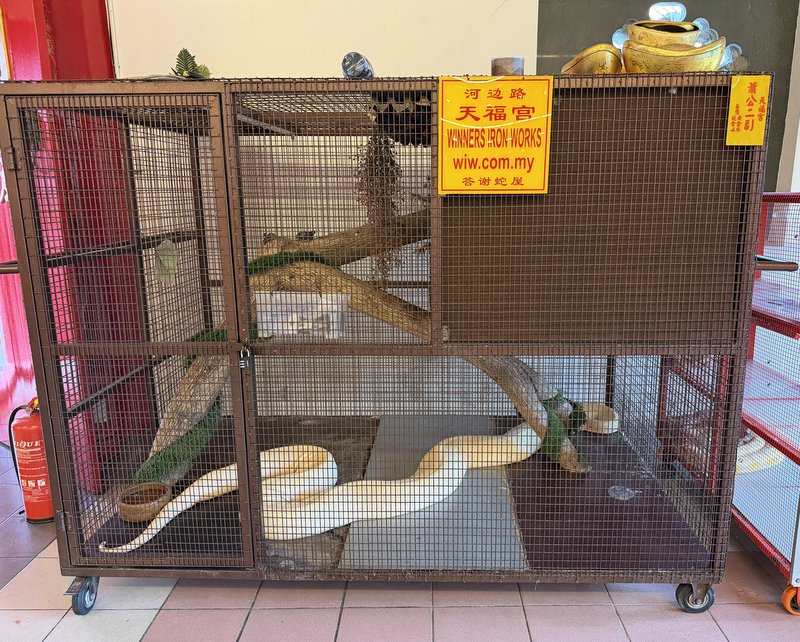
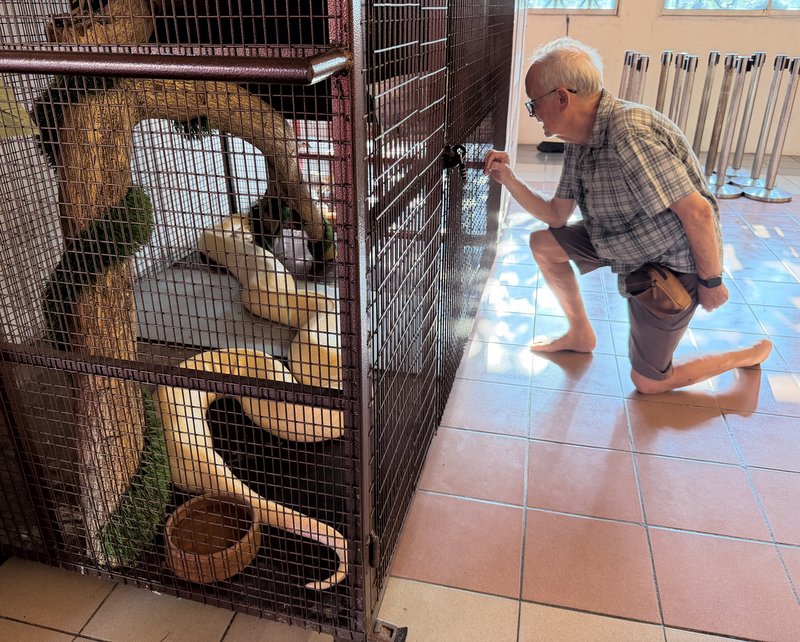
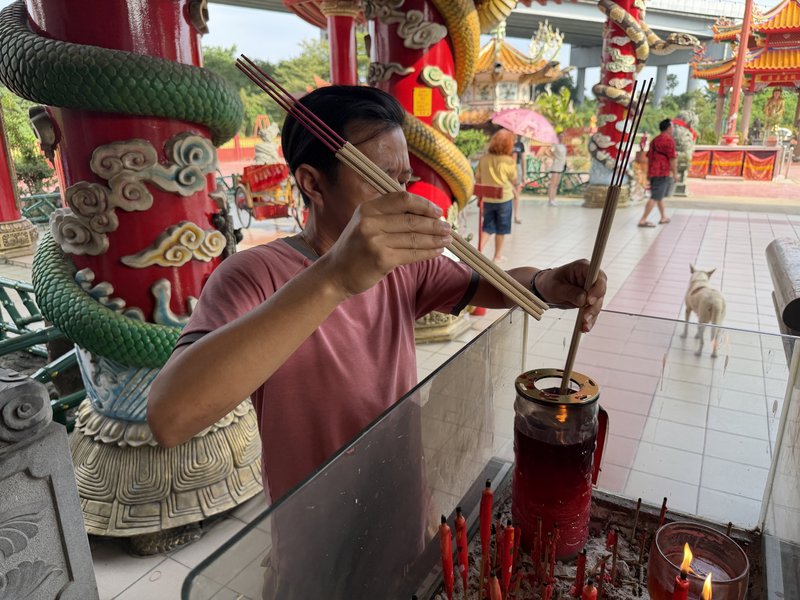
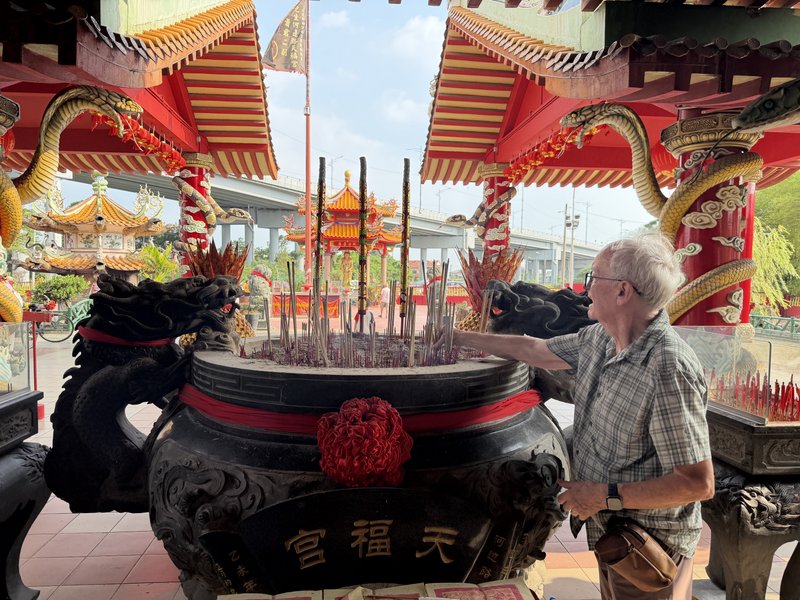
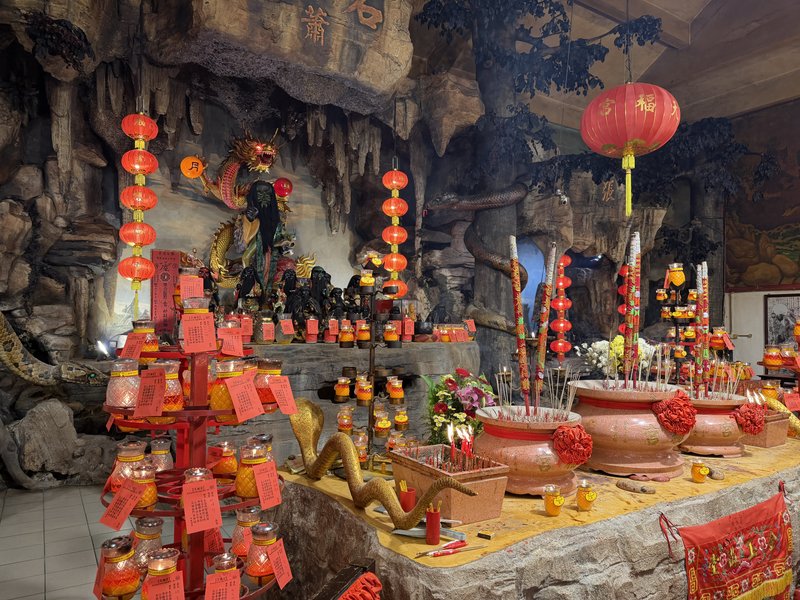
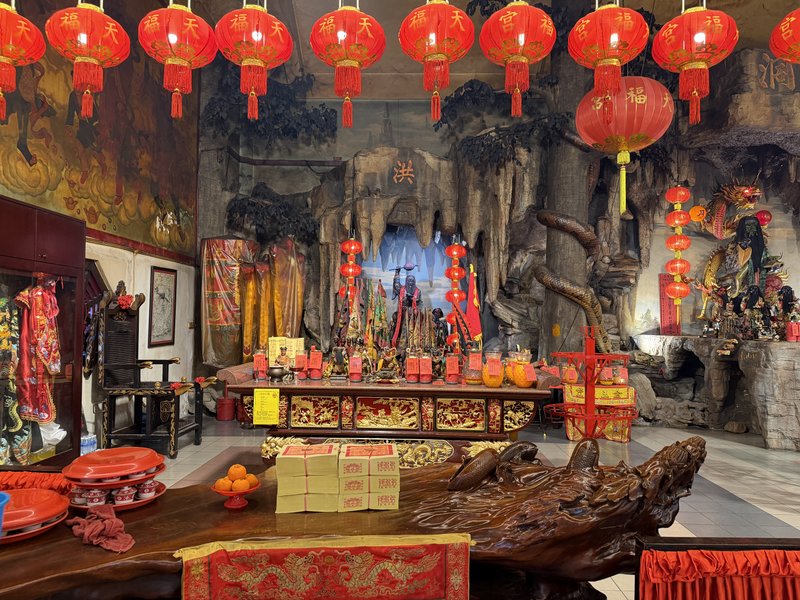
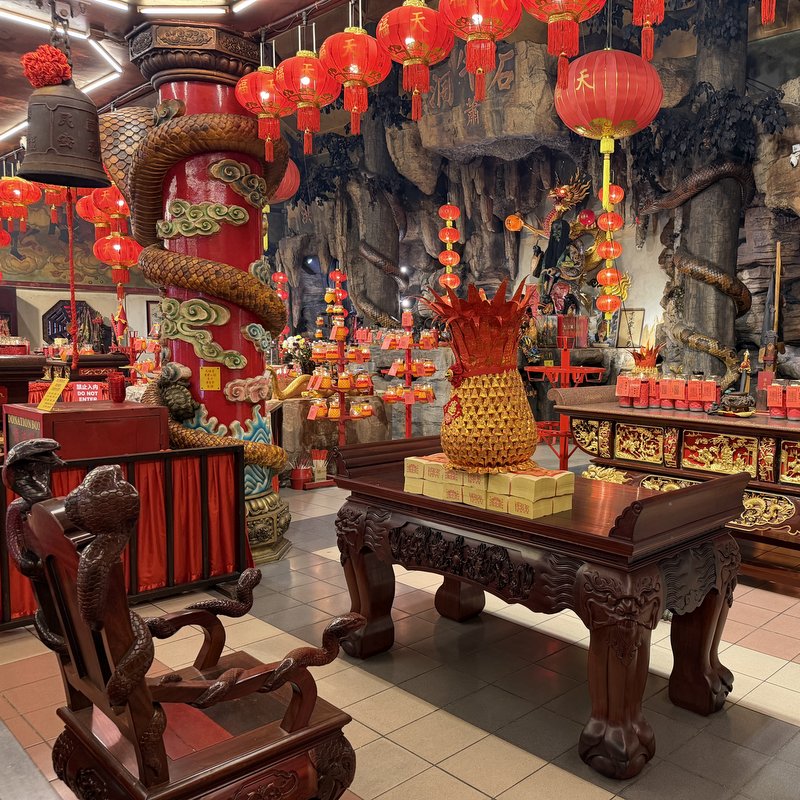
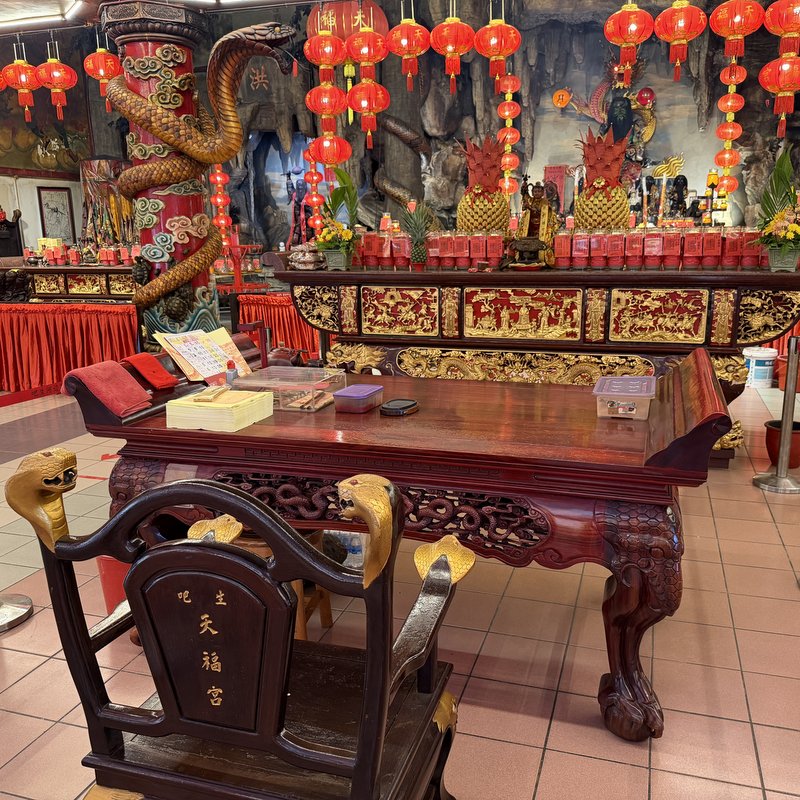
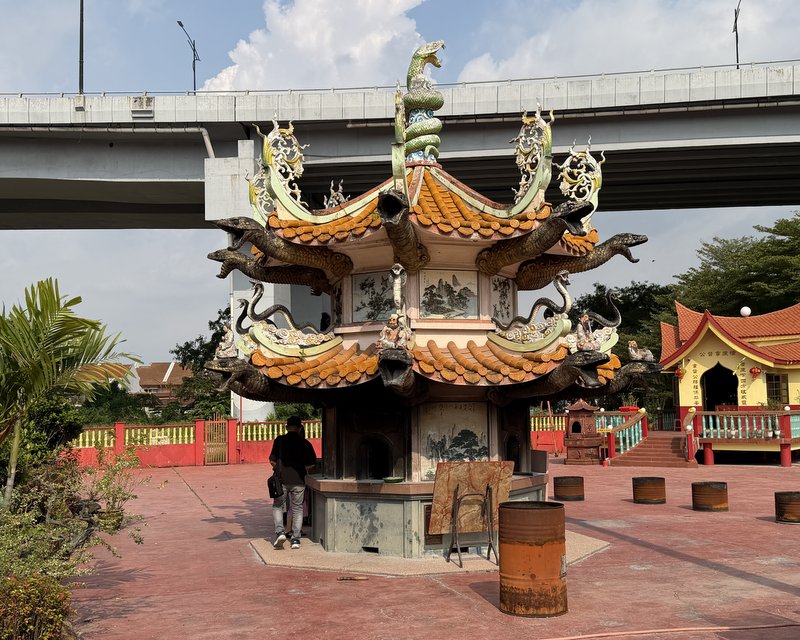
When Aric said, Let’s go to Klang and visit a temple there. It will be a surprise for you, I immediately accepted. One afternoon, we drove to Klang and used Waze to find the Tian Hock Keng temple (Temple of Heavenly Bliss). Here is the temple, when you look at the roof, you may already guess what makes it special. On Google Earth, you see its location. beside the Klang river, and next to a highway.
The temple is relatively new, built in the 1980s. In 2017, the Klang Third Bridge was opened, and the access road is dominating the temple. It is a typical Chinese temple, mainly Taoist, but with elements of Buddhism (an impressive shrine for Guan Yin) and folk religion (a Datuk Kong shrine).
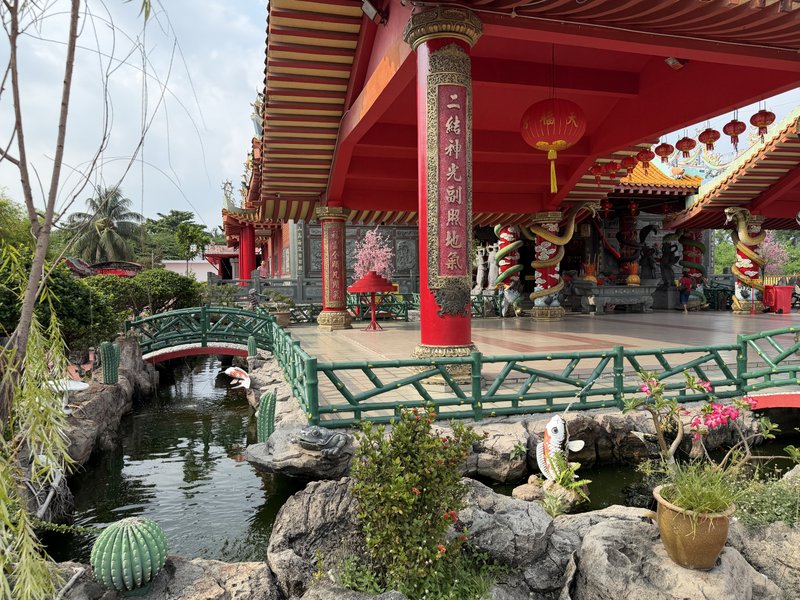
You enter the main hall by crossing a bridge.
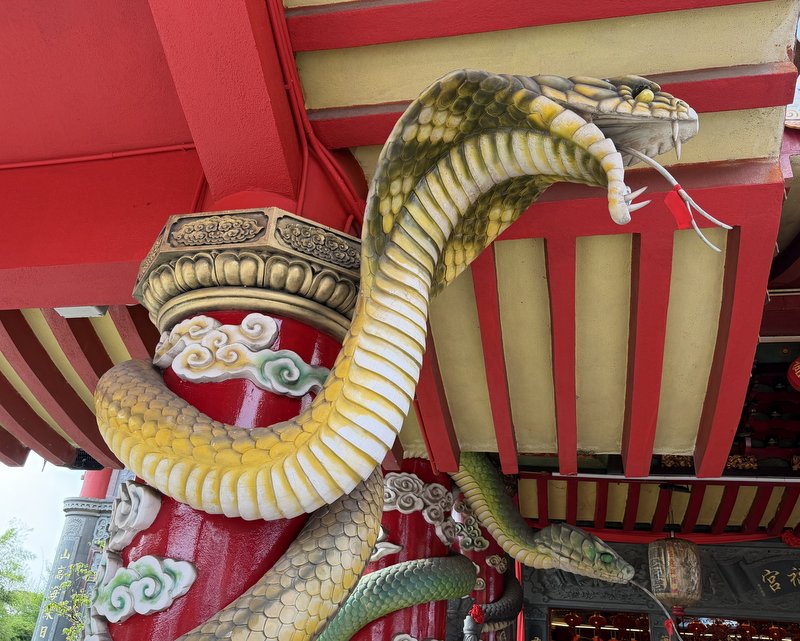
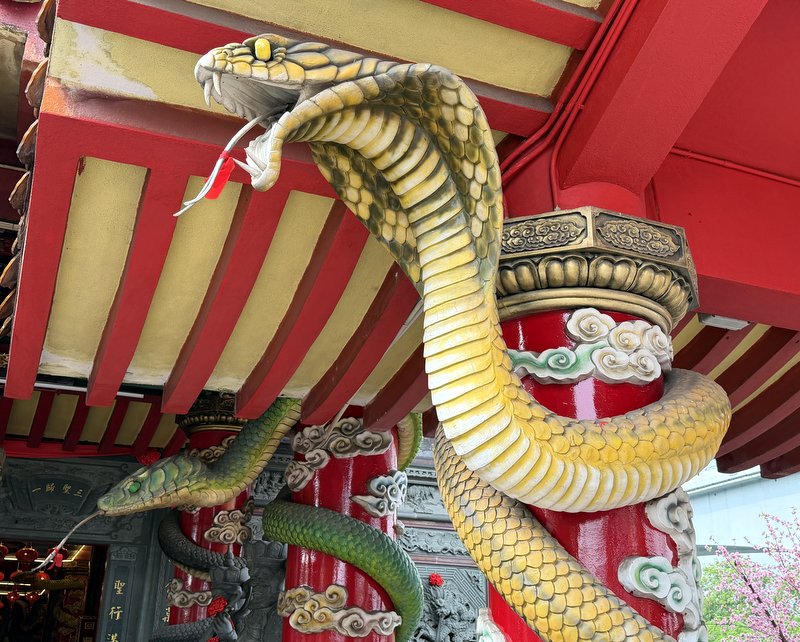
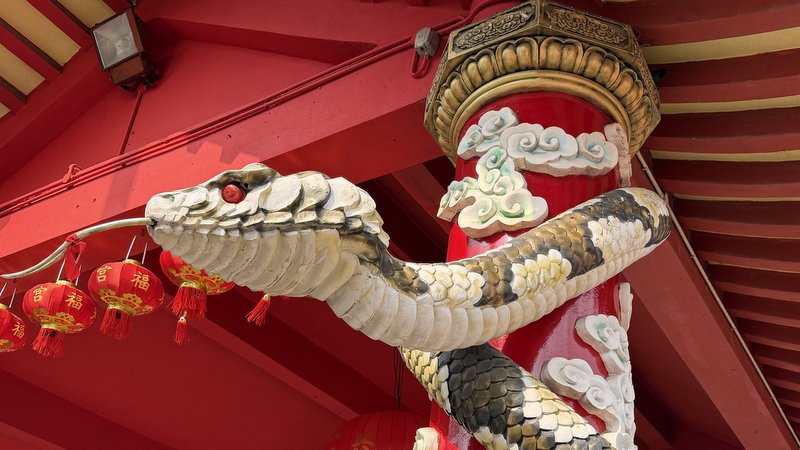
The entrance to the main hall makes clear why the temple is named the snake temple. No dragons here, but snakes. Everywhere, decorating the pillars, on the roof, apparently more than 60 sculptures.
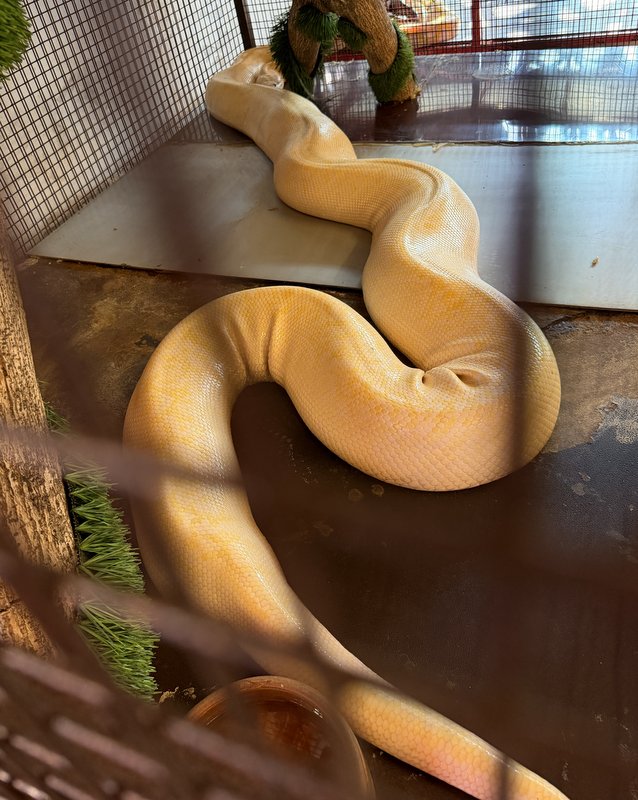
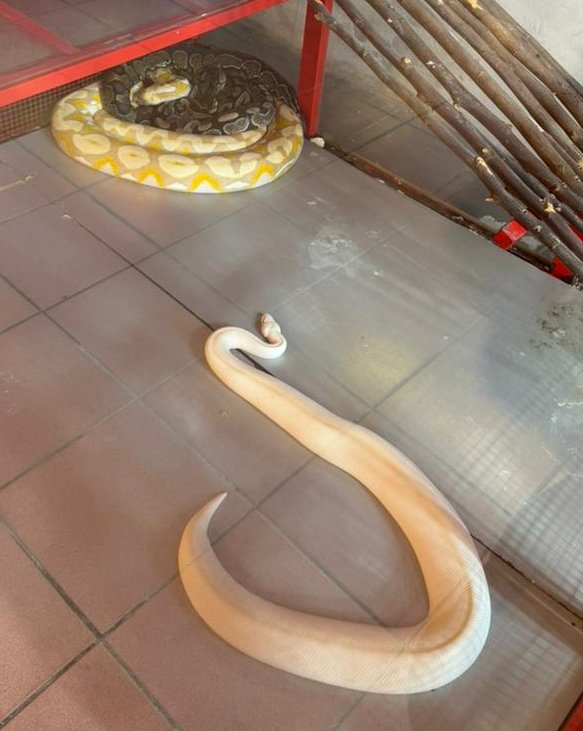
The temple also has a few real snakes. In cages. The albino python is very impressive/
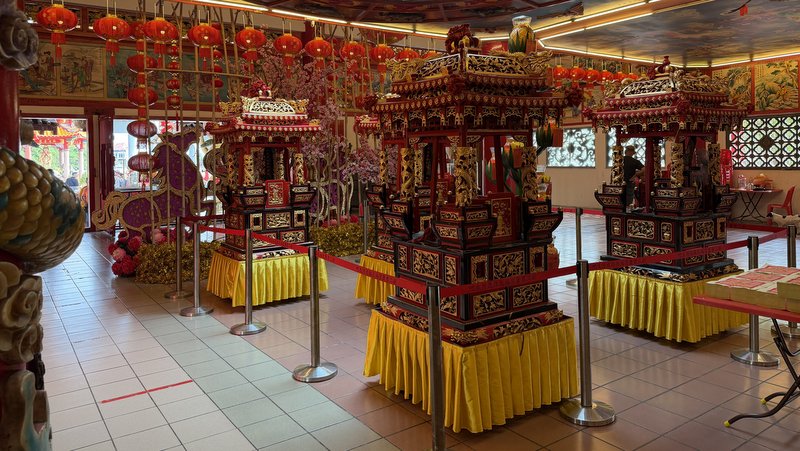
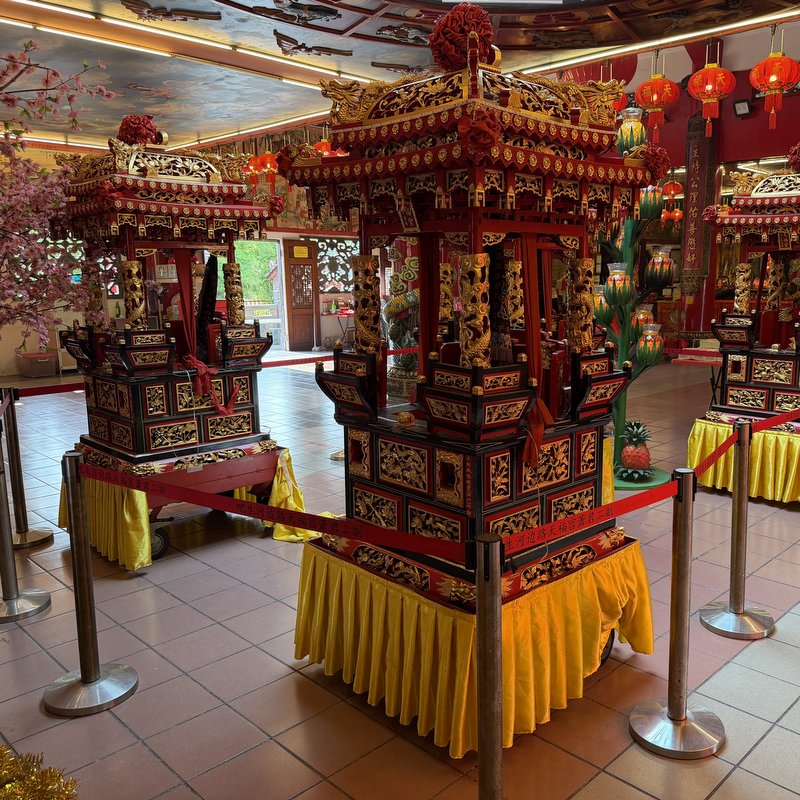
Entering the main hall, you will find several beautiful small wooden shrines. Maybe they are used to carry deities out during processions.
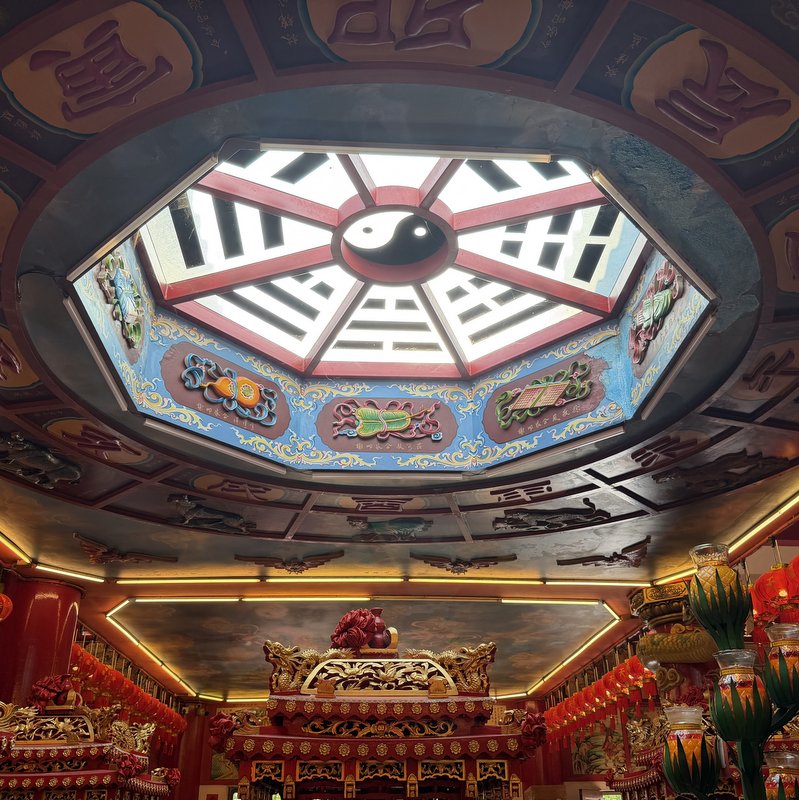
Should you still have any doubts, the octagonal window in the ceiling with the eight trigrams and the Yin Yang symbol proves that this is a Taoist temple.
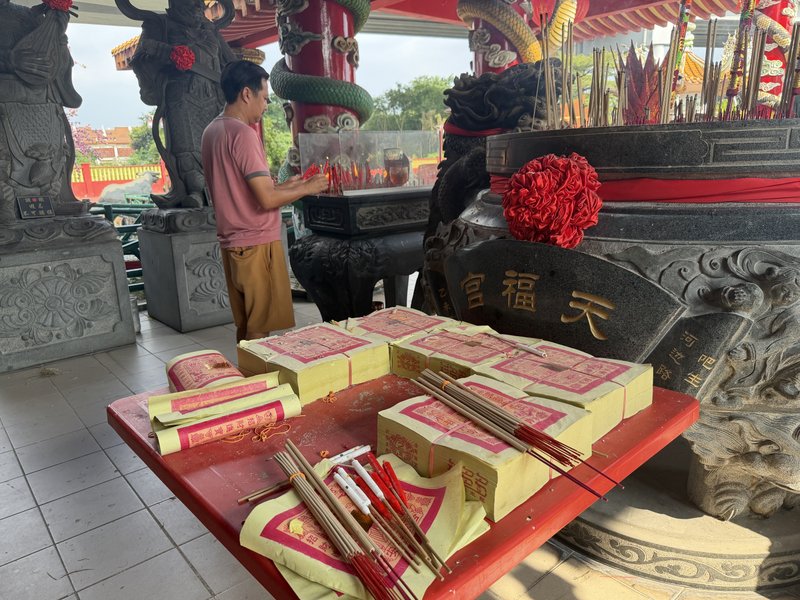
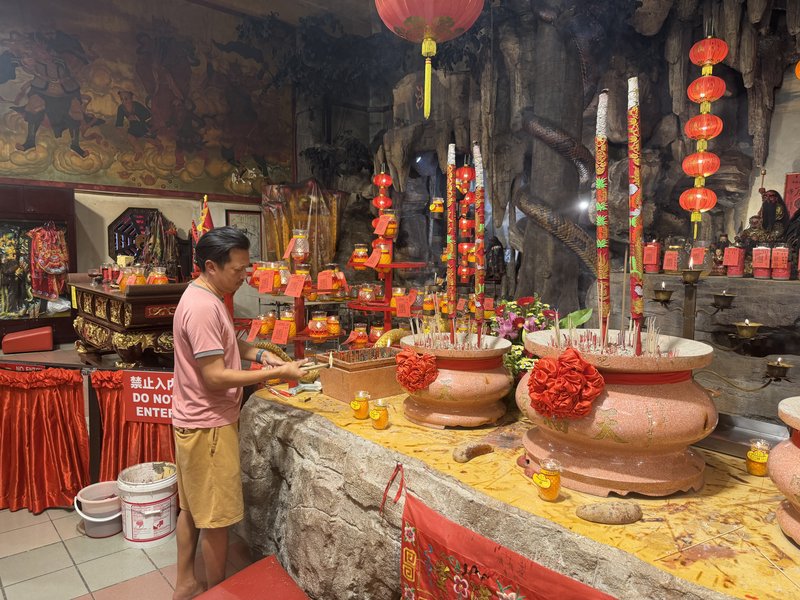
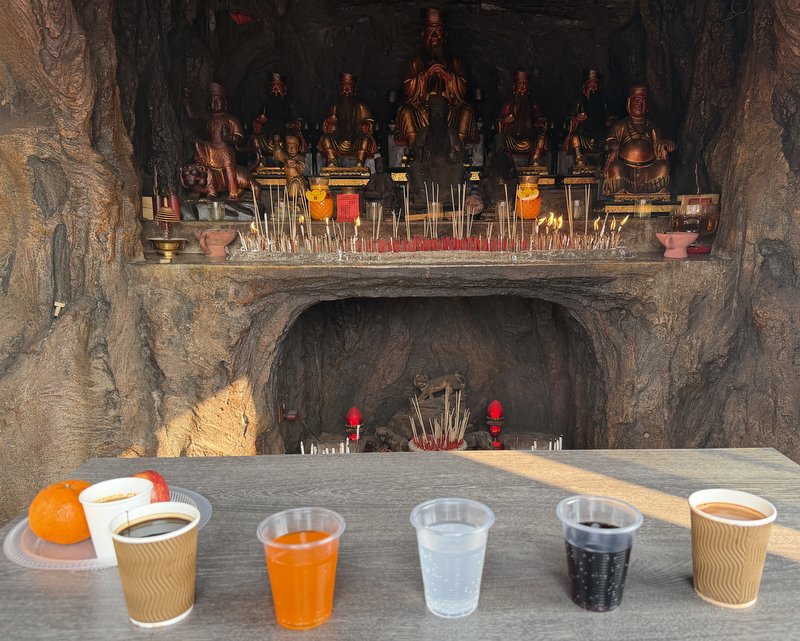
We bought a set of 24(?) joss sticks, 6 candles, and a pack of “hell money”. A signboard showed where and in which order the sticks and candles had to be placed. Took quite some time 😉
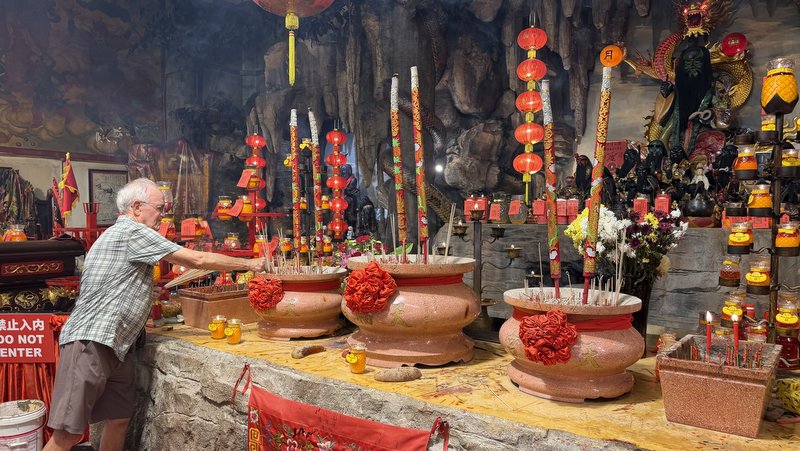
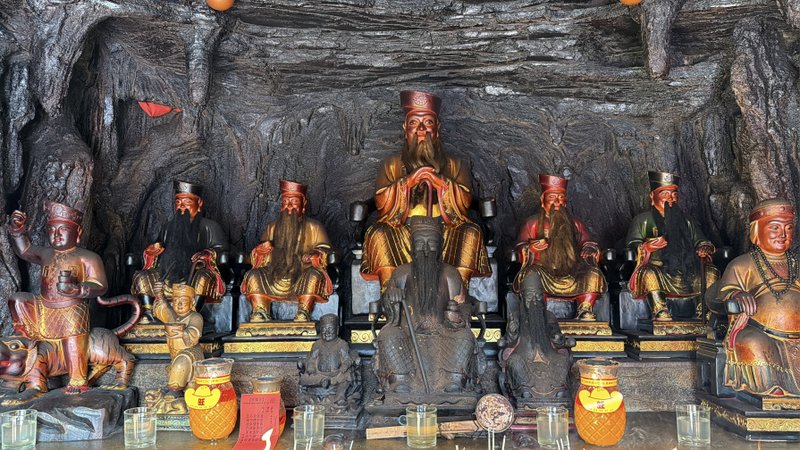
This is the main altar. The temple is dedicated to Xiao Jun Er Fu, a Taoist deity. According to legend, he was one of three brothers who defeated an evil serpent during the Song dynasty (960-1279), and was later deified.
He is generally depicted with a green face (left picture, with a snake curled around him)
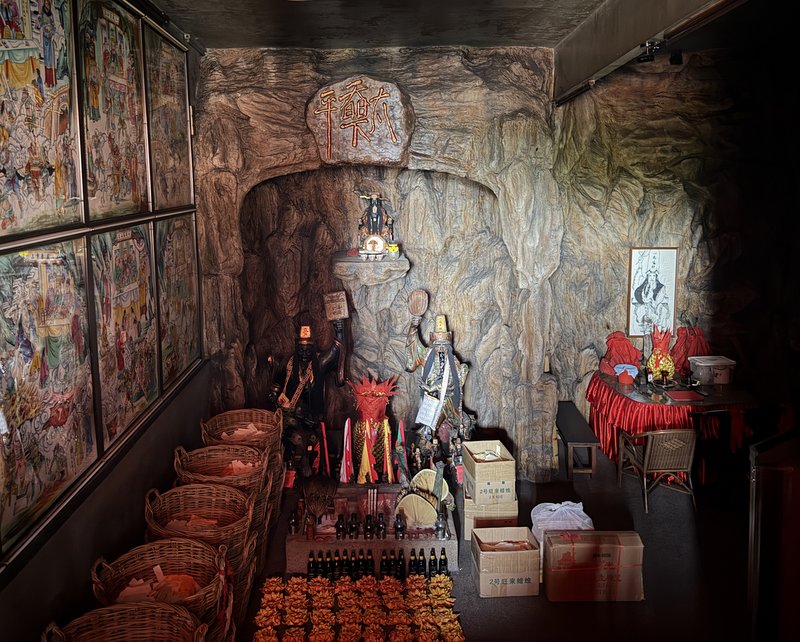
There were a few ornamental tables and chairs. Perhaps they are used when a medium enters a trance and can answer questions from devotees.
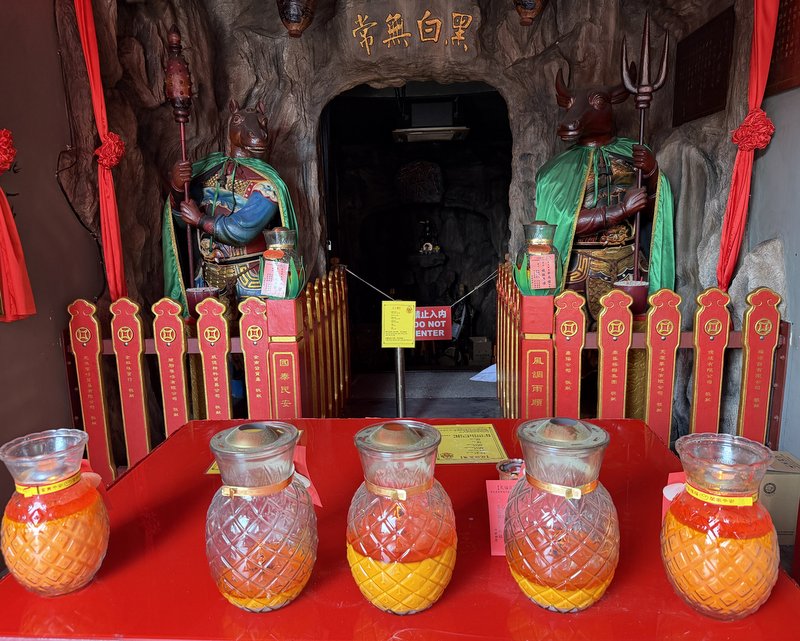
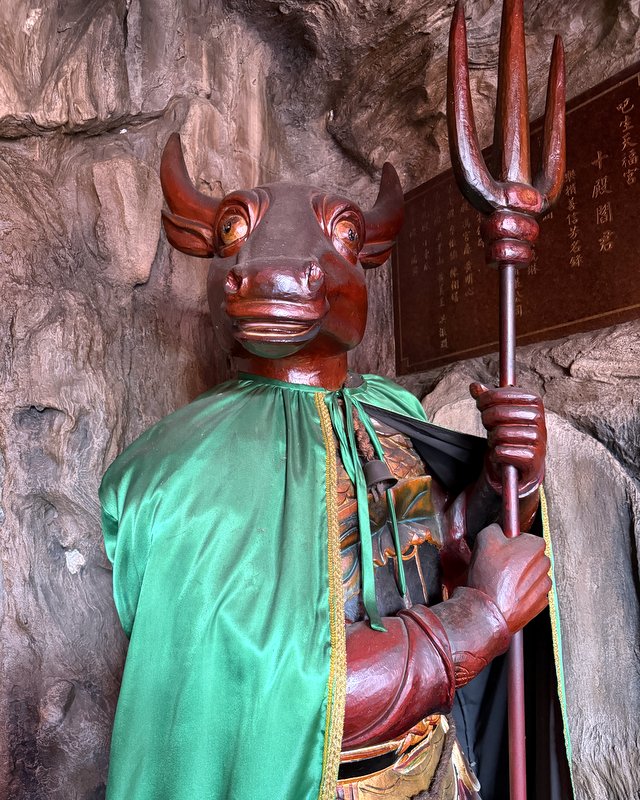
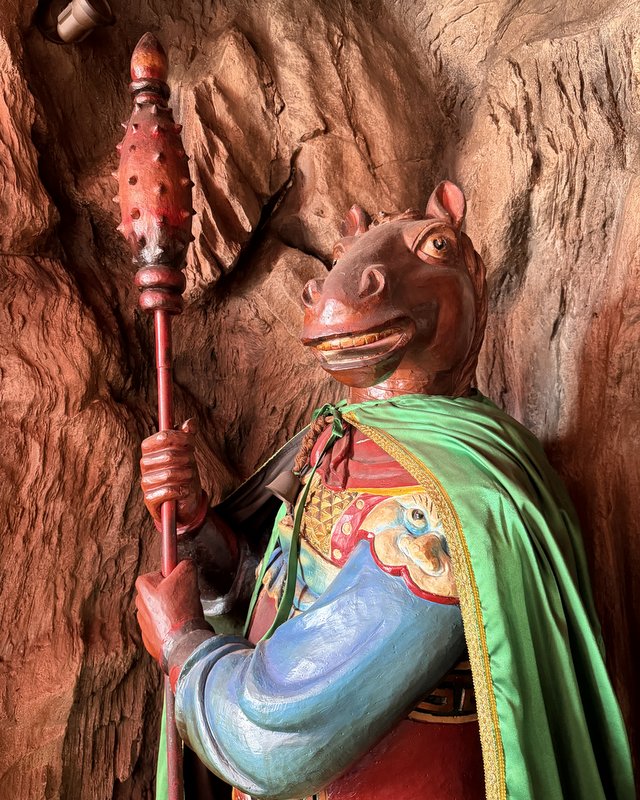
On the left side of the main hall, there is an entrance to the underworld!, guarded by Ox-Head and Horse-Face. Note that you can not enter the underworld, there is a modern sign Do Not Enter. But I could take a picture 😉
The Datuk Kong shrine is very beautiful and much more elaborate than the usual Datuk Kong shrines I have seen. All the figures are Datuk Kong, with a lot of symbolism. For example, the one in the center is dressed in yellow and represents balance and well-being. Their headgear looks like a tengkolok, worn by sultans and royals. The three in front are wearing songkoks. The walking stick is a common attribute and offerings can not contain pork.
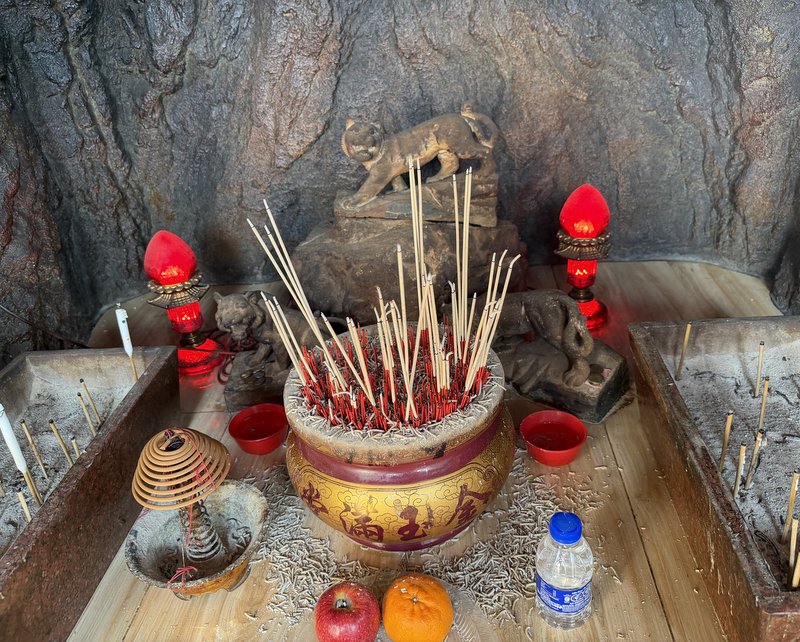
Below the main shrine, there is a small shrine dedicated to Hu Ye, the Tiger god, also a protector deity.
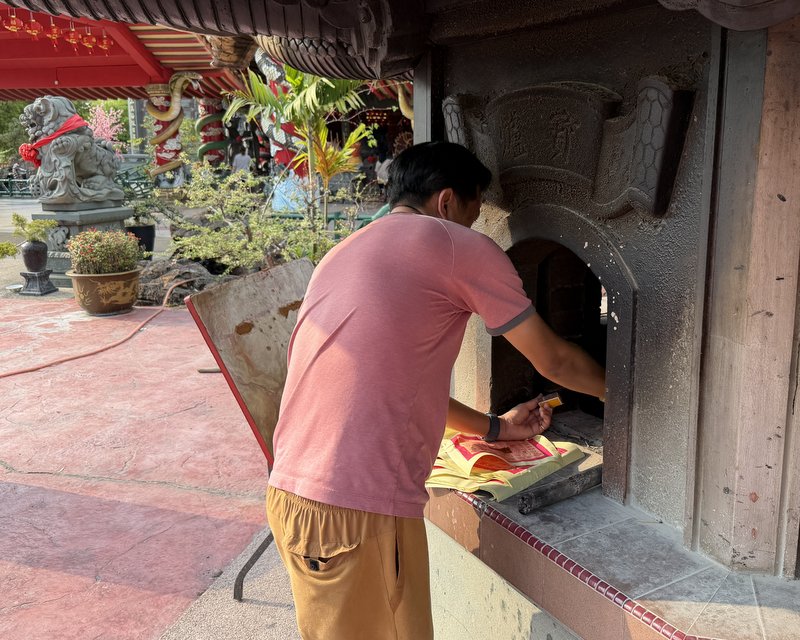
At the end of our visit, Aric burned the josspapers.
A very interesting temple. Not much information is available on the Internet, but this FMT article is quite informative.
On 10/01/2025, the Ipoh Echo published an article Ng Boo Bee Fountain Restored, about the iconic fountain in the Taiping Lake Gardens. I visited the fountain a few times, last year.
A quote from the article:
Originally located in front of the Taiping Market, this iron fountain was made by Penang Foundry and was donated by Ng Boo Bee
When you Google for Ng Boo Bee Fountain, you will find many similar hits: Donated by Ng Boo Bee in the late 19th century, originally located in front of the Taiping market, removed to the Lake Gardens when the New Clocktower was constructed in the 1960s.
Unfortunately, this story is completely wrong.
I will split this post in three parts, about the fountain in the Lake Gardens, about Ng Boo Bee and- about the origins of the incorrect story.
The fountain in the Lake Gardens
It was an eyeopener for me that there has been a fountain in the Taiping Lake Gardens from the beginning. Presented by the Chinese community, see my blog, Taiping Lake Gardens. I searched the NewspaperSG archive and found another report about the opening of the Lake Gardens.
Source: Straits Times Weekly Issue, 28 November 1893. I have added a transcription.
+
When Mr. and Mes. Swettenham arrive, they are met by the two leading members of the Chinese community, Chung Keng Quee (Ah Kwi), and Chin Ah Yam (Ah Yam). During the Larut Wars they were sworn enemies, as leaders of the Hai San and Ghee Hin, now they have become friends and both have been appointed Kapitan Cina. They hand over a silver key to Mrs. Swettenham and ask her to present the fountain on behalf of the Chinese to the Public Garden.
So that settles the question if Ng Boo Bee was related to the fountain. He was not and the name Ng Boo Bee fountain should not be used. Maybe name it Peace Fountain?
About Ng Boo Bee
Although Ng Boo Bee (1853-1921) has been very important for Taiping, not much information can be found on the Internet. There is no Wikipedia topic about him, like there is for Chung Keng Quee. In the Wikipedia article Malaysian Chinese there is only a picture of him with British officials, nothing about his life. Here is the picture, he is seated second from left, flanked by Sir John Anderson(incoming Governor of the Strait’s Settlements, and Sir Frank Swettenham (the outgoing Governor).
Ng Boo Bee was not only an important tycoon and a millionaire, but also a philanthropist . Here is a part of the obituary, published in the Pinang Gazette and Straits Chronicle after he passed away in 1921.
The Taiping people will remember him because of the handsome fountain he donated in 1908 to the fish market of Taiping. Not only decorative, but also functional because there were tanks around the fountain to keep the fish alive.
Two senior THS members remember the fountain, it was still there when they visited the fish market in the early1960s with their mothers. A few years ago they interviewed an old fishmonger, who told them how sad he was when the fountain was destroyed to make place for more stalls. So the fountain donated by Ng Boo Bee, doesn’t exist anymore. It would be wonderful to have a picture of that fountain.
It is not clear when it was destroyed. But this newspaper clipping might be a clue. Source: The Straits Times, 3 February 1965 A big freshen-up campaign by Taiping council. Here is a paragraph that might be interesting for this post:
The council is also considering sponsoring design competitions for a new $100,000 market, a clocktower $50,000 and a $30,000 water fountain.+
The clocktower and the fountain were built, although the fountain (and the roundabout where it was located), do not exist anymore. No new market has been built, could the money have been used to upgrade the Fish Market (resulting in the destruction of the fountain)?
The origins of the incorrect story.
I have spent much time the last few weeks searching for the source of the wrong story. The initial mistake is that the Ng Boo Bee Fountain was located at (outside) the fish market, instead of inside.
The earliest reference to a fountain AT the market that I have found, is this one: Ng Boo Bee Fountain, Taiping (4 February, 2006). It gives some information about Ng Boo Bee and then continues:
Ng Boo Bee’s fountain was made of cast iron at the Penang Foundry. It was originally installed at the Taiping Market, but was later moved to the lawn outside the Lake Gardens.
Another “old” reference is the Taiping Heritage Trail (~2015) which mentions the New Clocktower and writes about it:
Market Square used to feature an iron fountain (Ng Boo Bee Fountain) but this was relocated to the Lake Gardens and replaced by this extraordinary concrete clock tower
These two references are from popular, reliable websites and have percolated the Internet for many years. Even if they are corrected, it will take a long time before the Ng Boo Bee Fountain in the Lake Gardens has disappeared from cyberspace.
What might help, is an entry in Wikipedia about Ng Boo Bee, but to create it, would be a gigantic job.
A few weeks ago, I published a post about the KL Lake Gardens, now renamed Perdana Botanical Garden. The gardens were developed in the 1880s and opened on 13 May 1889. During this period Sir Frank Swettenham was Resident of Selangor, and his wife, Lady Sydney Swettenham, was a strong supporter of the project/ In her honor the lake was named Sydney Lake.
I knew that Lady Swettenham was also a supporter of the Taiping Lake Gardens, I searched for more information and found a Wikipedia article Taiping Lake Gardens, in which she is mentioned in the history section. But how? I was shocked. Here is a quote:
The Taiping Lake Gardens was originally a mining ground before it was established as a public garden in 1880. The idea of a public garden was the brainchild of Colonel Robert Sandilands Frowd Walker.[1] The garden was developed by Charles Compton Reade (1880–1933), who was also responsible for planning the Kuala Lumpur garden town, together with Lady Swettenham.
That the garden was developed by Reade is clearly nonsensical, as he was born in 1880., the year that Colonel Walker came with the idea.
I asked Marianne, a member of the Taiping Heritage Society and experienced in using the NewspaperSG online archive to search for information. She found a gem. Here it is
Source The Singapore Free Press and Mercantile Advertiser, 4 December 1893 As it is not easy to read, I have added a transcription.
The Public Gardens (the original name) were opened on+ 17 November 1893 by Sir Frank Swettenham, the Resident of Perak and his wife, Lady Swettenham. She performed the opening ceremony by turning on the fountain presented by the Chinese community. Frank Swettenham gave a speech in which he praised W.R Scott who had put his whole heart in the project.
Not only the reference to Raede is bizarre, also the opening date of the Garden is incorrect, and it is not the first public garden in what soon would become the Federated Malay States, because the Kuala Lumpur public garden had been opened in 1889, 4 years earlier.
What I often do, when I find discrepancies in Wikipedia, is to check the history of the article. Followers of my blog may remember the Amelia Earhart saga, where the author of the Tekah Aeodrome article , had wrongly assumed that she had landed there on 7 June 1937.
So I checked the history of the Taiping Lake Garden topic, and I was shocked to find that the creator of the Lake Gardens topic on 5 February 2009, was the same Andrew Kidman, who created the Tekah item on 12 June 2007. He has been quite active between 2007 abd 2012, creating 36 Wikipedia pages. No sign of life after that, I have tried to contact him in 2019, no response.
Does it matter, these two mistakes? Yes, because these errors have percolated the Internet during the more than 15 years that they went unnoticed. Google for the history of the Taiping Lake Gardens and you may find that they are the oldest public gardens in Malaya and designed by the New Zealand town planner Charles Compton Reade.
In my opinion, the Taiping Heritage Society has the best credentials to correct the errors. I am willing to assist them.
A humorous detail: Swettenham compares the two public gardens in Taiping and Kuala Lumpur. He can do that because, before becoming the Resident of Perak (1889-1896), he was the Resident of Selangor (1882-1889). This is his opinion about the Taiping Lake Gardens:
Of course they could never expect to have such a beautiful garden as in the adjoined State of Selangor when the grounds seemed to have been formed by Nature for the purpose
Would current visitors of both gardens still agree with him?
A final remark
Lady Swettenham opened the gardens by activating the fountain given by the Chinese community of Taiping. The beautiful fountain is still there and has been rejuvenated last year. It is commonly called the Ng Boo Bee Fountain. But that is incorrect. In my next post I will explain the confusion.
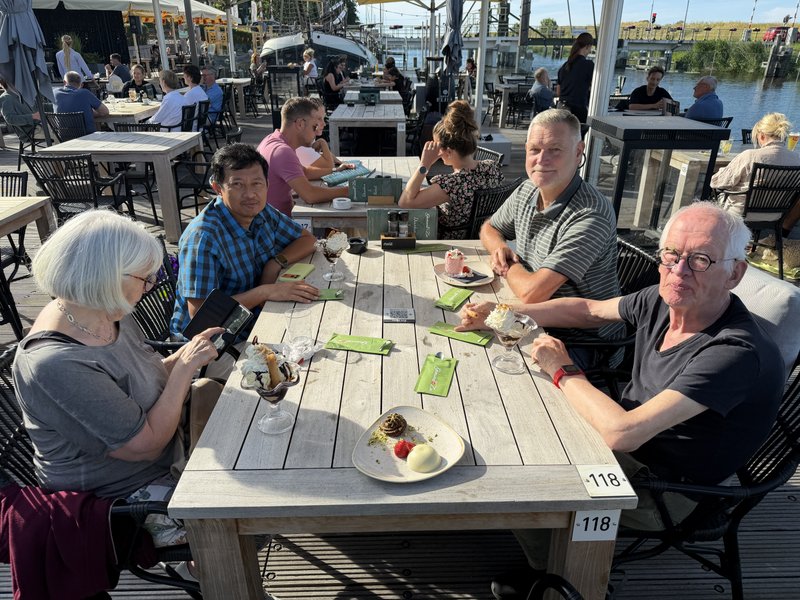
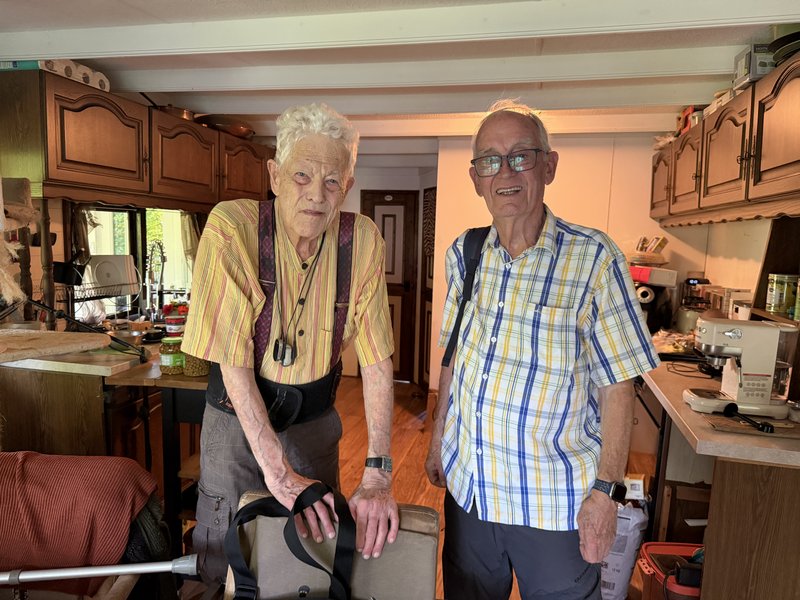
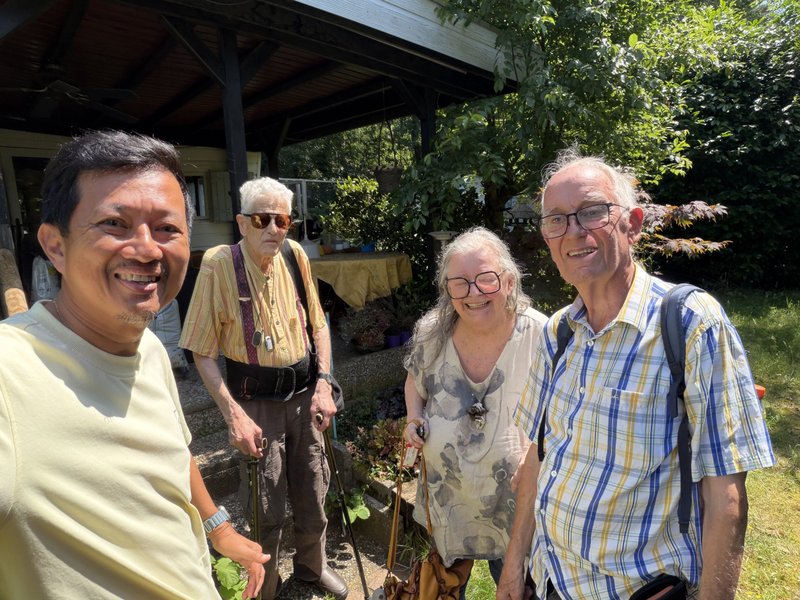
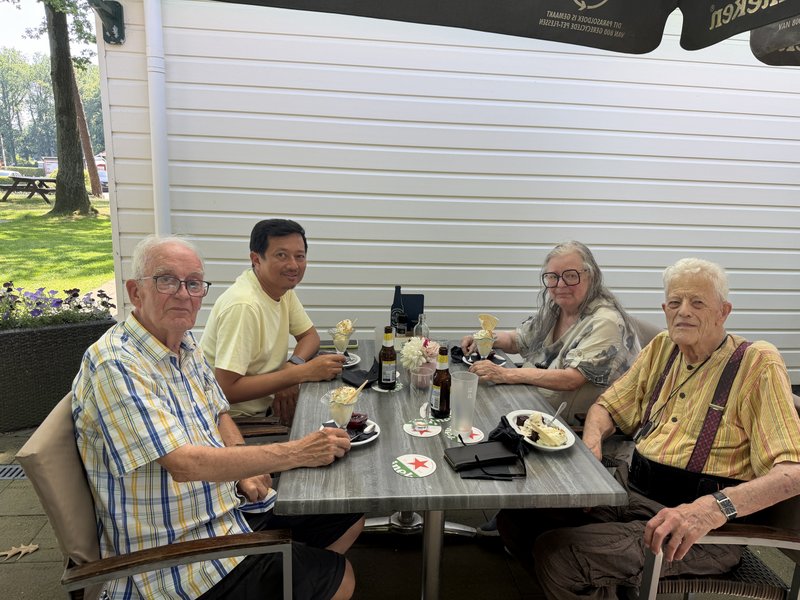
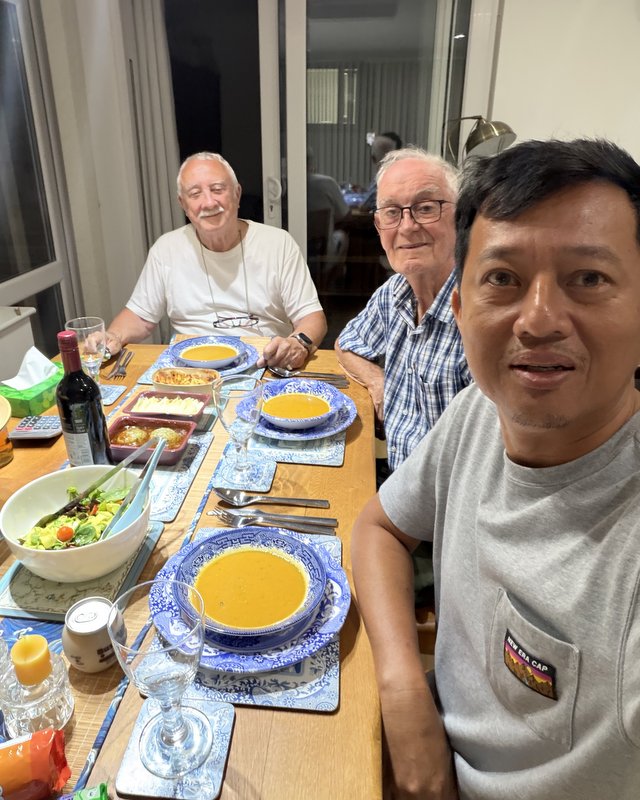
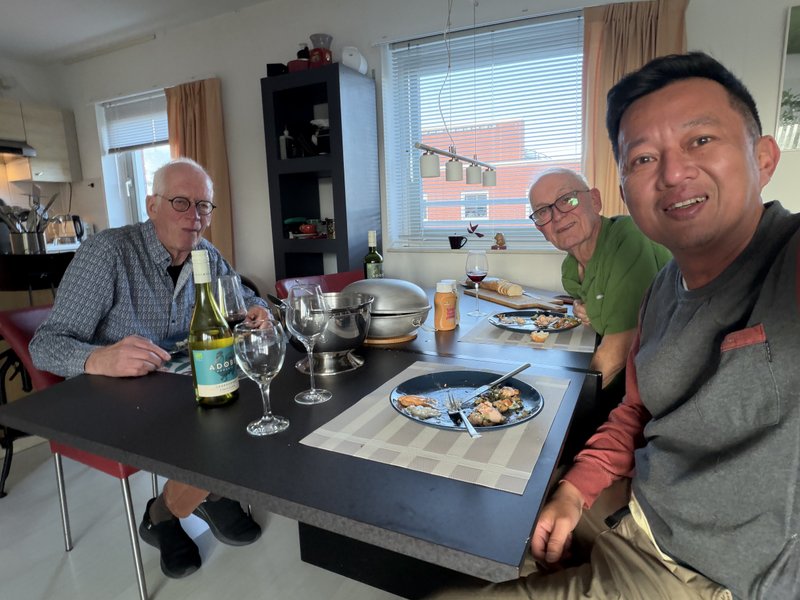
In2021 I wrote a post about the Gang of four, describing the friendship between four senior citizens. This year we will be all octogenarians, so our activities are getting more limited. After the COVID pandemic we have made three day trips, to Kampar(2022), Janda Baik(2022), and Jugra(2024). This time Khong suggested to have lunch at the WK restaurant in Ulu Yam, I suggested to combine it with a visit to a Buddhist sanctuary in Ulu Yam and Stephen proposed another restaurant in Ulu Yam, with the best prawn tom yam he had ever tasted.
We started with coffee in Serendah, a coffee shop where Khong was a regular.
Next, we continued to the “Buddhist Sanctuary”, which I had visited twice in the past, in 2007 and 2012. So long ago that I only remembered it was a nice, quiet place. It still is, but it is not a sanctuary. It is a monastery, following the Sakya school of Tibetan Buddhism. It is much more important than its remote location would suggest. I am interested in (Theravada) Buddhism, but not in the Tibetan variant so I had to Google for more information. The monastery serves as a major seat of the 7th Tharig Rinpoche, a spiritual leader of the Sakya sect. Here is the official website: Ulu Yam Sakya Tharig Monastery .I have found no info about a Thai background, although locals sometimes call it a Siamese temple. The monastery was officially opened in 1998.
This interesting statue at the entrance is not the Buddha, but a Bodhisattva. It is Avalokiteshvara, the male version of Guan Yin, the god of compassion.
The entrance to the main hall is flanked by the 18 Arhats.
`
The impressive main hall.
`–
There are two huge prayer wheels. When you turn them three times (clockwise), it will bring you luck. Of course Khong and I did it.
The twelve Zodiac signs are also there. I am a monkey, Aric is a dragon, of course I had to take “our” pictures.
A small shrine and a statue of the 6th Tharig Rinpoche.
Nice atmosphere.
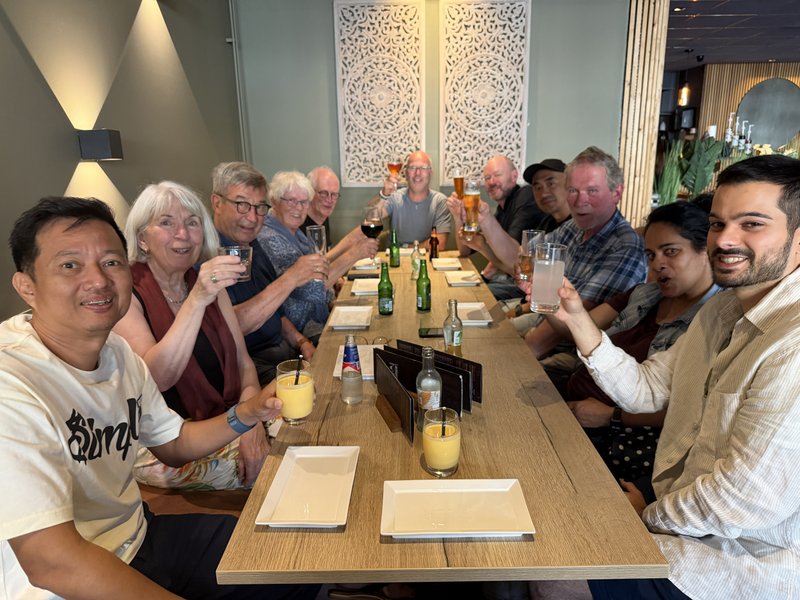
A photo of the Gang of Four.
Outside the monastery there is a cemetery and a columbary.
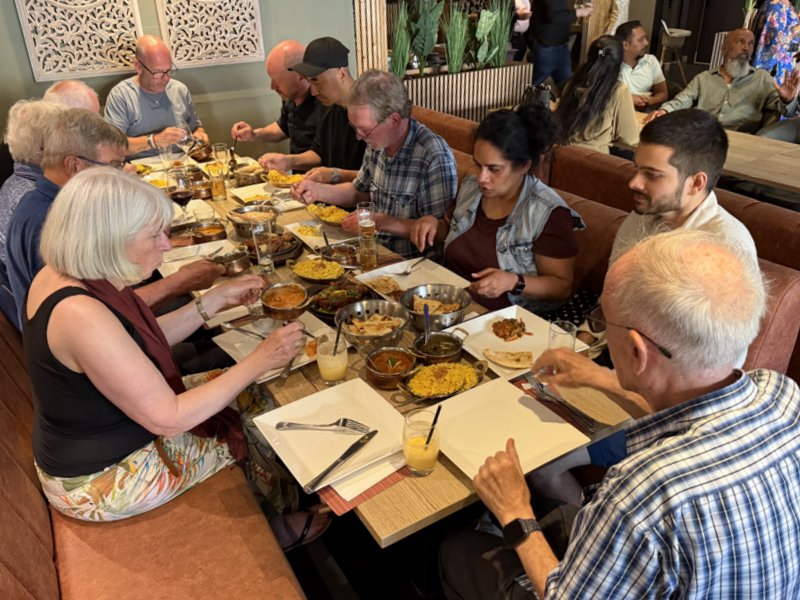
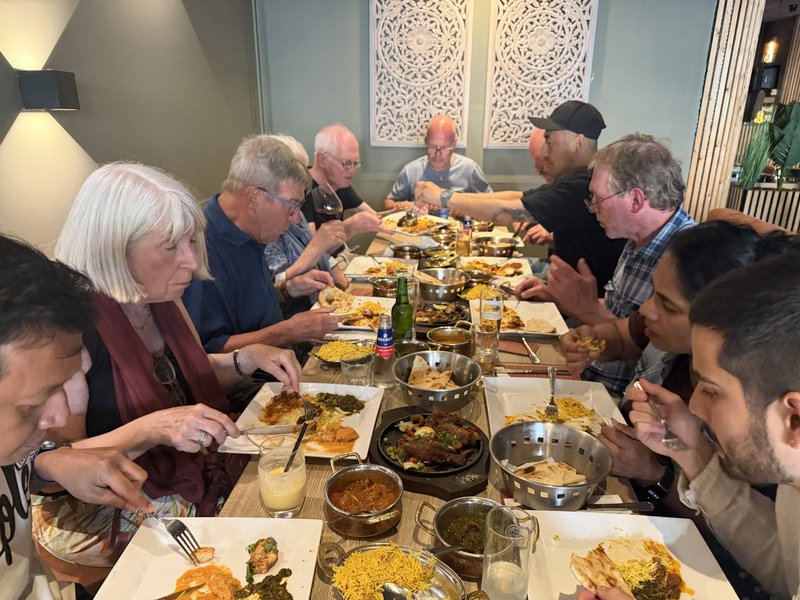
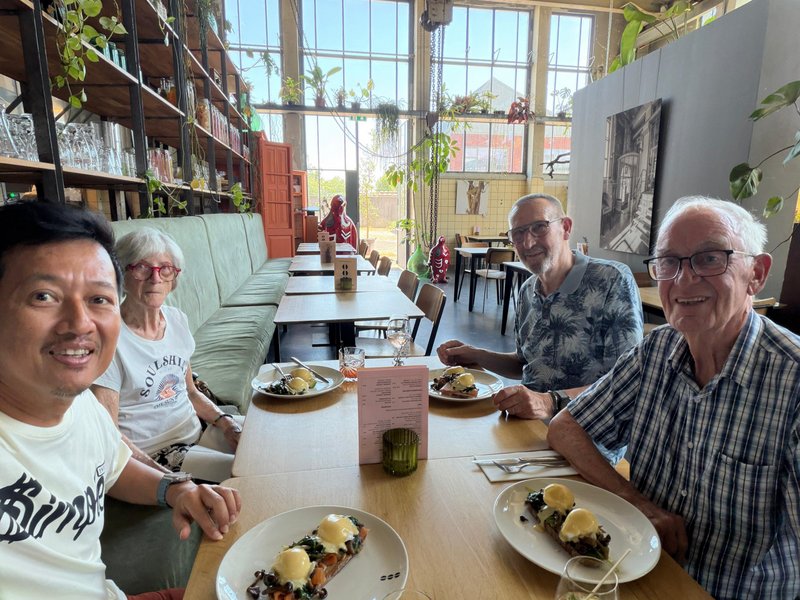
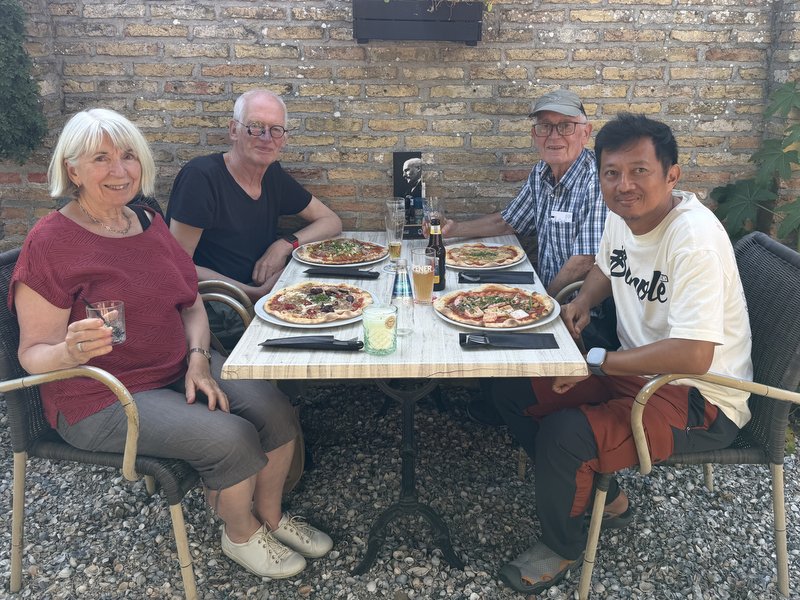
After this very interesting visit, it was time for lunch. We followed Stephen’s suggestion and went to the Hock Lay restaurant in Ulu Yam, where we had the “best Prawn Tom Yam ever””, fish, tofu and veggie for RM 139. Value for Money.
A nice outing. I hope that we don’t have to wait two years for the next one.
In my last blog post about the Chinese New Year, CNY 2025. I mentioned a few more CNY-reports. Interesting for me to read them again, as I forgot many details. They are basically all very similar, spending a few days with Aric in Parit Baru, meeting his extended family, and having lots of food.
This post is not different, but I have tried to change the format a bit and add some details.
Preparations
Compulsory preparations for CNY are buying new clothes and having a haircut.
Early Celebration
Ten days before CNY, there was an early reunion for Aric’s maternal family in Kepong.
Family members had prepared food for reunion dinner in buffet style.-
Of course ther was Yee Sang, tossing a salad.The higher you toss, the more luck it will bring you.
There was also a birthday celebration and of course the traditional group photo.
Two days before CNY
We arrived one day earlier than usual, because Aric needed time to prepare the CNY decorations. We reached Parit Baru in the evening and had dinner in the fishing village, a few km from the family house.
Not many people yet. We had dinner with Aric’s older brother Ah Peng, older sister Aei Ling, and her two kids, Teng Wei and Chun Yee. Of course, we had seafood.
CNY Eve
It is nice to join Aric at Parit Baru, after so many years, it feels like I am a family member. But it is also a challenge, because it is difficult to get some privacy. Fortunately, the family has a bungalow, a few minutes’ drive from the family house. We stayed overnight there, and Aric was my Grab driver when I needed some rest and privacy.
Next morning, we drove back to the family house, where an offering table had been prepared, prayers for the ancestors. That is a tradition on the last day of the year. At the back of the house, there was another, smaller offering table, which I had never noticed earlier. Apparently, it can be found in the countryside, also on the last day of the (lunar) year. Google gives various explanations (chicken, local deities, ancestors).
Aric was busy the whole day, preparing the CNY decorations with the help of nephews and nieces. It was a kind of three-dimensional construction kit, not easy.
I had nothing to do, so I decided to take some pictures of the house and its surroundings. The house is located in a Malay kampung. Many years ago, Aric’s father and two uncles started a hardware shop here. Three families lived in the house. The hardware shop is doing well.
In the past, the three families always had the reunion dinner on CNY eve together, but this time it was separate. Aric’s brother Raymond had arrived with his family. Of course, we had the traditional steamboat 😉 .
CNY day 1
Here, Aric is inspecting the result of what they had prepared the day before. He is a perfectionist, so he was not 100% happy. “It could have been better” But it was good enough to enable him to create his usual digital CNY card.
There was another offering table for the ancestors. The first day of the month, so vegetarian this time. Note that the table is set for nine ancestors. The Deity on the altar is Tua Pek Kong, the Taoist god of Prosperity.
It was a quiet morning, but a bit hot to stay inside the house.
In the afternoon, we drove to a small shrine, a few km from the house. It’s a Datok Shrine, dedicated to a local deity, you find them everywhere in Malaysia. This one is situated nicely beside a small stream. We visit it every year.
Back at the house, I took a few pictures of the shrines there. Left is the shrine for the sky god, right a small Datok Shrine.
During the day, many more cousins, often with their kids, had arrived. I know the names of Aric’s nephews and nieces, but not of his cousins. Here everybody is relaxing in the common living room, playing cards or watching their smartphones.
Scenic photo of the front door with Aric’s decorations.
CNY Day 2
This year (and also the next two years), CNY and Ramadan start in the same lunar month. Because the Islamic calendar requires the new moon to be sighted, the actual start of the fasting is one or two days later. Parit Baru has a Kedai Kopi with very good roti canai, we went there for breakfast on the last day that it was open.
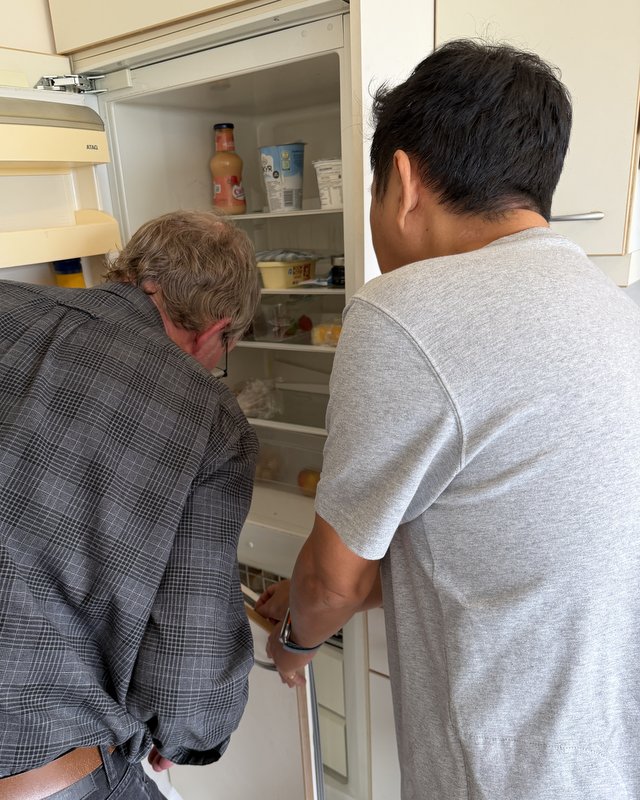
More photos of the family house. The living room and the kitchen are shared by the three families, but meals are prepared separately. There are three fridges, dining tables, kitchen sinks, etc.
Left the part of the kitchen for Aric’s family, the other photo shows the tables for the families of the two uncles.
Left the toilet and shower section. Right the backyard, doing laundry is a daily chore.
After many days of Chinese food, I was in the mood for something different. We drove to Sungei Besar where they have a McDonald’s. I enjoyed a cheeseburger.
CNY day 3
The last part of my pictures of the family house. The house is partly wooden, especially the first floor, where each family has its private rooms. During CNY so many people come back that all available space is used to put mattresses. Good that I could escape to the bungalow 😉 .
Giving and/or receiving Ang Pow is part of the CNY celebration. The small red envelopes contain money and signify good luck and prosperity. They are usually given by older people to younger ones. I give Ang Pow, as Uncle Jan, but I also receive them, not sure why ;-). Giving Ang Pow to Aric’s nephews and nieces is always a nice ritual. Aric invites them to the family room, where he has prepared surprises for them.
A few of the young ladies had prepared two beautiful vegetarian Yee Sang plates. The three families did the tossing in the common living room.
Day 3 is always the party day for the Cheah family, with Aric as the organiser. It was a bit unfortunate that it started raining in the afternoon.
The family had decided to use a caterer for the buffet dinner. Indian food for a change.
For the young kids, a fire was prepared, so they could put marshmallows on a stick and fry them.
Later, the rain stopped. Aric always organises a kind of lottery game.
The traditional group photo. More than 50 people.
Of course, there were fireworks.
CNY day 4
In the morning, there was another offering table, set for one ancestor only. The first wife of the grandfather, who had passed away on day 4, many years ago. The family is very traditional in keeping the rituals alive. In the right photo, you see how everybody is folding “ghost money” to be burned later.
After lunch it was time to go home.
I had asked Aric to bring his drone and take some aerial views of the family house and the surroundings. At the horizon the Bernam river, with Perak at the other side.
Left Pekan Pari Baru, right a close-up of the Cheah “mansion”.
CNY day 5
I was quite exhausted after a 6D5N stay in Parit Baru. But on day 5, we were invited to another CNY reunion in Damansara Mutiara, near where we live. Another big crowd, I escaped to the garden. Aric’s extended maternal family this time.
Both kids and adults like to play cards.
And of course, another group photo, the third one for me 😉
Hokkien New Year Eve,dy 8
After recovering during the weekend, there was a nice, small-scale finale on day 8. Aric’s brother-in-law is Hokkien, and they celebrate the New Year on day 9. We visited them in Puchong on the evening of day 8.There was the usual offering table.
Although I am not a Taoist, I don’t mind joining them in prayers.
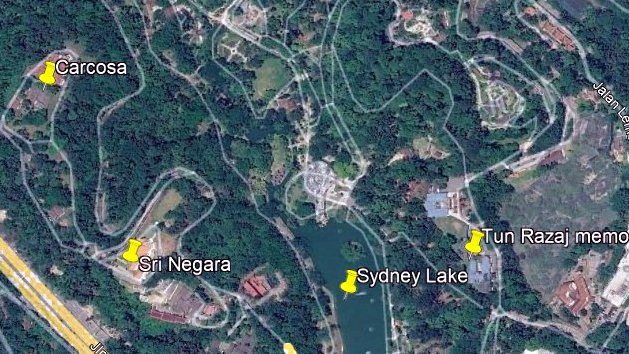
In May 2025, my friend Pek Foong invited me for a walk in the Lake Gardens, a visit to the Tun Razak Memorial, and a drink in the Royal Lake Club. It was a nice outing, resulting in a blog post: KL Lake Gardens. During that walk, I didn’t see any lake, so a few days ago I came back with my friend Paul for another walk. Here is a Google Earth screenshot, with our walk marked in green.
I took the MRT to Museum Negara, where I met Paul. I have visited the National Museum only once, decades ago. I must go again soon.
It’s a short walk, using a tunnel under a busy highway, to reach the entrance of the Lake Gardens. The official name is now Kuala Lumpur Botanical Garden.
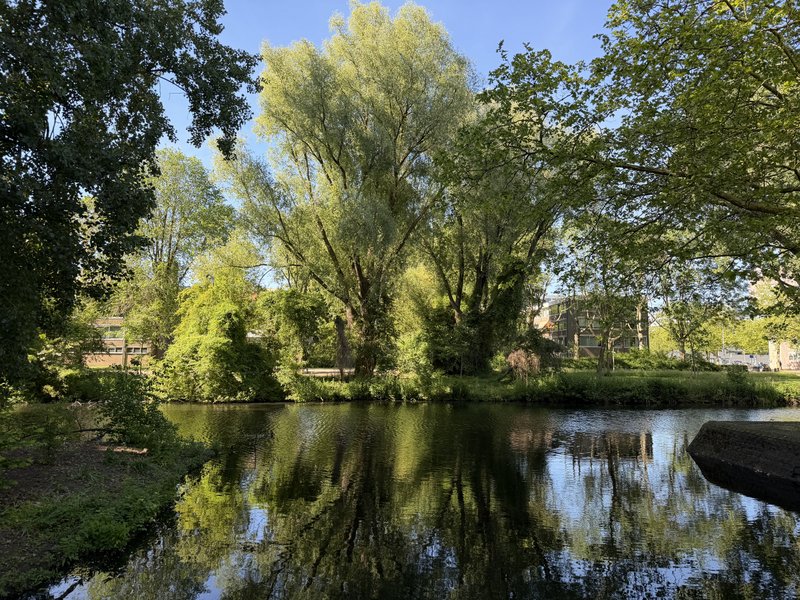
Here is the lake. It is not a former mining pond, like the Taiping Lake Gardens; it was created in the 1880s by damming a small river. The park was officially opened in 1889, and the lake was named Sydney Lake, in honor of Lady Sydney Swettenham, a strong supporter.
The park is close to the center of Kuala Lumpur and well-maintained, although the paddleboat section was closed.
Signboards indicate the various attractions.
Trees have information boards. There were not many flowers during our visit.
–
A decorative building is a nice place to rest.
Another attractive building made of bamboo.
Peaceful and scenic.
–
The lake is located in a valley, and stairs lead to the higher parts of the gardens.
There is a deer park.
The Tun Razak Memorial is located just outside the Botanical Garden.
It is really a beautiful garden.
Halfway, we took a rest for coffee and biscuits. An exotic visitor was interested in the crumbs. It looked like a pitta, but it is a Splendid Starling, that has escaped from the nearby Bird Park. Its habitat is East Africa. Not shy at all, a nice surprise.
Attractive bridges are very suitable for taking pictures.
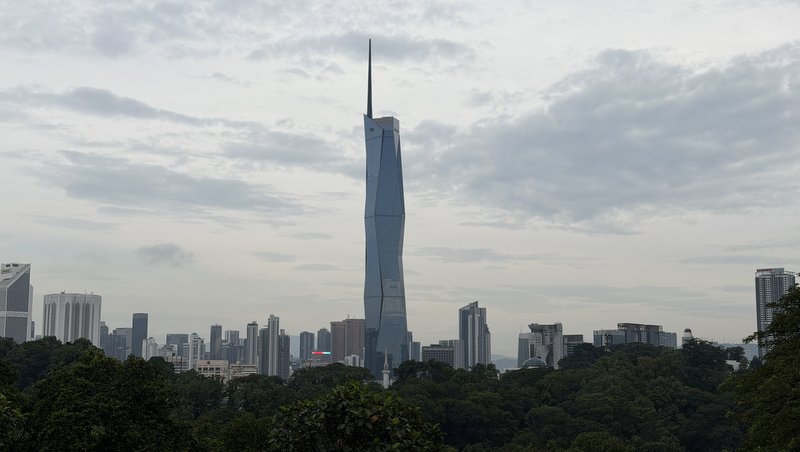
Walking back, we had a good view of the Merdeka 118 skyscraper, the world’s second-tallest building.
On Tuesday, 17 February 2026, the Chinese Year of the Fire Horse started. The next day, Wednesday 18 February, was Ash Wednesday, the start of the Christian Lenten fasting. And on 19 February, in Malaysia, the fasting month of Ramadan started. A remarkable coincidence? On 19 February, a Facebook article was posted. If you have FB, you can read the article by clicking on the screenshot.
The article states that this coincidence happened the first time since 1863 and will not happen again until 2189 It is rare because three calendars are involved: the Muslim calendar, the Chinese calendar and the Christian calendar.
I am interested in calendars and have written several times about it (here and here and here), so I was interested and decided to check the statement. First, some information about the various calendars.
The Gregorian calendar
Introduced by Pope Gregorius XIII in 1582, it is the globally accepted civil calendar. It is a solar calendar, 365 days with a leap day on 29 February if the year is divisible by 4 (except for century years not divisible by 400).
The Islamic calendar+
The Islamic calendar is lunar, a lunar year equals 12 lunar months of 29 or 30 days, and is 11-12 days shorter than a solar year. So the lunar year moves forward through the seasons. After 33 years, it has made a complete cycle. All Islamic celebrations, like Hari Raya, Muharram, etc/ are movable feasts.
In 2026 the first day of Ramadan fell on Thursday, 19 February. In the table, dates for a few more years are given. The first day of Ramadan moves forward 11-12 days each year, and in 2059, 33 years later, it falls again in February.
Year
Start of Ramadan
Commnet
2026
Thursday,19 February
2027
Monday, 8 February
11 days earler
2028
Friday 28 January
11 days earlier
2029
Tuesday, 16 January
12 days earlier
…..
2059
Friday, 14 February
33 years later
The Chinese calendar
This calendar is lunisolar, to avoid the drifting through the seasons, every few years an extra lunar month is added. As a result the Chinese New Year is still a movable feast but with a limited range (the earliest date is 21 January, the latest date is 20 February).
In 2026 the Chinese New Year started on 17 February. The table shows the same years as the Ramadan table. Note that in 2026, 2027 and 2028, CNY and the start of Ramadan use the same New Moon. The 2-day difference occurs because CNY uses the astronomical New Moon, whereas in Islam, a New Moon must be SIGHTED. More in the appendix. Also note that in 2059 the start of Ramadan and CNY “coincide” again!
Year
Chinese New Year
Comment
2026
Tuesday, 17 February
2027
Saturday, 6 February
11 days earlier
2028
Wednesday 26 Janaury
11 days earlier
2029
Tuesday, 13 February
2028 was a leap year
…..
2059
Wednesday, 12 February
The Christian Calendar
The Christian calendar is often identified with the solar Gregorian calendar, but that is a bit confusing. Yes, Christmas and related events like Advent and Epiphany are celebrated on fixed dates, but Easter and related events like Lent, Pentecost, are movable feasts related to the moon cycle in a complicated way. Easter falls on the Sundayafter the first full moon on or after the Spring equinox. This leads to a window for Easter (22March-25 April) and also for the beginning of Lent, 46 days earlier, Ash Wednesday (4 February-10 March). Comparing the windows for CNY and Ash Wednesday, note that there is a partial overlap,
Here is the table for Ash Wednesday. In 2026 it fell on 18 February and again a few more years are shown. Because of the complicated procedure to determine the date for Easter, date for Ash Wednesday looks quite irregular. But note that in 2059 it falls on the same day as CNY!
Year
Ash Wednesday
Comment
2026
Wednesday, 18 February
2027
Wednesday, 10 February
8 days earlier
2028
Wednesday, 1 March
12 days later
2029
Wednesday, 14 February
15 days earlier
……
2059
Wednesday, 14 February
Combining the three calendars, we see that indeed, 2026 is special, because CNY (17 February), Ash Wednesday (18 February) and the start of Ramadan (19 February) occur within two days. According to the FB article, this is extremely rare; the next time it will happen is, according to “calendar experts”, after 163 years, in 2189. The FB message was copied many times, for example, on Instagram.
But is it true? Look at the year 2059 in the three calendar tables. n 2059, after 33 years, CNY (12 February), Ash Wednesday (12 February), and the start of Ramadan (14 February) will occur within 2 days.
The claim that the next occurrence will be in 2189 is FALSE. It will happen again in 2059.
What about 2092, another cycle of 33 years later? I checked the data, and the answer is NO. CNY falls on Thursday, 7 February, and Ramadan starts on Saturday, 9 February. But Ash Wednesday is one week later, 13 February. The “calendar experts” may be right that there is another occurrence in 2189, but they have overlooked 2059.
Appendix
The Islamic and Chinese calendars can have celebrations at the Same New Moon, but never at the same date; there is always a difference of 1 or 2 days. The reason is that both calendars define the start of a lunar month in different ways.
The astronomical New Moon is not a day, but a specific time on that day. For example, the New Moon occurred on 17 February 20:01 Malaysia time.
The Chinese calendar uses this time. there fore, 17 February was the first day of the Year of the Horse.
The Islamic calendar states that a new day starts at sunset and that a new lunar month starts when the new moon is visually sighted. But on 17 February at sunset, the new moon has not yet occurred, so the first sighting can only take place at sunset on 18 February, and the first day of Ramadan will be 19 February, two days later
It takes about 10-15 hours after the new moon for an observer to spot the first sliver of the new moon
I will illustrate this using data for an occurrence of CNY and Hari Raya. As Hari Raya is a major celebration for Muslims, as CNY is for the Chinese, a coincidence of the two is so special that it got its own name, Kongi Raya. It will happen in 2029, 2030 and 2031
Here is the table, with the times of the new moon added.
Year
New Moon
Chinese New Year
Hari Rya
2029
18:31
13 February
15 February
2030
00:07
3 February
4 February
2031
12:31
23 January
25 January
In 2029, the new moon occurs on 13 February at 18:31. Impossible to sight the moon, Hari Raya start two days later. One year later the new moon occurs at 00:07. That same eveing the new moon can be sighted, so Hari Ray starts at 4 Fevruary. In 2032, the new moon occurs at 12:31. Not enough time to sight the new moon at susnet, Hari Raya 25 January
The Hindu calendar is also lunisolar, their main festival Deepavali can also occur together with Hari Raya. This is called DeepaRaya and will happen again in 2037-2039
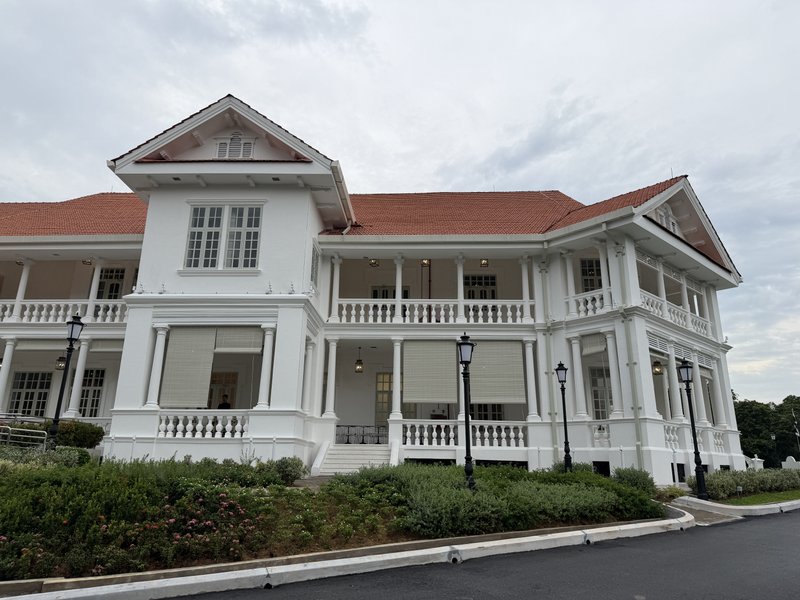
In 2017, I published a detailed report about KL Heritage. In this report, I give more information about the impressive Sultan Abdul Samad building, the former Government Offices during the colonial era. After the independence of Malaysia, the building housed the superior courts of Malaysia until they were relocated to Putrajaya in 2003. Since then we could only admire the impressive building from the outside. But last year it was refurbished, and a few weeks ago it reopened to the public.
Free access during February, so we joined the crowd to have a look inside. We parked our car under Merdeka Square and walked to the building. The facade must have been cleaned; it looked fresh and wonderful. It was already late afternoon, as we wanted to take night pictures.
We didn’t even need to register; we could just walk in. The building is large, clear ground plans are helpful for your orientation. The group floor has two galleries. We started with the Royal Selangor gallery (number 1 in the plan).
It is mostly a sales gallery. Royal Selangor, world-renowned for its pewter, has its visitor center in Setapak, and has now opened a branch here.
Beautiful stuff, very expensive.
One part of the gallery is the School of Hard Knocks (5), where workshops will be held for people who want to craft their own pewter dish.
There is also a cafe (4) where we decided to have a coffee and cake
Next, we wanted to visit the Kuala Lumpur Gallery(2), but it closed at 6 pm. This gallery about the history of KL will be more interesting, so I have to come back another time. I understand that the exhibits are basically the same as the former KL City Gallery (See my KL Heritage blog), but it will be interesting to see them in this new location
So we walked up to the first floor. Of course we took numerous pictures.
There are more restaurants in the building, on the ground plan I counted six(!). This is a real restaurant,
We could not resist the temptation to take a picture of ourselves.
There were many visitors, both locals and tourists.
At around 7 pm, the lights came on. We went back to the ground floor. This is the backside of the building, a nice, quiet courtyard.
We left the building and crossed Merdeka Square to the Selangor Club. What a fantastic view of the whole building.
–
A few more pictures.
The building deserves to become one of the top attractions of Kuala Lumpur.
Before driving back home, we took a few more night pictures of other interesting buildings in the region. Here is the Masjid Jamek, rather dwarfed by the modern background.
Old Railway Station and the National Mosque.
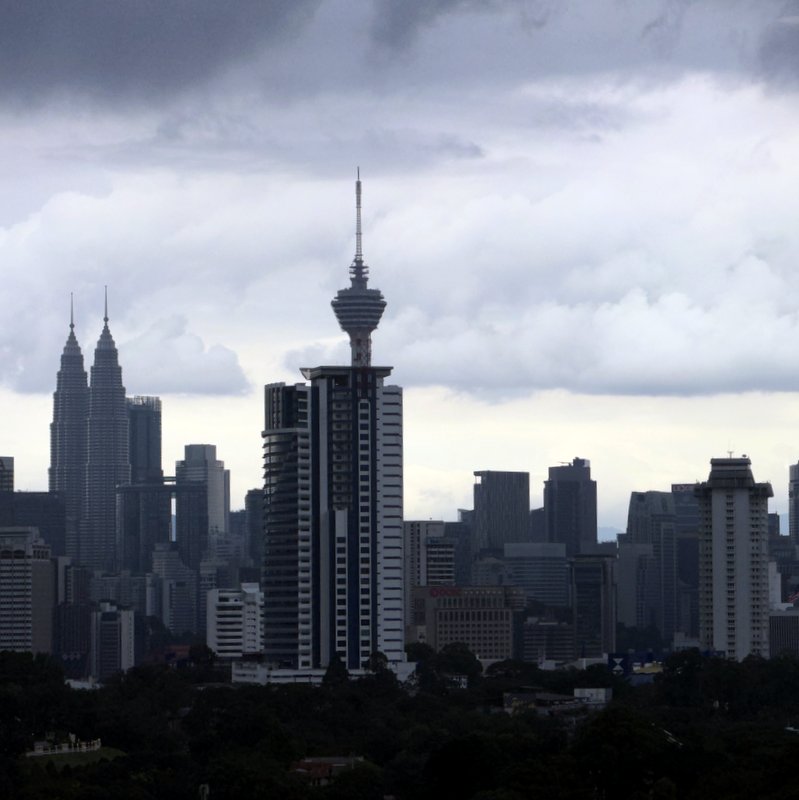
KL Tower and the Merdeka 118 skyscraper.
No idea if access will remain free after this month. For those living in Malaysia, use the opportunity. Open from 8 am until 10 pm, but galleries close at 6 pm.
Taiping, my adopted hometown, is dominated by Maxwell Hill. Now renamed Bukit Larut, it is the oldest hill resort in Peninsular Malaysia. Established in 1884, it contains several colonial bungalows, which make it an important cultural heritage site. My friend Suet Fun published a book in 2019, Beguiled on Larut Hills, in which she describes all aspects of Maxwel Hill in great detail.
This blog describes my personal experience with Maxell Hill.
My first visit to Maxwell Hill was in December 2003. I joined my friend Stephen on a trip to Taiping, his hometown, and we stayed one night in Speedy’s Rest House.
What a beautiful view of Taiping, far below in the plains. The caretaker of the bungalow was Guna. Lat-er that night, after the rain, the night view was spectacular too.
The next year, in April, I came back to Speedy’s with friends to celebrate my 60th birthday.
It was a very enjoyable celebration. Guna prepared a nice dinner. A detailed report about this trip, with many photos, can be found here.
Later that year, in December, I came back to Taiping with my friends Khong and George. Khong had aroused my interest in waterfalls, and we visited several of them. The Maxwell Hill waterfall is visible from Taiping, but we didn’t know how to reach it.
It was only several years later, in January 2007, that a friend of George showed us the trail to the waterfall. Quite impressive.
–
I visited Taiping often, as I became more and more interested in its cultural heritage, like the famous Lake Gardens. Even without visiting Maxwell Hill, it was always visible.
In July 2008, I visited a heritage site in the foothills near a mysterious bridge. An old abandoned swimming pool was constructed by the New Club in the first quarter of the last century. It was fed by water from the Maxwell Hill waterfall.
There is another waterfall on the slopes of Maxwell Hill. I visited it in January 2009 with George and Richard. I named it Kamunting Fall, although it is actually a waterfall in the Ranting River. The trailhead is the same as for the Maxwell Hill fall, but access is tougher.
A few months later, George and I used the jeep service to go up the hill. Not to stay overnight, just to walk around in the fresh air and have a look at the bungalows around the jeep station, colloquially called the 6th Mile.
You could call it a small village, with several bungalows and a cafeteria..
Speedy’s bungalow is a bit further uphill. We walked there and found that the bungalow was closed and Guna’s living quarters were vacant. Later, we were told that his lease had not been renewed. Sad.
We met Guna at the Sri Maha Kaaliamman Temple near the “village” where he was working now. Near the temple, they were building a huge complex, meant to become a hostel? Until present, it has never been used.
My next visit to Maxwell Hill was in May 2012. A birding trip with the “extended” Gang of Four. We- had booked accommodation in the Beringin bungalow/.
A detailed report with pictures of birds and flowers can be found here. We walked up to Speedy’s bungalow and noticed that it had been transformed into a Biodiversity Center.
There were signboards in the garden, and we could enter the bungalow, but there was nobody.
We also walked to the Indian temple, where we met Guna, who guided us around.-
I have a fascination for ruined heritage, so I came back several times to the New Club Swimming Pool. My friend Khong shared a picture he took of the access path, taken in 199. I did the same in November 2013 and February 2016. The difference in water flow might be seasonal.-
199920132016
Here are four photos of the main basin. In 2003 with George, 2016 with Paul, Fahmi and Rani, 2019 with Halim, and in 2025 with Yeap.
In January 2017 I revisited the Kamunting waterfall with Rani, Paul and Fahmi. On our way back, we also+ had a look at the Maxwell Hill fall.
Close to Speedy’s, there is another bungalow, called the Nest. Owned by the Methodist Church, I had never visited it. That changed when the Church leased the bungalow to my friend Suet Fun and Peter, her husband. They transformed the bungalow into a beautiful home for themselves, with accommodation for paying guests. In May 2017, I visited the Nest for the first time, with Aric and Hong, an Ipoh friend. We had booked a jeep that brought us to Speedy’s, from where it was a short walk to the Nest.
A hearty welcome by Suet Fun and Peter.
I was very impressed by the bungalow. I took many pictures, and Aric had brought his drone. I have written a separate blog, The Nest, Heaven on Earth, with pictures of all my visits to the Nest.-
In this report, more about what we did during our stay. First, we had a look at Speedy’s, which you pass, walking from the Nest to the main road. The Biodiversity Center, which we visited in 2012, was no longer in use, unlocked, a failed project.
Between Speedy’s and the Nest, there existed another bungalow, named the Hugh Low bungalow. Hong and I managed to find the remains of it. A real adventure, as there was no trail, I have never seen a picture how the bungalow originally looked like.
The next day, another adventure. A heritage friend of mine, Wan Amril, knows a lot about Maxwell Hill. He told me that there was a monument for J.W.W Birch, the first British resident of Perak, near the Telecom towers at the end of the road, and he was willing to guide us there. It was a nice walk, and near the end of the road, he showed us a vague trail that led in a few hundred meters to the monument.
The inscription says that T.W.W Birch was the first Englishman to climb the mountain (Gunung Hijau) in 1875. The T must be a mistake, because J.W.W Birch indeed climbed the mountain. I wrote a post about his “expedition”, click here.
After visiting the monument- (many leeches!), we walked to the end of the road, to the Cottage, the oldest bungalow on Maxwell Hill. Unfortunately not accessible as it is occupied by the Telecom people.
Wan Amril drove us back to Taiping after a stop at the Cafeteria, managed by him. There is a small waterfall beside the road, where the jeep service doesn’t stop.
+
It was a very rewarding trip. I wrote a detailed report about it, Maxwell Hill
When I visited Taiping later in 2017, I joined Wan Amril on a half-day trip to the 6th mile village, where he had work to do at his cafeteria. I had lunch there and walked around.
Some of the bungalows looked good; others were damaged by landslides. A mixture of beauty and decay, not uncommon in Taiping town as well.
More decay at Speedy’s, the Biodiversity Center was abandoned and desolate.
Although I knew that Suet Fun and Peter were not in the Nest, I had a look. Good that there was a locked gate.
I was fascinated by the atmosphere of the Nest and came back, on my own, April 2018, to relax after busy days in Taiping-
I walked up the road to visit the Birch monument and noticed that there was now a signboard. Actually, it is a bit more than 50 meters!
Speedy’s still the same.
Three months later, I visited the Nest again. Enjoying the hospitality and the food.
Speedy’s apparently had a new destination, a basic hostel?
In November, I came back with Aric. Paul and Fahmi joined us this time.
In the evening it can be a bit chilly.
A few bright lights outside the bungalow attract hordes of moths.
The Nest from the air, drone photo by Aric. Taiping down in the plains.
I was expecting to revisit the Nest more often. But that was not to be. In 2019, Suet Fun and Peter closed the Nest because she was working on her book. At the end of 2019, a major storm caused so much damage to the access road that it had to be closed for repairs. The road reopened in April last year.
Here is a Google Earth screenshot of the winding road with the locations mentioned in this post. The road ends at the Cottage, but the top of the mountain, climbed by Birch, is still a hiking trail.
Of course, I am very curious about the current situation of the bungalows on Maxwell Hill after six years of forced abandonment. Sad news is that the Church took back the Nest a few years ago, Suet Fun and Peter had to vacate their Heaven on Earth. It seems that the bungalow is now being “renovated. How will Speedy’s look like now? Three bungalows have been reopened. What about the other ones?
I was thinking about using the jeep service for a day trip when I am back in Taiping. Going up in the morning to the 6th mile, walk around, having lunch in the cafeteria, and back in the afternoon.
But I understand that at the moment the jeep service is only available for people who have booked accommodation in one of the bungalows, not for day trippers. Why?
To be honest. I have a suspicion that the authorities have a hidden agenda. To revive the idea of a cable car up the hill. Similar to Penang Hill.
When I celebrated my 60th birthday in Speedy’s bungalow on Maxwell Hill, I knew that there was another bungalow, a few hundred meters away, called the Nest. Apparently, it was owned by the Methodist Church.
More than ten years later, the Church leased the Nest to Suet Fun, a friend of mine. She and Peter, her husband, transformed the bungalow into a colonial-style home. A few rooms were available for paying guests. I visited them for the first time in May 2017 and was so enamored of the peaceful atmosphere that I came back three times in the following year. A Heaven on Earth. I
I had hoped to visit the Nest more often, but unfortunately, that was not to be. In 2019, Suet Fun -closed the Nest for the time being, because she was working on a new book and needed to be in Taiping. Later that year, a major landslide at Maxwell Hill caused so much damage to the access road that the authorities had to close it. After about six years of repair, the road was reopened in April 2025. But in the meantime, the Church had taken back the Nest, so Suet Fun and Peter had to vacate the bungalow. At the moment the Nets is being renovated.
During my four visits to this Heaven on Earth, I took many pictures of the Nest. Here is a selection.
First, an aerial view of the Nest, surrounded by pristine forest, on the slopes of Maxwell Hill.
The drone picture was taken by Aric during my first stay in May 2017. He also took a drone video. For what we did during our stay, see my report on Maxwell Hill (still under construction). In this post I just want to evoke the atmosphere of the Nest and show the hospitality of our hosts.
The moving clouds can change the atmosphere within minutes.
Suet Fun is a creative cook.
The next morning
Lunch and dinner on the second day.
My second visit was in April 2018.
The path leading from Speedy’s bungalow to the Nest. As if you are going back in time.
Three months later, in July 2018, I returned to the Nest, where I stayed two nights
View from the Nest of Gunung Bubu, about 60 km away. And the path leading back to “civilisation”.`
—
My last visit was in December 2018. This time I was joined by Aric, Paul and Fahmi/ We stayed two nights. The first night, we were the only guests.
it can get a bit chilly in the evening.
The next day, a group of Suet Fun’s friends arrived. No problem for her to prepare dinner for a large group!
During this visit, Aric recorded another drone video. Here is a screenshot showing the Nest with Taiping far down in the plains. Click on the picture to watch the video/.