Meet your great-(~10 million times)-grandmother

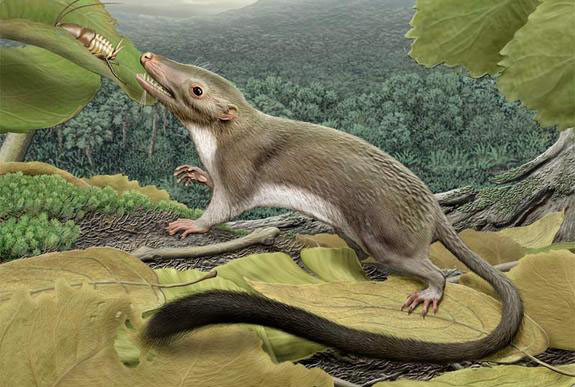
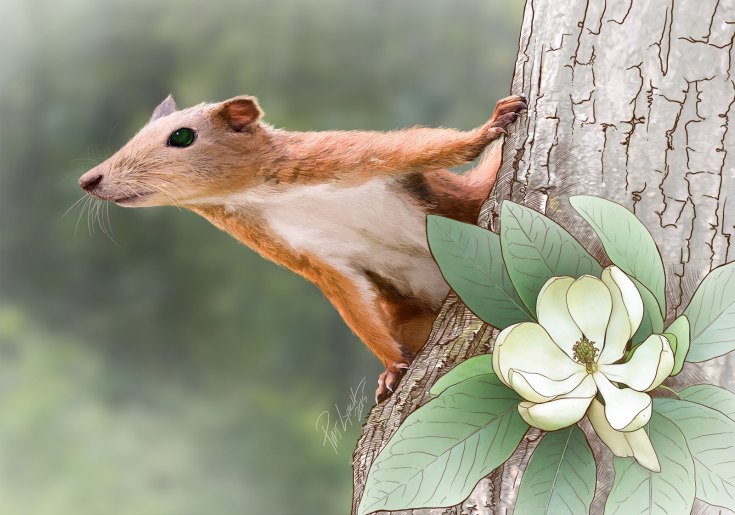
In my blog The Tree of Life, published a few months ago, I wrote about the Last Common Ancestor (LCA) of all placental mammals, that it was a shrew-like animal, living about 65 million year ago. Terrestrial, with insects and fruits as food.

Our maternal ancestor

Yesterday Yale University has published an interesting update. Our ancestor most probably was not terrestrial, but lived in trees. More a squirrel than a shrew. This conclusion was drawn, based on a study of fossil ankle bones of Purgatorius as our LCA was named.

purgatorius

Of Bacteria and Men

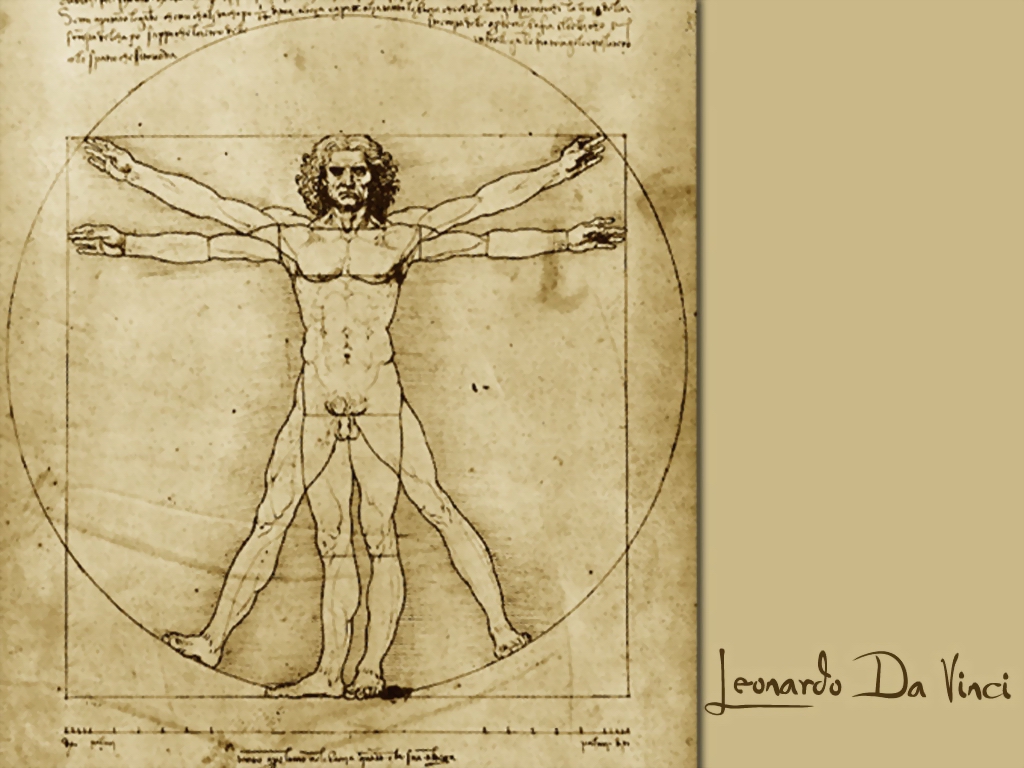
My recent Tree of Life post described how all living creatures share a common ancestor. Both Homo Sapiens and the E. Coli bacterium in his bowels belong to the same “extended” family!

Leonardo-da-Vinci-Vitruvian-Man

2_jpg35416396-ead4-4bc6-9cb4-3632839dad1cLarger

In that post I promised to write another blog about bacteria and the human body. Here it is..:-)

We humans are multi-cellular organisms consisting of roughly 10 trillion cells. For those not familiar with the naming of big numbers, one trillion = 1000 billion = 1000000 million. And for comparison, the global human population is at the moment ~ 7.3 billion, so there are ~ 1500 times more cells in your body than there are people living on our planet.

Bacteria are single-cell organisms. How many bacteria do we have in and on our body? A staggering 100 trillion, 10 times as many as we have body cells! They can be found on our skin, on our teeth, basically everywhere, but most of them live in our bowels, the so-called gut flora . The size of these bacteria is roughly 10 times smaller than an average human body cell,  their total mass is estimated to be 1-2 % of our body mass. Mind you, that is still a lot, about 1 kg of your body mass is bacterial!.

Probably you will have been taught that bacteria are bad and dangerous. Wash your hands, keep everything clean, etc. And of course there are bacteria that can harm you, even kill you. But most of the bacteria in/on your body are harmless and many are even needed for your survival. You would die without your gut flora!

Here are a few  things your gut flora will do for you:

  • The bacteria will do part of the digestion and help forming your stool
  • They are important to build your immune system and keep it in good order
  • They will fight harmful (pathogen) bacteria
  • They are needed for the production of Vitamin-K
  • Etc, etc

Together, all of the bacteria in the body would be the size of a large liver, and in many ways, scientists say, this microbiome (as the whole community of microorganisms in our body is often called) behaves as another organ in the human body: the Forgotten Organ…:-)

As the importance of our  microbiome has been recognised more and more in the last decades, some scientists nowadays consider us as superorganisms  or see us as an ecosystem!

Or, as a microbiologist recently formulated it, in a rather extreme way: “we would do well to begin regarding the human body as “an elaborate vessel optimized for the growth and spread of our microbial inhabitants.

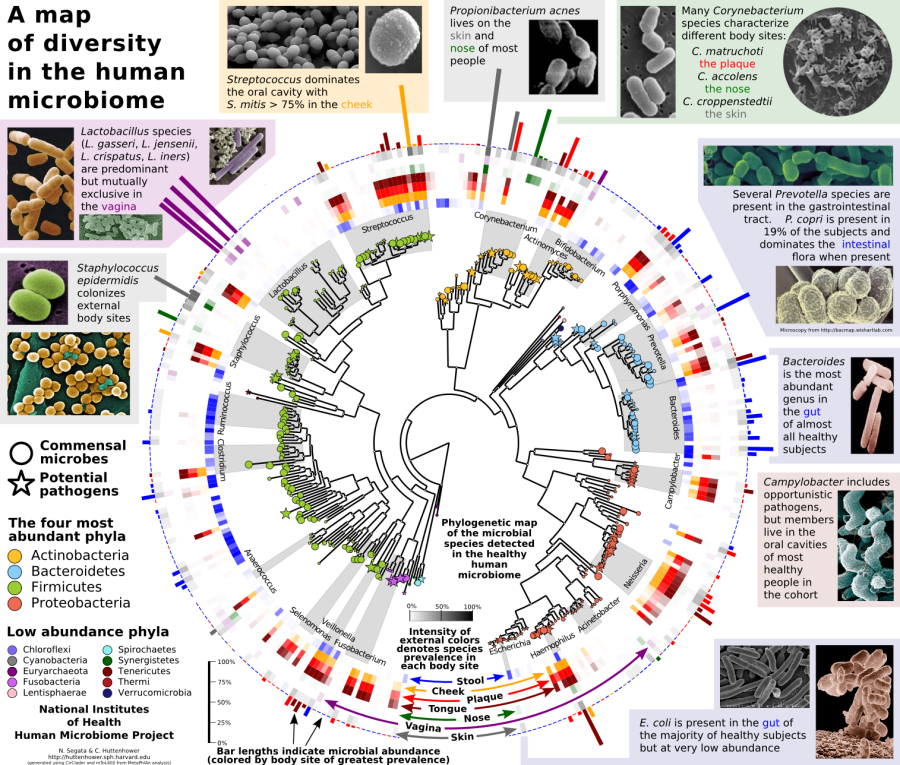
A project of the US National Institute of Health, the Human Microbiome Project has been researching the human microbiome. Here is a survey of what they found (click on the picture to see details).The various parts of our body have different bacterial communities.

HMB project

What about a baby, is it born with a gut flora? No, the womb is sterile (although maybe not 100%). But as soon as the baby has left the mother, the bacterial invasion begins and within days the gut flora is there. Essential to build the immune system of the baby!

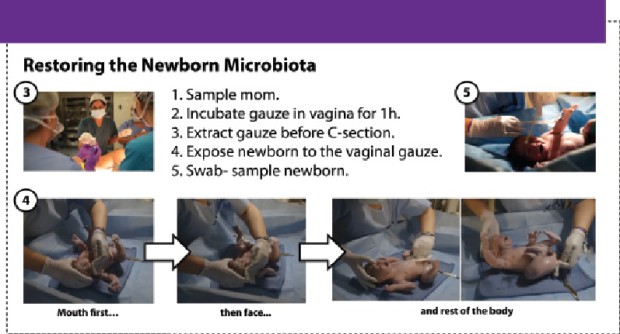
Interesting detail: the composition of the gut flora is different for Vaginal delivery and Caesarean section delivery. Now it is well known that babies delivered by Caearean section run a higher risk of asthma, allergies and several other health risks, because of the different gut flora. Here is an interesting solution

gut flora

Can you believe it…:-)? It is true.

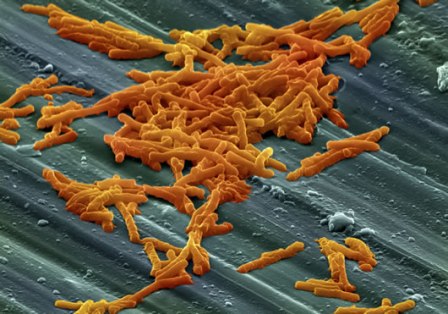
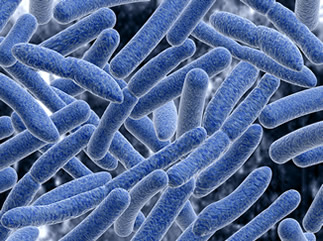
What about this. The Clostridium difficile bacteria is a common bacteria in soil, but can also live in your bowels. Pathogenic strains of this bacteria can cause diarrhea and inflammation of the colon, especially when the normal gut flora has been damaged by antibiotic treatment. The bacteria itself is resistant against most antibiotics, so it takes over the gut flora. Here is a picture of the bacteria.

clostrdiff

Infection with C. Difficile can be life-threatening, it kills approximately 14000 people yearly in the USA.

A promising solution?  Fecal transplantation therapy. Or, in common English: Stool transplant! Take some of the feces of a healthy donor and put it in the colon of the patient. It often works!!

The bacteria in the stool are able to restore the balance in the compromised gut flora of the patient.

Can you believe it…:-)? It is true. Here are some success stories: The Power of Poop

Here is Rosetta again! (updated)

In two earlier posts I have reported about the exciting space adventure of Rosetta, a spacecraft launched in 2004 with as destination a comet, the  67P/Tsjoerjoemov-Gerasimenko. The first post, Wake up, Rosetta!, described how, after a hibernation of more than two and a half years, Rosetta woke up in January 2014, according to plan.

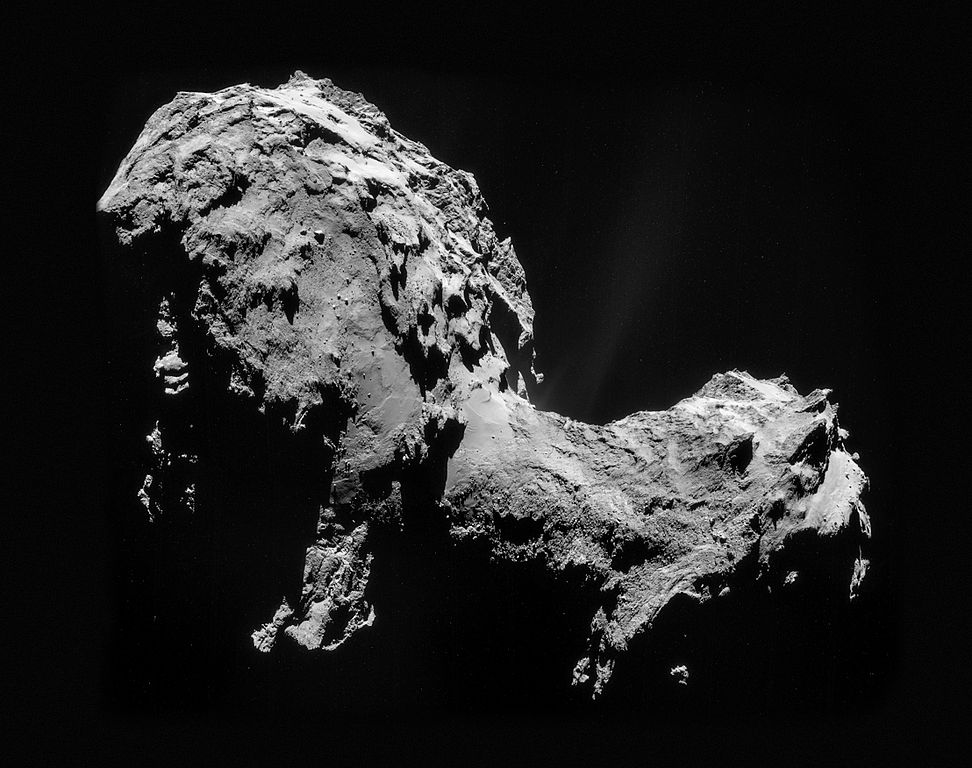
The second post, Rosetta meets 67P, published last August, reports how Rosetta successfully goes into orbit round the comet. It turns out that the comet has a strange shape, like a rubber bathtub duck.  Here is a picture, taken on 19 September at  28.6 km from the center of the comet. The head points to the right. If you look carefully you will see a kind of smoke coming from the “neck” of the comet. That is the coma, part of the comet material is evaporating because it is approaching the sun. Later, closer to the sun, 67P will develop the characteristic comet “tail”. The comet is rotating with a period of 12 hours and 36 minutes.
67P

The last few months the scientific instruments on board Rosetta have already been busy. For example analysing the composition of the “coma” smoke. With interesting results, finding not only water and carbon dioxide, but also methanol, ammonia and hydrogen sulphide. Here is an interesting blog about The “perfume” of 67P.  Quote:  If you could smell the comet, you would probably wish that you hadn’t

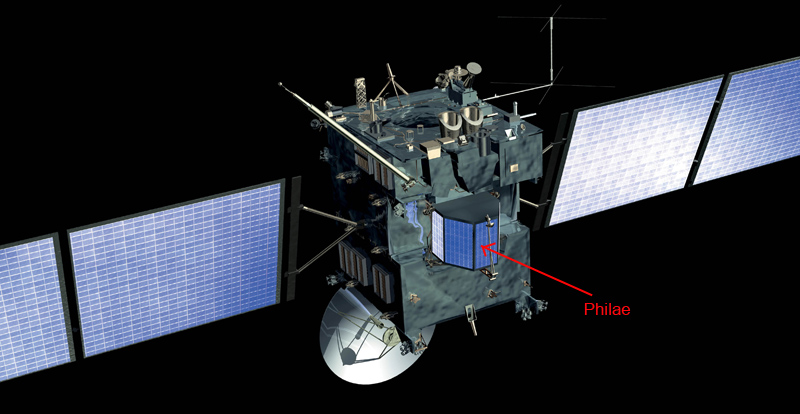
But the ultimate goal of the expedition is to land a module on the comet itself! This module has been called Philae and you can see it here still attached to Rosetta.
Rosetta with Philae

The last few months,  the scientists have been working hard to find a suitable landing site for Philae. That has not been a simple job, because of the complicated structure of the comet. The landing site should be relatively flat and smooth. Several options have been studied, finally the decision was made to choose location J, on the head of the duck in the picture below.
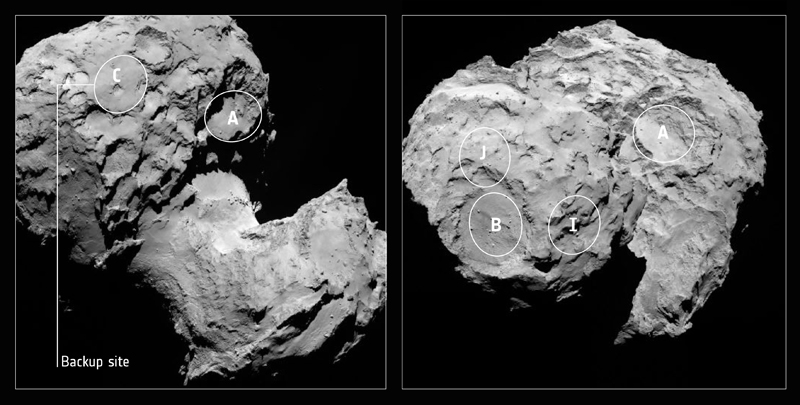
Landing sites

The landing site has now been renamed Agilkia. Why? Google and find out yourself 🙂 Hint: there is a relation with Rosetta and Philae.

The critical landing operation will take place on Wednesday November 12. At 8:35 GMT Philae will be deployed from Rosetta and start its slow fall to the comet.  It has no thrusters that can change its course, so ultimate precision is required in the timing of the separation. Keep also in mind that the distance between earth and the comet is at the moment about 500 million km, so signals take time to reach Rosetta. To be exact: 28 minutes and 20 seconds one way! So it will be 9:03 GMT before we know if the separation has been successful.

Falling to the comet? Yes, because the gravitational attraction of the comet is very small, but it exists. The falling proces willl take about 7 hours! And the speed at landing will be “only” ~ 1m/s. For comparison, that is the speed an object would get here on earth, when it falls 5 cm!

As soon as Philae touches the surface of the comet, two harpoons will be fired down to anchor the module. Otherwise it might bounce back into space! Here is an artist impression of a successful landing.
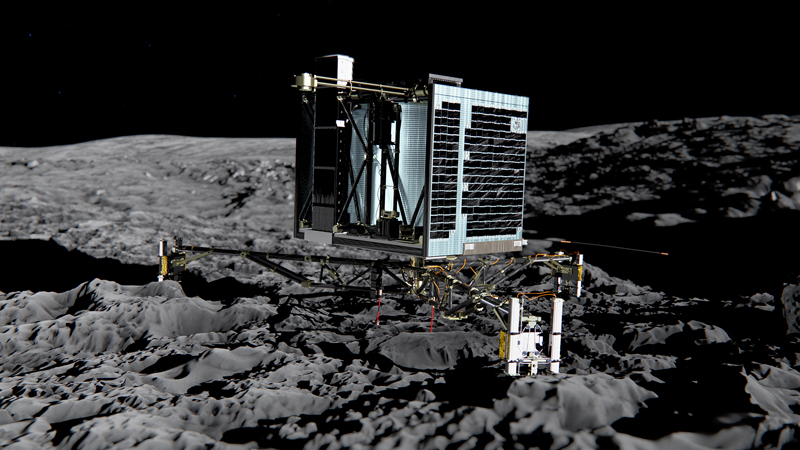
Philae landed

The two red lines under Philae are the harpoons. The construction of the three supporting “legs” allows landing on moderate slopes. If the slope is steeper than 30 degrees, the Philae might topple over, resulting in failure. The whole procedure is considered a risky one, success estimates of 75% “only” have been mentioned..

So let us keep our fingers crossed Wednesday! Malaysian time is GMT + 8 hrs, Dutch time is GMT + 1 hr. Here is the ESA control room. How many nails will be bitten on that day, waiting seven hours, while you can do nothing…:-)?
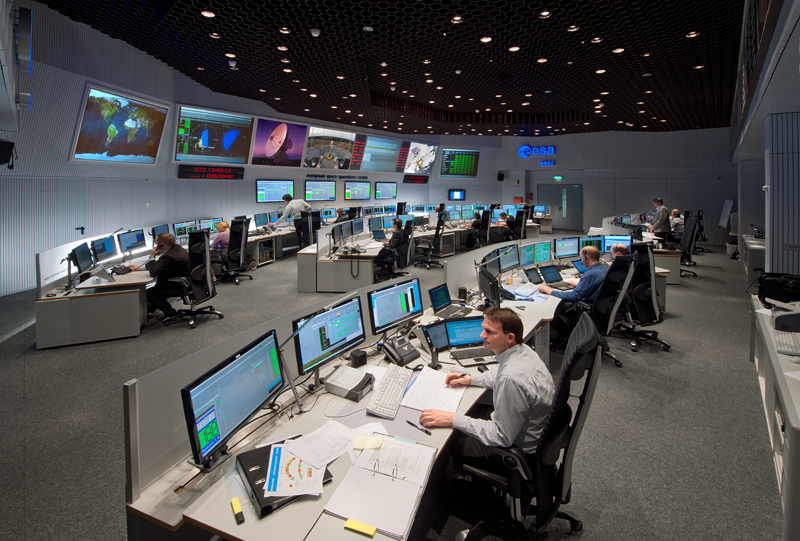
ESOC

On Wednesday there will be a live broadcast of the landing procedure

UPDATE 12 NOVEMBER

5am GMT

The Live broadcast has started already. It is still early in Darmstadt, people are arriving in the ESOC control room, where it is obviously quite cold…:-) Many sniffy people.

Here is a diagram of what will happen today. As I explained in my post, after separation Philae will “fall” to the comet. No course correction possible after separation, so utmost precision is needed

.Rosetta_s_trajectory_12_November_node_full_image_2
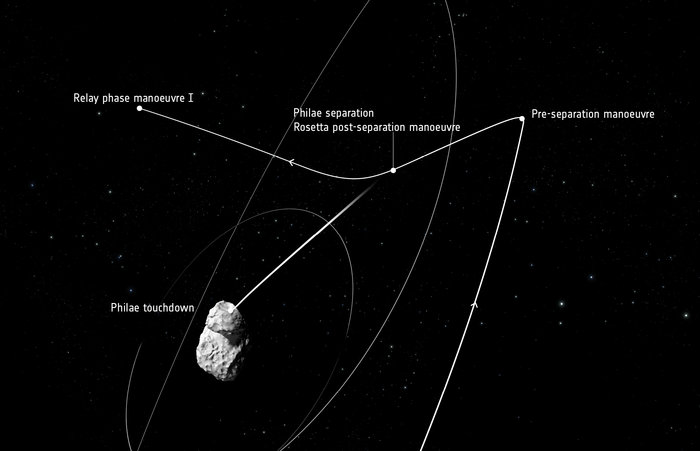
The last few days pictures have been taken by Rosetta with amazing details. Click here for a collection. Here is  a spectacular one.
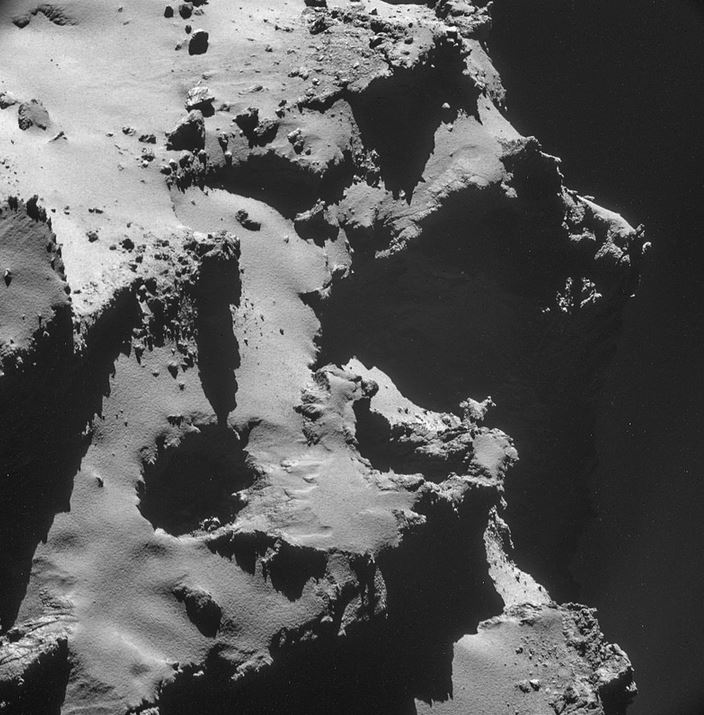
67P_detail

7:30 GMT

Just watched an interview with Gerhard Schwehm, mission manager of the Rosetta project. Now retired. I did not realise that the project started in 1985, almost 30(!) years ago. Less than one hour now until separation.

8:05 GMT 

I have been naive..:-) Thinking that at this moment the command should be sent to Rosetta to deploy Philae (because it takes 28 minutes for the signal to reach Rosetta). But of course they will not do it that way..:-)  Rosetta has been programmed to deploy Philae at 8:35am !  Around 9am GMT the ESOC will know if that separation has been successful.

8:35am  GMT

At this moment, 511 million km away, the Philae is starting its fall to the comet 67P. In spite of a problem that has been found in the  lander. As explained in my post, the Philae could bounce back after touching the surface of the comet. Therefore two harpoons are fired at touchdown to anchor it. Also, on top of the Philae, an amount of gas should be released, giving the Philae an extra push to the surface. It seems that this “thruster” doesn’t work properly.So everything will now depend on the harpoons.

9:05am GMT

Separation is succesfull!!

Waiting. Tense
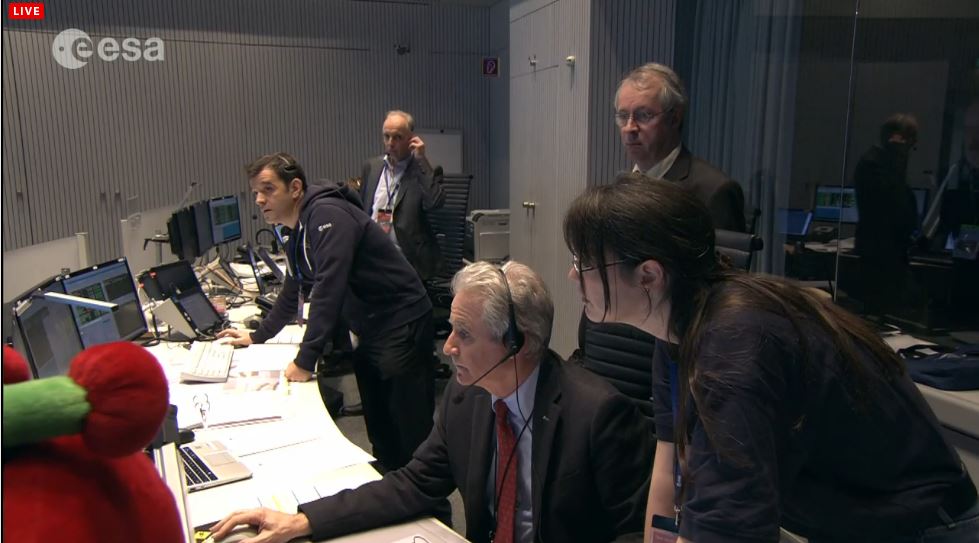
Waiting

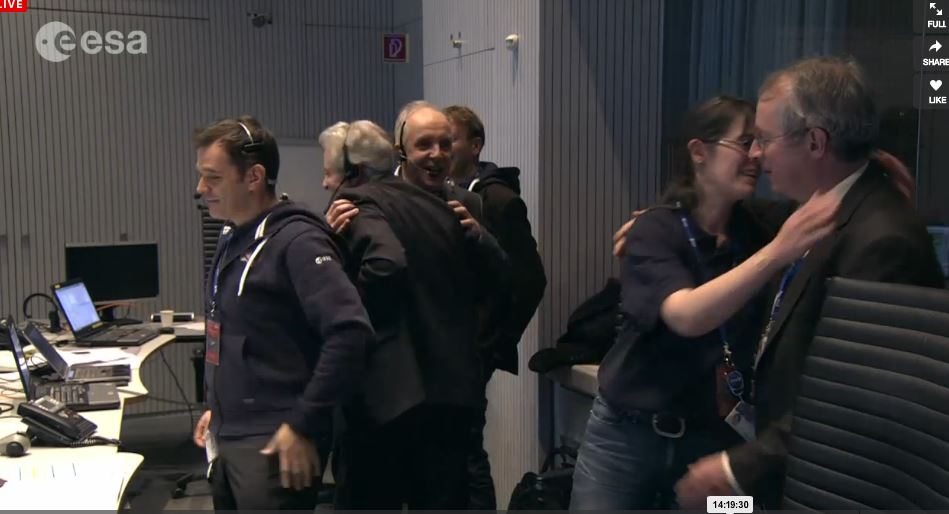
Relief. Hugging

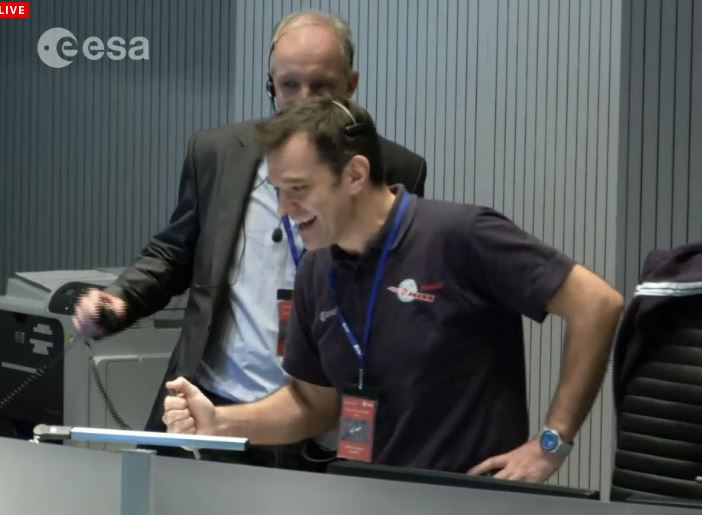
We did it

From now on, the Philae is on its own. In two hours time hopefully contact will be reestablished between Rosetta and Philae

11:10am GMT

Contact established between Philae and Rosetta! Great! This is a bigger step than the deployment. Philae is too weak to communicate directly with Earth, it has to do that via Rosetta. And it did! So now we can follow its descent to the comet, and it may even be able to send pictures.

Tension and relief again..:-)
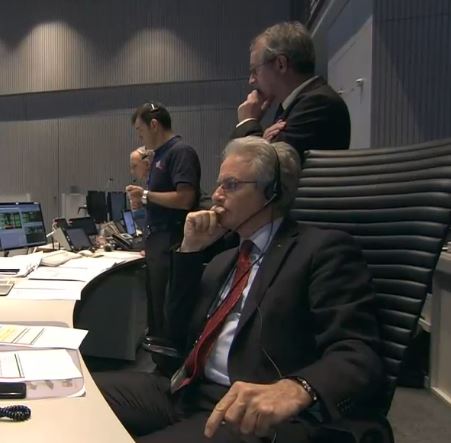
Waiting for a sign of life2

We got it

2:20pm GMT

The first image taken by Philae of Rosetta, just a short time after deployment. Unprocessed, so not high quality, but convincing proof that Philae is on its way to 67P
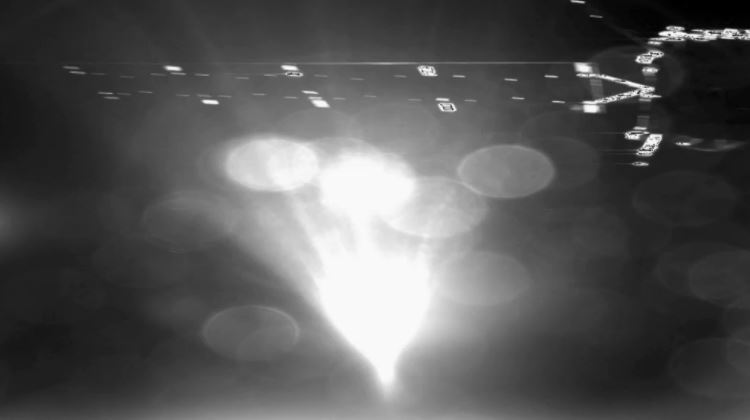
Rosetta as seen from Philae

2:40pm GMT

Telemetry data from Philae show that it is following the calculated trajectory accurately. The landing will be the most critical part. Everybody at Esoc keeps his/her fingers crossed.

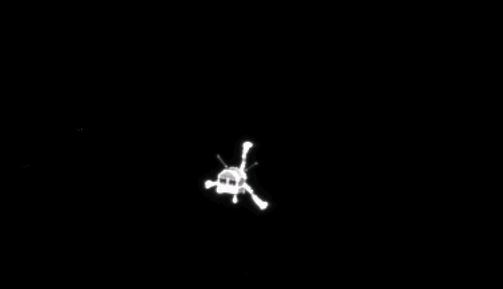
Here is an image taken by Rosetta’s Osiris camera of the descending Philae lander. Amazing. The landing arms are out.
filae

3:30pm GMT

Waiting now for news about the landing. Personally I do no like the optimistic way of talking about success. There is a reasonable chance of failure, and then the disappointment will be huge.

4:05pm GMT

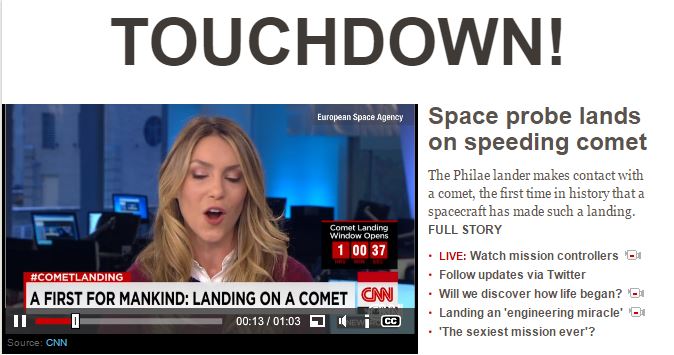
Success? Or not? It seems Philae has landed. Congratulations

And within minutes the news is spreading all over the world…:-)
CNN

UPDATE 14 NOVEMBER

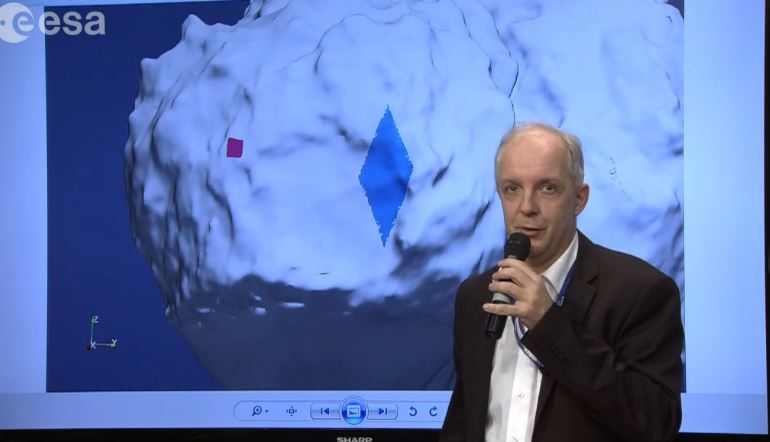
We know now that the Philae has really landed, but not without difficulty! The harpoons meant to anchor the lander, did not fire, so the lander bounced back after touchdown. Because of the low gravity of the comet, it took almost 2 hours before the second touchdown! Then, a few minutes later, the third and final touchdown. The first bounce took the lander up, about 1 km vertically, but also possibly the same distance horizontally. So at the moment the scientists are not sure where actually the Philae landed! During a live broadcast, 13-11, one of the lead scientists explained that the intended landing location was the red square (see below). But after the two bounces, the probable location is now within the blue “lozenge”
location

Because the Philae is not anchored, some of the planned experiments (like drilling to obtain and analyse some comet material) will be risky, as the lander might loose its balance and topple over.

It seems that the Philae has landed in a location that is more rocky than intended, maybe even beside a cliff. Those rocks may obstruct sunlight from reaching the solar panels of Philae. At the moment Philae is using the energy of its batteries, but soon it will depend on solar energy.

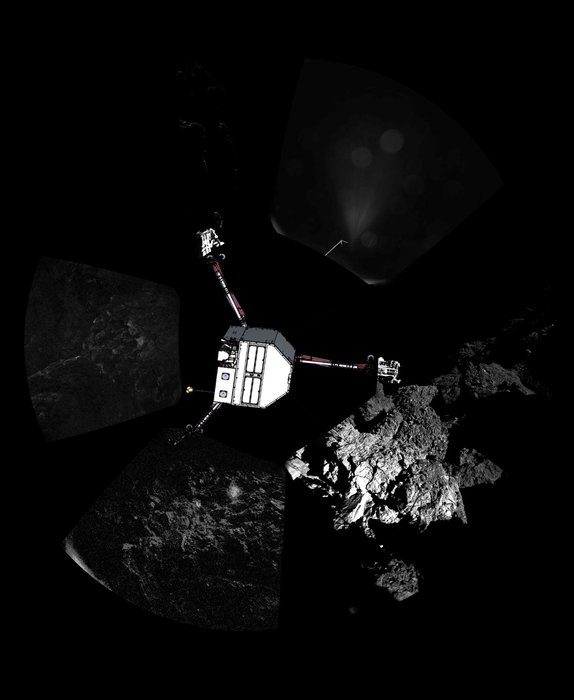
So there are minor(?) problems, which can hopefully be solved. Still the landing is an awesome achievement and at the moment the lander is already collecting scientific data and sending them to Rosetta. Also pictures of the surroundings have been taken. Here are first results, not yet fully processed. To the left a series of six “panoramic” pictures. On some of them a foot of the Philae can be seen. The collage to the right shows the same pictures, but with Philae superimposed.

ESA_Rosetta_Philae_CIVA_FirstPanoramic-838x1024

Comet_panoramic_lander_orientation_node_full_image_2


The Tree of Life

The Evolution Theory of Darwin is now generally accepted, although an astonishing 42% of the American population still thinks that the Christian God created humans more or less in their present form, about 10.000 year ago, according to a Gallup poll, held in May this year!

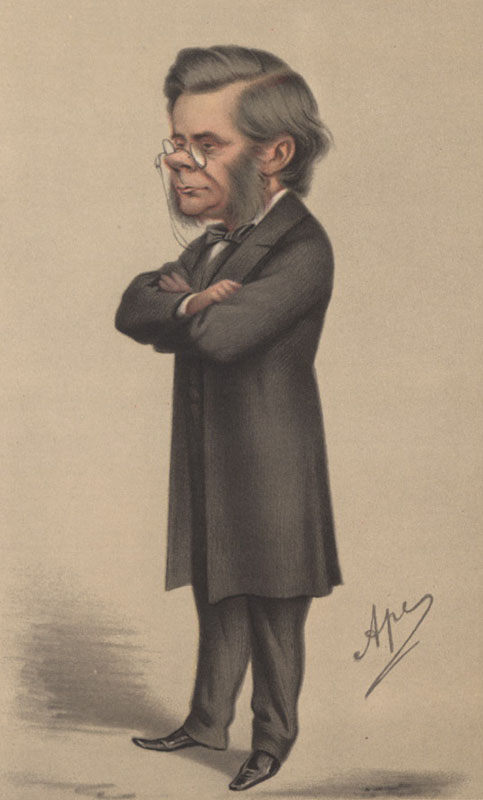
Huxley

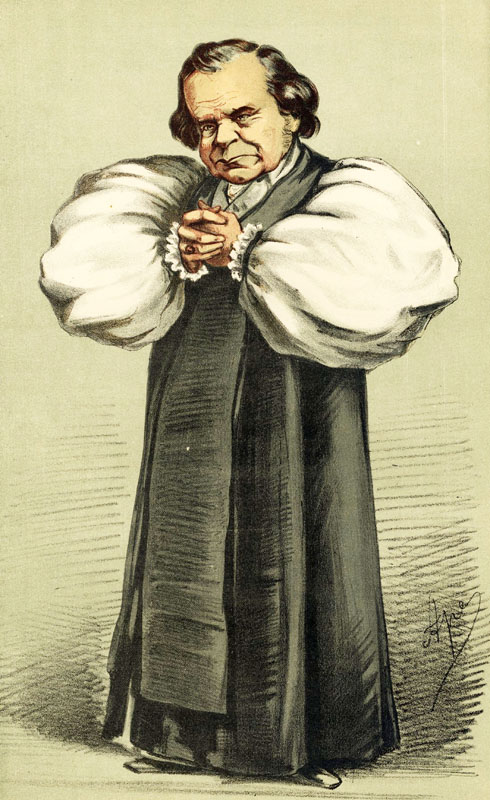
Wilberforce

In 1860, after Darwin had published his book “On the Origin of Species, a debate was organised in Oxford between proponents and opponents of this new theory. Supposedly in this debate Bishop Wilberforce asked proponent Huxley  whether it was through his grandfather or his grandmother that he claimed his descent from a monkey

Huxley is said to have replied that he would not be ashamed to have a monkey for his ancestor, but he would be ashamed to be connected with a man who used his great gifts to obscure the truth.

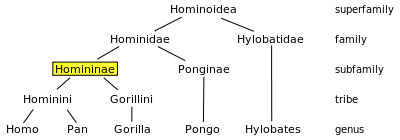
Actually both were wrong in assuming that humans descend from monkeys. Humans and monkeys have a common ancestor which may have resembled neither a human nor a monkey. Our closest relatives are the chimpanzees and the bonobos and our Last Common Ancestor (LCA) is estimated to have lived about 6 million years ago. For the LCA with the gorilla we have to go back ~ 7 million year, for the orang utan ~ 14 million year and for the gibbon ~ 18 million year.

Here is our extended family, in a diagram and as a collection of (baby) photos.

Our family

Homo: Humans                         Pan: Chimpanzees & Bonobos Gorilla: Gorillas                Pongo : Orang Utan                 Hylobates: Gibbons


our family

Of course the story does not end here. Our extended family belongs to the class of the “placental” mammals, together with mice, elephants, whales and bats and more than 5000 other species. The LCA of this (sub)class has lived around the time that an asteroid impact in Mexico may have caused the extinction of the dinosaurs, about 65 million year ago.

Last year an interesting article was published in Livescience: Meet Your Mama: First Ancestor of All Placental Mammals Revealed . It is an attempt, using advanced techniques, to determine the age of our Last Common Ancestor. In this article even an artist expression is given of our LCA (by palaeoartist Carl Buell )

Our maternal ancestor

Now, look at this picture carefully. This could be the (maternal) ~ 10 million-greats-grandmother of every living mammal, including you and me! Think about that for a while. You came from the womb of your mother, as she did from the womb of your grandmother. Repeat that ~ 10 million times and you end op with this shrew-like critter.

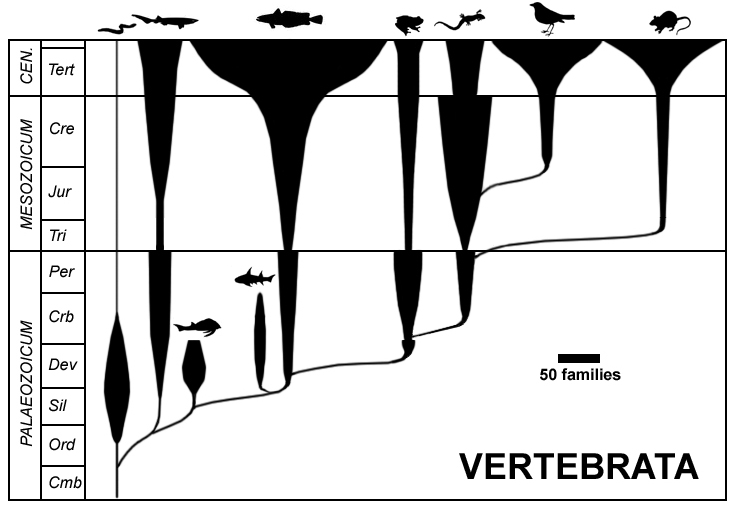
The Mammals are a class in the (sub)phylum of the Vertebrata, which contains six more classes (birds, reptiles, amphibians and three classes of fishes). Also here there has been a Last Common Ancestor, living somewhere around 500 million year ago. May have looked like a kind of segmented worm, with a gut, a mouth and an anus…:-)

Look at this interesting way to show the development of the seven vertebrate classes. To the left you see the geological eras Cambrium, Perm, Trias etc. The thickness of the various classes indicates the number of families in the class.

Vertebrates

Notice the sudden change in thickness at certain times. They mark mass extinctions.. During the Perm-Trias extinction ( ~ 250 million year ago) numerous families and species became extinct.  The other extinction shown is the one caused by the asteroid impact, 65 million year ago. Note the reduction of the reptile class (dinosaurs!)

The Vertebrata phylum belongs to the kingdom of the Animalia, together with eight other phyla. The most important of them are the Arthropods (insects, spiders, lobsters, centipedes)  Sponges, sea urchins, jellyfish, earthworms are all animals and have their own phylum.

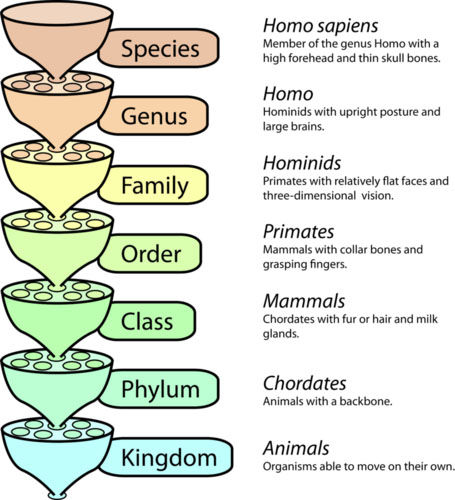
Confused by all these concepts like  family, class, phylum, kingdom? This part of biology is called taxonomy Here is a diagram of our human lineage.

human taxonomy

To keep it simple, I have skipped the category Order (we are Primates), taken the sub-class Placental Mammals and the sub-phylum Vertebrata, because the term is more familiar than Chordates.

So we humans are a member of the kingdom Animalia. Together with how many other species? Present count is ~1.5 million (mostly insects…haha) Estimated total animal species count between 2 and 20 million…


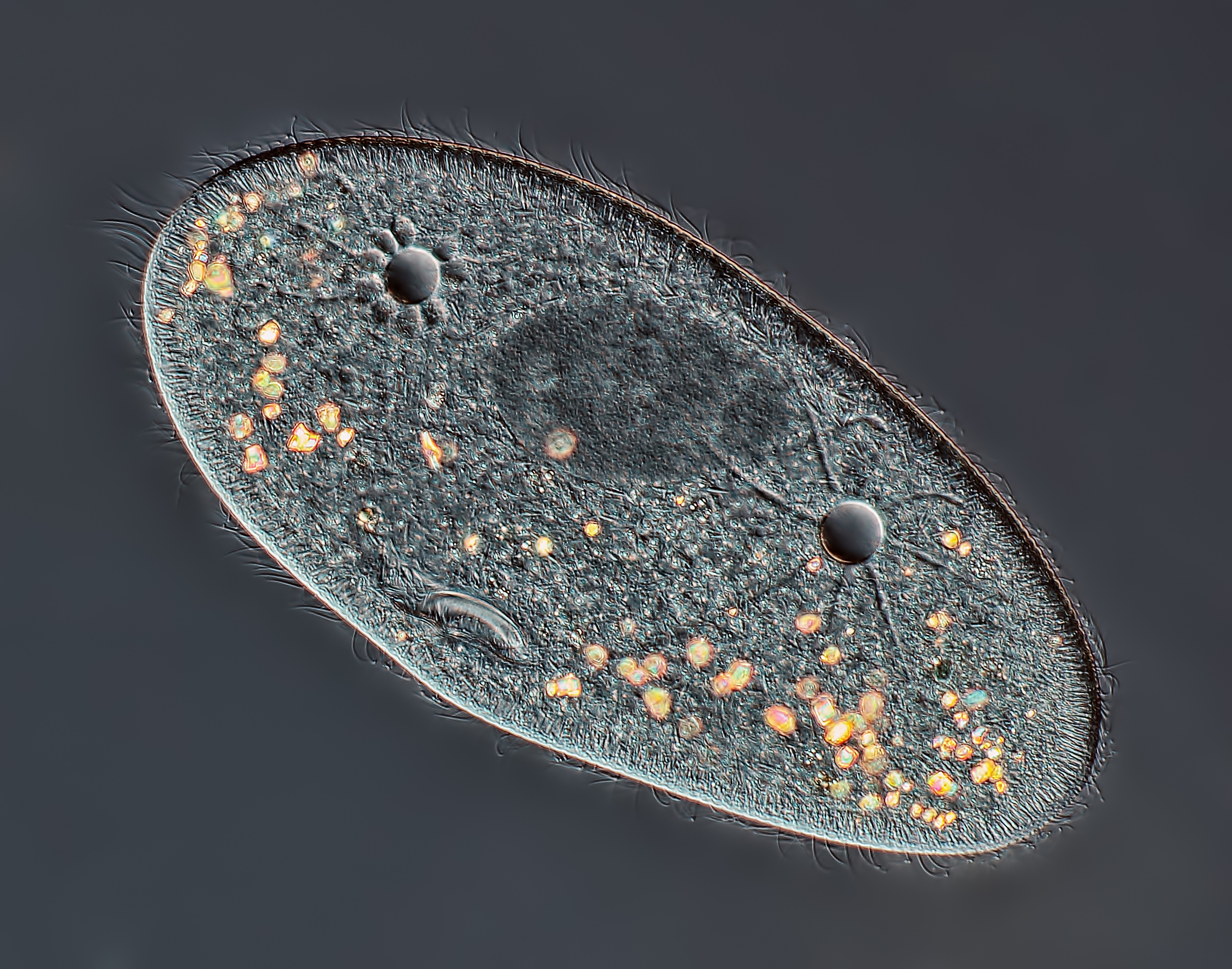
The kingdom of animals. Are there more kingdoms? Yes, there is also the kingdom of plants and the kingdom of fungi. All three contain multi-cellular organisms. And there are other kingdoms of unicellular organisms, like the paramecium, almost always present in stagnant water, and visible under the microscope                                                                                                                                                                                                                     Paramecium

Keep in mind that there has been a Last Common Ancestor of you and this amoeba-like critter! 

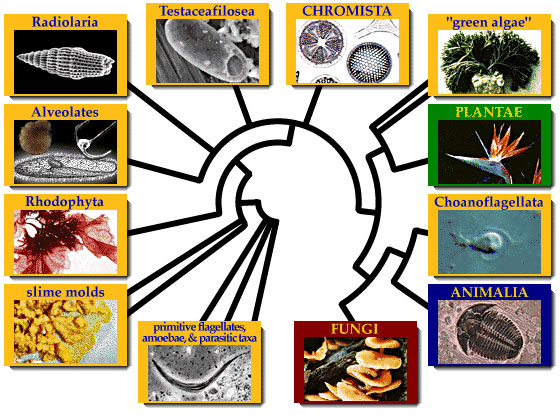
Why are these kingdomscombined together? Because they share a very important property: their DNA is contained in a separate part of the cell, the nucleus. These kingdoms form the domain of the Eukaryota  Here is a visual representation of the kingdoms in this domain.

eukaryota

Again, keep in mind that there has been a LCA of all the organisms in this picture  Although we have to go back far in time…:-) About 2 billion years, there is still a lot of discussion going on about the timing. But it is clear that developing a nucleus containing the DNA and organising the various functions of the cell was a major breakthrough in the evolution of life.

Do cells exist nowadays that do not have a nucleus? Sure! There are two more domains where the cells have no nucleus. One of them will be familiar to everyone, the domain of the Bacteria.  The other one is the domain of the Archaea, also a kind of bacteria and only recognised as a separate domain during the last decade. Click here if you want to know more about the differences between the two (warning, very technical).

Bacteria are small organisms but there are many of them. The number of different species is unknown, estimates vary between 10 million and 1 billion…! They are everywhere! There are typically 40 million bacteria in a gram of soil and a million bacteria in a millilitre of fresh water. And don’t forget the bacteria in our own body. There are about ten times more bacteria in our body than there are body cells! On average about 2 kg in an adult human body, mainly in your gut. And important for your digestion, you would die without them.

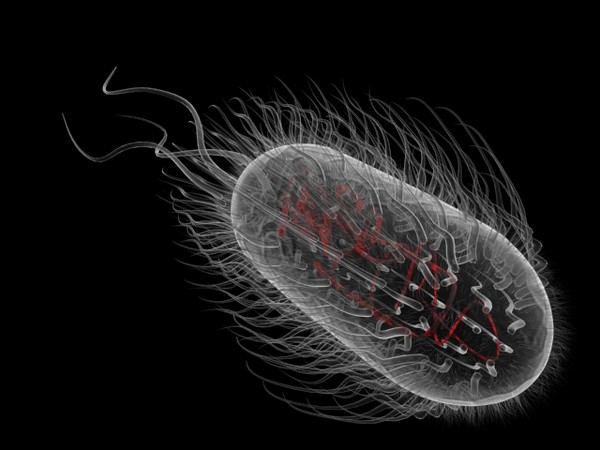
Here is a picture of the most common bacteria in your gut, the E. Coli bacteria. I will write a separate post later about bacteria and the human body.

e-coli

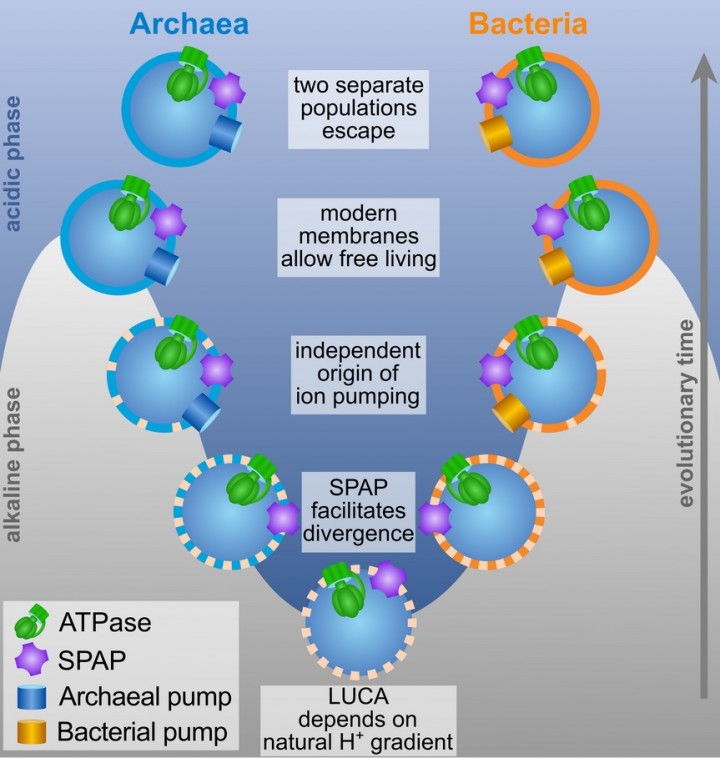
So, finally we have arrived at the beginning of life. About 3.5-3.8 billion years ago there lived the Last Universal Common Ancestor (LUCA) of every organism living now. We do not know much about it. It may have lived in the deep sea, near to a volcanic vent. Read Four Billion Year-Old Mystery of Last Universal Common Ancestor Solved for more information. Here is a diagram from this site, showing the first major evolutionary split, in Bacteria and Archaea .

luca

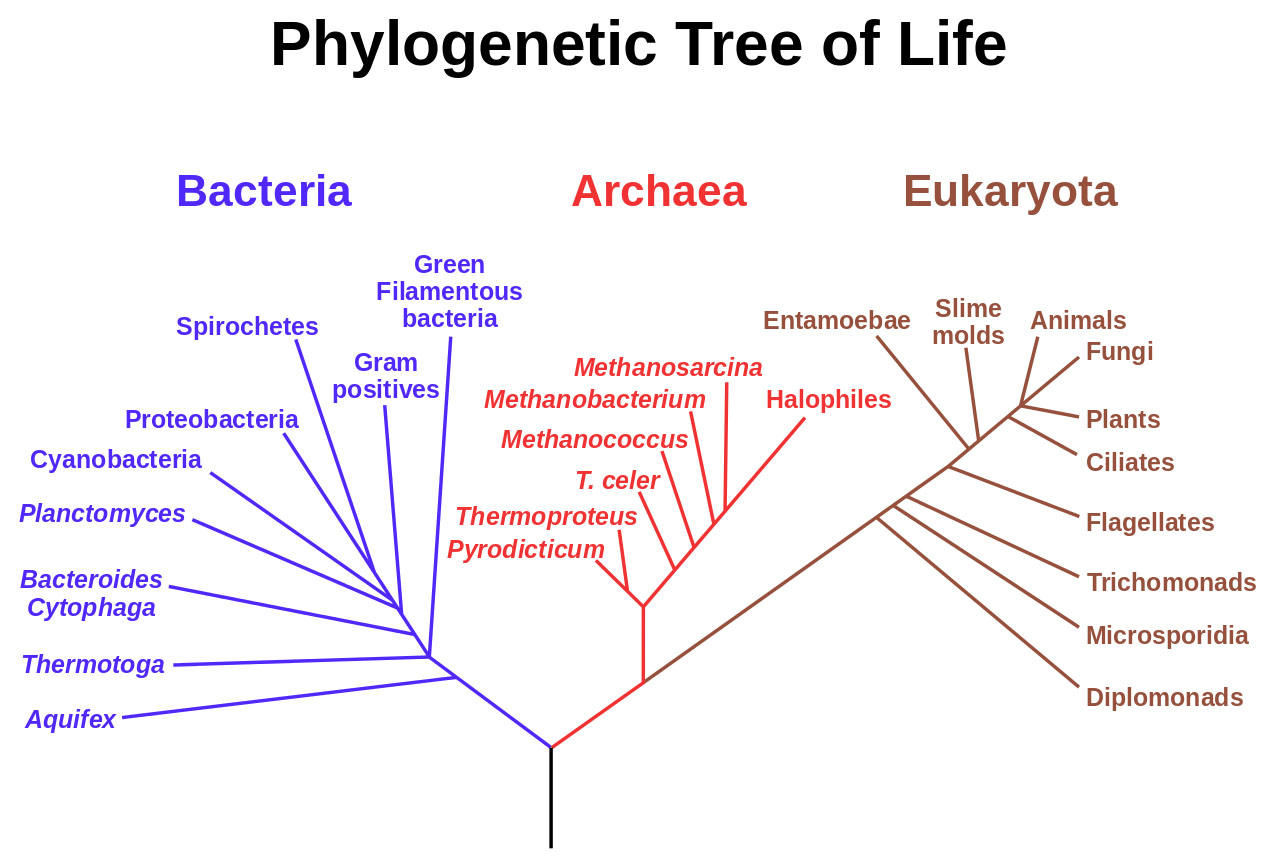
And here is the tree of life, showing the split in the three domains. First the split in Bacteria and Archaea, with the Eukaryota branching off from the Archaea. Note that the Kingdoms of Eukaryota in the graph below have often different names from the names in the visual representation above. A clear sign how this field of evolutionary biology is still in development.

tree of life

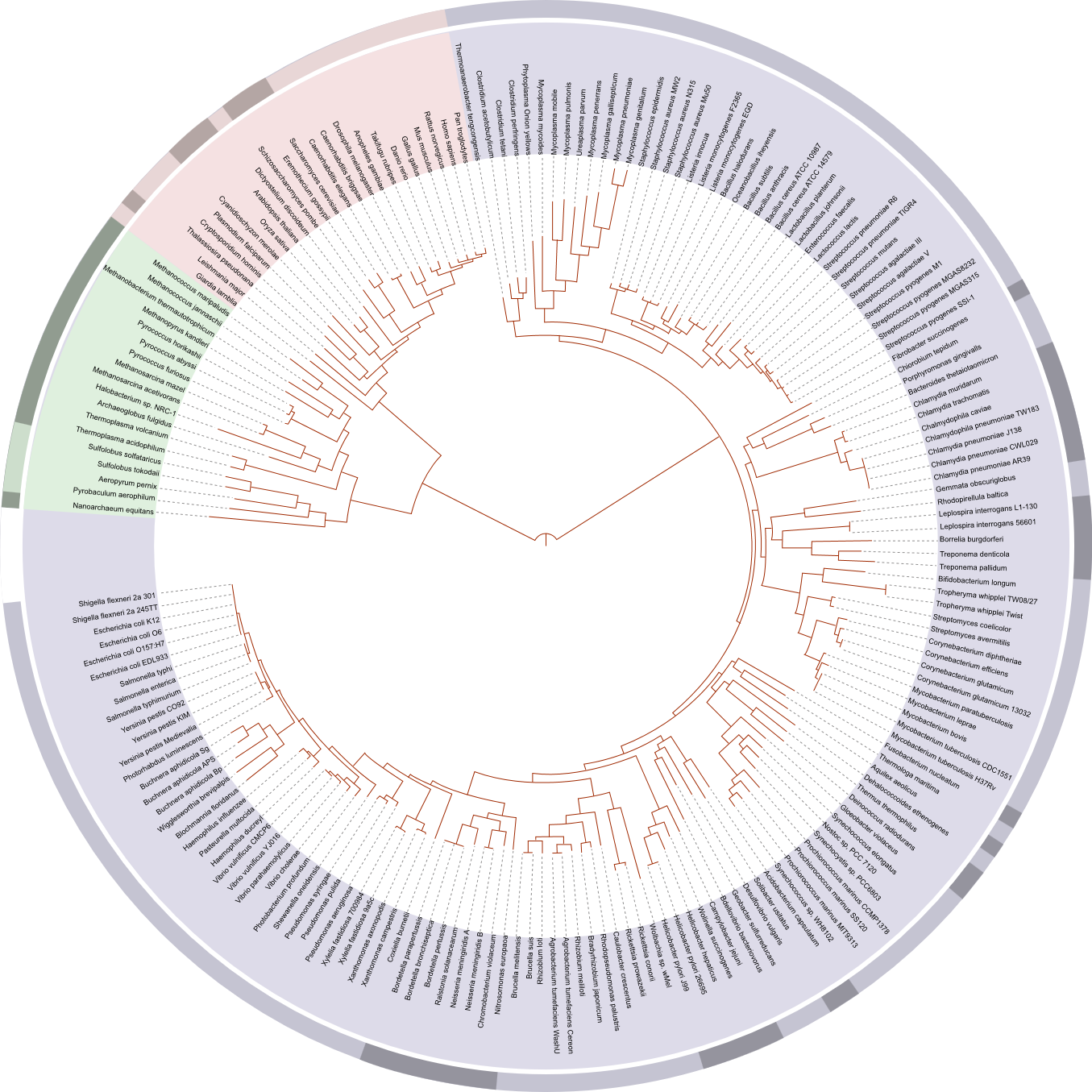
A much more detailed tree of life, although looking less like a tree, you can see below. Click here for a larger version. In blue the domain of bacteria, in green the Archaea and in red the Eukaryota. Each domain showing some of its kingdoms in different shades. Try to find homo sapiens..:-) And notice how huge and complicated the domain of the Bacteria is.

The names in the outer circle of this diagram are representative species in their kingdom. You can spend hours checking details in Wikipedia…:-)  For example Anopheles Gambiae : Mosquito, Oryza Sativa: Rice, Takifugu rubripes : Pufferfish, etc.

Tree_of_life_SVG

That a single tree of life can be constructed for all the living organisms, suggests that life has only started once on earth.  If life arose repeatedly then all of the separate origins must have disappeared without trace.

All living organisms belong to one big family with a common past of ~3.5 billion years. Isn’t that a nice conclusion for this post…:-)?

_______________

Much of the information in this post comes from the monumental book The Ancestor’s Tale, written in 2004 by Richard Dawkins

The Ig Nobel Prizes

Last week for the 24th time the yearly Ig Nobel prizes have been awarded. The ceremony took place at the prestigious Harvard University in Cambridge, Massachusetts , USA
The Ig Nobel prizes?

Here is what the supporting foundation for Improbable Research says about it:

IG Nobel prizes are awarded for research that makes people LAUGH and then THINK

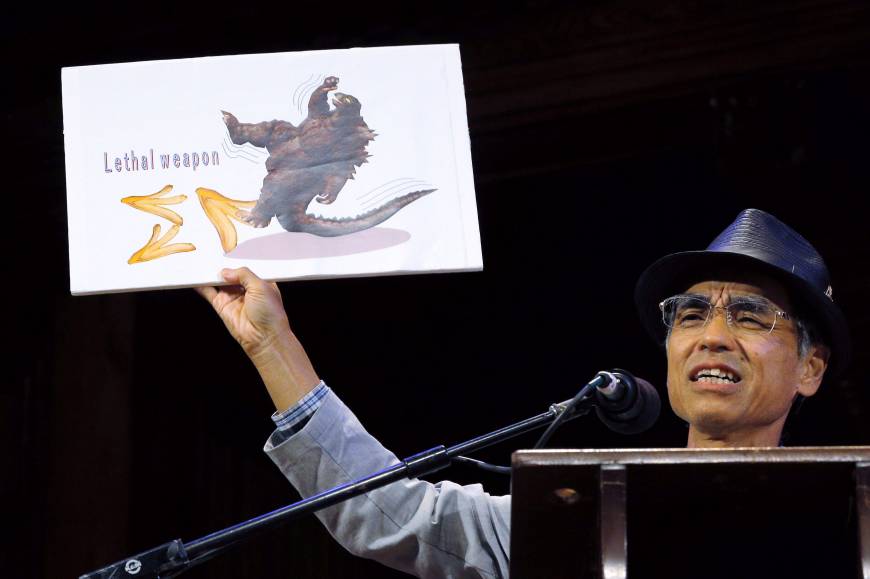
This year the Ig Noble prize for physics has been given to the Japanese scientist Kiyoshi Mabuchi of Kitasato University for studying the hazards of stepping on a banana peel!  Here he is, during the official ceremony

Ig Nobel prize


Don’t underestimate his research! Here is the official paper: Frictional Coefficient under Banana Skin.

A few more examples of Ig Nobel prizes.

2014 Neuroscience:  to Jiangang Liu, Jun Li, Lu Feng, Ling Li, Jie Tian, and Kang Lee, for trying to understand what happens in the brains of people who see the face of Jesus in a piece of toast.

2013 Biology/Astronomy: Marie Dacke, Emily Baird, Marcus Byrne, Clarke Scholtz, and Eric Warrant, for discovering that when dung beetles get lost, they can navigate their way home by looking at the Milky Way.

2012 Medicine: Emmanuel Ben-Soussan and Michel Antonietti, for advising doctors who perform colonoscopy how to minimize the chance that their patients will explode

Click here for the complete list. In the beginning the prizes sometimes had a sarcastic undertone, like for example

1998 Physics: Deepak Chopra of the Chopra Center for Well Being, La Jolla, California, for his unique interpretation of quantum physics as it applies to life, liberty, and the pursuit of economic happiness

But now it has become more serious, the prize winners eagerly travel (at their own expenses) to Harvard to attend the ceremony and the prizes are given by “real” Nobel Prize winners.

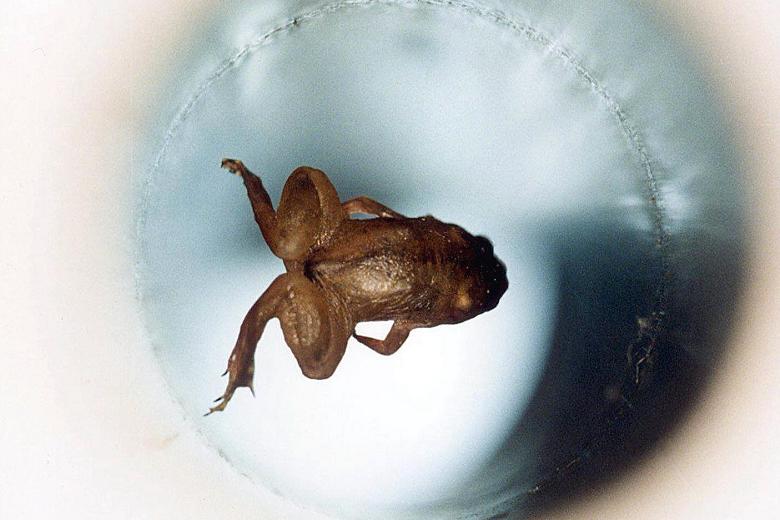
There is even one scientist who has won BOTH the Ig Nobel prize AND the Nobel prize! Andre Geim, a Soviet-born Dutch-British (!) physicist, won the Ig Nobel prize for physics in 2000 experimenting with magnets to levitate a frog. Here is a picture of the poor critter. If you are wondering how this is possible, it is because of diamagnetism

Levitating frog

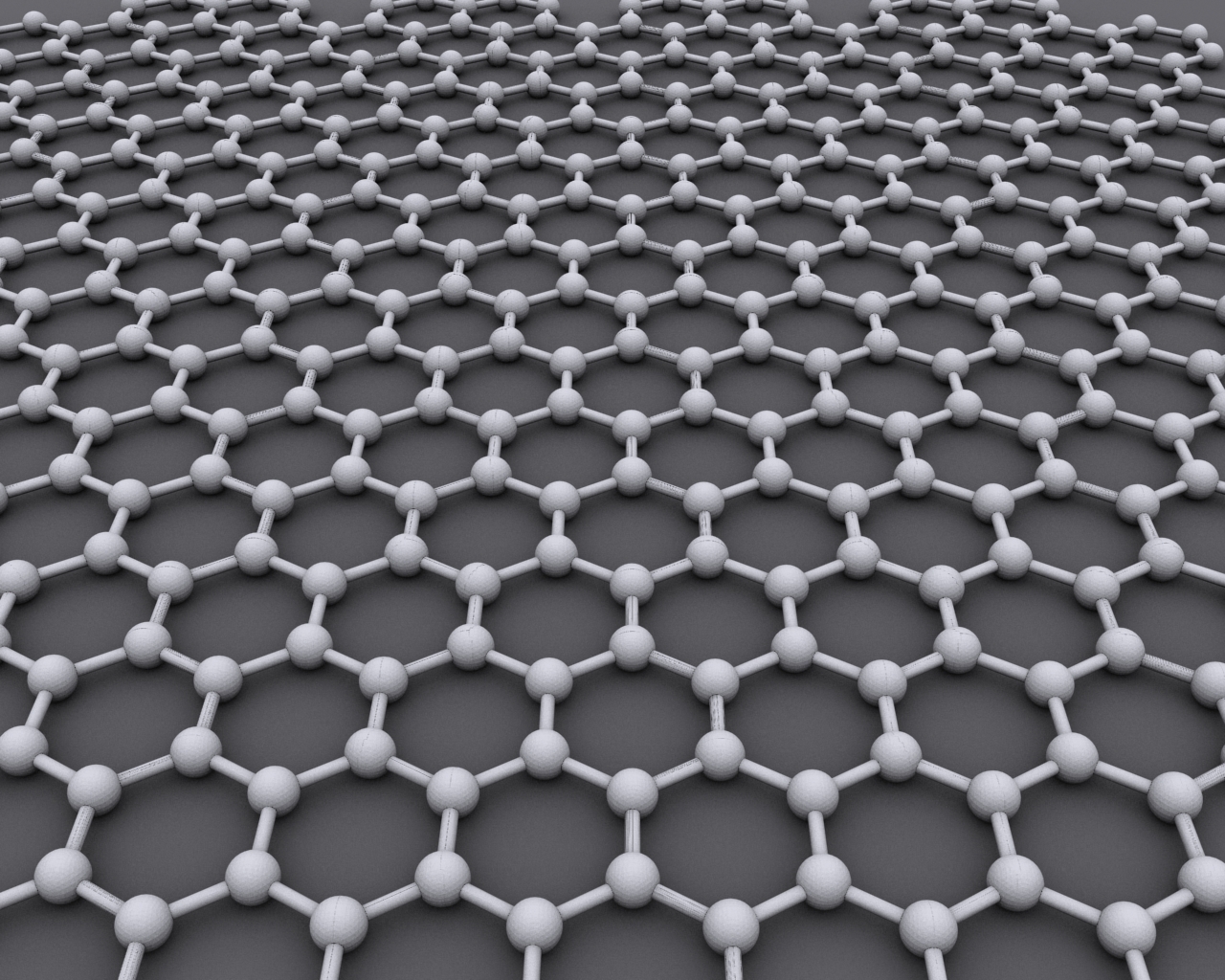
Ten years later, in 2010, Geim received the Physics Nobel prize for his research about the new wonder material of graphene, a two-dimensional layer of carbon atoms.

Graphene

The way he and his collaborator Novoselov managed to make a single layer of carbon atoms? They used Scotch tape!

Ok, here is one more Ig Nobel prize…:-)

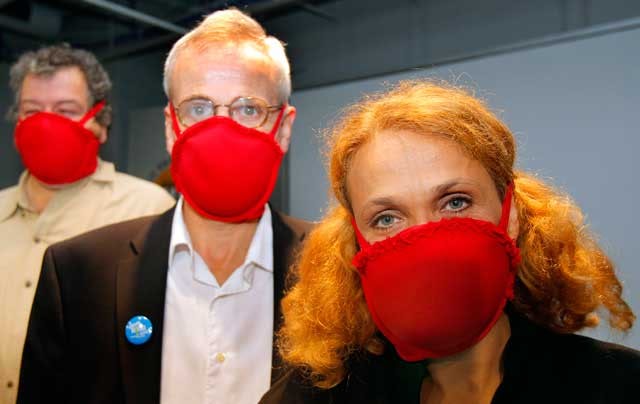
2009 Public Health: Elena N. Bodnar, Raphael C. Lee, and Sandra Marijan of Chicago, US, for inventing a bra that can be quickly converted into a pair of gas masks—one for the wearer and one to be given to a needy bystander

bra_gasmask

By the way, ever heard about the Darwin Awards?  Maybe a suitable topic for another post…:-)

Where does the Moon come from?

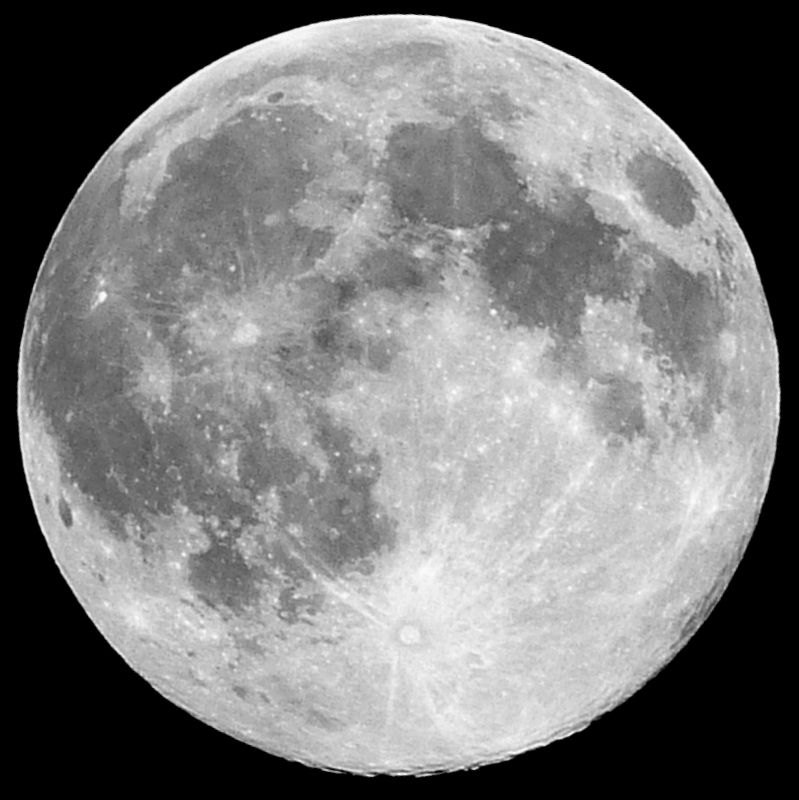
Last week it was full moon, and not just an ordinary one, but a perigee full moon, often popularly called a “Super Moon”. The orbit of the moon around the earth is elliptical, so the distance between moon and earth varies between 363.104 km (perigee) and 406.696 km (apogee). When a full moon occurs at perigee, the moon looks larger and brighter. It’s not a rare phenomenon, 9 September this year will  be the next perigee full moon, and June 2013 there was another one. It’s a bit of a media hype.

My friend Chuan took a beautiful picture of this perigee full moon, in the middle of the night, with his point and shoot camera(!), handheld, 24x zoom.

perigee full moon

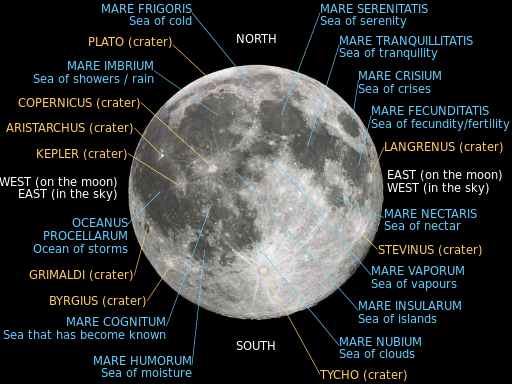
The dark regions are called Mare (Sea) because in the past people believed that there was water on the moon. Actually they are basaltic plains, formed by ancient volcanic eruptions. Huge craters mark the places where meteorites have hit the moon. Here is a map of the moon with the names of craters and seas.

Names of seas and craters

We can see only one side of the moon because the moon is “tidally locked” to the earth, always showing the same face to us. This interesting phenomenon deserves a separate post..:-)  So how does the other (“dark”) side of the moon look like? It’s only after the start of the space age that we were able to explore. With a surprising result. Here is the other side of the moon

Far side of the moon

A lot of craters, but no “seas”. Why so different? Which leads to another, more basic question, where does the moon come from? Was it “born” at the same time as the sun and the other planets, ~4.5 billion years ago? Many hypotheses have been formulated, here is the theory that is generally accepted at the moment. It is called the Giant Impact Hypothesis

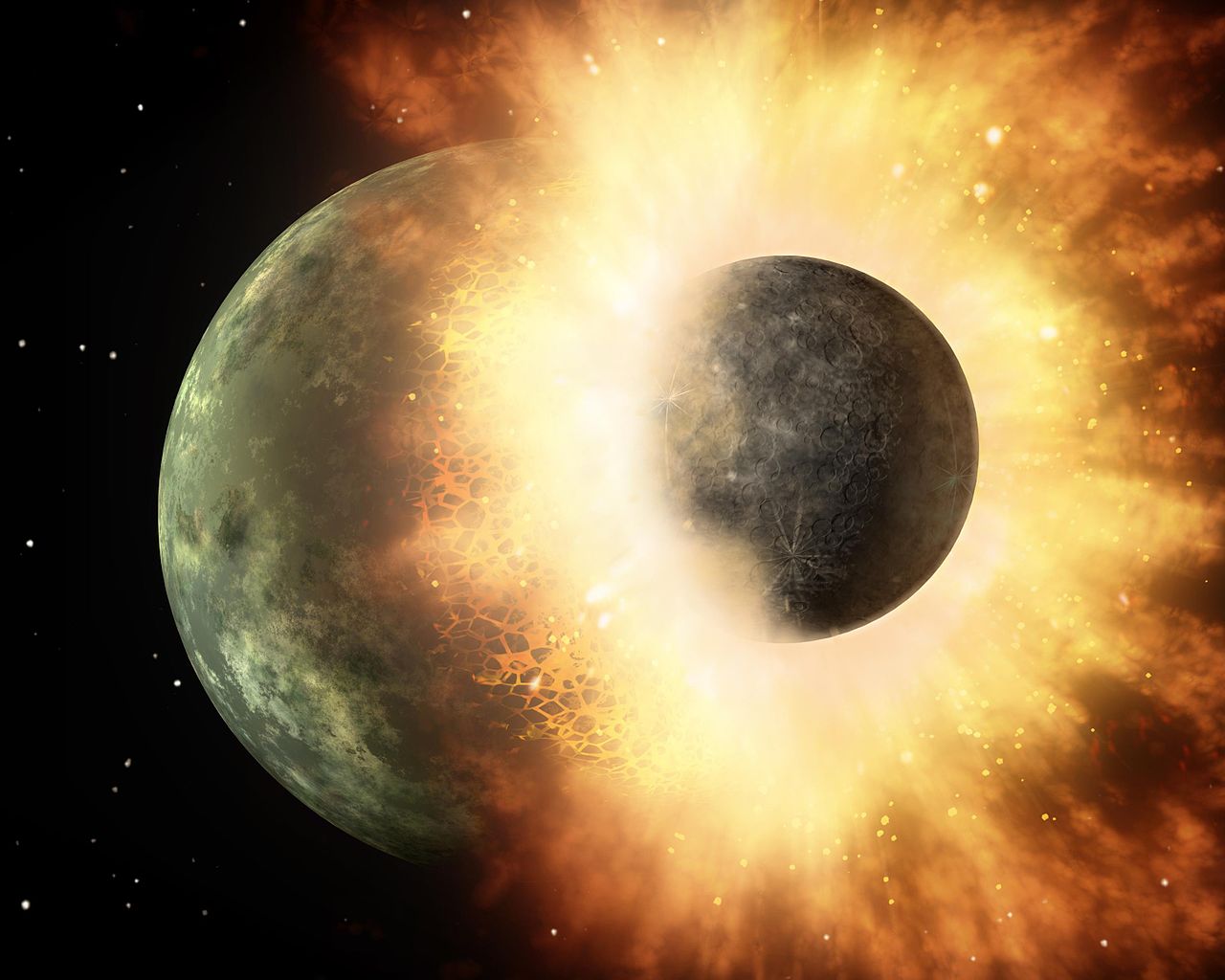
Not long after the formation of the solar system, there was another planet, about the size of Mars, which collided with the (young) Earth. Here is an artist impression of this collision.

Theia meets Gaia

This hypothetical planet has been named Theia, after a Greek goddess, the mother of Selene, the goddess of the moon. The effect of this dramatic collision was that a large part of Theia and Gaia, as the young Earth is sometimes called, melted together, forming the present Earth, but another part of Gaia and Theia was thrown out during the collision and coalesced into the Moon.

So powerful was this collision that the new Moon and probably also part of the Earth consisted of molten magma. The Moon, being smaller, cooled faster, and because of the heat of Earth and the tidal locking, the near side of the moon got a thinner crust than the far side! According to this theory that might be the reason that the near side has had more volcanic activity than the far side. There are many more arguments in favour of this giant impact hypothesis.

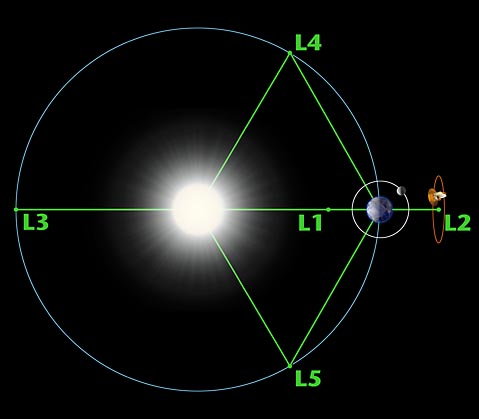
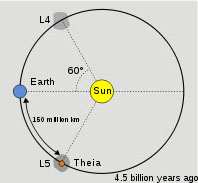
Of course the next question is then, where did Theia herself come from? A very promising idea is that this planet might have been formed in  about the same orbit as Gaia. In 1772(!) the French mathematician Lagrange studied the properties of rotating systems, like the earth orbiting the sun. He discovered that there exist points in such a system, where other objects can exist in a stable way. There are five such points, nowadays called Lagrange points

lagrange points

In the Lagrange points L4 and L5 the gravitational force of Sun and Earth balance in such a way, that objects will corotate with Earth around the Sun. During the formation of the solar system, mass could have accumulated in for example L5 and formed Theia. Through the disturbance by other planets (Venus for example), this planet could, after millions of years, leave L5 and collide with Earth.

theia1

theia2

theia3

Just skip this last part if you find it too complicated…:-)

Rosetta meets 67P

In January I have published a post about the Rosetta spacecraft, launched in 2004 with as destination a comet, the  67P/Tsjoerjoemov-Gerasimenko. It had gone in hibernation in June 2011 and on 20-1-2014 it woke up again.

In the past six months the spacecraft has been coming closer to the comet while its thrusters have slowed it down in a number of carefully planned maneuvers.

Today (6-8-2014) was another critical moment. In a thrust of more than 6 minutes, the spacecraft should reduce its speed relative to the comet to about 1 m/s, while at a distance of ~ 100 km away from 67P.

It has been confirmed that the operation was successful. Mind you, the comet and Rosetta are at the moment moving between Mars and Jupiter, on their way to the Sun. The distance to earth is about 400 million km, so signals between Rosetta and Earth take more than 20 minutes!

Check this fascinating link to follow Rosetta in its complicated trajectory, from the start in 2004 until the end of the mission in 2015: Where is Rosetta

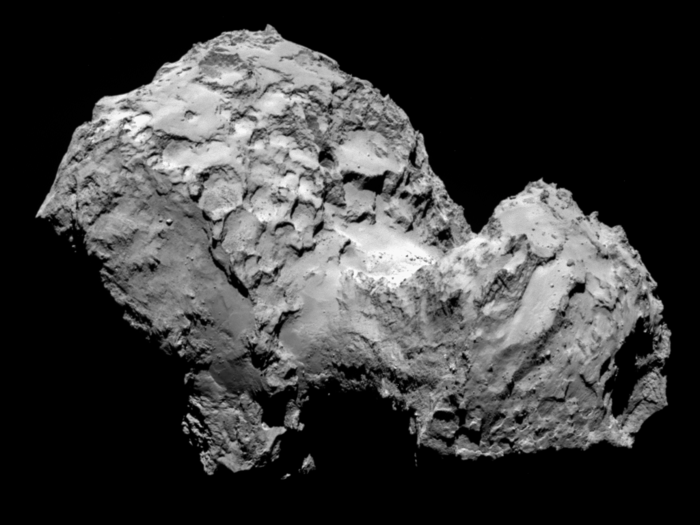
As Rosetta is now close to the comet its on board camera has taken pictures of the comet. Here is one, taken three days ago. Comet An amazing picture. The comet has already been nicknamed “rubber duck”. A “binary” comet, consisting of two parts! And it doesn’t look like a “dirty snowball” at all. To say that the scientists are excited, would be an understatement..:-)

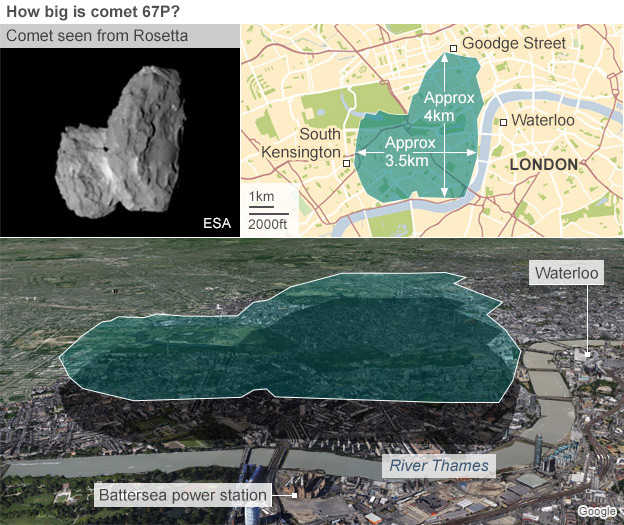
Here is another interesting picture, superimposing the comet on the city of London, to give an impression of its size.

67P_London

What will happen next? Rosetta will follow a complicated triangular trajectory the coming weeks (using again its thrusters) to test and explore the gravitational field of the comet. Here is a YouTube of its proposed trajectory. Almost like an abstract ballet..:-).

The sudden orbital changes are caused by the thrusters, the curvature by the gravitational field of the comet. The complicated shape of the comet may make it more difficult to determine its gravitational field. Finally Rosetta will settle down in a stable orbit around the comet, maybe as close at 10 km,  and then, in November, it will launch its small probe Philae, to make a soft landing on the comet.
That will become another update…:-)

For more information, follow the very informative Blog of Rosetta

Wake up, Rosetta!

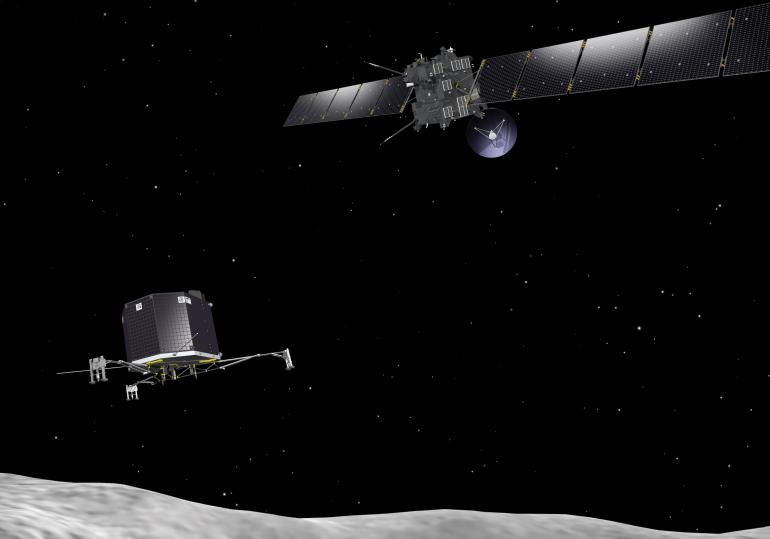
Almost ten years ago, in March 2004, the European Space Agency (ESA) launched a spacecraft with an ambitious mission: to orbit and land on a comet. The spacecraft was called Rosetta. Once in orbit around the comet, a small probe, called Philae, would be launched to make a soft landing on the comet. In this artist impression you see Rosetta in orbit and Philae on its way down to the comet.

Rosetta and Philae

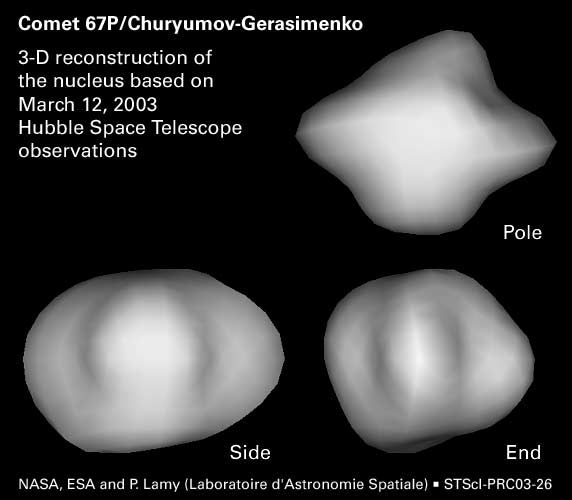
Destination of Rosetta is the comet 67P/Churyumov–Gerasimenko This “dirty snowball” as comets are sometimes called, was discovered in 1969. It has a diameter of 4 km and orbits the Sun with a period of 6.45 year. Comet orbits are very elliptical, when they are close to the sun, some of the comet material evaporates and gives rise to the famous comet tail. At the moment this comet is on its way to the Sun, reaching its closest distance (perihelion) in August 2015. Here is a model of the comet nucleus, generated from images taken by the Hubble telescope.

Nucleus of 67P

If everything goes as planned Rosetta will reach comet 67P/Churyumov–Gerasimenko in May 2014. A few months later, in November 2014, the probe will land on the surface of the comet. End of mission in December 2015.

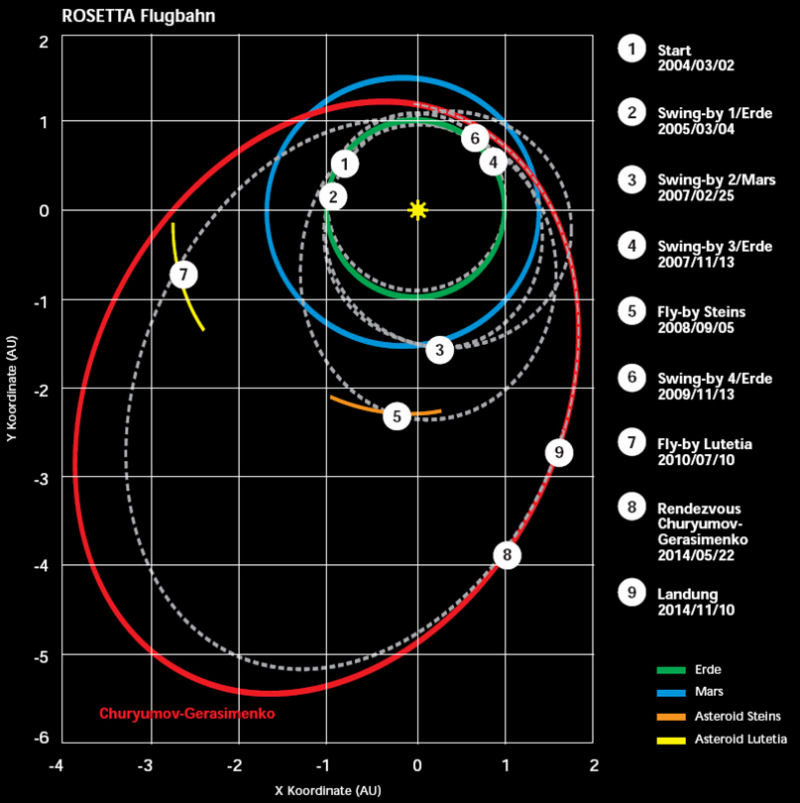
Why does it take so long to reach the comet? Have a look at this diagram, where you see the orbit of the comet (red), the orbits of Earth and Mars (green and blue) and the flight path of Rosetta (dashed line).

Rosetta flight path

The reason for the complicated flight path is that it is not feasible to give the spacecraft enough speed at launch to reach its target. To give the spacecraft its required speed, one or more so-called gravitational slingshots are needed.The principle is this: steer the spacecraft close to a planet or moon. Because these objects have their own (high) speed, the force of gravitation can give extra speed to the spacecraft.  A simple analogy can be found in sports. When a ball hits a stationary held tennis racket, the speed of the ball will basically remain the same (only reversed). But when the player moves the racket towards the ball, the ball will bounce back with a much higher speed.

Rosetta has used four of these slingshots, marked in the diagram above  Three times with Earth (2,4,6) and once with Mars (3). Imagine how accurately the scientists have to steer!

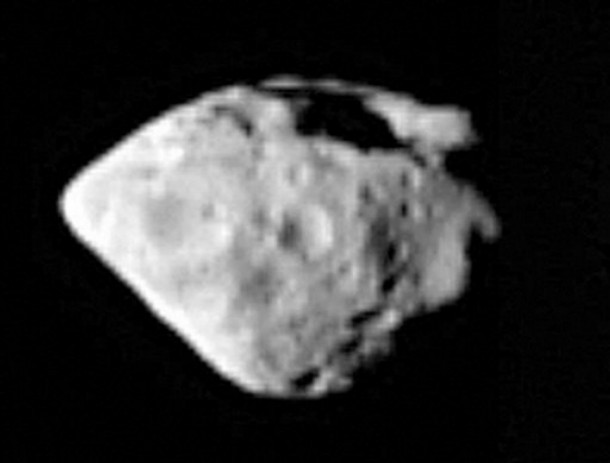
Actually they did it in a clever way so there were a few bonuses..:-) The second slingshot by Earth (4) was performed in such a way that the path of Rosetta would cross the path of an asteroid, Steins, on 5 September 2008! Perfect to test if all equipment was still working correctly. Here is an image of this rather small (diameter ~ 6 km) asteroid, taken by Rosetta during the fly-by (5 in the diagram). Closest distance between the two ~ 800 km, distance from the Sun more than 300 million km. Amazing.

Stein asteroid

The last slingshot brought Rosetta in a very elliptical orbit, similar to the target comet. This is necessary because the spacecraft must approach the comet with a low relative speed, otherwise it can not go into orbit around the comet

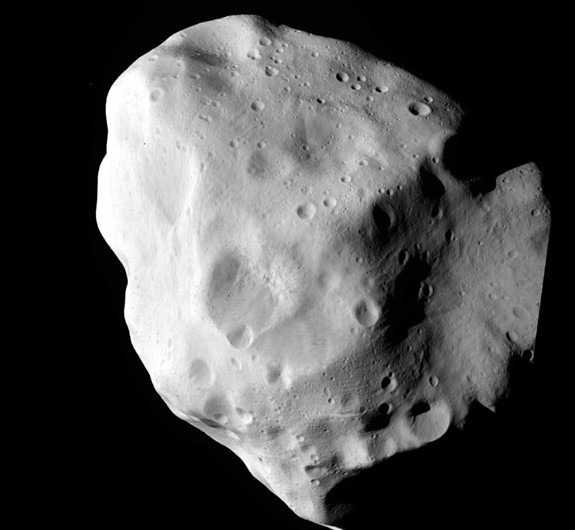
Again a bonus, a spectacular one. The path of Rosetta crossed the orbit of another asteroid, a big one (diameter ~ 120 km), called Lutetia. Here is a picture. Asteroids are as old as the solar system, what an inferno it must have been in the beginning, noticing the surface pockmarked with craters.

Lutetia

The very elliptical orbit of Rosetta after the last slingshot, means that it is moving very far from the Sun. And it depends on the Sun for it uses solar power. The engineers came with an ingenious solution, they let Rosetta go into hibernation!

On 9 June 2011, they sent a signal to Rosetta to switch off all instruments, keeping only the main computer and some heating alive, and starting a timer. It worked, because from then on the spacecraft did not send any signals.

For more than two and a half years there has been no communication with Rosetta! The timer has been programmed to give Rosetta a wake up call on 20-1-2014 at 10.00 GMT. The wake up process will take many hours. The controlled spinning has to be stopped, the antenna has to be pointed to earth etc, etc. It is expected that the first signal should reach Earth around 17:30-18:30 GMT (Malaysia time is GMT + 8 hours).

You can follow the events on Monday 20-1-2014 via live streaming (starts 9:15 GMT):

More information can be found on the ESA Wake Up Rosetta page. They have done a good publicity job. For example they have organised a Wake Up Rosetta competition for the general public. You can create a video and submit it (until tomorrow). Here is the Facebook page where you can view the contributions. And vote for your favourite!

Tomorrow will be a nerve-wrecking and nail-biting day for many scientists!

UPDATE 21-1-2014

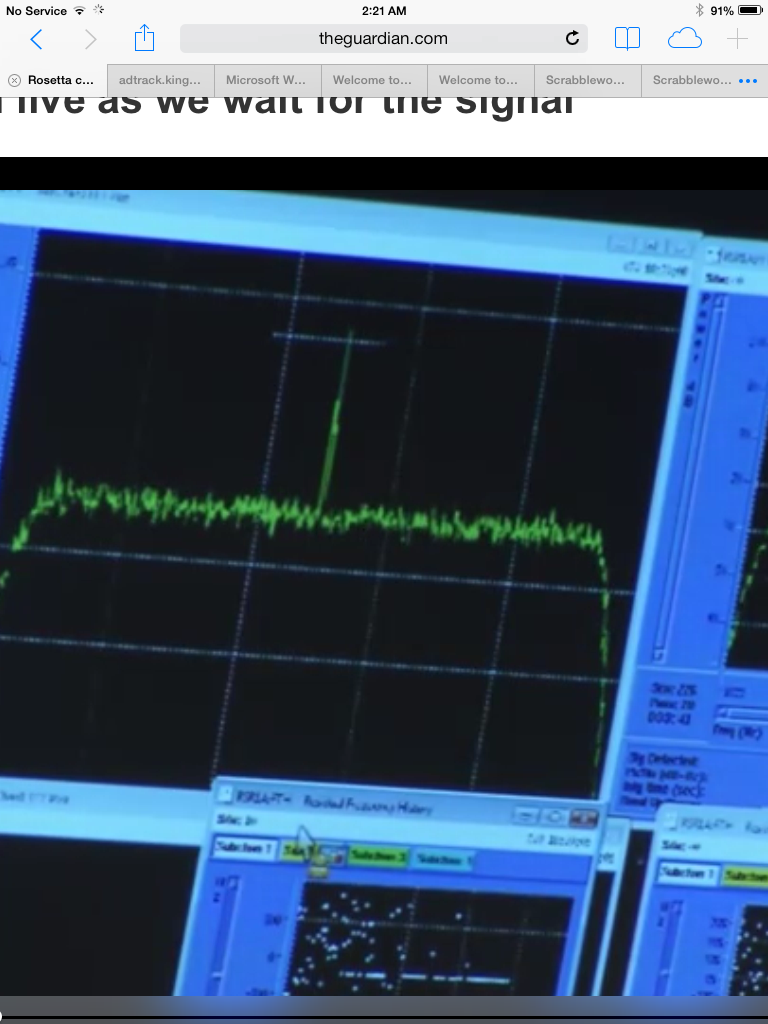
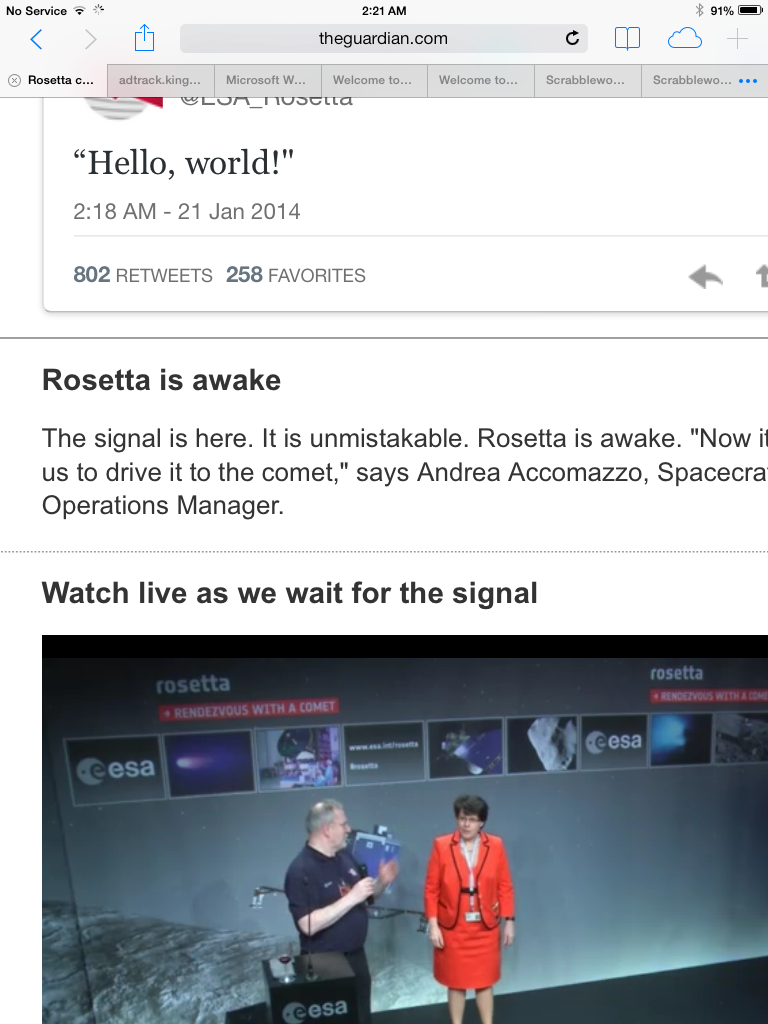
Rosetta has woken up! Yesterday at 18:20 GMT a big applause started in the ESA control room, when a spike appeared in the spectrum analyser. It was the first signal from Rosetta, which had traveled for 45 minutes to reach Earth, 800 million km away.. In Malaysia it was already 2:20 am but I could not sleep, had to watch…:-) Here are two screenshots from the live blog

The signal

Hello World, I am awake

This was a sign of life, next step will be to receive a health report. What a brilliant achievement.

Another update

A friend sent me a link to an ESA webpage: Where is Rosetta An animation of the path of Rosetta through the Solar System. Breathtakingly beautiful. You can zoom in and out, tilt, etc. The page takes time to load, but really worth the effort !


Our Sun again

It is almost one year ago that I gave you an update about the Solar Sunspot Cycle 24. For those who have not read those earlier posts, a short recapitulation.

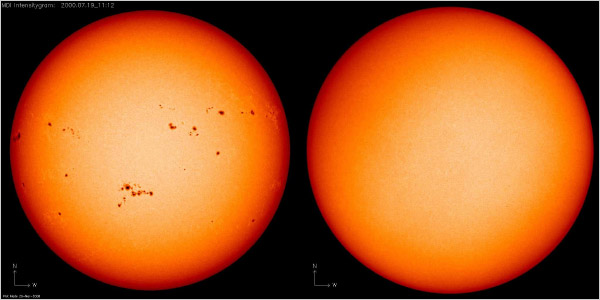
Sunspots are dark spots on the surface of the Sun and related to the sun’s magnetic structure. It is a periodic phenomenon, sometimes there are many, sometimes there are almost none at all. The period is about 11-12 years, and one such a period is called a Sunspot Cycle.

Sunspots

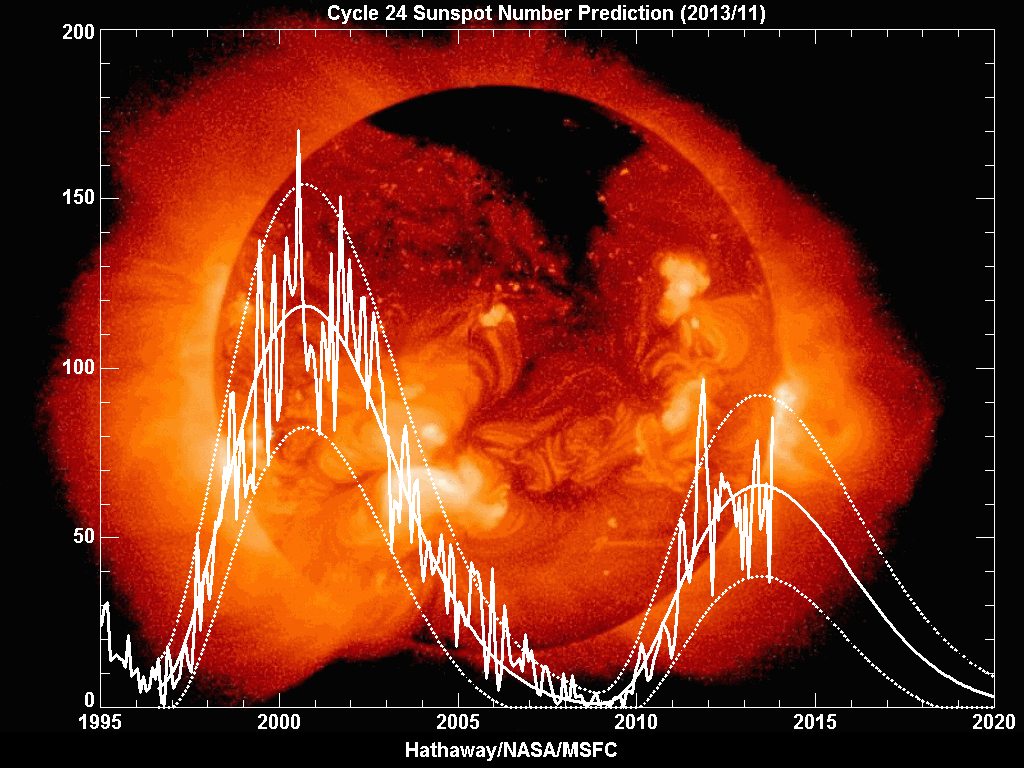
This periodic behaviour was discovered in 1843 by Schwabe, a German astronomer. Rather arbitrarily a numbering was introduced, with cycle 1 lasting from 1755 until 1766. We are now at the maximum of cycle 24. In the picture below the ‘average’ number of sunspots is shown as a function of time, for cycle 23 and 24, updated until November 2013

Cycle 23 and 24

As you see, the maximum is considerably lower than the maximum of cycle 23. And that is the reason that I have published my earlier posts, for example Don’t worry, our Sun is not dead. You can read more background information there.

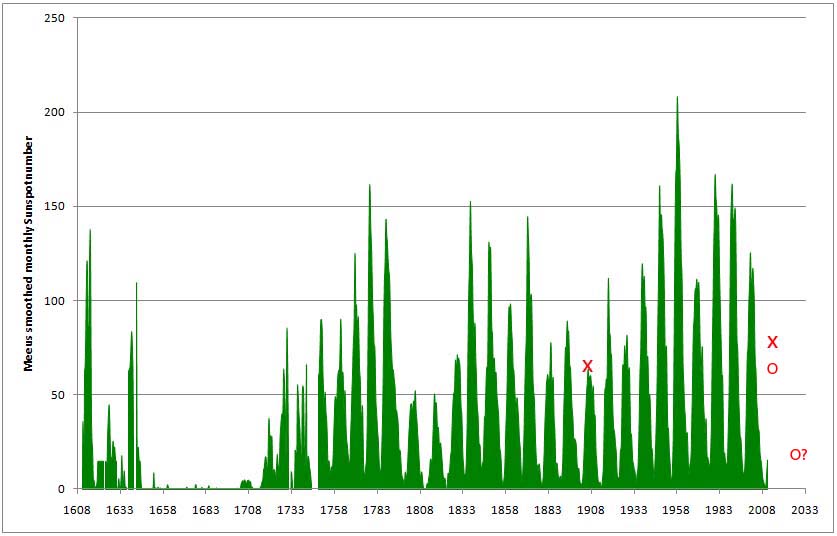
Here is a graph showing you the large variation in these sunspot maxima during the last 500 years. In the last 50 years the sunspot activity has been unusually high, whereas in the second half of the 17th century there was hardly any activity at all. This period is called the Maunder Minimum, whereas the last 50 years are sometimes called the Modern Maximum. Another period of low activity occurred in the beginning of the 19th century: the Dalton Minimum.

Solarcycles

So now the burning question is: are we on our way to a new minimum 

The picture above I have used already in my post, one year ago, How is the Sun doing these days? At that time the prediction was that the maximum would be about 76 and I had marked this maximum with a red cross, comparing it with the low value of 64 in 1906. Now, one year later, we have reached the maximum and it is even lower than predicted, ~ 65 (red circle). Although it is a bit early, a few predictions have been made already for cycle 25, which will peak around 2024. Peak may not be the right word, because the maximum might be as low as 7!

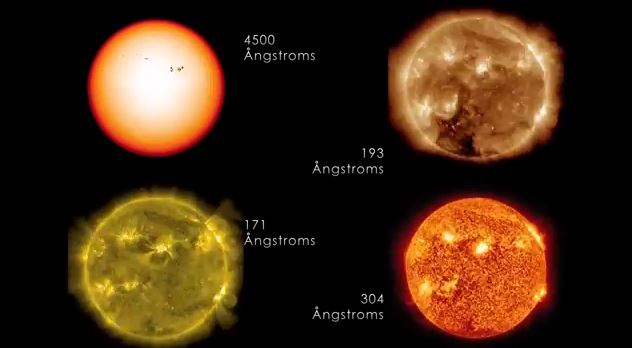
If we are going to a new minimum, will it be Dalton-like or Maunder-like? No one can tell at this moment. We do not really understand much of the underlying mechanism. When we study the Sun in visible light, it looks peaceful, with occasionally a few spots..:-). But look at the Sun in the ultraviolet region, and you see how violent it is.

solar images

Is there a relation between the periods of large/small solar activity and the climate on Earth? During the  Maunder Minimum we had the Little Ice Age.  Is the Global Warming fully due to the hothouse effect of carbon dioxide, or has the Modern Maximum also its influence? This is a sensitive topic, that I will not touch. The next decade we will hopefully learn more.

For more information, here is a very readable article in Sky and Telescope (published already two years ago): Is the Sunspot Cycle About to Stop?

The BEHGHK-boson

After the (tentative) discovery of the Higgs boson earlier this year, it was generally expected that the 2013 Nobel prize for physics would be awarded to the theoretical physicists who, fifty years ago, postulated the concept of a particle that would give all the other elementary particles their mass (ok.. this is a bit of a simplification, lol).

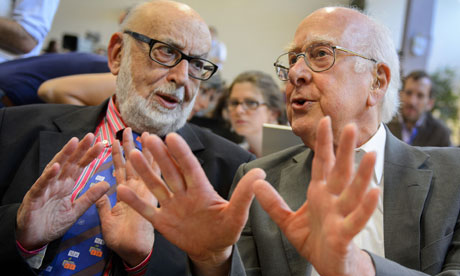
And so it happened. On 8-10-2013 the Nobel committee awarded the prize to Peter Higgs and François Englert. François Englert? I had never even heard about this man!

Englert and Higgs

Here they are, Englert (Belgian) to the left and Higgs (British) to the right.

I was intrigued and started surfing and reading. Not about the theoretical background, that is way to complicated for me. I was interested in the human aspects. The result is this post.

In the second half of the last century, physicists all over the world were trying to build a model for the fundamental forces in nature. This resulted in what now is called the Standard Model. See my post God’s Particle for (a little bit) more information.

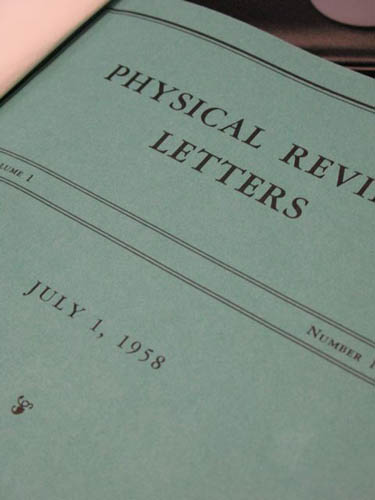
When a physicist finds something new and interesting, of course he wants to publish it. For example in the Physical Review, one of the leading physics magazines. As it was peer-reviewed, it could take easily half a year after submitting your paper before it got published. Therefore it was decided in 1958 to create Physical Review Letters, a weekly journal meant for short contributions. Time between submission and publication a couple of weeks only.

First issue of PRL

When I was doing my PhD research, there was always a copy of the Physical Review Letters in the library of our institute, available for perusal.

And it was a dream for many young scientists to publish something in this highly valued journal.

By the way, I never did…:-)

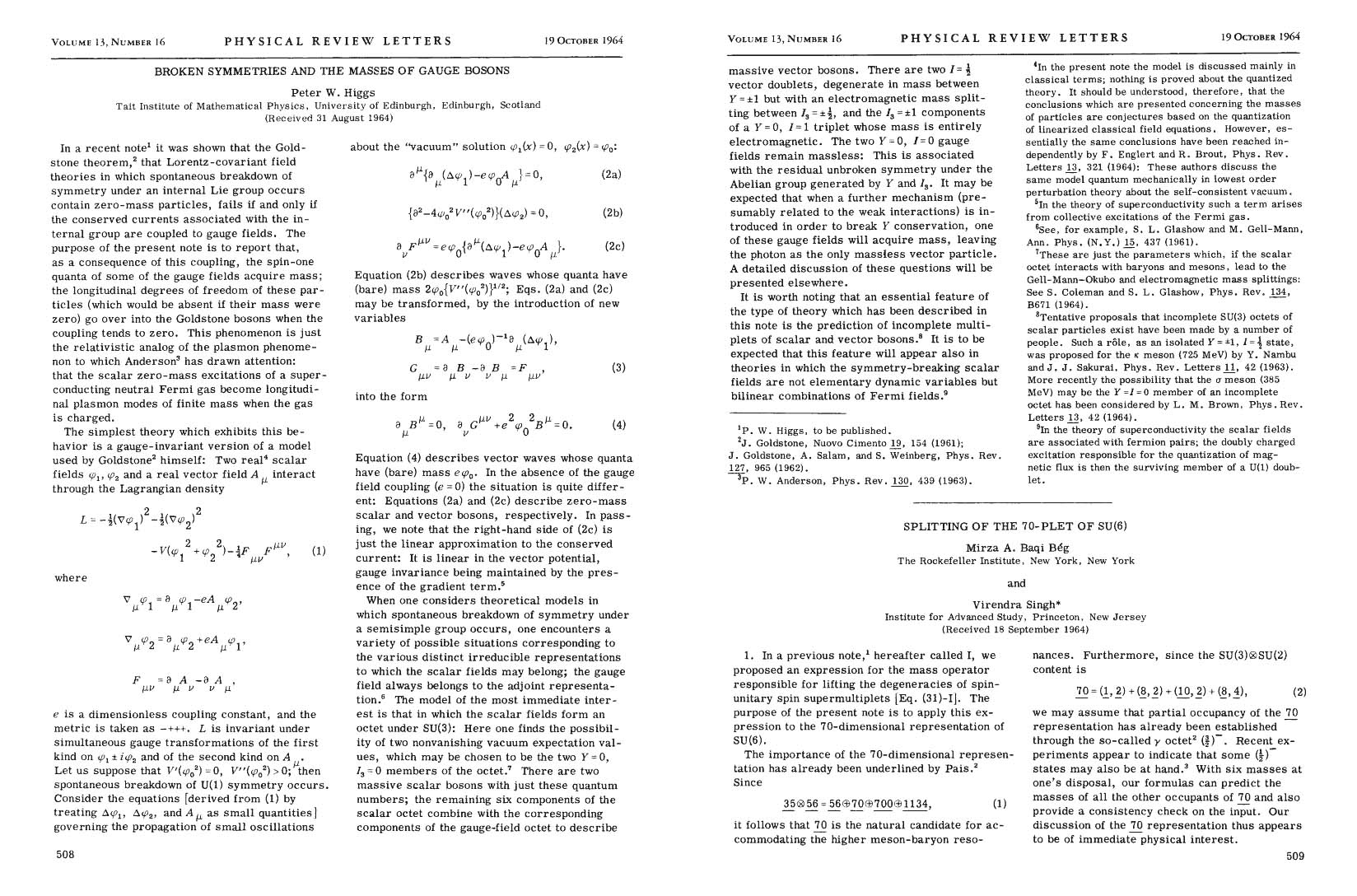
It was in 1964, that Peter Higgs (then 35 years old) published a letter in this journal: Broken symmetries and the masses of gauge bosons , submitted August 31 and published October 19. It was this article that finally resulted, almost 50 years later, in the Nobel Prize. Here it is ( don’t try to understand it)

Higgs

So what about Englert? Well, he and Robert Brout (Belgian American) had published a few weeks earlier, in the same magazine, an article with the title Broken symmetry and the mass of gauge vector mesons ! Submitted June 26 and published August 31. Comparing the titles you probably will accept, even without any understanding, that the two contributions basically cover the same ground!

And that is not all. A third article was published a few weeks later, again in the same journal. Thomas Kibble (Imperial College, London) had been studying with two American guest scientists, Gerard Guralnik and Carl Hagen, the same problem of symmetry breaking and mass, and come to similar conclusions. Their paper was submitted on October 12 and published November 16.

Three papers within three months. Independent research, no doubt about that, it was just that the time was ripe for it…:-). There has also been recognition by the physics community for all six authors. Three years ago the American Physical Society has awarded the prestigious Sakuarai prize to them.

Sakurai Prize

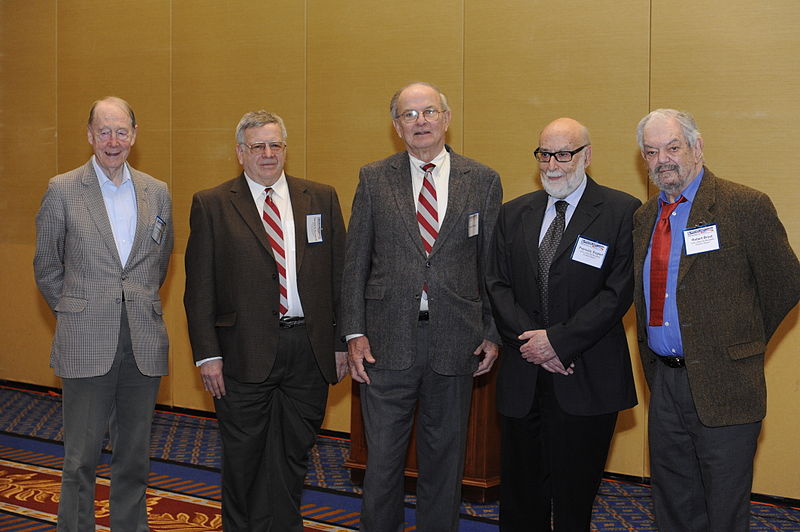
From left to right: Kibble, Guralnik, Hagen, Englert, Brout. Is it on purpose or accidental that Higgs is missing…:-)?

In the years after publication, when the Standard Model was developed, it became customary to talk about the Higgs boson, the Higgs field, the Higgs mechanism. Not really fair to the others, although Higgs was not to blame for that. Abdus Salam, one of the fathers of the Standard Model, used the name Higgs-Kibble boson, but it did not catch.

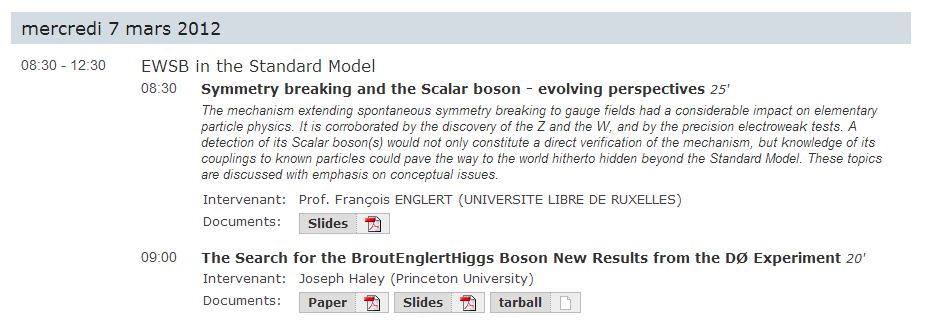
Recently, when it became clear that a Nobel Prize was coming, the discussion started again and became a bit less friendly. In a  2012 physics conference there was a directive that in contributions the name Higgs-boson should be avoided and replaced by BroutEnglertHiggs boson or by SM Scalar boson ! It caused a bit of an uproar, many physicists objected.

Here is a part of the program of this 2012 Moriond conference

Moriond program

Even in these alternatives the work of Guralnik, Hagen and Kibble remains invisible, so there was also a suggestion to rename the Higgs boson as BEHGHK boson. (the initials of the six authors).

Kibble found a name change silly, but Hagen objected to the name Higgs boson, because: ‘The rest of us are fighting not just for our ego but for our place in the annals of physics.‘ Read more about this controversy here

A Nobel Prize can be awarded only to people who are still alive and to a maximum of three people. That is the rule. So, what would the Nobel Committee decide? One option would have been, to choose one person in each of the three groups. Brout passed away two years ago, so the choice for the first two groups would be simple: Englert and Higgs. But what about the Imperial College group? How to choose between Kibble, Guralnik and Hagen?

I have read somewhere that this year the meeting of the committee about the Physics Nobel Prize took longer than usual…:-) Finally it was decided to leave the third paper out and award the prize to Englert and Higgs.

I think that Kibble will be phlegmatic over the outcome. Not so sure about Guralnik, Hagen will be disappointed.

To honour all six, here is a collage

The six authors

From left to right: Brout, Englert, Higgs, Guralnik, Hagen, Kibble: BEHGHK

Theoretical physicists are human too ..:-)