God’s particle

About three months ago CERN has announced the discovery of the Higgs boson, a.k.a. the God Particle. Several of my friends have asked me if I, being a physicist, could explain what it was all about. I tried, but it was not easy.

Here is another attempt…:-)

Let me start with an overview.

In the 19th century it became increasingly clear that matter is composed of molecules, and that molecules themselves are composed of atoms. Only a limited number of different atoms exists, ninety occur in nature, quite a few more have been made in laboratories. Imagine the tremendous simplification, everything around us is composed of these building blocks!

The periodic table of elements. Uranium (92) is the heaviest element found in nature. Promethium (61) and Technetium (43) are radioactive and not found in nature, giving a total count of 90 elements occurring naturally.

A monumental breakthrough took place in the 20th century, when it was discovered that atoms themselves consisted of only three (!) elementary particles, protons, neutrons and electrons. Protons and neutrons in the nucleus of the atom with electrons orbiting around this nucleus. Just a matter of numbers. Carbon with 6 protons and 6 neutrons in its nucleus and 6 electrons around this nucleus. Add one of each, and you get Nitrogen, do this again and you get Oxygen.This amazing simplicity was one of the reasons I decided to become a physicist. Even a nuclear physicist..:-)

Actually two more particles had to be added to the list. Light also consists of particles, called photons. And some of the elements are not stable but radioactive, the nucleus can send out an electron and at the same time another particle, called neutrino. Everything controlled by four forces. The strong nuclear force, keeping the protons and neutrons in the nucleus together, the electromagnetic force, keeping the electrons in orbit, the weak nuclear force, responsible for the radioactivity and, finally, the force of gravitation.

But this is not the end of the story, soon it became more complicated again! In cosmic radiation, and also in laboratory experiments (using powerful accelerators to let elementary particles collide), new particles were discovered. Not stable, often only living for split seconds, before decaying in other elementary particles. They were named muons, pions, hyperons, a confusing multitude.

It was discovered that protons and neutrons were actually NOT elementary particles, but that they were composed of “quarks”. Not just one, but several families of quarks. Bound together by “gluons”. And the electron and the neutrino were accompanied by other particle families, the muon electron, the tau electron, with corresponding neutrino’s. The strong nuclear force is actually the force between the quarks, with three quarks forming a proton or a neutron.

It has also been discovered that the elementary forces are carried by “force particles” and that the photon is actually the force particle of the electromagnetic force. One of the big successes of the last decades, was the experimental observation of the “weak nuclear force” carriers, the W and Z bosons.

All these experiments lead to what is now called the Standard Model. Three families of quarks, three families of ‘electrons’, three elementary forces with their force particles. This leaves out until now gravitation. That is actually a big problem, but we will not discuss it here
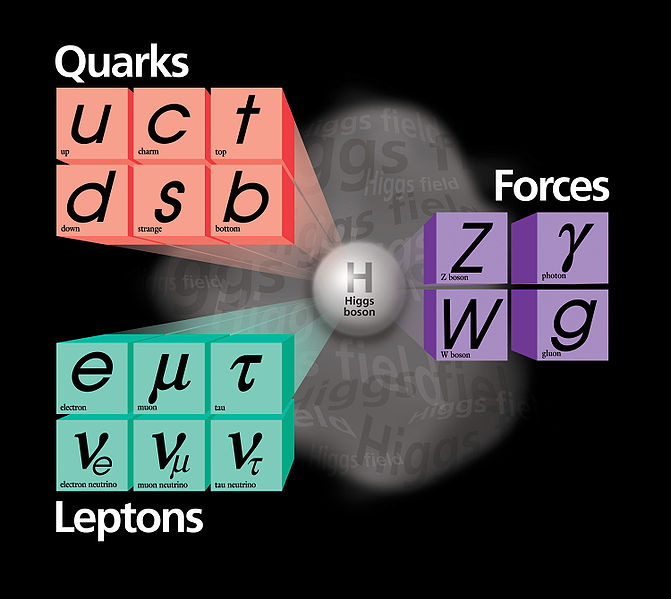
The Standard Model. Gravity is not taken into account. There are three quark families (up-down), (charm-strange) and (top-bottom). And three “lepton” families, electron, muon and tau, with their corresponding neutrinos. Finally the force particles, photon, gluon and the (W,Z) bosons

All the particles in the picture above have been “observed”. Observed in quotes, because these particles are so short-lived that their existence must be concluded from the traces they leave behind when they die…

Much more complicated than the simple “proton-neutron-electron” model, but definitely one of the most impressive results of modern physics.

One problem remains. All these particles, the quarks, the leptons, the force particles, have mass. Some are heavy like the quarks, some are light like the leptons, the photon has no mass, the neutrinos almost nothing. Why?

In 1964 Higgs and a few others came with a theory. There might exist another force field, permeating the universe, acting as a kind of “syrup”, slowing down other elementary particles and in that way giving them inertia ( = mass!). But if that field existed, it should have its own force particle, the Higgs boson. Nicknamed the God particle, because it gave mass to all the other particles.

The theory was widely accepted, so the search for the Higgs boson was on. A fierce competition resulted between CERN and the Fermilab in USA.

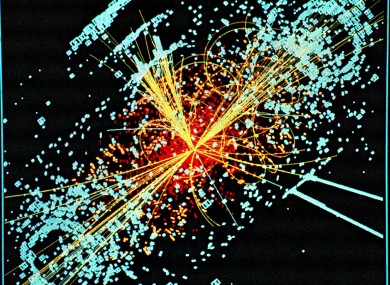
It now looks like it has been found. With a mass about 130 times the mass of the proton. And so short-lived that I have not even been able to find an estimate on the Internet. So you have to look at the traces it leaves behind when it dies. Here is an artist impression.
And here is a picture of the experimental setup at CERN (the ATLAS experiment) Try to spot the human figure in the picture!
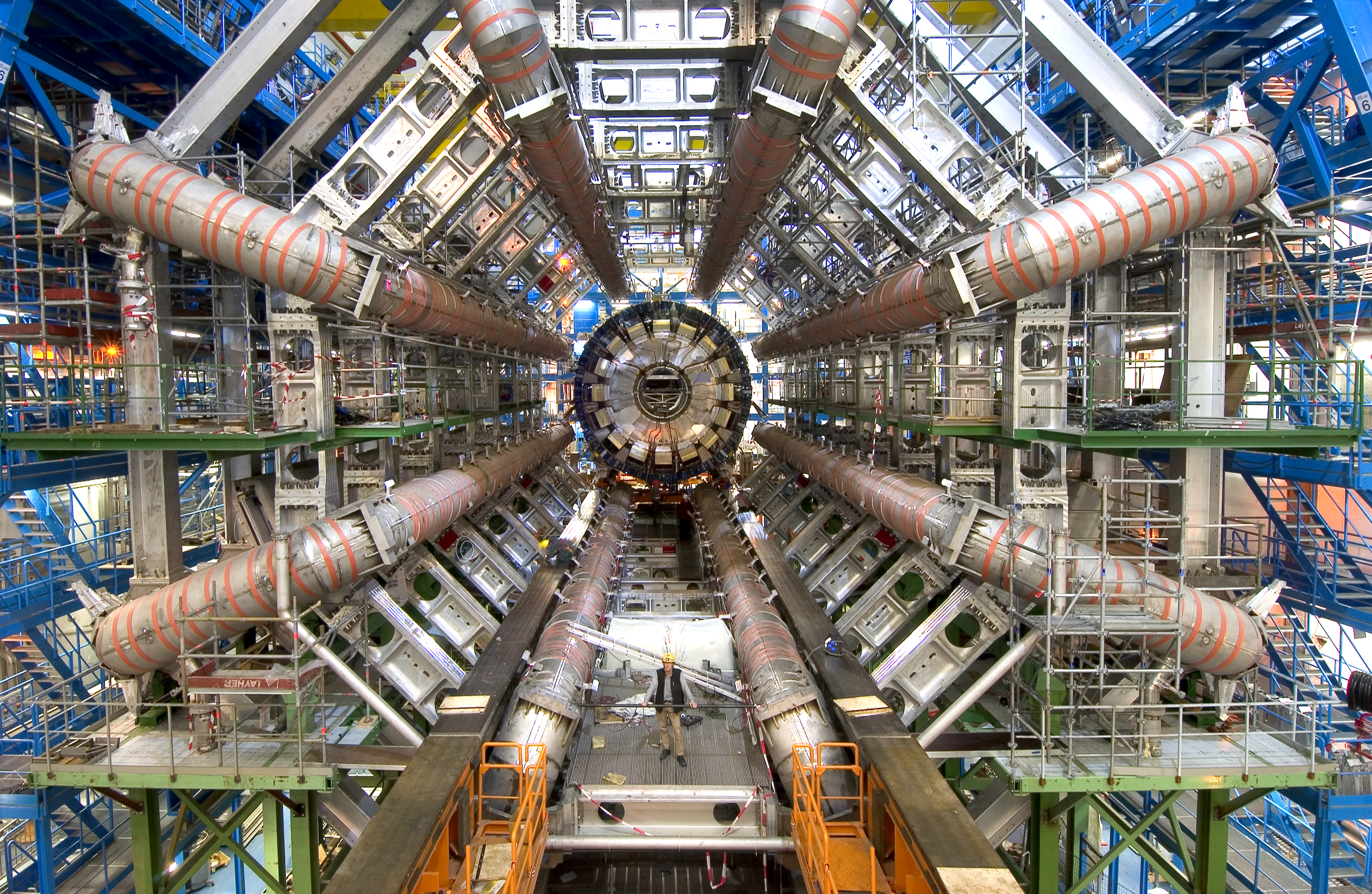
This is ATLAS, one of the four experiments at the Large Hadron Collider of CERN.

Is our understanding of the physical universe now complete? No way!

As mentioned before, there is still the problem left to combine the Standard Model with gravitation. Maybe string theory, but not everybody is convinced that this will be the solution.

There is a much bigger challenge. During the last decades it has become convincingly clear that there has to be more in our universe than quarks, electrons, photons, etc. Let’s call this “normal matter”. From what we know about the Big Bang and from the way our universe is expanding after the Big Bang, we now are sure that there are two more constituents of our Universe. There has to be “Dark Matter“, until now invisible. And there has to be “Dark Energy“, a repulsive force that actually accelerates the expansion of the Universe. That’s about all we know at the moment.

A small correction to the Standard Model? Absolutely not! Here is the present estimate. Normal matter takes only 4% (!). The rest is basically unknown at the moment!
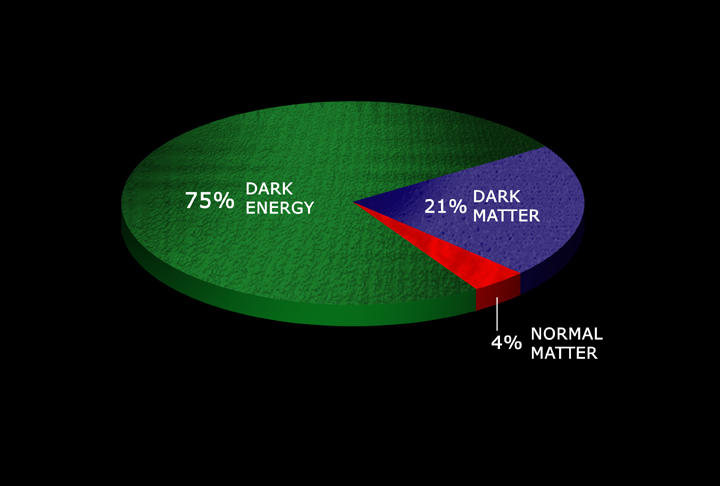
We know a lot about the 4% normal matter and next to nothing about the rest!

A sobering thought. But also exciting. There is still a lot to discover and explore in our physical universe. And for the ambitious among you: a lot of Nobel Prizes to win!
 

How is the Sun doing these days?

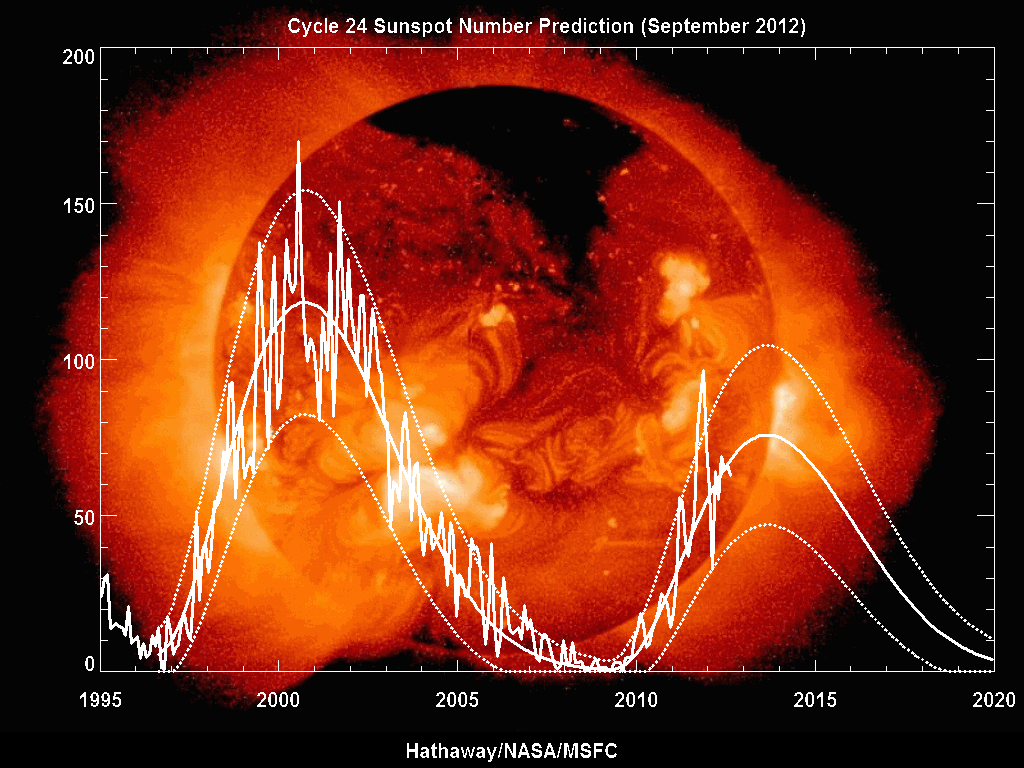
My last post about the Sun is from August 2010. At that time it had become clear already that the present Solar Cycle 24 would be a weak one. We are now two years further, the maximum in solar activity is expected around September next year. Time for an update.

Here is the most recent prediction, with data points until September

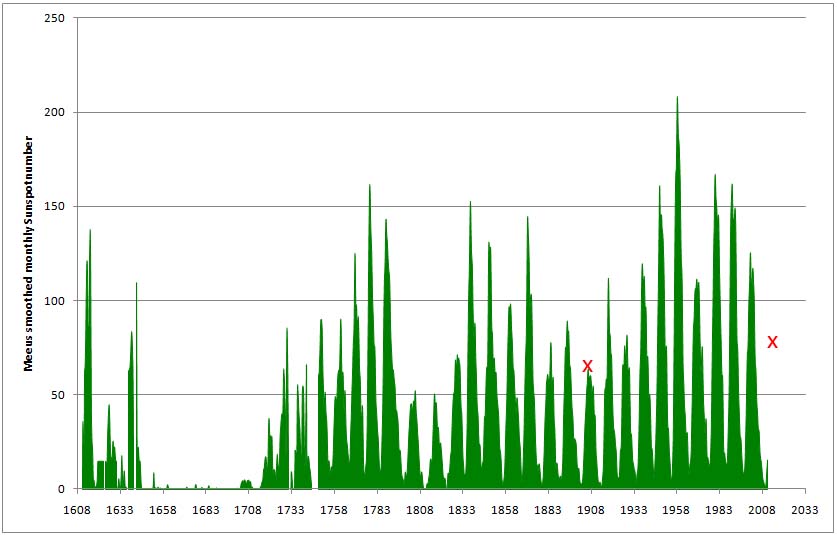
The current prediction is a (smoothed) sunspot number maximum of about 76. That is low! We have to go back to Cycle 14 in 1906, to find a lower maximum value of 64.

Here is a graph of the Solar Cycles over the past four centuries. With red crosses I have marked the 1906 maximum and the (predicted) 2013 maximum.

You will notice that the last half century we have had a “wave” of solar activity. Is that coming to an end now and will we enter a period of low solar activity? Nobody knows, as we do not understand very well the origin of the Solar Cycle.

Both the Maunder minimum (17th century) and the Dalton minimum (~ 1800) had influence on the Earth climate. Severe winters in Europe as can be seen in paintings of the Dutch School, like this famous one by Hendrick Avercamp (1585-1634)

Now we live in a period of global warming. There are strong indications that our carbon emission is at least partly responsible for this. But could there also be a contribution due to the high solar activity during the last fifty years? Those are sensitive questions..:-)

The discovery of extra-solar planet Kepler 22b

It is quite a long time ago that I have reported to you about interesting science topics!
Much of this year has been quiet, but that might change. So expect a few posts..:-)

1. Probably you have heard about neutrino’s traveling faster than light? That would be a really shocking discovery, if true….
For the time being, personally I bet it is not true. I may write about it later
2. There are rumours going around that next week CERN, during a press conference, will announce evidence for the Higgs boson, a.k.a the God particle.
It might be lighter than expected.
3. The Nobel prize for physics has been awarded this year for a discovery, the importance of which can be explained easily to interested outsiders. I will write about it soon.

This postl is about the discovery of extra-solar planet Kepler 22b.

You may remember that I have written a post in September 2010, about another extra-solar planet, the Gliese 581 g  located in the habitable zone of its star.
By the way, when you follow the Wikipedia link, you will see that there is some doubt now if this planet  really exists.

In March  2009, a satellite has been launched with a mission to discover Earth-like planets orbiting other stars. It was named  , very appropriately,  the Kepler satellite

Here is the satellite, note the size of the humans

How to discover planets? The stars may be hundreds of light-years away. Planets will not be directly visible at that distance.
Here is the procedure followed by the Kepler mission:

1. When a star has a planet,  the orbit of this planet can be such that it passes between Earth and the star.
2. In that case, the amount of star light reaching the earth will be slightly reduced during passage of the planet.
3. Measure the light intensity of the star. If there are periodic (minuscule) dips, it could be because of a planet passing. This will give the period of the planet. How large the dip is, will tell us something about the size of the planet.
4. When you know the mass of the star, Kepler’s third law will give you the radius of the planetary orbit, so you can draw conclusions if the planet is in the habitable zone of its star.

An ambitious program, right?
In 2004, our own planet Venus passed between the Sun and Earth.
With a group of friends we have been watching the event. You must take precautions not to be blinded by the sunlight.
Here is what we managed to see. The black dot in the sun’s image is Venus.

The Kepler approach will be, to look at the intensity of the starlight and at the dip in this intensity during the passage of the planet.
Not easy. “This is akin to sensing the drop in brightness of a car’s headlight when a fruitfly moves in front of it“

Well, it works!!
Until now, more than two thousand of so-called Kepler Objects of Interest (KOI’s), have been found. Not all of those will be planets.
Here is a preliminary list of potential habitable planets, found until December 2011.

Now, do NOT be fooled by the “artist impressions” of these planets.The blueish, watery color of several candidates is not based on any factual information about the presence of water.
The Kepler data give information about the size of the planet and its location within the habitable zone. It’s amazing that this can be done, for a star that maybe at a distance of hundreds of lightyears, but that’s it, for the time being.

By the way, note that Gliese 581 d is still in the list (outer edge of the habitable zone), but Gliese 581 g is no longer mentioned.

And also Kepler 22-b is not there, because that is the recent discovery, announced last week, that caused so much excitement.

Why the excitement? Here is a sketch

a) The star Kepler 22 is very similar to our Sun, in size and temperature
b) Kepler 22-b is within the habitable zone of the star
c) The planet is still larger than earth, but not much larger. So it could be a rocky planet. (Large planets, Jupiter size, will be gaseous) A rocky structure and liquid water are often seen as prerequisites for the development of life.

Again, the image of Kepler-22b in the above picture is an artist impression!
Keep that in mind when you read  reports like Human-like Life Could Exist on Newly-discovered Planet
With this quote: “A newly-discovered Earth-like planet could very well contain continental features where normal human-like life could exist. Or it  could be more of a water world with an ocean containing life forms similar to dolphins”

Hm. Then I like this report better: Kepler 22b: probably not home to interesting aliens

Here are a few more links
The official website of the Kepler Mission ,well-designed, very interesting.
The website of the Planetary Habitability Laboratory

Do you want to help? Kepler is monitoring more than 150.000 stars, and is using computer software to look at recurring “dips” in the received starlight. A huge job. Humans are still better in pattern recognition. So why not become a planet hunter yourself?

The Great Debate: Are we alone? part 2

Two months ago I published The Great Debate: Are we alone? part 1

Here is finally part 2. My apologies for the long delay.

Quite a few of you gave their opinion about the question “Are we alone or not”.
Not surprisingly most ‘votes’ went to “We are not alone”, same as in the poll at the end of the Great Debate video.

My own opinion?
It will be wonderful and fascinating if (intelligent) life is found elsewhere in the universe, but personally I think we are alone.
Mind you, that is not arrogance, I would be more than happy if even primitive life is found elsewhere!

Let me explain why I have become (recently) more skeptical about life elsewhere in the universe.

In discussions about the probability of extraterrestrial life, you will often encounter the Drake equation.
In 1961 Frank Drake tried to make an educated guess about the number of intelligent civilisations in our own galaxy, the Milky Way.
He started with the (huge) number of stars in the Milky Way, then asked questions like: “how many stars will have planets”, “how many planets will be ‘habitable'”, “what is the chance that on such a planet (primitive) life will develop”, “what is the chance that intelligent life will evolve”, and several more of this kind of questions.
In his original estimate Drake comes to a number of about ten planets in our Galaxy at this moment, with intelligent, technologically advanced civilisations.

Many of the factors in the Drake equation are the result of guesswork.
For example, one of the points of discussion in the “Great Debate” is about the chance that intelligent life will evolve from primitive life. Drake’s estimate was 1 %. Marcy in the “Great Debate” thinks it might be close to zero. “Maybe we humans are just a freak evolutionary incident?”

However, both Werthimer and Marcy agree: “primitive life will be teeming in the Universe.”
Drake estimated the chance that life will develop on a habitable planet as 100%!
And Michio Kaku, an American ‘science communicator’, who always enjoys being in the limelight, goes even further: “The Laws of Probability Tell Us That the Universe Should Be Teeming With Intelligent Life Forms” Elsewhere he  writes (foolishly, IMHO) about a 100% probability!

Well, if they are right, why has until now no evidence of life been found on Mars?

A few days after my first “Are we Alone” mail, I sent you a short email about the exciting discovery of a habitable planet, orbiting Gliese 581, a red dwarf star at a distance of 20 lightyear from the sun.
Here is the picture again. Planet g is causing the excitement. The blue band is the habitable zone.

The concept of a habitable zone is based on the assumption that you need liquid water for the development of life. The (surface) temperature of a planet should not be too low or too high.  For a (cool) red star like Gliese 581, this zone lies much closer to the star, than for a hotter star like our Sun.
Of course you can think about more exotic  forms of life, based on silicon, ammonia, etc. Click here for a detailed discussion.

Now, when you look at the picture above, you will notice that both Earth and Mars are orbiting in the habitable zone of the Sun.
The Viking and Phoenix missions to the Red Planet had as one of their main targets the search for life on Mars, and I am sure that many scientists were hoping, or even convinced that evidence of life would be found. So was I.
But “nothing” has been found yet. Of course more exploration is needed and quite a few new missions have been planned.
Still it is disappointing and personally I believe now that the chance that life will develop on a habitable planet, might be small, maybe even very small.
Sure, the Miller-Urey experiments have shown that it is “easy” to synthesize amino acids, the building blocks of life, when the conditions are right.
And organic compounds have been found even in interstellar clouds.

But the next step is huge. Life is characterised by two fundamental properties, replication and metabolism.
We know that this step has been made at least once, on Earth.
Even on Earth there is no evidence that this step has been made more than once! Click here for more information about what is called abiogenesis.

So, this is my position:
As soon as evidence of life will be found, on Mars or deep under the frozen oceans of Jupiter’s moon Europa , I will celebrate and be convinced that life indeed is teeming in the Universe.
Until then, I believe in the Rare Earth Hypothesis , that we might well be alone.

New extrasolar planet has been discovered

Just two days after I had published my first post about life in the Universe, it was announced by two American astronomers, Vogt and Butler, that a new extrasolar planet has been discovered, the first one where life might be possible. See for example this New York Times article:

Reason for me to send publish an extra post, before I compose part two of the Great Debate post..

Gliese 581 is a so-called red dwarf star, located at a distance of 20 light-year from the Sun.
In itself a smallish nondescript star in our Milky Way, but interesting because it has been found that a number of planets orbit this star.
Four were known already, two more have been discovered now.
I have roughly given their position, size is not to scale. (keep in mind that the distance scale is logarithmic)

For comparison the Sun and some of its planets are also shown.
The blue band is the habitable zone, not too cold, not too hot, assuming water-based life.
Excitement is about planet g, right in the middle of Gliese’s habitable zone. This is a first. It has a mass of about 3 earth masses, and orbits Gliese in 37 days.

Only a pity, that the planet, like its 5 siblings, is tidally locked to Gliese, meaning that it always faces the same side to its sun (same as our moon is tidally locked to Earth). So it has a cold side and a hot side. If life exists there, it would probably be in the twilight zone

The Great Debate: Are we alone? part 1

On 26 April 1920, a debate took place at the Smithsonian Museum of Natural History (Washington DC), between two American astronomers, Shapley and Curtis, about the scale of the Universe. Point of contention was the distance of the “nebulae” like Andromeda.
Shapley argued that the Milky Way was the entirety of the Universe and the Andromeda nebula was inside the Milky Way.
Curtis contended that Andromeda and other nebulae were separate island galaxies.
The debate became known later as The Great Debate.
We know now that Curtis was right. The Universe is huge and our Milky Way is only one of ~ 100 billion galaxies. Each galaxy contains on average 100 billion stars.
Our Sun is one of these ~ 10.000.000.000.000.000.000.000 (!) stars, and was formed relatively recently, about 4.6 billion years ago (The Universe is ~ 13.8 billion years old)
Eight planets orbit the Sun (sorry for Pluto, not a planet anymore…), and on (only?) one of them, our beautiful Earth, life developed, about 4 billion years ago.
Evolution took place. But it was only about 200.000(!) years ago that Homo Sapiens (yes, that’s us) evolved, most probably in Africa.

Was that a unique incident?

About half a year ago another astronomical debate took place, at Berkeley University, 30 April 2010, almost exactly 90 years later, and it was also called a Great Debate.
A bit preposterous, IMHO…:-)
This time the topic was: Are we alone in the Universe?
The recording of the debate can be viewed at http://seti.berkeley.edu/the-great-debate . Be warned, it takes 1.5 hours…:-), but watching it is worthwhile…

Debaters were Dan Werthimer, the chief scientist of the SETI project, and Jeff Marcy, an astronomer who has discovered more extrasolar planets than anyone else.

The SETI project is Searching for Extra Terrestrial Intelligence, so Werthimer is, not surprisingly, convinced that there are many planets with highly developed technological civilizations around us. SETI is searching for about 40 years now ‘only’, it will just take more time to find evidence for intelligent life elsewhere in the Universe, according to him.

Marcy is a skeptic. Ok, many, if not most, stars will have planets orbiting around them. And he agrees with Werthimer that primitive life will be “teeming” in the Universe.
But intelligent life? Is that an evolutionary advantage? The dinosaurs ruled the world for 200 million years and never developed intelligence with their peanut brains! Why not?
Maybe speed or a thick skull will serve you better to survive. Maybe we humans are just a freak evolutionary incident?

He has other interesting arguments. For example the water content of a planet. Quite critical.
Assuming that water has been brought to the earth by asteroids, it should be about 0.03%. Not more, nor less.
Less, and the planet will be a desert. More, and it will be just oceans. Is a technological civilisation possible under those adverse conditions?

At the end of the debate, after a Q&A session, there is a poll for the audience. Are we alone or not?

I have an opinion myself, but will only tell you in the second part of this email…:-)

How is our sun doing these days? An update

End of March I have added a post about the (lack of) sunspot activity on the Sun.
Solar cycle 24 was so slow in starting, that some scientist got worried.
What is the present situation? See the graph below. Four more data points became available (April-July). The graph comes from http://solarcycle24.com/sunspots.htm
The red curve is a prediction, made in 2009.
The authors write:
“If our prediction is correct, Solar Cycle 24 will have a peak sunspot number of 90, the lowest of any cycle since 1928 when Solar Cycle 16 peaked at 78 ”

When you look at the latest data points, the prediction seems too high, it should be adjusted.
Actually this has been done last month, see below. This new prediction gives an even lower maximum, below 70 !!

If this prediction comes true, we even have to go back to solar cycle 14, with a peak value of  64, in 1906. Click here for the list of solar cycles.
You can bet on it that solar scientists are following the development with great interest.
I will give you another update in a couple of months.

Don’t worry, our sun is not dead!

As you know, the sun is our life source..:-)
Already for more that 4.5 billion years she (or is it he?) is providing the energy for our solar system and she will continue to do so for another 5 billion years, before she will “die” and end as a so-called white dwarf
So why did the well-known Dutch solar astronomer Kees de Jager remark in an interview, November 2009, that the sun was dead?

Well, he was talking about the sunspot activity of the sun. Or rather, the lack of sunspot activity!

Here is an image of the sun, with a number of sunspots

Sunspots are a result of magnetic activity on the sun. The number of sunspots fluctuates in time with a period of roughly 11 years.
See the graph below. It is clear that it is a periodic phenomenon, but also that it is quite irregular.
The cycles are numbered from the time accurate observations became available, around 1750.
Cycle 23 started in 1996, reached its maximum around 2002, ending in 2007.
At about that time, 2007-2008 the new cycle 24 was expected to start.

But it did NOT!

During 2008 and 2009 the sun was surprisingly quiet, with long periods without any sunspots at all.
Therefore astronomers all over the world were watching the sun with more than usual interest.
A special website http://solarcycle24.com/ is monitoring daily the behaviour of the sun.

Here is a detailed graph, updated until February 2010. The red curve is the expected one.

As you see, 2008 and 2009 have been very quiet, with the average sunspot number almost approaching zero.
BUT, starting from December 2009 it looks like we have the beginning of cycle 24! Finally.
In a couple of days the results for March will be published. You can check for yourself:  http://solarcycle24.com/sunspots.htm

Is this topic only of academic interest?
No.
There may be a relation between the solar activity and the temperature of Earth.

Here is one more graph of the solar sunspot activity, this time over a time period of 400 years. In 1610 sunspots were observed for the first time with the newly invented telescope.
The red crosses represent these early observations. They are less accurate, but nevertheless it is obvious that in the second half of the 17th century there were hardly any sunspots at all.
This dip in solar activity is called the Maunder Minimum.


In the same period Europe and North America (and probably the rest of the world) were subjected to very cold winters, this period is called the Little Ice Age
There is an ongoing debate if there is a causal connection.
The last 50 years there has been a maximum in sunspot activity. Could it be that this increased activity has been another factor in the global warming, besides carbon emission?

Again Apophis

I got a few interesting questions about my first Apophis post

“Why not wait with a mission until after 2029, then it will be clearer if the Earth might be hit in 2036”
“Is it a coincidence that there are exactly seven years between the two data?”

Here is a bit more information. For some of you it may be a bit (too) technical ..:-) Don’t worry.

The present orbit of Apophis is shown in the figure below as the blue line, together with the orbits of Mercury, Venus and Earth, with the Sun in the center.
Distances are given in Astronomical Units (AU), where 1 AU = ~ 150 million km, the average distance between Earth and Sun.
Apophis has a period of  323.6 days, six weeks shorter than a year, and its orbit is quite elliptical, coming almost as close as the orbit of Venus, but also crossing the Earth orbit.

During an orbit Apophis crosses the Ecliptic twice. One crossing is no problem, but the other one is, because there it crosses the Earth orbit as well!
And Apophis, with its shorter period, is continuously overtaking Earth…..

The images come from an interesting NASA website where you can follow the course of Apophis in time.
Try it out and check that both Earth and Apophis will arrive at the Danger Point on 13-4-2029!

On that day Apophis will pass Earth at a distance of about 30.000 km and because of the Earth gravitation its orbit will be strongly disturbed.
It will get a boost from the encounter, increasing its orbit and its period. See the sketch below.

The uncertainty in the trajectory is indicated, the white bar is about 1000 km at present.

So, no need to worry about 2029. But there IS a (small) chance that Apophis might hit Earth exactly seven years later!
This could happen if Apophis, after deflection, enters into a resonant orbit with Earth.

What are resonant orbits? Two orbits are resonant if there is a simple relation between their respective periods, like 2:3, 5:6 etc
Example: two planets A and B with periods of 300 and 450 days have resonant orbits (2:3). Starting from any given position, they will be in exactly the same position after 900 days (A will have completed 3 orbits, while B has completed 2).

Back to Apophis.

There is a possibility that on 13-4-2029 Apophis will be deflected into a (6:7) resonant orbit! In that case it might hit Earth exactly 7 years later, having completed 6 orbits itself.

This will only happen when Apophis will pass through a very small “window” during its encounter with Earth in 2029. Estimated width about 600 meter(!) only. Astronomers call it a keyhole  🙂
Remember, Apophis has a size of ~ 300 m, so it just fits in the keyhole….

At this time the estimated probability that Apophis will pass through the 6:7 resonance keyhole is only about 1:250.000. Almost negligible .

Why is it then that for example the Russian Space Agency is still proposing a mission?
Well, if more accurate calculations in the coming years show that Apophis will pass through the keyhole, it will be rather easy to steer the asteroid away from it. As the keyhole is so small, just a few hundred meters will do.
That will be orders of magnitude easier than steering it away from the Earth, once it has passed the keyhole!

One last remark.
There was a question if a second hit, again on April 13, took into account leap years.
It does. A year is 365.25 days, so seven years equals 2556.75 days. And between 13-4-2029 and 13-4-2036 there are 2557 days (7 x 365 + 2 leap days).
Difference is only 6 hours. By the way 13-4-2036 will be a Sunday. Easter Sunday..:-)

Will the Earth be hit by Apophis in 2036?

A few days ago there was a news item about a proposal by the Russian Space Agency that they were considering a mission to this asteroid to deflect its course, because there is a risk that it might hit the earth in 2036.
Most asteroids orbit the Sun between Mars and Jupiter, but not all of them. Those with Earth-like orbits are monitored, because they might collide with the earth, with devastating consequences.

On 19-6-2004 an asteroid was discovered, which might collide with the earth in 2029. It was named Apophis, after the demon of darkness and chaos in Egyptian Mythology.
More accurate observations followed, and showed that this asteroid will NOT hit the Earth in 2029, although it will pass the Earth on Friday, April 13 (yes!) 2029 at a distance of only 30.000 km.
Mind you, that is closer than the altitude of the TV-satellites, circling the Earth!

At such a close distance the course of Apophis will be disturbed by the Earth. Calculations show that there is a small probability that at their next encounter, on Sunday, April 13 2036, Apophis could hit the earth. The estimated size of this asteroid is about 300 m and an impact could release an energy of ~ 900 megaton TNT (the Hiroshima atomic bomb was ~ 15 kiloton TNT, 60.000 times smaller!)

Here is the estimated risk path for such a collision

No wonder that it is the Russian Space Agency coming with this proposal.

When you want to know more about how to deflect such a massive piece of rock, there is a really fascinating educational website  about asteroids, Apophis, and how to deflect it. Choose the Expert option.