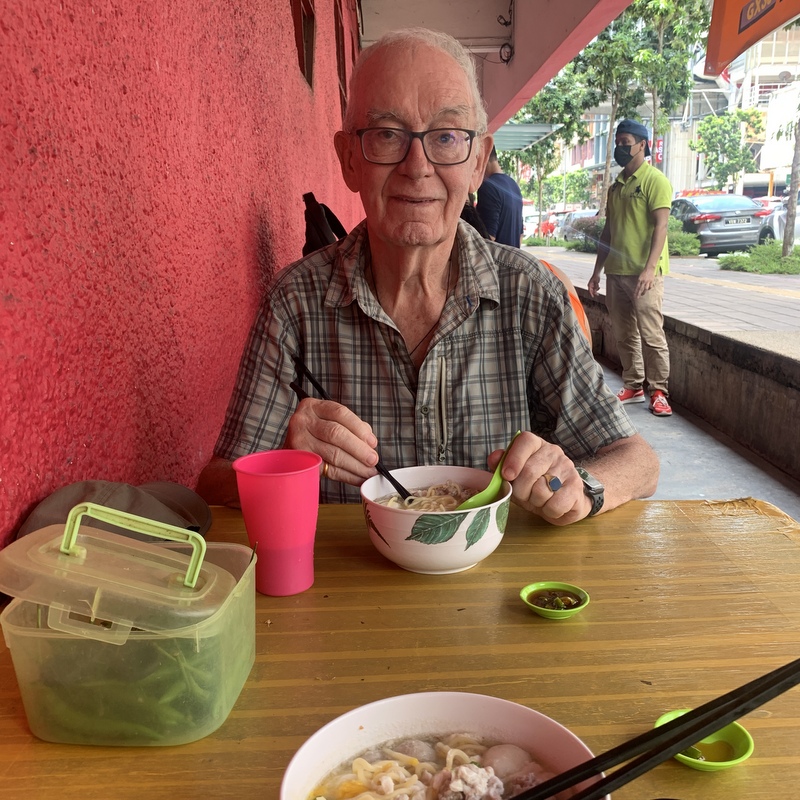
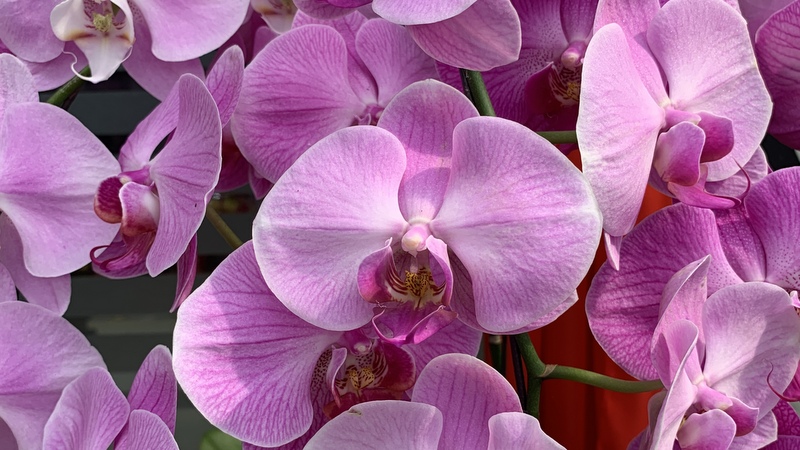
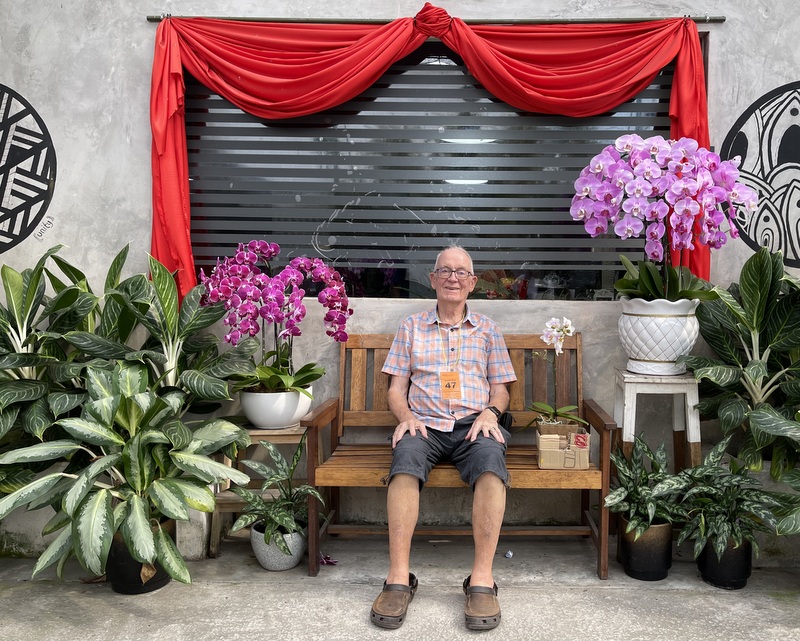
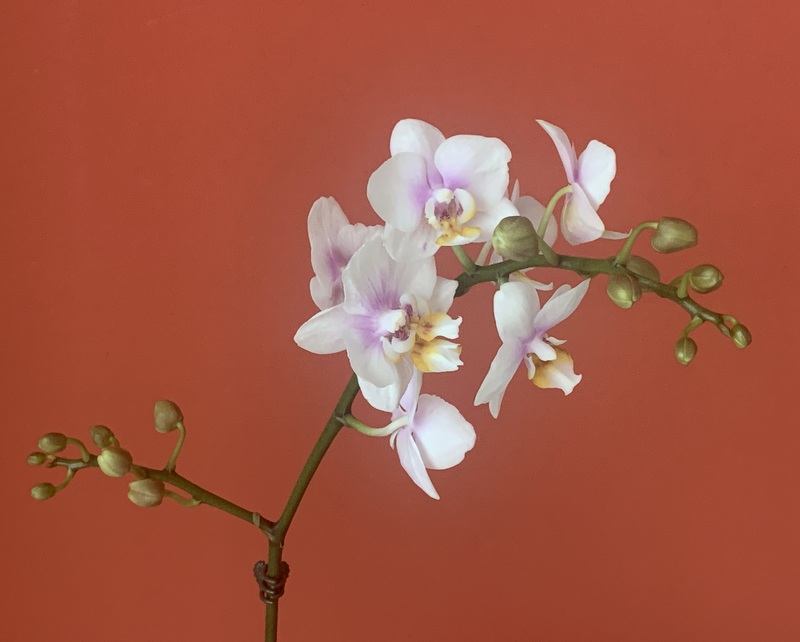
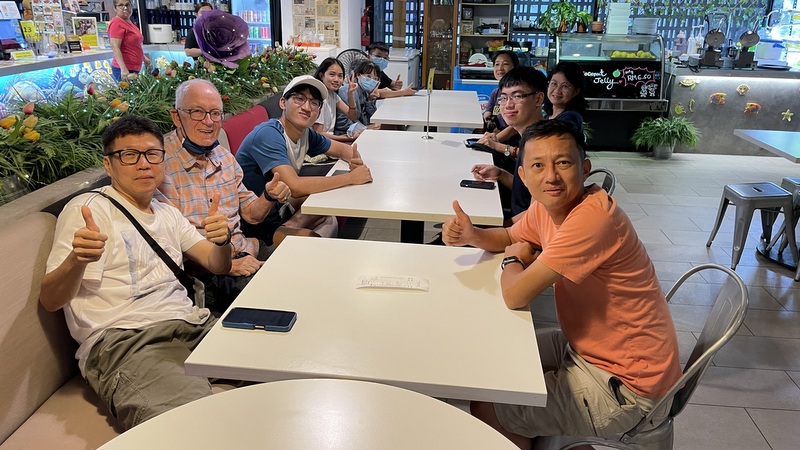
On 22 January the Chinese year of the Rabbit started. People wish each other Gong Xi Fa Cai (Mandarin) or Gung hay fat choy (Cantonese). Meaning Congratulations get rich.
Here is our CNY wish for all of you..
——————- About the Chinese Zodiac
The Chinese Zodiac has twelve signs (Rat, Ox, Tiger, Rabbit, Dragon, Snake, Horse, Goat, Monkey, Rooster, Dog and Pig) and five elements (Wood, Fire, Earth, Metal and Water).The signs repeat in a 12-year cycle, the elements in a 10-year cycle (an element takes two years, one yin and one yang). The combination of signs and elements gives a 60-year cycle. On your 60th birthday you start all over again, that’s why this birthday has a special significance. I celebrated mine in Taiping, on Maxwell Hill, click here for a report
Here is the Zodiac wheel , including the elements, for one 60-year cycle, from 1984 until 2043. Use your birthyear to find your sign and your element. If you were born before 1984, add 60 to your birthyear and use the same wheel. For example, I was born in 1944. I add 60 to my birthyear, 2004 and see in the wheel that I am a Wood Monkey.
The date of CNY is variable (see below). can be between 21 January and 20 February., When you are born in that period, you need to know the CNY date in your birthyear. Here is a list of CNY dates between 1930 and 2030.
——————- 2023 is a leap year
The Chinese calendar is based on lunar months. An average lunar month (time between a new or full moon and the next new/full moon) is ~ 29 d 12 h 44 min, therefore a lunar year of 12 lunar months is about 11 days shorter than a solar year. Without correction the Chinese New Year would advance about 11 days each year. To keep in sync with the solar year, on average every two/three years one of the months is duplicated, a leap month. Compare it with the leap day (29 February) that is inserted in the Gregorian calendar basically every 4 year.
CNY this year was on 22 January. Next year it would be 11 or 12 January. But this year has an extra month, so next year , CNY will be actually on 10 February.
Here is a list of CNY dates, with the leap years marked in yellow. Also I have marked which month is duplicated. In this year 2023, the 2nd month is duplicated.
2016
Feb. 8, 2016 (Monday)
Monkey
2017
Jan. 28, 2017 (Friday)
leap month 6
Rooster
2018
Feb. 16, 2018 (Friday)
Dog
2019
Feb. 5, 2019 (Tuesday)
Pig
2020
Jan. 25, 2020 (Saturday)
leap month 4
Rat
2021
Feb. 12, 2021 (Friday)
Tiger
2023
Jan. 22, 2023 (Sunday)
leap month 2
Rabbit
2024
Feb. 10, 2024 (Saturday)
Dragon
2025
Jan. 29, 2025 (Wednesday)
leap month 6
Snake
2026
Feb. 17, 2026 (Tuesday)
Horse
2027
Feb. 6, 2027 (Saturday)
Sheep
2028
Jan. 26, 2028 (Wednesday)
leap month 5
Monkey
2029
Feb. 13, 2029 (Tuesday)
Rooster
To determine which lunar month is duplicated in a leap year, is a quite complicated. If you are interested, have a look at my webpage The Chinese Calendar.
——————- Gong Xi Gong Xi
In the period around CNY you will hear everywhere Chinese New Year songs. One of the most popular ones is Gong Xi, Gong Xi. When I hear it , I can not easily get it out of my head 😉 The same happens for me with the Bolero of Ravel.
Until recently I thought that this was a very old traditional Chinese song. But I was wrong, when I was born the song did not yet exist. It was composed in 1945 by Chen Gexin, NOT as a New Year song, but as a song to celebrate the defeat of Japan and the liberation of China at the end of the Second Sino-Japanese War (World War II).
The Wikipedia article Gong Xi Gong Xi , has the lyrics of the song. Here are a few lines (in translation).
After experiencing so many difficulties, Going through so many ordeals, How many hearts are looking forward To the news of Spring! Congratulations, congratulations
Although there are numerous Gong Xi’s (Congratulations) in the song, there is a feeling of sadness. Chen was jailed and tortured during the war. Nevertheless, soon it became a popular Chinese New Year Song.
——————- A bit off topic: the D-minor key
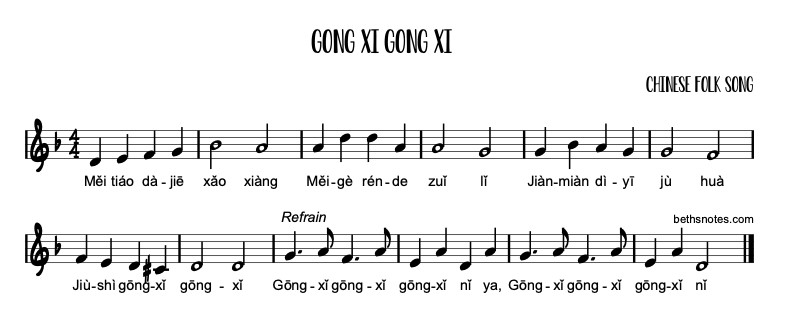
Actually the song is written in a minor key, D minor. Here is the score.
The Wikipedia article D minor. gives a list of classical musical works written in that key. I was surprised to discover that several of the works mentioned belong to my all-time favorites.
I can not resist the temptation to mention three of them.
Top of the list, the chaconne from Bach’s 2nd partita for solo violin in D minor. .The most beautiful music ever written. Some of the variations still give me goosebumps. I wrote a blog about it: The Chaconne
Two works by Mozart. Here is his piano concerto KV 466 in D minor, my favorite. Here played by Maria João Pires, also my favorite 😉 . I wrote a blog about her: I have fallen in love
And his Requiem in D minor. I didn’t write a blog about it, but I watched the movie Amadeus many times 😉
Ok, one more, sorry. Bach again, his Toccata & Fugue in D-minor for organ. I wrote a blog about this and other toccatas: Toccatas
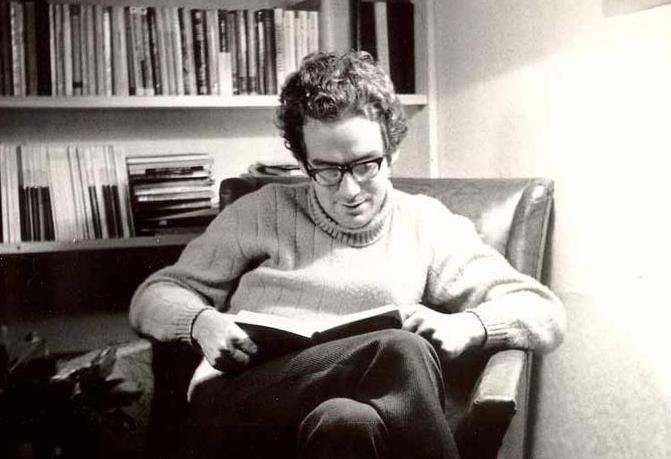
A few weeks ago I published a blog post Me as a Physics Teacher. Searching my archive for photos, I came across several pictures taken during my “student” days. So here is a post about my life as a student.
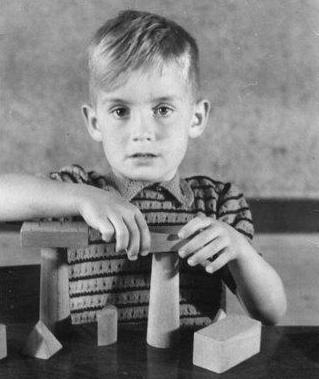
Here is the only photo I have about the start of my “student” life 😉 Taken when I was 5 year old, during my stay at the kindergarten school.
Some photos must have been taken during my primary school time, but I cannot find any in my archive. My results were good, I skipped a class and was only11 year old in 1955 when I went to the Christelijk Lyceum in my hometown Alphen a/d Rijn. In those days a Lyceum was a school type with two courses, a five year one (HBS) and a six year one (Gymnasium). The Gymnasium stream had Greek and Latin as additional languages (besides Dutch, English, German and French) and prepared for university.
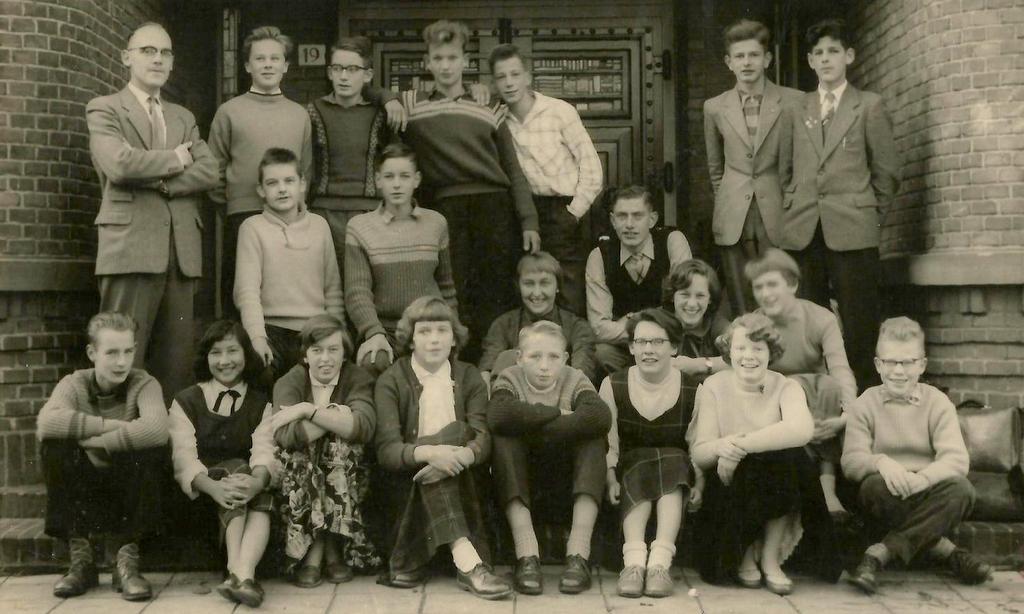
I was admitted to the Gymnasium stream. Here is my 2 Gym class in 1956-57. I am standing, fourth from the right.
One year later, class 3 Gym. I am standing in the back row, third from left. Next to me my best school friend Bram and my physics teacher Smit, who played an important role in my decision to study physics.
Our Gymnasium class was already quite small, but in class 5 Gym it was split in two, Alpha and Beta. The alphas got more Greek and Latin, the betas more mathematics and science. Here is the small 5 Gym Beta class with our Greek language teacher Flink. He was a nice old-fashioned gentleman, and we accepted willingly the awful smell of his pipe tobacco (smoking in the classroom was still permitted in those days). Can you find me? Sitting in the center, next to my friend Bram.
The usual school photo, in class 5 Gym Beta. February 1960, I am still 15 year old, will be 16 in April.
The final examination for Gymnasium classes was quite special in those days. In addition to the written tests, there was also oral ones, taken by your teacher and a university professor. After an exciting day, the end result was discussed by teachers and visitors in the staff room. We had to wait in a classroom for the verdict. Luckily in our small group everyone passed.
Time to celebrate, here in front of my family house.
Many of us continued our studies at various universities. The famous Leiden University was close to my hometown and a logical choice, but I was the first in my (extended) family to go to university and my parents preferred the Christian Vrije Universiteit in Amsterdam. They managed to find lodgings for me with a nice (Christian) landlady. I was only seventeen year old, in retrospect too young.
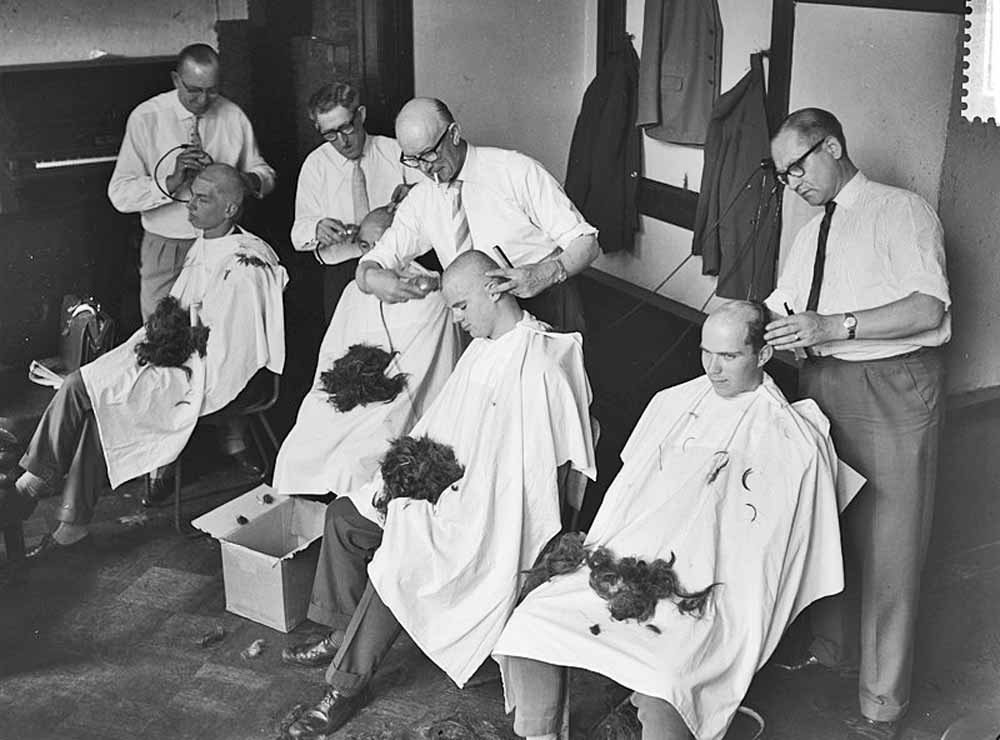
I enrolled for physics and mathematics. and I also joined the student corporation of the VU. In those days the student corpora had severe initiation rituals. The aspirant members had their head shaven and were humiliated in many ways a couple of weeks, before they were accepted. Here is a picture I found on the Internet, taken in 1961. I still vividly remember the experience.
At the end of 1961 a few of my classmates had a kind of reunion. Our favorite teacher of Dutch language, Miss Dubbeldam, was also present. Notice that my hair is growing back already, pity that I don’t have a picture when my head was clean shaven.
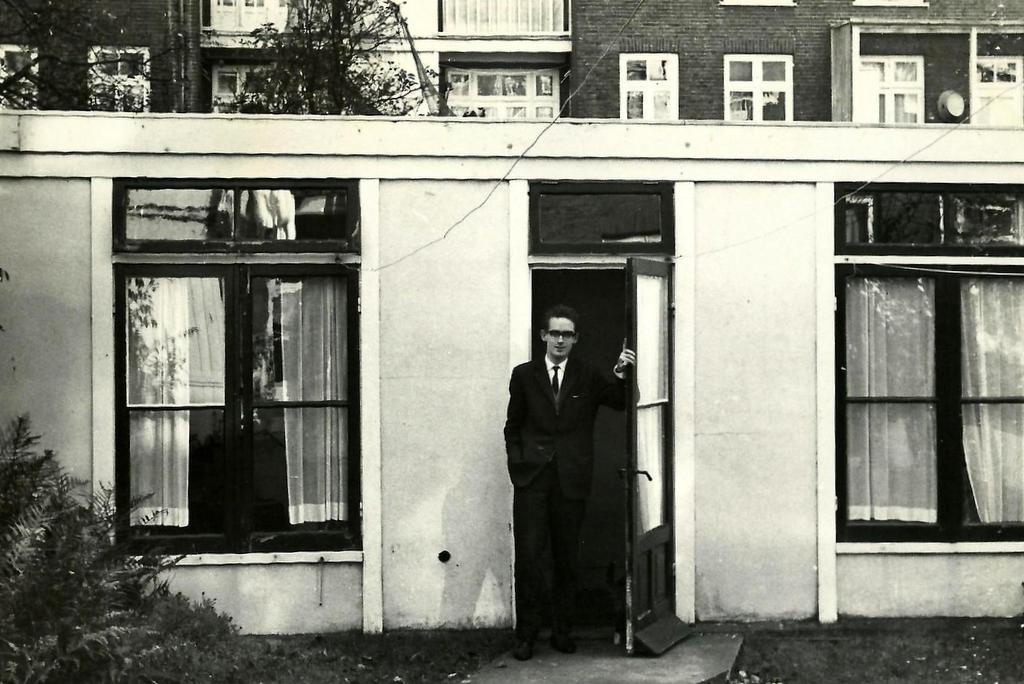
My room in Amsterdam was actually a kind of garden house. Private, but to reach it, I had to pass through the house of my landlady. Here I am standing in front of my rooms, around 1963. I did not really enjoy those first years at university, as soon as the lectures finished (Saturday morning!) I took the bus back to my hometown and stayed there with my family until Monday morning.
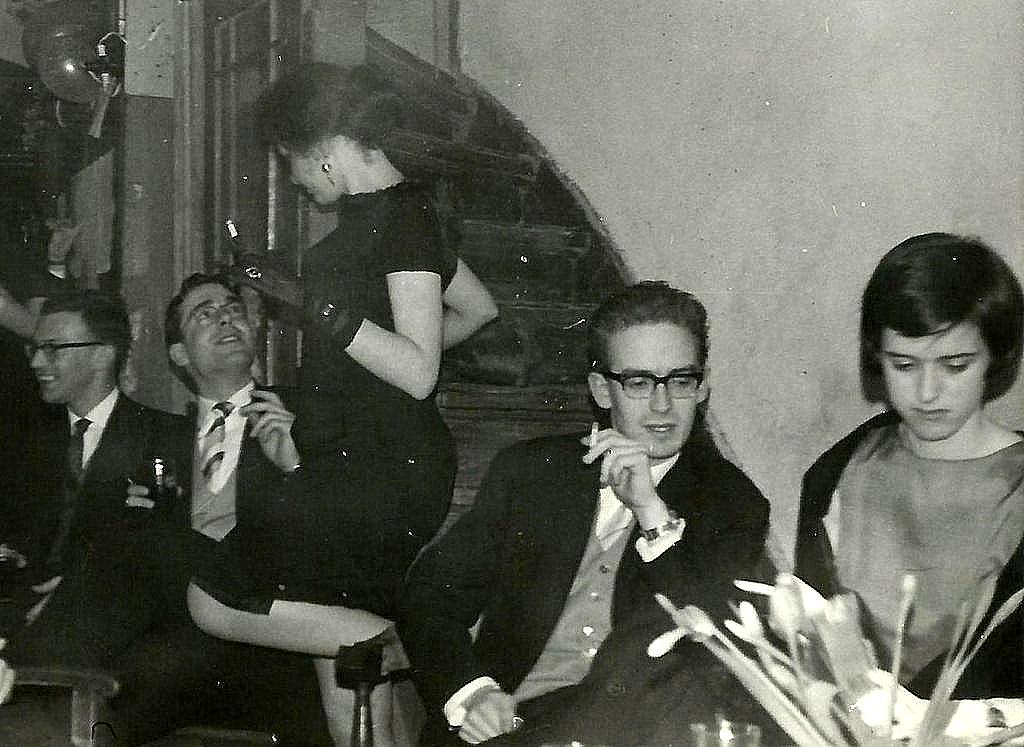
After I was accepted in the student corporation, I became a member of the sorority (“dispuut”) Odysseus. Weekly we met for drinks and there were regular meetings, where you could train/show your oratorical skills. A nice “cultural” dispuut, but still too macho for the immature guy I was. After a few years I left the club.
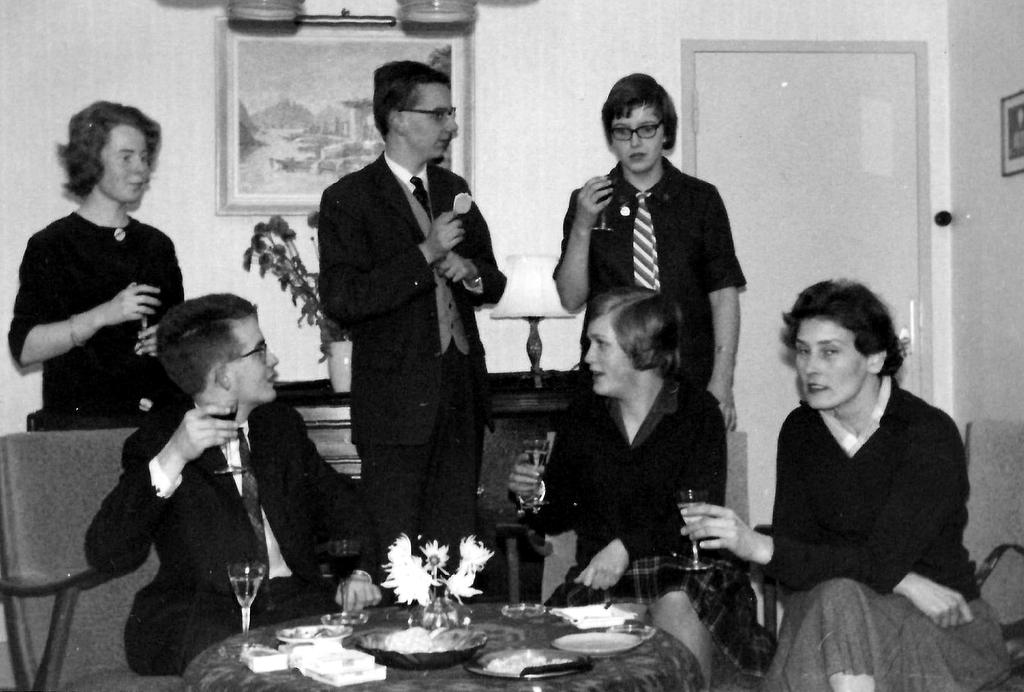
I had a few good friends. One of them is Nellie, we first met when we were both freshmen, more than 60 year ago. Here I have joined Nellie at a party of her :”dispuut” Notice how formally dressed I am, in a three-piece suit..
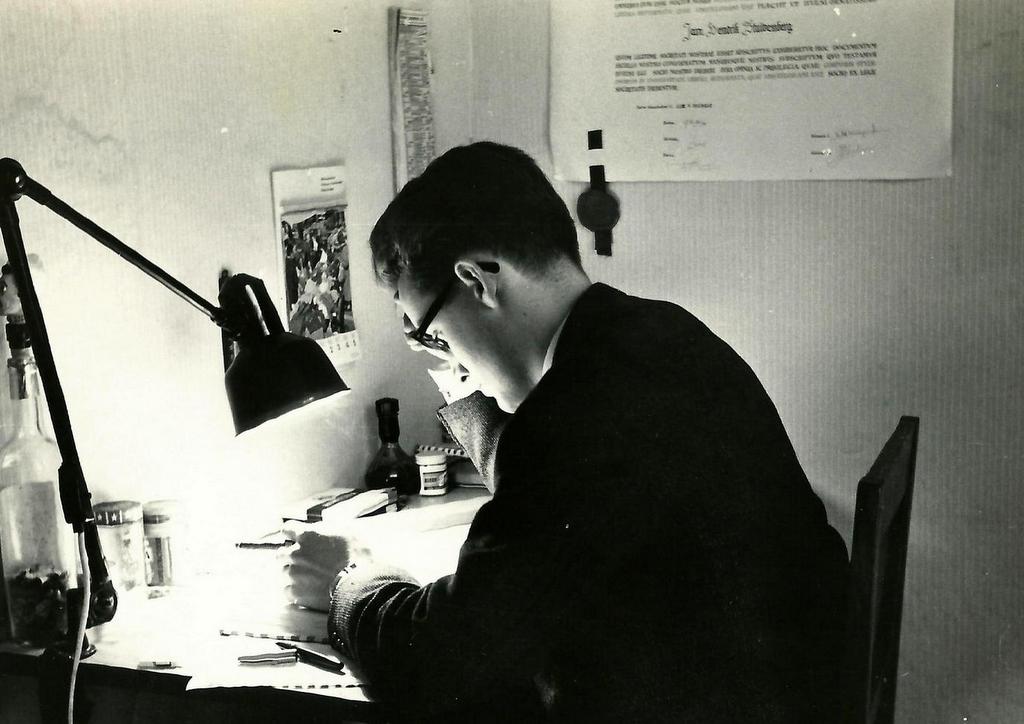
I was a diligent student. On the wall of my room the certificate that I was a member of the student corporation.
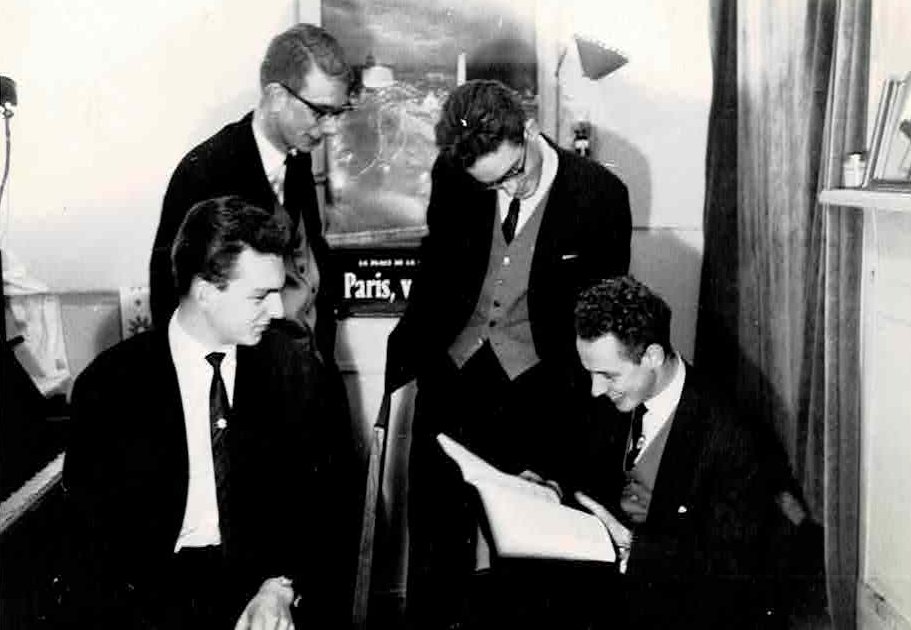
In my room with some more friends. Jan, my best friend in those days, is trying to sing something from Bach. We were a serious bunch.
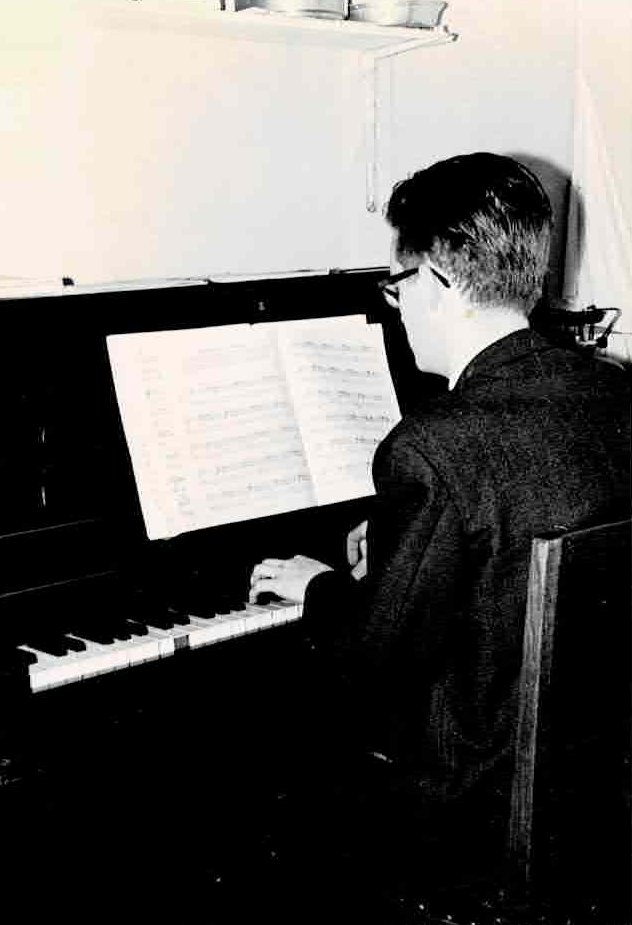
Pictures taken at the same time. I had bought an old piano and was still following piano lessons in my hometown. It must have been a party, with the bottles stored in the piano, but I don’t remember what we celebrated. .
In those days university studies were split in two parts , the “kandidaatsexamen” and the “doctoraalexamen”, more or less equivalent to present day Bachelor and Master degrees.
I passed my “kandidaats” in 1965. In those days taking four years for this degree was quite normal. For the second phase, we had to follow lectures, pass tests, but also .work in the physics laboratory, taking part in excursions to other universities etc. I chose nuclear physics as a specialism and worked in a group, led by Anne de Beer, who was doing research for his PhD thesis. A very enjoyable few years
In 1967 I took part in a trip to the UK where we visited several laboratories
At the end of the trip we enjoyed a nice dinner. Notice that we are smoking cigars.
At the end of 1967 an important event took place in my life, resulting in a big change in my outward appearance. It was hippie time, my hair grew longer, my clothing became informal and I got interested in popmusic. See my blog Musical Nostalgia.
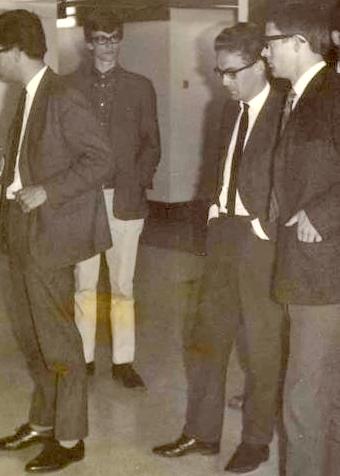
In those days military service was still compulsory, but you got a deferment if you studied. In 1968 I was given a test to determine whether I had leadership qualities. It was fun, here I am (no 26), I didn’t try to qualify because I had already decided to become a conscientious objector in case I had to go into military service.
Anne, the leader of my group defended his dissertation on 20 December 1968. He asked me and another student to be his paranymph, an old tradition. Formally dressed in white tie, but with long hair, I was of course subject to funny remarks.
A few months later I obtained my doctoraalexamen (Master of Science degree), I became a doctorandus .My university asked me if I would like, to stay , get a part-time job as scientific assistant and do research for a Ph.D. .I was honored and accepted. As my interest was more in theory than in experiments, it was decided that I would do research in theoretical nuclear physics.
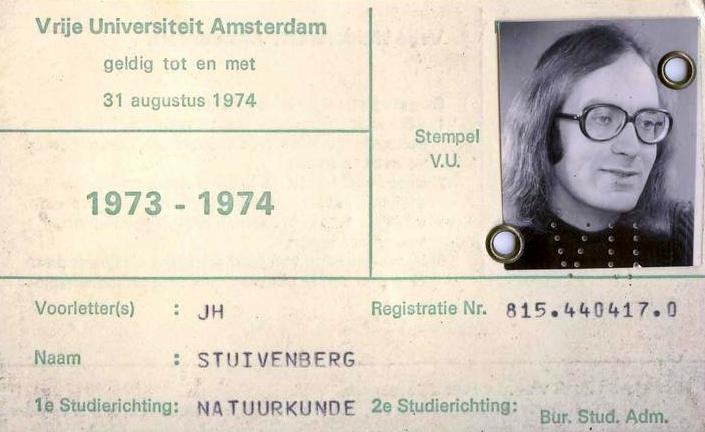
Although I was no longer a student, I was still entitled to a student identity card
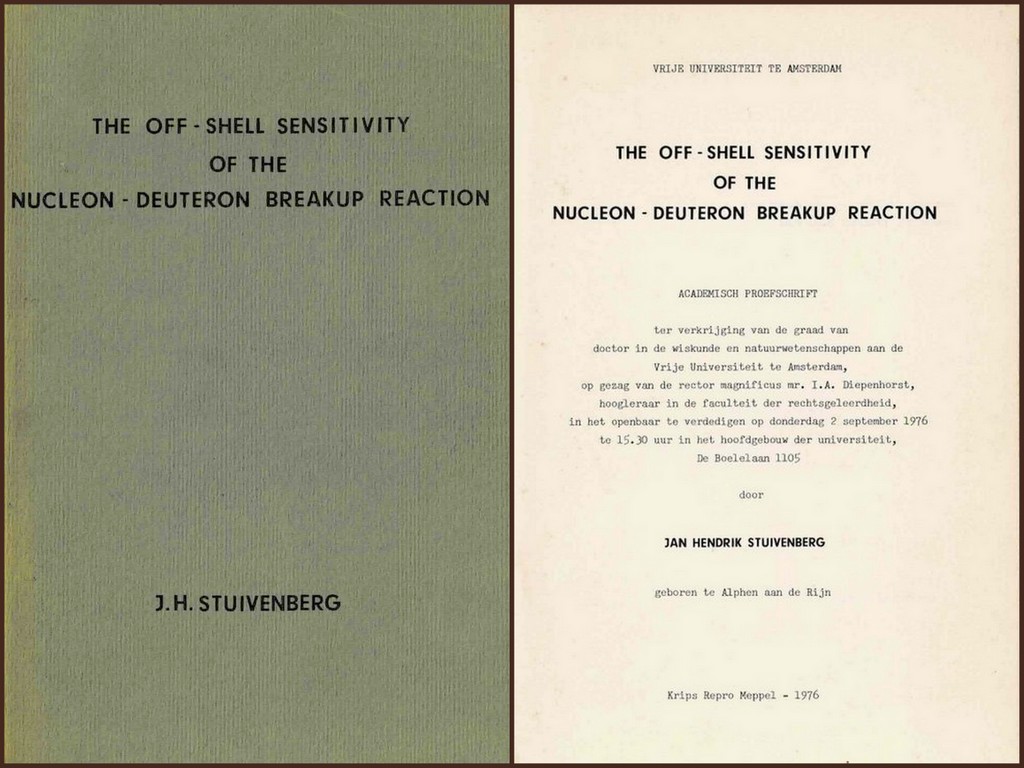
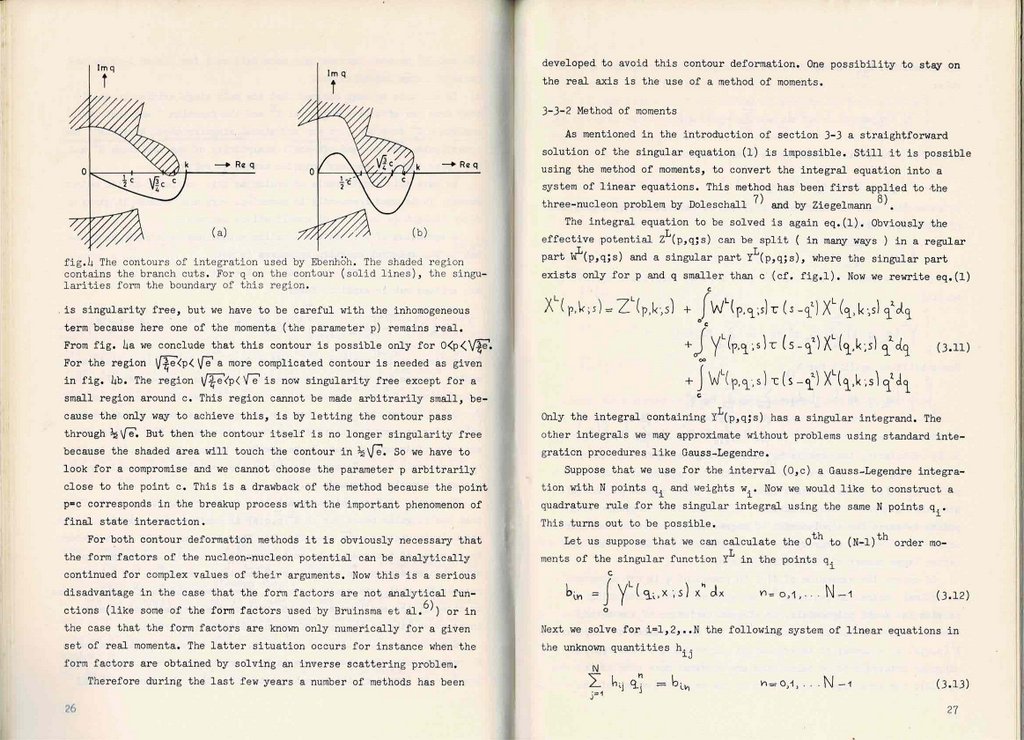
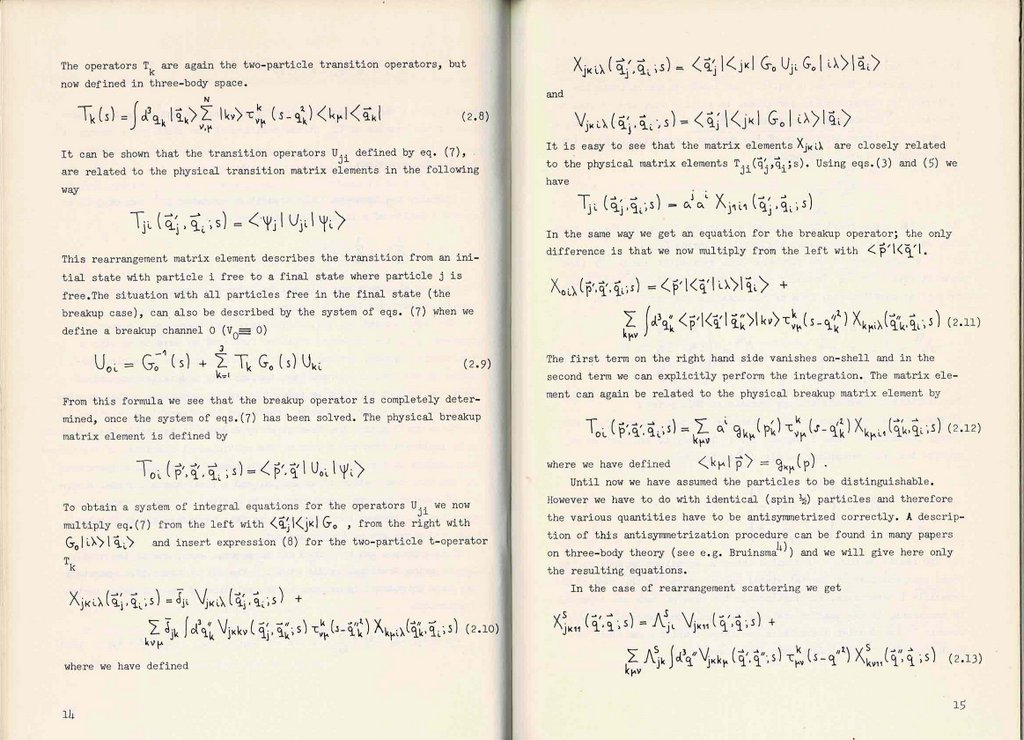
For various reasons it took me a rather long time to do my research and write my thesis. Here are a few pages of my thesis.
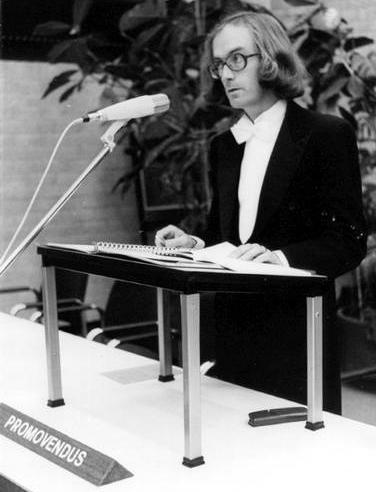
Here I am defending my thesis, 2 September 1976. Paranymphs were no longer needed.
It was a public ceremony, colleagues from the physics faculty were present, my proud family on the first row. My physics teacher from the Lyceum was there (second row, second from right), I had already accepted a job as physics teacher and started a few weeks earlier. The principal of my new school was there and a teacher colleague with a few young pupils from one of my classes (one row below the top row, in the middle).
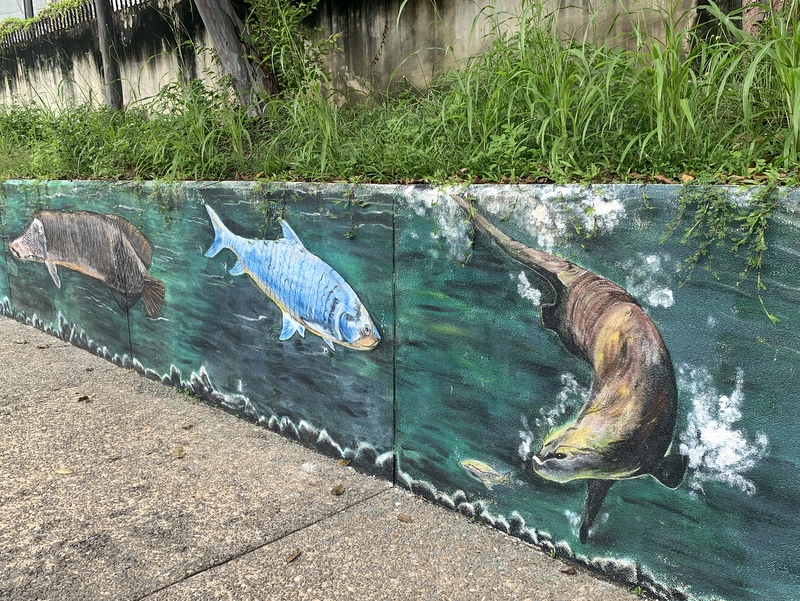
When we walked the River of Life route recently, we started at the trail head near the Midvalley Megamall and stopped at Chinatown, because we wanted to have a look at the murals there. Click here for a detailed report. So we skipped the part from Chinatown to Masjid Jamek, considered the be the most beautiful part of the route.
As there are LRT stations both at Masjid Jamek and near Midvalley (Abdullah Hukum) , I suggested to Paul that we could walk another time, one way, from Masjid Jamek and going back by train.
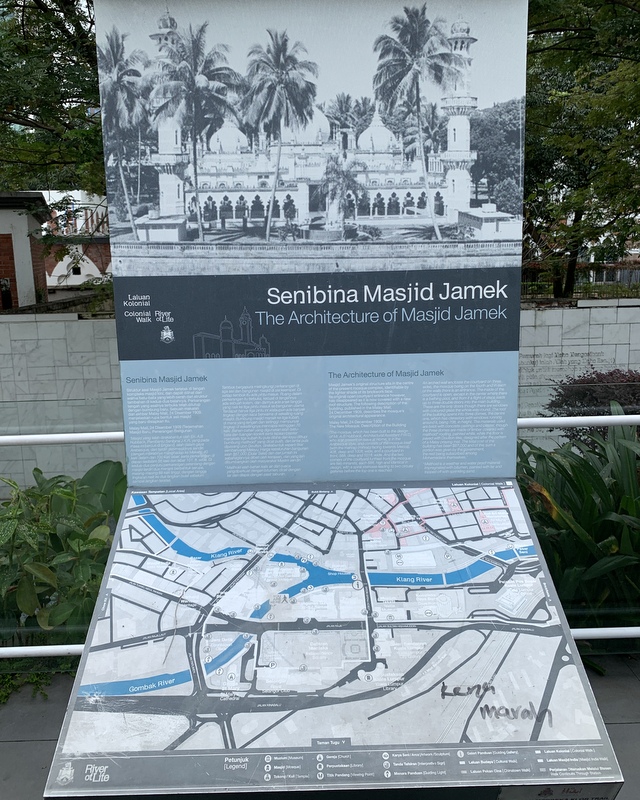
We met at the exit of the Masjid Jamek LRT station and started our walk from there. A clear signboard gives information about the River of Life project.
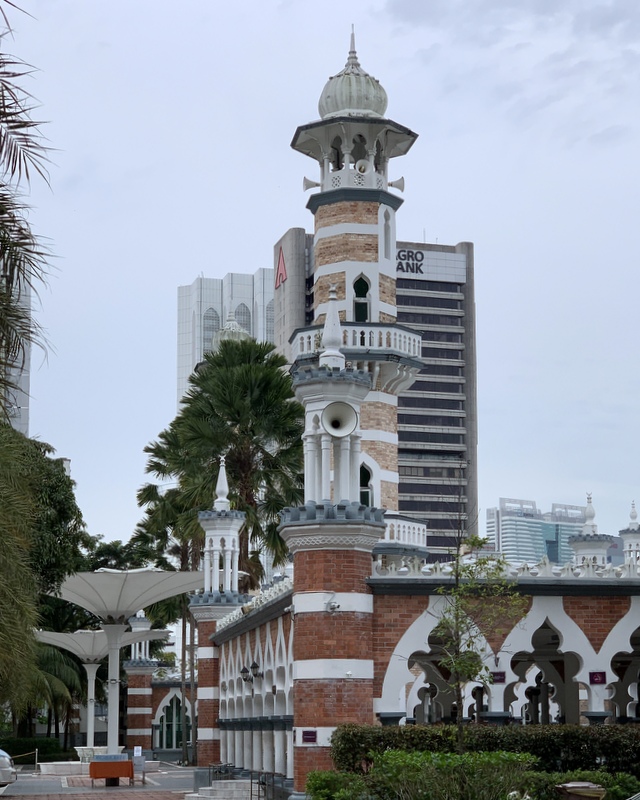
Our walk started in front of the Masjid Jamek, one of the masterworks of Arthur Benison Hubback, built in 1909. Non-Muslims can visit the mosque, but there is a dress code. Left an explanatory signboard, right the mosque as seen from the main entrance.
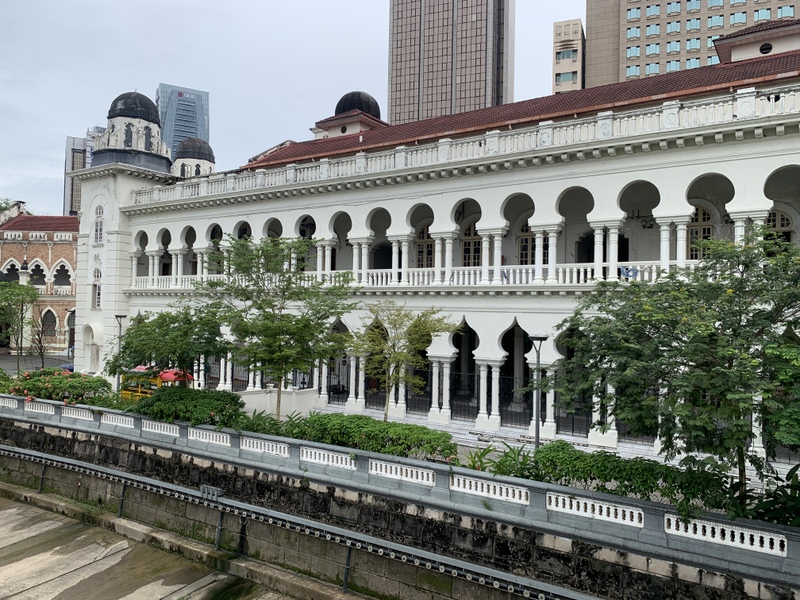
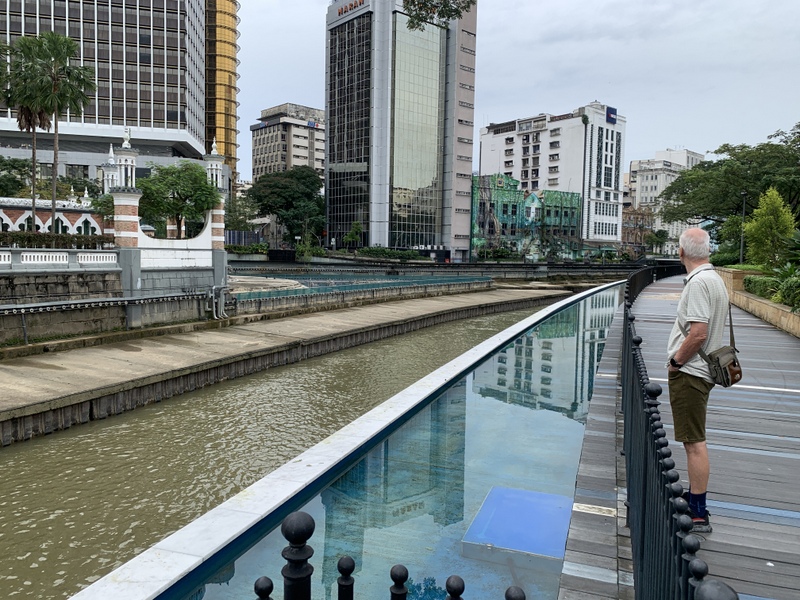
The route passes the magnificent (old) Supreme Court building, another creation of Hubback (1915). Not in use at the moment and the interior needs urgent repairs. The picture has been taken from the new pedestrian bridge crossing the Gombak river. In the right picture Paul is looking at the mosque, located at the confluence of the Gombak and Klang rivers.
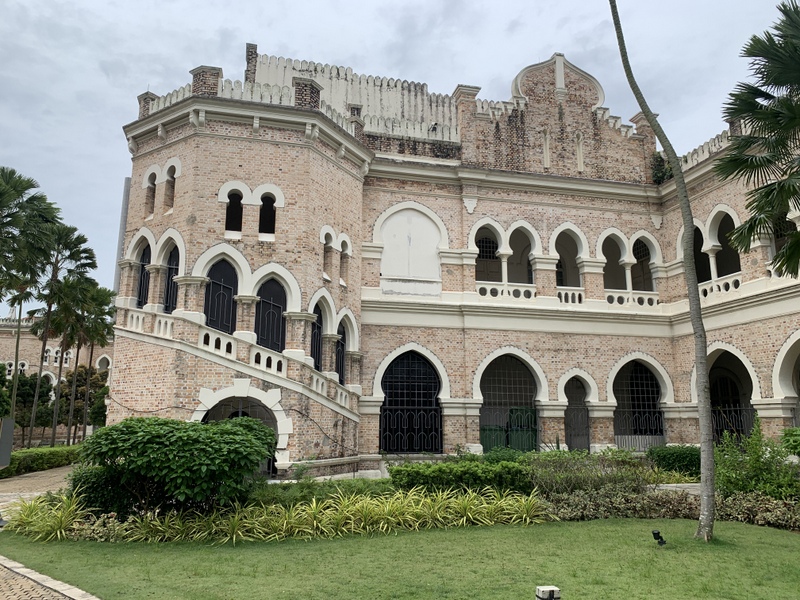
The next few hundred meters are for me the highlight of the River of Life project You pass the back of the former Government Office (1897). The front side, facing Dataran Merdeka, is probably the most photographed building of KL The tranquil , peaceful backside was an unexpected surprise for me
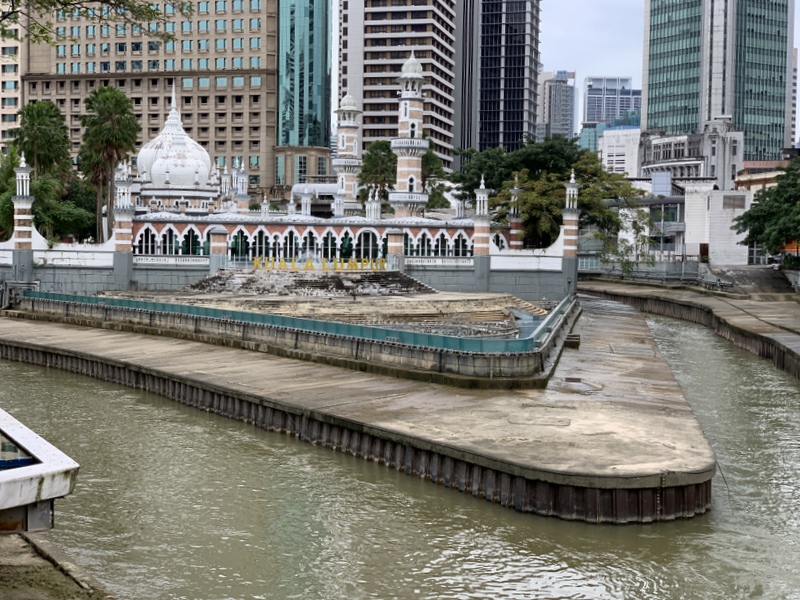
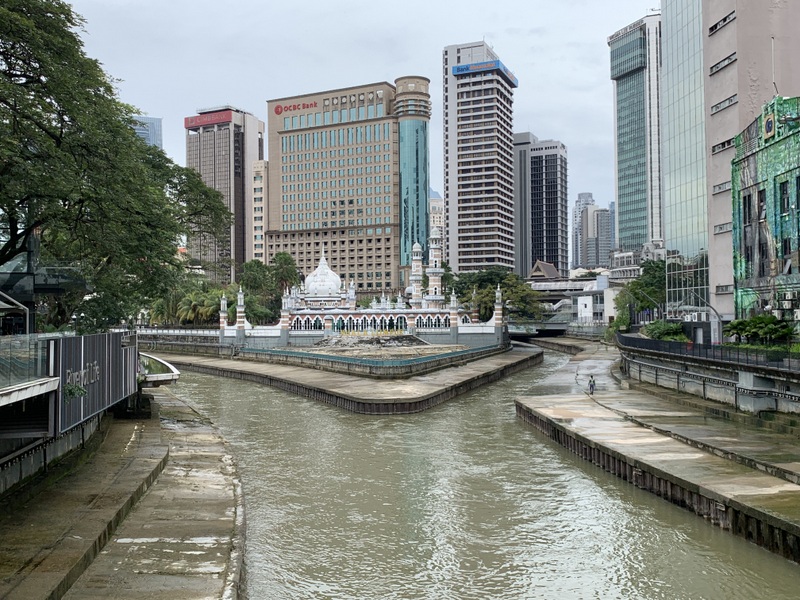
Continuing along the Gombak river, you have nice views of the Mosque and the confluence of the two rivers.
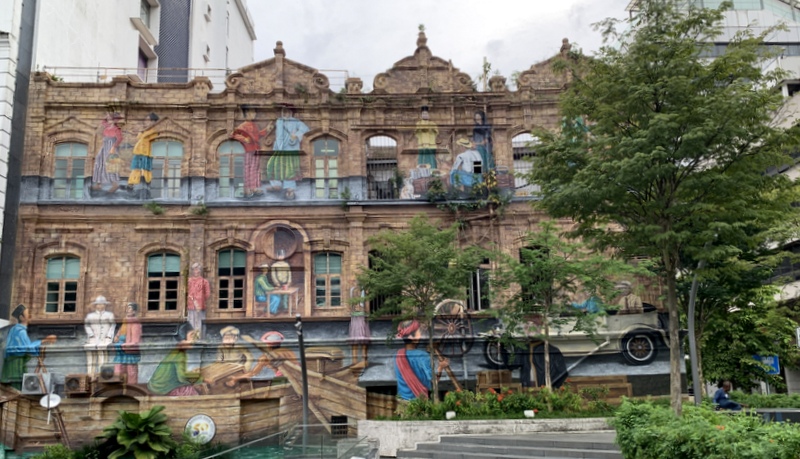
Before you reach the next bridge, there is interesting mural art. These three buildings are still in use, as can be concluded from the numerous aircon’s .
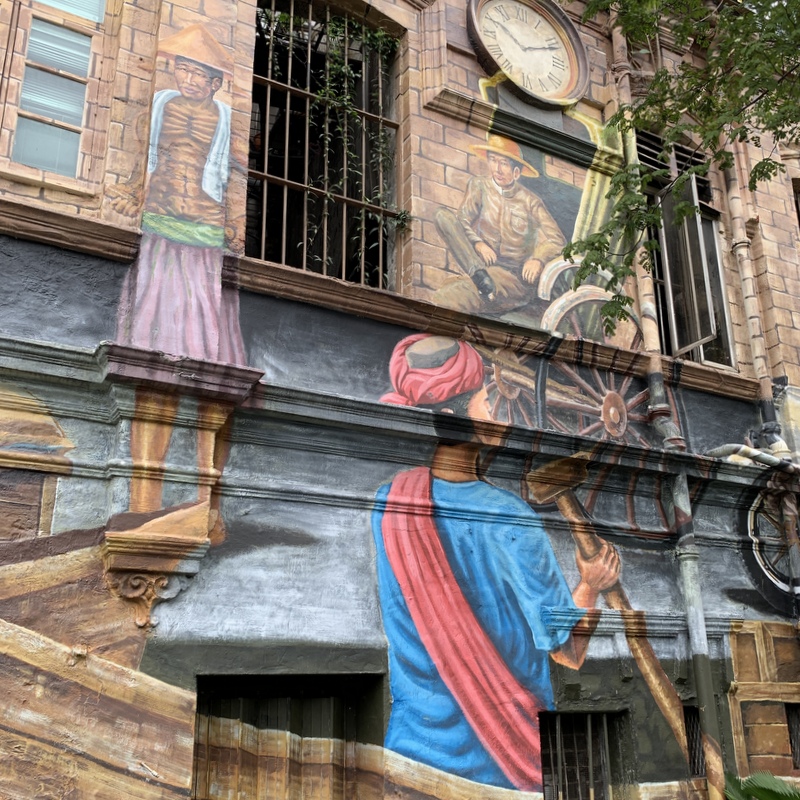
Almost next to it, this building looks vacated, not a good sign . The façade has been used to paint various sketches of Kuala Lumpur’s past
It looks like after the bridge you can continue at the same side of the river, but soon, the raod is blocked (left pic), so you have to cross the bridge here, where you can find a modern work of art. (right pic)
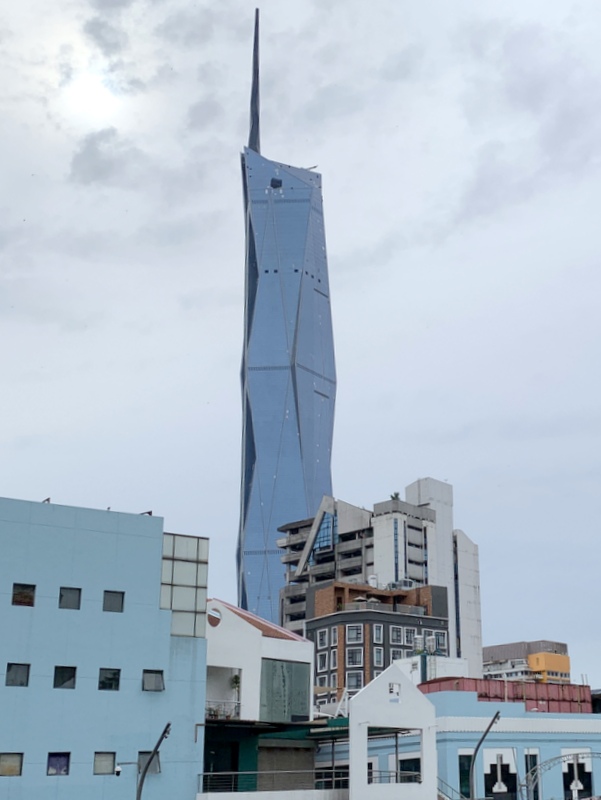
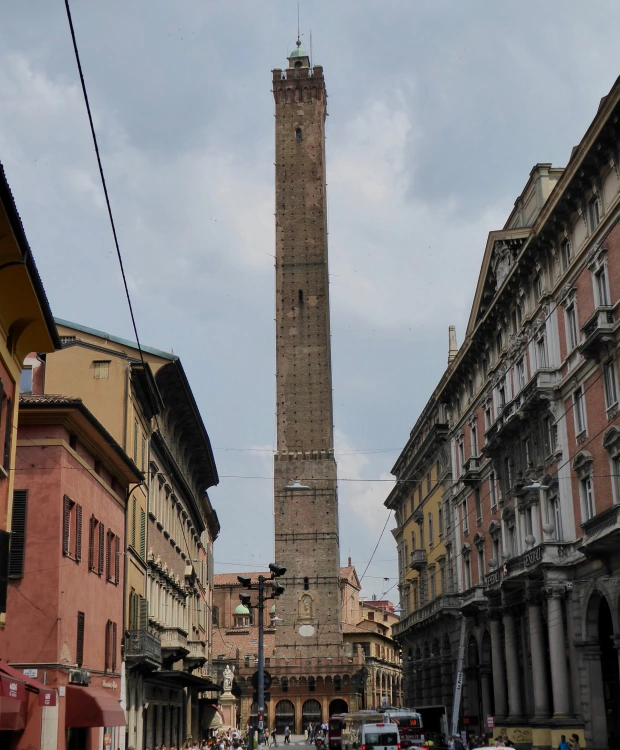
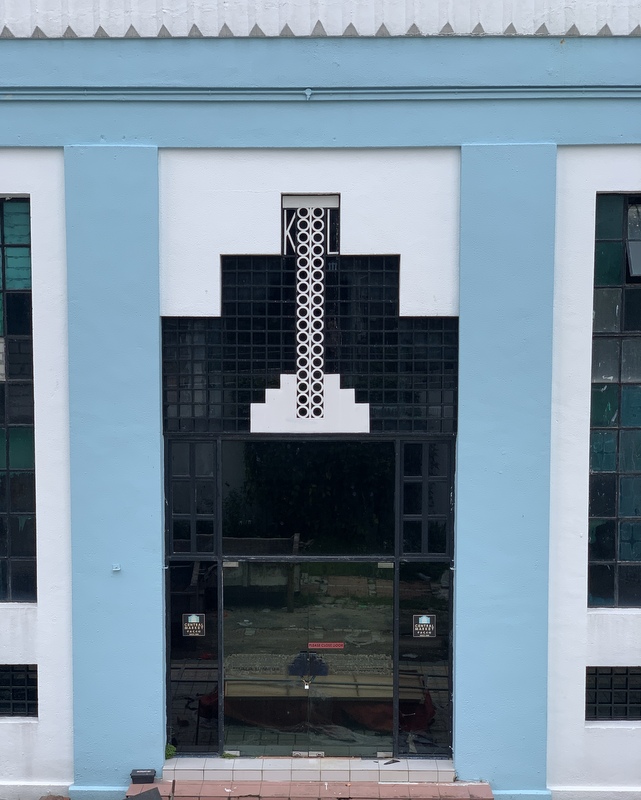
You will pass now the Central market (Art Deco , 1937). The left picture shows a part of its façade, with towering above it the new Merdeka 118 skyscraper, still under construction. It will become the second-tallest skyscraper in the world. I can’t resist the temptation to digress for a while. When I see a photo like this I immediately have the association with a phallic symbol and that these symbols have been constructed since time immemorial. The right pic shows the Asinelli tower in Bologna, built in 1107 😉 .
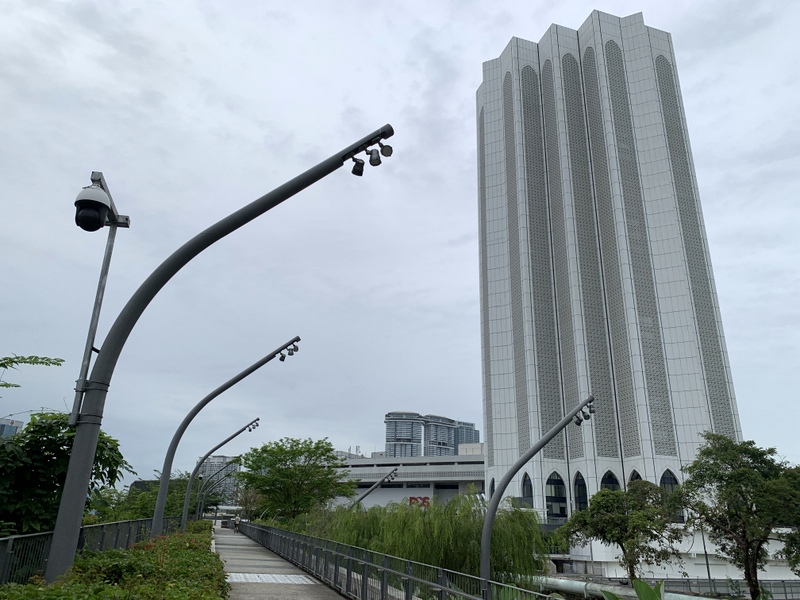
Left a detail of the Central Market and right one of my favourite buildings in KL, the Dayabumi building. Completed in 1984 and for one year the tallest skyscraper of Malaysia. For me it is a fine example of Islamic Architecture.
Passing the Dayabumi complex (left) we reach the Pasar Seni LRT station (right in the center), where we cross again the river.
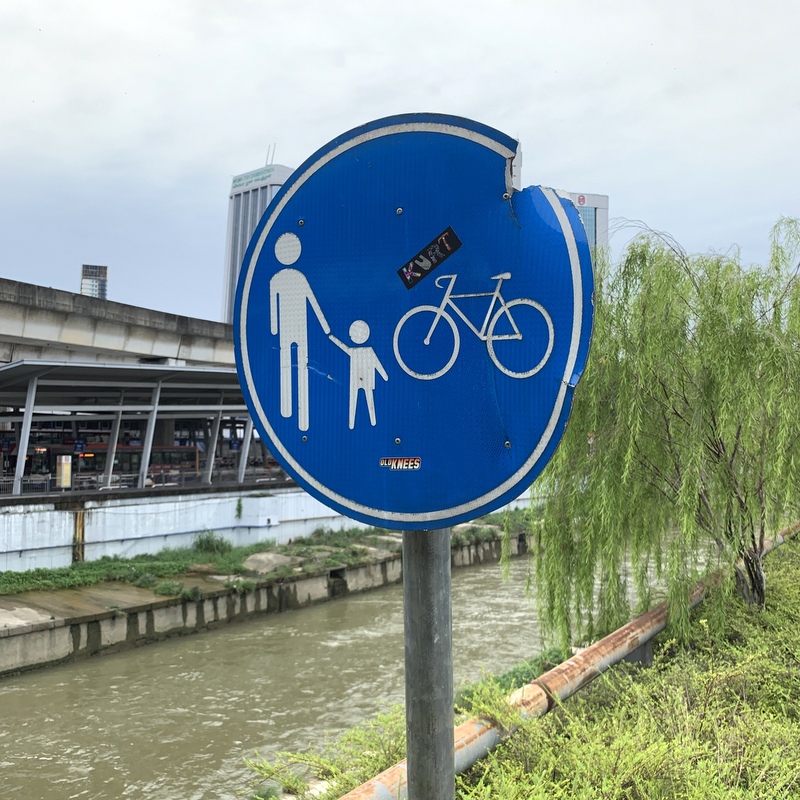
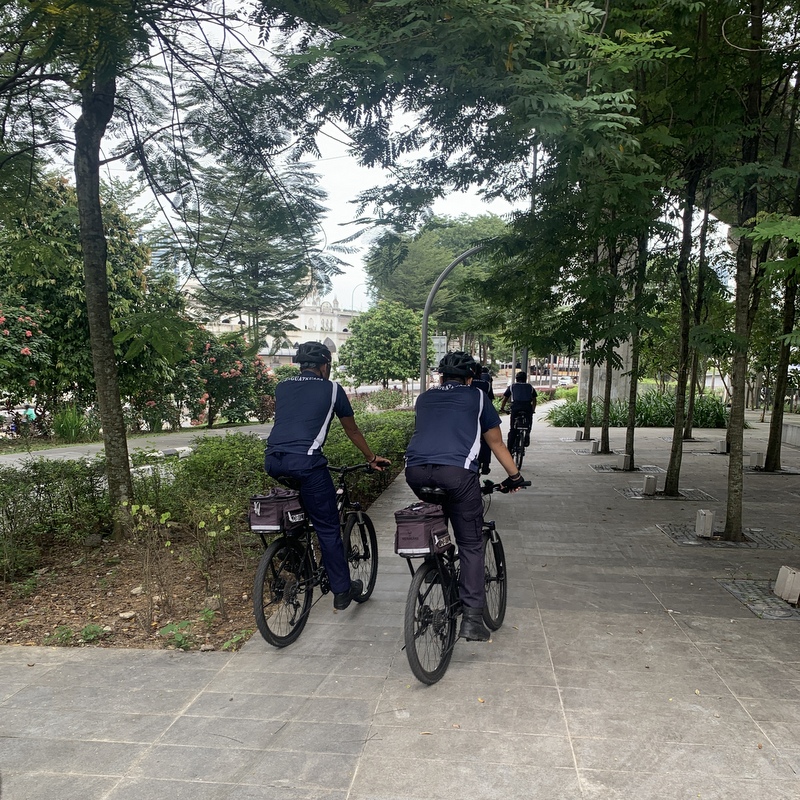
From there we followed the same route as during our first trip, so not many photos. It is basically a bicycle lane and we noticed a few cyclists.
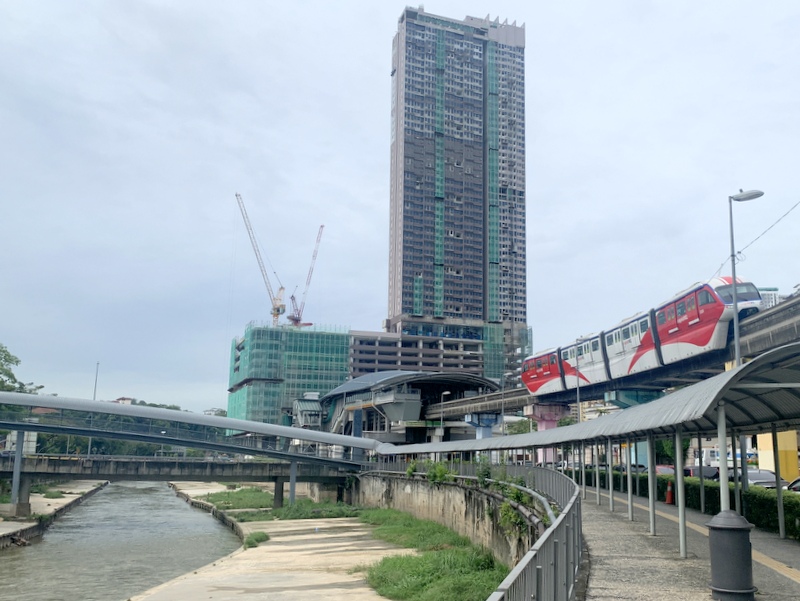
Mural art (left) and the Tun Sambanthan monorail station in Brickfields (right)
This time we decided to cross a bridge and continue at the other side of the river, so we didn’t walk through Brickfields. Distance is a bit shorter, but it is not interesting at all.
And there is one part where you have to walk a few meter away from busy, noisy highway traffic. Really to be avoided.
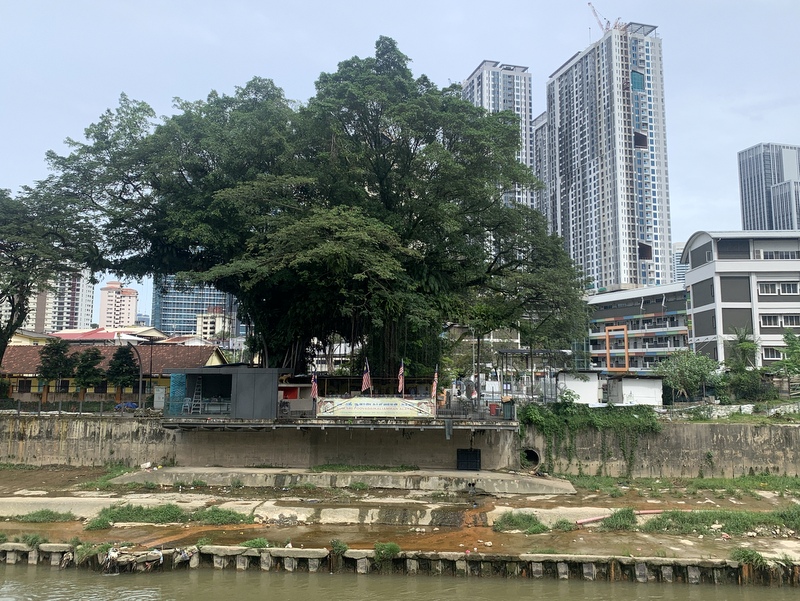
The Kalaimman temple is at the other side of the river. The majestic tree is now even more impressive
As soon as possible we crossed back to the other side of the river, and continued the trail until where we had started during our first trip. There was a sign near the building that it is the Southern Gallery. Completely empty, maybe there are plans to put some exhibits inside.
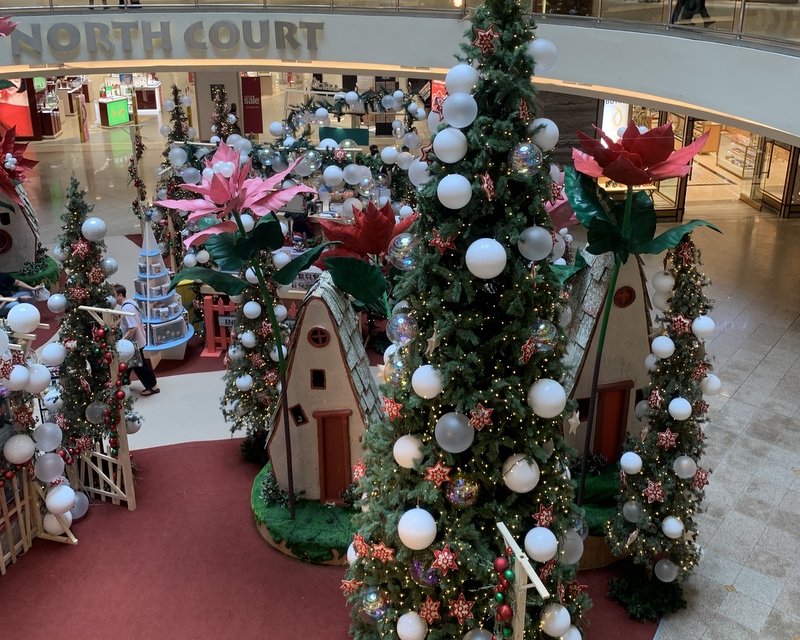
To reach the Abdullah Hukum LRT station we had to cross the Midvalley complex, where you can get easily get lost. Christmas atmosphere.
To reach the station we had to cross once more the Klang river.
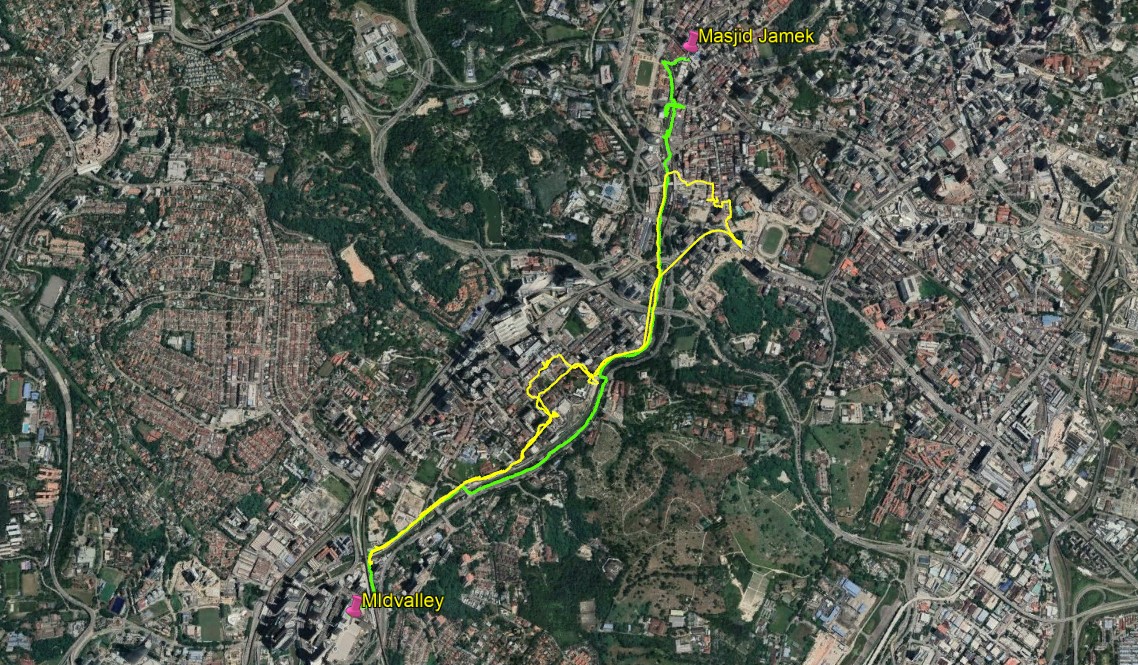
Here is a Google Earth map of our walk, in green. For comparison also the route of the first trip is shown (in yellow) . Notice the part where we walked at the other side of the river, avoiding Brickfields. To be avoided at all costs, Brickfields is much more interesting,
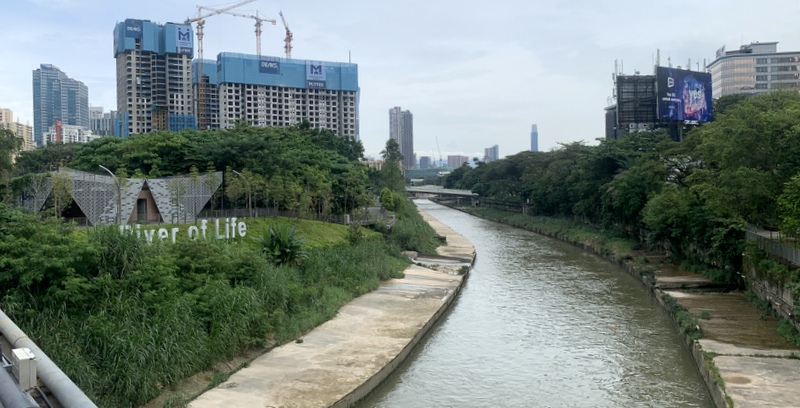
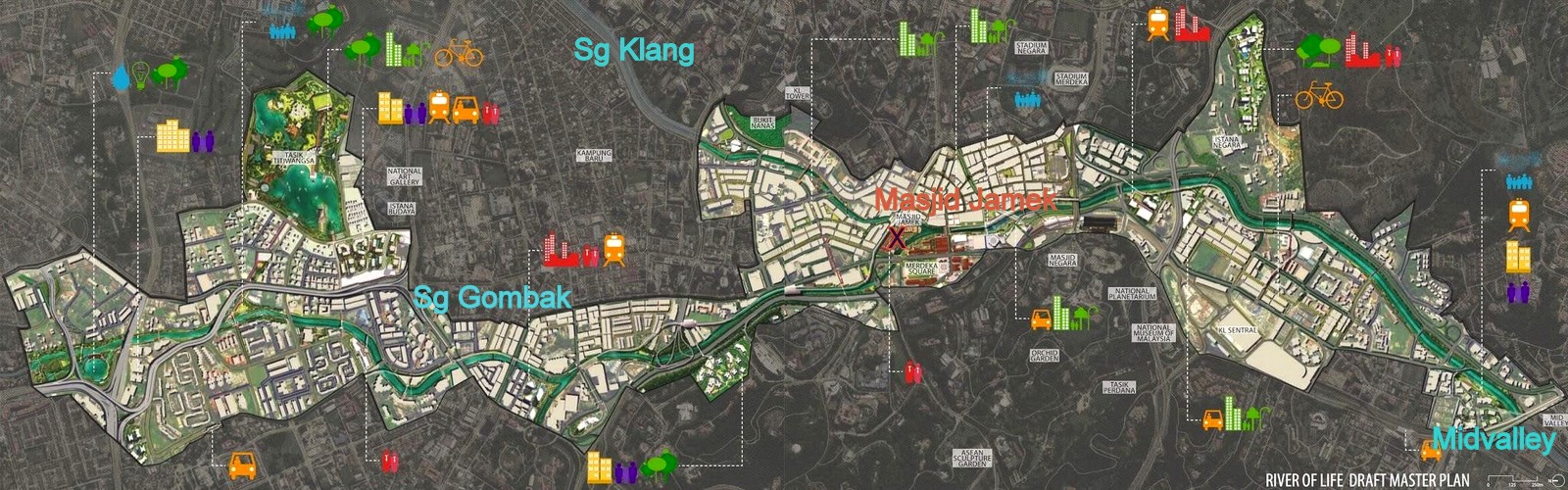
The River of Life (ROL) project was launched in 2011 and aimed at reviving the Klang River and Gombak River within the city of Kuala Lumpur, transforming the banks into waterfront areas with economic , touristic and commercial value through river cleaning and beautification. An ambitious project, here is the masterplan. Click to enlarge. I have put a few markers,the Klang en Gombak rivers, the Friday Mosque , where their confluence is and to the right Midvalley where the City of Kuala Lumpur ends.
In 2017 the first phase of the project was officially opened, the region around the confluence of the two rivers and the historic city center. A pedestrian bridge has been built across the river from where you have a nice view of the Masjid Jamek, and the river banks are brightly lit at night. During the visit of my family in August we took pictures from the bridge. The Friday mosque in the centre, left the Gombak river, right the Klang river. Spectacular, but too blue in my opinion.
Another part of the project is a biking/hiking trail along the Klang river between Masjid Jamek and the Midvalley megamall. My friend Paul had walked this trail and was willing to show it to me. He suggested to start at the Midvalley side,
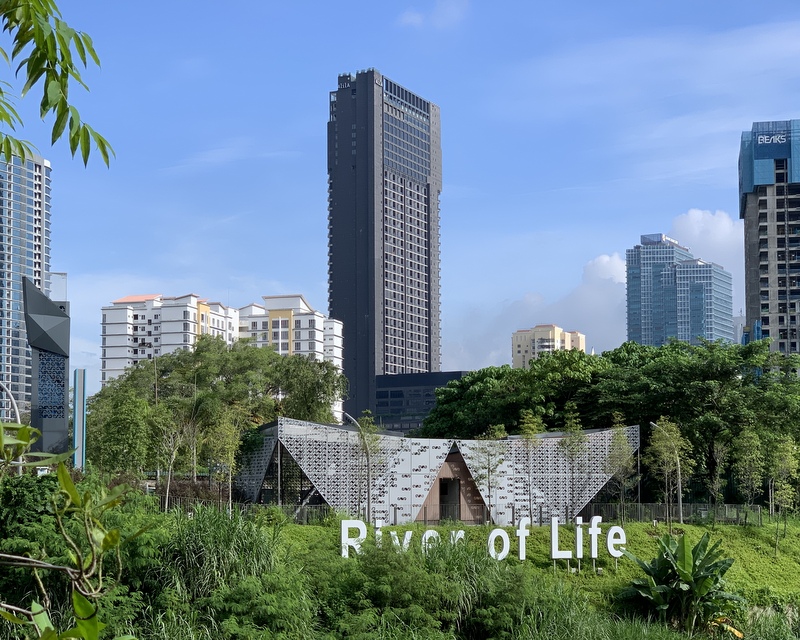
The start of the trail is marked on Google, close to Midvalley, but we needed Waze to find it, at the end of a minor dead end road (left picture). A signboard River of Life made it clear that we had reached the correct spot. The building behing the signboard looked nice but was unused.
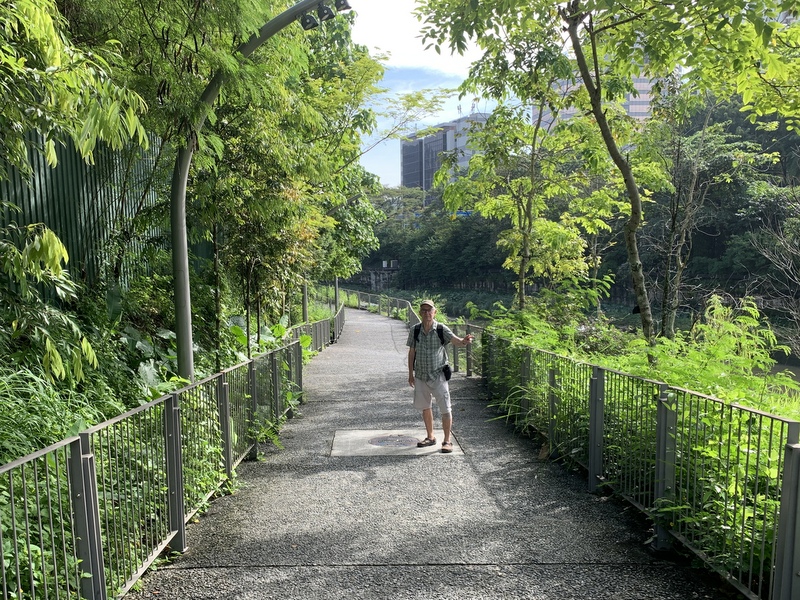
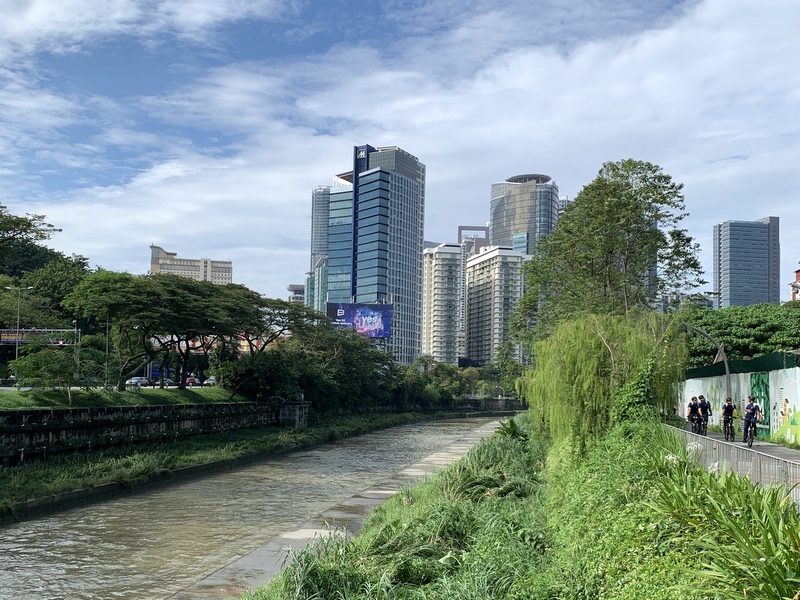
The first part of the trail is very pleasant. It is very wide as it is meant primarily as a bicycle route. The right picture , looking back at the Midvalley complex, shows a group of cyclists
Along the route descriptive panels give information about the history of the Klang river.
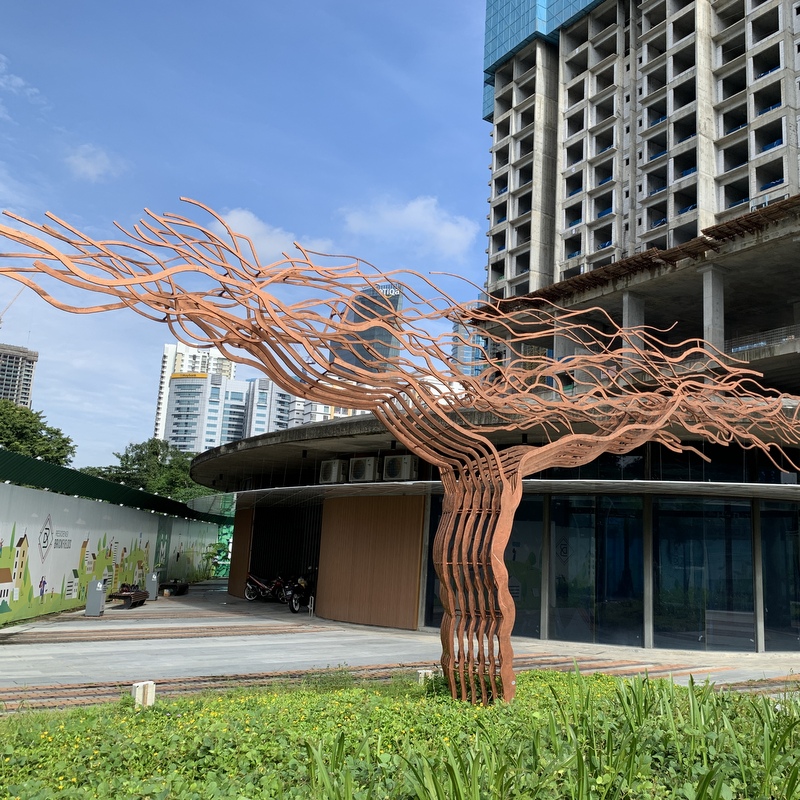
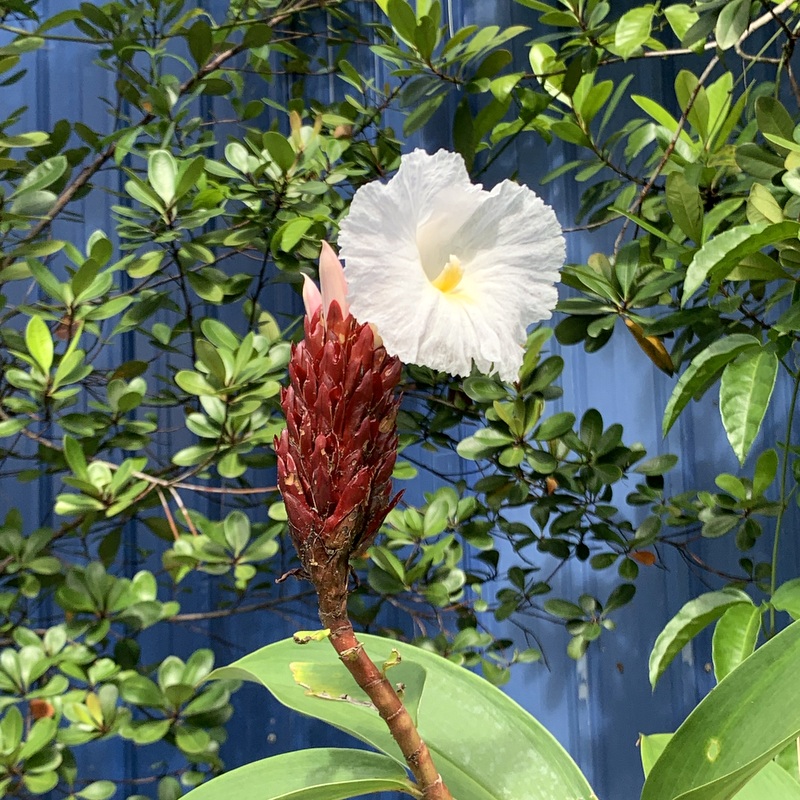
We passed building sites, still under construction. A nice sculpture with an unfinished building. A nice flower in front of a fence.
We could have crossed the white bridge in the background to the other side of the Klang river, but decided to follow the bicycle route.
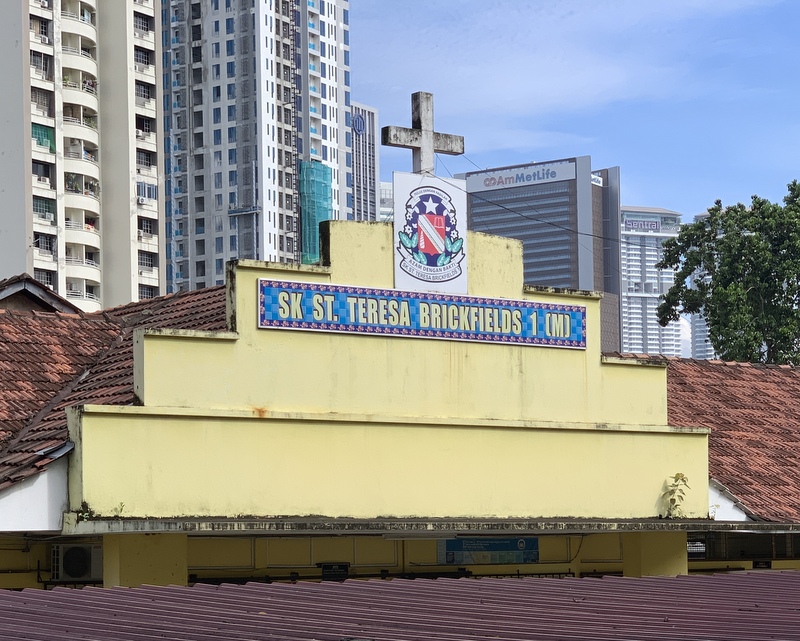
Entering Brickfields. Beautiful trees. We passed the St Teresa school.
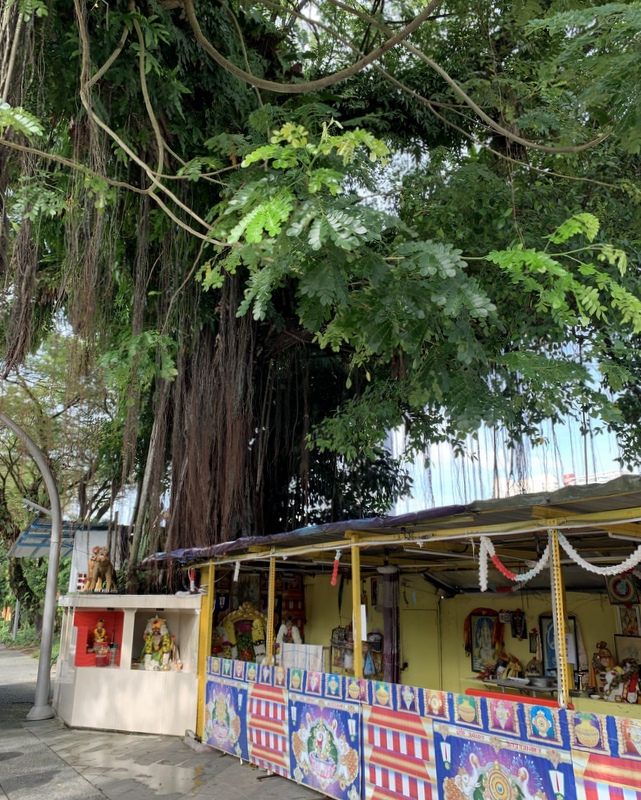
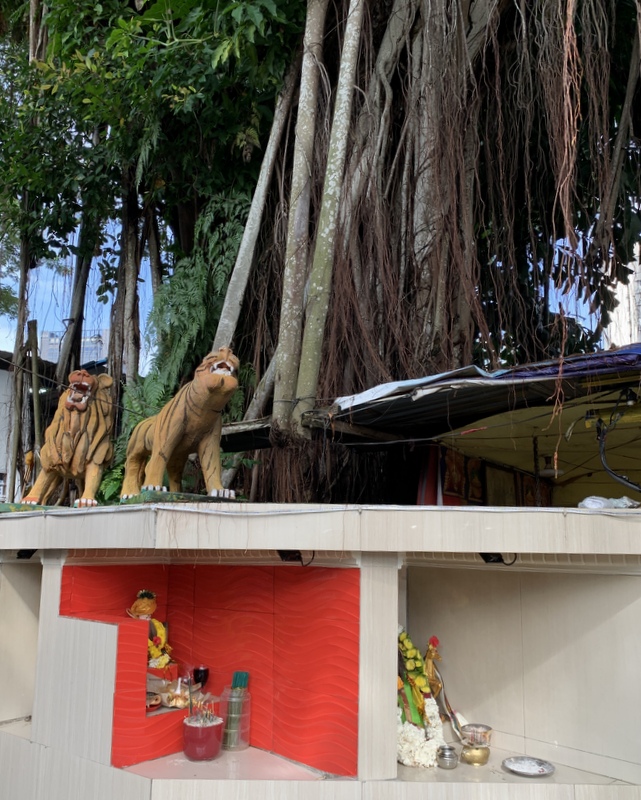
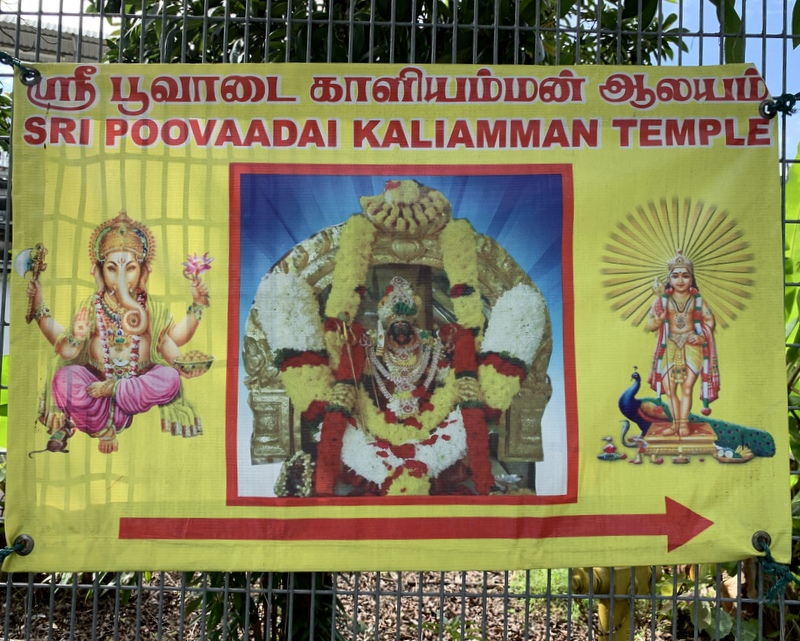
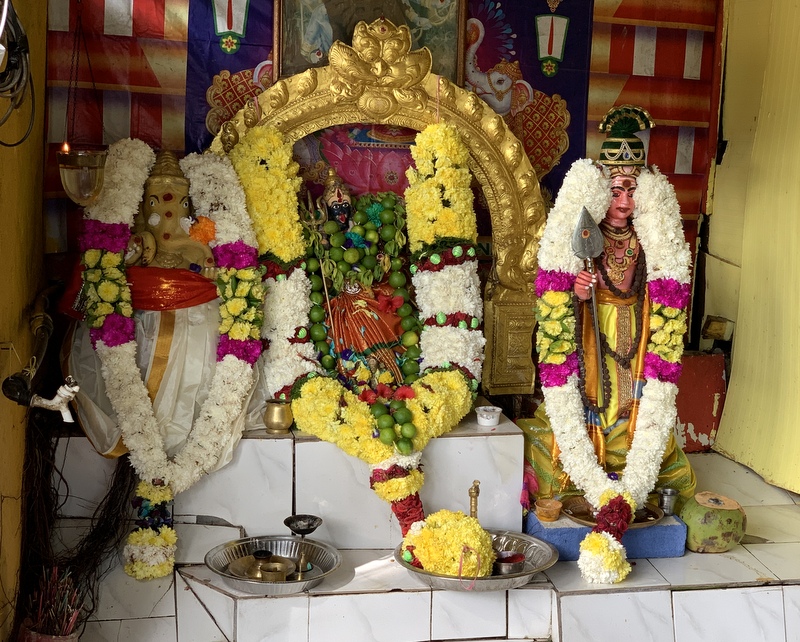
In the left picture above you can see a small white building. This is the Sri Poovaadai Kaliamman temple, built around a gigantic banyan tree. An interesting surprise.
After the temple it is not possible to walk along the river, but a blue bicycle ribbon leads you through Brickfields,
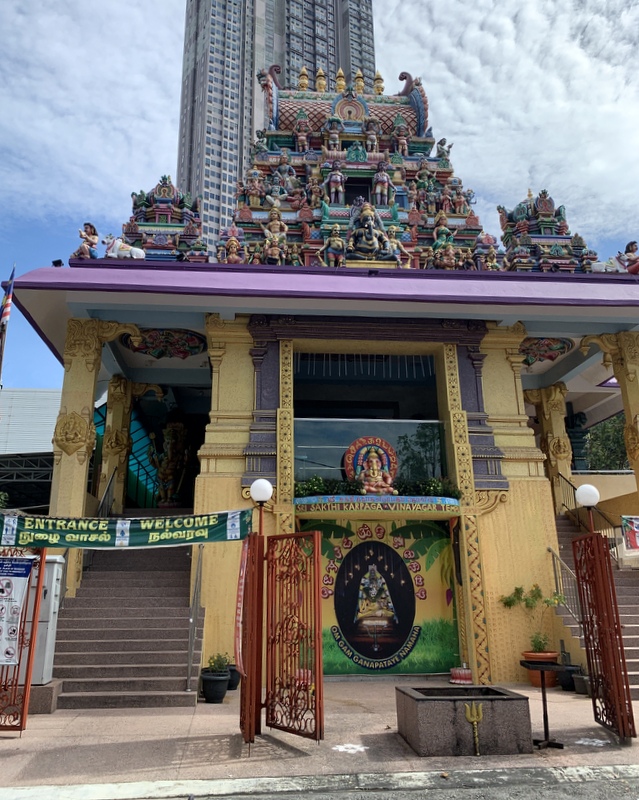
It is an interesting part of the walk, Brickfields is very Indian, We passed another temple, the popular Sri Sakthi Karpagar Vinayagar temple.
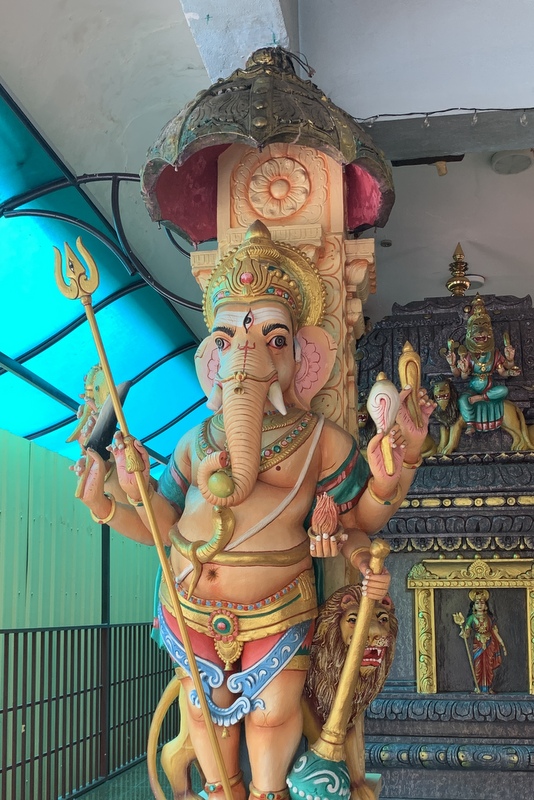
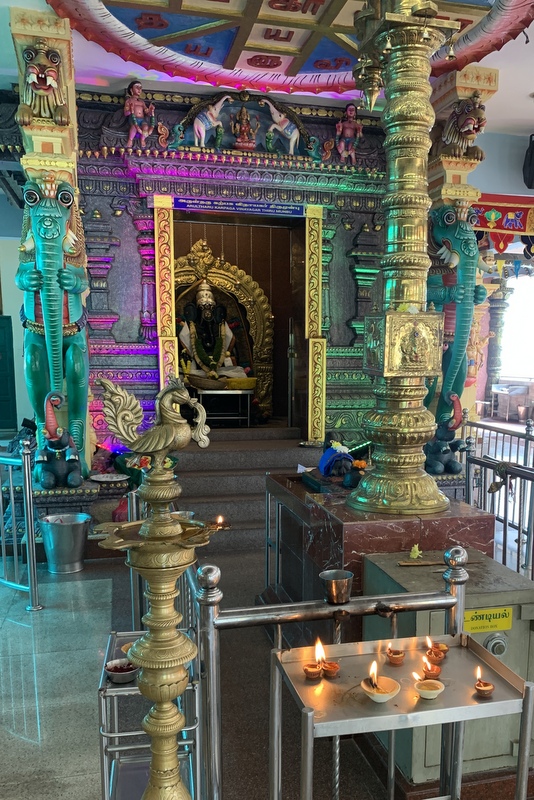
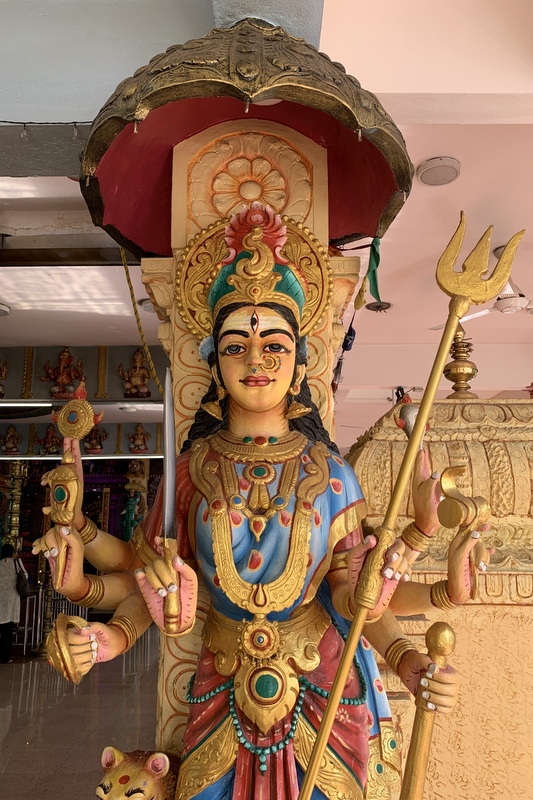
I walked around in the temple and took pictures.
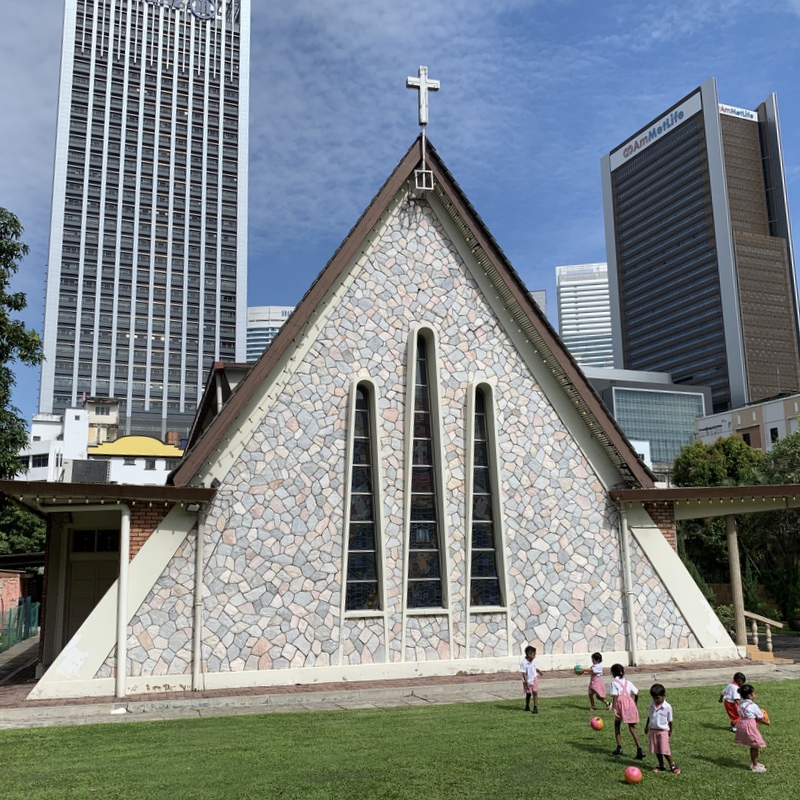
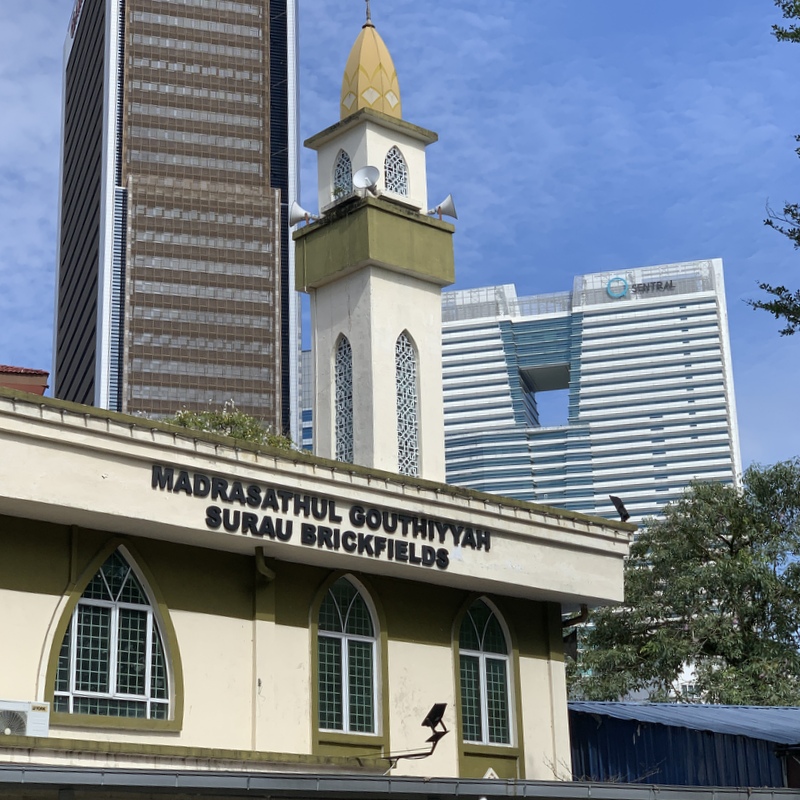
Left the Tamil Methodist Church (1908), right a Muslim Surau & Mosque. Brickfields is multi-religious 😉
After passing through Brickfields the route joins again the Klang river. In the center the Merdeka 118 building, 679 meter tall, the second-tallest skyscraper in the world.
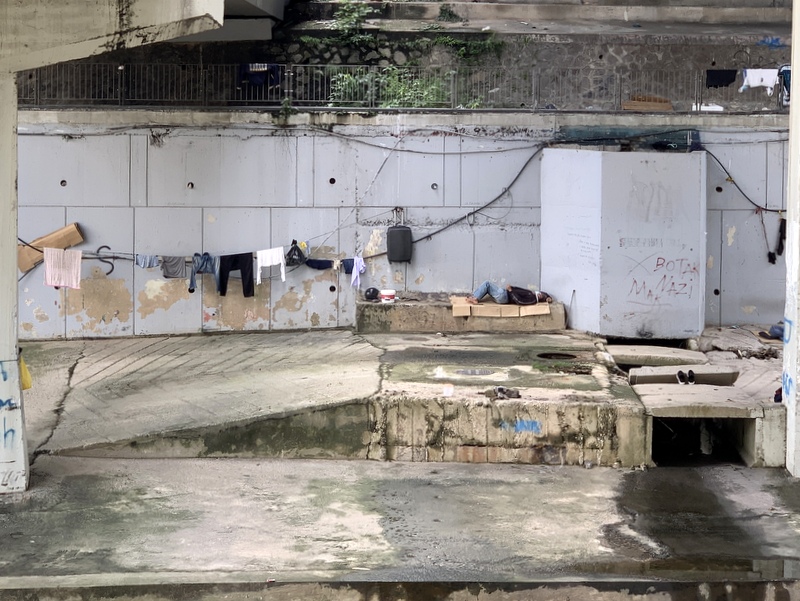
Murals along the route, at the other side of the river, a homeless person has hung his laundry to dry, and is taking a nap.
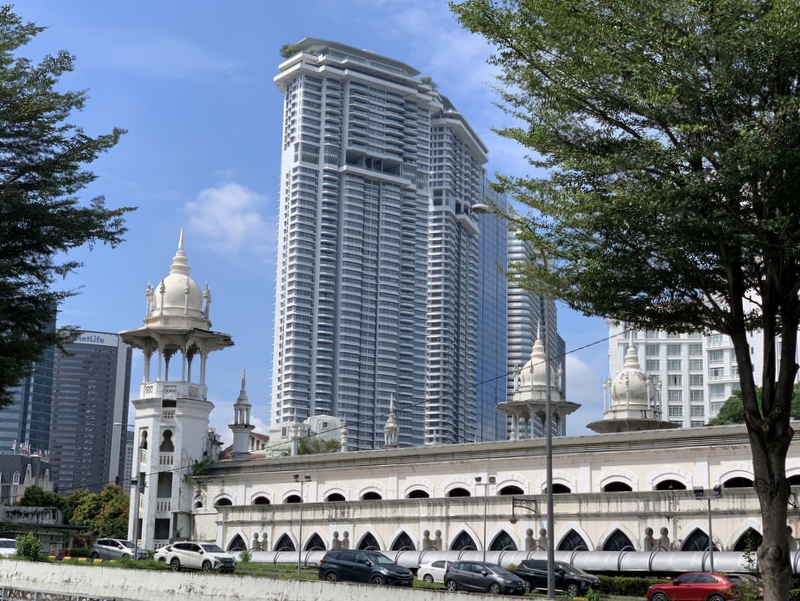
We passed the iconic Old Railway Station, a creation of Hubback (1917) and reached the underground MRT Pasar Seni station
Here we decided to leave the last part of the route, to Masjid Jamek, for another walk and instead explored the KL murals in the region around Petaling street in Chinatown,
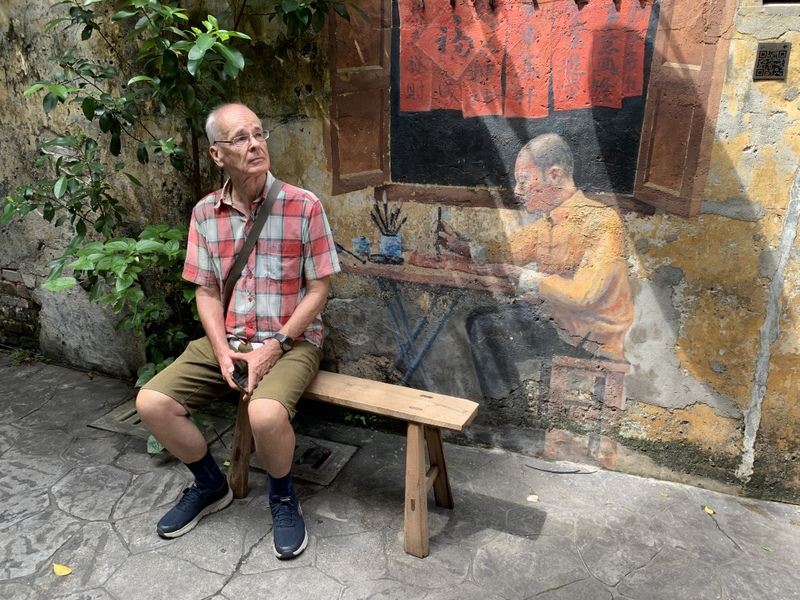
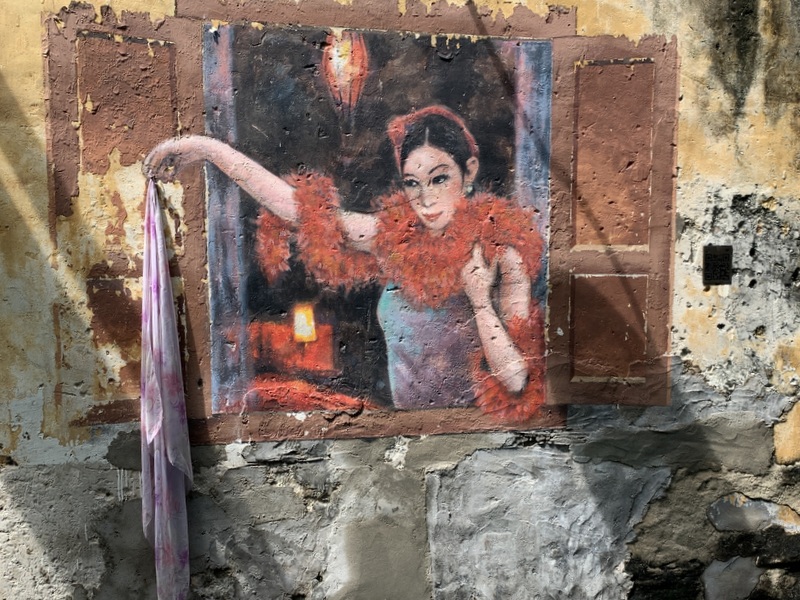
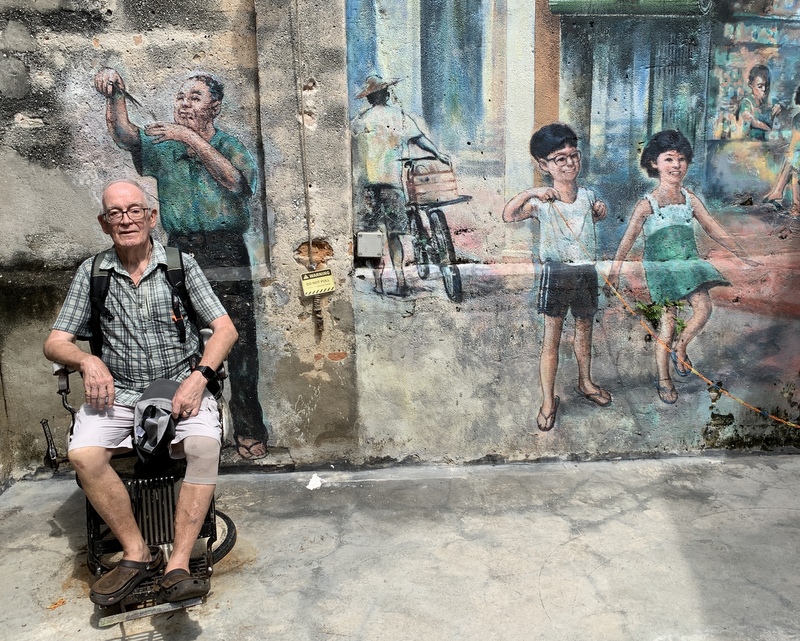
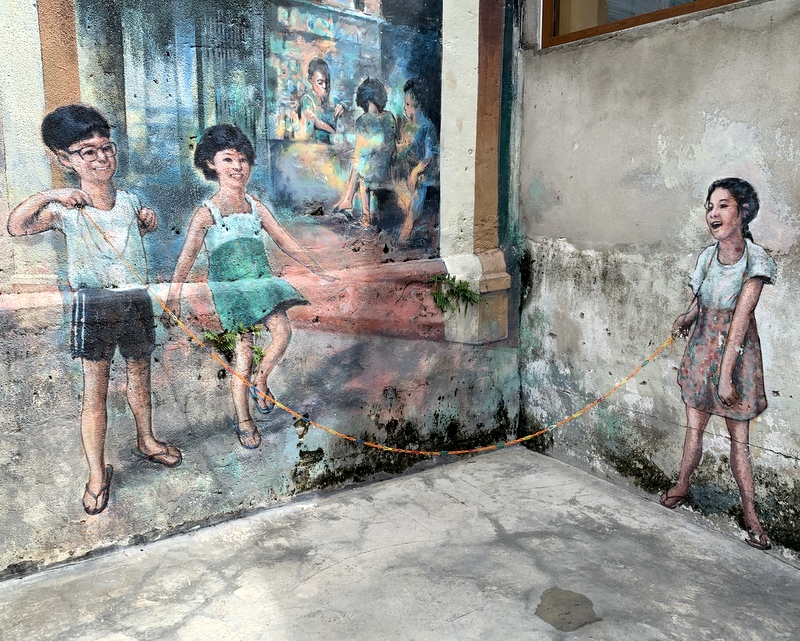
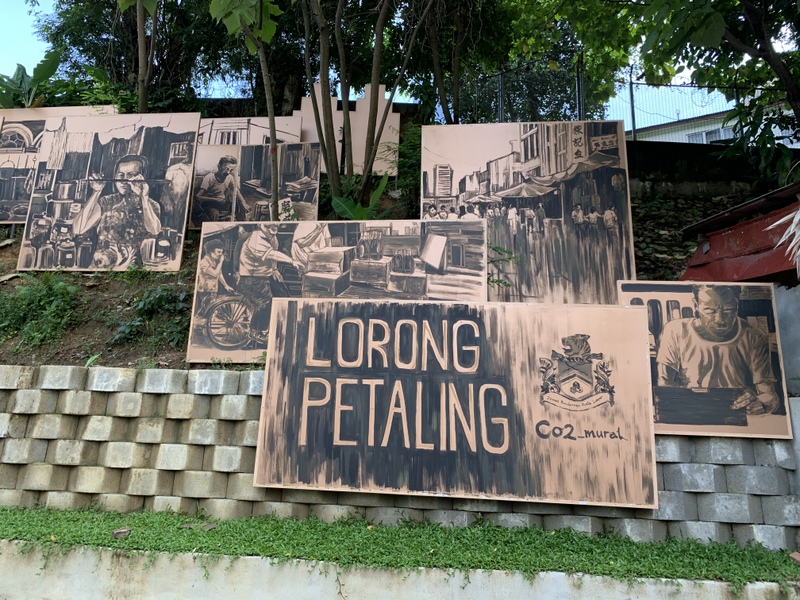
Lots of murals have been created during the last years, to liven up the neighborhood. Many different styles. Here is a collection, without comments
I like it when there are some 3D elements, like the barber chair and the kids jumping rope.
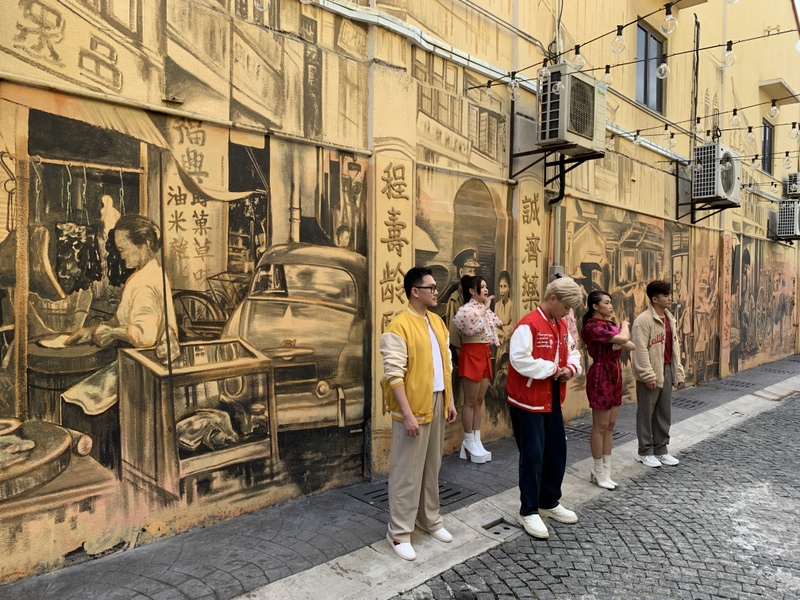
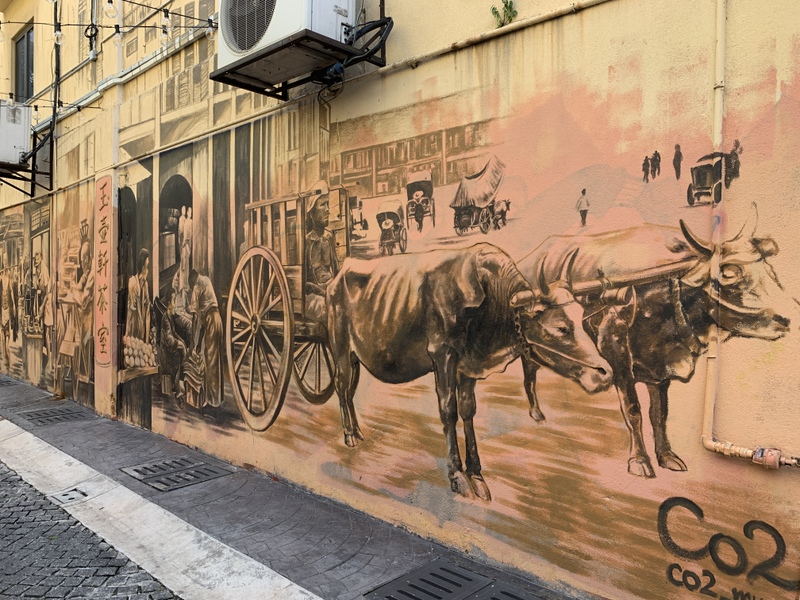
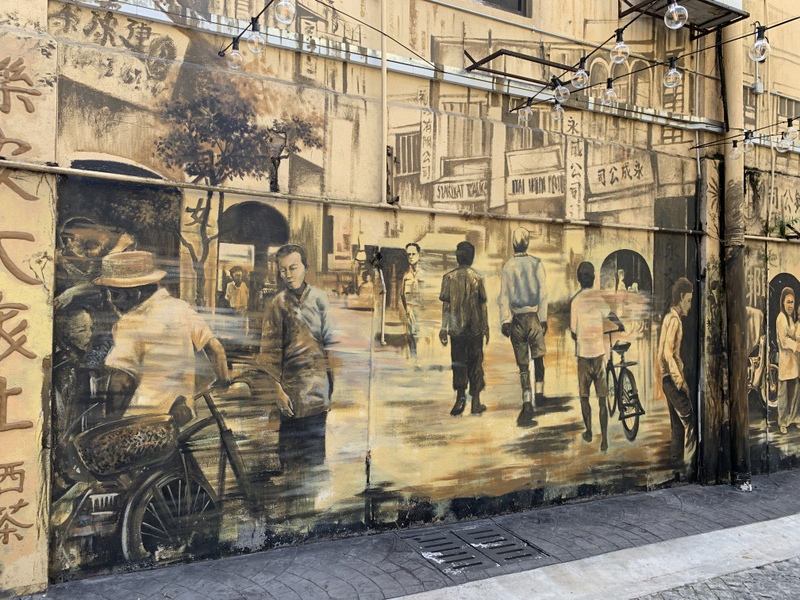
In another back lane the walls have been painted with scenes of KL’s past. It attracts tourists, but it is not really my favourite
A nice contrast, skyscrapers around Chinatown. Two times Merdeka 118 (why did they not come up with a more interesting name?) and in the center a photo of the attractive Wisma Tun Sambanthan (1988)
We had to go back to our car, near Midvalley but didn’t want to walk all the way. Therefore we walked to the Maharaja Lela station of the Monorail and took it back to Brickfields
We were hungry, but it was too late for Thosai or Roti Chennai. Finally we found a Chinese pork noodle stall. Good quality food and not expensive.
After lunch we walked back the last part. Passing again the temple. Notice how huge the tree is. The last picture is at the empty building, near my car.
Here is the route we followed, the Monorail part in orange. It was an interesting walk, we are planning to walk one more time and then include the part near Masjid Jamek.
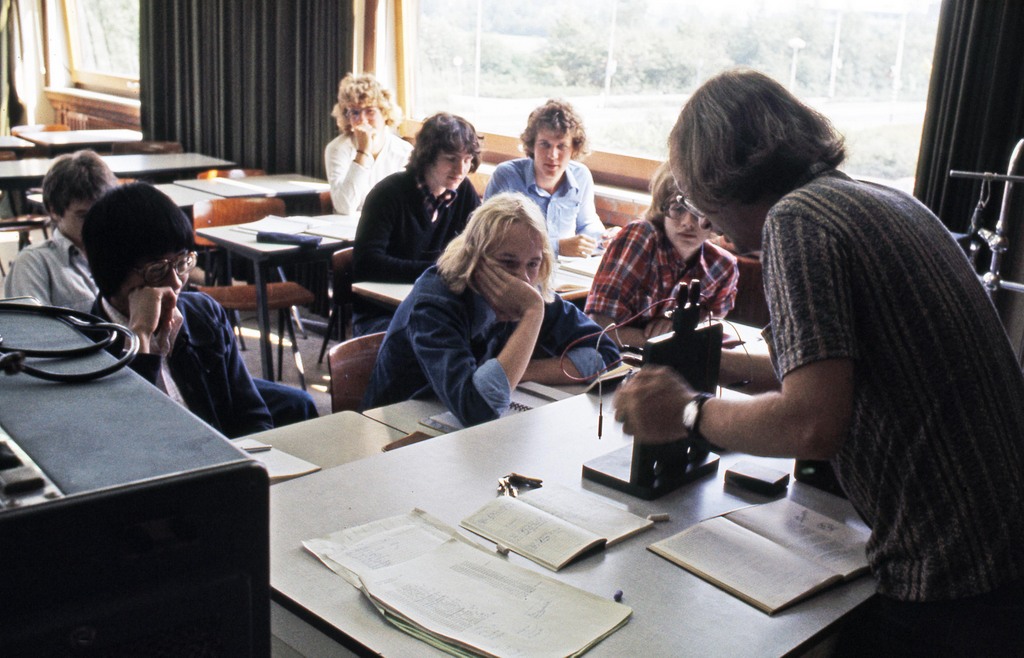
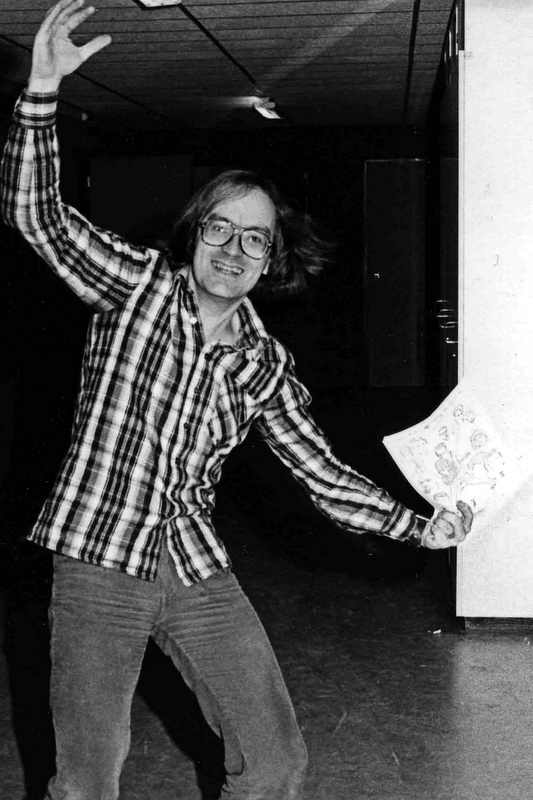
In 1976 I started as physics teacher. at a secondary school in Amstelveen. The physics department had an amanuensis (technical education assistant), Dick Vader, who was also an avid photographer. Of course we are both retired, but still in touch. Recently he sent me a collection of photos taken by him during my first decade of teaching and I can not resist the temptation to publish them in this blog.
I was a hippie in those days, 32 year old when I started, with long hair, that was already beginning to thin 🙂
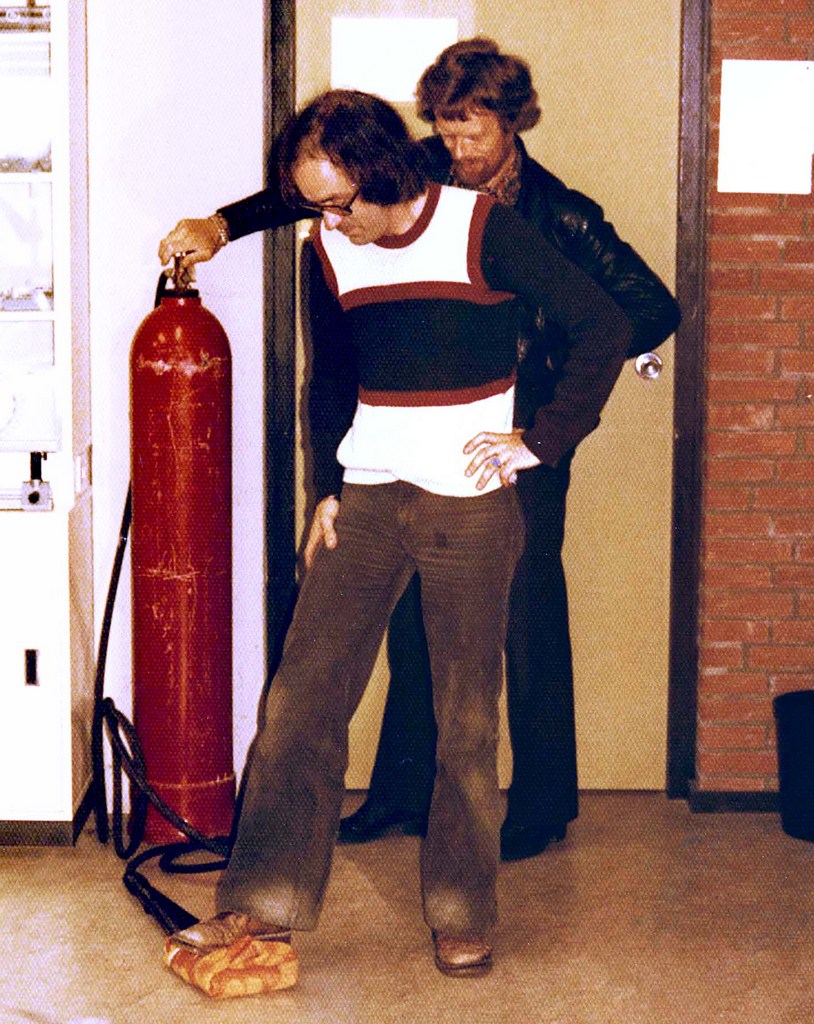
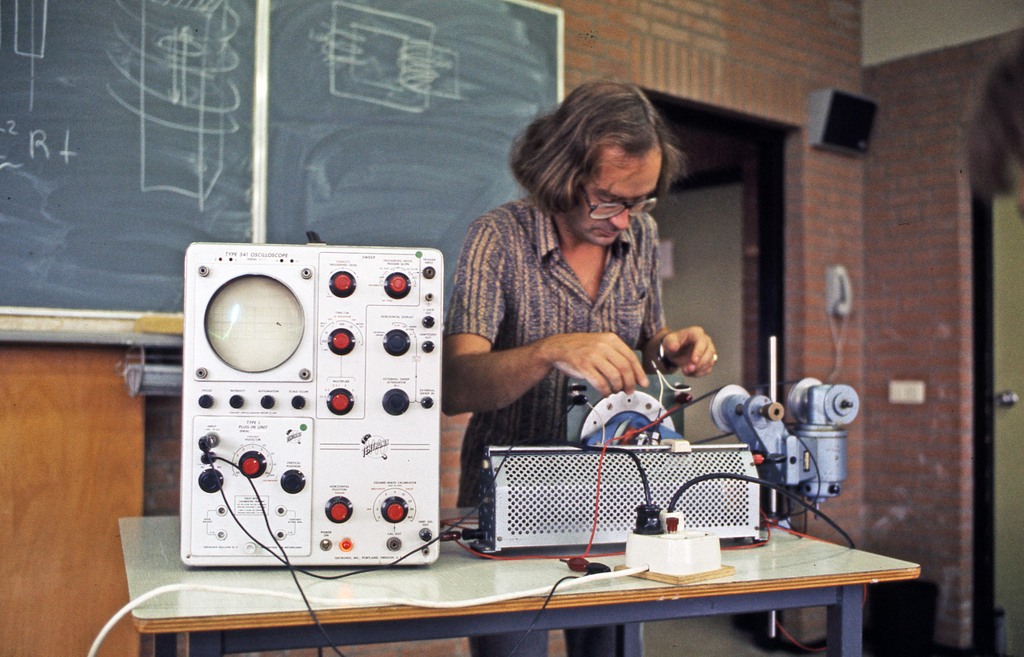
1976-1977, Dick Vader is assisting me to make dry ice, for use in physics experiments
My first year was not easy. As a flower-power hippie, I found it difficult to exert authority. Fortunately I had a small group of final year students, where I could relax after hectic junior classes.
Preparing a demonstration of an alternating current motor
Look how they are watching the demonstration. A teacher’s dream.
I was still smoking pipe in those days. Not in the classroom of course, But no restrictions in the staff room and even the students were allowed to smoke in their own student canteen, and outside the school premises. Those were the days ;-). Soon I changed to cigarettes, to smoke pipe you need to be more relaxed
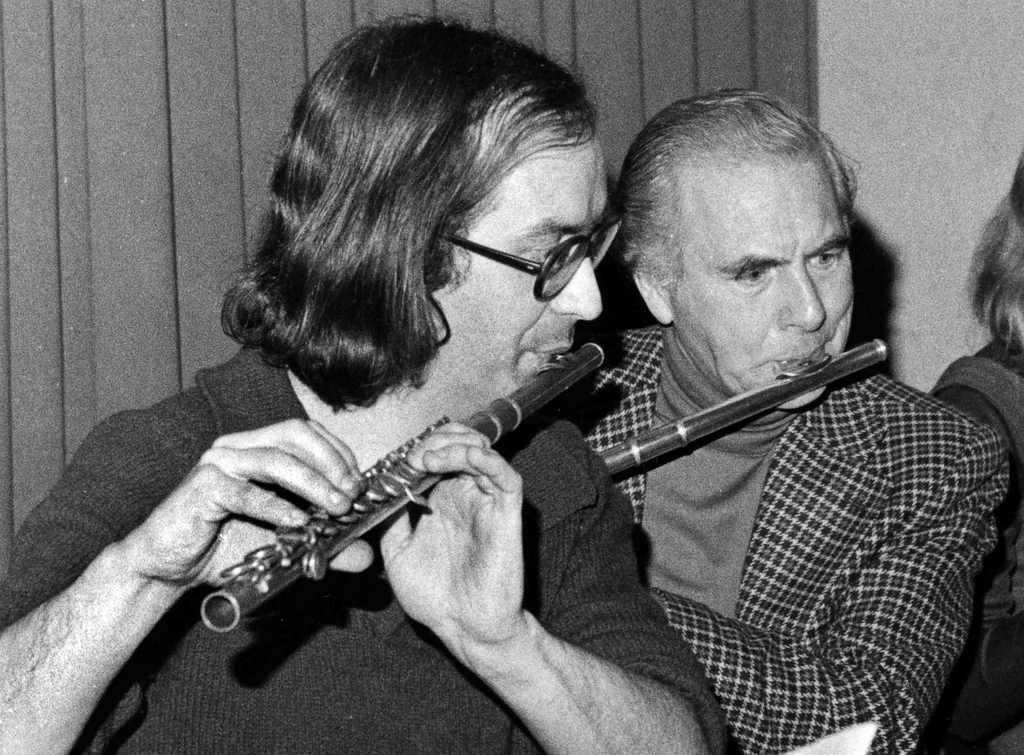
As I played the flute in those days and there was a school orchestra, of course I joined. Here with a French language teacher.
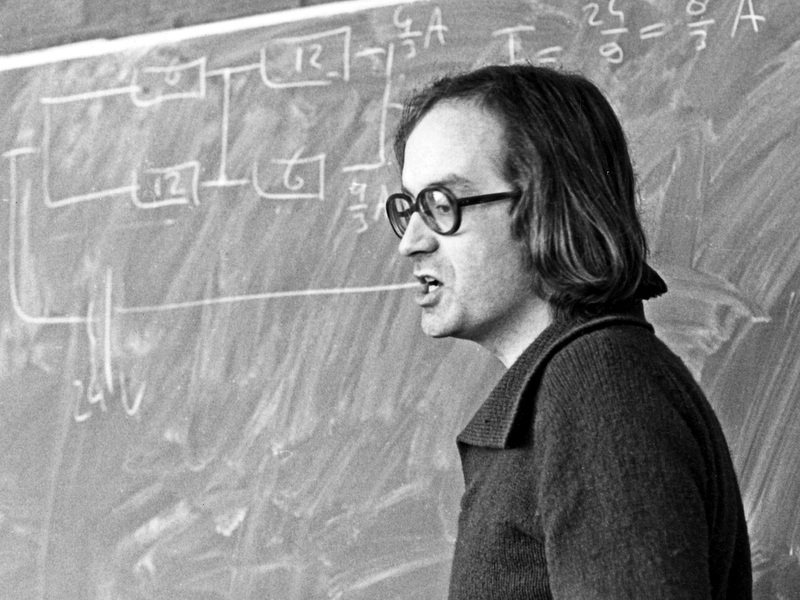
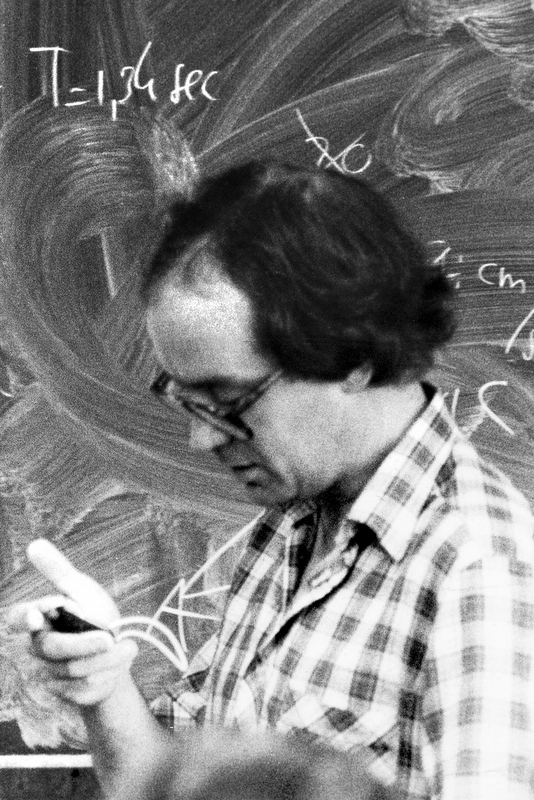
Still in my first year teaching. Explaining electrical circuits. I should have cleaned the blackboard better 😉 .
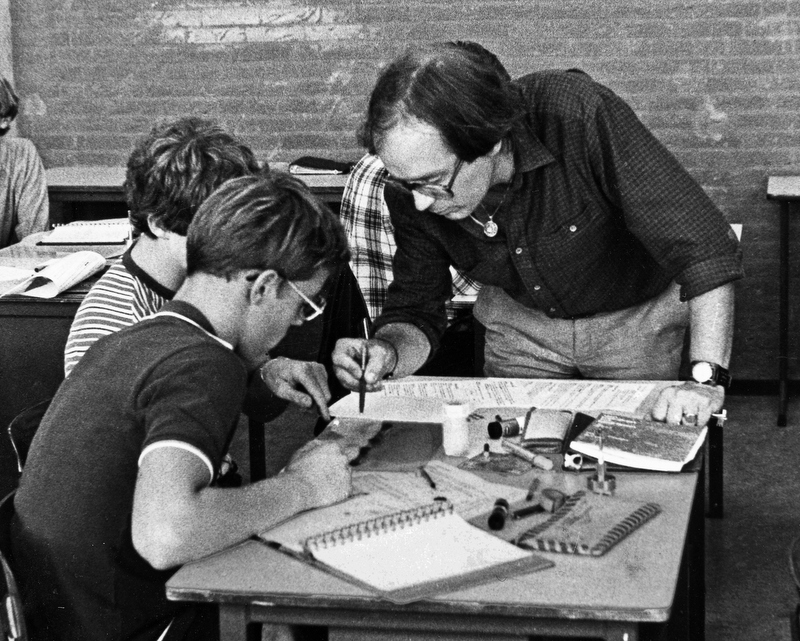
1980-1981 Helping my students with their homework.
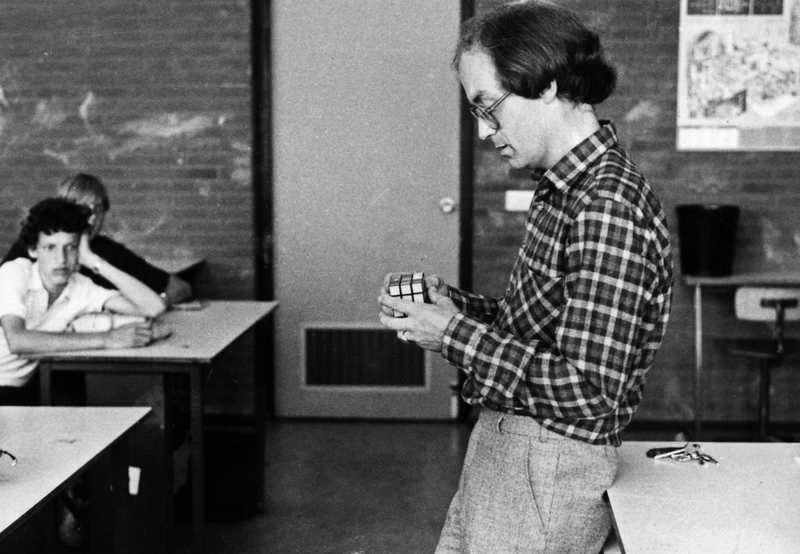
In 1980 Rubik’s Cube became a popular toy. Once I had a competition with my students who could solve it fastest. I remember that I was not bad, but I didn’t win.
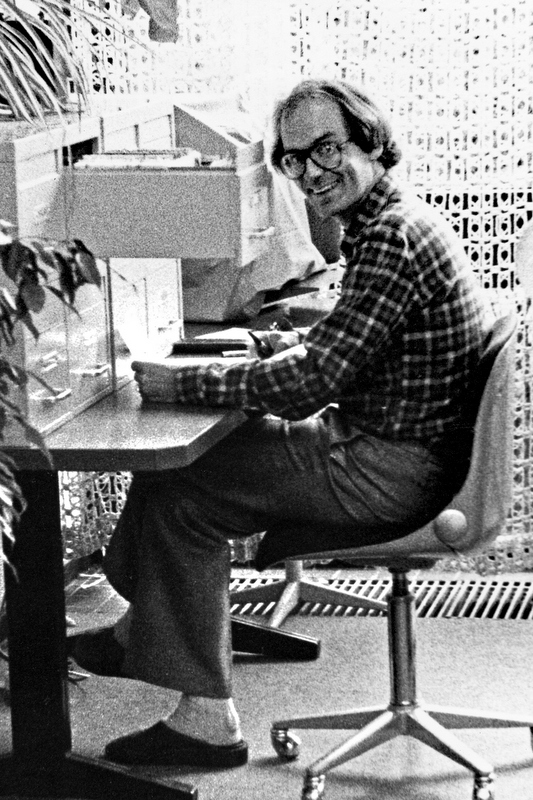
A teacher also has administrative duties (left). Not sure what I am doing in the right picture. Reading a stopwatch? My blackboard is still a mess. Pictures from around 1982
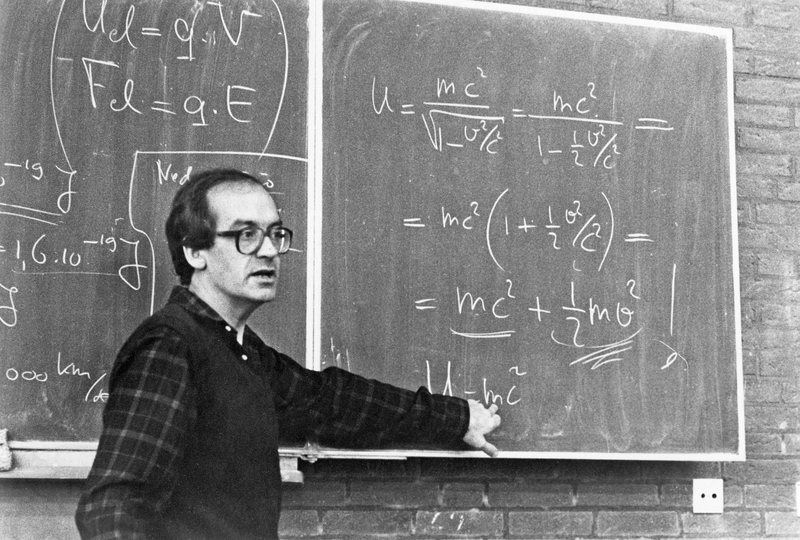
1983-1984 Here I explain a bit of Einstein’s Special Theory of Relativity. Not really part of the physics syllabus, but I liked to show my students a glimpse of what they would learn at university (if they decided to study physics 😉 ).
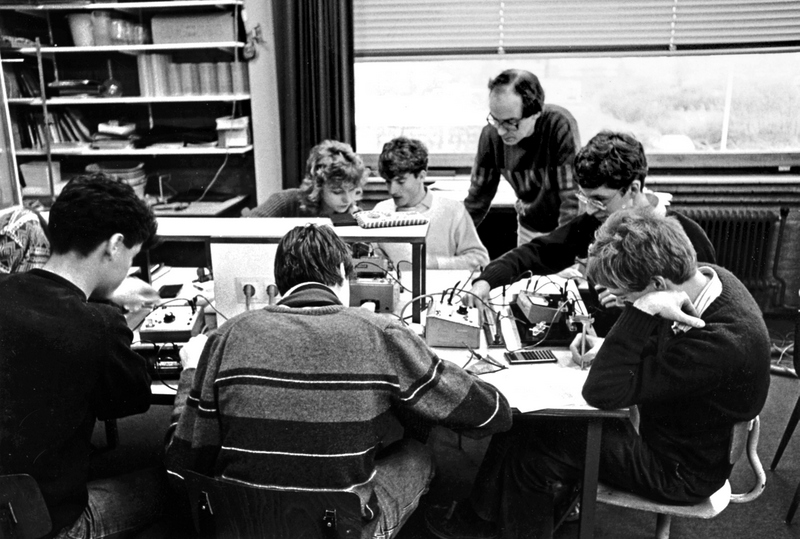
1983-1984 Students in their final year had to do experiments themselves and report about them.
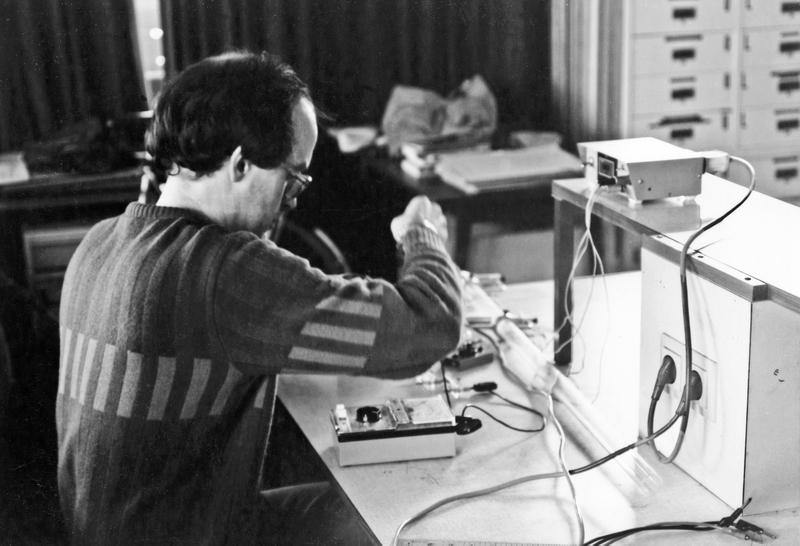
I had also to do experiments myself.
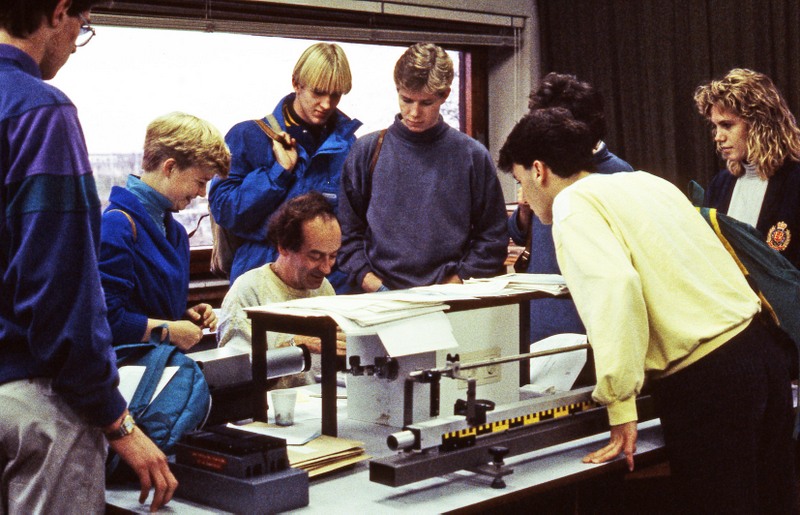
1987 I don’t remember what I am doing here and why my students are so interested to watch me.
This was the last photo , taken by Dick Vader. I continued teaching for another 15 years.
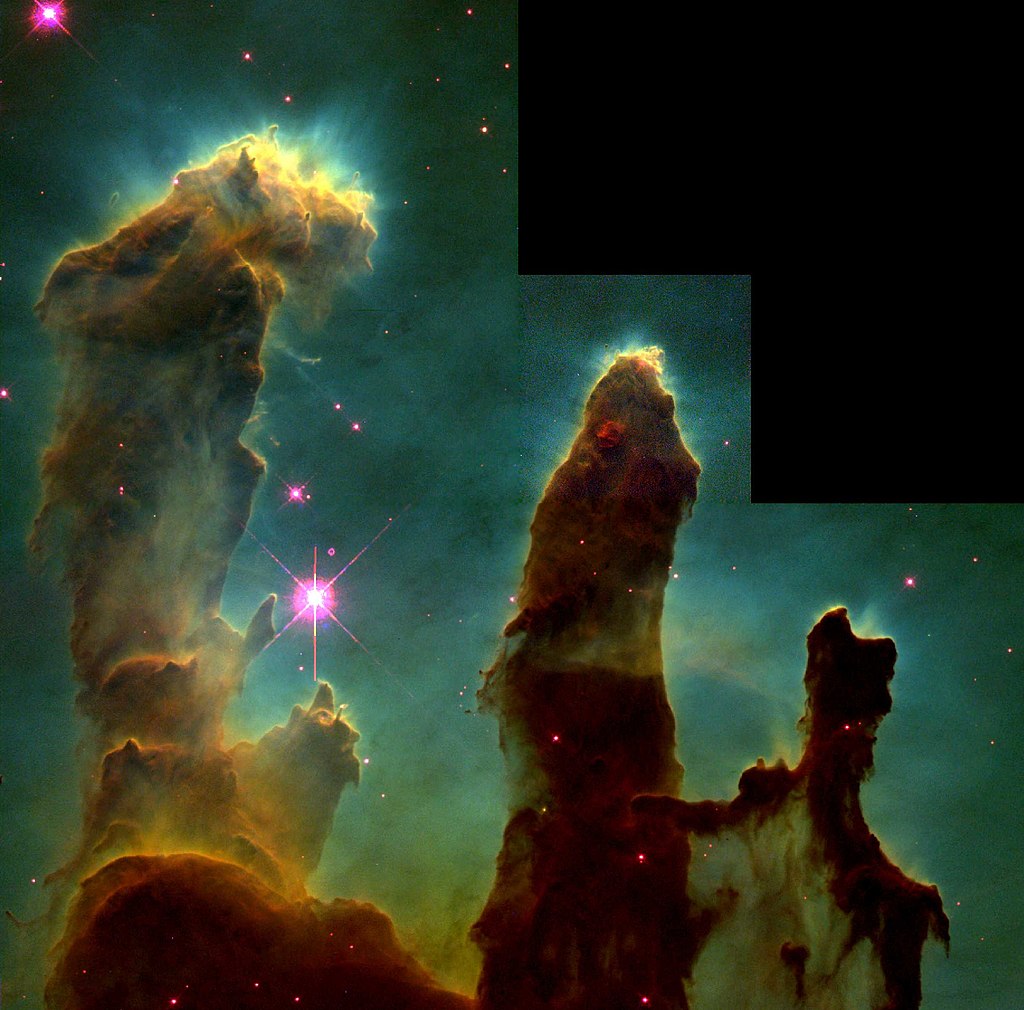
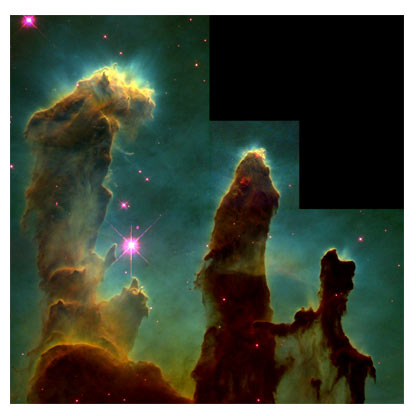
In 1995 NASA published this picture, taken by the Hubble Space Telescope. It shows a small part of the Eagle Nebula and became instantly famous. Because in the “pillars” stars are born, the picture got the name “Pillars of Creation”.
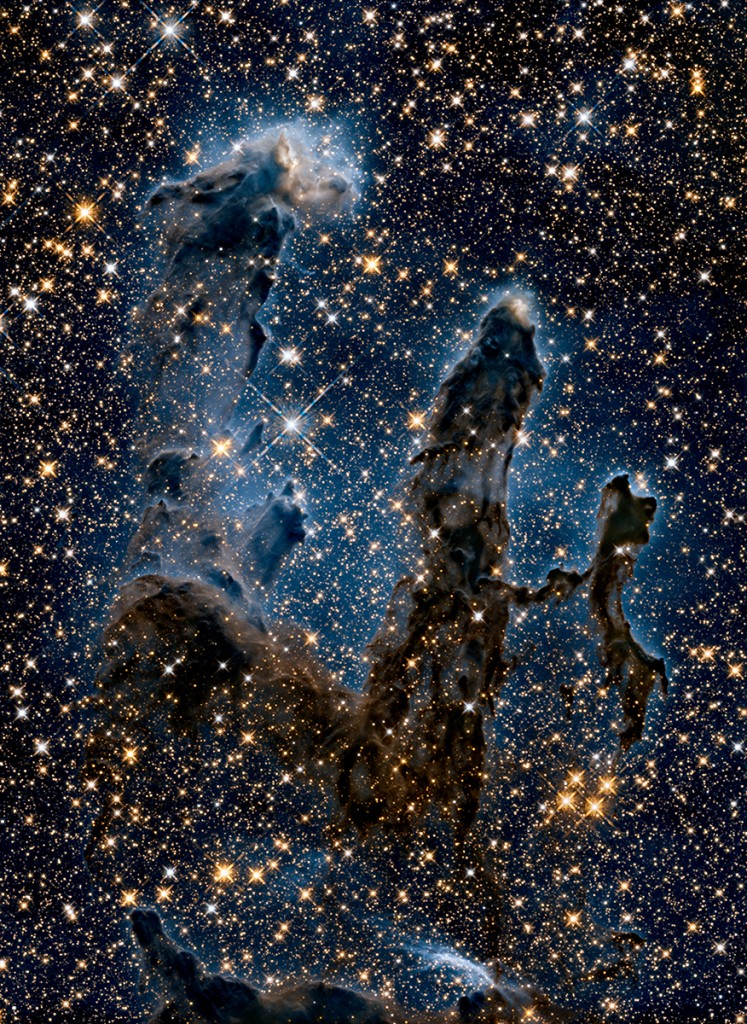
The Hubble Space Telescope was launched in 1990 and is still operating, with quite a few Space Shuttle service missions. To celebrate its 25th anniversary, a new picture of the Pillars of Creation was published in 2015. With a new camera installed, more details are visible,
At the same time this picture was published, an infrared picture of the Pillars. Infrared light can travel more easily through dust and clouds and that is why now you see stars in the pillars, where young stars are still being formed. But I hope you wonder how this can be an infrared picture as infrared light is invisible light. The explanation will be the main part of this post.
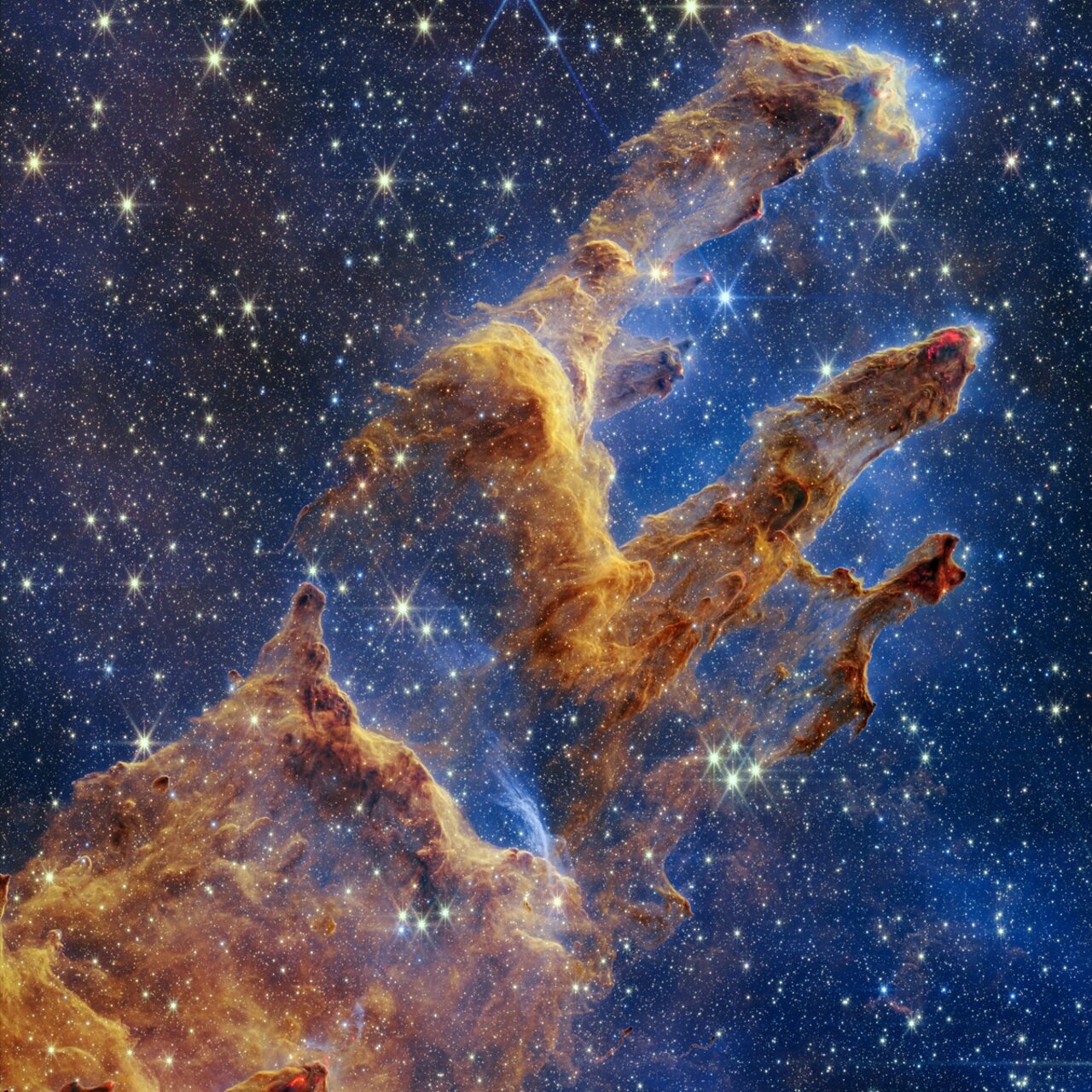
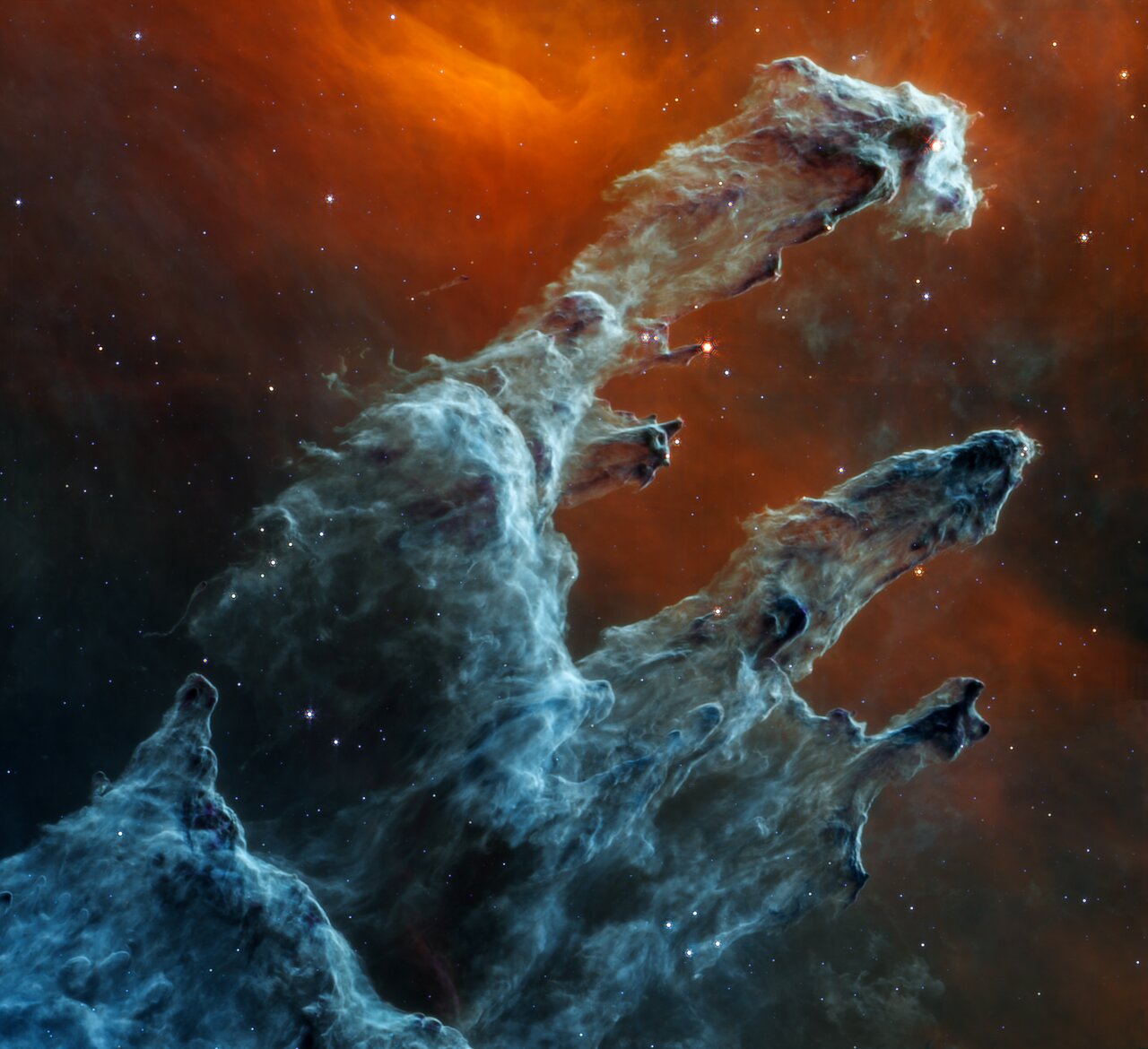
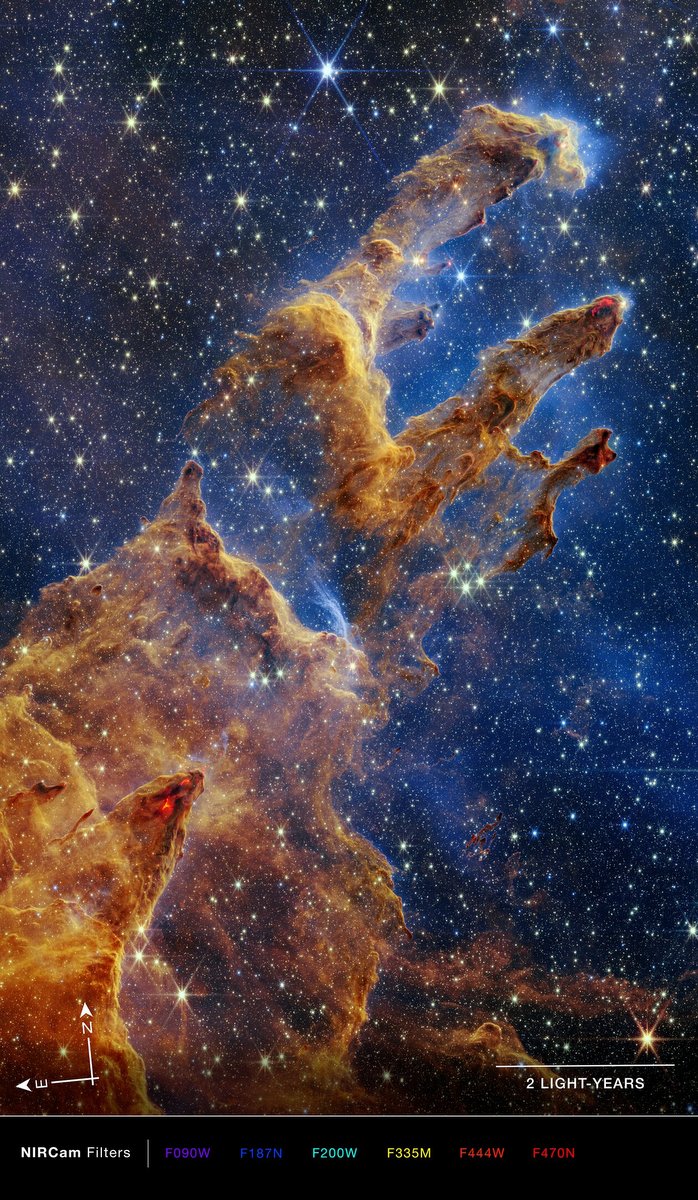
But first here are two pictures, recently taken by the James Webb Space Telescope. The JWST is an infrared telescope has and has two cameras on board to take pictures. The NIRCAM for near infrared light and the MIRI for medium infrared light. Here is the NIRCAM photo
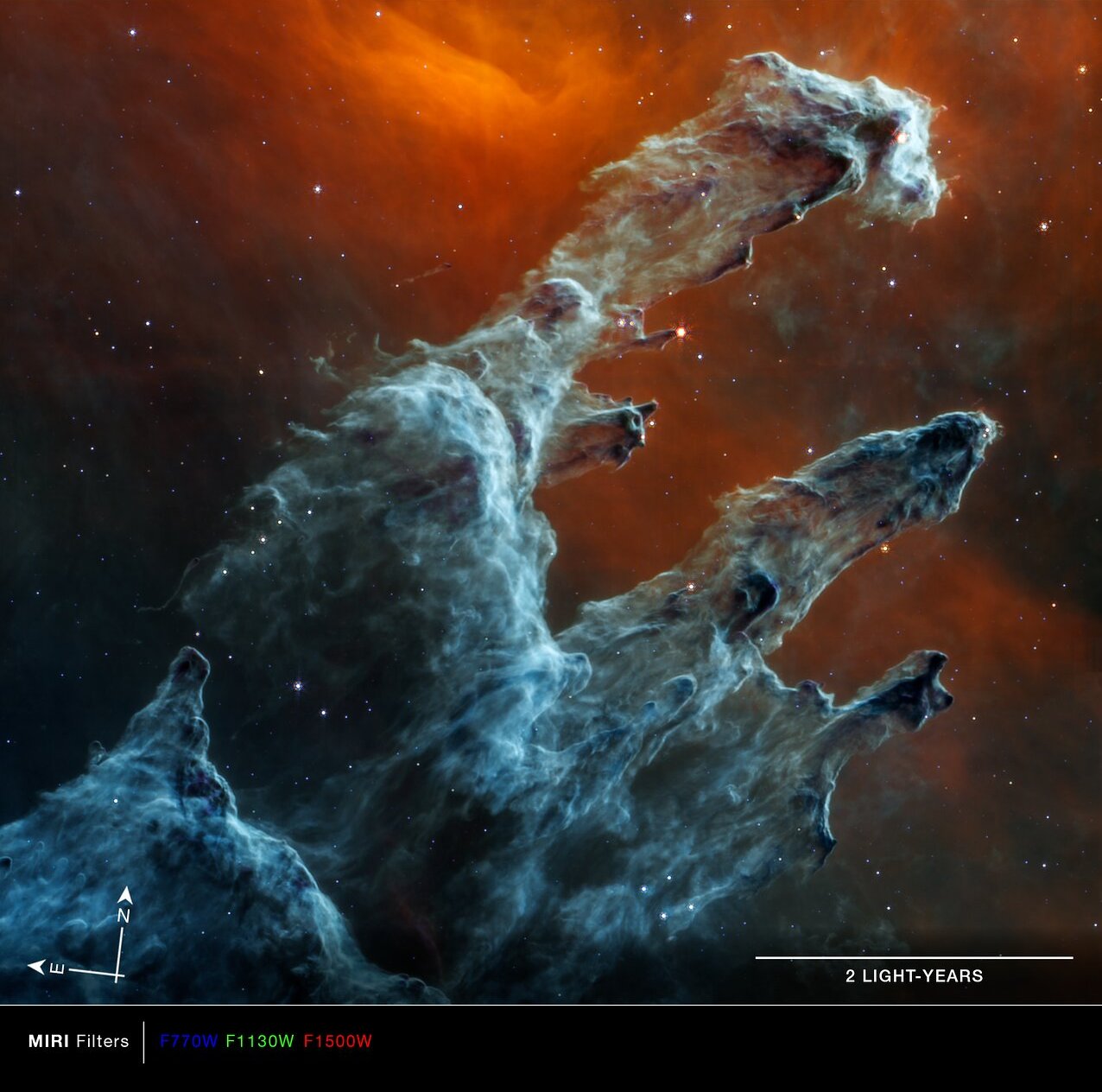
And here is the image from MIRI, Amazingly different. And again, how can these be infrared pictures’?
f
Time to give some explanation about the pictures and also about the Eagle Nebula, where the Pillars of Creation are located.
———————————————– About visible and invisible light
Light is an electromagnetic wave, as are microwaves, radio waves, X-rays etc, They all have different wavelengths. The wavelengths of visible light are often given in nanometers (nm), where 1 nm is 1/billionth meter. Or in micrometer (μm) where 1 μm = 1000 nm. The human eye is sensitive to wavelengths between ~380 and ~750 nanometer and sees the various wavelengths as different colors! The longest wavelengths are seen as red, the shortest as purple/blue with all the “rainbow” colors in between.. In this diagram the electromagnetic spectrum is shown. The infrared part can be subdivided in near infrared, mid infrared and far infrared
The Hubble telescope has two cameras onboard. Most of the iconic Hubble pictures have been taken by the Wide Field Camera. The present wide field camera (WFC3) can take photos in two channels, one for ultraviolet and visible light (UVIS) and the other one for near infrared (NIR), The range of UVIS is 200-1000 nm and of the NIR 800-1700 nm
The James Webb has two cameras, the NIRCAM for the near Infrared, range 600-5000 nm and the MIRI for the mid Iinfrared, range 5000-28000 nm (5 μm -28 μm).
Before we describe in some detail how digital cameras record images, it is useful to have a look at the way the human eye sees colors.
———————————————– How does the human eye see colors?
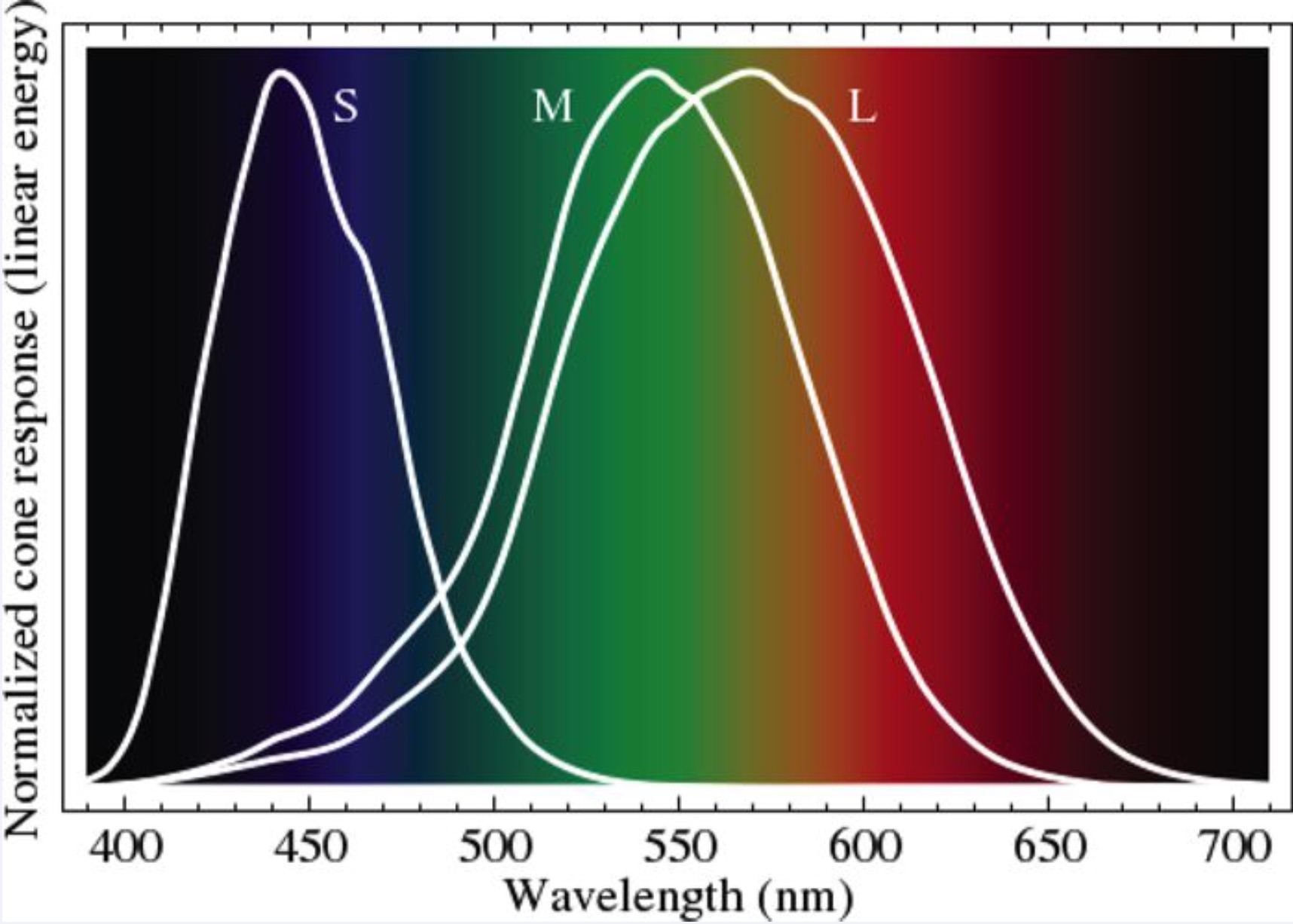
The retina of the human eye contains about 6 million nerve cells, called cones. These cones come in three different types, S, M and L, sensitive to various parts of the spectrum. The S type cones are sensitive to the blue part of the spectrum and are also often called Blue cones, In the same way the other two are often called Green and Red.
The brain is able to combine the response of these RGB- cells. For some people the M and/or L cone cells are not working properly. As a result they are colorblind.
———————————————– How does a digital camera record colors?
Digital cameras have sensors consisting of millions of individual pixels that record the intensity of the incoming light, basically in a gray scale (black and white). That these cameras can take color pictures is because in front of the sensor there is a color filter, consisting of a mosaic of millions of red, green and blue “pixels”. A so-called Bayer filter. See the diagram below. Taking a picture, means actually taking a red, green and blue picture at the same time, but these pictures are “incomplete”. By mathematical techniques (interpolation) the full color pictures are constructed.
.
Here is an example, where three images, in red, green and blue, when combined, give the full image in natural colors.
The sensors in space telescopes do not have these Bayer filters, they just record the image in gray scales. However, various filters can be placed in front of the sensor and multiple images can be taken of the same object. For example, the Hubble WFC3 camera has a huge choice of filters, 47 for the UVIS channel and 14 for the IR channel.
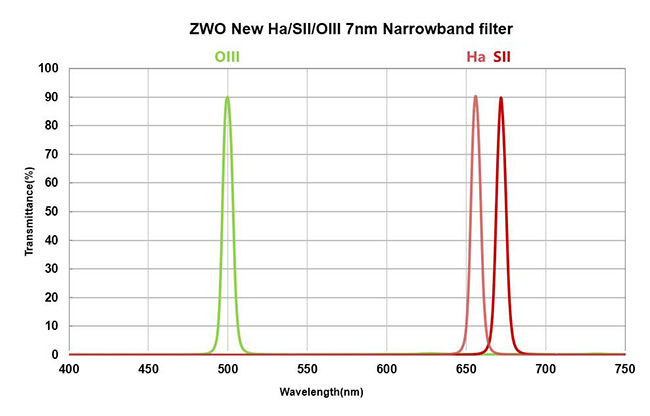
Why so many? Some filters are broadband, they pass a wide range of wavelengths. From a scientific point of vew the narrowband filters are interesting because they pass only the light emitted by specific elements. Here is one example, hydrogen (H) emits red light with a very specific wavelength of 656 nm. So one of the filters only passes wavelengths around that value and a picture taken with this filter shows the presence of hydrogen. Similar filters can be used to check the presence of oxygen (O), sulphur (S) etc.
———————————————– The Pillars of Creation pictures are “false-color” pictures!
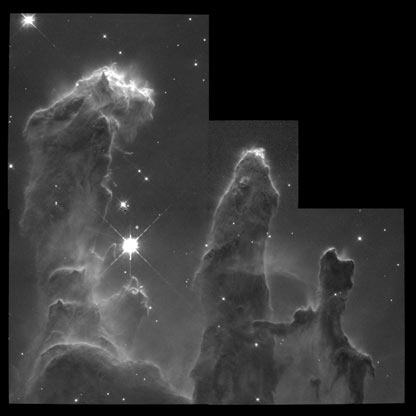
On 1 April 1995, astrophysicists Jeff Hester and Paul Scowen published an article The Eagle Nebula, in which they showed a picture of the Pillars of Creation. If you think that was “just” a picture taken by the Hubble telescope, you are seriously mistaken. The PBS/NOVA website More than just a pretty picture explains in 19(!) webpages how the iconic photo was created. Very readable,
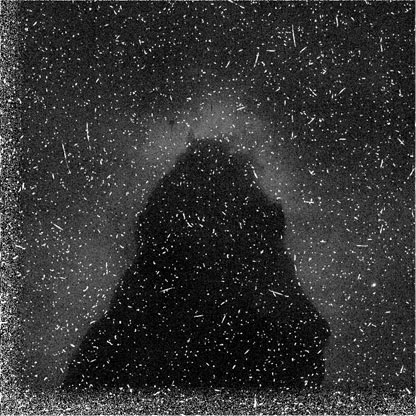
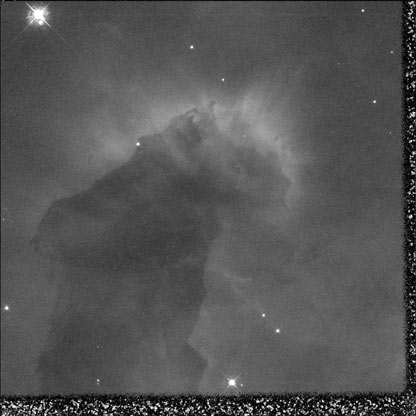
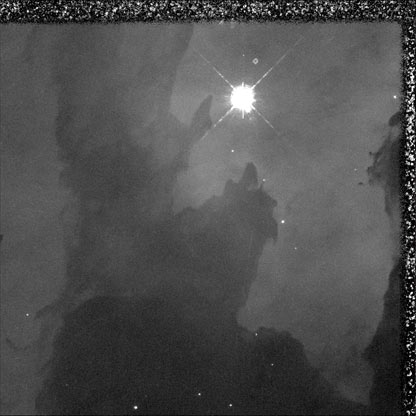
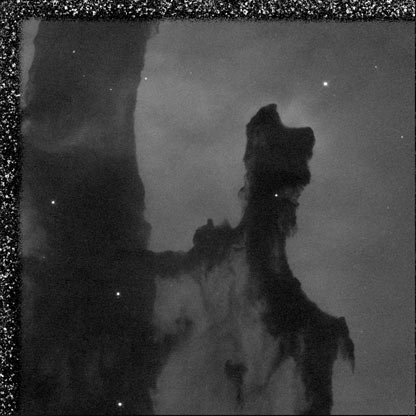
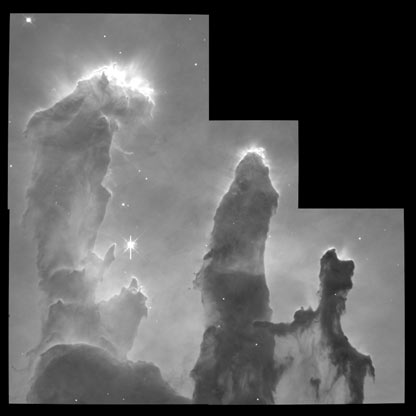
The WFC2 consisted actually of four cameras, each recording a quadrant. The top-right quadrant camera was slightly different, zooming to show more details. Resizing it to the format of the other three, causes the characteristic Hubble image with the “steps” in one corner. Here is the original image of this top right quadrant, in gray scales. What a mess. For an explanation how to clean this image, see the website. The second image shows the result of the various cleaning operations. What a difference !
We can do the same for the other quadrants.
top leftbottom leftbottom right
Now we can “glue” the four parts together. You can still see a bit the seams between the four images.
For this mage a filter was used that only let blue-green light through from (doubly ionised) Oxygen atoms (OIII). Two more filters were used to create images in the same way. One filter let only the reddish light from Hydrogen atoms through (Ha), the other one selected reddish(!) light from ionised Sulphur atoms SII). Three narrowband filters, two of them in the same color range.
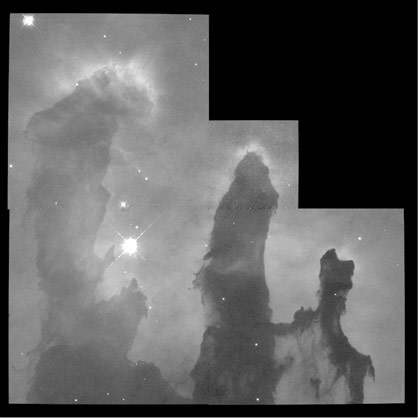
Here are the three filtered images
SII filterHa filterOIII filter
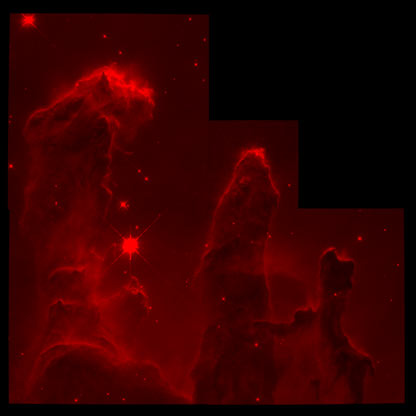
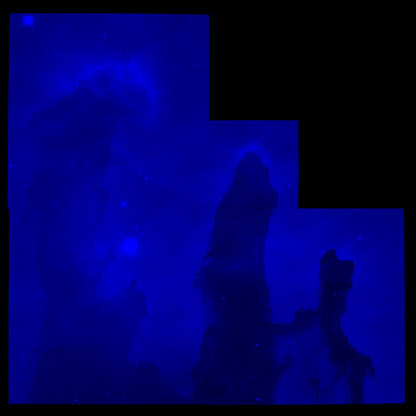
You might expect that the next step would be to give these image’s color corresponding to the filter used for each of them. The Ha and SII reddish and the OIII one greenish. But that is NOT what Hester and Scowen did. They assigned the RGB colors to the three images. Blue to the OIII image, Green tot the Ha image and Red to the SII image.
SIIHaOIII
Final step is to combine them: the Pillars of Creation.
The main reason to assign “false colors” to the pictures is to enhance the contrast and to see how the various elements are distributed. Almost all Hubble photos are false color (also called pseudo color). Using the three narrowband filters for S, H and O and assigning them to RGB is so common that it is often called the Hubble Palette. Doing a Google image search for Hubble Palette gives a huge number of hits. Here is a part.
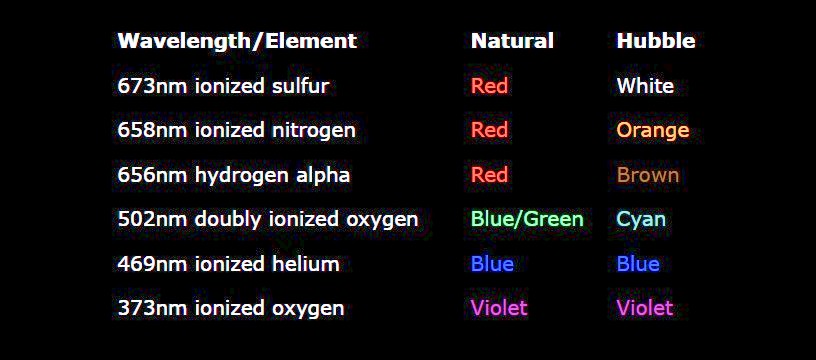
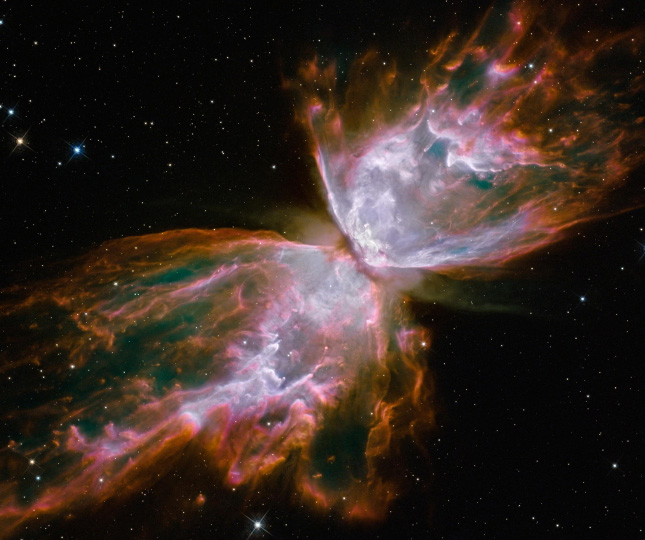
Other combinations of narrowband filters are also used. Here is an example where 6 filters have been used for the Butterfly Nebula. Besides SII, Ha and OIII, also ionised nitrogen, helium and oxygen. In the table the natural colors are given and also the colors assigned in the Hubble palette.
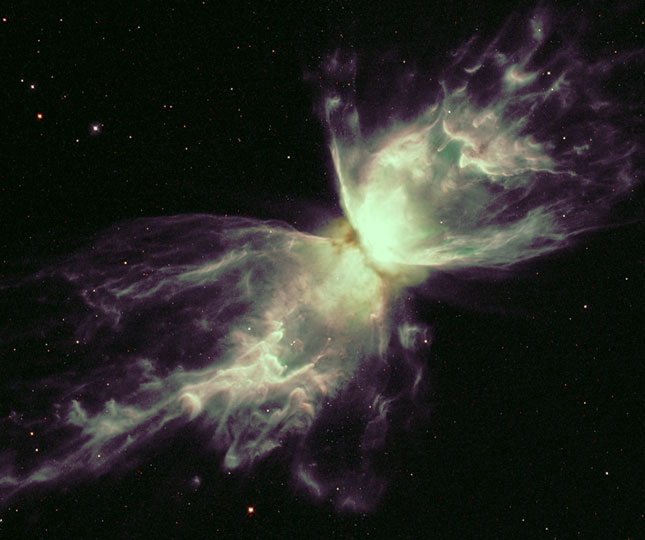
An American astrophotographer got curious how this nebula would look in the natural colors. Here are two images’, left the false color one and right the picture in natural colors. It is clear that the artificial image reveals many more details
It must be clear now that while with the Hubble telescope you have a choice to use false colors, with the JWST there is no other option, as infrared light is not visible. Here are the filters used for the MIRI camera. The colors suggested for the various infrared ranges are not significant, just to guide the eye.
For the MIRI picture three filters were used, F770W, F1130W and F1500W. In the above diagram I have marked them. For this picture they are assigned Blue, Green and Red respectively.
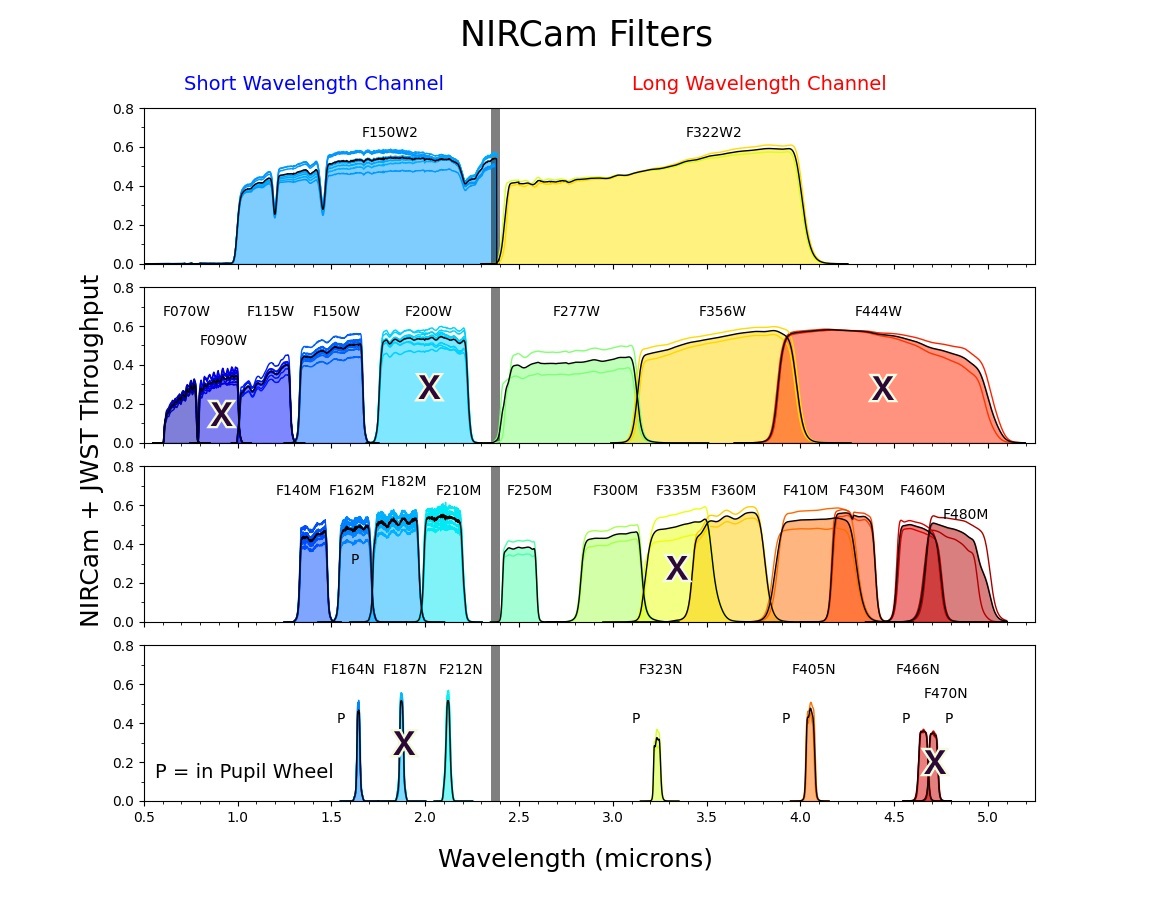
The NIRCam camera has many more filters, broadband, narrowband etc.
For the NIRCam picture 6 filters have been used, marked in the diagram above.
t
I have read somewhere that creating these images should be considered as art and I agree.
———————————————– The Eagle Nebula
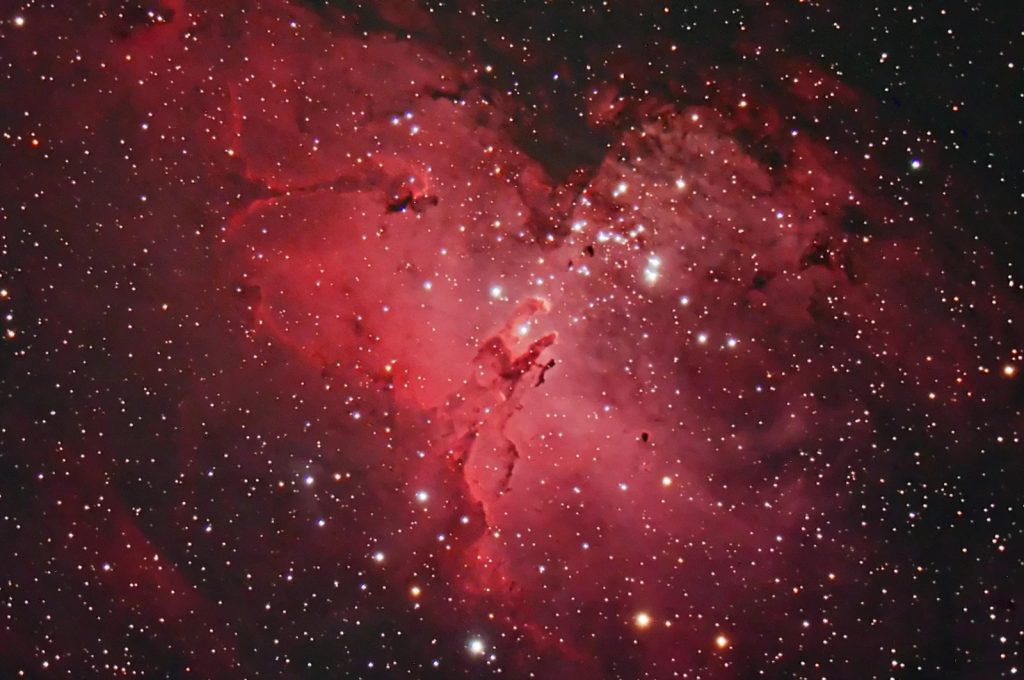
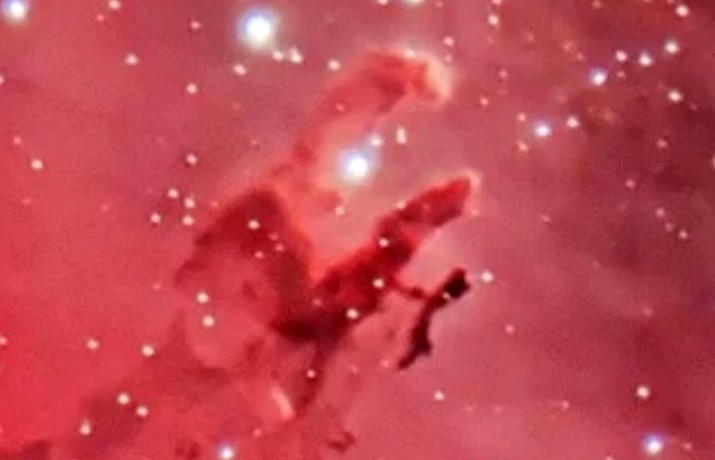
Finally a few remarks about the Eagle Nebula. When massive stars die, they can “explode” as a supernova, erupting their remnants into space. In these clouds of dust and various elements, new stars can be formed. The Eagle Nebula is such a cloud, here is a picture taken by an astrophotographer, using a telescope and a DSLR camera! Many of the bright spots in this picture are young stars already formed in the cloud. These stars are so hot that they emit UV light and even X-rays. This radiation can has enough energy to ionize the cloud. Such a cloud is called an emission nebula. The dominant reddish color is caused by hydrogen
The Eagle nebula is located about 7000 lightyear away and is huge, roughly 70 x 55 lightyear. It is a young nebula, estimated age is 5.5 million year. It is also a temporary event, the forming of new stars still continues and the radiation those stars will erode the nebula.
In the center of the above image, you can see the pillars of creation.Here is a dteail. Comapre it with the images of Hubble and Webb. Even these pillars are huge, the logext one is about 4 lightyear long.
A final remark. From the Hubble and Webb picture you might think that the pillars are almost like rock, impenetrable. But this is not true at all. The density of nebulas varies between 100 – 1 million particles per cubic cm. A high vacuum on earth still has considerably more particles per cubic cm. It is just the huge size that makes the pillars look like solid.
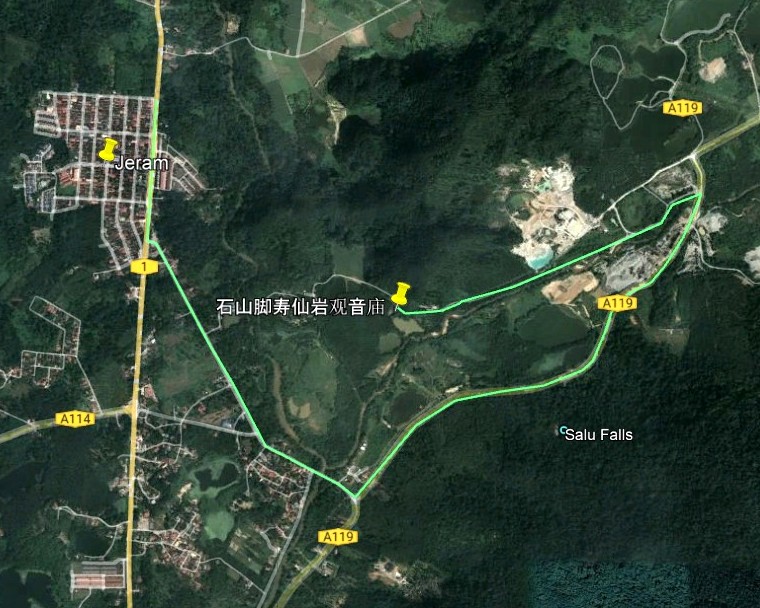
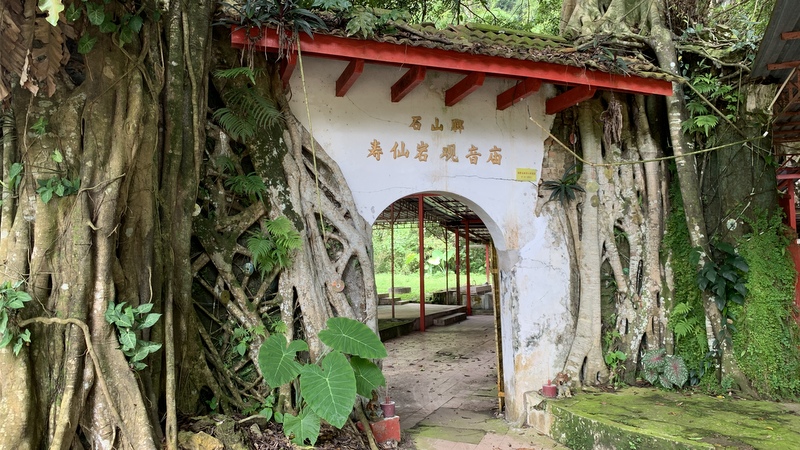
On 22 October Free Malaysia Today had an article with the intriguing title Mysterious 135-year-old temple in Perak’s jungles .Of course I was interested and wanted to have a look myself. But where was this temple located? The article mentioned Jeram and Jalan Chenderiang. Still a bit too vague. Fortunately my friend Siak Hong Law had visited the temple many years ago, he gave me the exact location. The temple is actually on Google Maps, named as 石山脚寿仙岩观音庙, which Google translates as the Shouxianyan Guanyin Temple at the foot of Shishan
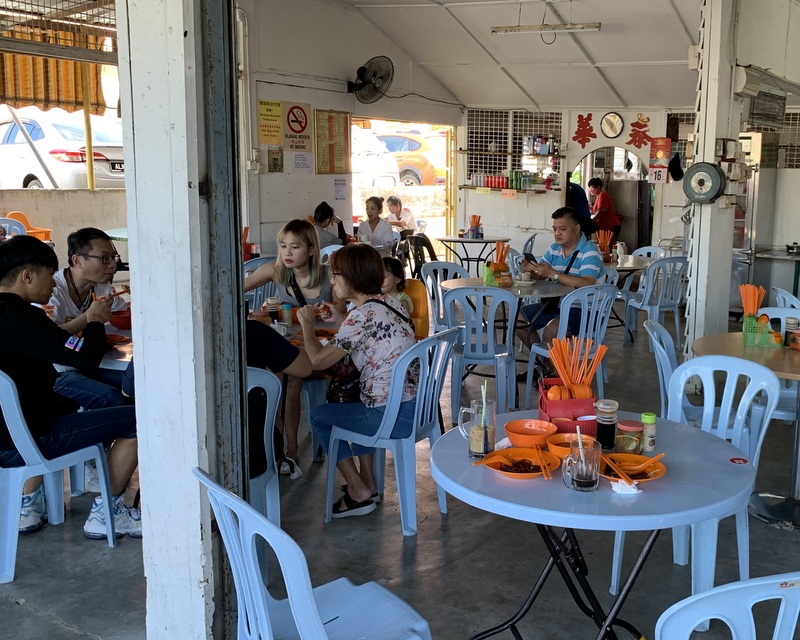
As the temple is still a two hours drive from PJ, Aric and I decided to make it a day trip, combine the temple with waterfalls and food. We started with breakfast in Tanjung Malim. The Thye Fah coffee shop is popular and well patronised.
The coffee shopMany customers
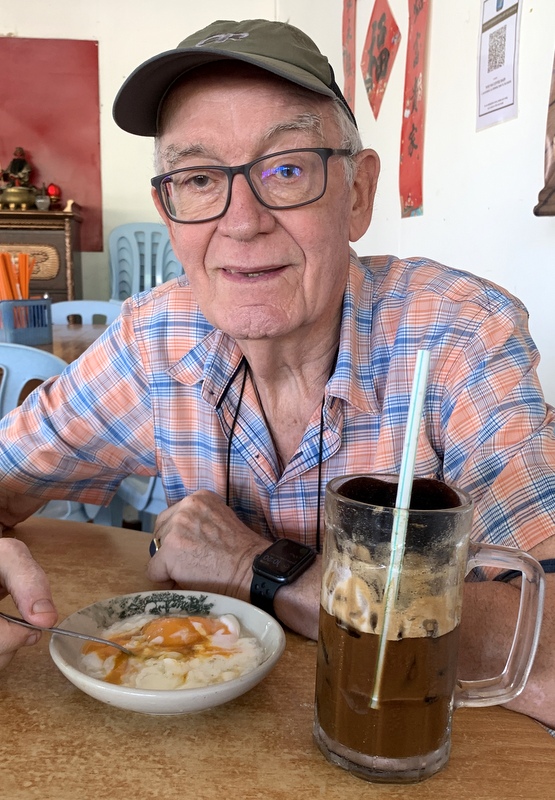
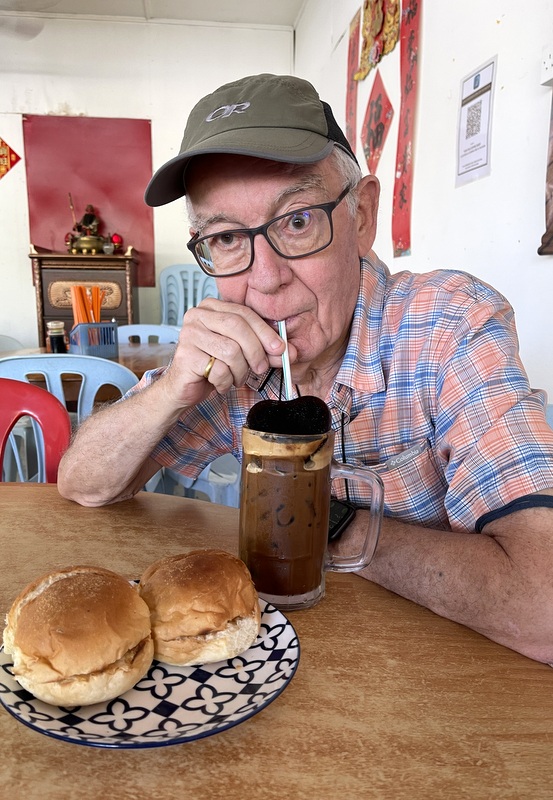
Their special ice coffee has a frozen coffee heart on top. I had my half-boiled eggs, the buns with butter and kaya were really delicious. A good start of the day.
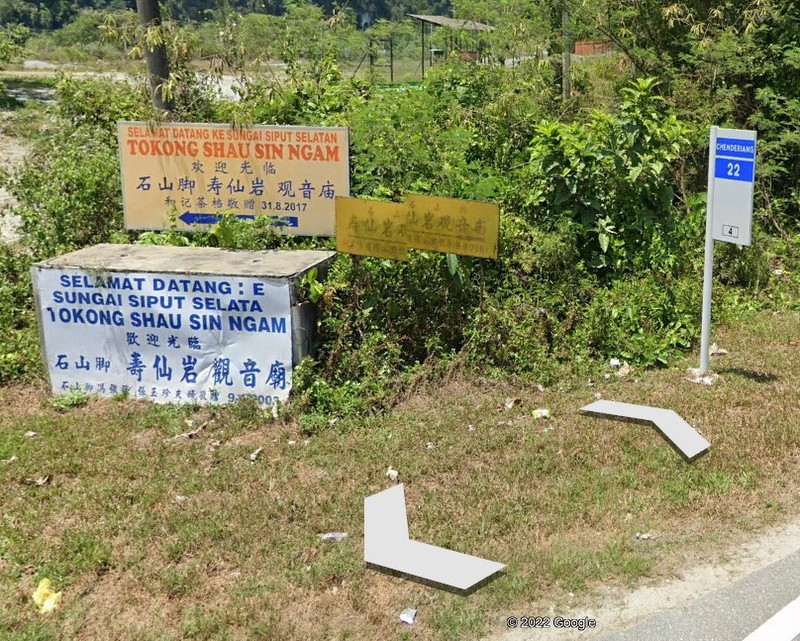
After our breakfast, we drove to Jeram and from there to the temple. In the left picture you see how to drive, first following the Chenderiang road until you turn left into a small road. I forgot to take a picture of the junction, so I took a screenshot of Google Street View. The description by the author of the FMT article of the temple as “hidden in the depths of a thick jungle.” and of the road as “you have to travel along a stretch of dirt road snaking through an oil palm plantation” shows that he has a rich imagination. The road is tarred, passing a few industrial sites, then following the peaceful Sg Dipang. No jungle at all.
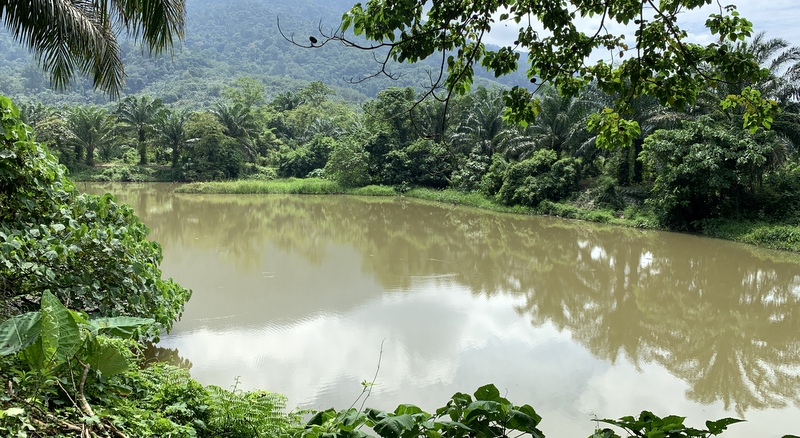
After less than 2 km, this road ends at a clearing, next to a former tin mining lake. Peaceful surroundings.
The entrance of the temple
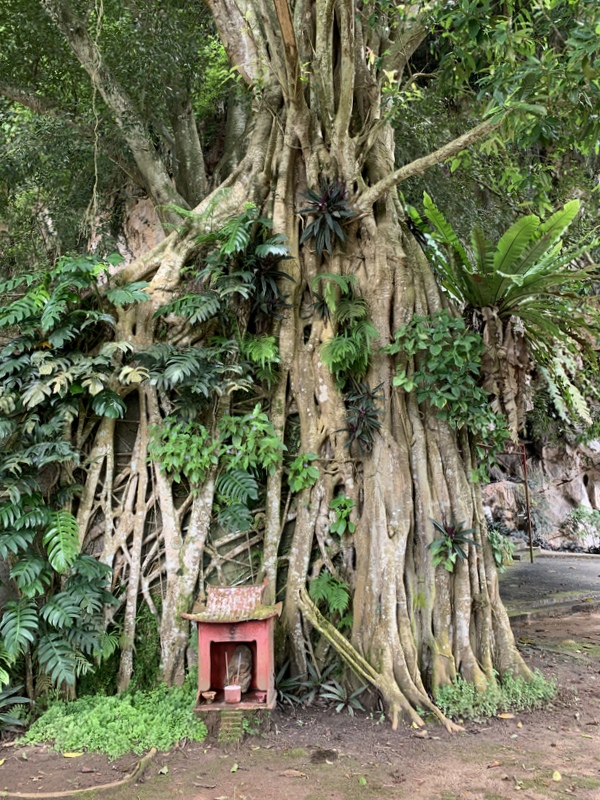
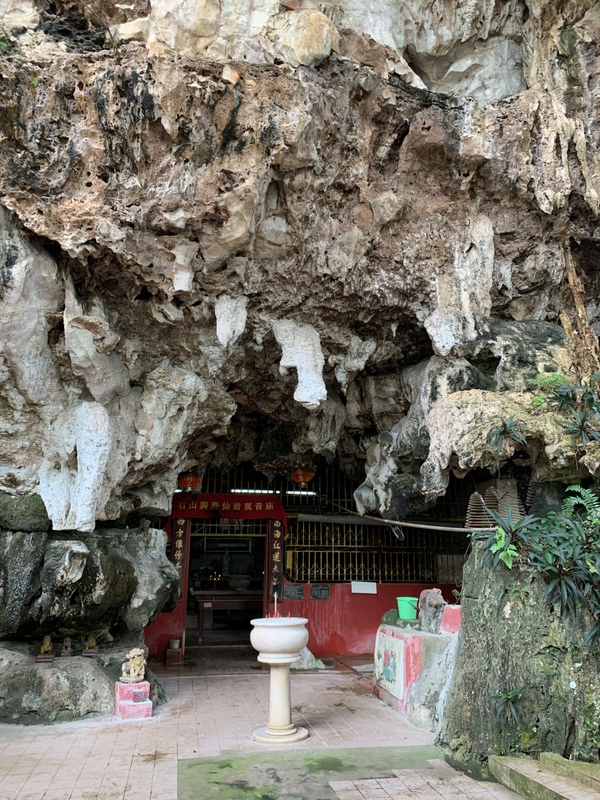
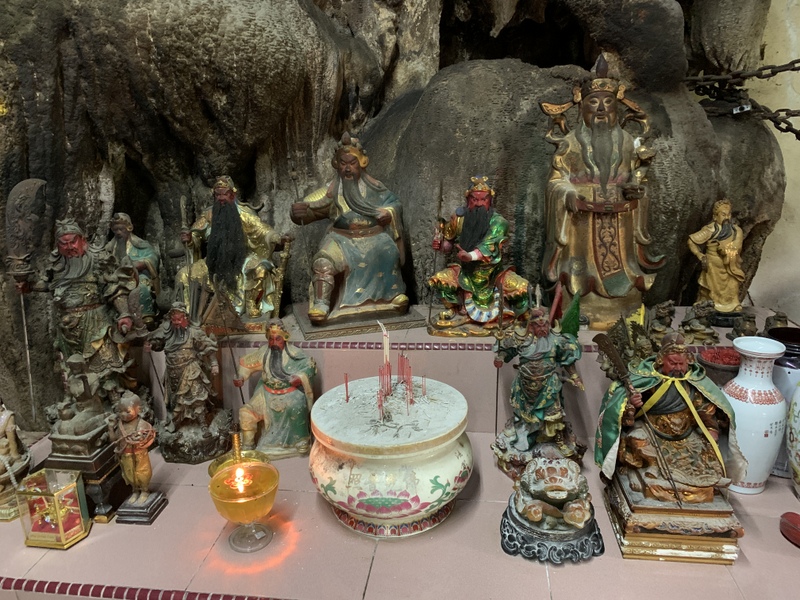
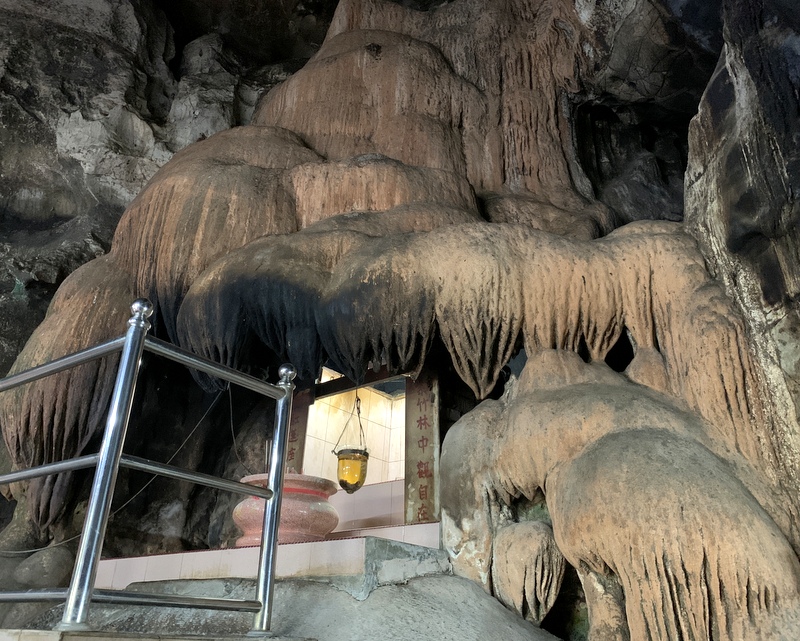
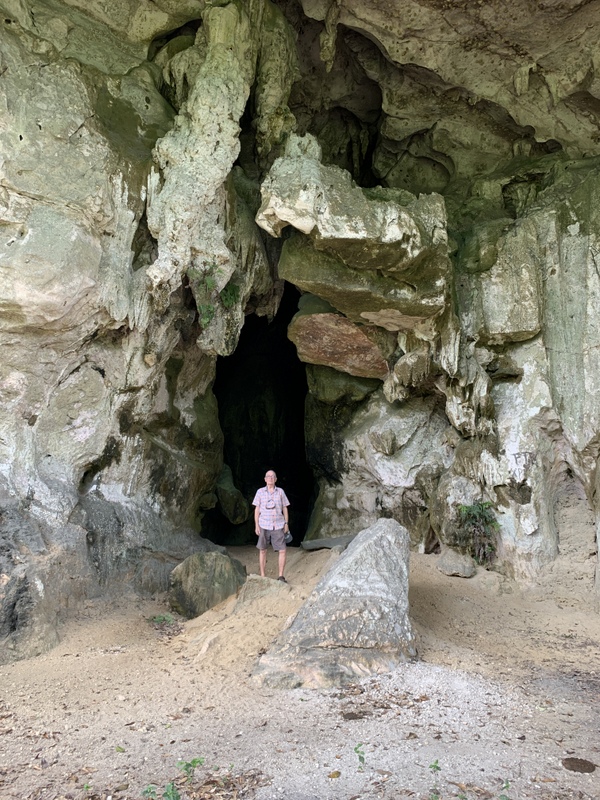
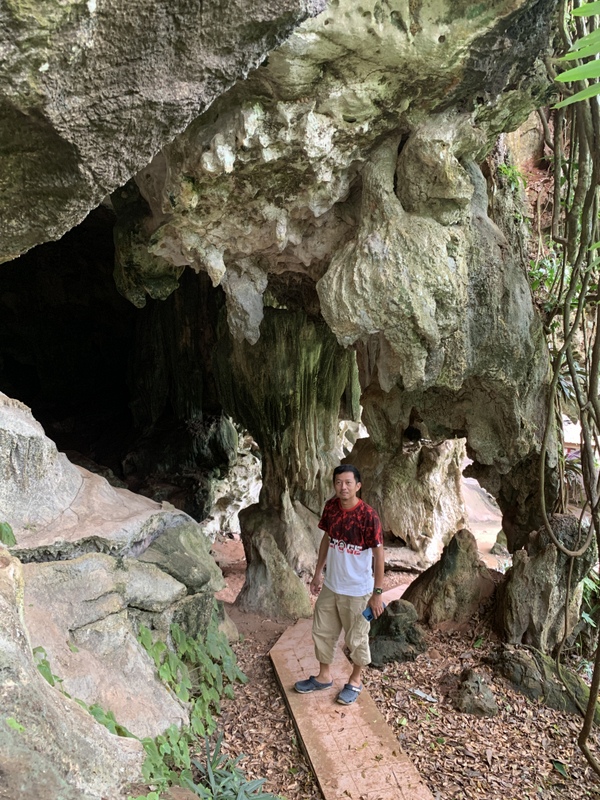
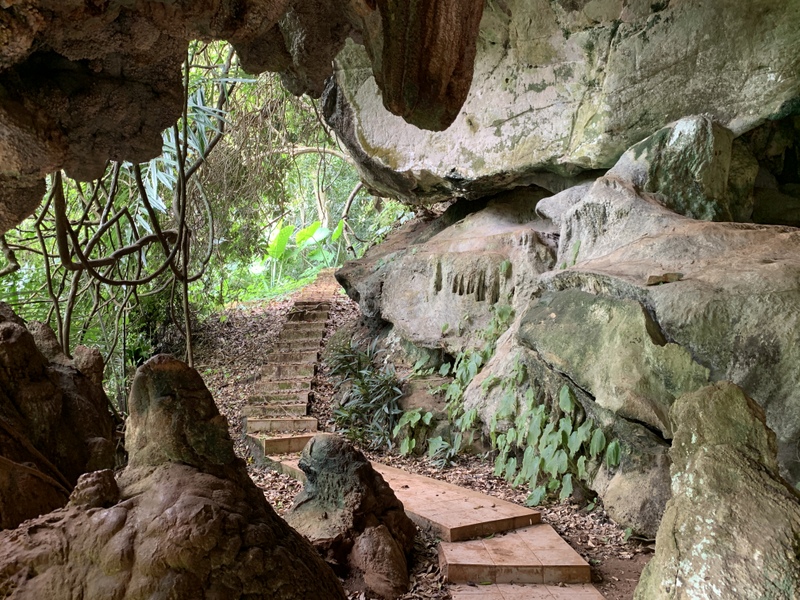
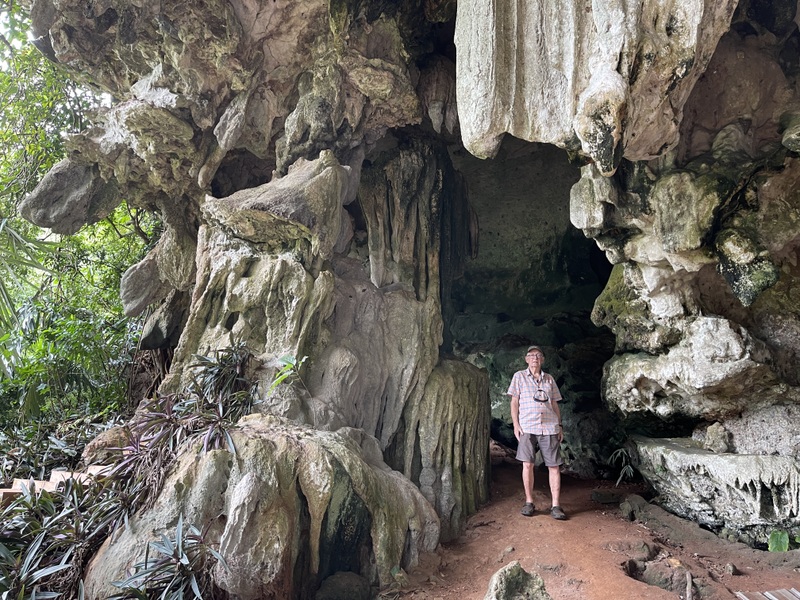
The temple complex is partly built inside a limestone cave. Overgrown with trees. It is a Taoist temple dedicated to Guan Yin, the Goddess of Mercy. According to the FMT article more than 135 year old.
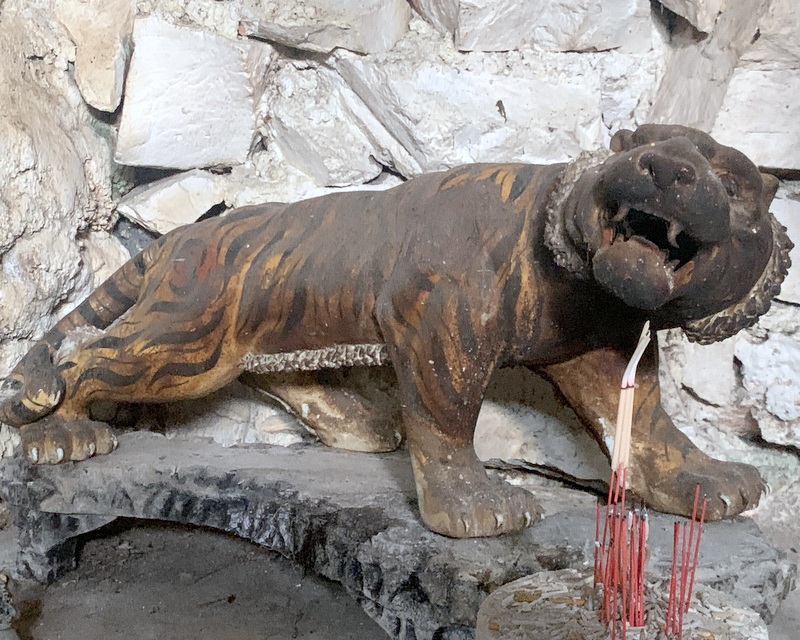
Here is a collection of pictures, taken inside and outside the temple.
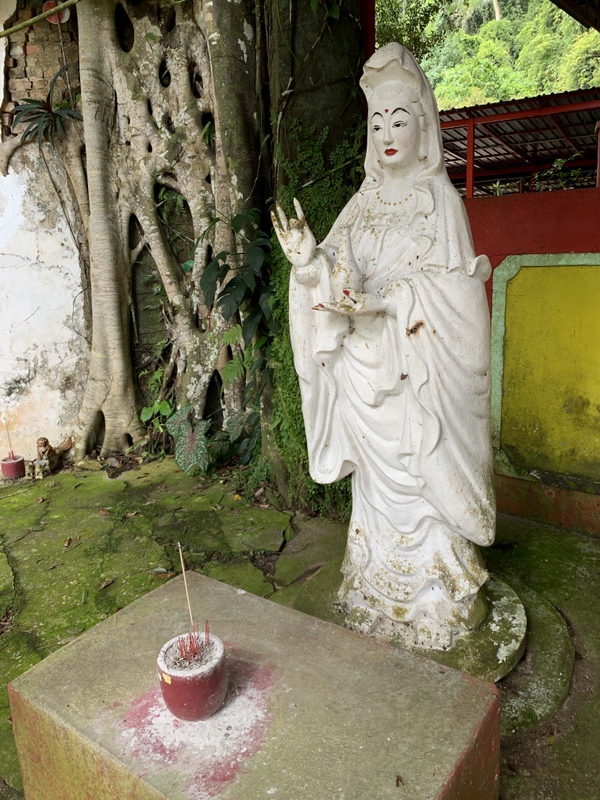
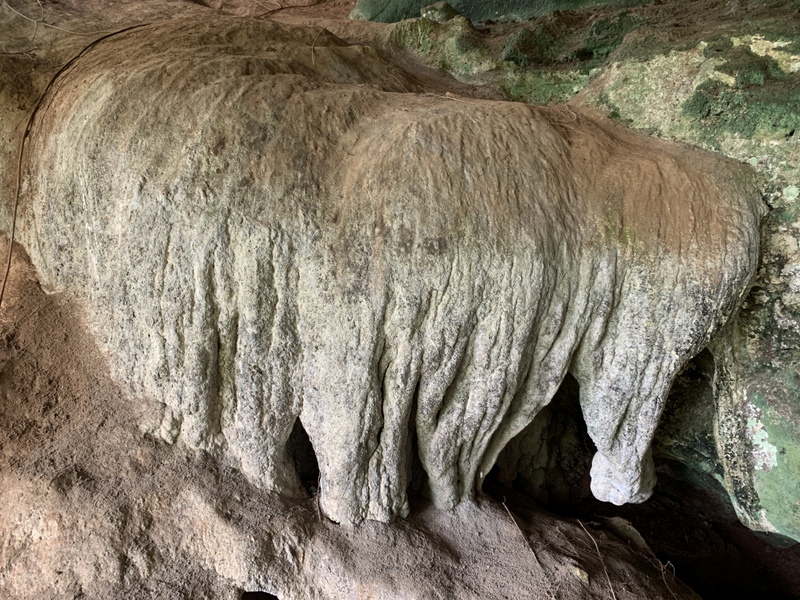
Guan YinNice flowstone formations
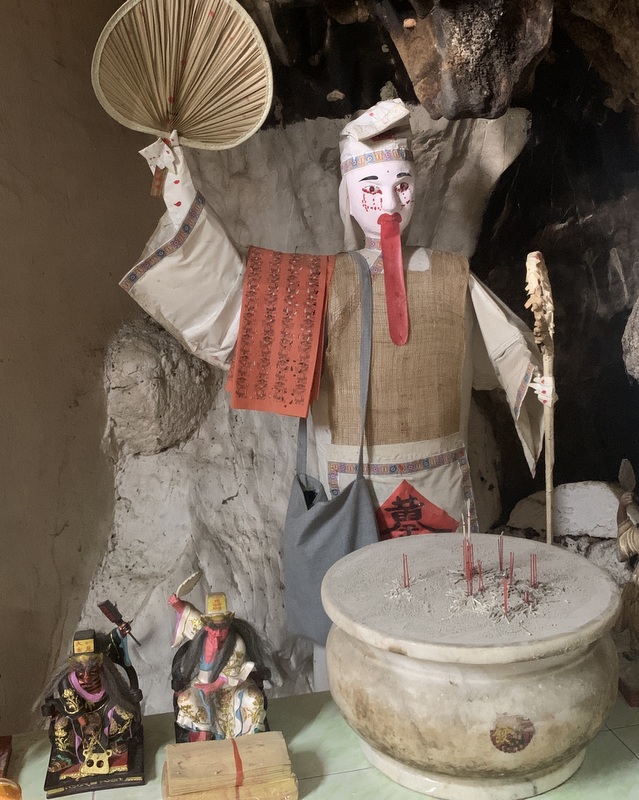
Left a statue of Guan Yin, right a statue of the White Guard, one of the Heibai Wuchang deities, escorting the souls of the deceased to the underworld.
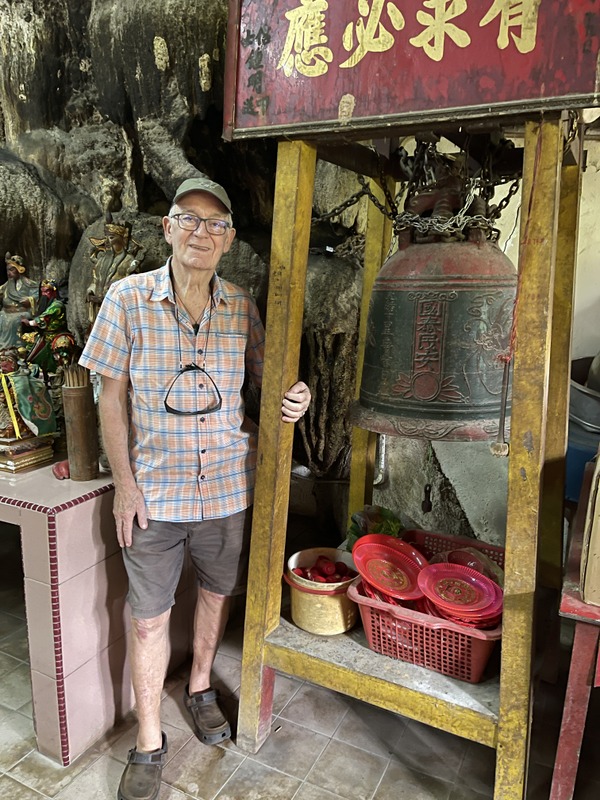
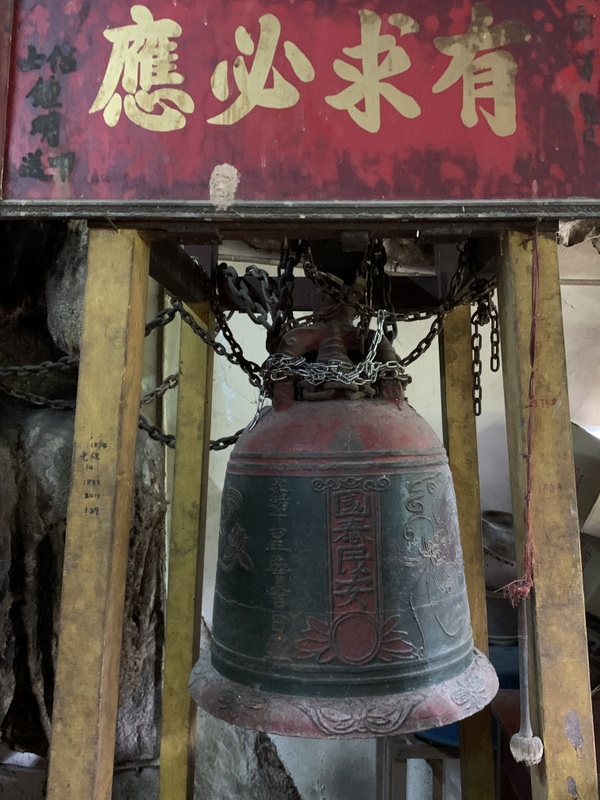
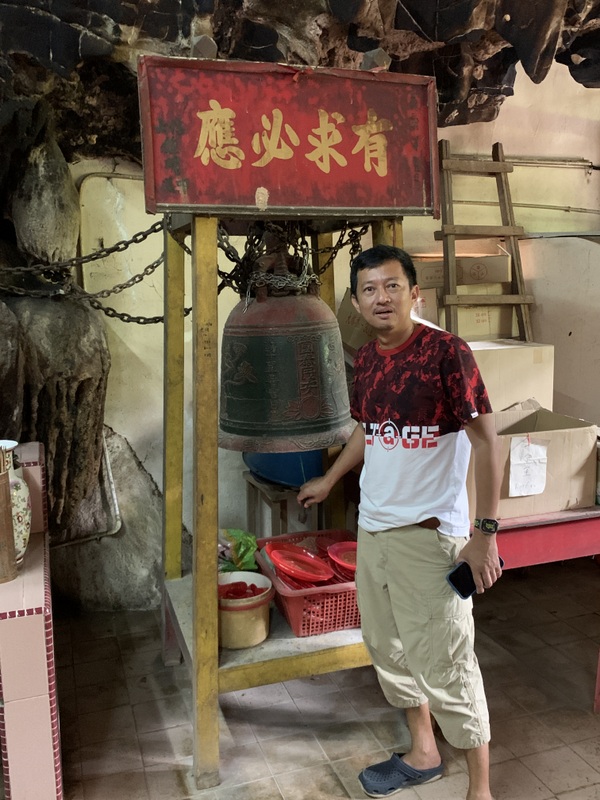
The friendly caretaker told us that the temple bell was quite old and that attempts have been made to steal it. The bell is now tied with metal chains to its scaffolding.
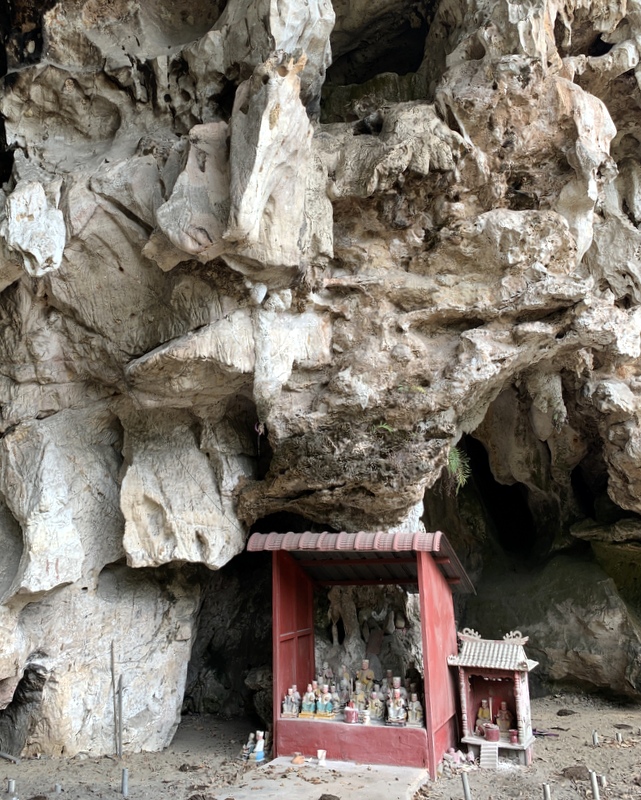
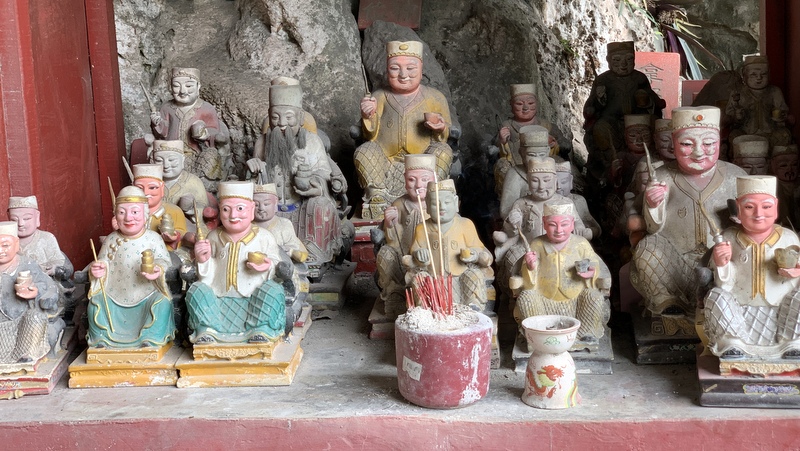
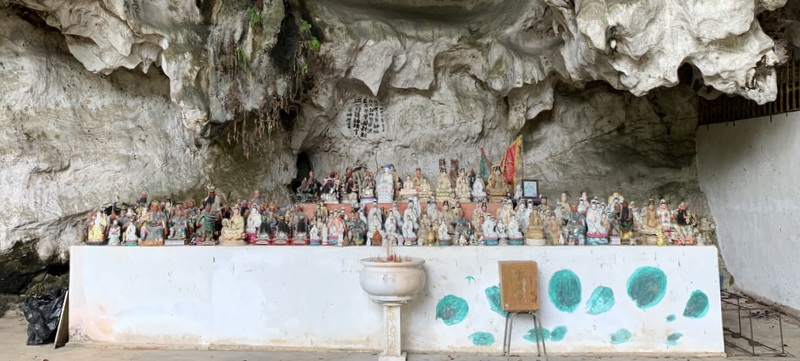
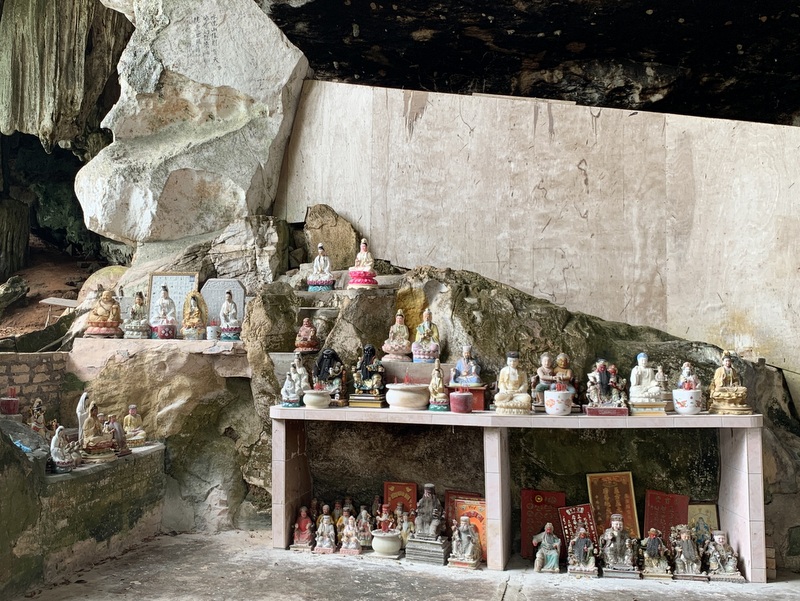
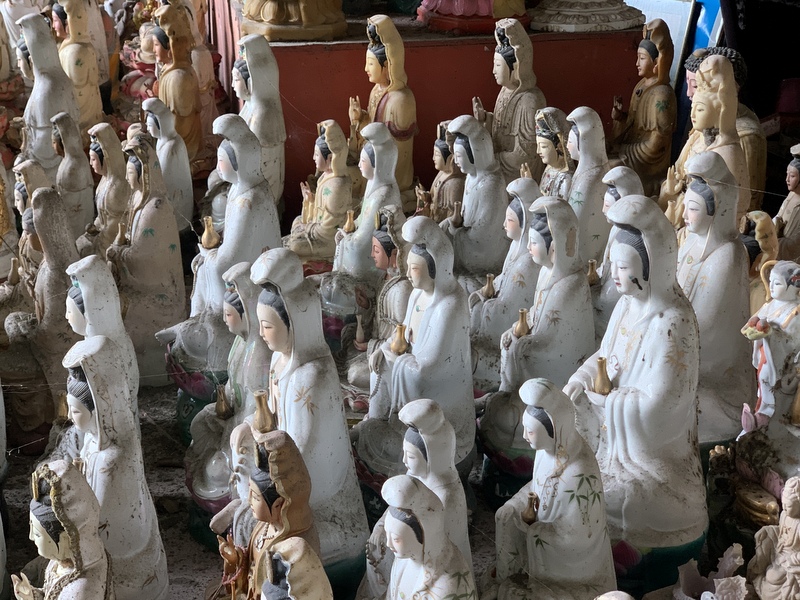
Next to the temple there is a fascinating collection of idols, left there by devotees who had no place for them in their home and didn’t want to destroy them.
We walked around a bit, there are many small caves
It was a very rewarding visit.
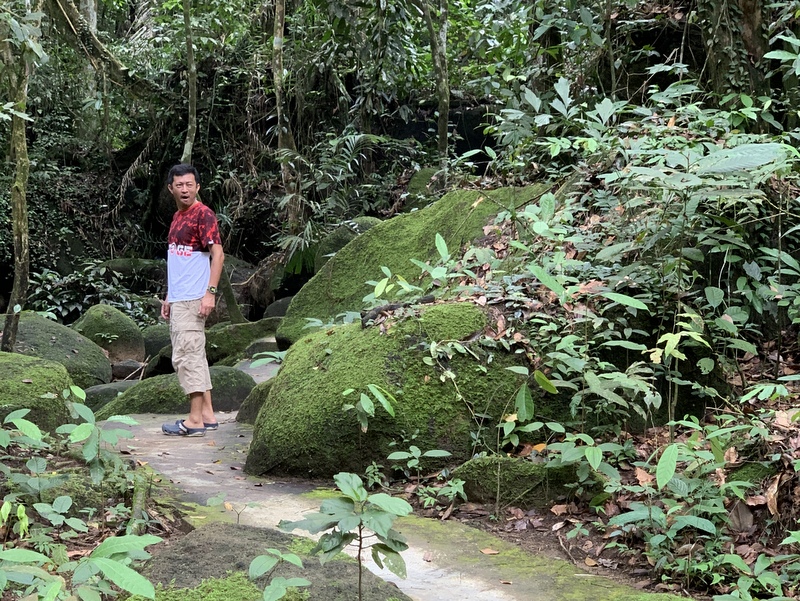
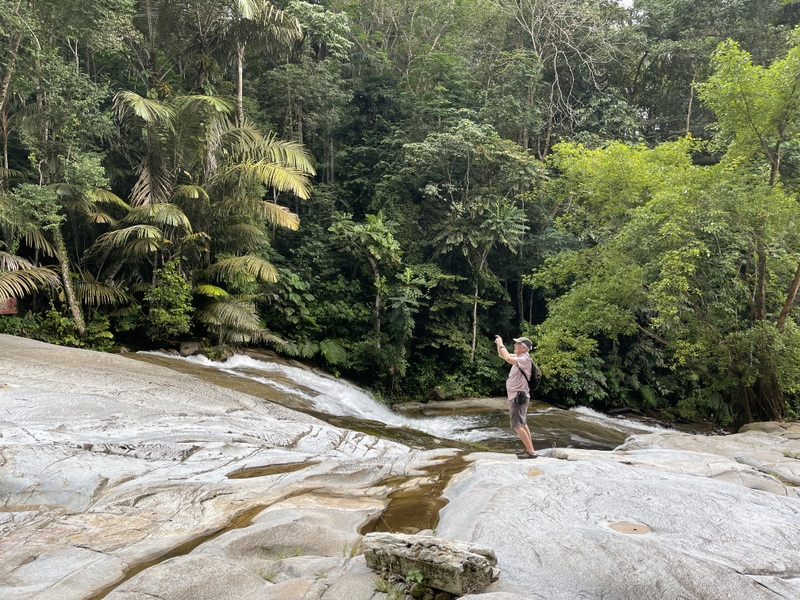
Quite near the temple complex there are popular waterfalls, the Salu Falls. We had a look at the lower fall, easily accessible on a cemented path
It’s only a short walk and you can see and hear the fall from some distance already.
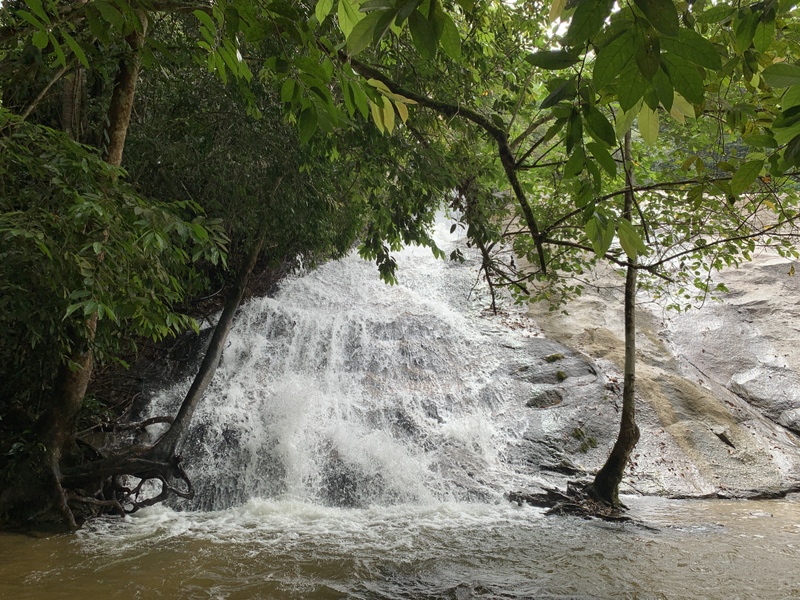
Here is the waterfall. There are more upper tiers, but they are more difficult to reach..
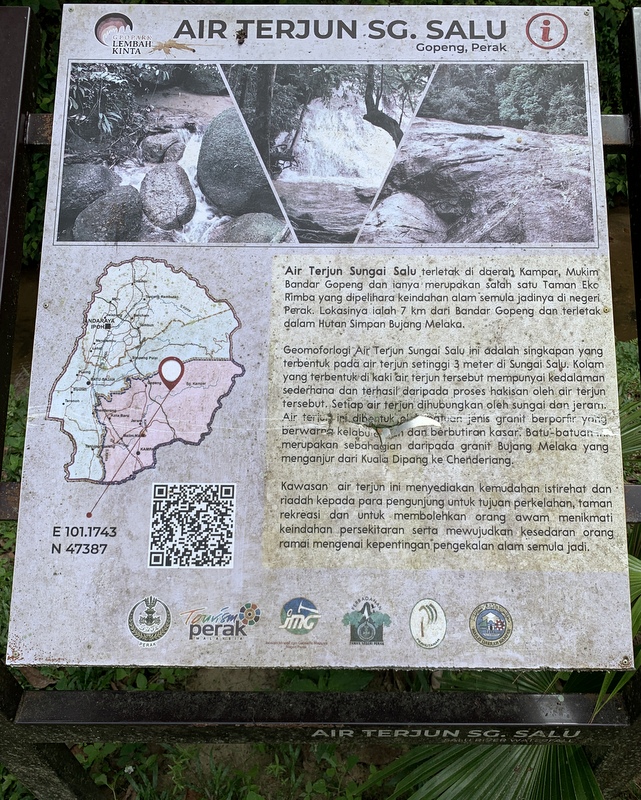
The Salu falls have now been upgraded to the Taman Eko Rimba Sungai Salu. Taman Eko Rimba is a fashionable concept, you can find them now all over Malaysia..
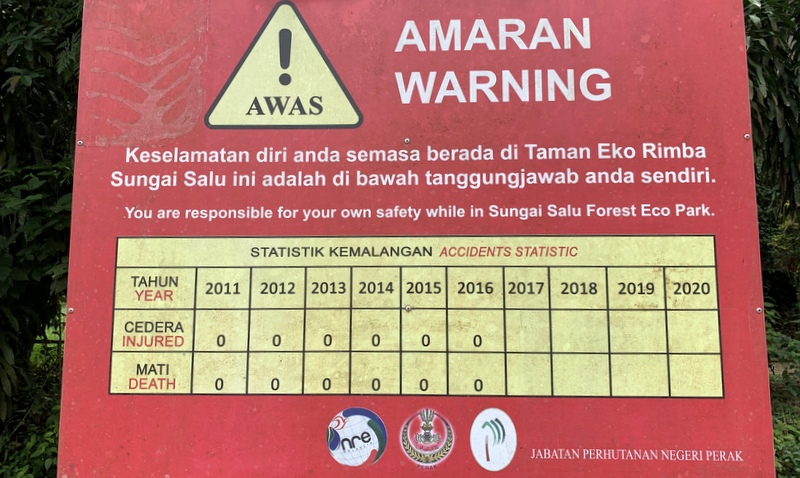
I had to smile about the warning signboard. Started in 2011, counting yearly accidents and fatalities. I guess that when nothing had happened in the following 6 years, they gave up updating the signboard.
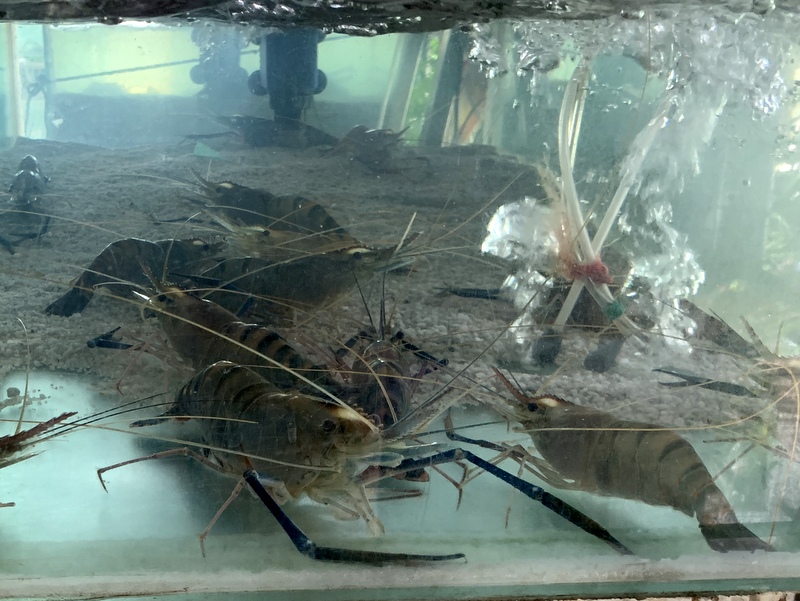
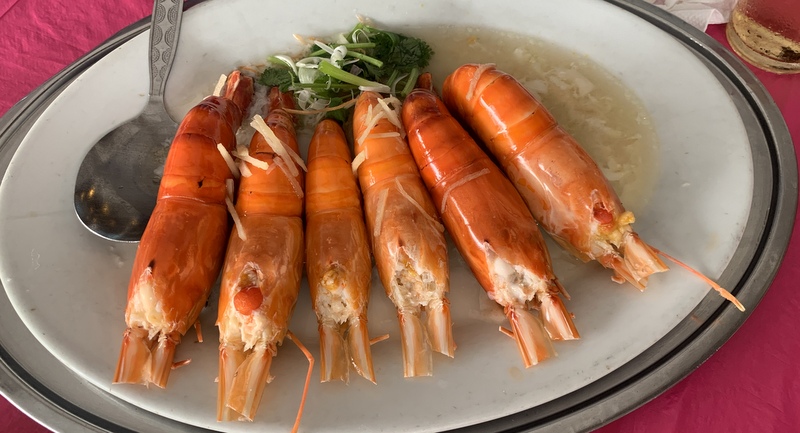
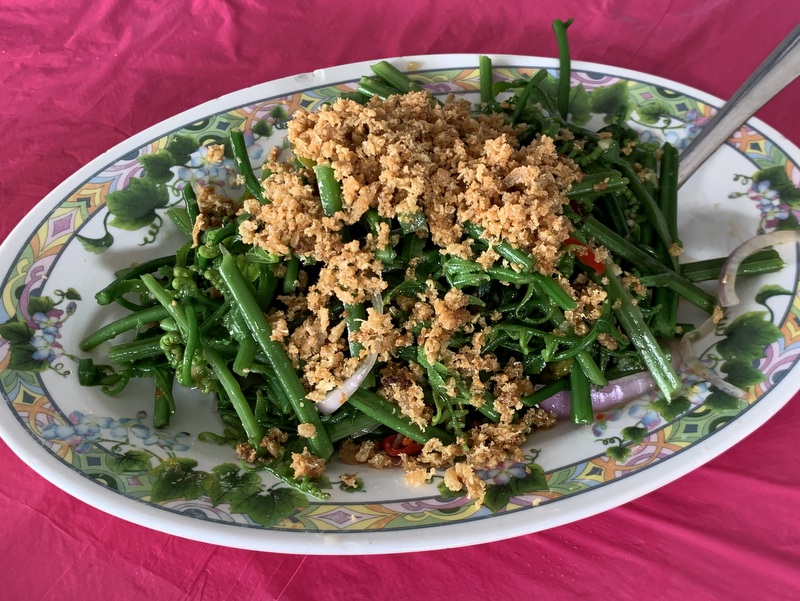
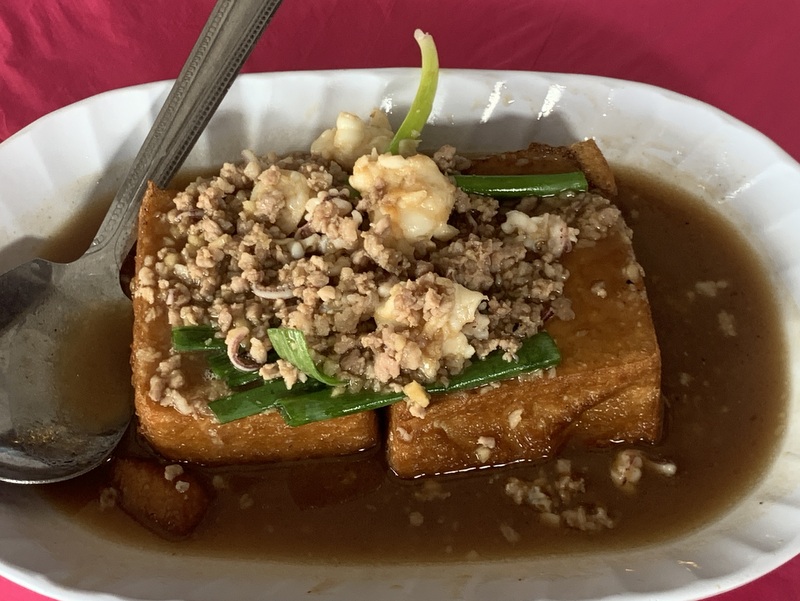
Time for lunch! We were not far from Tanjung Tualang, famous for its udang gala restaurants. We had our lunch in the You Kee restaurant. We knew that the prawns would not be cheap, but they were delicious, We had three big prawns each and there was Tofu and paku salad. The bill was RM 97, value for money.
paku saladtaufu
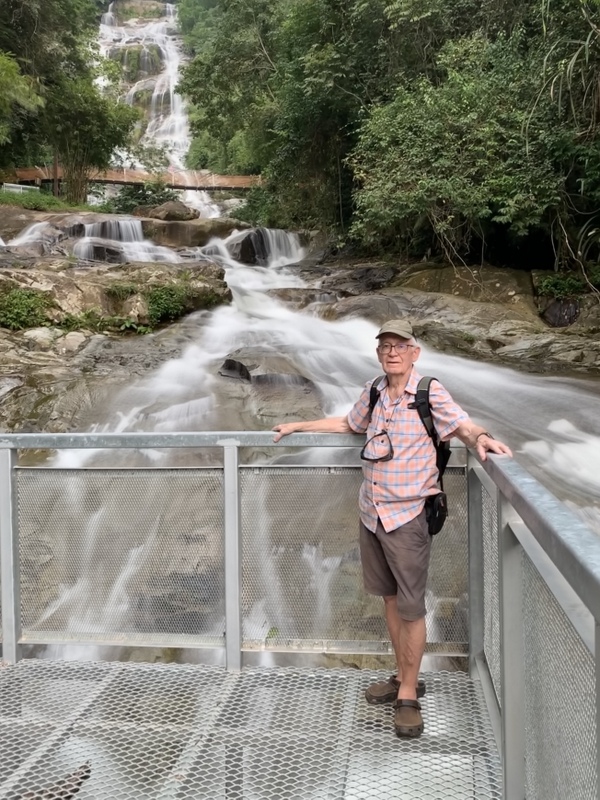
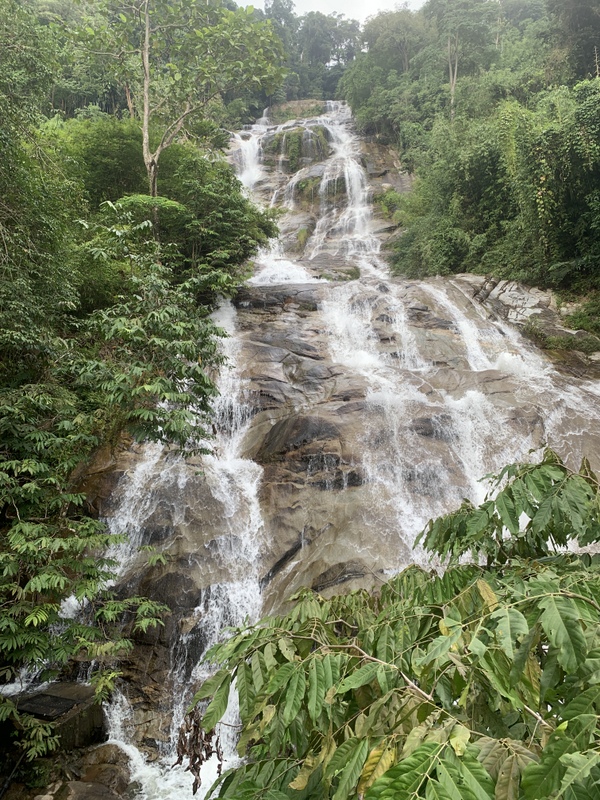
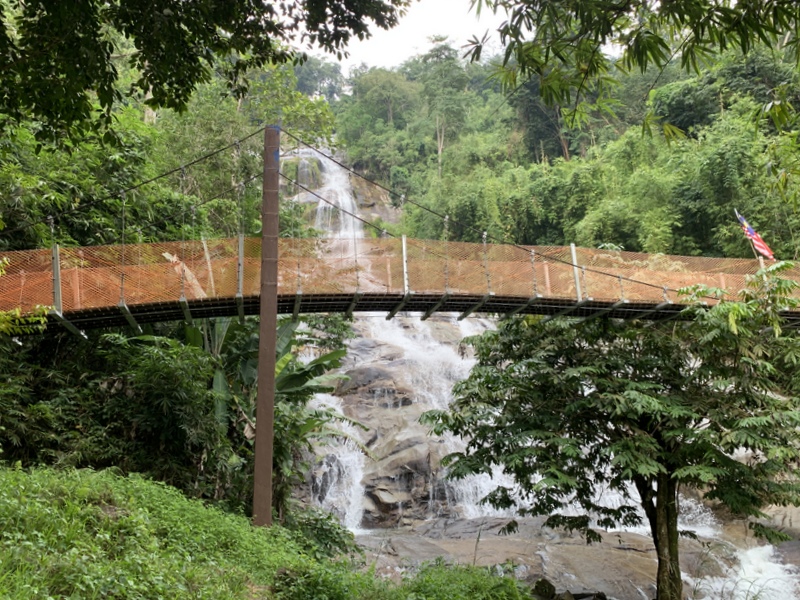
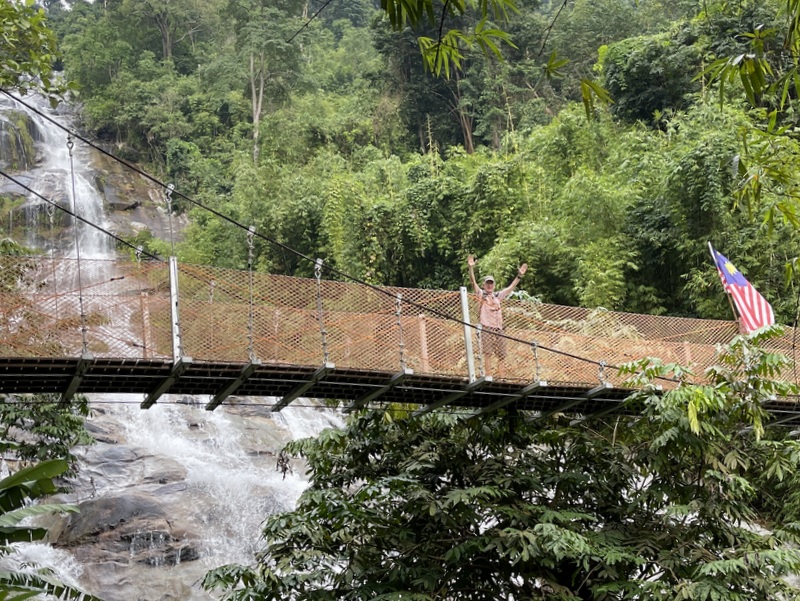
On our way back home we noticed that we were not far from the Lata KInjang waterfall. Most Malaysians will have seen this waterfall, driving on the North-South highway. Not many will have visited the falls. Also these falls have been upgraded and are now named Taman Eko Rimba Lata Kinjang. Access is not cheap, we paid RM 21! (Foreigner RM 10, Malaysian adult RM 6 and car park RM 5). Here are some pictures. It was already a bit late in the afternoon, we just walked to the hanging bridge and back again. We reached our car just before it started to rain.
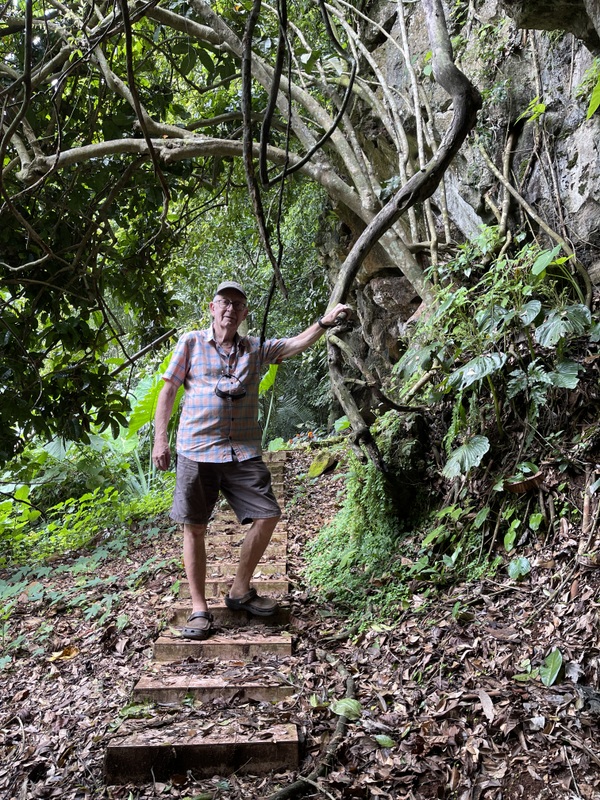
Notice me on the bridge
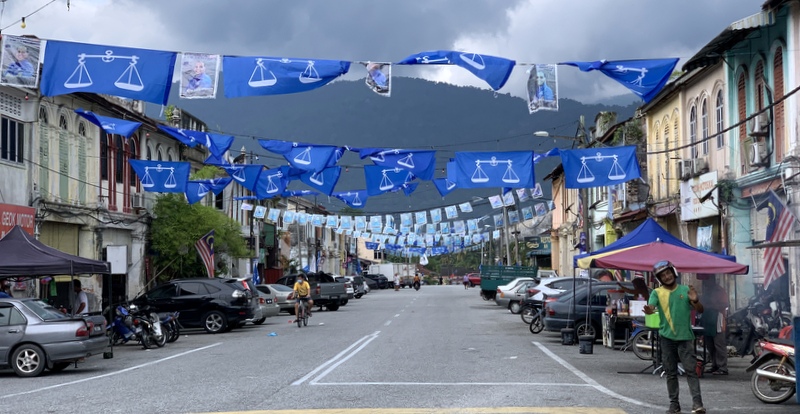
We made this trip on 16 November 2022, three days before the GE15 elections. This is the small town of Chenderiang, near Lata Kinjang.
A rewarding day trip, very Malaysian. A combination of Culture, Nature and Food. Malaysia Boleh!
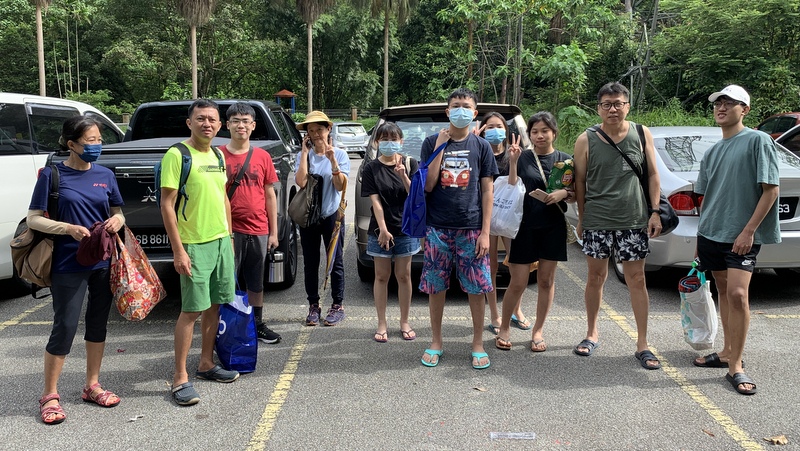
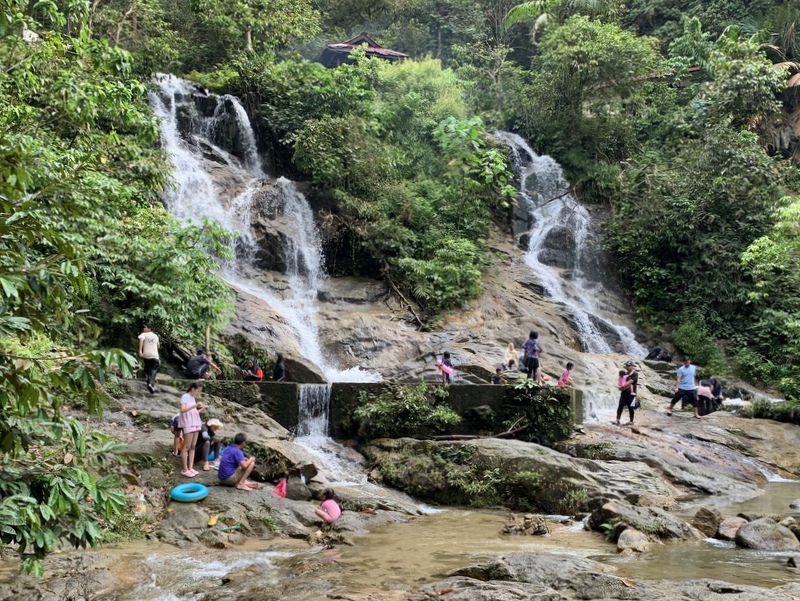
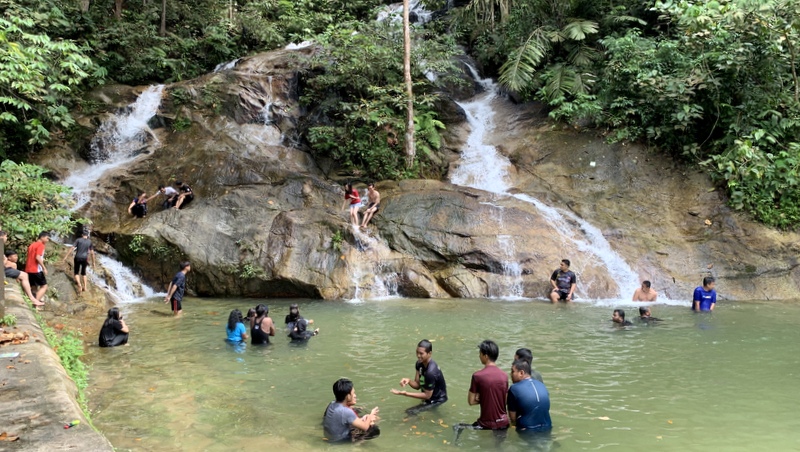
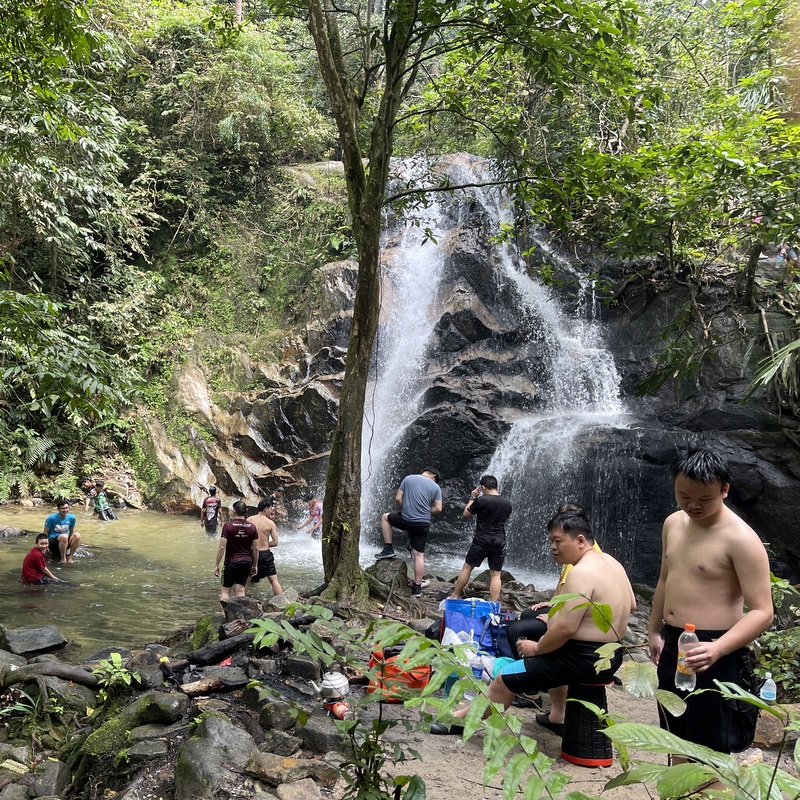
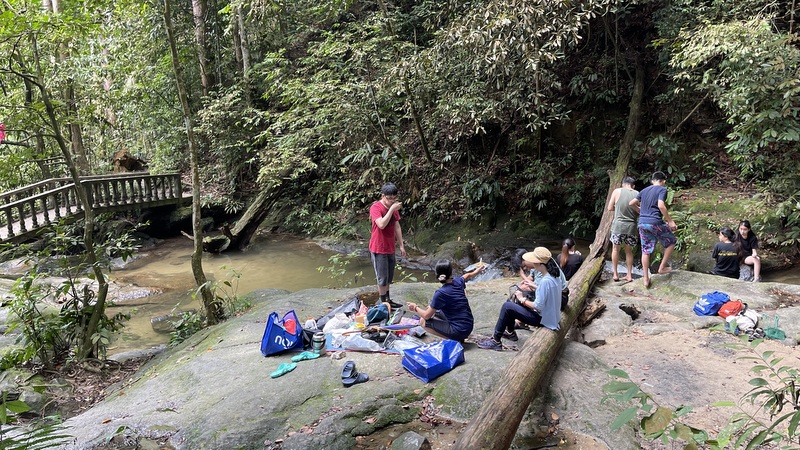
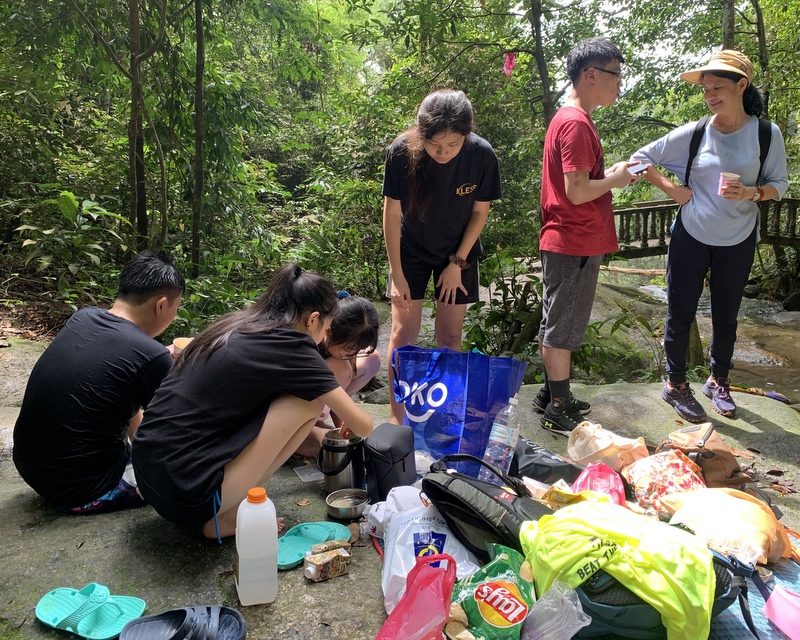
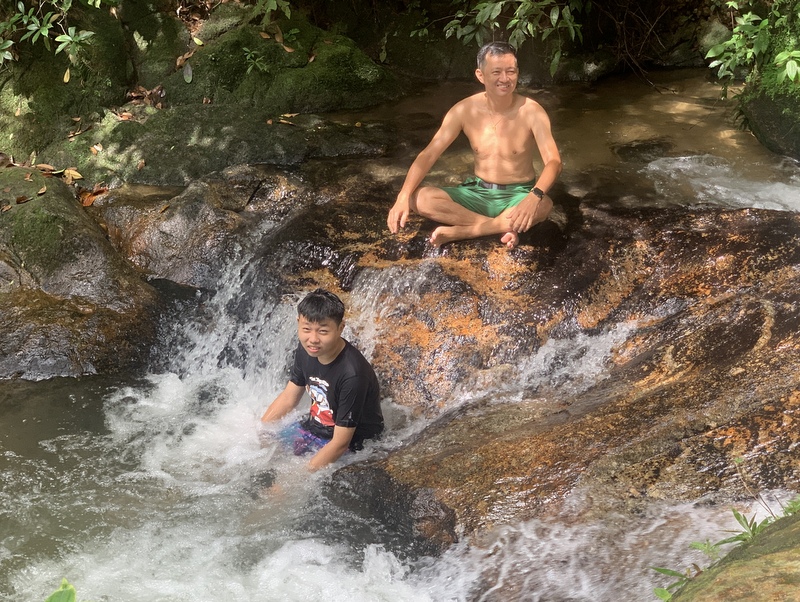
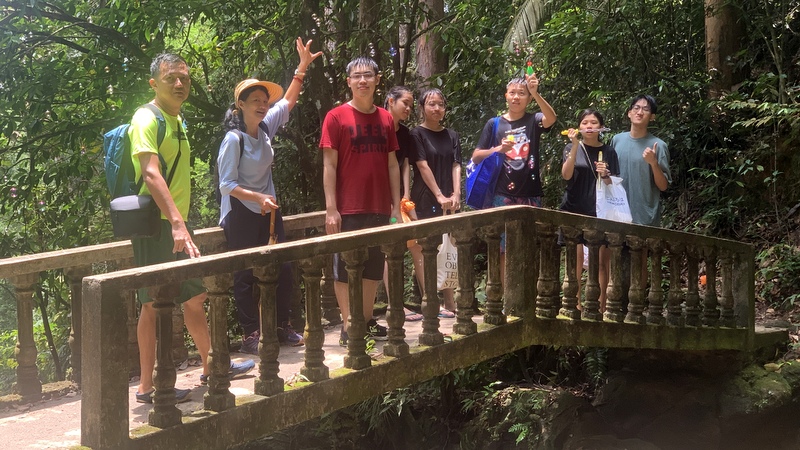
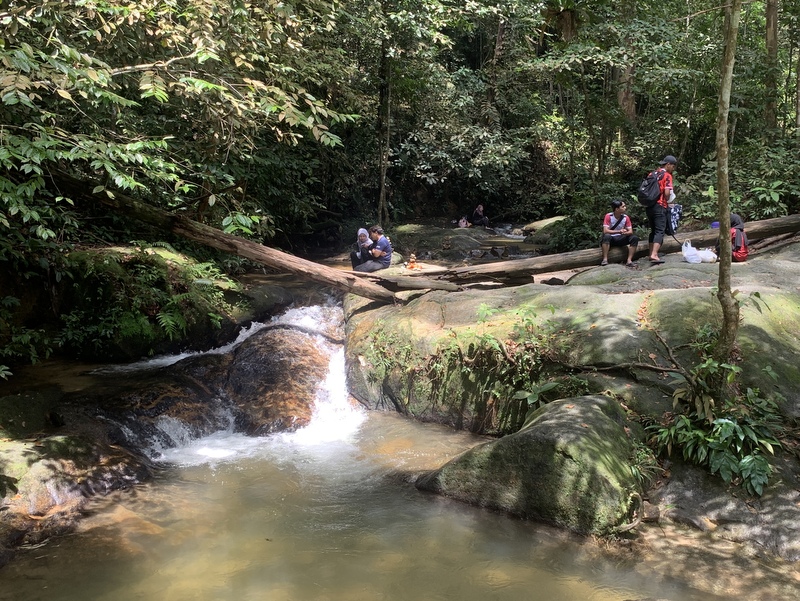
For a long time there has been a plan to visit a waterfall with Aric’s family, but it was not easy to find a suitable date. As 10 October was a holiday, we decided to make a trip to the Kanching waterfall between Selayang and Rawang. When we arrived at the carpark, it became clear that we would not be the only visitors, it was full, we had to drive a bit further to an additional parking. Here we are ready to go, notice the many bags with food for the picnic 😉
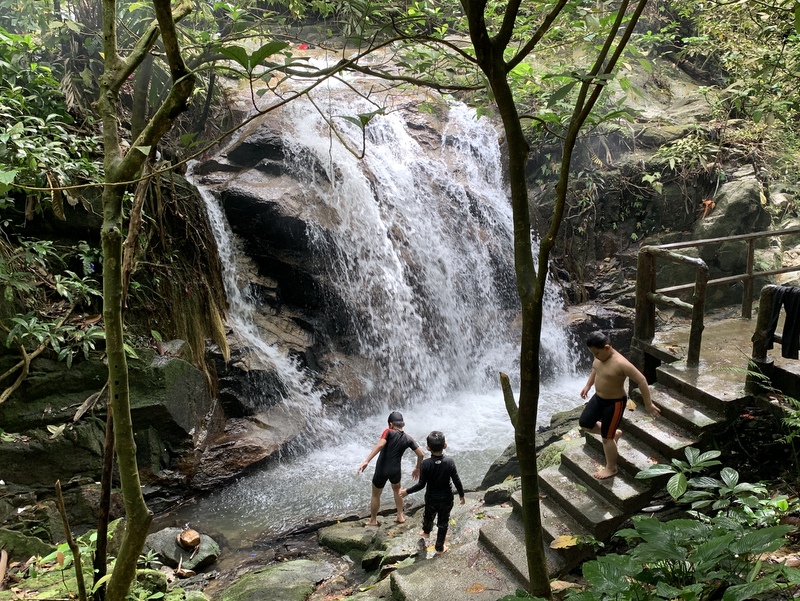
There are 7 waterfalls (and 2 more far upstream). Here are the first and the second fall.
The third fall, the Kapor fall, is the most popular waterfall. Too crowded, so we walked further up.
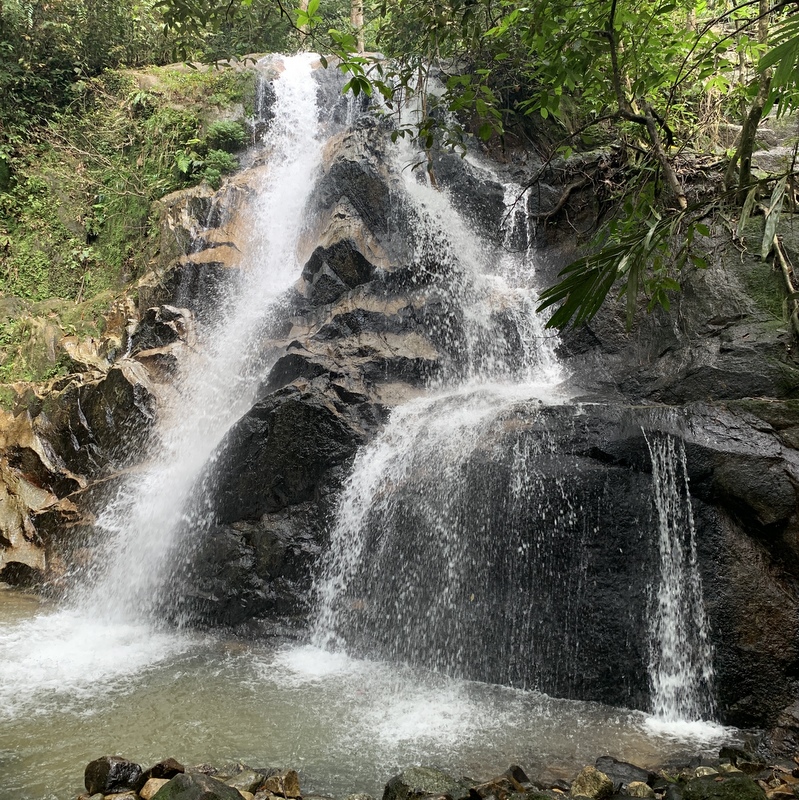
Where the cemented steps end, a trail continues, we expected that less people would hike that far. And that was the case, but there were still many people at my favorite fall no 5. I managed to take a picture of the fall without people!
We found a suitable, more quiet place between fall 4 and 5, a big rock where we could enjoy our lunch.
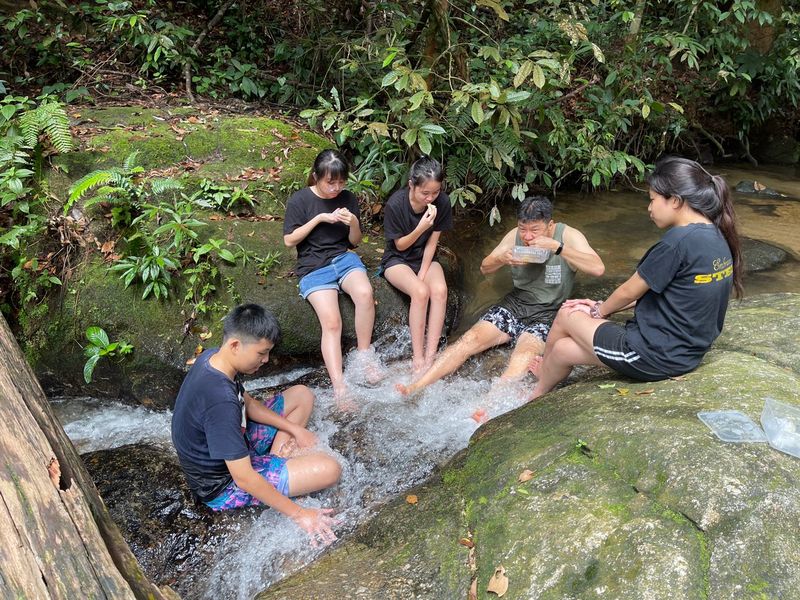
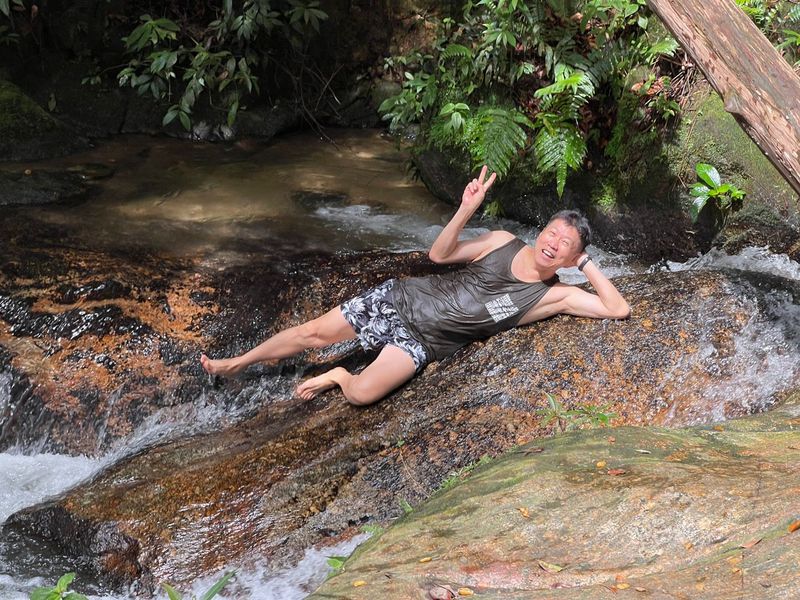
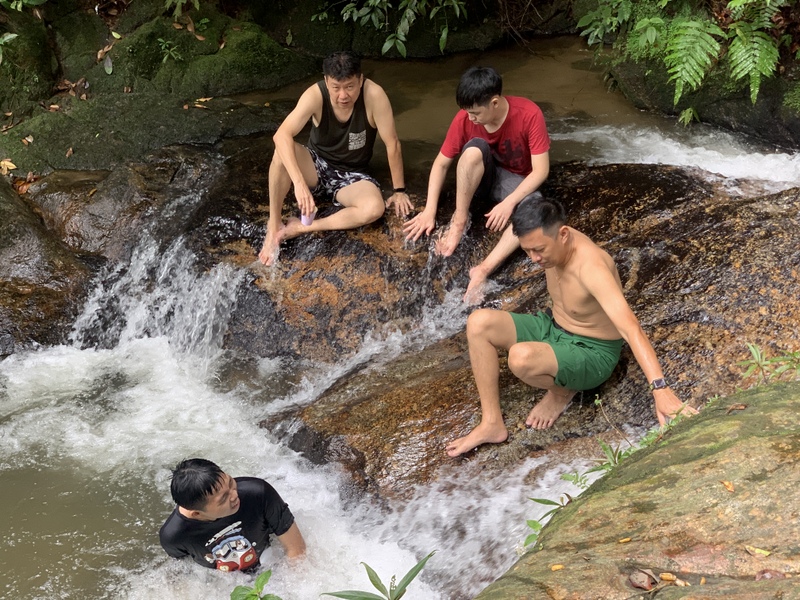
There was a small cascade next to our rock, a perfect place to enjoy the cooling water.
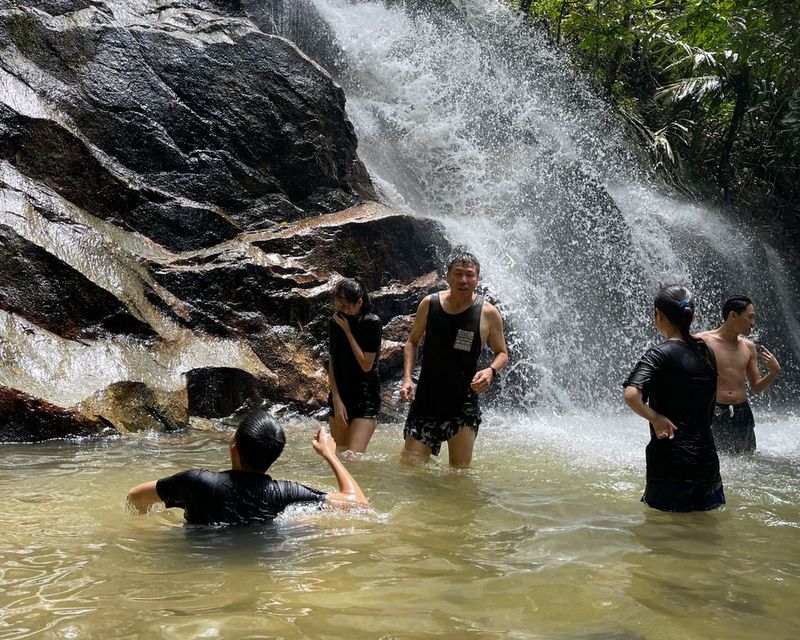
A few of us went for a while to fall no 5 to take a shower.
During my waterfall hikes I always liked to leave a stone marker at the waterfall. Here there was no need to do that because another visitor had already built two ones. In the right picture Zhi Le is blowing bubbles..
Ready to walk back.
Two views from the bridge. Left the rock where we had our picnic ( of course we left no rubbish) and the small cascade . Right looking down to fall number 4.
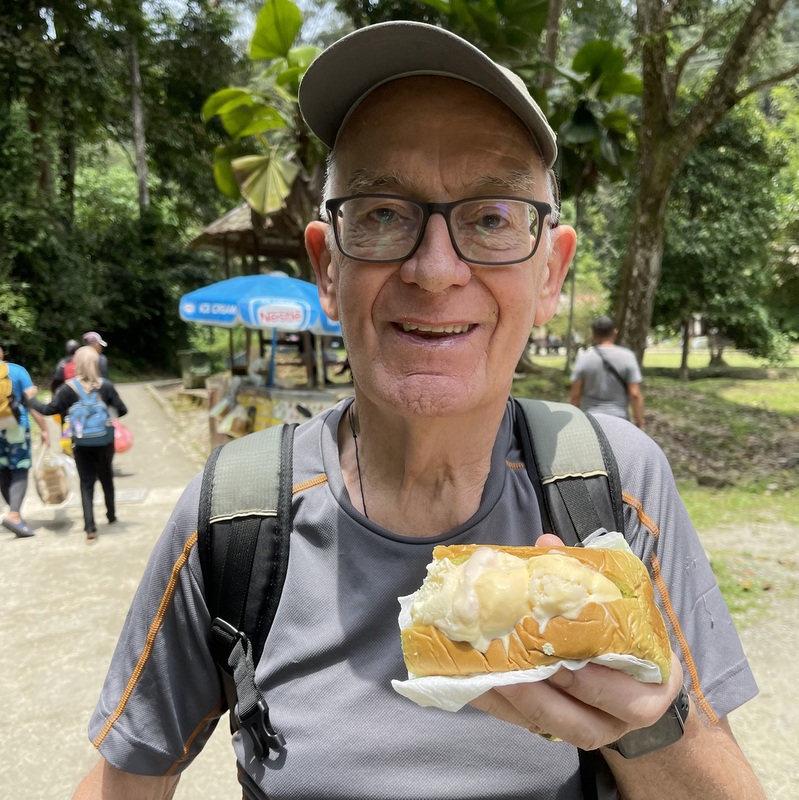
The Kapor fall was even more crowded now. Near the entrance we met an ice cream seller, I could not resist the temptation to have a roti ice cream 😉
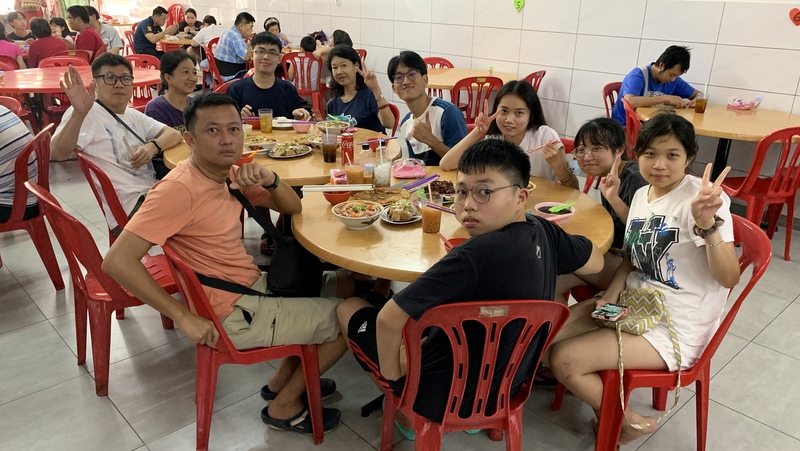
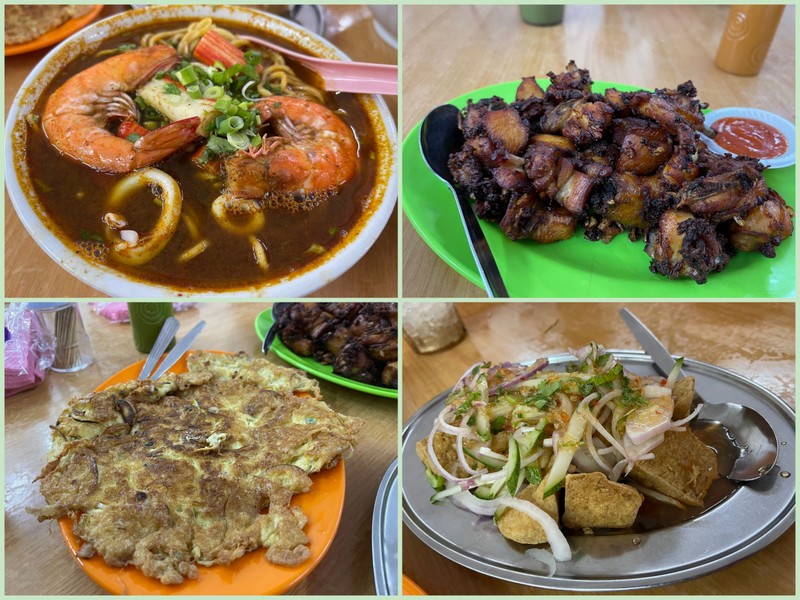
We were still hungry and decided to go to Restoran Tom Yam Serendah, where we had enjoyed nice food several times in the past. Then it was a small basic restaurant near the main road, but now it had moved to a new location, very clean but less atmosphere.
The food was ok, although the tom yam not as nice as before. Still cheap, RM 180 for 11 pax!
After our lunch we were in the mood for coffee, we decided to visit the World of Phalaenopsis , which not only has orchids, but also a nice café. However, here there was again a massive crowd, so we only walked around and bought an orchid to take home.
Driving back we looked for a kopi tiam, but we were not lucky. Finally we ended, almost home, in the DIB restaurant in Damansara Perdana. DIB stands for Deaf In Business, it is a relaxed, very friendly place, where we come regularly.
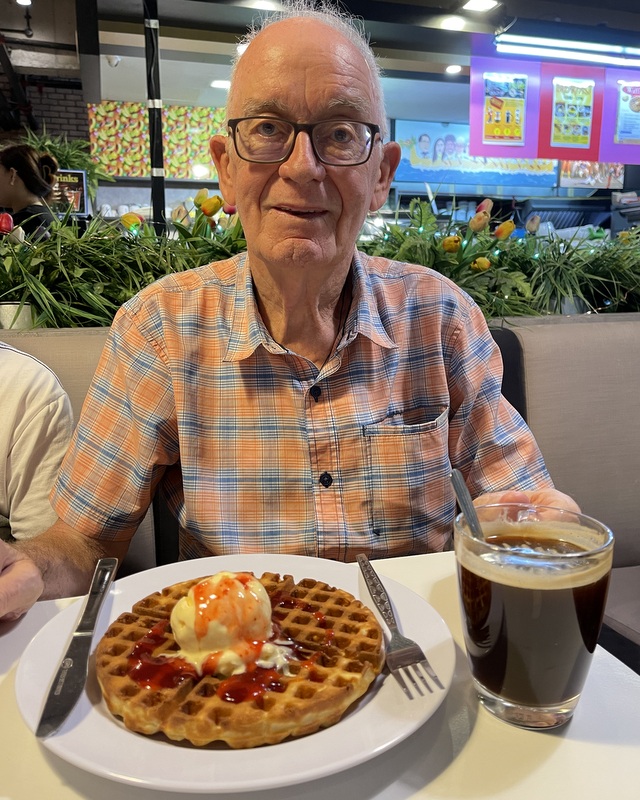
We had coffee, I was not yet hungry, had only a waffle with ice cream
it was a very nice outing, worth repeating (but preferably on a weekday)
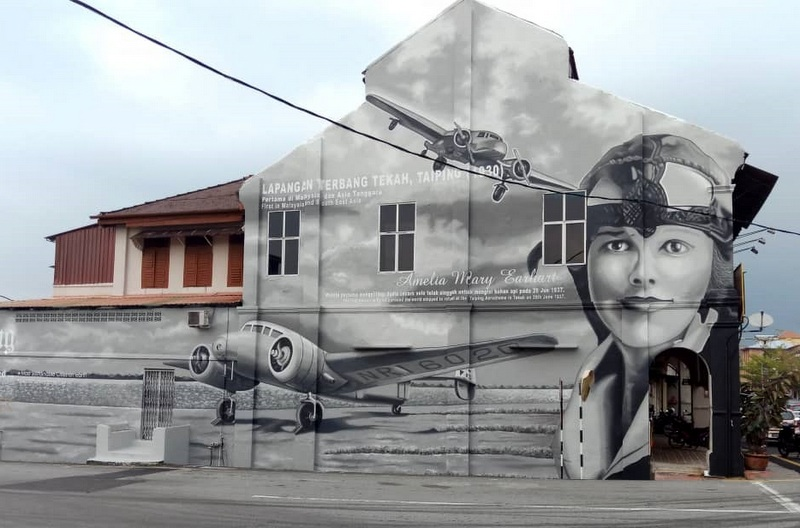
In September 2019 I published two blog posts about Amelia Earhart, the American aviator, who flew over present-day Malaysia from Bangkok to Singapore on 20 June 1937. A mural had been created in Taiping, honoring her landing on 20 June at the Taiping Aerodrome for a refueling stop.
Here is a bit more information about how the confusion started./
In 2007 a Wikipedia contributor, Andrew Kidman, starts a topic Taiping Airport. He adds content in the following years, for example on 1 February 2009 :
” … The airport also achieved fame through the famous American aviator, Amelia Mary Earhart in 1937, when she was doing her world flight and stopover at the Taiping Airport for refueling petrol. Amelia Earhart was doing her flight route from Thailand to Singapore, her permission to land at Taiping Airport was allowed on 7 June 1937 by the then Resident-General of Malaya….”
The second sentence is correct, the first one is his own conclusion and erroneous. His last edit of Taping Airport was in April 2009, he is not active anymore, I have tried to contact him, without success.
Yes, Amelia Earhart received a letter on 7 June that she was permitted to land at the Taiping Areodrome. Does that make Taiping at least a bit special? To make clear that this was mot the case, we must keep in mind that in 1937 Malaysia did not exist, it was British Malaya, consisting of the Straits Settlements , the Federated Malay States and the Unfederated Malay States, Crossing the airspace of British Malaya, Amelia needed several authorizations. In my second blog copies of these letters are shown. Each gives authorization for a specific period (‘in or about June’) and mentions the airports where she is permitted to land. Here is the list, with date of the authorization letter and the airports. Kedah and Johore were unfederated states and had to give authorization separately.
15 June Straits Settlements (Penang, Singapore)
.7 June FMS (Taiping)
17 June Kedah (Alor Star)
17 June Johore (Batu Pahat)
Taiping was just one of the five airports where she was allowed to land. But she did not , as is clear from the book Last Flight. In her report she mentions a few times Alor Star (We checked over Alor Star airport but did not stop, and headed for Singapore)
Amelia Earhart never landed in Taiping and had no intention to do so
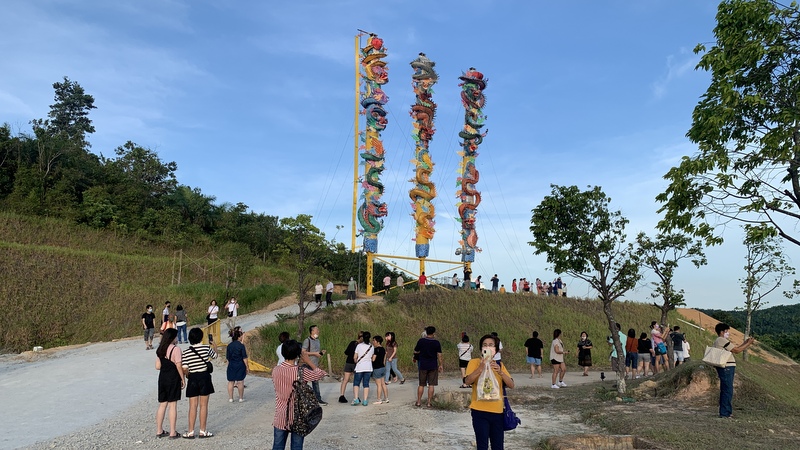
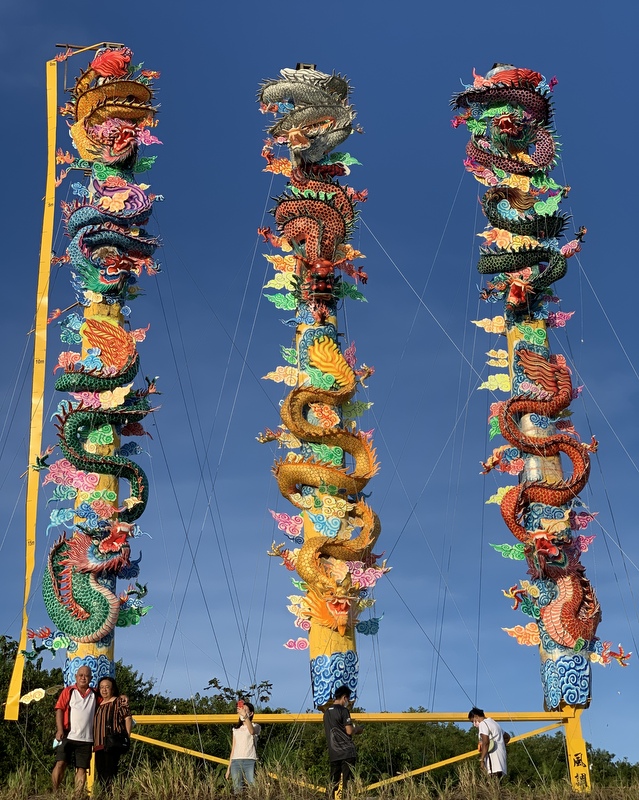
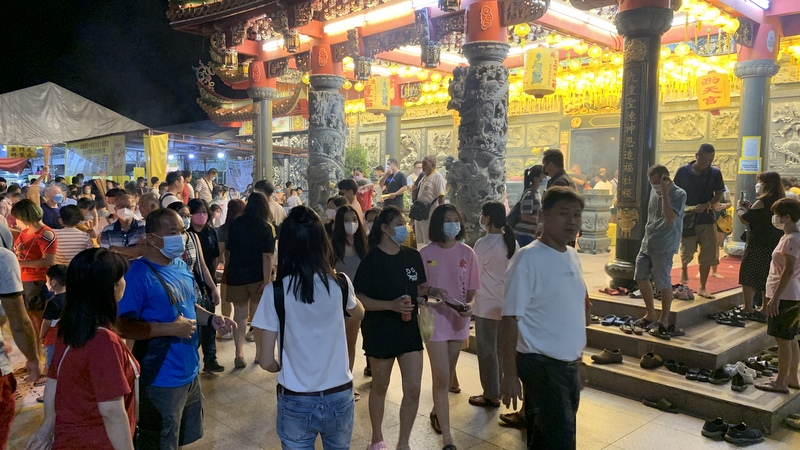
After Aric had heard that a temple near Kuala Pilah had built three giant joss sticks for an upcoming festival., he suggested that we should go there and have a look. Kuala Pilah, in Negeri Sembilan is quite far from KL and it took us almost two hours to reach the temple. The temple is located about 7 km sount of Kuala Pilah, along the road to Tampin. We were not the only visitors, there was a massive crowd. Well organised, we followed instructions to find a parking place.
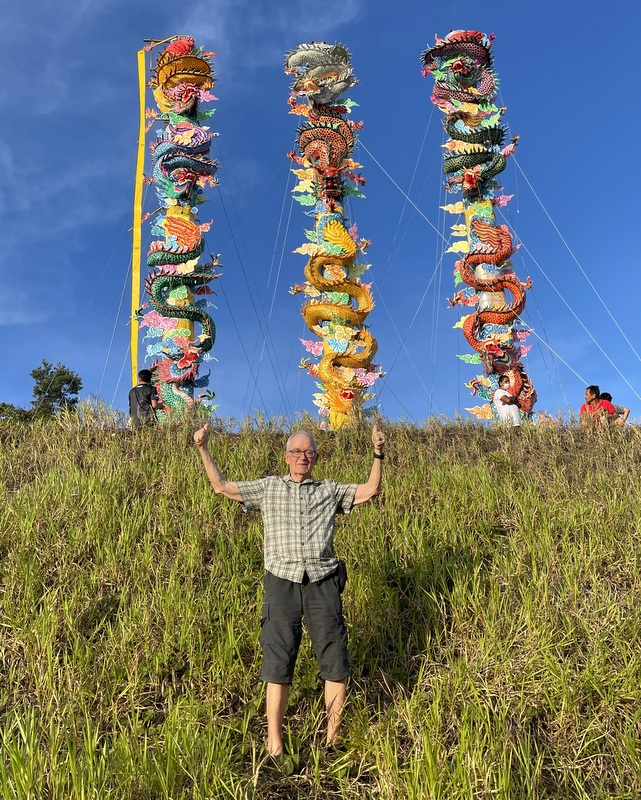
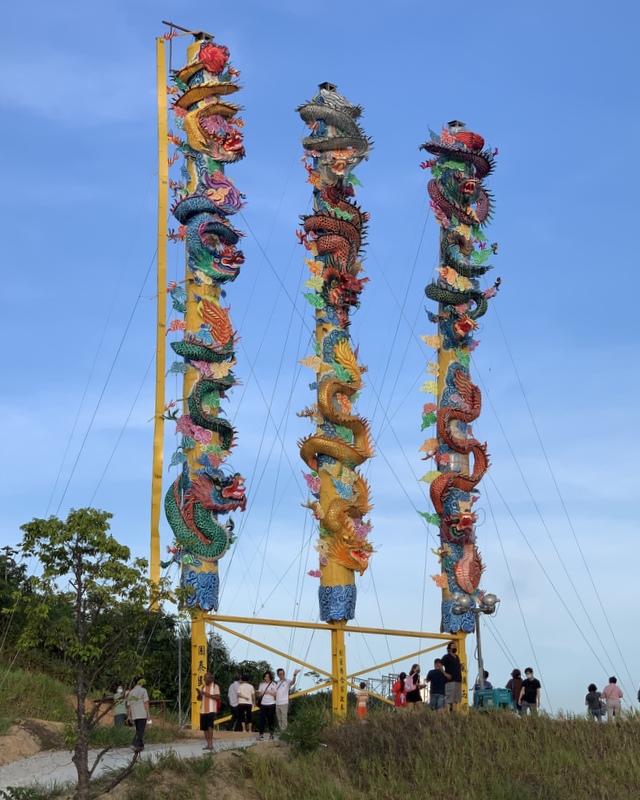
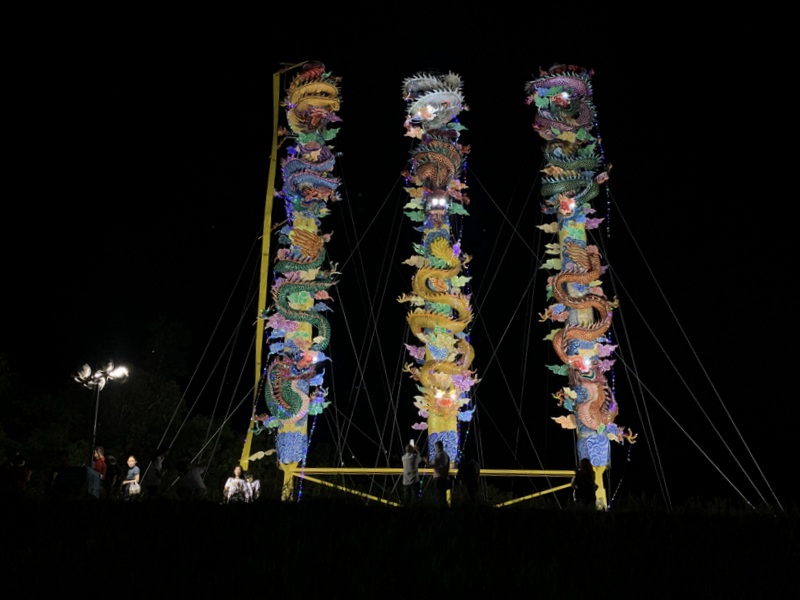
We started our visit with the giant joss sticks. And huge they are, almost 20 meter tall. Visible from far away.
.The yellow ribbon left is a tape measure. Starting from 0 m at the top until almost 20 m at the bottom.
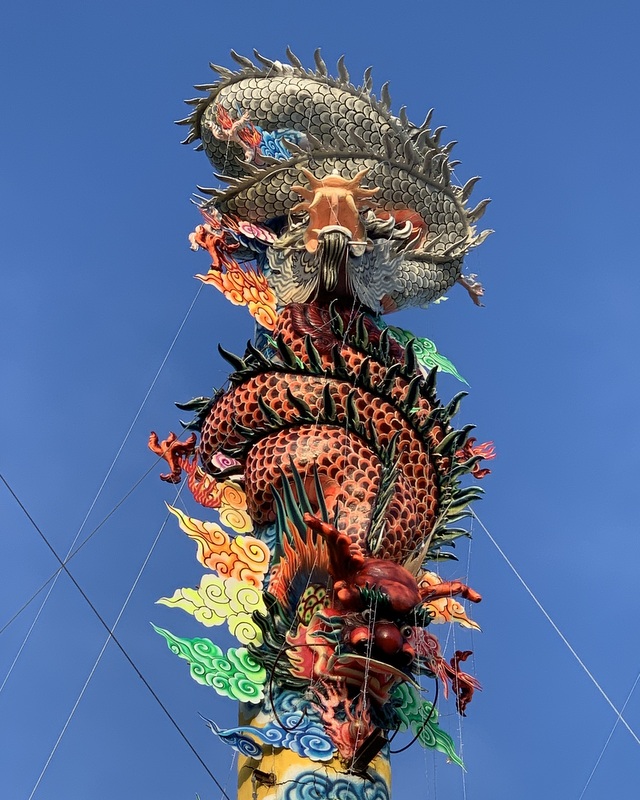
Beautifully decorated with dragons. Here are details from the three sticks
Left the top part of the center joss stick. Notice the many supporting cables in the right picture.
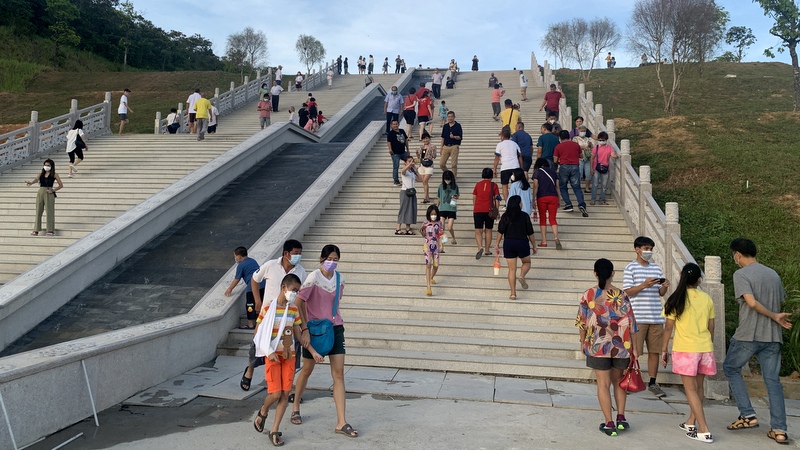
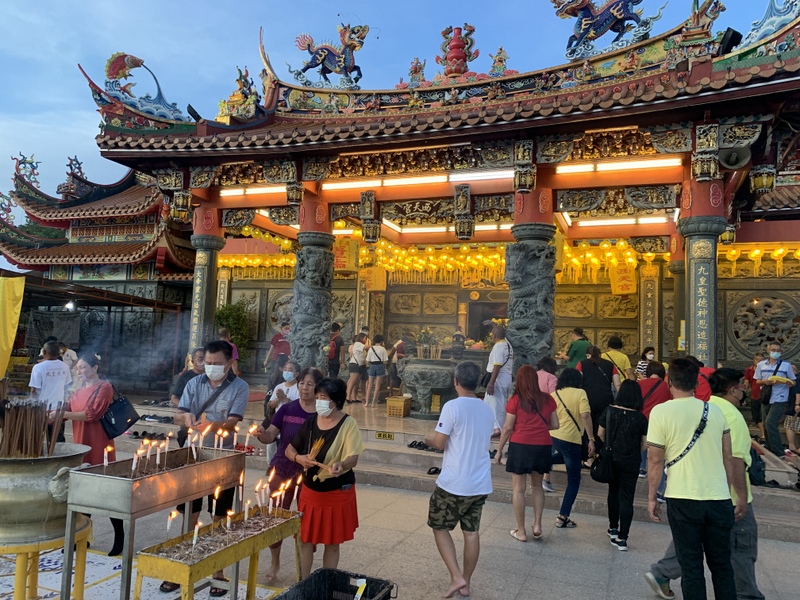
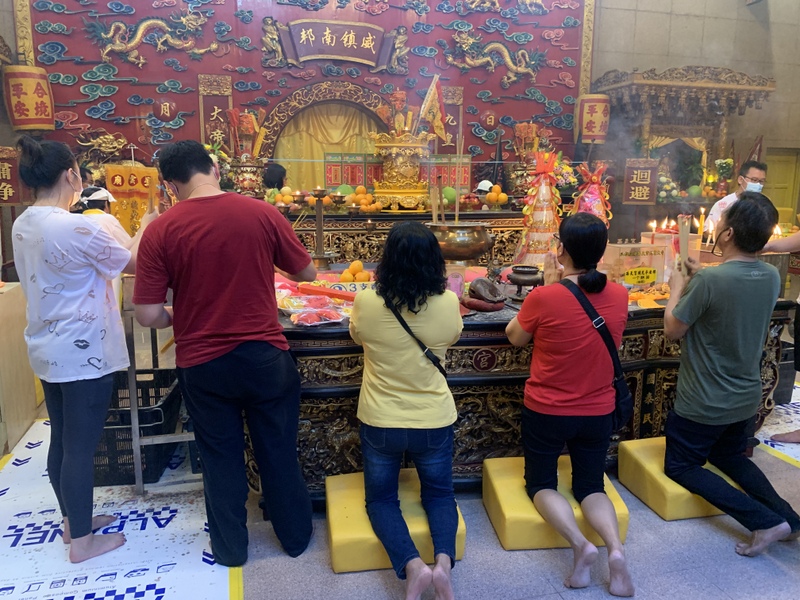
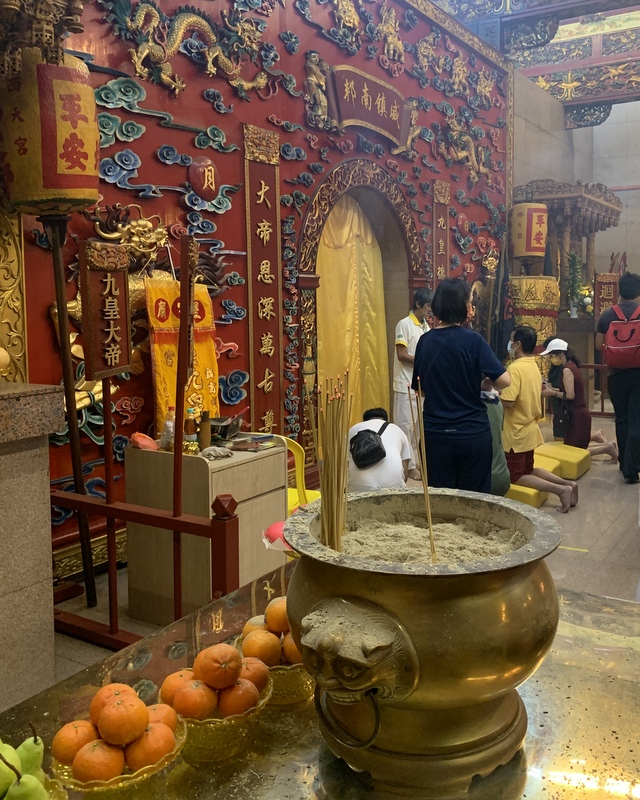
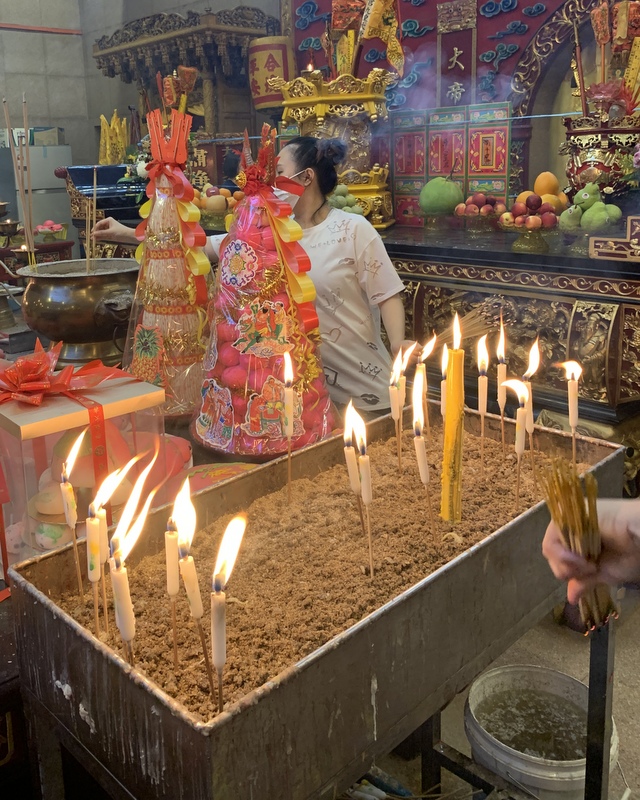
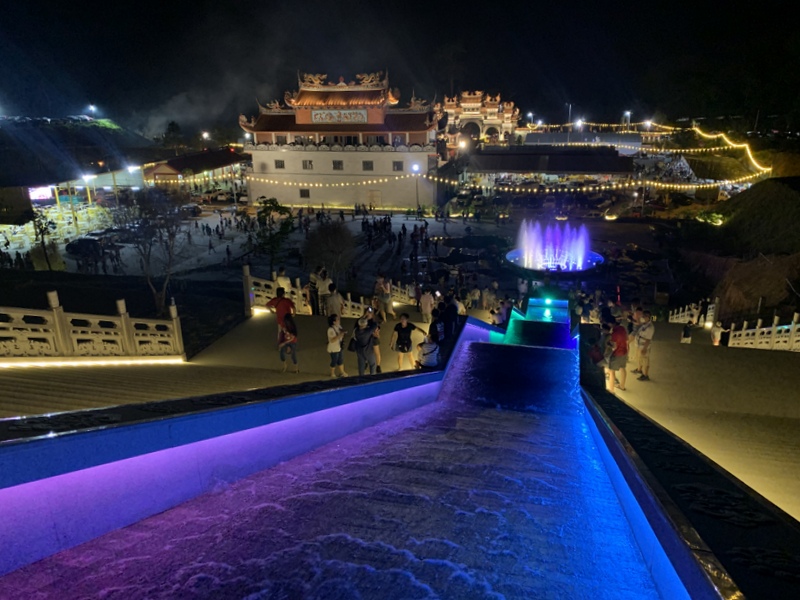
There is a lot more to see in this Si Thean Kong temple. It is a Taoist temple, dedicated to the Nine Emperor Gods. Originally it was located in the center of Kuala Pilah, but moved to this new location in 2015. Still not yet completely finished, there are plans to add a pagoda, but already quite spectacular.
The Nine Emperor Gods festival takes place in the beginning of the ninth lunar month, culminating on the ninth day. This year that will be on 4 October and that explains the huge crowd of devotees. On that day the crowd will be much larger. Usually the temple will be more quiet, see this YouTube video.
Here is a drone video of the temple complex, taken by Aric.
We walked down from the joss sticks to the main temple.
The main temple
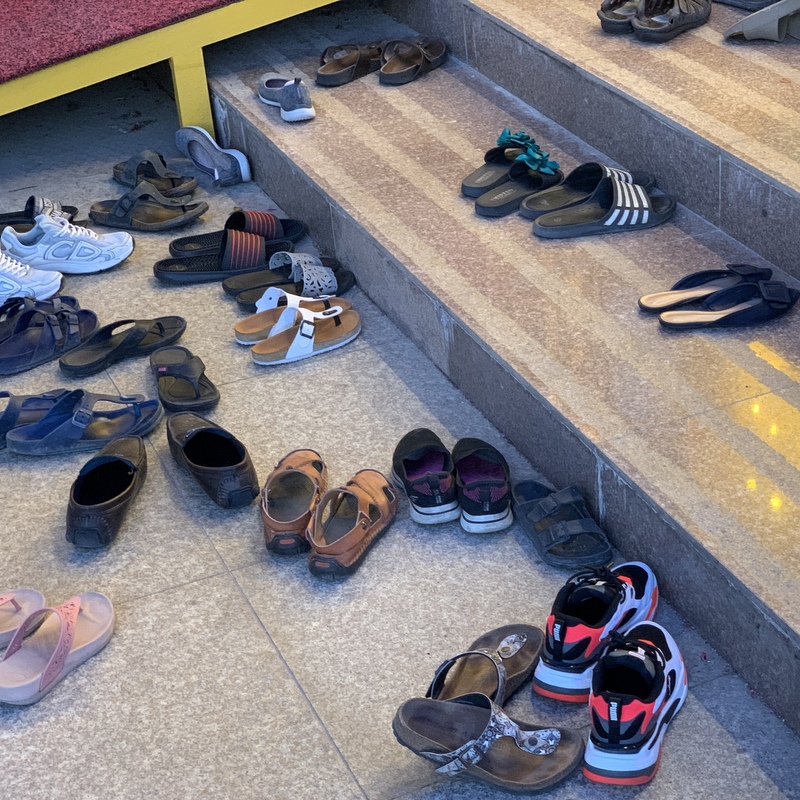
Inside the temple you have to take off your shoes. Better remember where you left them, with this crowd it might be not easy to find them back. You can give a donation for the ongoing construction.
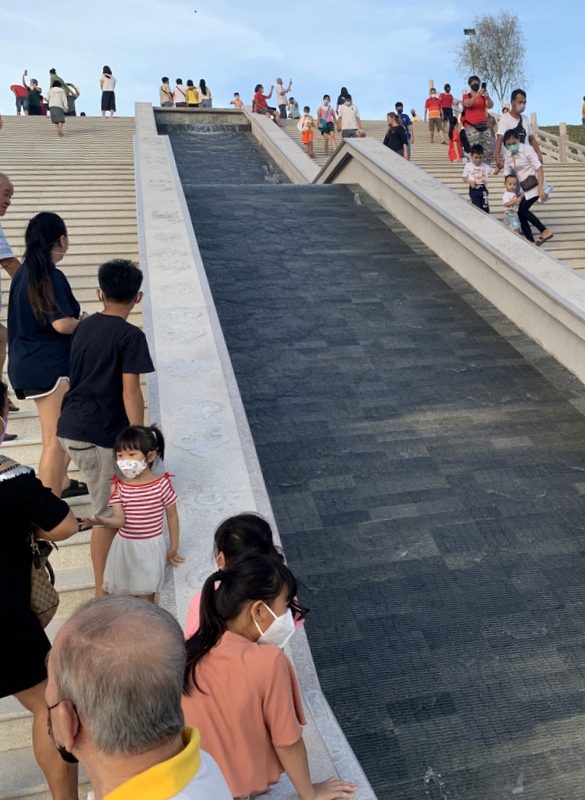
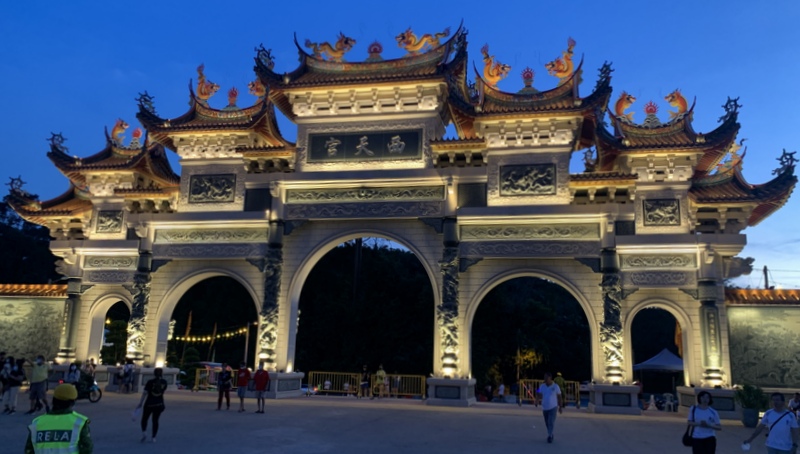
After visiting the temple we walked around. Well organised. Here a view of the monumental entrance arch. Tables and chairs for the visitors to rest.
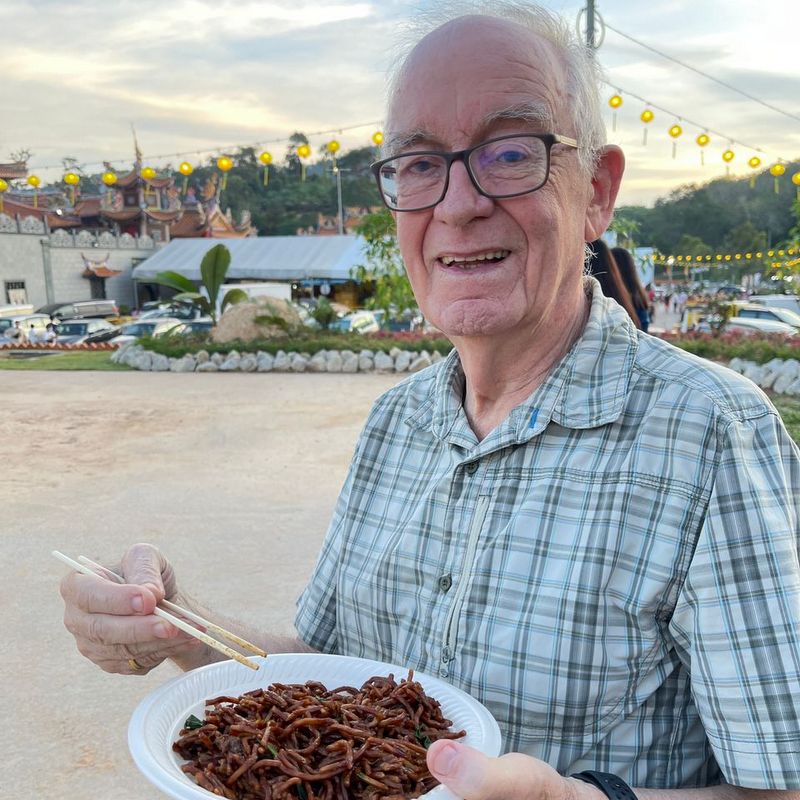
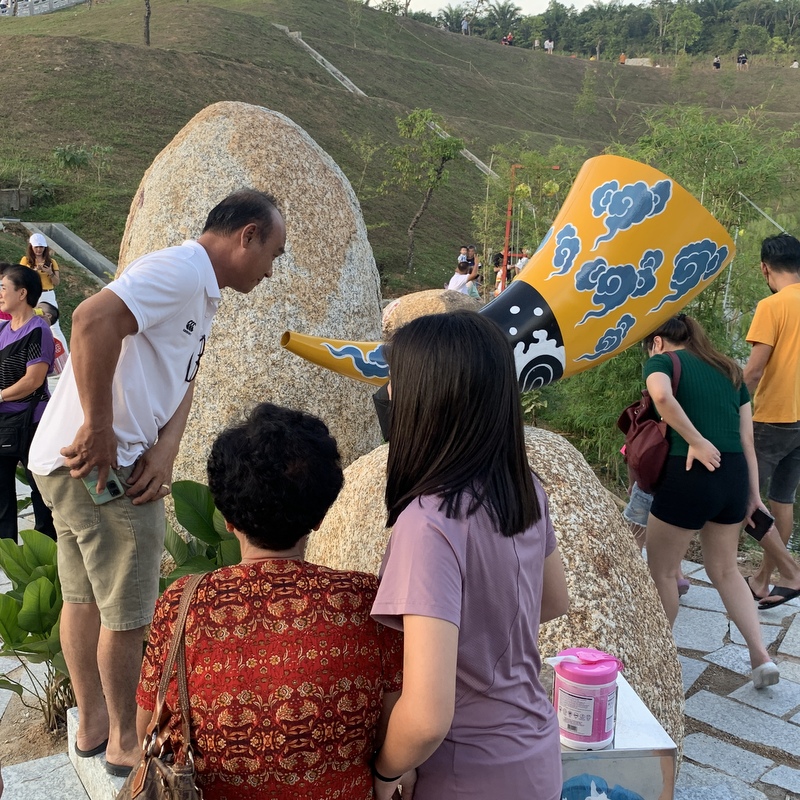
And eat! There was a hall were free food was served, I had a plate of mee goreng , while Aric was busy droning. The right picture shows a contraption, where a waterspout would rise in the air when you blew in the horn. Not related to the Nine Emperor Gods, just fun for young and old.
I took a short video of the horn blowing.
Here is the monumental stone arch, the biggest in Malaysia and already in the Malaysia book of records.
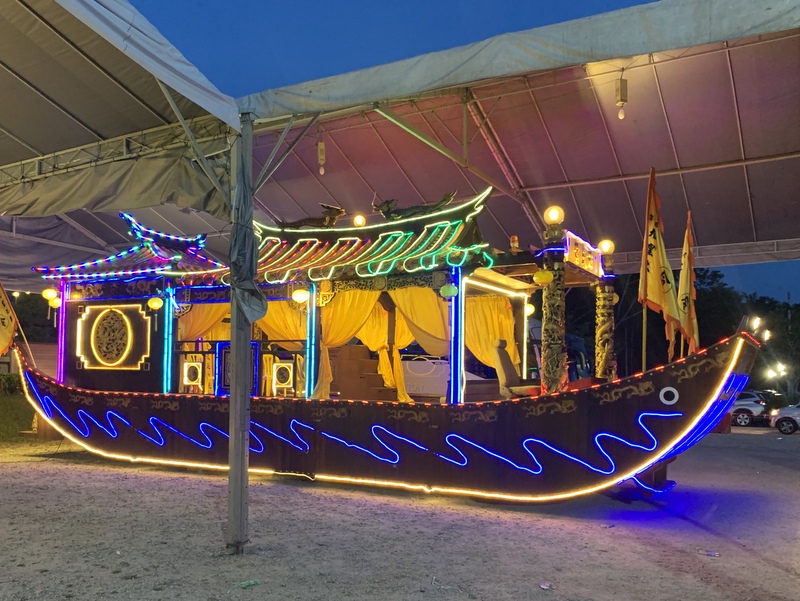
View from the roadside. At the main event on 4 October, there will be a big procession, where the “boat” in the right picture will take part.
We made another round, climbing up to the joss sticks and down again to the crowd
Aric took another video of the temple complex.
The crowd had grown a lot
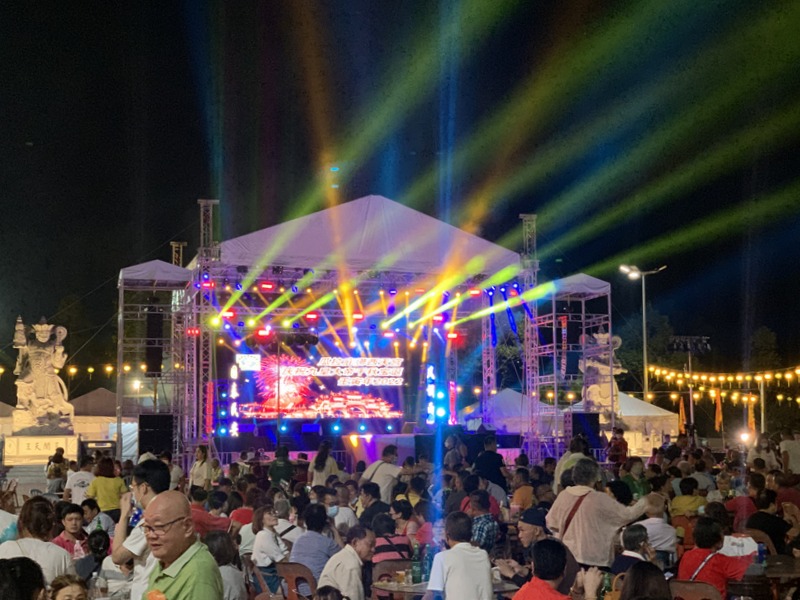
There was entertainment, left a traditional Chinese opera, right a modern light show.
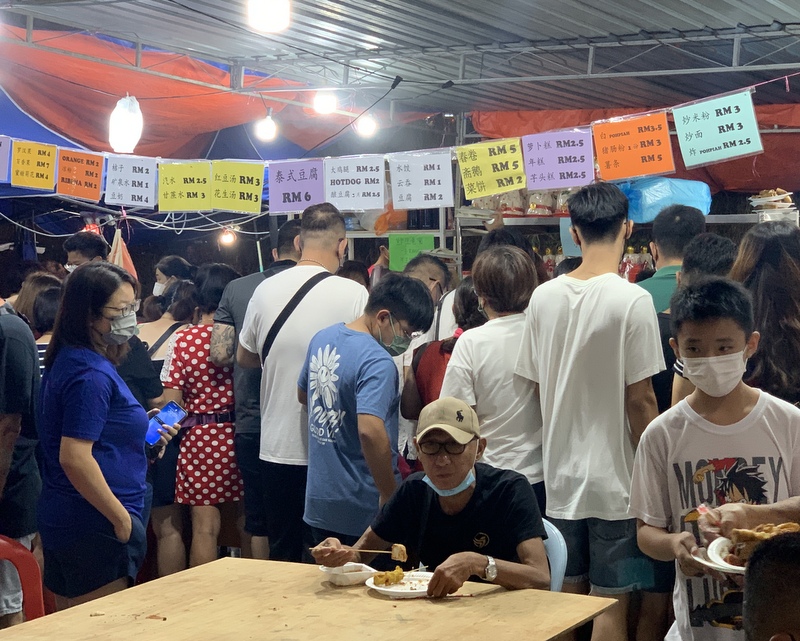
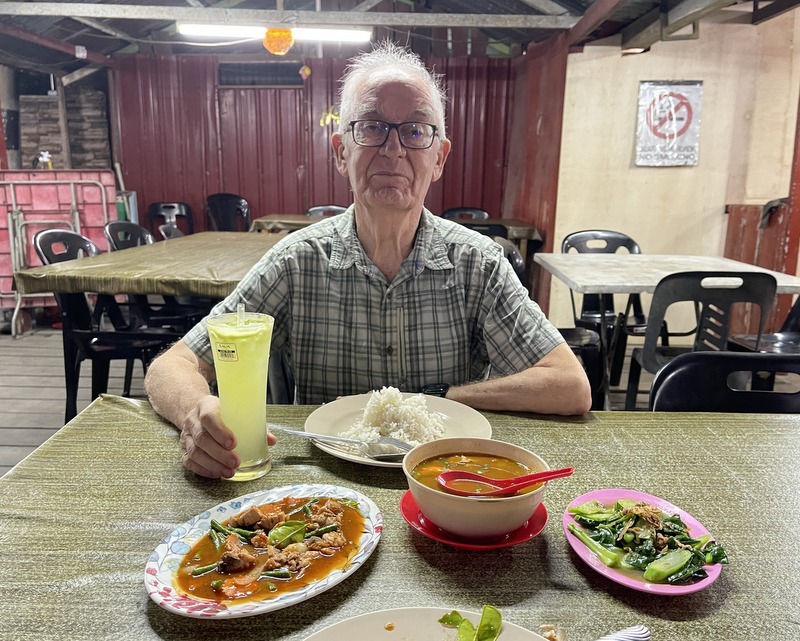
There were also many food stalls, but with very long queues, so we gave up, walked back to our car and had a late dinner at a Malay stall in Kuala Pilah.
This temple will become a major tourist attraction in Negeri Sembilan and even in Malaysia. Many of my friends are not yet aware of this place.