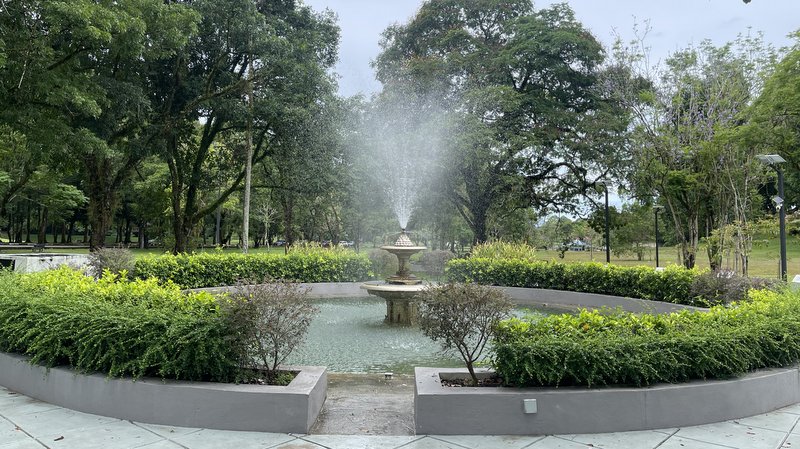
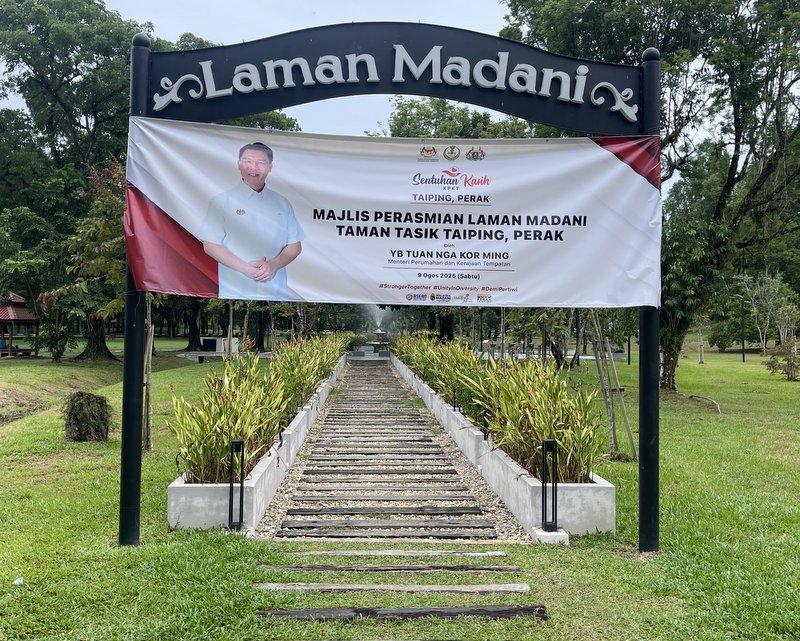
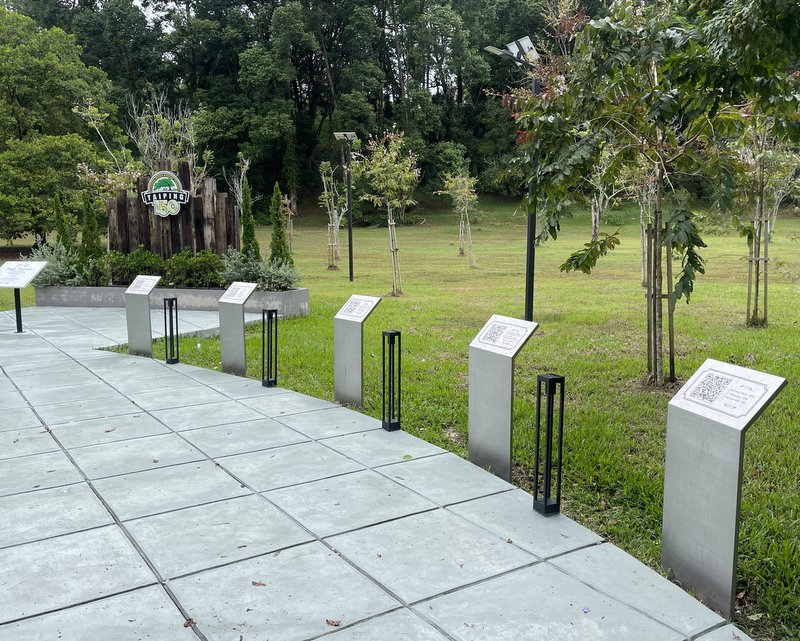
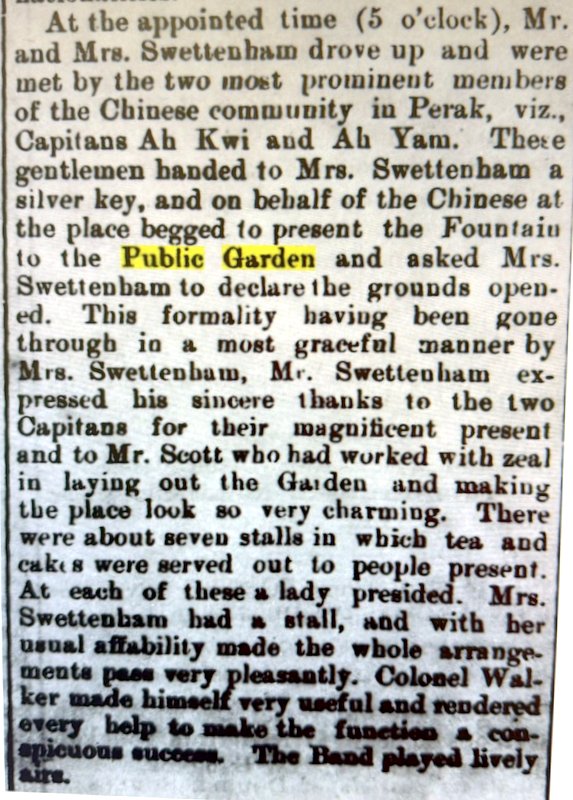
In May 2025, my friend Pek Foong invited me for a walk in the Lake Gardens, a visit to the Tun Razak Memorial, and a drink in the Royal Lake Club. It was a nice outing, resulting in a blog post: KL Lake Gardens. During that walk, I didn’t see any lake, so a few days ago I came back with my friend Paul for another walk. Here is a Google Earth screenshot, with our walk marked in green.
I took the MRT to Museum Negara, where I met Paul. I have visited the National Museum only once, decades ago. I must go again soon.
It’s a short walk, using a tunnel under a busy highway, to reach the entrance of the Lake Gardens. The official name is now Kuala Lumpur Botanical Garden.
Here is the lake. It is not a former mining pond, like the Taiping Lake Gardens; it was created in the 1880s by damming a small river. The park was officially opened in 1889, and the lake was named Sydney Lake, in honor of Lady Sydney Swettenham, a strong supporter.
The park is close to the center of Kuala Lumpur and well-maintained, although the paddleboat section was closed.
Signboards indicate the various attractions.
Trees have information boards. There were not many flowers during our visit.
–
A decorative building is a nice place to rest.
Another attractive building made of bamboo.
Peaceful and scenic.
–
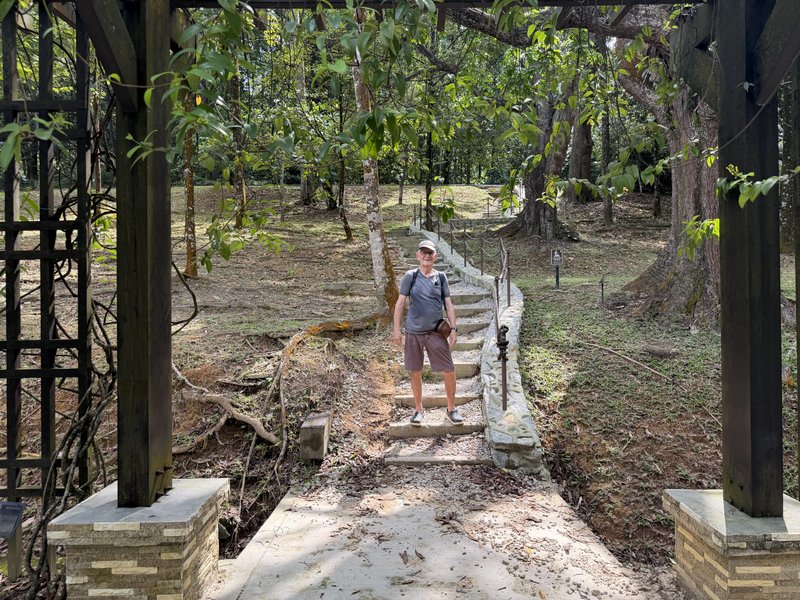
The lake is located in a valley, and stairs lead to the higher parts of the gardens.
There is a deer park.
The Tun Razak Memorial is located just outside the Botanical Garden.
It is really a beautiful garden.
Halfway, we took a rest for coffee and biscuits. An exotic visitor was interested in the crumbs. It looked like a pitta, but it is a Splendid Starling, that has escaped from the nearby Bird Park. Its habitat is East Africa. Not shy at all, a nice surprise.
Attractive bridges are very suitable for taking pictures.
Walking back, we had a good view of the Merdeka 118 skyscraper, the world’s second-tallest building.
On Tuesday, 17 February 2026, the Chinese Year of the Fire Horse started. The next day, Wednesday 18 February, was Ash Wednesday, the start of the Christian Lenten fasting. And on 19 February, in Malaysia, the fasting month of Ramadan started. A remarkable coincidence? On 19 February, a Facebook article was posted. If you have FB, you can read the article by clicking on the screenshot.
The article states that this coincidence happened the first time since 1863 and will not happen again until 2189 It is rare because three calendars are involved: the Muslim calendar, the Chinese calendar and the Christian calendar.
I am interested in calendars and have written several times about it (here and here and here), so I was interested and decided to check the statement. First, some information about the various calendars.
The Gregorian calendar
Introduced by Pope Gregorius XIII in 1582, it is the globally accepted civil calendar. It is a solar calendar, 365 days with a leap day on 29 February if the year is divisible by 4 (except for century years not divisible by 400).
The Islamic calendar+
The Islamic calendar is lunar, a lunar year equals 12 lunar months of 29 or 30 days, and is 11-12 days shorter than a solar year. So the lunar year moves forward through the seasons. After 33 years, it has made a complete cycle. All Islamic celebrations, like Hari Raya, Muharram, etc/ are movable feasts.
In 2026 the first day of Ramadan fell on Thursday, 19 February. In the table, dates for a few more years are given. The first day of Ramadan moves forward 11-12 days each year, and in 2059, 33 years later, it falls again in February.
Year
Start of Ramadan
Commnet
2026
Thursday,19 February
2027
Monday, 8 February
11 days earler
2028
Friday 28 January
11 days earlier
2029
Tuesday, 16 January
12 days earlier
…..
2059
Friday, 14 February
33 years later
The Chinese calendar
This calendar is lunisolar, to avoid the drifting through the seasons, every few years an extra lunar month is added. As a result the Chinese New Year is still a movable feast but with a limited range (the earliest date is 21 January, the latest date is 20 February).
In 2026 the Chinese New Year started on 17 February. The table shows the same years as the Ramadan table. Note that in 2026, 2027 and 2028, CNY and the start of Ramadan use the same New Moon. The 2-day difference occurs because CNY uses the astronomical New Moon, whereas in Islam, a New Moon must be SIGHTED. More in the appendix. Also note that in 2059 the start of Ramadan and CNY “coincide” again!
Year
Chinese New Year
Comment
2026
Tuesday, 17 February
2027
Saturday, 6 February
11 days earlier
2028
Wednesday 26 Janaury
11 days earlier
2029
Tuesday, 13 February
2028 was a leap year
…..
2059
Wednesday, 12 February
The Christian Calendar
The Christian calendar is often identified with the solar Gregorian calendar, but that is a bit confusing. Yes, Christmas and related events like Advent and Epiphany are celebrated on fixed dates, but Easter and related events like Lent, Pentecost, are movable feasts related to the moon cycle in a complicated way. Easter falls on the Sundayafter the first full moon on or after the Spring equinox. This leads to a window for Easter (22March-25 April) and also for the beginning of Lent, 46 days earlier, Ash Wednesday (4 February-10 March). Comparing the windows for CNY and Ash Wednesday, note that there is a partial overlap,
Here is the table for Ash Wednesday. In 2026 it fell on 18 February and again a few more years are shown. Because of the complicated procedure to determine the date for Easter, date for Ash Wednesday looks quite irregular. But note that in 2059 it falls on the same day as CNY!
Year
Ash Wednesday
Comment
2026
Wednesday, 18 February
2027
Wednesday, 10 February
8 days earlier
2028
Wednesday, 1 March
12 days later
2029
Wednesday, 14 February
15 days earlier
……
2059
Wednesday, 14 February
Combining the three calendars, we see that indeed, 2026 is special, because CNY (17 February), Ash Wednesday (18 February) and the start of Ramadan (19 February) occur within two days. According to the FB article, this is extremely rare; the next time it will happen is, according to “calendar experts”, after 163 years, in 2189. The FB message was copied many times, for example, on Instagram.
But is it true? Look at the year 2059 in the three calendar tables. n 2059, after 33 years, CNY (12 February), Ash Wednesday (12 February), and the start of Ramadan (14 February) will occur within 2 days.
The claim that the next occurrence will be in 2189 is FALSE. It will happen again in 2059.
What about 2092, another cycle of 33 years later? I checked the data, and the answer is NO. CNY falls on Thursday, 7 February, and Ramadan starts on Saturday, 9 February. But Ash Wednesday is one week later, 13 February. The “calendar experts” may be right that there is another occurrence in 2189, but they have overlooked 2059.
Appendix
The Islamic and Chinese calendars can have celebrations at the Same New Moon, but never at the same date; there is always a difference of 1 or 2 days. The reason is that both calendars define the start of a lunar month in different ways.
The astronomical New Moon is not a day, but a specific time on that day. For example, the New Moon occurred on 17 February 20:01 Malaysia time.
The Chinese calendar uses this time. there fore, 17 February was the first day of the Year of the Horse.
The Islamic calendar states that a new day starts at sunset and that a new lunar month starts when the new moon is visually sighted. But on 17 February at sunset, the new moon has not yet occurred, so the first sighting can only take place at sunset on 18 February, and the first day of Ramadan will be 19 February, two days later
It takes about 10-15 hours after the new moon for an observer to spot the first sliver of the new moon
I will illustrate this using data for an occurrence of CNY and Hari Raya. As Hari Raya is a major celebration for Muslims, as CNY is for the Chinese, a coincidence of the two is so special that it got its own name, Kongi Raya. It will happen in 2029, 2030 and 2031
Here is the table, with the times of the new moon added.
Year
New Moon
Chinese New Year
Hari Rya
2029
18:31
13 February
15 February
2030
00:07
3 February
4 February
2031
12:31
23 January
25 January
In 2029, the new moon occurs on 13 February at 18:31. Impossible to sight the moon, Hari Raya start two days later. One year later the new moon occurs at 00:07. That same eveing the new moon can be sighted, so Hari Ray starts at 4 Fevruary. In 2032, the new moon occurs at 12:31. Not enough time to sight the new moon at susnet, Hari Raya 25 January
The Hindu calendar is also lunisolar, their main festival Deepavali can also occur together with Hari Raya. This is called DeepaRaya and will happen again in 2037-2039
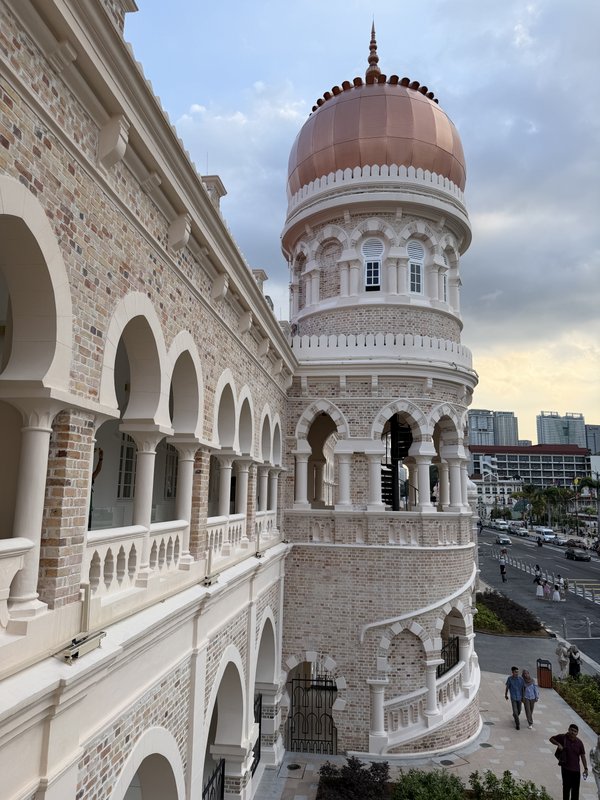
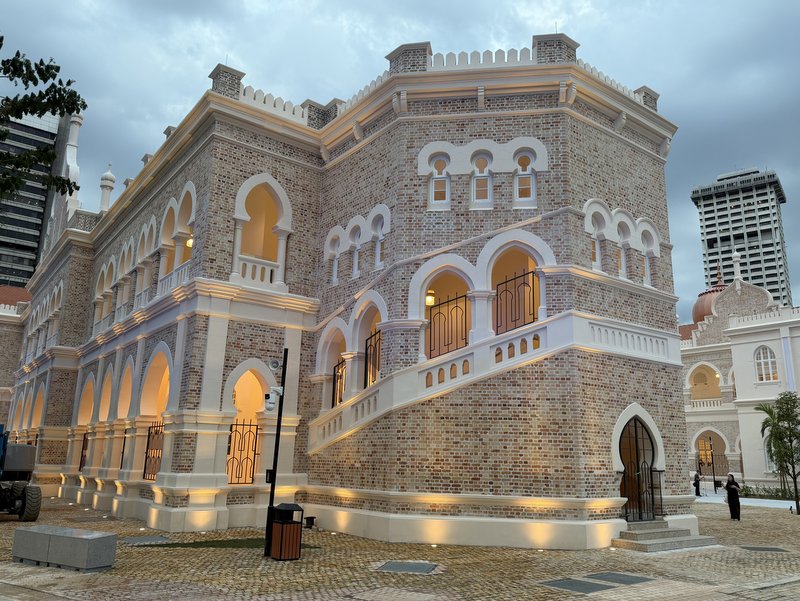
In 2017, I published a detailed report about KL Heritage. In this report, I give more information about the impressive Sultan Abdul Samad building, the former Government Offices during the colonial era. After the independence of Malaysia, the building housed the superior courts of Malaysia until they were relocated to Putrajaya in 2003. Since then we could only admire the impressive building from the outside. But last year it was refurbished, and a few weeks ago it reopened to the public.
Free access during February, so we joined the crowd to have a look inside. We parked our car under Merdeka Square and walked to the building. The facade must have been cleaned; it looked fresh and wonderful. It was already late afternoon, as we wanted to take night pictures.
We didn’t even need to register; we could just walk in. The building is large, clear ground plans are helpful for your orientation. The group floor has two galleries. We started with the Royal Selangor gallery (number 1 in the plan).
It is mostly a sales gallery. Royal Selangor, world-renowned for its pewter, has its visitor center in Setapak, and has now opened a branch here.
Beautiful stuff, very expensive.
One part of the gallery is the School of Hard Knocks (5), where workshops will be held for people who want to craft their own pewter dish.
There is also a cafe (4) where we decided to have a coffee and cake
Next, we wanted to visit the Kuala Lumpur Gallery(2), but it closed at 6 pm. This gallery about the history of KL will be more interesting, so I have to come back another time. I understand that the exhibits are basically the same as the former KL City Gallery (See my KL Heritage blog), but it will be interesting to see them in this new location
So we walked up to the first floor. Of course we took numerous pictures.
There are more restaurants in the building, on the ground plan I counted six(!). This is a real restaurant,
We could not resist the temptation to take a picture of ourselves.
There were many visitors, both locals and tourists.
At around 7 pm, the lights came on. We went back to the ground floor. This is the backside of the building, a nice, quiet courtyard.
We left the building and crossed Merdeka Square to the Selangor Club. What a fantastic view of the whole building.
–
A few more pictures.
The building deserves to become one of the top attractions of Kuala Lumpur.
Before driving back home, we took a few more night pictures of other interesting buildings in the region. Here is the Masjid Jamek, rather dwarfed by the modern background.
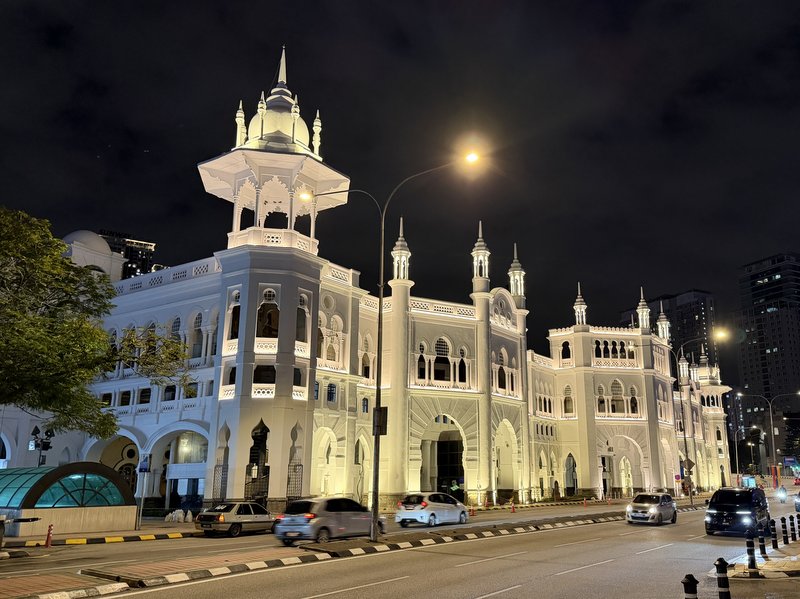
Old Railway Station and the National Mosque.
KL Tower and the Merdeka 118 skyscraper.
No idea if access will remain free after this month. For those living in Malaysia, use the opportunity. Open from 8 am until 10 pm, but galleries close at 6 pm.
Taiping, my adopted hometown, is dominated by Maxwell Hill. Now renamed Bukit Larut, it is the oldest hill resort in Peninsular Malaysia. Established in 1884, it contains several colonial bungalows, which make it an important cultural heritage site. My friend Suet Fun published a book in 2019, Beguiled on Larut Hills, in which she describes all aspects of Maxwel Hill in great detail.
This blog describes my personal experience with Maxell Hill.
My first visit to Maxwell Hill was in December 2003. I joined my friend Stephen on a trip to Taiping, his hometown, and we stayed one night in Speedy’s Rest House.
What a beautiful view of Taiping, far below in the plains. The caretaker of the bungalow was Guna. Lat-er that night, after the rain, the night view was spectacular too.
The next year, in April, I came back to Speedy’s with friends to celebrate my 60th birthday.
It was a very enjoyable celebration. Guna prepared a nice dinner. A detailed report about this trip, with many photos, can be found here.
Later that year, in December, I came back to Taiping with my friends Khong and George. Khong had aroused my interest in waterfalls, and we visited several of them. The Maxwell Hill waterfall is visible from Taiping, but we didn’t know how to reach it.
It was only several years later, in January 2007, that a friend of George showed us the trail to the waterfall. Quite impressive.
–
I visited Taiping often, as I became more and more interested in its cultural heritage, like the famous Lake Gardens. Even without visiting Maxwell Hill, it was always visible.
In July 2008, I visited a heritage site in the foothills near a mysterious bridge. An old abandoned swimming pool was constructed by the New Club in the first quarter of the last century. It was fed by water from the Maxwell Hill waterfall.
There is another waterfall on the slopes of Maxwell Hill. I visited it in January 2009 with George and Richard. I named it Kamunting Fall, although it is actually a waterfall in the Ranting River. The trailhead is the same as for the Maxwell Hill fall, but access is tougher.
A few months later, George and I used the jeep service to go up the hill. Not to stay overnight, just to walk around in the fresh air and have a look at the bungalows around the jeep station, colloquially called the 6th Mile.
You could call it a small village, with several bungalows and a cafeteria..
Speedy’s bungalow is a bit further uphill. We walked there and found that the bungalow was closed and Guna’s living quarters were vacant. Later, we were told that his lease had not been renewed. Sad.
We met Guna at the Sri Maha Kaaliamman Temple near the “village” where he was working now. Near the temple, they were building a huge complex, meant to become a hostel? Until present, it has never been used.
My next visit to Maxwell Hill was in May 2012. A birding trip with the “extended” Gang of Four. We- had booked accommodation in the Beringin bungalow/.
A detailed report with pictures of birds and flowers can be found here. We walked up to Speedy’s bungalow and noticed that it had been transformed into a Biodiversity Center.
There were signboards in the garden, and we could enter the bungalow, but there was nobody.
We also walked to the Indian temple, where we met Guna, who guided us around.-
I have a fascination for ruined heritage, so I came back several times to the New Club Swimming Pool. My friend Khong shared a picture he took of the access path, taken in 199. I did the same in November 2013 and February 2016. The difference in water flow might be seasonal.-
199920132016
Here are four photos of the main basin. In 2003 with George, 2016 with Paul, Fahmi and Rani, 2019 with Halim, and in 2025 with Yeap.
In January 2017 I revisited the Kamunting waterfall with Rani, Paul and Fahmi. On our way back, we also+ had a look at the Maxwell Hill fall.
Close to Speedy’s, there is another bungalow, called the Nest. Owned by the Methodist Church, I had never visited it. That changed when the Church leased the bungalow to my friend Suet Fun and Peter, her husband. They transformed the bungalow into a beautiful home for themselves, with accommodation for paying guests. In May 2017, I visited the Nest for the first time, with Aric and Hong, an Ipoh friend. We had booked a jeep that brought us to Speedy’s, from where it was a short walk to the Nest.
A hearty welcome by Suet Fun and Peter.
I was very impressed by the bungalow. I took many pictures, and Aric had brought his drone. I have written a separate blog, The Nest, Heaven on Earth, with pictures of all my visits to the Nest.-
In this report, more about what we did during our stay. First, we had a look at Speedy’s, which you pass, walking from the Nest to the main road. The Biodiversity Center, which we visited in 2012, was no longer in use, unlocked, a failed project.
Between Speedy’s and the Nest, there existed another bungalow, named the Hugh Low bungalow. Hong and I managed to find the remains of it. A real adventure, as there was no trail, I have never seen a picture how the bungalow originally looked like.
The next day, another adventure. A heritage friend of mine, Wan Amril, knows a lot about Maxwell Hill. He told me that there was a monument for J.W.W Birch, the first British resident of Perak, near the Telecom towers at the end of the road, and he was willing to guide us there. It was a nice walk, and near the end of the road, he showed us a vague trail that led in a few hundred meters to the monument.
The inscription says that T.W.W Birch was the first Englishman to climb the mountain (Gunung Hijau) in 1875. The T must be a mistake, because J.W.W Birch indeed climbed the mountain. I wrote a post about his “expedition”, click here.
After visiting the monument- (many leeches!), we walked to the end of the road, to the Cottage, the oldest bungalow on Maxwell Hill. Unfortunately not accessible as it is occupied by the Telecom people.
Wan Amril drove us back to Taiping after a stop at the Cafeteria, managed by him. There is a small waterfall beside the road, where the jeep service doesn’t stop.
+
It was a very rewarding trip. I wrote a detailed report about it, Maxwell Hill
When I visited Taiping later in 2017, I joined Wan Amril on a half-day trip to the 6th mile village, where he had work to do at his cafeteria. I had lunch there and walked around.
Some of the bungalows looked good; others were damaged by landslides. A mixture of beauty and decay, not uncommon in Taiping town as well.
More decay at Speedy’s, the Biodiversity Center was abandoned and desolate.
Although I knew that Suet Fun and Peter were not in the Nest, I had a look. Good that there was a locked gate.
I was fascinated by the atmosphere of the Nest and came back, on my own, April 2018, to relax after busy days in Taiping-
I walked up the road to visit the Birch monument and noticed that there was now a signboard. Actually, it is a bit more than 50 meters!
Speedy’s still the same.
Three months later, I visited the Nest again. Enjoying the hospitality and the food.
Speedy’s apparently had a new destination, a basic hostel?
In November, I came back with Aric. Paul and Fahmi joined us this time.
In the evening it can be a bit chilly.
A few bright lights outside the bungalow attract hordes of moths.
The Nest from the air, drone photo by Aric. Taiping down in the plains.
I was expecting to revisit the Nest more often. But that was not to be. In 2019, Suet Fun and Peter closed the Nest because she was working on her book. At the end of 2019, a major storm caused so much damage to the access road that it had to be closed for repairs. The road reopened in April last year.
Here is a Google Earth screenshot of the winding road with the locations mentioned in this post. The road ends at the Cottage, but the top of the mountain, climbed by Birch, is still a hiking trail.
Of course, I am very curious about the current situation of the bungalows on Maxwell Hill after six years of forced abandonment. Sad news is that the Church took back the Nest a few years ago, Suet Fun and Peter had to vacate their Heaven on Earth. It seems that the bungalow is now being “renovated. How will Speedy’s look like now? Three bungalows have been reopened. What about the other ones?
I was thinking about using the jeep service for a day trip when I am back in Taiping. Going up in the morning to the 6th mile, walk around, having lunch in the cafeteria, and back in the afternoon.
But I understand that at the moment the jeep service is only available for people who have booked accommodation in one of the bungalows, not for day trippers. Why?
To be honest. I have a suspicion that the authorities have a hidden agenda. To revive the idea of a cable car up the hill. Similar to Penang Hill.
When I celebrated my 60th birthday in Speedy’s bungalow on Maxwell Hill, I knew that there was another bungalow, a few hundred meters away, called the Nest. Apparently, it was owned by the Methodist Church.
More than ten years later, the Church leased the Nest to Suet Fun, a friend of mine. She and Peter, her husband, transformed the bungalow into a colonial-style home. A few rooms were available for paying guests. I visited them for the first time in May 2017 and was so enamored of the peaceful atmosphere that I came back three times in the following year. A Heaven on Earth. I
I had hoped to visit the Nest more often, but unfortunately, that was not to be. In 2019, Suet Fun -closed the Nest for the time being, because she was working on a new book and needed to be in Taiping. Later that year, a major landslide at Maxwell Hill caused so much damage to the access road that the authorities had to close it. After about six years of repair, the road was reopened in April 2025. But in the meantime, the Church had taken back the Nest, so Suet Fun and Peter had to vacate the bungalow. At the moment the Nets is being renovated.
During my four visits to this Heaven on Earth, I took many pictures of the Nest. Here is a selection.
First, an aerial view of the Nest, surrounded by pristine forest, on the slopes of Maxwell Hill.
The drone picture was taken by Aric during my first stay in May 2017. He also took a drone video. For what we did during our stay, see my report on Maxwell Hill (still under construction). In this post I just want to evoke the atmosphere of the Nest and show the hospitality of our hosts.
The moving clouds can change the atmosphere within minutes.
Suet Fun is a creative cook.
The next morning
Lunch and dinner on the second day.
My second visit was in April 2018.
The path leading from Speedy’s bungalow to the Nest. As if you are going back in time.
Three months later, in July 2018, I returned to the Nest, where I stayed two nights
View from the Nest of Gunung Bubu, about 60 km away. And the path leading back to “civilisation”.`
—
My last visit was in December 2018. This time I was joined by Aric, Paul and Fahmi/ We stayed two nights. The first night, we were the only guests.
it can get a bit chilly in the evening.
The next day, a group of Suet Fun’s friends arrived. No problem for her to prepare dinner for a large group!
During this visit, Aric recorded another drone video. Here is a screenshot showing the Nest with Taiping far down in the plains. Click on the picture to watch the video/.
Four years ago, on 23 November 2021, I published a post titled “The DART Mission,” about NASA’s attempt to crash a spacecraft into a small asteroid in an effort to divert its orbit. The launch would take place the next day, and the crash was planned on 23 September 2022. So I ended the post with: My next update about DART will probably be in October next year.
Here is finally that update ;-). Let me start with an image from that blog. Didymos is an asteroid, a Near Earth Object (NEO) and even a Potentially Hazardous Asteroid (PHA), although there is no risk of collision with Earth in the next hundred years. A tiny moonlet Dimorphos, orbits the asteroid and was the target for the mission.
After a successful launch on 24 November 2021, DART arrived at the asteroid on 26 September 2022, about 11 million km away from Earth. How to direct DART to hit the tiny moonlet (about 150 m in diameter)? DART must do that itself with the help of its built-in camera DRACO. Four hours before reaching Dimorphos, still about 90.000 km away, DART became autonomous, using DRACO for navigation. Here is a photo taken by DRACO, 2.5 minutes before impact, the last picture where Didymos is still fully visible.
NASA collected all the pictures taken by DRACO and combined them into a time-lapse video. It shows the final 5.5 minutes, ten times faster, except for the last 6 images, which are shown in real time, every second. The “shakiness: in the beginning is a result of minor course corrections. The last image could only be transmitted partly because of the crash. A fascinating video.
The collision of DART and Dimorphos was a frontal one, so it reduced the speed of the moonlet a little but. This would cause Dimorphos to move a bit closer to Didymos with a slightly shorter period (see the first image above). Before the impact, one orbit of Dimorphos took about 12 hours. I wrote in my 2021 blog that the impact was expected to shorten the period by about 10 minutes. So it was a surprise that after the crash, the period of Dimorphos became 34 minutes shorter! In the appendix I explain how they could measure this, from Earth!
The explanation for the large reduction, was that the speed reduction of Dimorphos was not only caused by the crash of DART, but also, and even more, by the material blown away from the moonlet, causing an additional recoil.
How do we know that there was a lot of debris ejected by the crash? Because there was an eyewitness!
DART had on board a tiny spa craft, called LICIACub, which it released two weeks before reaching Dimorphos. This LICIACub had two cameras on board to take pictures of the crash and its aftermath. Here are two of the pictures. The left picture was taken 156 s after the impact, the right one after 175 s. The crash caused a lot of moonlet material to be ejected, probably leaving a crater in Dimorphos.
DART was very successful . It demonstrated that impacting asteroid could divert its course, important if ever an asteroid would be on a collision course with Earth.
n. October 2019 I published a blog Will an asteroid hit Earth?, after frightening reports of an impending asteroid collision with Earth appeared in the tabloid press. in that post I explained that the reports were sensational and not true. But catastrophic collisions have occurred in the past and may happen again in the future, so Earth must be prepared. NASA has its Planetary Defense program and so do other Space Agencies.,
In the context of this Planetary Defense, an ambitious collaboration started around 2013, between NASA and ESA. the Asteroid Impact and Deflection Assessment (AIDA) project. Two missions, DART by NASA and AIM (Asteroid Impact Mission) by ESA. AIM was to become the eyewitness, launched earlier than DART and going into orbit around Didymos, from where it could observe the impact and its aftermath.
The AIDD mission is shown below. AIM (lower right) is already in orbit around Didymos and has released two CubeSats and a Mascot lander which is hovering at the moonlet, here still called Didy-moon.
A fascinating project. But already a few years later, in 2016, ESA had to cancel the AIM mission, because Germany was unable/unwilling to contribute its portion of the funding. NASA decided to proceed with DART anyway and managed to include inro the spacecraft a CubeSat, which could act as an eyewitness. In my blog about DART, I wrote: As an European, I feel rather ashamed.
Then, in 2018, ESA came up with an alternative for AIM, called Hera. Basically, with the same mission, only reaching the asteroid in 2026, four years after the impact of DART. Here is an artist’s impression. It shows Dimorphos, with a very pronounced crater, the result of the crash. Two CubeSats are shown. No lander, but one if the CubeSats may land on the moonlet at the end of the mission.
Hera was successfully launched on 7 October 2024 and is now on its way to Didymos, where it will arrive in late 2026. In 2022 The atseroid was 11 million km away from Earth, but Hera has to travel nuch farther, abou 190 miilion km. In the video you can follow the trajectory of Hera. On12 March 2025 the spacecraft has used a gravity assist from Mars to get the right course to Didymos. In the vidoe Hera is the orange dot and Didymos the red one.
During the flyby Hera took fascinating pictures of Mars and its small moon Deinos.
When Hera arrives at Didymos, it will go into orbit around the binary asteroid. Spacecraft has landed on asteroids and crashed into them, but never gone into orbit. It needs careful navigation, much of it autonomous. Hera will study the crater formed by the impact of DART and investigate the properties of Didimos and Dimorphos. A fuill programme for the planned 6 months of the mission.
Appendix
You may wonder how astronomers discovered that Didymos had a companion, the tiny moonlet Dimorphos. Even with large telescopes, the asteroid shows as a tiny speck of (reflected) sunlight. In 2003 scientists noticed that the brightness of the speck of light varied periodically, showing tiny dips. They concluded that there had to be a companion transiting the asteroid, passing in front and at the back! They could measure the period to be 11 hours and 55 minutes, before the impact, and 34 minutes shorter after the impact.+
This image shows the effect, in an exaggerated way. The big dips are when Dimorphos passes behind the asteroid, the smaller ones when it transits before the ateroid, blocking a bit of its light.
The actual effect is so small that the scientists need advanced techniques to filter the data.
When Aric suggested to go on an overnight trip to Kulai, I didn’t even know the location of that town. Actually, it is in Johore, near Johor Bharu, a 4-5 hour drive from where we live! He said that we would visit the Putuo Village, which features an interesting Chinese temple.
It is not really a village, located in a bamboo forest, quite far from Kulai town. There was a cafe where we had coffee and some snacks.
The temple is next to the cafe.
To enter the temple, we had to cross a bridge over a canal, decorated with lanterns in rainbow colors.
There are two guardians at the entrance, one male and one female. See if you can spot the difference.
A big surprise for me. A huge dragon made of bamboo hung from the ceiling in the entrance hall. No surprise for Aric, as this was why he wanted to visit the temple in the first place, his zodiac sign being a dragon.
Later, I read on the Internet that this work of art was only placed here during the CNY 2024, a Year of the Dragon. Made by an Indonesian craftsman who worked on it for six months. An amazing creation.
Entering the main hall, there were more surprises. The temple is dedicated to Guan Yin, the goddess of compassion in Mahayana Buddhism, but here she is shown as the female manifestation of the bodhisattva Avalokiteśvara. The other surprise was the bamboo architecture, which reminded me of Gothic cathedrals in Europe. Fascinating.
The beautiful statue, with eighteen arms, is the largest in Malaysia. At the back of the hall, there is another statue with even more arms.
`
We bought a candle, and I offered it to the goddess. Out of respect, although I am not a Buddhist.
In the court, there was a wishing tree. You have to throw the red ribbon up and hope that it will get caught in one of the branches.
–
We bought one, and Aric managed to get it stuck, after several tries.
It was a pleasure to walk around and enjoy the serene atmosphere. Everywhere colorful rainbow flags. There was also a gallery with prayer wheels.
We found a traditional statue of Guan- Yin. Aric is bathing the (baby) Buddha, a traditional ritual during Wesak, the Buddha’s birthday.
A separate shrine for the God of Wealth, -important for Chinese devotees. The dragon looks fierce and unfriendly.
After spending quite some time in the temple, we went to the second attraction of Putuo Village, the Purple Bamboo Valley. In a picturesque bamboo forest, several attractions have been constructed, often utilizing bamboo, making them perfect for taking pictures. We paid a small entrance fee,
Sun and Moon in the bamboo forest.
Very attractive and peaceful.
Concrete steps allow you to climb several attractions. The snake statue is probably a new addition, because this year is the Year of the Snake. We visited the valley on a weekday, and there were not many visitors. Of course, we took many pictures.
+
The forest also has some shrines. The decoration is about the Mid-Autumn festival and may be temporary.
The temple is only a few hundred meters away and connected via a walkway, decorated with rainbow flags.
After spending many hours in the Putuo Village, we were a bit dehydrated. Before going to our hotel in Kulai, we went to a cafe for an ABD and a rojak
Our hotel was in a new part of the town, a very small room, but clean.
Using the WIFI in our hotel, I searched for more information about the Putuo Village. It began around 2005 as a small Buddhist site dedicated to Guan Yin. Around 2015, a major renovation started, using local bamboo. This renovation is continuing. The name Putuo comes from Mount Putuo, a sacred mountain in China, the “residence” of Guan Yin. Many temples there, and also a famous Purple Bamboo Forest.
We decided to visit the temple again the next morning, after breakfast in Kulai.
We were curious about the bamboo architecture and about how the dragon was made from bamboo.
Here are two details of the dragon. The whole creature has been “woven” from bamboo! Absolutely amazing.
About the architecture, it looks like the roof of the temple is supported by bamboo. But when you look carefully, you will see that behind the bamboo there is a metal structure. And the fanlike “pillars” may have been filled with cement, for strength.
We found a scale model of the temple in the entrance hall. Aric managed to take a picture inside this model.
–
In a Chinese temple, you will often find divination tools to gain insight, guidance, or answers about the future. This Mahayana Buddhist temple is no exception. On a table, we found two examples, Poe blocks and Chinese Fortune sticks. The Poe blocks have a flat and a curved side. When you throw a pair on the floor, while making a wish, it matters how they fall, flat side up or curved side up. One flat, the other one curved, is positive. The fortune sticks are numbered, you shake the container until one stick falls out. Then you read the message.
Another interesting shrine is the Datok Kong shrine in the temple grounds.
We walked around the temple to admire the architecture. Notice the Datok Kong shrine, next to the temple. Those shrines, dedicated to a local deity, were built before the construction of the main temple started.
After this second visit, we left a bit reluctantly for the long drive back home. Altogether, we drove more than 700 km in two days, but it was worth the effort.
Besides eight planets, our solar system has a huge number of smaller astronomical bodies, mainly asteroids, but also comets and dwarf planets. They are collectively called Minor Planets, and data about their properties are collected by the Minor Planet Center in a database. At the time of writing this blog, the monumental database contains 1,478,907 objects, with new discoveries added daily. Most objects are asteroids in the main belt between Mars and Jupiter, but there is an important subcategory, the Near-Earth Objects (NEO), that come close to Earth. Their number in the MPC database is now 40,146, also daily increasing. When asteroids in this category have orbits that cross the orbit of Earth, and are large enough to cause substantial damage in case of a collision, they are called Potentially Hazardous Asteroids (PHA). At the moment, their number is ~2500, with an estimated ~2000 not yet discovered.
This beautiful image, published by NASA in 2013, show the orbits of the ~1400 PHA’s, known at that time.
On 19 June 2004, the Pitt Peak National Observatory discovered a “new” asteroid. It got a provisional designation 2004MN4 in the MPC database. In a recent blog, I explained the coding used by MPC. The M stands for the 2nd half of June, the N for the number 13, and the 4 means 4×25. This asteroid was the 13 + 4 x 25 = 113th asteroid, discovered in the second half of June 2004.
But 2004MN4 was not an ordinary asteroid. After its orbit was calculated, it became clear that it was a NEO and even a PHA, with a small probability (2.7%) that it would hit Earth on 13 April 2029. More accurate calculations of its orbit showed that it would not hit Earth, although it would come very close, and there remained a possibility that it might hit Earth exactly 7 years later, on 13 April 2036.’ The asteroid got a permanent number in the MPC database (99942) and was given the name Apophis, the Egyptian god of the underworld, the enemy of the sun god Ra.
The possibility of a hit in 2036 remained a matter of concern, and in December 2009 I read in the Guardian about a Russian proposal to send a spacecraft to Apophis and modify its course away from Earth. The newspaper had this impressive artist’s impression of what could happen if Apophis were to hit Earth. Click on the image for a link to the Guardian article.
This was the first time I read about Apophis, and I was curious to know more. I had just started blogging, and in January 2010 I published my first post: Will the Earth be hit by Apophis in 2036? I got a few comments from readers and published a second post a few weeks later: Again Apophis, with more details and an explanation why in 2036 it would be again on 13 April.
In the following years, accurate calculations of Apophis’ orbit showed that also in 2036 the asteroid would not hit Earth, not even in the next 100 years. Actually, none of the known PHA’s will hit Earth in the next century!
But on 13 April 2029, less than 4 years from now, Apophis will pass Earth within about 30,000 km. That is closer than the orbits of the geostationary satellites. An asteroid crossing our own backyard, what a unique opportunity!
In July 2024, the European Space Agency (ESA) proposed a mission to Apophis. It got the name Ramses (Rapid Apophis Mission for Space Safety), to be launched between mid April and mid May 2028 and to arrive at Apophis in February 2029 . It would then measure properties of Apophis before, during and after the flyby. It would also deploy two so-called CubeSats, miniature spacecrafts. One of them might try to land on Apophis. Here is an artist’s impression of RAMSES, the two CubeSats and Apophis, about 30,000 km above the surface of Earth.
Preparations for the mission started in July 2024 with partial funding by ESA. In August 2025 JAXA, the Japanese Space Agency, decided to collaborate with ESA and received funding from the Japanese government. RAMSES will be launched on one of their rockets.
Would RAMSES receive full funding by the European Union? Those decisions are made by the ESA Council meeting at Ministerial level, this year held in Bremen, 27 November. The result:
Three missions have been approved. So It means green light for RAMSES, which now has to be built on a very tight schedule, within two and a half years! But it makes sense, because RAMSES is part of ESA’s Planetary Defense System. Apophis is not dangerous, but another asteroid might be in the future, and inthat case fast action is critical. It explains the “Rapid” in the name of the mission.
This will be the first post about RAMSES, just to celebrate that it has been funded.
My fourth visit to Taping this year! The main reason was the 9 Emperor Gods Festival. But it so happened that my friend Lay Chun celebrated her birthday, and she invited me to her birthday dinner. On Monday, 27 October, I took the MRT and ETS to Taiping. The train was fully booked. And freezing cold.
From the station I took a Grab to Hotel Furama; I always have the same room; it feels like my second home.
I went out for my lunch and walked to the Peace Hotel, where I had my Char Kway Teow. After Lay Chun introduced me to this stall, I became a regular visitor.
A few days earlier, there had been heavy rain with flooding and evacuations in several regions around Taiping, but now the weather was splendid, so I decided to walk around a bit. One of the reasons I love Taiping is the mixture of beauty and decay. Here are two examples. The beautiful Peranakan house on Jalan Stesen and a ruin, which also has its charm..
I passed the former Perak Railway Headquarters (later the PWD department), which was recently destroyed by fire. The third fire in a heritage-related, abandoned building in the last three years. Very suspicious, in my opinion. More about the “Shame of Taiping” later in this post.
PWD building 2025Rest House 2023Majestic Cinema 2025
Before returning to my hotel, I relaxed for a while at the Lake Gardens.
One month ago, Siang Malam reopened after the rebuilding. I was interested to have a look and when I mentioned it to my friends, they liked to join. Pleasant atmosphere, quite a big crowd. I had Wantan Mee, not bed.
The 9 Emperor Gods Festival is held during the first 9 days of the ninth lunar month. The main procession is on day 8, and the firewalking is on the final night. In 2019, I watched the procession for the first time. Click here for a report. I found it so spectacular that I came back in 2023 (report here), so this was my third time. Again, I was the guest of Ng Teng Hin and Bok Kin, in the townhouse of Ng Boo Bee, Teng Hin’s ancestor..
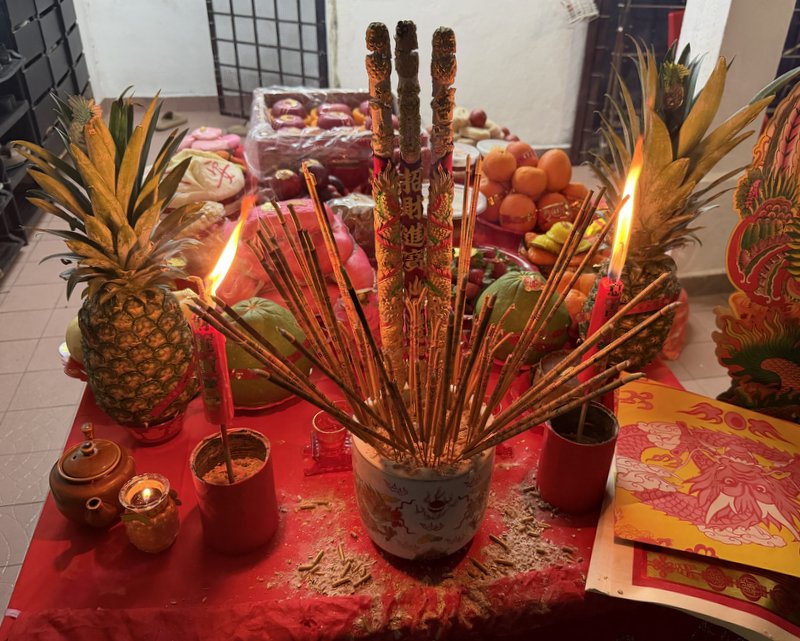
The Ng family always prepares an offering table. When the procession passes the house, they stop for a while and perform rituals.
Here are two short videos about the procession..
A few more pictures. The piercings were less extreme than in 2019 and 2023 but still fascinating. Mostly tongue and cheek piercings
After the floats and devotees had passed the house, I walked slowly back, again encountering the procession. Here, a float is passing the clock tower. The other picture shows Kavadi carriers taking a rest. The Hindu Navaratri festival takes place in the same period as the 9 Emperor Gods festival, and the procession has devotees from both religions.
Devotees are always supported by helpers, who carry a stool if they need to rest.
The floats can be large and are often impressive.
Later that evening, I was picked up from Furama by my friend Goh for the birthday dinner. Lay Chun had invited 17 guests and booked two tables. A delicious mix of Chinese dishes, the picture shows six of the eight courses
At the end of the dinner, of course, there was the traditional birthday cake.
The next morning, I had breakfast with Yeap and his wife. Indian food/
I was interested to (re)visit the old New Club Swimming Pool and asked Yeap if he would like to join me. The last time I visited the pool was with my friend Halim in 2019. The path starts near the Indian temple, just before the bridge. It’s an easy path that, in a few hundred meters, brings you to the pool.
After a few more steps, we reached the swimming pool. It was built in the early 19th century exclusively for New Club members. After the New Club built a new swimming pool near the club building, the old swimming pool was abandoned, but Yeap told me that in the seventies, as a teenager, he. had still been swimming here, organised by his school/
The pool was heavily silted, and the buildings (changing rooms, a canteen, etc) were long gone, but as a memory from the past, the pool could become an interesting heritage attraction..
In 2019, my friend Halim posed as a diver, and I did the same this time. In 2019, the pool was not yet silted!
Small steps lead to an upper terrace. We did not explore further and walked back to the road.
The Indian temple and the romantic footbridge
Next, we had a look at the Kempe Club, visited by me in 2019 (report here) when it was still used by old-timers. Now locked, but still in good condition. Yeap, a Rotarian, told me that the Rotary Taiping had used this club for their weekly meetings.
In the afternoon, I went out for lunch at Ansari Cendol, taking a different route. Again the charm of Taiping, a mixture of beauty and decay.
I like this kind of mural better than the huge “official” ones.
On my way, I passed the replica of the Pasar. At the moment an empty shell. Will it ever become a market again?
At Ansari, this time I had not only a cendol, but also a pasembor.
I walked back along Jalan Stesen. Two years ago, an ambitious plan was launched to transform the Rest House and the adjoining buildings (Perak Railway building) into a boutique hotel. Click here for the Facebook page. But until now nothing happened; it seems that there is a permission issue, with possibly racial undertones.
Officially, both buildings have been fenced off, but access was still possible, as I have shown in several earlier blog posts. As a result, homeless people have been staying in both buildings. Since earlier this year, the Rest House has even a real entrance gate. I went inside and noticed that the resident had parked his motorbike inside the compound..
The complex next to the Rest House, the former Railway Headquarters, consists actually of two buildings. A two-story timber structure, dated to 1885, and a two-story brick building, added later. It is this brick building that has been damaged by fire. The timber structure, shown below, had its own resident, access via a small opening in the fence.
No sign of a resident this time. I sneaked in to have a look at the murals.
No fire in this building, but for many years it has been a ruin, the courtyard has become a jungle. At the back, you can see the facade of the brick building..
Here is the brick building, where the fire raged. Too dangerous to enter, but I could take some photos from the outside. Left the Cross Street facade, right the main facade at Jalan Stesen.
The brick structure is still solid, but the roof is destroyed. Inside, it was vandalized years ago, and the wooden flooring was stolen. That’s why I assumed that no resident would live in this building.
But there is one location, outside the building, near the counter, familiar to many Taiping folks, that shows traces of human presence. Notice that there is a suitcase, a mattress. and some clothes.
I walked back to my hotel. Again, the charm of Taiping, the mixture of beauty and decay.
The beautiful Larut, Matang & Selama Land and District Office, a design by Caulfield, completed in 1897. One of the few heritage buildings maintained by the authorities, most of the other heritage buildings are preserved by private initiative.
On the other side of the road, the Kwangtung Association building, with a huge mural on its side facade.
The FMS restaurant (on the site of the former Raja Rest House) and the Silver Jubilee Jetty. Walking around in Taiping is always a pleasure.
In the evening, I went with Yeap and his wife to the 9 Emperor Gods Temple in Tupai for the firewalking ceremony. Waiting for them, I walked to the nearby Peng Loong kampong. The kampong had a bad reputation, but it is now peaceful.
The Tupai Temple is the oldest 9 Emperor Gods temple in Taiping, and attracts a crowd of devotees and other visitors during the festival.
During the nine days of the festival, devotees eat vegetarian food. In and around the temple compound, there are many eateries. We had dinner there, the traditional fare, nee rebus, curry mee, all vegetarian..
I had a look at the firewalking place, where they were busy preparing the embers. It is a small stretch, between the two black flags, where the devotees will walk..
I also visited the temple.
There are many rituals in preparation for the actual firewalking. Here is a video.
Preparing for the actual firewalking. The guy with the yellow “apron” is the leader and the caretaker of the temple. Notice the red glowing of the embers!
A video shows better what firewalking is. Some devotees walk slowly, even carrying a kid. Others run as fast as they can.
Teap told me that many devotees stay in the temple during the nine days and showed me the dormitories, with people going home
After the firewalking. preparations are made to send off the Emperor Gods.
A fascinating ceremony! Before I went to sleep, I needed to relax a bit at the Lake Gardens.
The next morning, I had breakfast with my friend Foo, Chee Cheong Fun at the Circus Grounds, , one of our traditions.
Later, he picked me up from Furama and dropped me at the station. I am fortunate to have good friends in Taiping!
Recently, I was in Taiping with two Dutch friends. They loved the Lake Gardens and enjoyed the food. I also showed them the impressive mural of Amelia Earhart, the famous American aviator.
Here, I am standing in front of it.
I pointed out the text on the mural:
Amelia Mary Earhart, the first woman to fly solo around the world stopped to refuel at the Taiping Aerodrome in Tekah on 20th June 1937.
And I told him that Amelia Earhart actually never landed in Taiping.
Of course, Mathew was surprised. I gave him the link to my blog, Did Amelia Earhart land in Taiping?, written three years ago. In that blog I had demonstrated convincingly that she had never landed in Taiping and had not even the intention to do so. Although there was some publicity in the press, no action was taken by the relevant authorities to correct the mistake and I decided to let it go.
Mathew was intrigued and, back in the Netherlands, he searched in Delpher. a Dutch newspaper archive for more information about Amelia Earhart. He found many clippings, in Dutch language of course. I will describe them in the appendix.
Singapore also has a newspaper archive, NewspaperSG. I had used it often to find information about the history of Taiping. But I never searched for information about Amelia Earhart. Now I did! Here is a direct link to the June 1937 database.
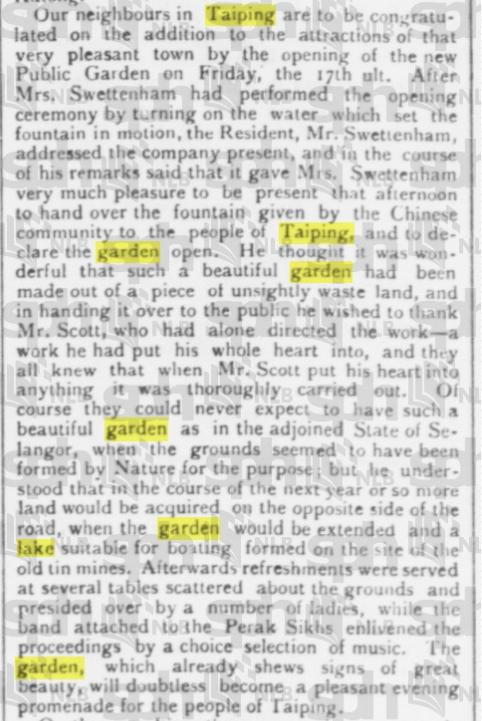
Almost immediately I found what I was looking for. In the Pinang Gazette and Straits Chronicle of 21 June. Here it is
On 20June 1937 Amelia Earhart left Bangkok for her flight to to Singapore. The aerodromes of Penang and Alor Star made preparations in case she decided to land at either of them. At 2:35pm a message from Alor STar said that she had passed over. In Penang there was hope she might land there, but after about 45 minutes …
… a message was received from Taiping to say that Miss Earhart’s machine had passed over that State.
This should end the controversy. Will the relevant authorities take action this time and modify the text on the mural?
____________________________________
APPENDIX
Amelia Earhart’s solo flight around the world was global news. Even more so in the Netherlands, for several reasons. In 1934, the KLM had won the prestigious handicap race, London-Melbourne. The flight of the “Uiver” caused a lot of enthusiasm. In those early decades of aviation, Fokker, a Dutch company, dominated the civil aircraft industry. And Amelia Earhart’s flight plan included Bandung in the Dutch East Indies. a Dutch colony (now Indonesia).
Here are a few newspaper clippings collected by Mathew. I have added the English translation (in blue italics) and some comments of my own
+++++++++++++++++
Sumatra-bode, 19 June 1937
Amelia Earhart’s Flight Akyab, June 18 (Aneta). Amelia Earhart arrived from Calcutta and departed for Bangkok at 6:4 GMT, but after battling the monsoon for two hours and failing to establish radio contact with the bearing stations in Rangoon and Akyab, she returned. The return trip occurred during a heavy thunderstorm. Amelia Earhart encountered dense cloud cover, while visibility was poor over the desolate coastline, one of the most treacherous factors on long-distance flights. Earhart will continue her world flight on June 19.
The original plan was to fly from Calcutta to Bangkok with a refueling stop in Akyab. But she had to battle the monsoon weather and was forced to return to Akyab. The visibility was so bad that she didn’t dare to fly over land where suddenly a hill might appear. Instead, she followed the “desolate” coastline.
+++++++++++++++++
Algemeen handelsblad voor Nederlandsch-Indie¨, 21 juni 1937
Amelia’s World Flight. Arrived in Rangoon. Rangoon, June 19 (Own service). —Amelia Earhart arrived in Rangoon on Saturday morning.She took off from Akyab three times. After the first takeoff, she turned back.After this, she tried again, but again, due to bad weather, she turned back. Finally, the third time, she succeeded. Upon her arrival in Rangoon, the round-the-world flyer declared that the Akyab-Rangoon leg was the worst of the entire trip.
The next day, the weather was even worse. No way of reaching Bangkok. After a few unsuccessful attempts, she managed to land in Rangoon and stay overnight there.
+++++++++++++++++
Nieuwe Apeldoornsche courant, 21 juni 1937
Amelia Earhart to Bandung Won the Rangoon-Singapore route of the “Ibis” and an English plane. Amelia Earhart, coming from Rangoon, landed in Singapore. She arrived ten minutes ahead of the KLM plane, the “Ibis.” The two KLM and Imperial Airways airliners took off from Bangkok at the same time as Amelia Earhart. The brave pilot said she had made a bet with the airline pilots that she would cover the distance from Bangkok to Singapore the fastest. Laughing, she took a picture of the “Ibis” as the plane landed at the airport after her. To continue her flight around the world, Amelia Earhart left for Bandung, in the Dutch East Indies, last night.
On 20 June the weather improves and Amelia Earhart reaches Singapore, after a refueling stop in Bangkok. A bit earlier than the Ibis and the English plane, but the story about a bet is fake news and will be corrected later. Notice how this newspaper, based in the Netherlands, writes that she left for Bandung “last night”. Amelia avoided flying at night, she left Singapore early morning on 21 June, Different time zones… 😉
+++++++++++++++++
Het nieuws van den dag voor Nederlandsch-Indie¨, 21 juni 1937
WHERE WAS AMELIA EARHART…? Last Saturday, wild rumors circulated in a small circle in Bandung that the daring American ocean aviator Amelia Earhart, who was on a round-the-world flight over the British East Indies, would be honoring Bandung with a visit. The Royal Netherlands Air Force (KNIL) agency here had received word that Lady “Lindy” would most likely land in Andir on Sunday, or yesterday during the day. However, it was not to be. An Aneta report,distributed via the Nirom, informed the public yesterday morning that Lady “Lindy” had only arrived in Rangoon last Saturday afternoon, after having taken off from Akyab three times previously; however, the exceptionally bad weather forced her to return to Akyab an equal number of times. Last night we received a telephone message from the KNIL agent here, Mr. L. Mees, in Bandung, stating that Miss Amelia Earhart is expected in Andir Monday morning (today) between 8 and 10 a.m.
A nice article from a newspaper in the Dutch East Indies, where people are anxiously waiting in Bandung for her arrival on 20 June, until they are notified about the delay in Burma.
+++++++++++++++++
Dagblad nieuwe Hoornsche courant, 21J une 1937
Amelia Earhart in Bandung. BANDUNG, JUNE 21 (Aneta—A.N.P.). Amelia Earhart arrived in Bandung at 1:56 p.m. local time. Further information. BANDUNG, June 21 (Aneta—A.N.P.). The aviator Amelia Earhart landed in Bandung this morning at 10:56 a.m. on her round-the-world flight. She circled above the airfield for fifteen minutes, presumably because the various signs on the ground were obscured by the low-hanging clouds. Then several aircraft from the aviation department took off and landed to show Amelia how to land. There was great interest at the airfield. The “Bandung Vooruit” association offered flowers. Miss Earhart will stay here for three days, as KLM has the only equipment in Bandung where it can have the instruments of its modern aircraft thoroughly overhauled. Miss Earhart will visit the Tangkoeban Pra-hoe this evening.
On 21 June, Amelia Earhart lands in Bandung. Notice that the arrival time is given twice, with a strange difference of three hours. The report contains one interesting detail, which I have not found elsewhere, that local aviators took off to help her land because low-hanging clouds obscured the landing signs on the runway. Amelia stayed three nights here, so the KLM workshop could thoroughly inspect her plane. Therefore, she had time to be a tourist and visit the Tangkoeban Pra-hoe , a famous volcano near Bandung.
+++++++++++++++++
Dagblad nieuwe Hoornsche courant, 21J une 1937
No Bet BATAVIA, June 21 (Aneta—A.N.P.). The commander of the “Ibis,” Mr. Stork, reported that Amelia Earhart, after taking off from the airport in Singapore, returned there due to engine trouble. She was still there when the “Ibis” took off. Regarding reports of a so-called friendly competition between Amelia Earhart and the KLM “Ibis,” he stated that competitions are never held with KLM aircraft, and moreover, the Rangoon-Singapore route for the “Ibis” was completely different from that for the American aviator. The “Ibis” made stopovers in Bangkok, Penang, and Medan, where delays occurred for refueling, food, mail, and loading, while Amelia Earhart—except for a stopover in Bangkok—flew directly to Singapore. It should also be noted that the “Ibis” had a speed of 270 km/h, while Amelia Earhart, with her Wasp Junior engines, had a speed of 237 km/h. The entire betting story must therefore be considered completely false.
In the same newspaper, a correction of the “bet” story. The pilot of the “Ibis” explains that there has never been a bet. The Ibis was a commercial airliner; it had to make two intermediate landings, in Penang and Medan. In a direct competition, the Ibis would have won, because the machine was faster.
My blog post will end here. Amelia Earhart stayed in the Dutch East Indies longer than planned (repairs, sickness), then continued to Australia and New Guinea. On 2 July, she and her navigator, Fred Noonan, started for the long flight (about 20 hours, more than 4000km) to Howland Island.
Where they never arrived. Most plausible explanation is that the plane ran out of fuel and crashed into the Pacific Ocean. But there are other possibilities, including several conspiracy theories.