The Goldberg Variations

In 1741 Johann Sebastian Bach published a work for harpsichord, consisting of a theme and a set of 30 variations. Its modest title was Clavier Ubung (Keyboard Practice) and it may have had its first performance by an in those days famous harpsichord player, Johann Gottlieb Goldberg. It is now known as the Goldberg Variations and generally considered one of Bach’s masterpieces.

416px-Goldberg-titlepage

Of course Bach has composed numerous masterpieces, so it is no wonder that this one went more or less unnoticed for a long time, until in 1955 the young Canadian pianist Glenn Gould recorded it for Columbia. It became a huge success and established Gould’s reputation.

Not surprisingly, you will find numerous recordings of the Goldberg Variations on YouTube. More surprising is the Open Goldberg Variations, a Kickstarter project based on what is called crowd funding. Aim of the project is to make the musical score, together with a first-class performance, available to the general public. There is even an app now for the iPad, Open Goldberg, which gives you both the musical score and the recording in an interactive way.

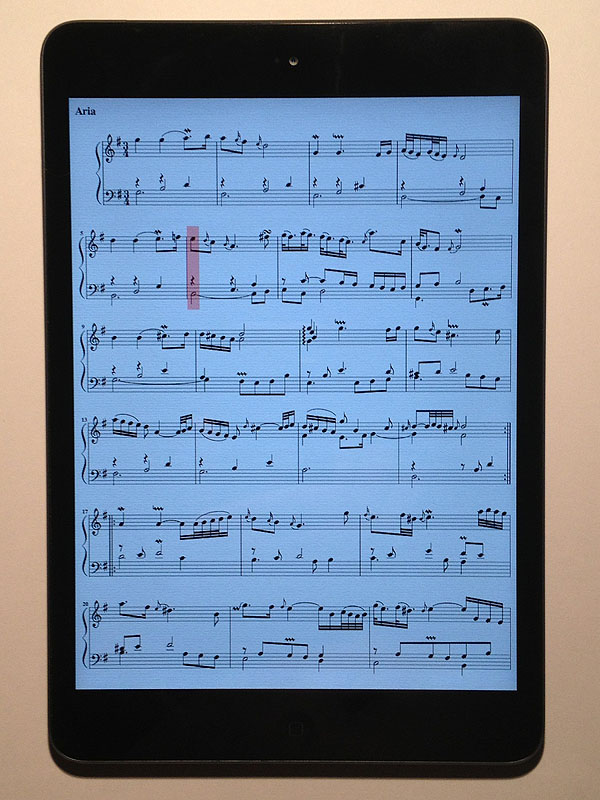
Here is the app on my iPad, showing the theme of the Variations. A colored bar follows the score, karaoke style, while it is played.

Goldberg Variations theme

The theme (Aria) is played by the German-Japanese pianist Kimiko Douglass-Ishizaka

She has recorded the complete Goldberg Variations for the above-mentioned project.

Here are a few of the YouTube recordings with some comments.

As Bach wrote this work originally for harpsichord, it is appropriate to start with this instrument, although it is not my personal favourite.
However, Gustav Leonhardt, a Dutch harpsichordist (1928-2012), plays it beautifully. In this YouTube, he plays variation 25

Many recordings for piano can be found on YouTube, for example by Murray Perahia and Andras Schiff , just to mention a few. And of course Glenn Gould (his 1955 recording)

Gould made another recording in 1981, one year before his (premature) death. This time not only sound but also video. Fascinating to see him play! And hear his humming, because that is Gould’s trademark. Some people hate it, others do not mind.

Some of the variations have been written by Bach for a harpsichord with two manuals (keyboards), where left and right hand can each use one keyboard. Not easy to play on a piano with only one keyboard. Watch the YouTube to see how Gould plays it. Fascinating!

You can find on YouTube also versions for other instruments. I found one for organ and a guitar version (theme and 1st variation). The most exotic one is the version for saxophone and contrabass , performed by the Japanese group of Yasuaki Shimizu . Five saxophones and four contrabass, you must see it to believe it. But still very much Bach!

Last but absolutely not least there is this beautiful transcription for string orchestra by Dmitry Sitkovetsky This Russian-born violinist and conductor also created a version for string trio, here recorded by (again) Japanese musicians…:-)

This post could also have been called Variations of Goldberg 🙂

Rock Balancing

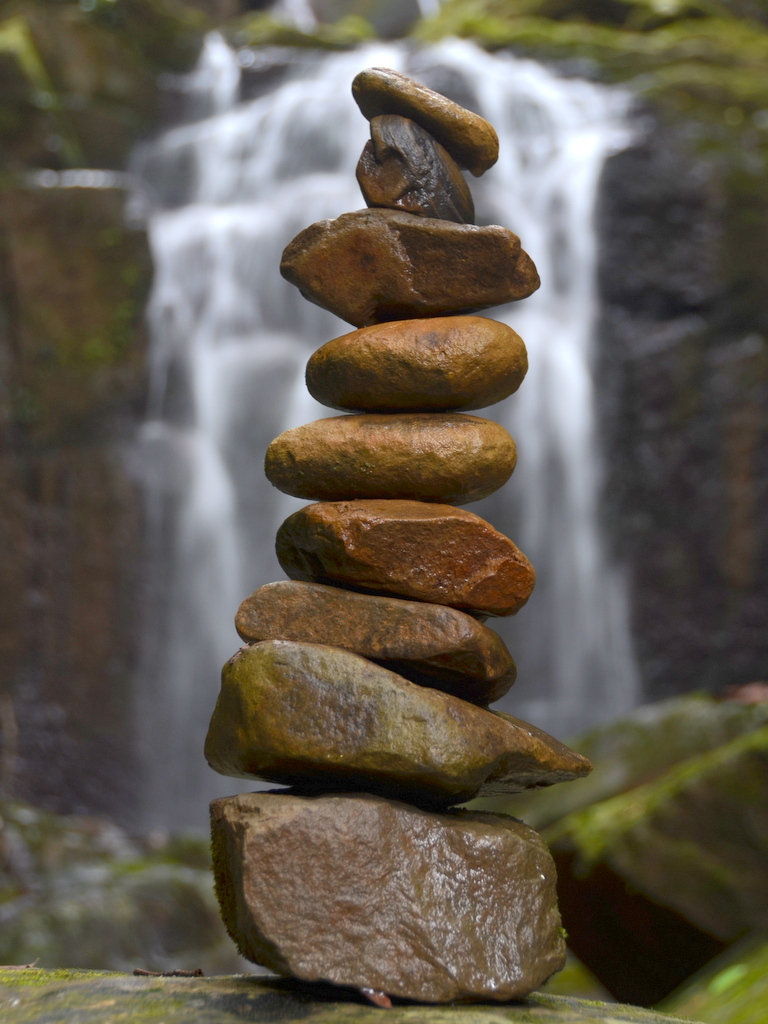
A few years ago I have started a habit of building a stone marker when I visited a waterfall. A sign that I had been there. Here is an example

Stone marker

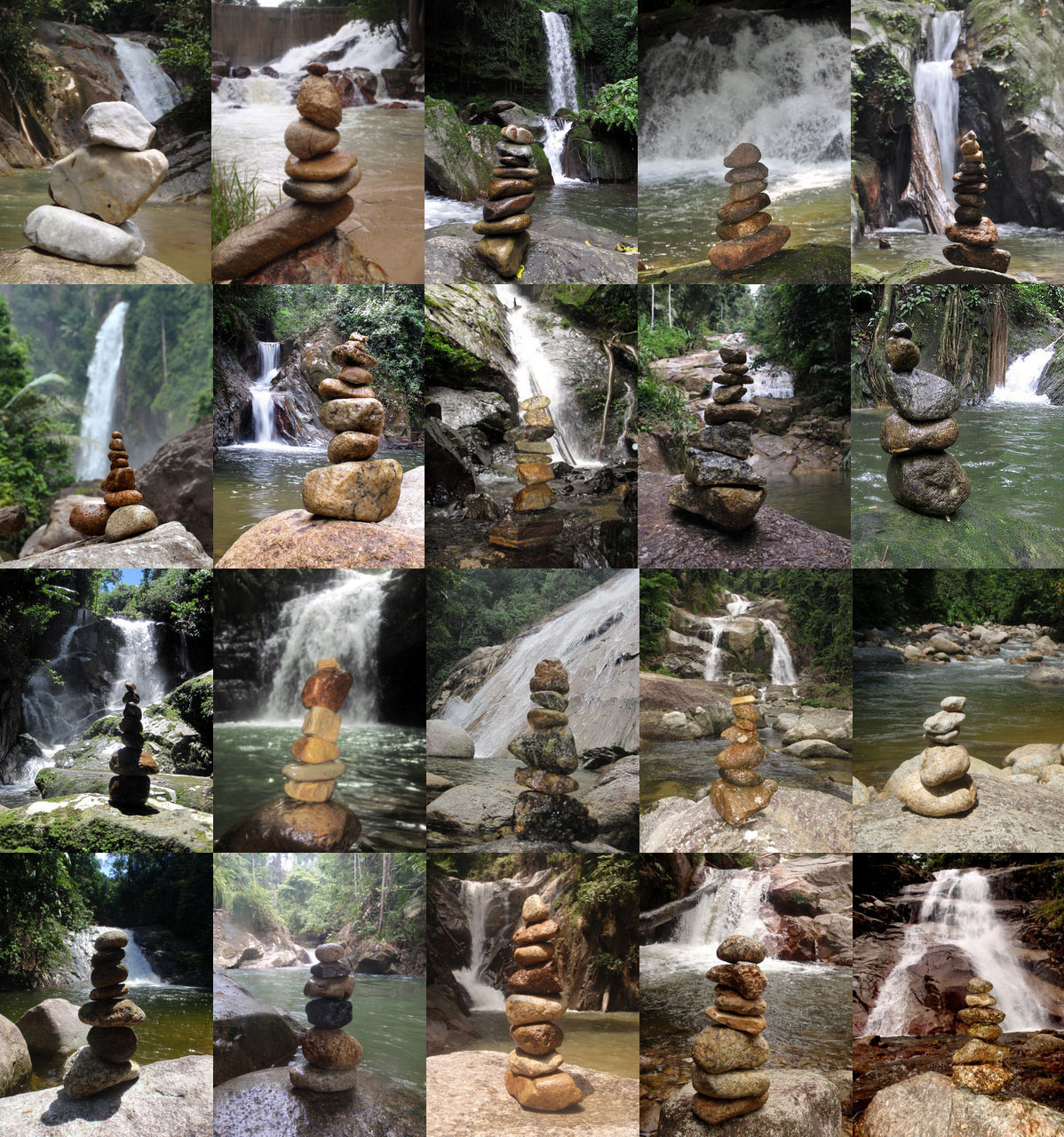
And here is a collage of many more. It is a nice pastime and doesn’t require much effort. Just collect a few suitable rocks and see how tall you can make the tower. A downpour, or strong wind, and it will be gone. So I leave only a temporary marker, which I find quite symbolic for human existence in general..:-)

collage

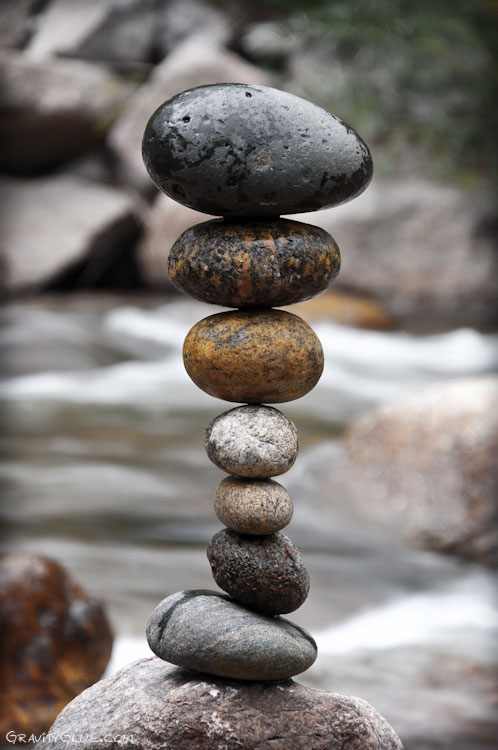
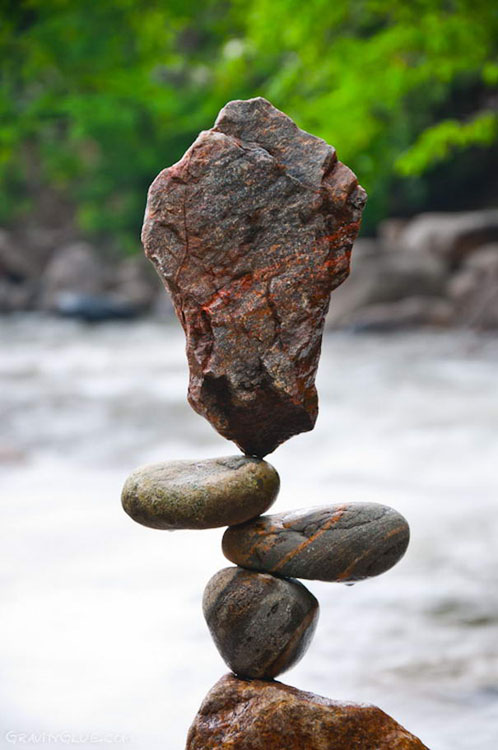
It can also be done in a very different, spectacular way! Recently a friend sent me an email with pictures of amazing balancing rock formations. Like this one

Gravityglue1

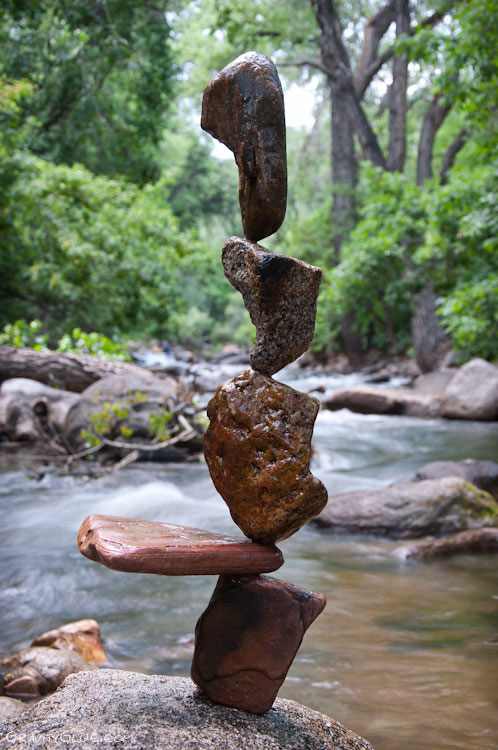
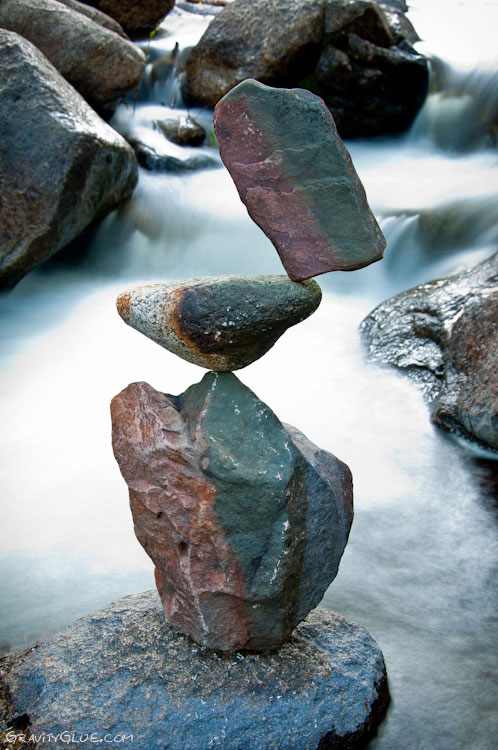
The “maker” is a young Canadian artist/designer, Michael Grab. He has a website Gravity Glue where you can find many more of his creations.Here are a few

Balance-Art-By-Michael-Grab_09Balance-Art-By-Michael-Grab_05Gravityglue3Gravityglue2

I find them extremely, almost unearthly, beautiful. They seem to defy gravity, although as a physicist  I understand of course that it is gravity which keeps the pieces of rocks in place, at least temporarily.

Not surprisingly some of the comments on his website suggest that it is all fake, that he is using superglue, or metal pins to keep the parts together. Watch this short YouTube video (until the end!) for a convincing proof that it is NOT fake…:-)

You can find more YouTube videos on the Internet, for example this one. Although I do not share his philosophy, I admire his patience and perseverance.

GE13 the Aftermath

It is now about three months ago that the 13th General Election was held in Malaysia. Time for some comments, primarily for my non-Malaysian followers, although there might also be something new for my Malaysian friends..:-)

As I wrote in my post GE13: the Results , the ruling BN coalition remained in power, although with a reduced majority (133 against 89  for the opposition), but they lost the popular vote.
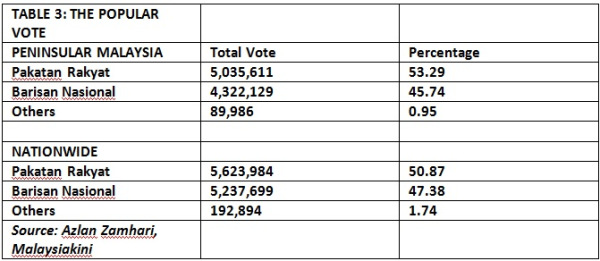
popular-vote

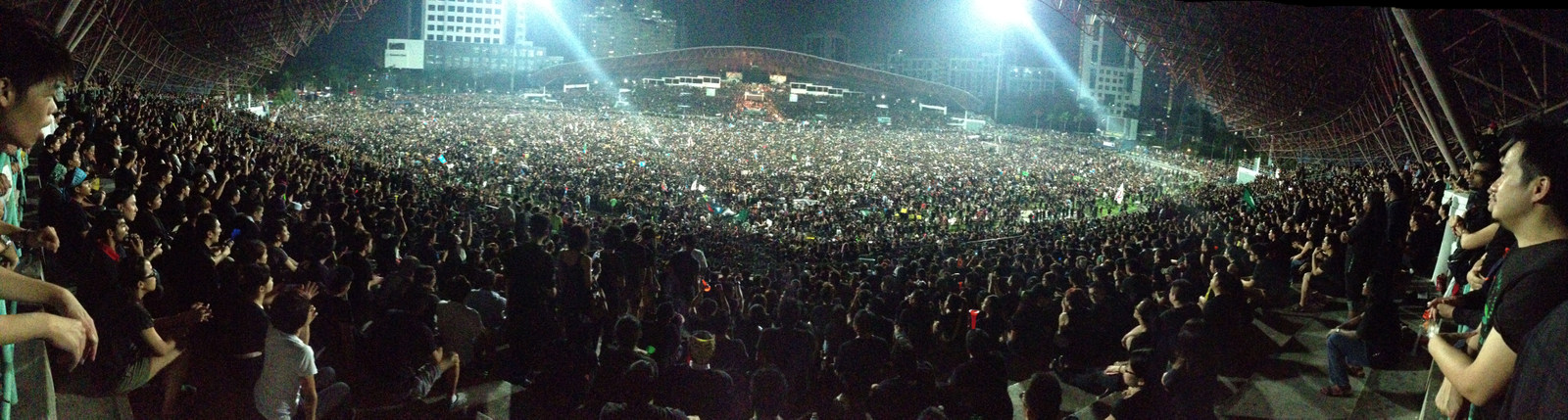
In the weeks following Election Day, numerous protest demonstrations were held, all over the country. Aric attended the biggest one, in Kelana Jaya and came home, deep in the night, full of enthusiasm: “There were people from all races and all ages. I really felt that I was a Malaysian“. He took this picture:
Kelana Jaya protest

Prime Minister Najib’s  first reaction was about a Chinese Tsunami. Newly-appointed Home Minister Datuk Seri Ahmad Zahid Hamidi said Malaysians who are unhappy with the country’s political system should leave the country. But it was not a Chinese tsunami, it was a result of the urban-rural divide.

There were more intelligent responses. Nazri, now minister of Tourism, in an interview with the Malay Mail, about the reduced support for BN: This is the tragedy of education. You keep them stupid, so they will keep you in government or you educate them and risk having them go against you. To be fair to him, he added: I will still choose the latter.

I will now try analyse the election results a bit. Let me recapitulate what I explained in my earlier post GE13. Malaysia uses a District System for the elections, instead of Proportional Representation. Two “dangers” in a District System are gerrymandering and malapportionment. Districts (constituencies) should have more or less the same size, if that is not the case, there is malapportionment. Even when they have the same size, you can still have gerrymandering. I found this very clear example of gerrymandering on the Internet. It shows four districts, equal in size, with two parties, Green and Purple. Counting the dots (voters), you will find 36 Green and 28 Purple. So Green would have a majority in a PR system.

In a District System the outcome depends strongly on the boundaries of the districts.
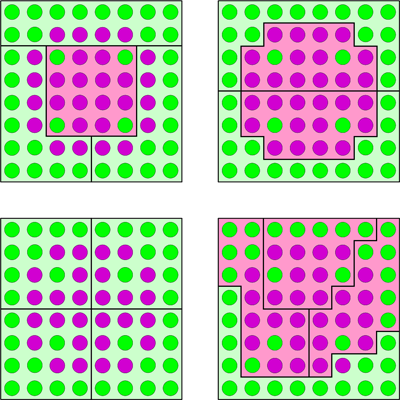
GerrymanderingLower left: in all four districts Green wins

Upper left: three Green districts, one Purple,

Upper right: two Green, two Purple,

Lower right: one Green, three Purple, so Green even looses!!

The delineation makes all the difference!

I have no idea how much gerrymandering is taking place in Malaysia, but the malapportionment is very obvious and in the rest of this blog I will concentrate on it.
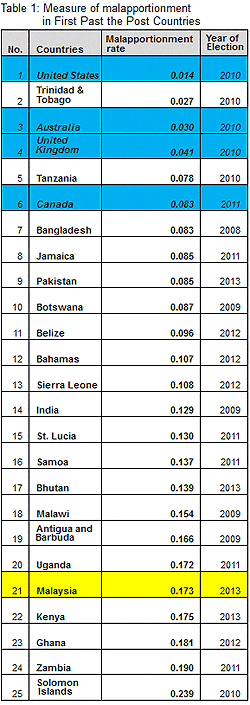
Malapportionment

Last week Malaysiakini published an article about malapportionment. In a list of 25 countries that use the District system, Malaysia takes a shameful 21st place, between Uganda and Kenya.

The reason is clear. In most countries there are rules for the relative size of districts. For example in the UK there can be no more than 5% difference with the national quota, where the national quota is defined as the number of voters divided by the number of MP’s

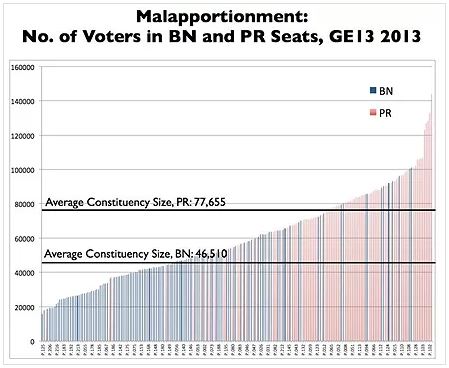
Malaysia had these rules too, but they were relaxed and finally completely abolished by the BN government.As a result in the last election, in the state of Selangor the Kapar district had 144159 voters and the Sabak Bernam district 37318. The national quota in the GE13 was 48927, so Kapar is ~ 195% more and Sabak Bernam ~ 25% less

Almost unbelievable!

In discussions with my Malaysian friends often even more extreme examples are given, for example the Igan district in Sarawak with 17771 voters or, the most extreme, Putrajaya Federal Territory with 14345 voters, TEN times less than Kapar.

Here is a graph of all 222 constituencies ordered by size. Notice the huge difference in size, but especially that the constituencies where the Government (BN) won are on average a lot smaller than those where the Opposition (PR) won!
Malapportionment

A far cry from the One Man, One Vote principle! Of course after the election many people calculated how the result would have been if all votes would have had equal weight. Here is the result, taking Malaysia as a whole, if there would have been Proportional Representation. Not a majority for BN, but a clear win for the Opposition. The “real” election results are given for comparison, in orange.

Total voters Seats Quota BN BN seats PR PR seats
Malaysia 10861683 222 48927 5237699 107|133 5623984 115|89

Understandable that there was a lot of unrest and protest after the election, as many people felt that BN had no moral right to form a new government. However, the calculations given above are NOT correct, as I will explain now.

We have to go back to 1963, when Singapore, Sabah and Sarawak were considering/asked to join the newly (1957) formed Federation of Malaya. They were worried that they would be overwhelmed by the Peninsular states. As a safeguard it was agreed in the negotiations that the the three states would get 1/3 of the seats in Parliament, so for constitutional changes their consent would be needed. In 1963 the Federation of Malaysia was formed and the Parliament had 159 seats, 104 for Malaysia and 55 for the new states. A few years later Singapore decided to leave the Federation. And later the Federal Territories were created, first Kuala Lumpur (1974), then Labuan 1984) and finally Putrajaya (2001). In the present Parliament, Peninsular Malaysia has 153 seats, East Malaysia 56 and the three Federal Territories 13. Therefore East Malaysia has only ~ 25% of the seats in Parliament, less than 1/3, and many Sarawakians and Sabahans are unhappy with that!

Back to the elections. It will now be clear that the calculation of a national quota does not make sense in Malaysia, as it consists of three separate entities. For each of them we have to calculate the quota, and then we can for each of them calculate what the result of proportional representation would be! The results are given in this table:

Total voters Seats Quota BN BN seats PR PR seats
Peninsular Mal. 8690785 153 56803 4084928 72|82 4605857 81|71
East Mal. 1484784 56 26514 902866 34|47 581918 22|9
Federal Terr. 686114 13 53180 249905 5|4 581918 8|9
Malaysia 10861683 222 5237699 111|133 5623984 111|89

The three quota are in yellow. The quota for Peninsular Malaysia and the Federal Territories are in the same range, the quota for East Malaysia is much smaller, reflecting the special position of Sabah and Sarawak. For all three the number of seats is calculated according to proportional representation (light-blue) with the actual results in orange for comparison.

It is clear that in Peninsular Malaysia and the Federal Territories the opposition wins convincingly. But it is also clear that in East Malaysia BN wins convincingly, even with proportional representation! And because of the different weight factors, we come to a surprising final result: BN and PR would hold each other in balance, a hung Parliament, LOL.

Congratulations if you have been following this blog until here..:-) It has taken me many days to get a clear view of the situation.

A few concluding remarks

1. The numbers have been taken from this very accessible and detailed website: Malaysia Election Data

2. In many states a relatively small number of votes has been given to Independents etc. In total about 1.74%. None of these candidates got a seat. Also in proportional representation none of these candidates would get a seat. Therefore in the above calculations I have neglected those votes.

3. When you compare sizes of constituencies to show malapportionment, you must do that within each of the three entities. It makes no sense to compare Kapar and Putrajaya.

4. It is clear that the battle between government and opposition has to be fought in East Malaysia. East Malaysia is still the “fixed deposit” of the BN government.

5. The Election Commission will start a Delineation Exercise soon. For changing the number of seats a 2/3 majority is needed, for just delineation a simple majority is enough. The EC should be completely independent of the government, but the communis opinio in Malaysia is that EC and the government (BN) work hand in hand.

6. My bet is that the EC will propose to increase the number of seats for East-Malaysia, and as compensation for the opposition, split a few of the large constituencies in Peninsular Malaysia.


A Taoist temple and a festival

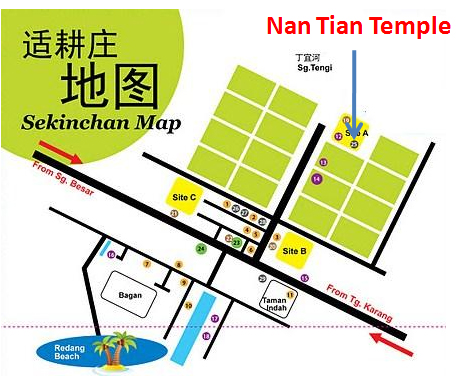
Last week, on our way to Aric’s hometown, we had planned to visit Bukit Melawati in Kuala Selangor, but it was quite hazy that day, so we decided to cancel that plan. What to do instead? According to Aric there was an interesting Chinese temple, somewhere in the paddy fields near Sekinchan. How to find its location?

Nowadays that is easy, just take your smartphone, go to the Internet , Google for “temple Sekinchan” and hey presto, you even get a map..:-) Plus lots of extra information, for example that in 1953 (during the Emergency!) the Sekinchan farmers were relocated in three new villages, still named site A, B and C.

Sekinchan temple

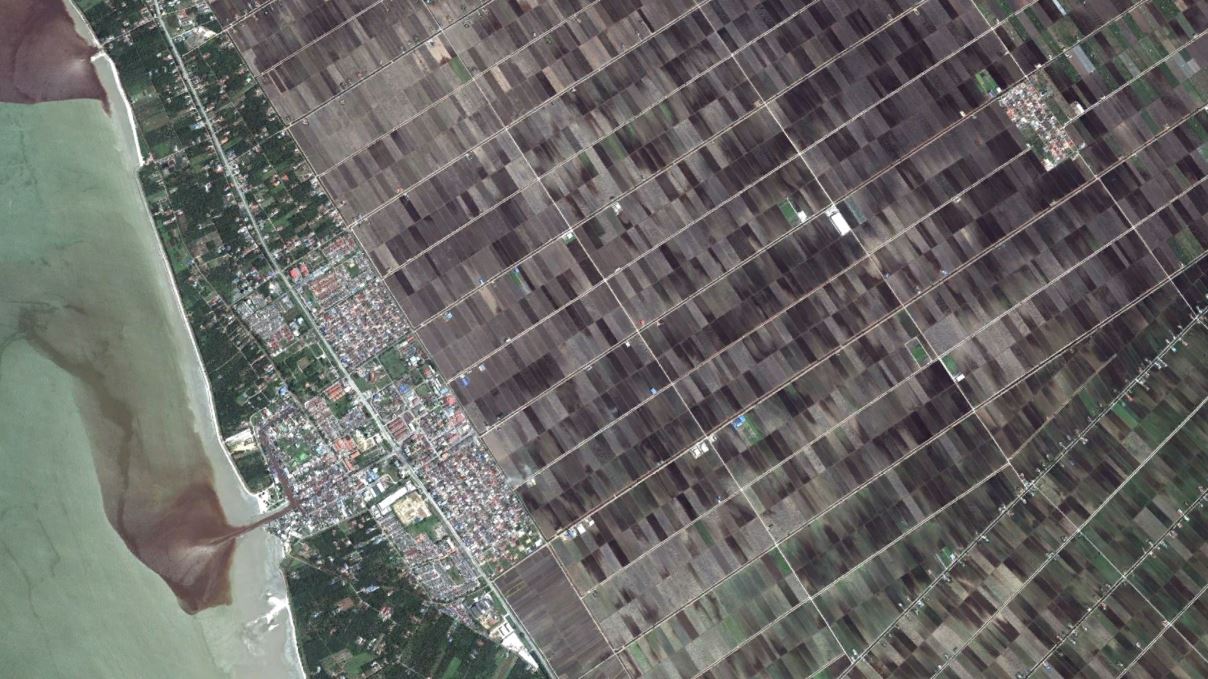
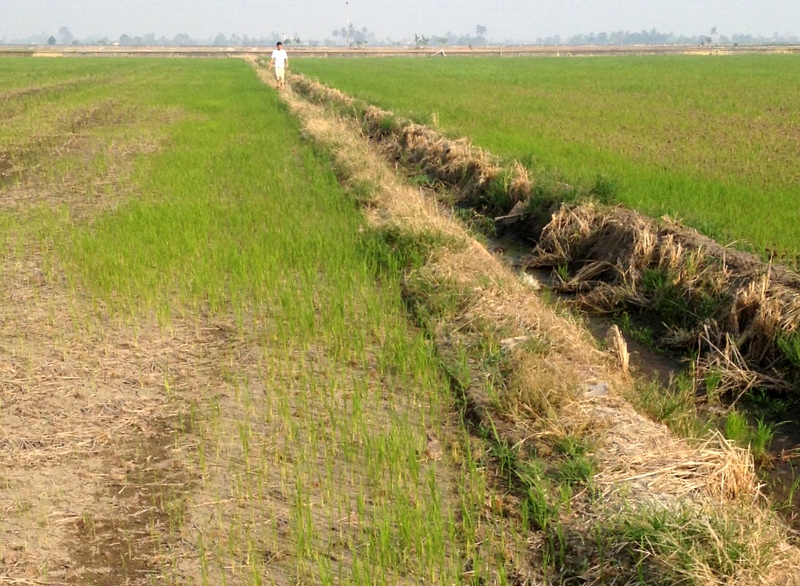
Here is a GE screenshot of this small Teochew village and the paddy fields. The fishing village (Bagan) in the lower left and Site A at the upper right. This image was taken in Februart 2012, when the paddy fields were barren. Interesting pattern, almost art…:-) During our visit, the seedlings had been planted, but many fields did not look healthy, the irrigation channels almost dry.

Sekinchan

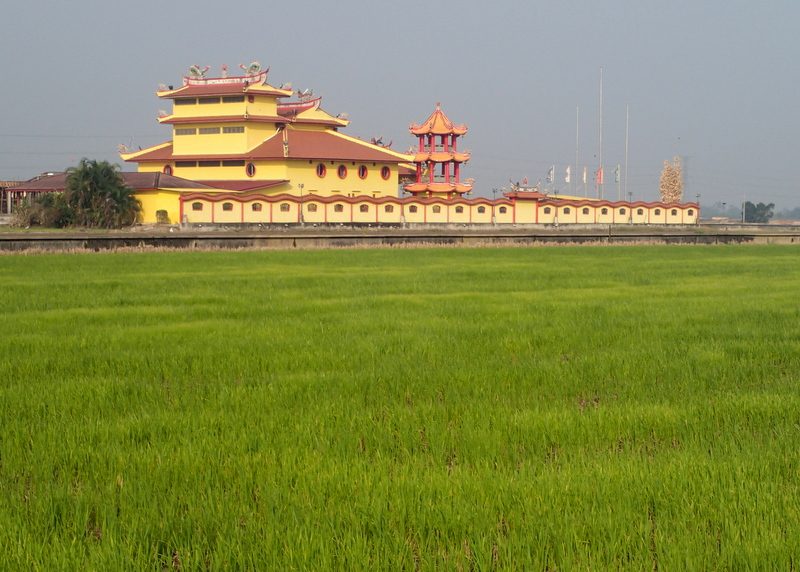
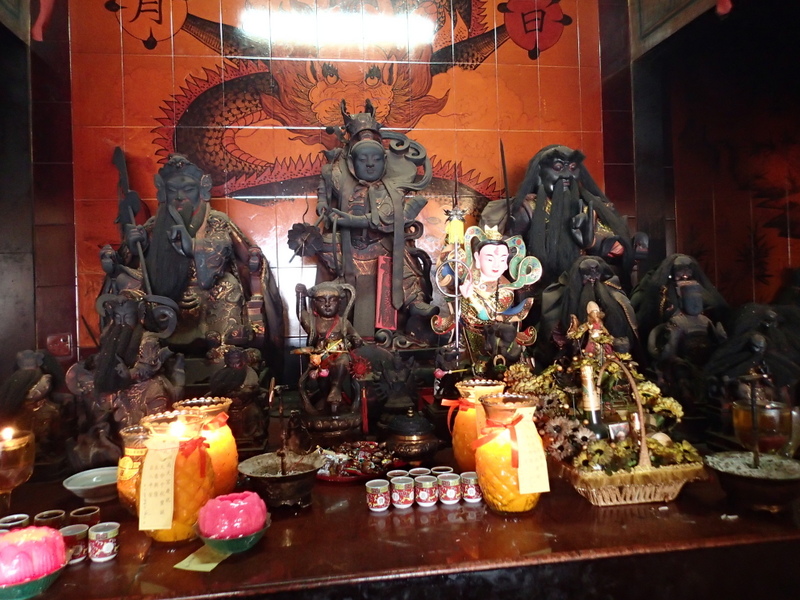
The Nan Tian temple in Site A is also called the Nine Emperor Gods temple, and attracts lots of visitors, especially during the 9th month of the Chinese calendar. Even now there was a bus from KL with devotees. From far away the temple complex is visible already.

Sekinchan temple

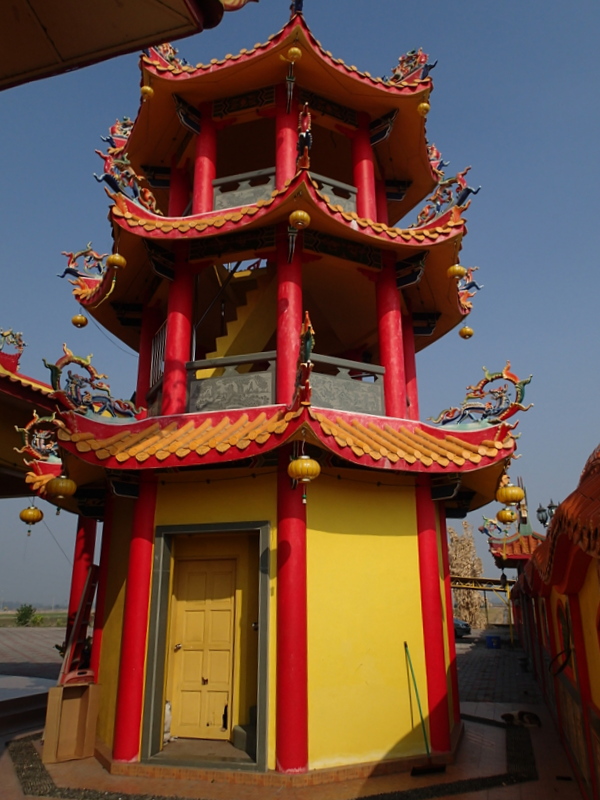
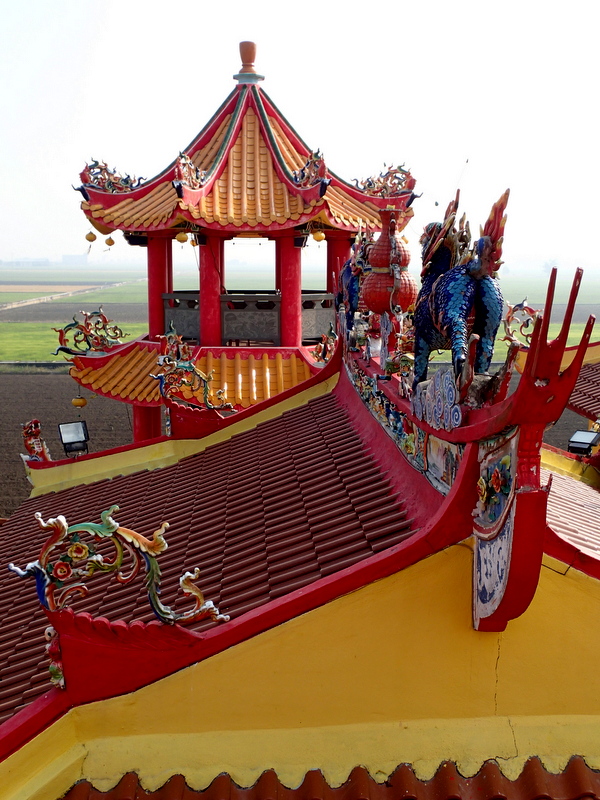
The location is very attractive. You can climb the towers in front of the main hall, from where you have a nice view of the surrounding paddy fields, although this time it was quite hazy.

Temple tower

View from tower

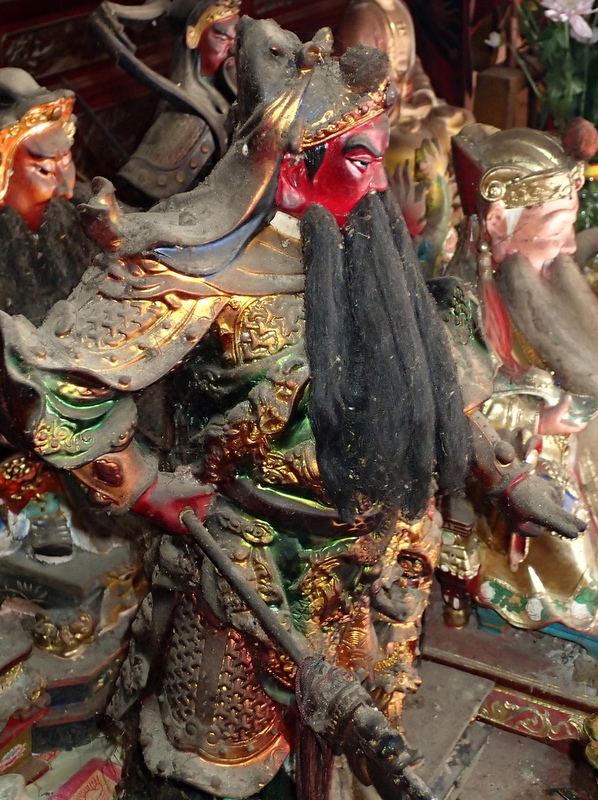
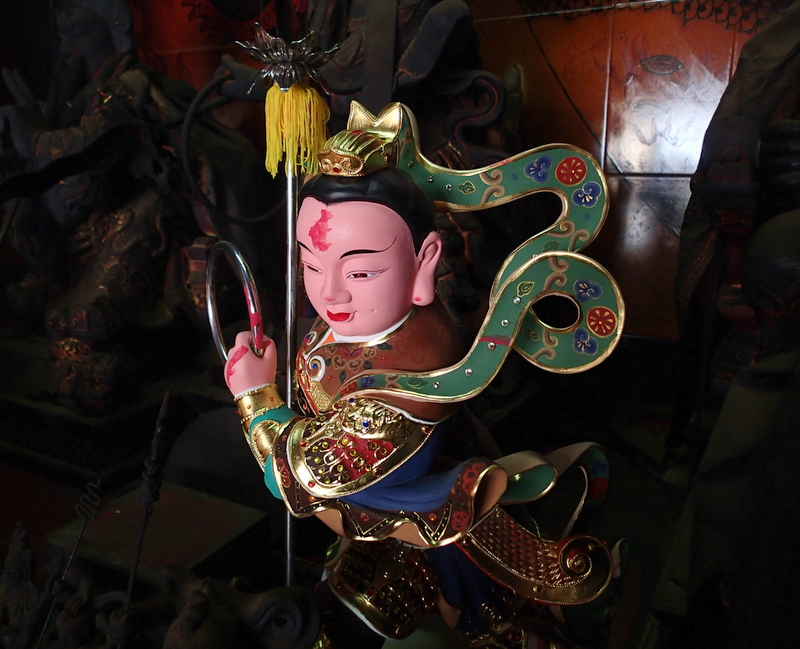
Here are a few more pictures of the temple interior.

Main hallA godDetail


We have to come back on a clear day…:-). There are also good seafood restaurants in Sekinchan.

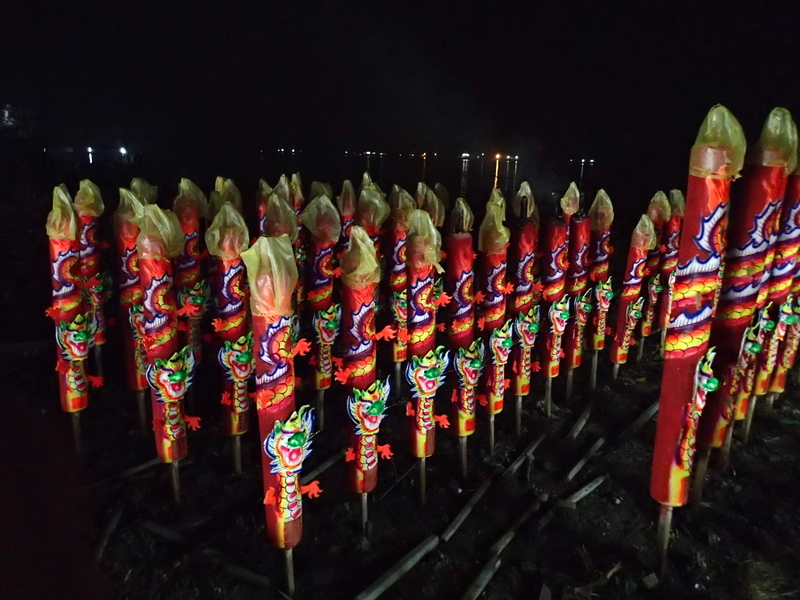
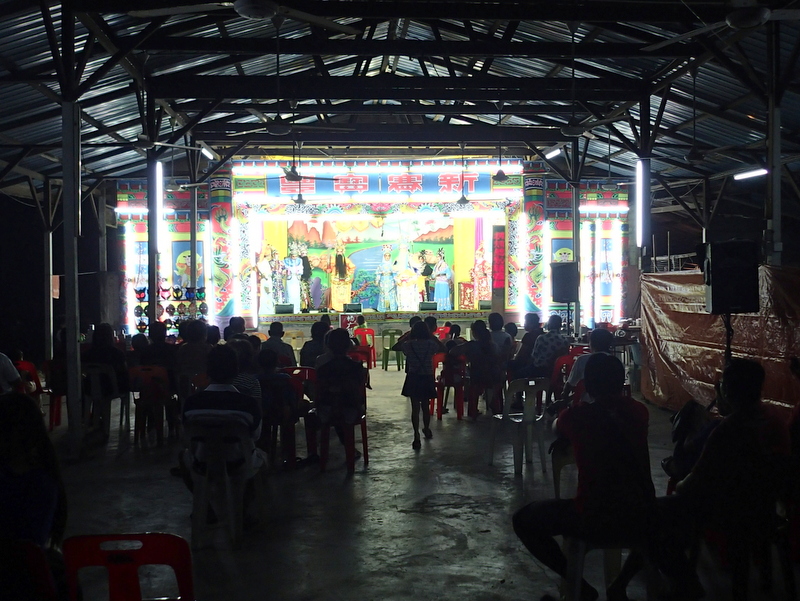
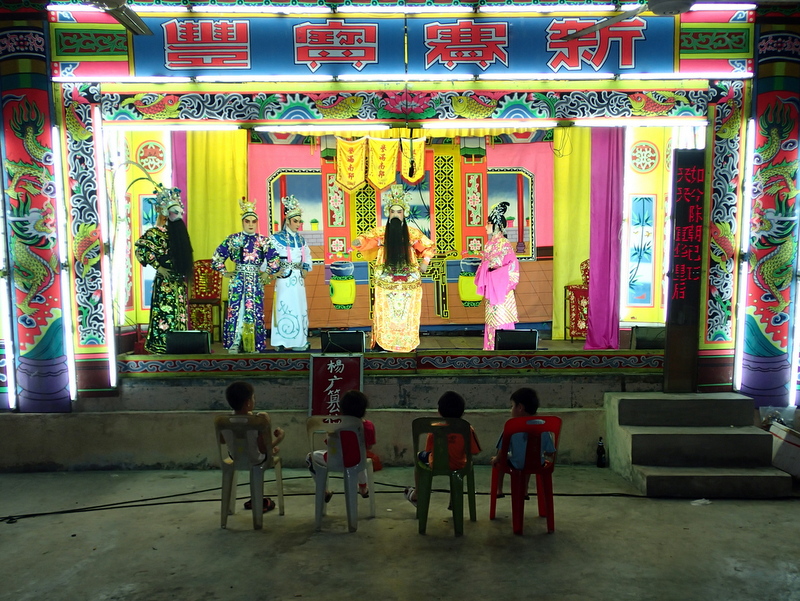
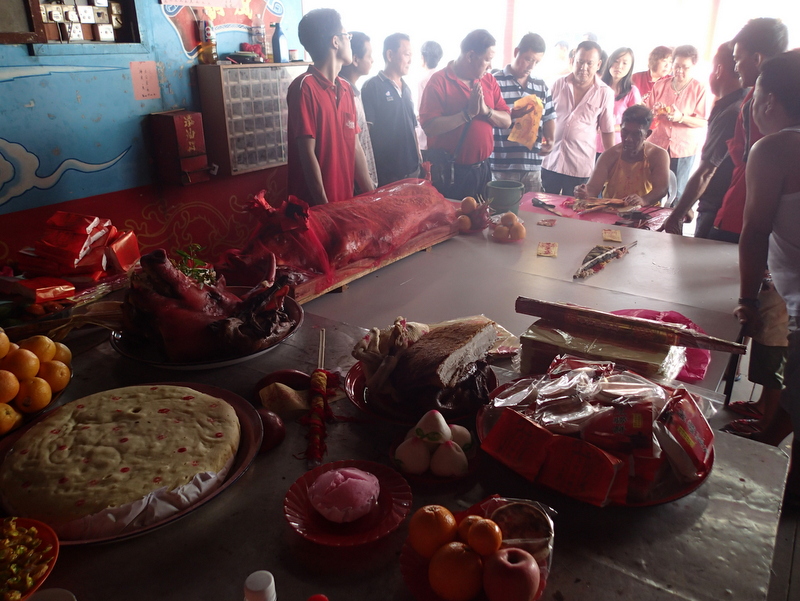
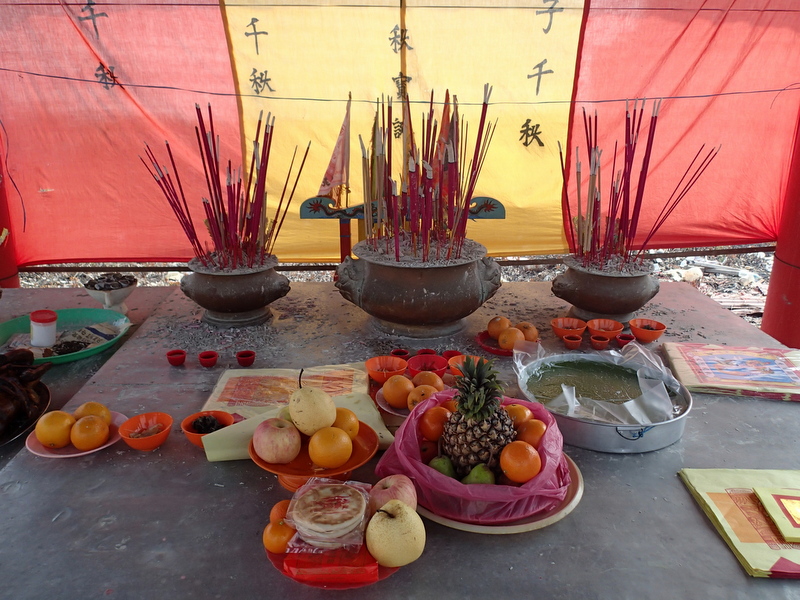
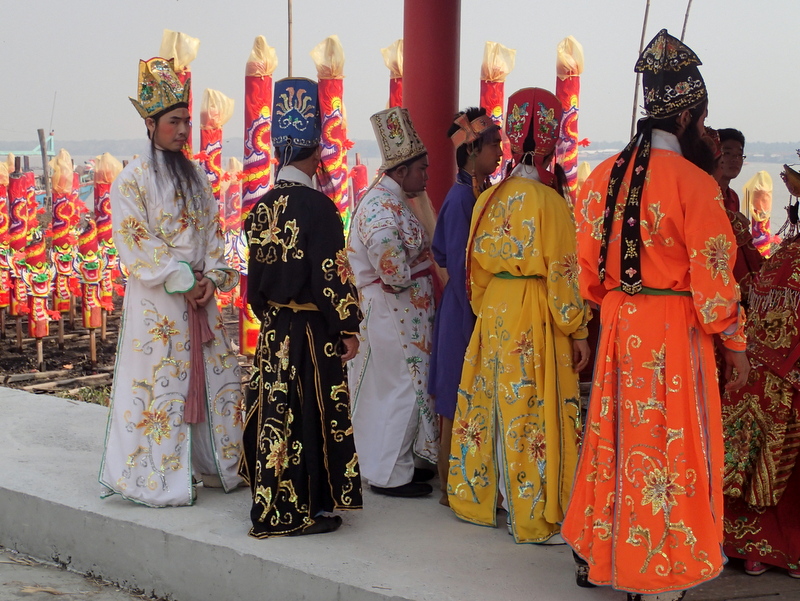
The reason to visit Aric’s hometown, was that there was a Taoist temple festival in the nearby fishing village of Bagan Parit Baru. Once a year in these Teochew villages the anniversary of the temple god is celebrated. A group of actors is invited to perform Chinese opera, there are prayers and offerings. Here you see the huge joss sticks outside the temple, with the Bernam river in the background.

Giant joss sticks

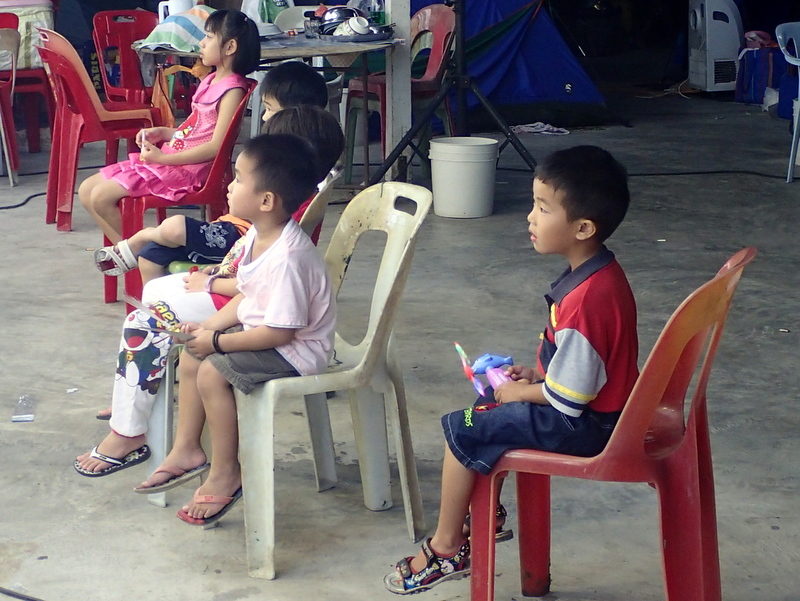
During the past years I have attended several of these temple festivals and slowly learned to appreciate Chinese opera…:-) I understand that in the past these performances attracted big crowds, but now many (young) people have left the villages, so the audience mostly consists of senior citizens and kids.

OLYMPUS DIGITAL CAMERA

OLYMPUS DIGITAL CAMERA

OLYMPUS DIGITAL CAMERA

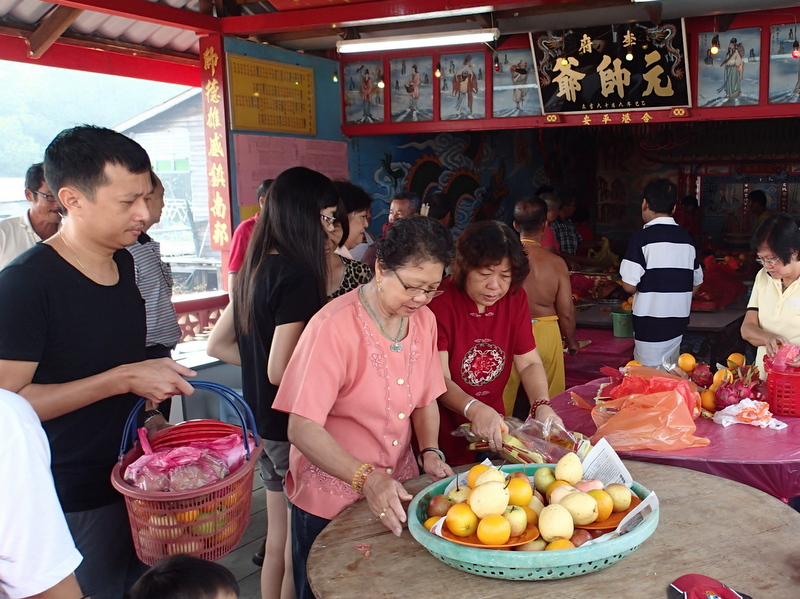
We came back the next morning, for the offering and praying.

OLYMPUS DIGITAL CAMERA

OLYMPUS DIGITAL CAMERA

OLYMPUS DIGITAL CAMERA

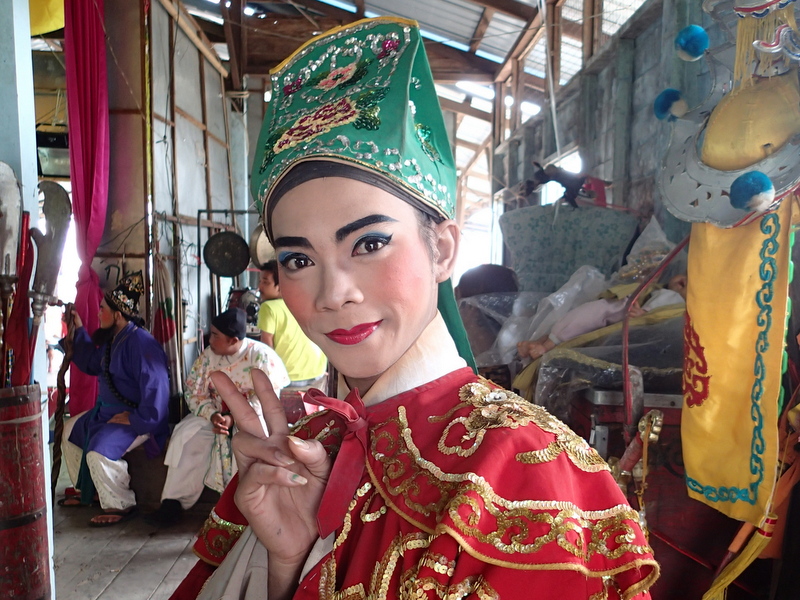
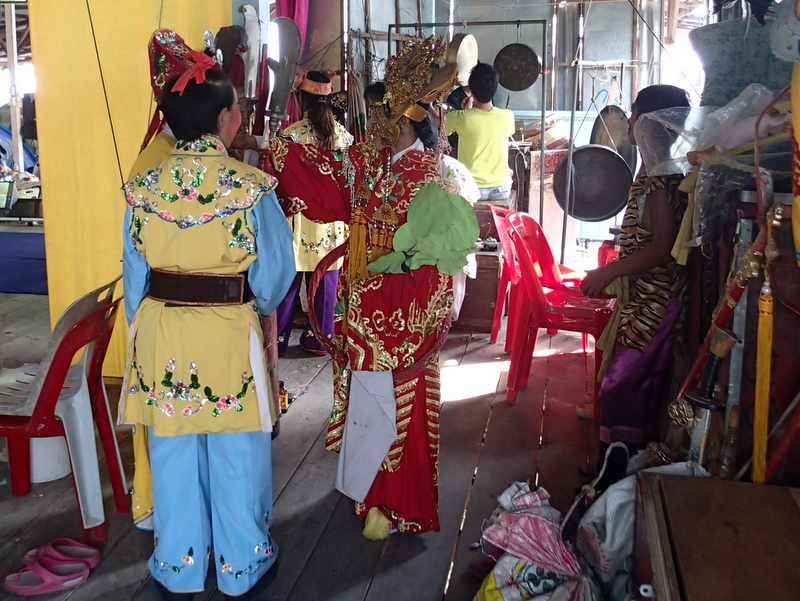
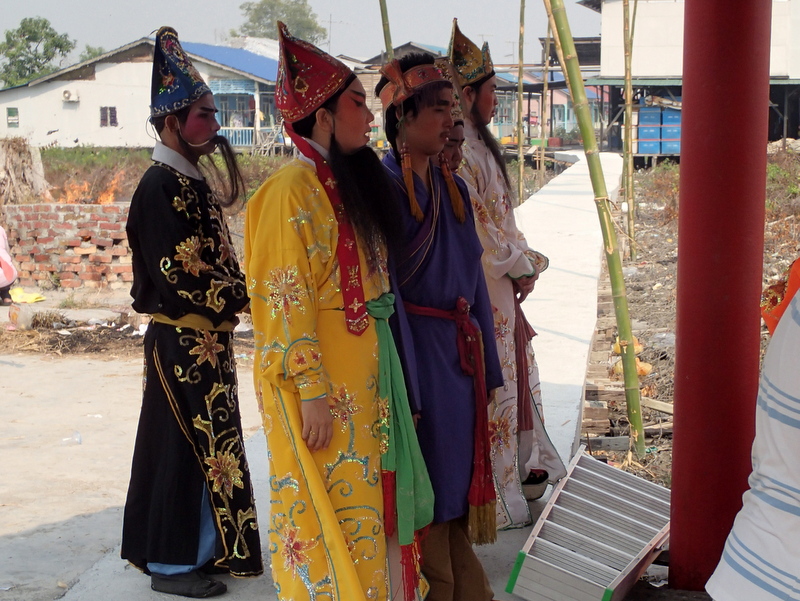
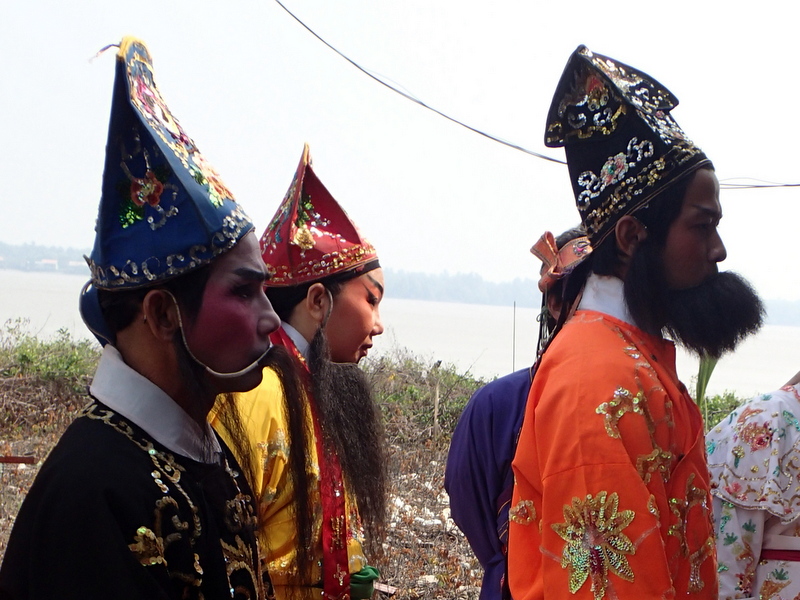
Even in the morning, the opera was going on. When I was walking around the stage, one of the actors noticed me and asked me to come backstage. I felt a bit shy, so I took only a few pictures. Some actors waiting their turn to go on stage, others are working on their make-up, or putting on their costume. During the festivities, the group is camping next to the theater. How I would love to stay with them a few days and make a picture report! But there would be a insurmountable language barrier.

OLYMPUS DIGITAL CAMERA

OLYMPUS DIGITAL CAMERA

OLYMPUS DIGITAL CAMERA

As a part of the praying ceremony, also the actors took part, walking in a procession to the temple. Fascinating

OLYMPUS DIGITAL CAMERA

OLYMPUS DIGITAL CAMERA

OLYMPUS DIGITAL CAMERA

Journal 23-7-2013

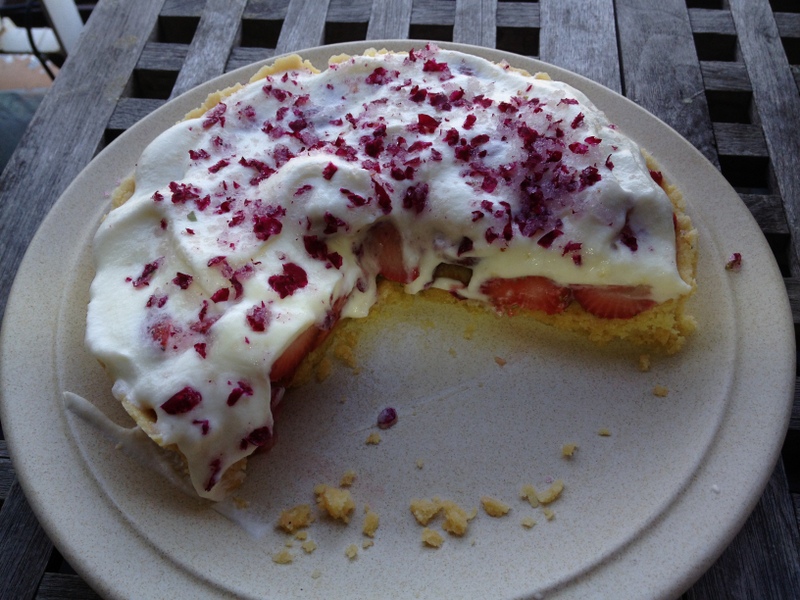
For Aric’s birthday, two weeks ago, I decided to surprise him with a birthday cake made by myself instead of buying one. A simple one, with his favourite strawberries and lots of cream. Note the subtle detail of crushed rose petals for decoration!

Birthday cake

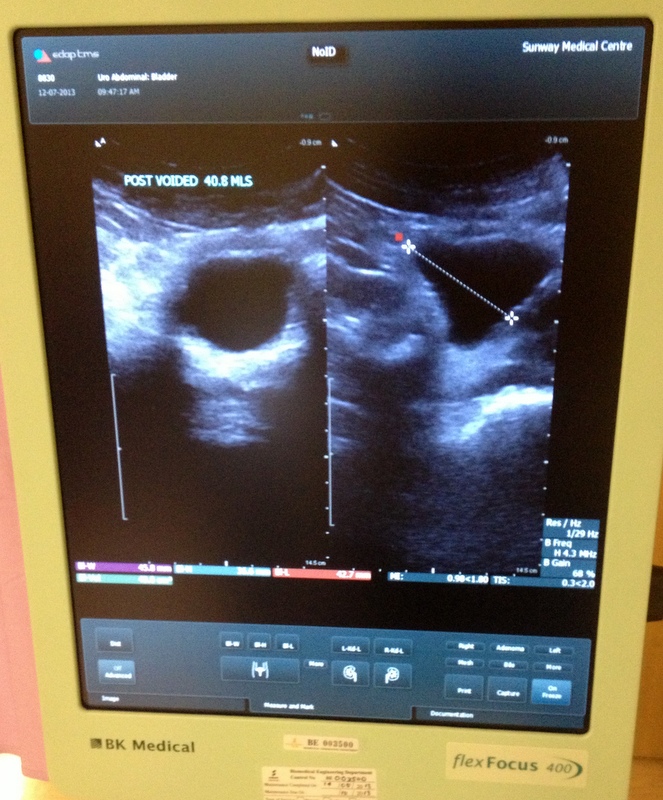
A few days later I had a routine check with my urologist. Everything was ok for a man of my age…:-) Somewhat shy I show you here a ultrasound scan of my interior, don’t ask me what it all means.

2013-07-12 09.34.32

Urologist

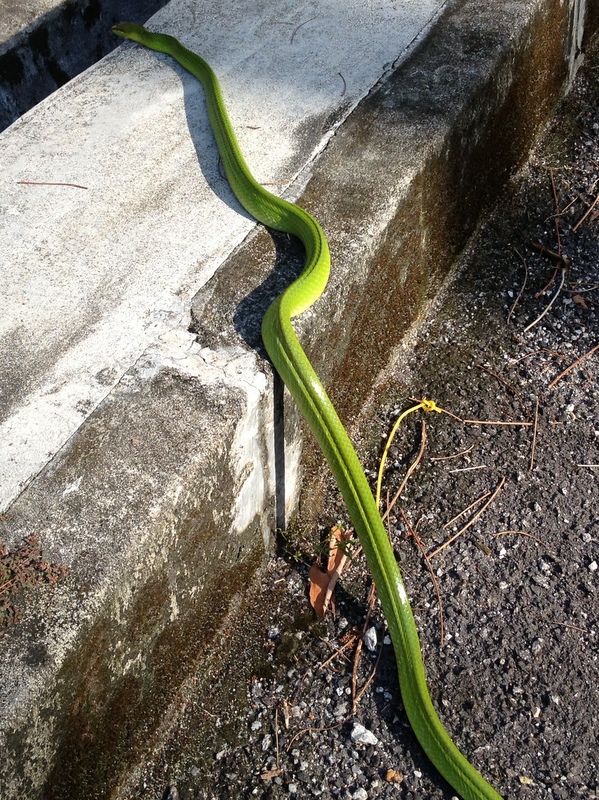
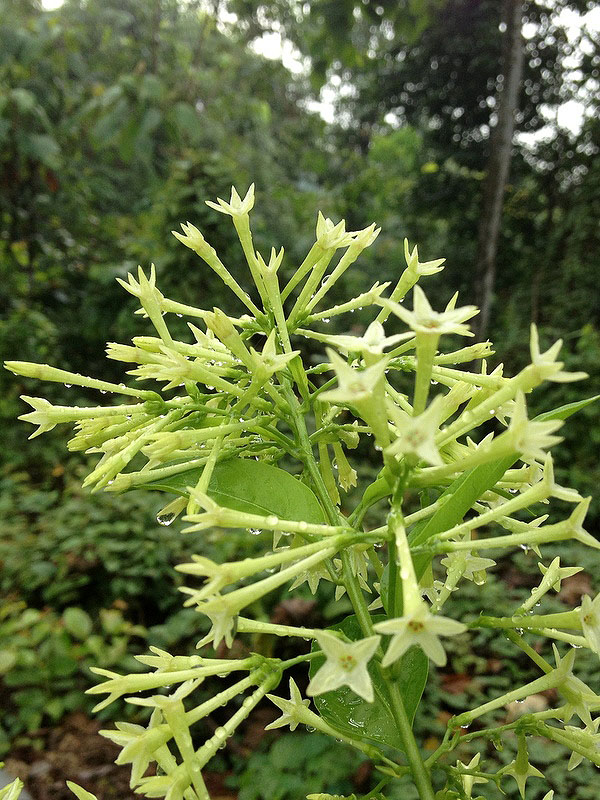
After a few weeks rest to let my knee heal, I am walking again in Kiara. Here two “green” pictures, a beautiful (harmless) tree snake and nice green flowers, name unknown.

Snake in Kiara

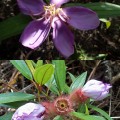
Flowers KIara

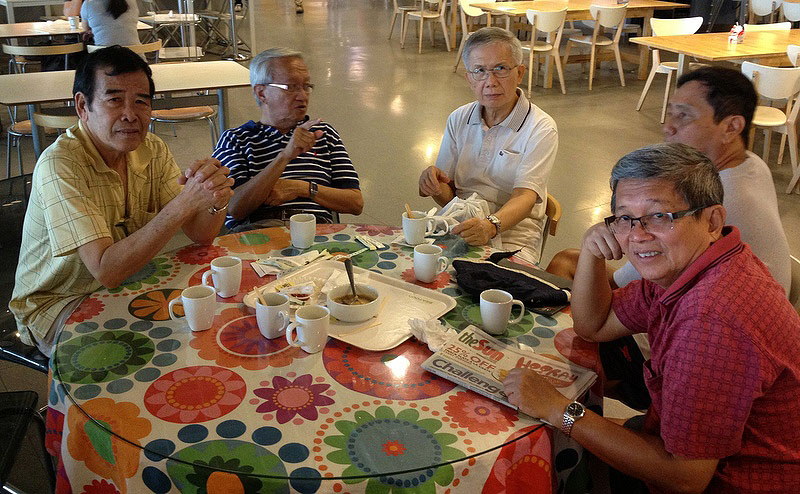
Breakfast in IKEA after my walk. The Kiara Bunch is falling apart a bit, but here we are welcoming back Robert (at the left) after he had been several months in Melbourne. Babysitting,  a common predicament for Chinese grandparents…:-)

Kiara bunch

We are just back from a few days in Sabak Bernam, Aric’s hometown. His mother had been staying with his sister for a while, and we brought her home. I am more a cat person than a dog lover, but the cute dog in the sisters house was so adorable that I had to take a picture. The haze had come back, so we cancelled our planned visit of Bukit Melawati. Instead we drove through the paddy fields, which did not look very healthy, not enough rain?

Cute dog

2013-07-22 17.35.43

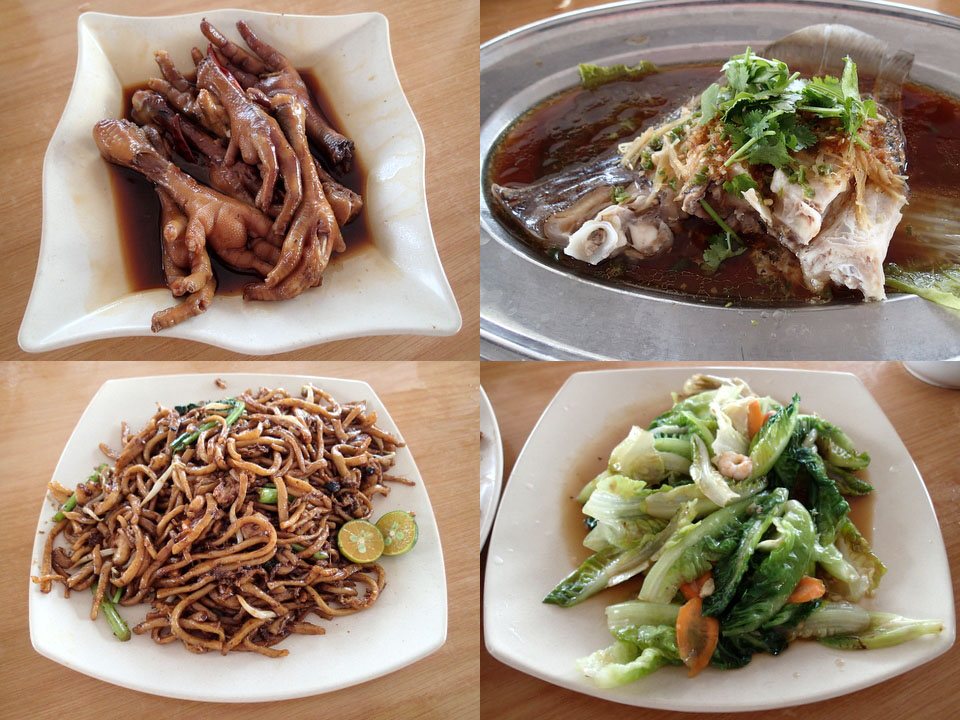
We visited a famous temple near Sekinchan, surrounded by paddy fields, see separate post. And we had dinner in Sg Besar in a restaurant famous for its chicken feet, prepared in a special way, really delicious.

Dinner Sg Besar

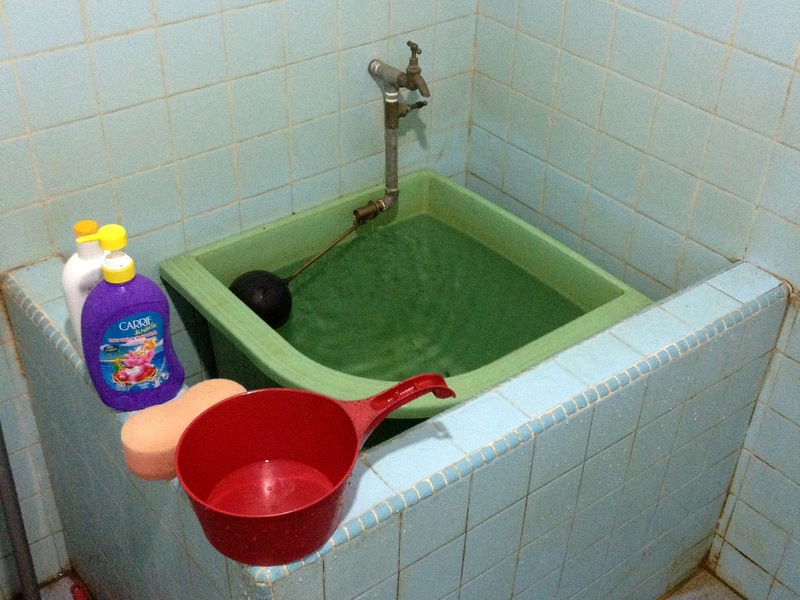
In Aric’s family house you still take a bath in the traditional way, refreshing but quite cold in the morning. So you are really awake after your “mandi” and in the mood to enjoy the beautiful orchids in the garden.

Old fashioned mandiOrchidOrchid

There was a celebration in a nearby temple, with Chinese opera, and offerings by the villagers. See separate post .

Enchanting Chiling

When we arrived at the entrance of the Chiling Fish Sanctuary and saw the crazy number of parked cars, we wanted to turn back and go home!

So many cars

It had been a last minute decision to visit the Chiling waterfall. My last waterfall was Berdebu, more than one month ago. I had hurt my knee on that trip and had been lying low for several weeks, only starting last week my regular Kiara walk. An easy waterfall trip would be a good test for the condition of my knee. I chose Chiling, although I realised that we would not be the only visitors, as this is the most popular waterfall in Malaysia, and only open during weekends.

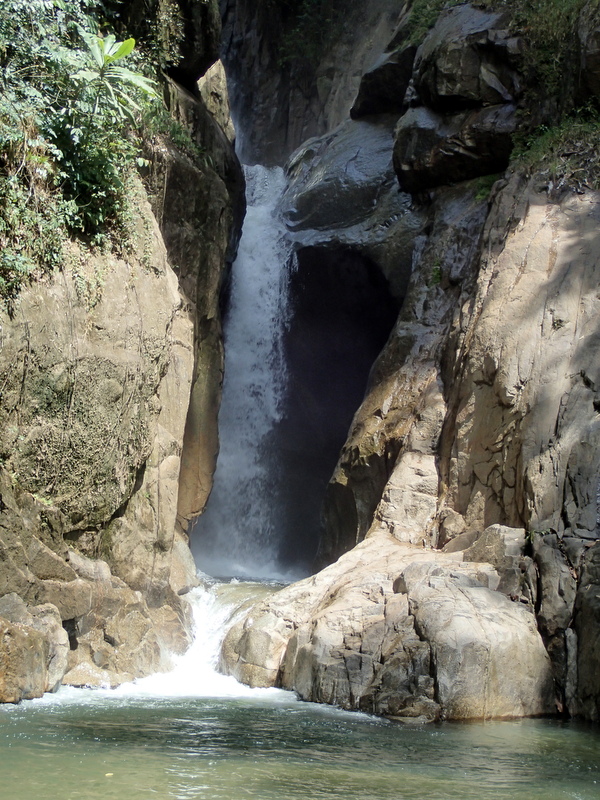
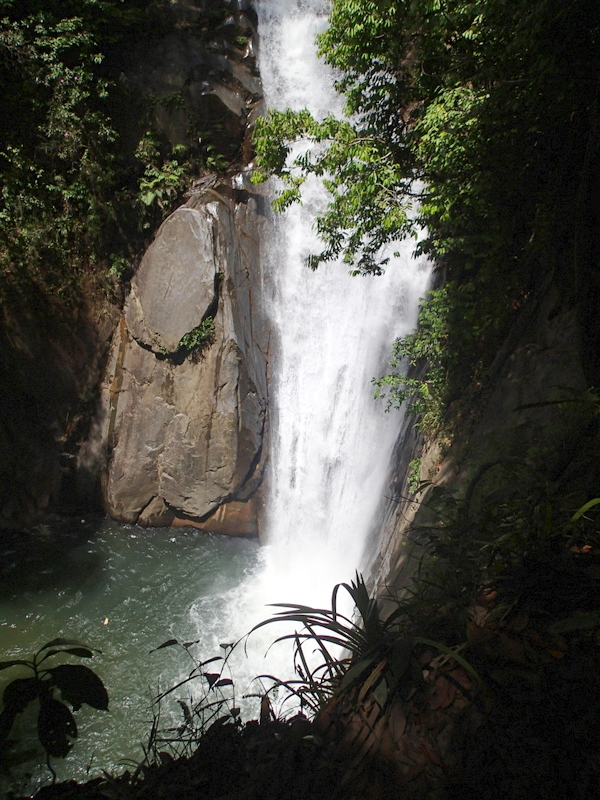
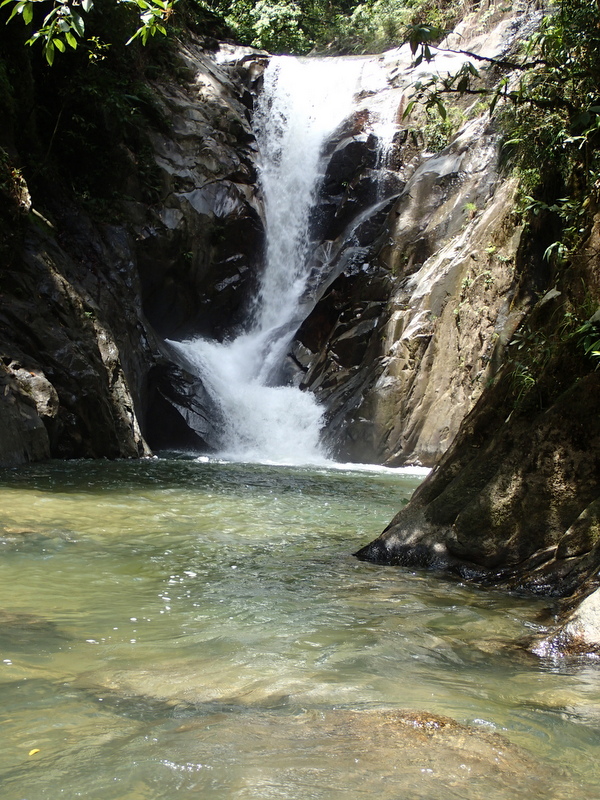
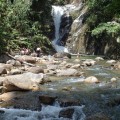
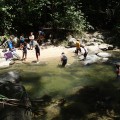
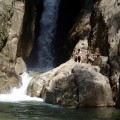
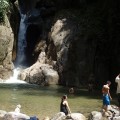
After some discussion (shall we go to Fraser’s hill instead?), we decided to accept the crowd…:-). A good decision, as the crowd was still acceptable and the reward formidable. It was many years ago that I had visited Chiling for the last time, and I had forgotten how beautiful the falls are. Here they are, from left to right the lower (main) fall, the middle fall and the upper fall.

Lower fall

Middle fall

Upper fall

The access to the waterfalls is an adventure in itself, as you have to cross the river six times. After heavy rain, that can be a bit problematic, but this time it was very easy. We skipped the main fall first, a steep scramble brings you to the impressive but inaccessible middle fall and then to the upper fall, much less crowded, as expected.

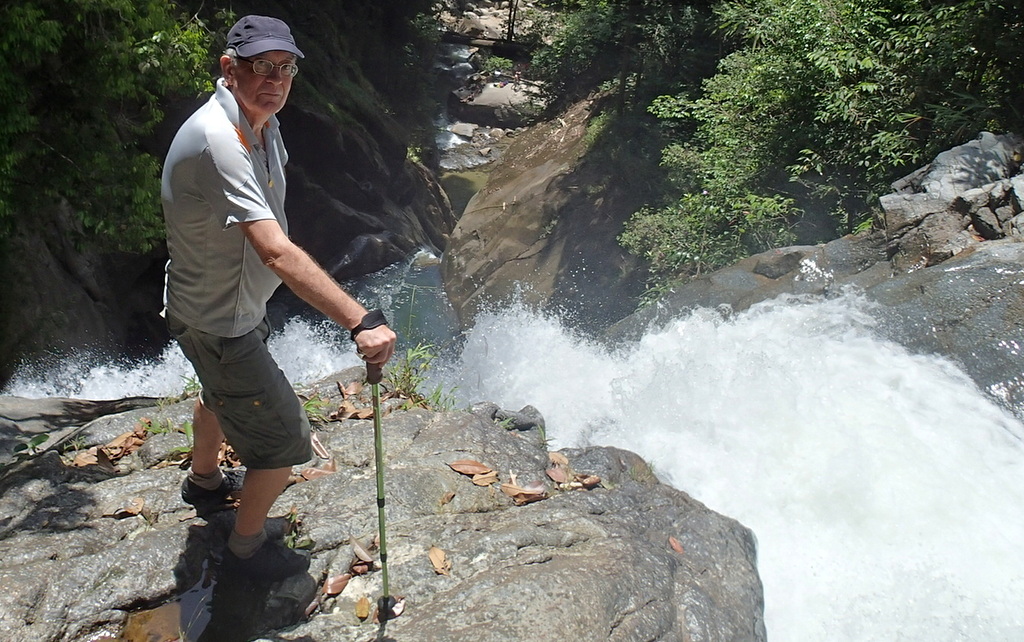
A good place to relax and prepare coffee. You can go (carefully!) to the top of the middle fall, from where you can look down to the bottom of the lower fall. Not advisable when you have fear of height…:-)

View

Here are more pictures of the trip. We started at 11:30 and were out at 14:30, still in time for lunch in Ulu Yam, famous for its loh mee and fish cakes.

A nice trip. And my knee did not give any problems!

Here are two YouTube video clips of the Middle fall and the Upper fall

An Interesting painting

A few days ago, a friend sent me an email with a picture of an interesting painting.

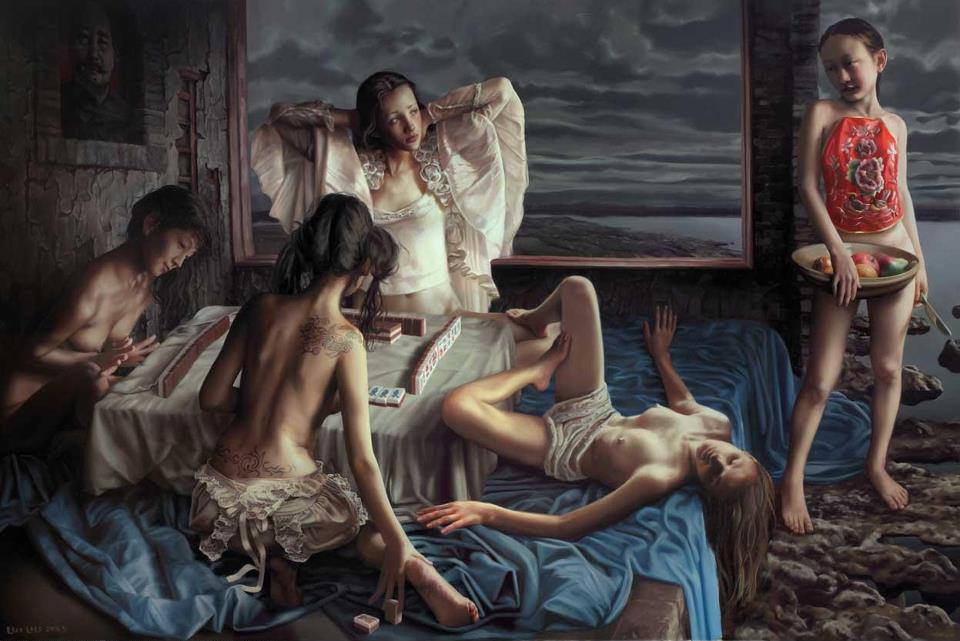
Beijing2008

The painting is a political allegory, for an explanation see below. But first more about the painting and the painter.

The painting is named Beijing 2008 and was created in 2005 by the Chinese-Canadian painter Lui Liu. He was born in 1957 in North China and is now living in Toronto. This painting was sold at an auction last year for more than 3 million US$.

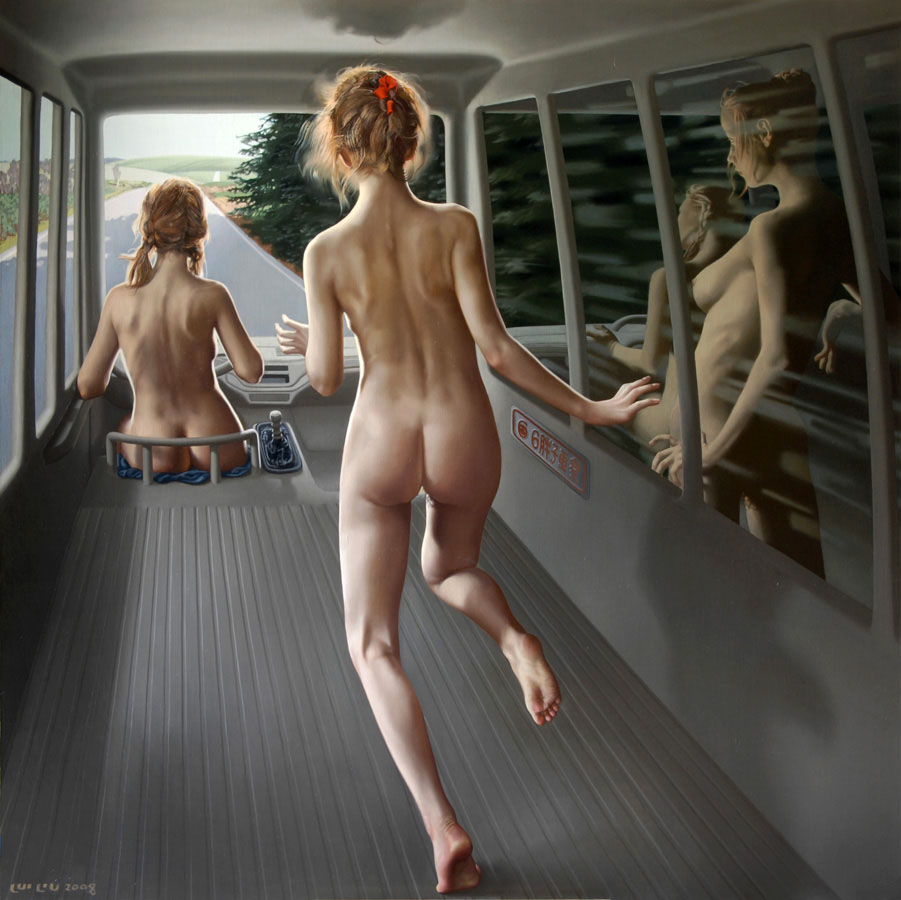
Here is another painting by Lui Liu, “Towards de Future” (2008)

Towards the future

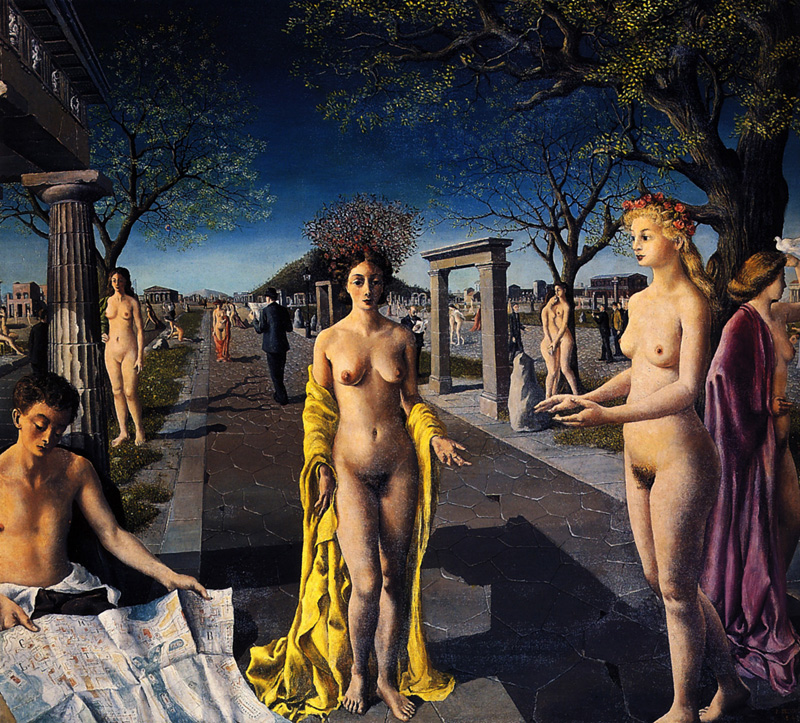
Personally I find his style of painting an interesting mixture of Magic Realism and Surrealism, similar to the paintings of Paul Delvaux (1897-1994), one of my favourite painters. See my Virtual Museum

Here is a painting by Delvaux: The Entrance to the City (1940)

The Entrance of the City

About the allegory, the title refers to the Olympic Games in Beijing, 2008. But in this painting another game is played, Mahjong. Here is the explanation as given in the email.

The woman with the tattoos on her back is China. On the left, focused intensely on the game, is Japan. The one with the shirt and head cocked to the side is America. Lying provocatively on the floor is Russia. And the little girl standing to the side is Taiwan.
China’s visible set of tiles “East Wind” has a dual meaning. First, it signifies China’s revival as a world power. Second, it signifies the military might and weaponry that China possesses has already been placed on the table. On one hand, China appears to be in a good position, but we cannot see the rest of her hand. Additionally, she is also handling some hidden tiles below the table.

America looks confident, but is glancing at Taiwan, trying to read something off of Taiwan’s expression, and at the same time seems to be hinting something at Taiwan.

Russia appears to be disinterested in the game, but this is far from the truth. One foot hooks coyly at America, while her hand passes a hidden tile to China, both countries can be said to be exchanging benefits in secret. Japan is all seriousness while staring at her own set of tiles, and is oblivious to the actions of the others in her self-focused state.

Taiwan wears a traditional red slip, symbolizing that she is the true heir of Chinese culture and civilization. In one hand she has a bowl of fruit, and in the other, a paring knife. Her expression as she stares at China is full of anger, sadness, and hatred, but to no avail; unless she enters the game, no matter who ends up as the victor, she is doomed to a fate of serving fruit.

Outside the riverbank is darkened by storm clouds, suggesting the high tension between the two nations is dangerously explosive. The painting hanging on the wall is also very meaningful; Mao’s face, but with Chiang Kai Shek’s bald head, and Sun Yat-Sen’s mustache.

At first glance, America appears to be most composed and seems to be the best position, as all the others are in various states of nakedness. However, while America may look radiant, her vulnerability has already been exposed. China and Russia may look naked, yet their key private parts remain hidden.

If the stakes of this game is that the loser strips off a piece of clothing, then if China loses, she will be in the same state as Russia (similar to when the USSR dissolved). If America loses, she also ends up in the same state as Russia. If Russia loses, she loses all. Japan has already lost everything.
Russia seems to be a mere “filler” player, but in fact is exchanging tiles with China. The real “filler” player is Japan, for Japan has nothing more to lose, and if she loses just once more she is immediately out of the game.

America may look like she is in the best position, but in fact is in a lot of danger, if she loses this round, she will give up her position as a world power. Russia is the most sinister, playing along with both sides, much like when China was de-occupied, she leaned towards the USSR and then towards America; as she did not have the ability to survive on her own, she had to weave between both sides in order to survive and develop.

There are too many of China’s tiles that we cannot see. Perhaps suggesting that China has several hidden aces? Additionally China is also exchanging tiles with Russia, while America can only guess from Taiwan’s expression of what actions have transpired between Russia and China. Japan on the other hand is completely oblivious, still focused solely on her own set of tiles.
Taiwan stares coldly at the game from aside. She sees everything that the players at the table are doing, she understands everything that is going on. But she doesn’t have the means or permission to join the game, she isn’t even given the right to speak. Even if she has a dearth of complaints, she cannot voice it to anyone, all she can do is to be a good page girl, and bring fresh fruit to the victor.

The final victor lies between China and America, this much is apparent. But look closely; while America is capable, they are playing Chinese Mahjong, not Western Poker. Playing by the rules of China, how much chance at victory does America really have?

Physics Nobel Prize (2011)

The Nobel Prize for Physics in 2011?

But that is long ago, the Nobel Prize 2012 has already been awarded and in October the winners of the 2013 prize will be known!

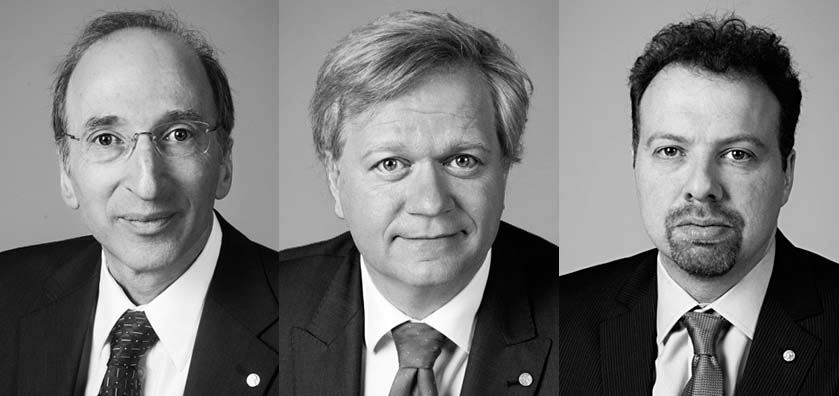
Yes, this post is long overdue, I know 🙂 Every year I am interested, being a physicist myself, who will get the Nobel Prize for physics and for what . And nowadays often I have no idea what it is about :-(, being out of touch with the modern developments for so long already. So I was quite happy that I understood the importance of the discovery made by Perlmutter, Schmidt and Riess in 1998 that our Universe is expanding at an accelerated rate.

From left to right, Perlmutter, Schmidt and Riess

2011_nobel_prize

Of course you have heard about the Big Bang, the primordial explosion that created the Universe, about 14 billion year ago. As a result of this explosion the Universe is expanding and also cooling down. Proof: when we look at faraway galaxies, we observe that they are moving away from us and each other, the farther away the faster they move. And in 1965 the Cosmic Background Radiation was discovered, proof of the cooling down of the Universe.

When I was doing my PhD research, in the seventies, the Big Bang theory was widely accepted. And also that the rate of expansion should decrease with time because of the mutual gravitational attraction between all matter in the Universe. If the Universe contained enough mass, the expansion would finally stop, followed by contraction and ending in what became known as the “Big Crunch” where the whole Universe would again be concentrated in a single point. And might even start again in another Big Bang! An attractive idea in those hippie days!

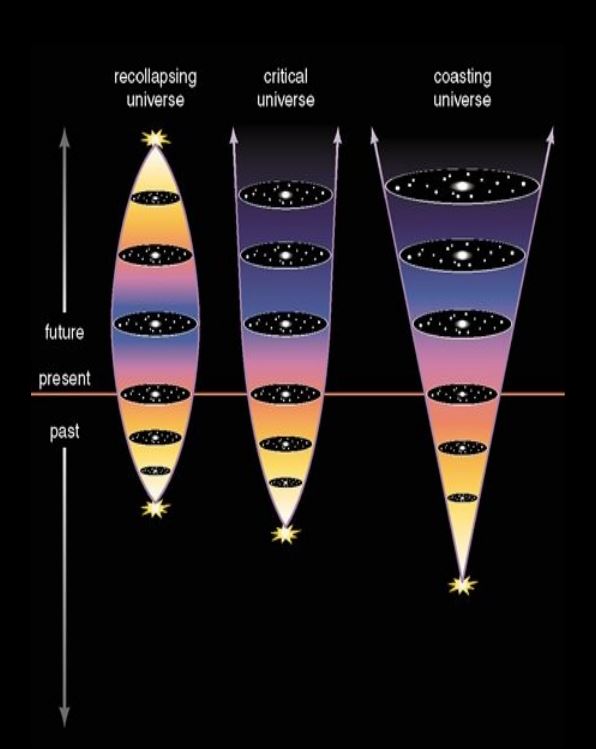
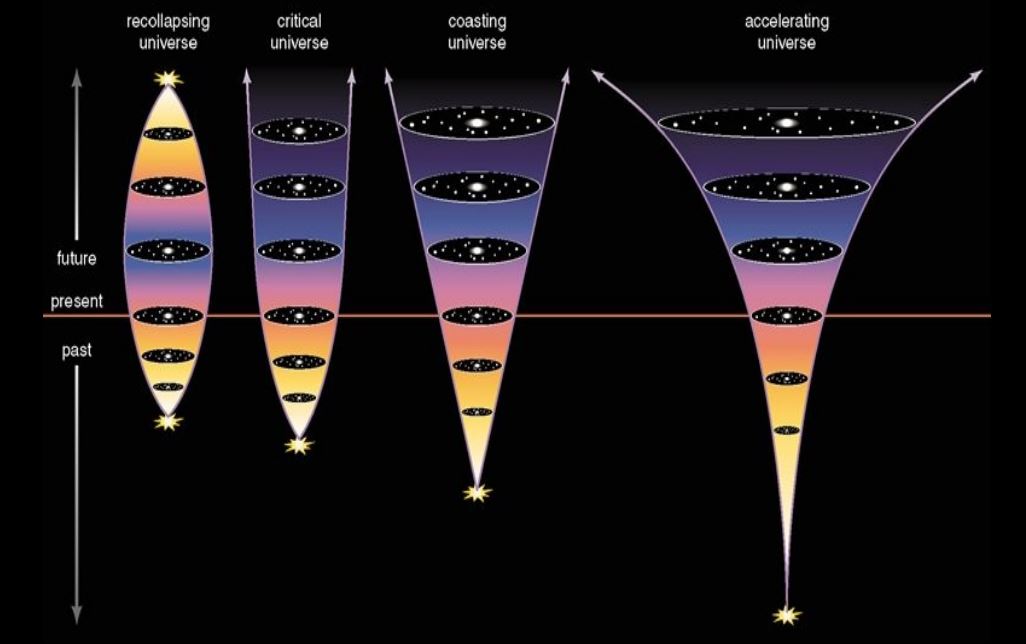
Here are the possible scenarios. In the coasting scenario there is not enough mass to stop the expansion, in the middle one there is just enough mass to stop it (asymptotically), but not enough to reverse the process (as in the left scenario)

future_of_the_universe

The problem was that when you counted all the visible mass in the Universe, there was just not enough to stop the expansion. It was named the “missing mass problem”.

Would it be possible to determine experimentally which scenarios was the correct one? To measure the rate of expansion, you should measure the velocity of very faraway galaxies. Measuring the velocity is not that difficult, you have to measure the Doppler shift. When an ambulance passes you, you will first hear a higher sound of the siren, and a lower sound when the ambulance is moving away from you. For light it is basically the same, here you will see a difference in colour. When a star or galaxy is approaching is, the colour is a bit bluer, when it moves away it will be redder. Measuring the “redshift” gives us the velocity.

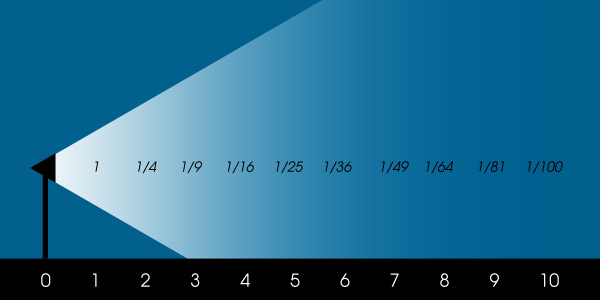
The big problem is how to determine the distance to such a faraway galaxy! The technique used in astronomy is based on the fact that light from a light source becomes more spread out when the distance is larger. Probably every photographer is aware of this “inverse-square law”

inverse square law

So if you know how “strong” the light source itself is, you can determine the distance by measuring the amount of light at that distance. But how do we know how much light a star really produces? In general that is impossible, because you have big bright stars and small, not so bright stars.

What the Nobel Prize winners did was looking at very special events, so-called (type 1A) supernova’s. A supernova is a star that explodes at the end of its life. During a few days/weeks it can produce more light than a whole galaxy. And the intensity of this light is basically the same for each supernova explosion (of type 1A). They are extremely rare events, it is estimated that in our own Milky Way they occur only a few times in a century! But when they occur, they are so bright that they can even be observed in very distant galaxies. And there are so many galaxies.

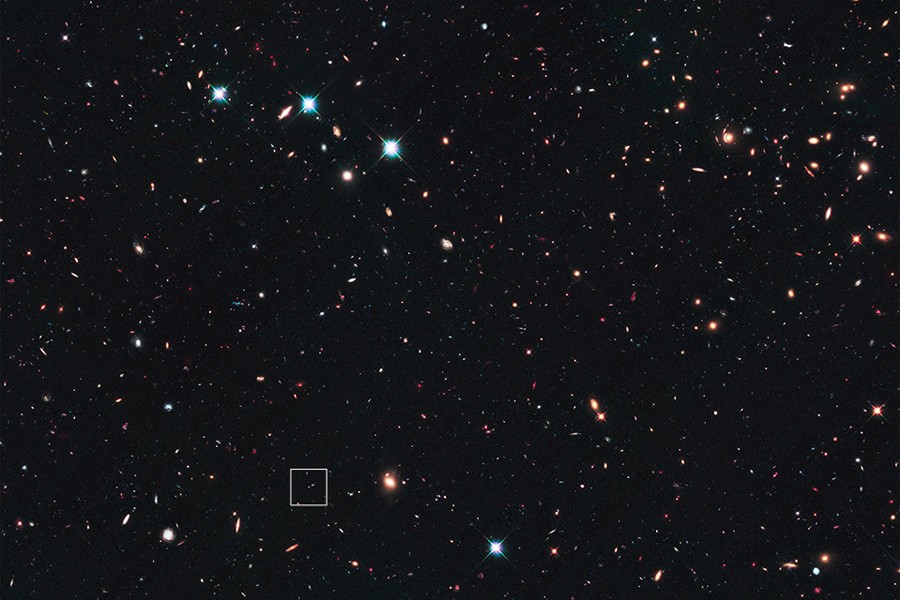
Finally we can now explain the research done by the (competing) teams of Perlmutter and Schmidt & Riess. They looked for type 1A supernovas in distant galaxies and determined the distance and the velocity. To show you how complicated this kind of research is, here is an image of a recent supernova discovery, SN Wilson. In this image a few bright points are stars, but many are galaxies. The tiny square contains the galaxy with the supernova.

supernova

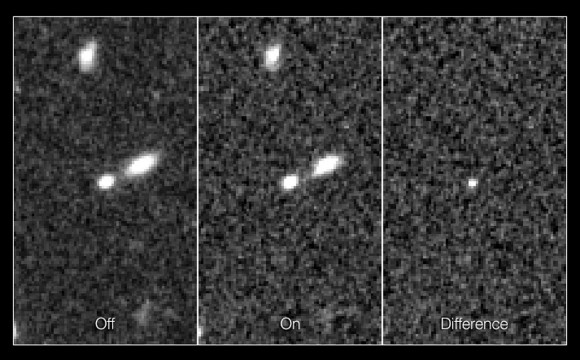
Here are three enlarged images of this tiny square. The galaxy is the round spot in the center. Left image shows the situation before the supernova exploded, in the middle one the supernova has exploded. You don’t see any difference? Let the computer “Subtract” the left image from the middle one and you get the image to the right! Voila, the supernova ..:-)!

Before and after

These images, taken by the Hubble telescope were taken by the team of Riess in 2010. The distance is 10 billion light year, which makes this galaxy the most distant one, observed until now.

As the light of this galaxy needed 10 billion years to reach us, we observe it now as it was 10 billion years ago! Looking far away means looking in the past. The scientists expected to find that in the past the expansion of the universe would be faster than it is now, as explained in the beginning of this post.

What they actually found, shocked the scientific world: the expansion of the Universe was accelerating . It was so unexpected that it was very fortunate that two research teams came to the same conclusion.

So there had to be a repulsive force, stronger than the attractive force of gravitation. This repulsive force is now named “dark energy” but we still have no clear idea what it is.

It is for this discovery that the two teams shared  the Nobel Prize.

The three scenarios, mentioned above are all wrong. It is the fourth scenario, shown below, that we now believe to be correct. There is even a possibility that this acceleration will increase so dramatically with time, that the Universe would end in a Big Rip, where finally, stars, planets, even atoms would be ripped apart.

accelerating universe

Much progress has been made since 1998, especially in the analysis of the Cosmic Background Radiation. It has confirmed that there is a repulsive force, now named “dark energy”. It has also confirmed that there is a lot of invisible matter in the Universe, now called “dark matter”. In both names “dark” describes our ignorance, at the moment we just do not know what they are. I am planning to write a separate post another time about this topic.

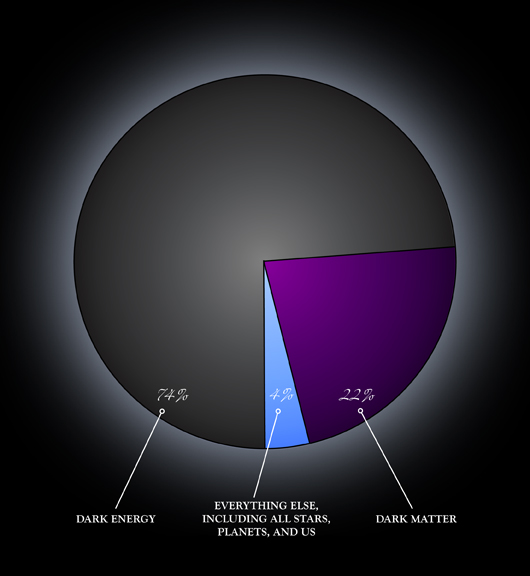
Let me end this post with an image that gives the distribution of “normal” matter, dark matter and dark energy in our Universe. I have seen this kind of picture numerous times, and I still find it shocking.

darkenergy_pie

The stars, the planets, humans, everything is made of normal matter: protons, neutrons, electrons. We know a lot about it.  But it is only 4% of our Universe. About the other 22+74 % we know next to nothing at the moment!

If I could start a new life now, I would choose astrophysics and cosmology as my field of study…:-)

Several images above have been taken from this very interesting set of lecture notes.

Penarikan recce

It must have been about five years ago that I heard or read for the first time about the Bahau Penarikan. Bahau is a small town in Negeri Sembilan and a penarikan is the Malay word for a portage. A portage is the process where a boat is “carried” overland from one waterway to another. In my native country, with its many separate canals and rivers it was a common procedure.

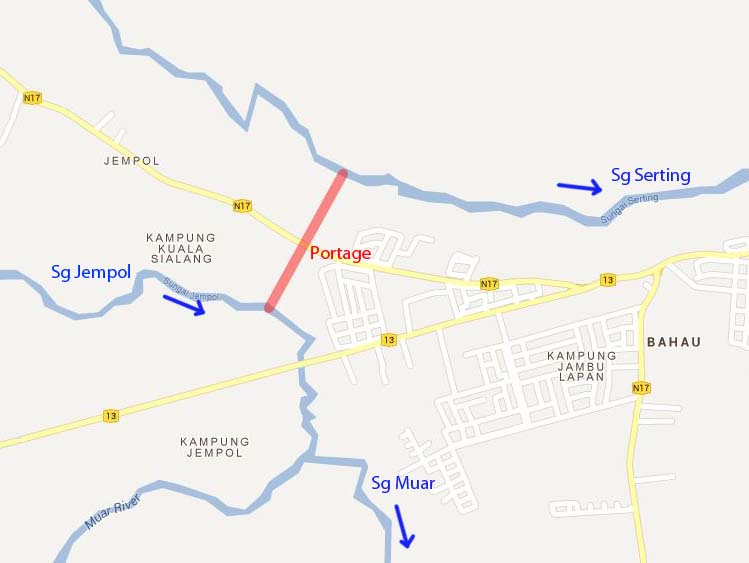
In Bahau it is a portage over a distance of less than 1 km between the Serting river and the Jempol river. Or better, it was, because we are talking about the past, many centuries ago!

Bahau portage

The Bahau penarikan is unique in that it basically connects the West Coast of Malaysia (the Straits of Melaka) with the East Coast (the South China Sea)!

Because the Serting river flows into the Bera river, which flows into the Pahang river, which reaches the South China Sea at Pekan.

And the Jempol river connects, close to Bahau, with the Muar river, which reaches the Straits of Melaka at Muar.

In the 14th century merchants discovered this connection as an alternative to the long and dangerous route around the Malay peninsula.

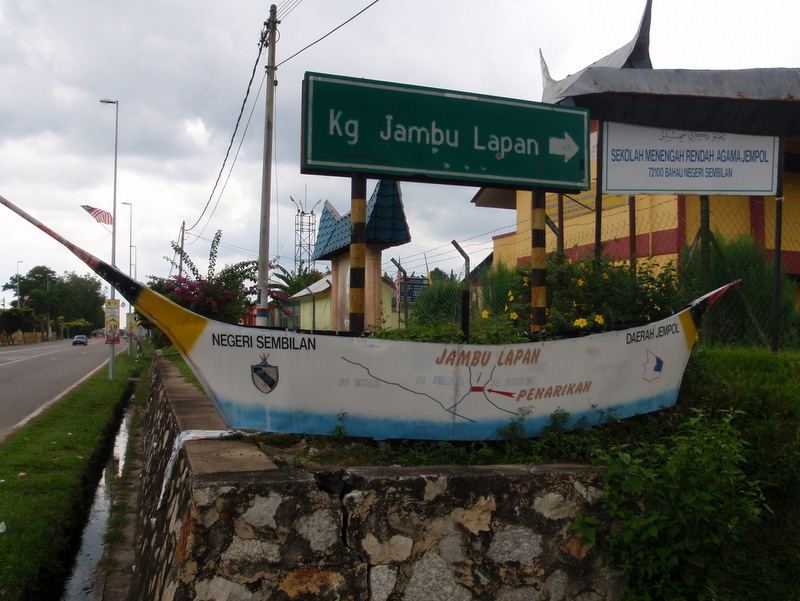
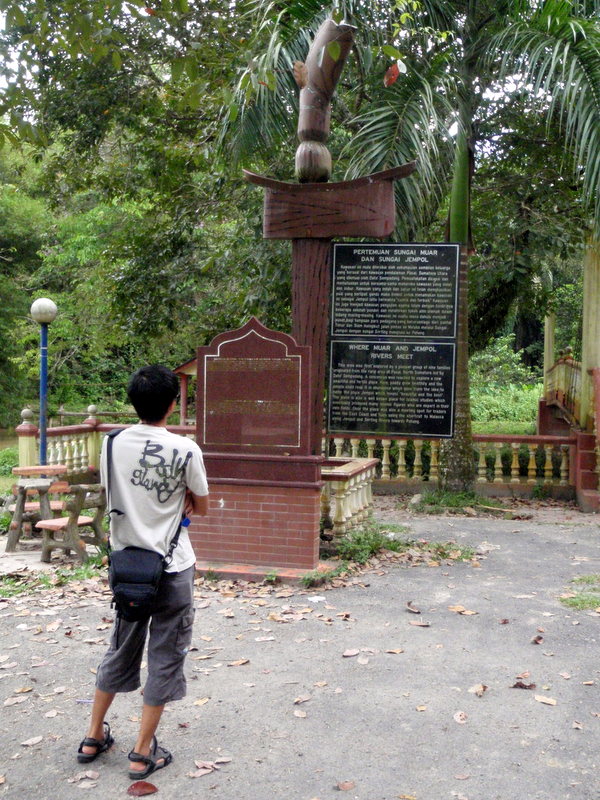
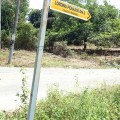
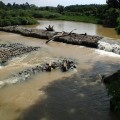
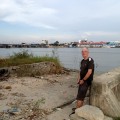
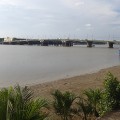
When I read about this, I wanted of course to have a look myself, so we went to Bahau. We found a road sign in the form of a boat and a rundown small memorial park. The Bahau penarikan predates the Malay sultanate of Melaka, so unfortunately there is not much official interest in it. We also had a look at the Serting and Jempol rivers, both small streams. Of course no trace anymore of the portage.

OLYMPUS DIGITAL CAMERA

OLYMPUS DIGITAL CAMERA

That was five years ago. I more or less forgot about the Bahau penarikan, until Chadel, a friend of mine, told me recently that he was planning to paddle by canoe or kayak from Muar to Pekan, using the Bahau portage! For this ambitious project he wanted to do a recce first, checking the portage region, finding a suitable “put in” location in Muar, and a “take out” location in Pekan. Of course I was eager to join him in this recce..:-)

Chadel decided that we would first do a recce from Bahau to Muar, then later a second one from Bahau to Pekan.

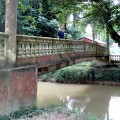
It was a very pleasant trip. In Bahau I showed him the memorial park, but I could not find the sign board anymore, maybe it has been removed. Near the confluence of the Jempol and Muar rivers they were doing construction work for the nearby water treatment plant, but according to Chadel that would be no problem. We checked the rivers at several places to find a place where taking out a canoe would not be too difficult. Have a look at the Google Map.

The green markers are where we had a look at the rivers. Clicking on a marker gives a picture of the river. The two red ones are probably the most suitable ones for the actual portage. When you zoom out, you will find a few more green markers, on our way too Muar we crossed the Muar river a few times. You will also see a number of blue markers, where the Serting and Bera rivers are accessible from the road. That is something for our next recce.

Here is a series of pictures taken during the trip

After lunch in Bahau we drove to Muar, choosing our route so that we would cross the Muar river a few times. When you zoom out in the Google map, you will see the extensive meandering of the rivers. Chadel estimates that he has to paddle about 540 (!) km and is planning to do that in about three weeks. In Muar we found two suitable start locations.

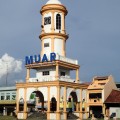
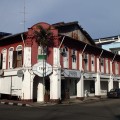
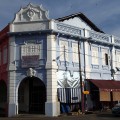
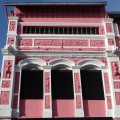
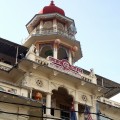
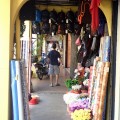
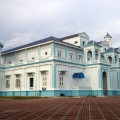
I had been in Muar only once before, quite long ago. I was pleasantly surprised by the town. Characteristic Chinese shop lots, a beautiful mosque, I must come back here soon. A few more pictures.

It was a long day, but very rewarding as we met all our objectives.

Looking forward to part two!

Journal 5-7-2013

Some mixed news

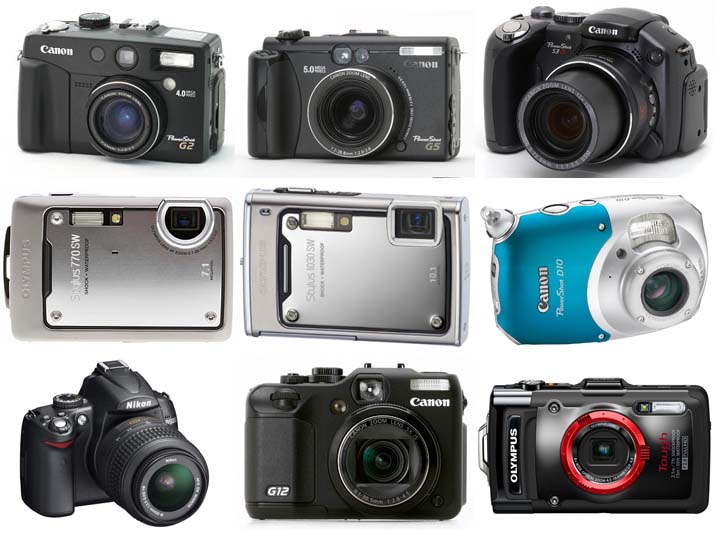
I bought a new camera. Again?,  you may ask. Yes. I am not very careful with cameras and I also use them often under difficult conditions, near waterfalls, crossing rivers, etc.Here is a collage of the cameras I have been using the last ~10 years. Most of them are no more. Only the Nikon 5100 DSLR is still ok. Nice camera, but bulky, not suitable for jungle trekking.

my cameras

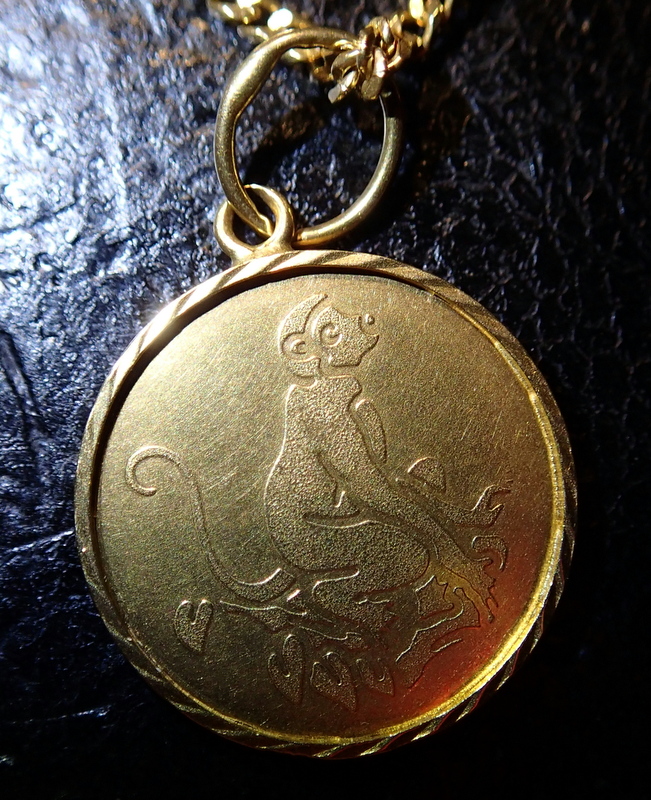
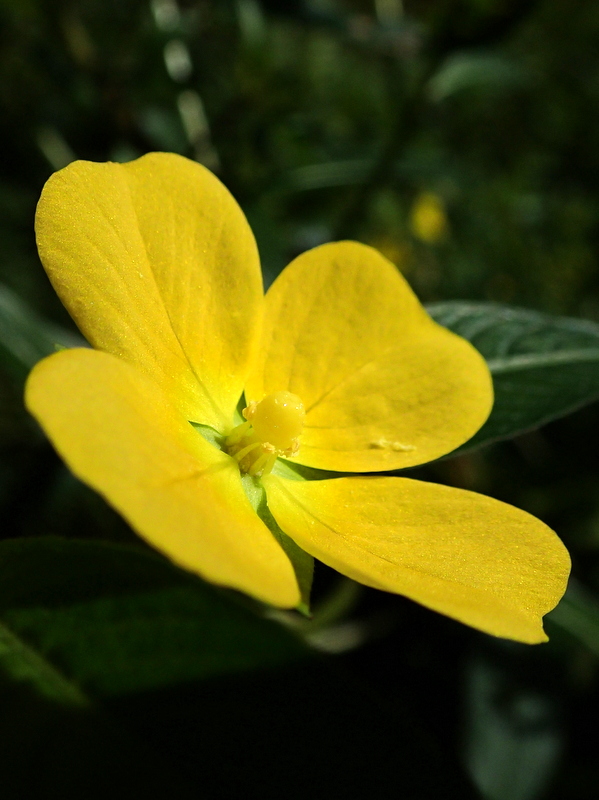
The last addition is the Olympus Tough TG2. A water- and shockproof camera. I am still testing it. It has a nice Macro option. Here are two examples

FlowerPendant

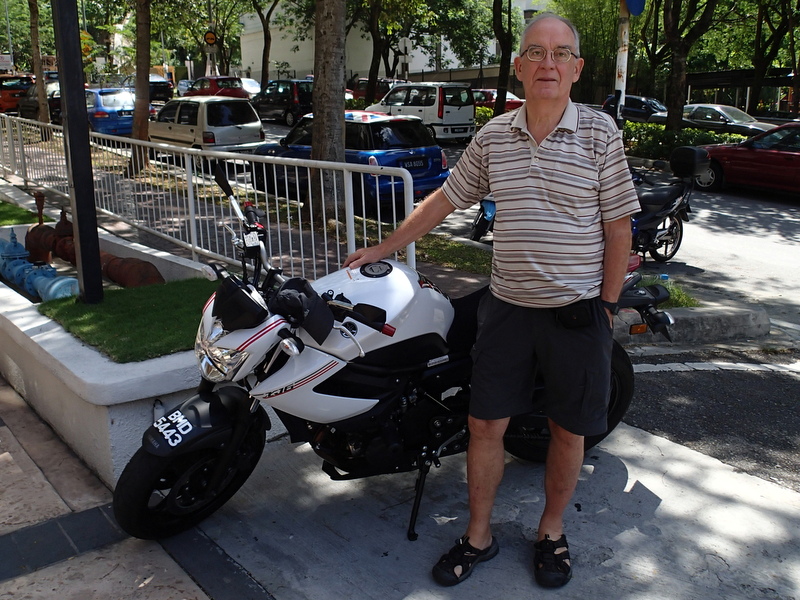
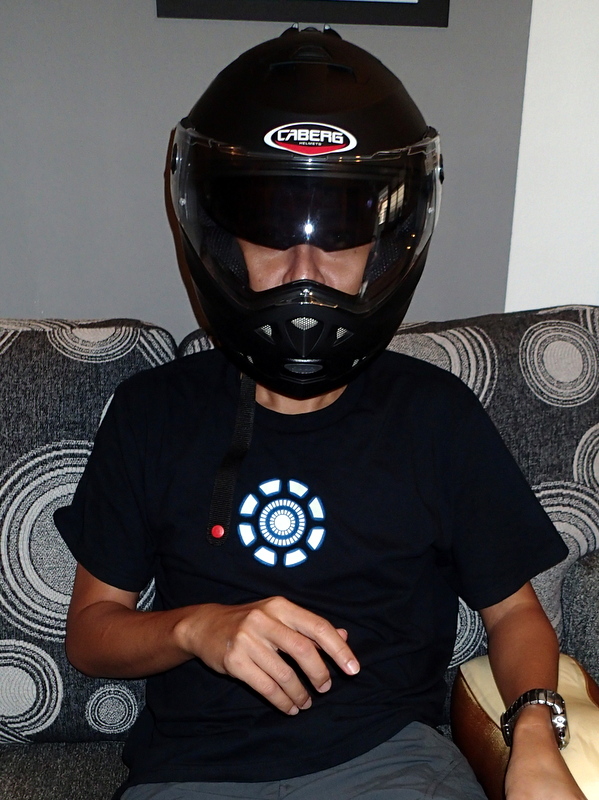
Last week our friend Rani invited us for dinner. He recently bought a “big” bike. Here I am posing as the owner..:-)  And Aric of course has to try the helmet.

Me and a bikeAric and helmet

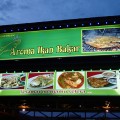
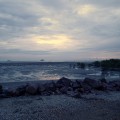
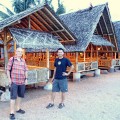
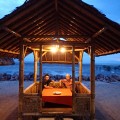
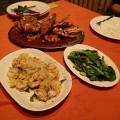
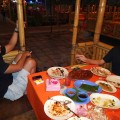
We had our dinner in an Ikan Bakar restaurant at the seaside, in Jeram. You first had to choose the seafood you would like to have. The restaurant is popular and can be crowded. Rani had booked in advance, so we had a “private” dining room! Here is a collection of pictures

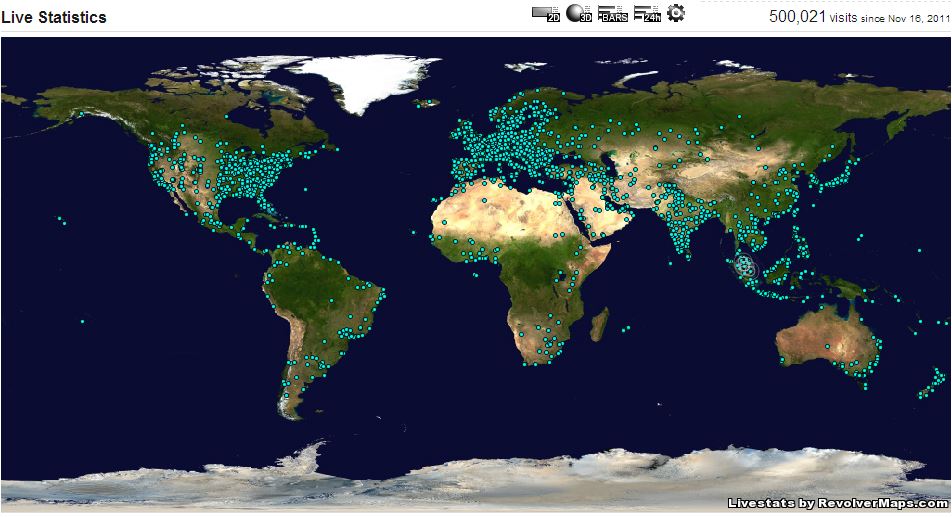
As I have mentioned in an earlier email, I monitor the traffic on my waterfall website, since November 2011. A few days ago the visitor count reached 500.000, on average 800-900 visitors daily. Half a million visitors from 173 different countries (of course mainly from Malaysia and Singapore).

WoM-visitors

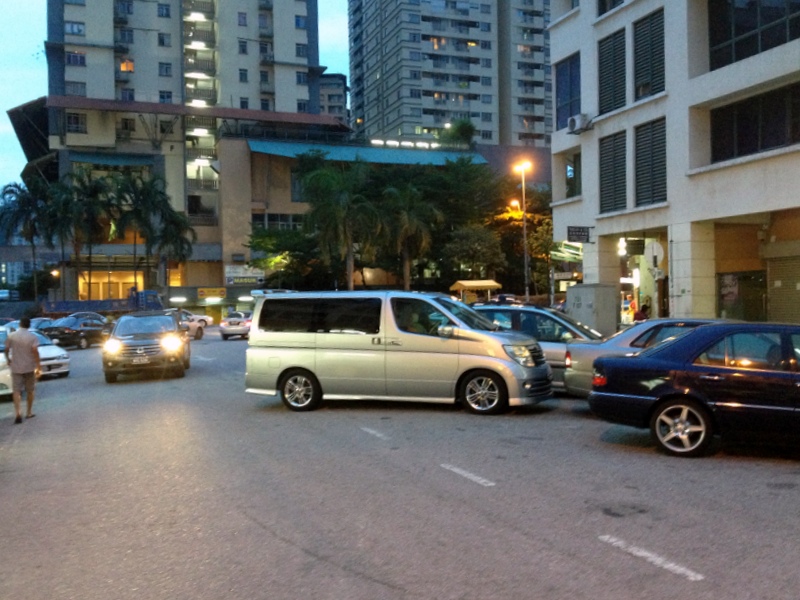
In another post I mentioned the Malaysian way of parking in a crowded area: far away from the curb, to avoid that you will be blocked by double-parked cars. Here is a crazy example of such a double-parked car, a big one, blocking more than half of the road. Malaysia boleh!

Double parking