Elusive Batangsi

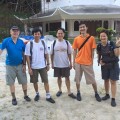
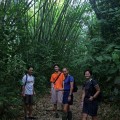
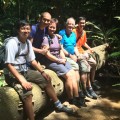
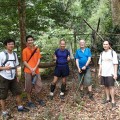
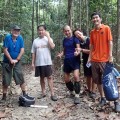
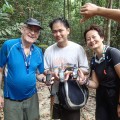
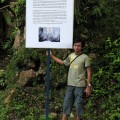
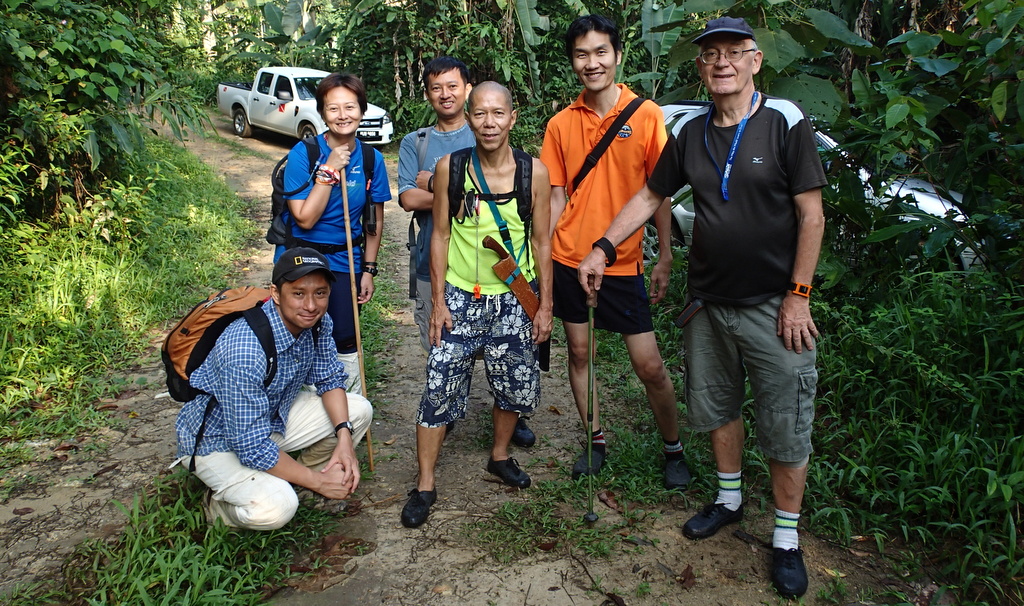
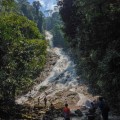
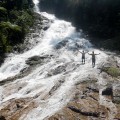
In my last Journal I mentioned an unsuccessful hike to a remote waterfall, where we went back because I felt “discomfort”. After my cardiologist had given me a clean bill of health, of course I wanted to go back and give this Batangsi waterfall another try..:-) This time with Aric, Edwin, Janine, Nick and Siang Hui as our guide. We met at Sg Long for breakfast, after which we bought our lunch at the lively pasar pagi.

Before I start the report about our hike, it may be useful to explain first why we are so interested in the mysterious Batangsi waterfall…:-) Here is a Google Map of the region (click to enlarge). At the top you see part of the Semenyih reservoir. The green marker gives the location of the well-known Nirwana Memorial Park and to the right you see the border between Selangor and Negeri Sembilan. And in the middle of nowhere there is a marker for the Batangsi Falls!

Could there really be a waterfall there, or is it just a mistake of the map maker? On the topo map of the region there is no mention of a waterfall.
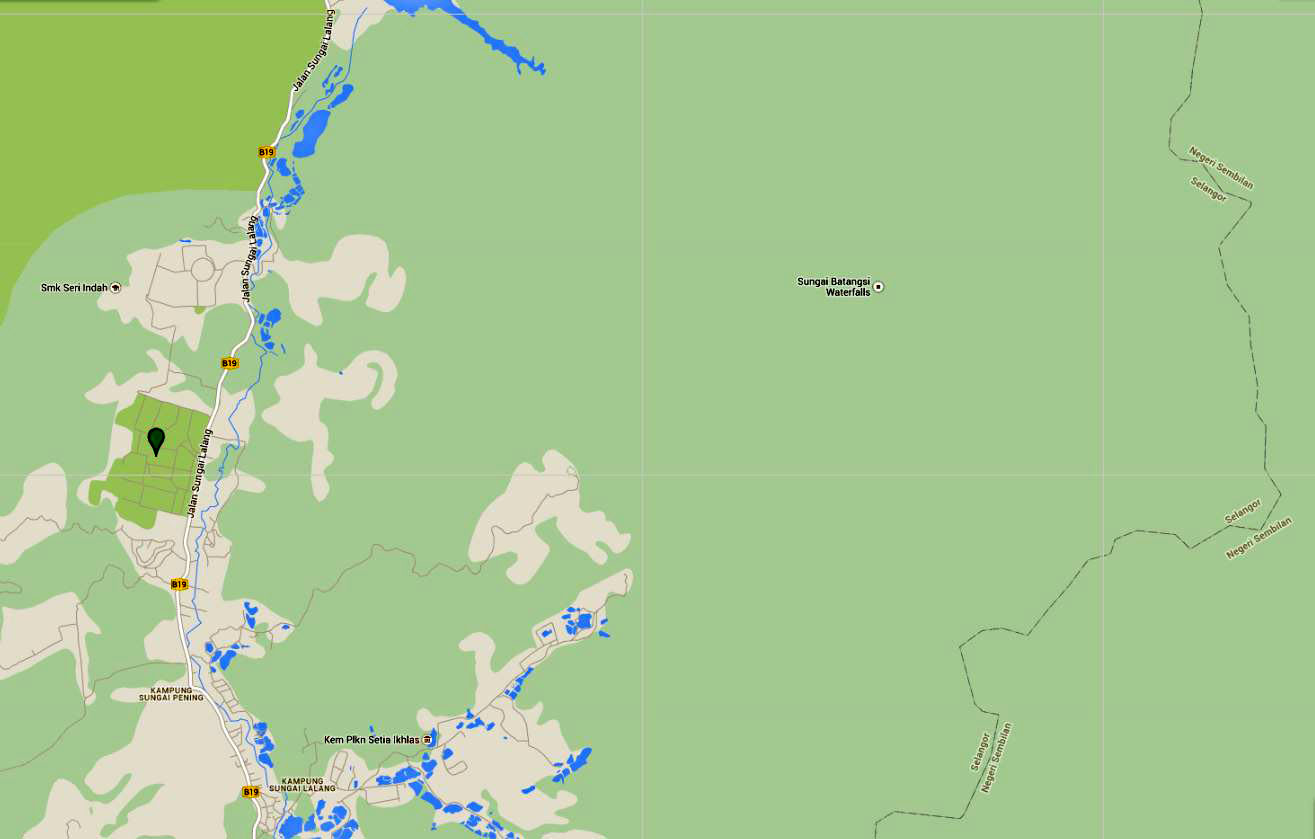
Google Map

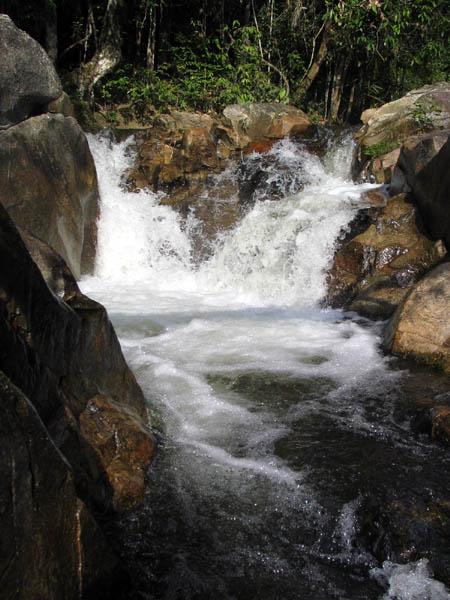
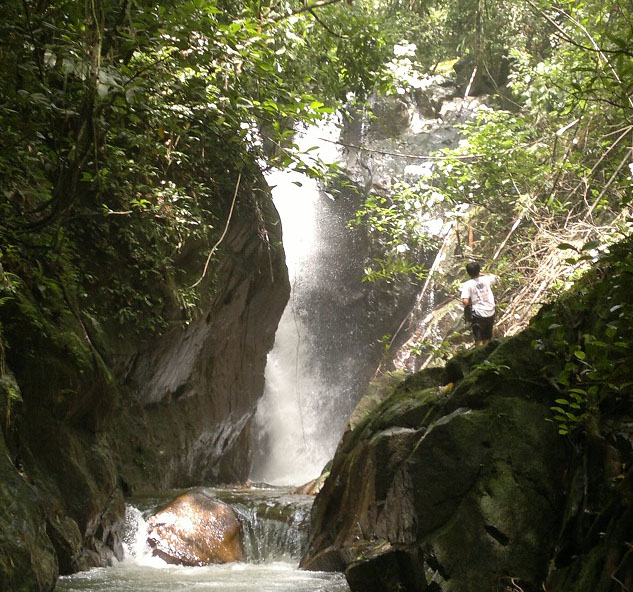
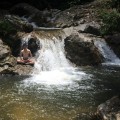
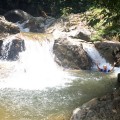
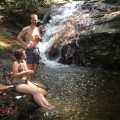
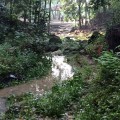
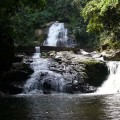
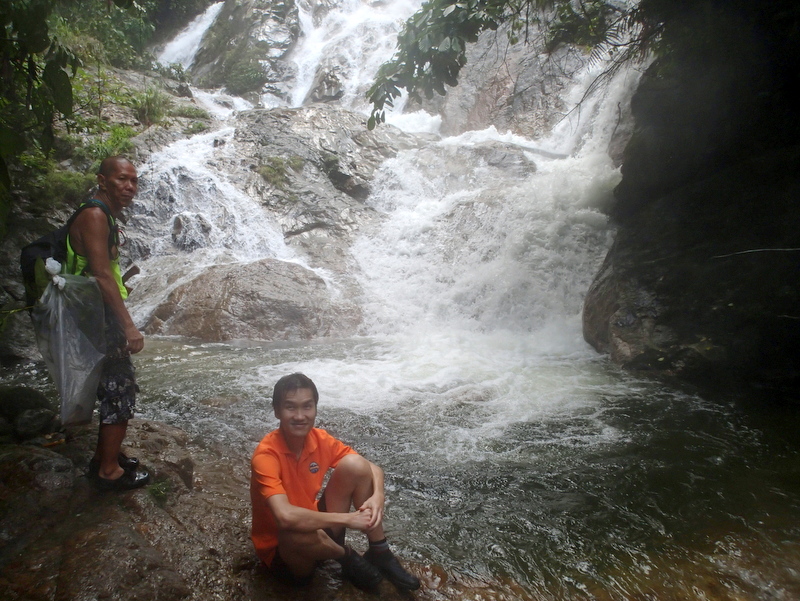
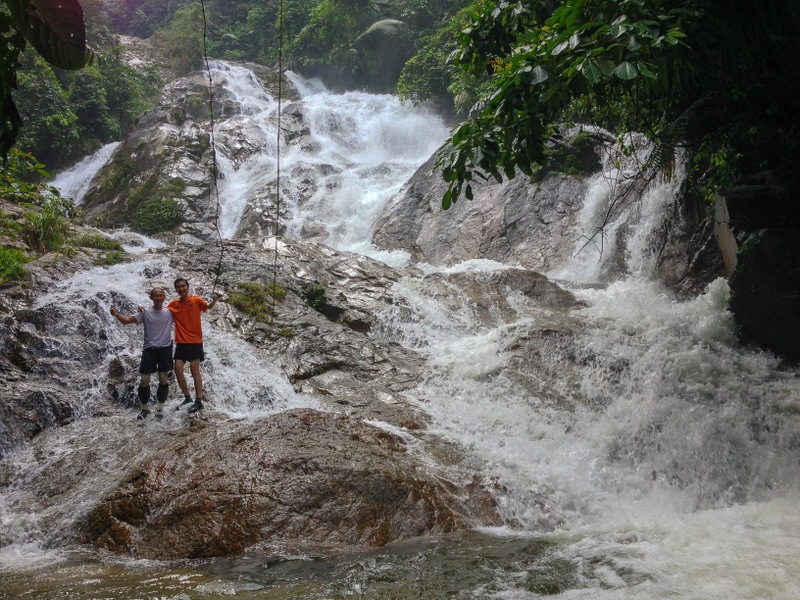
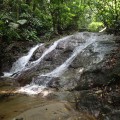
Intrigued by this mysterious fall, we have been exploring the region several times during the last ten (!) years. We found the Batangsi river with a few cascades and small waterfalls. It resulted in a webpage Batangsi Fall on my Waterfalls of Malaysia website. Here are two of the small waterfalls/cascades we found.
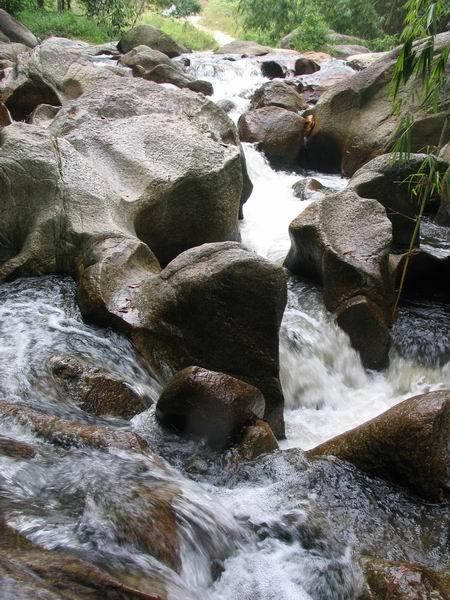
Batangsi

Batangsi

Were there more waterfalls upstream? In 2008 I joined Aurelius and his friends, we followed a farm road until the end. From there we river trekked upstream for about three hours. Nice hike but no waterfalls.
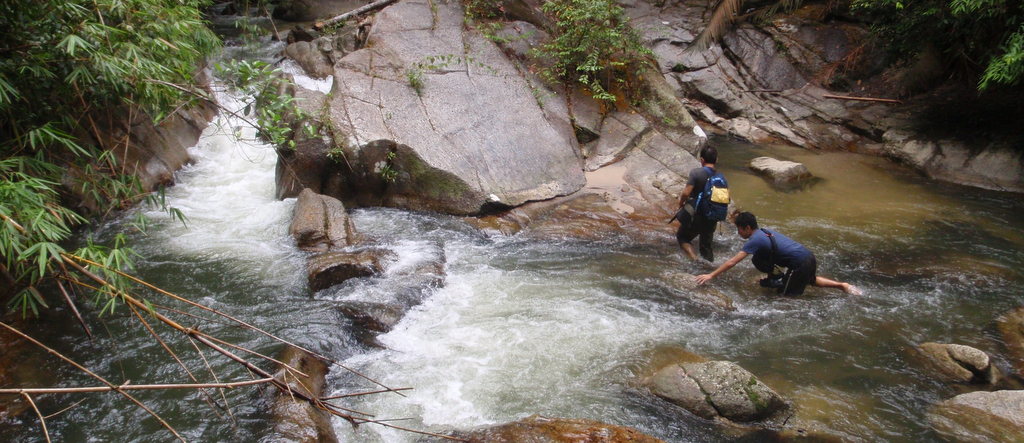
Batangsi Aurelius

Here is a Google Map with our hike. Black is the farm road, blue the river trekking.
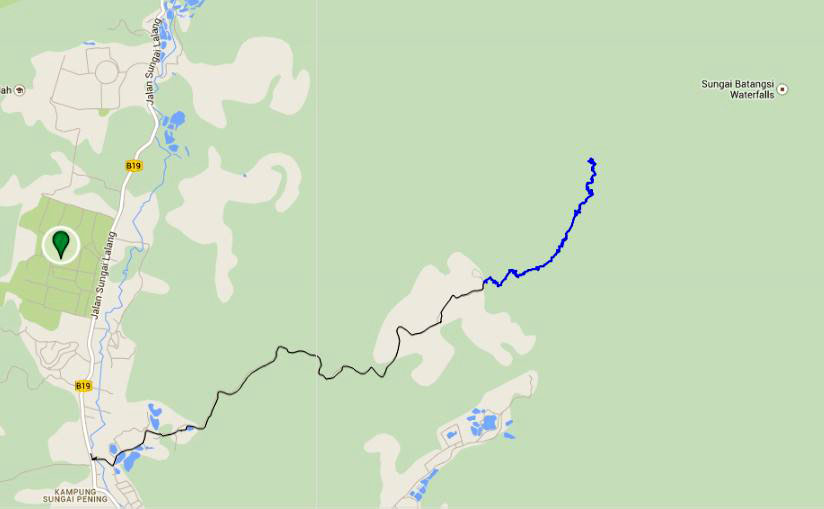
Google_Aurelius

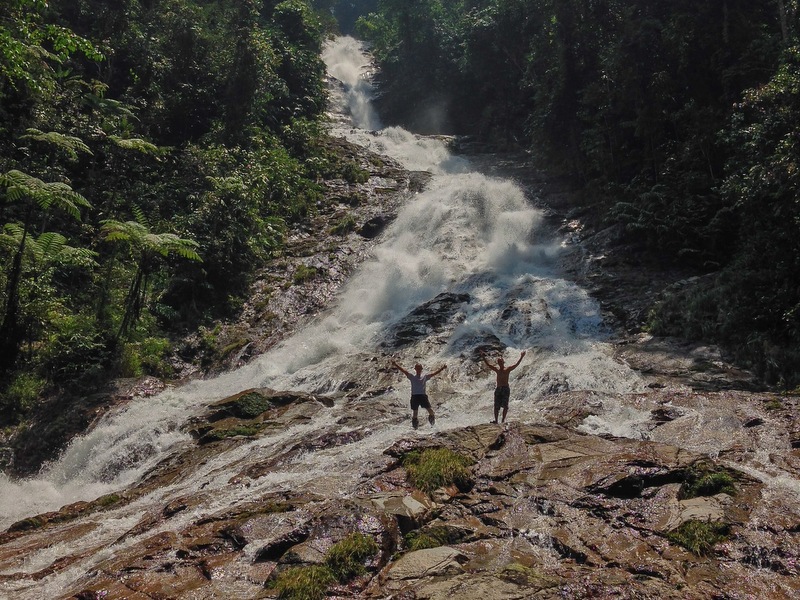
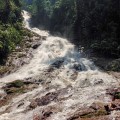
In 2012 Siang Hui and Harry (†) did another hike, following the river much further. Coming to a split in the river, they decided to follow the right branch and finally found a real waterfall…:-)
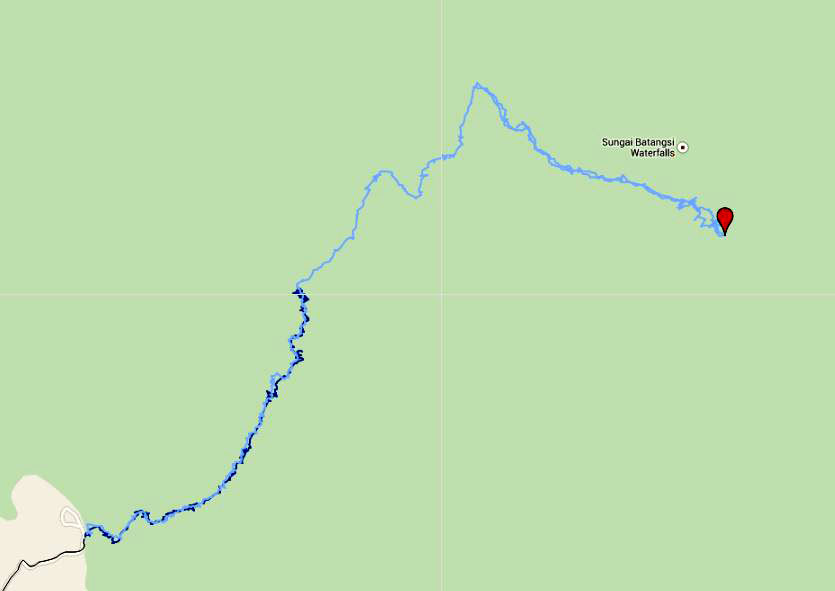
Google_SH_Harry

Batangsi Fall

During this hike they had come to a split of the Batangsi river and decided to follow the right branch. Could there be another waterfall in the left branch? Studying the contour lines of the topo maps, Siang Hui thought there might be one.

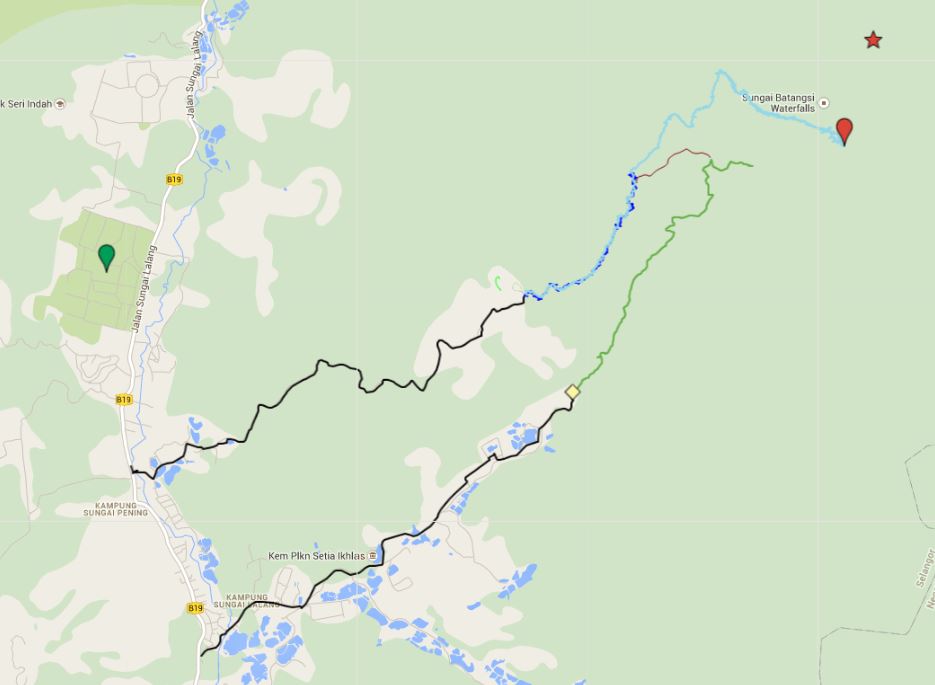
When you look at the first map picture in this blog, you will notice that there are two farm roads leading inland and for our next recce we took the other one. It ends at a temple, from where a clear trail starts. Unfortunately I did not feel well after about one hour hiking , so we turned back. Here is a Google Maps screenshot. The possible waterfall is marked with a red star.
Another Recce

The yellow marker indicates the location of the temple. As you see our hike (green track) brings us quite deep into the interior! On our way back we went down to the river for a bath (brown line)

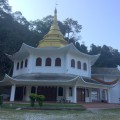
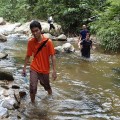
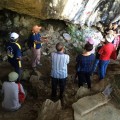
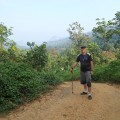
After this “longish” introduction, here is the report about our latest hike. Again we followed the farmroad, passing flower and vegetable farms, until we reached the impressive Buddhist temple.

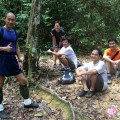
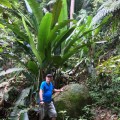
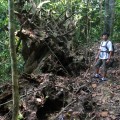
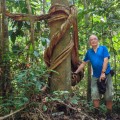
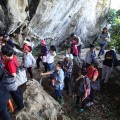
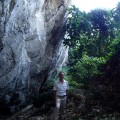
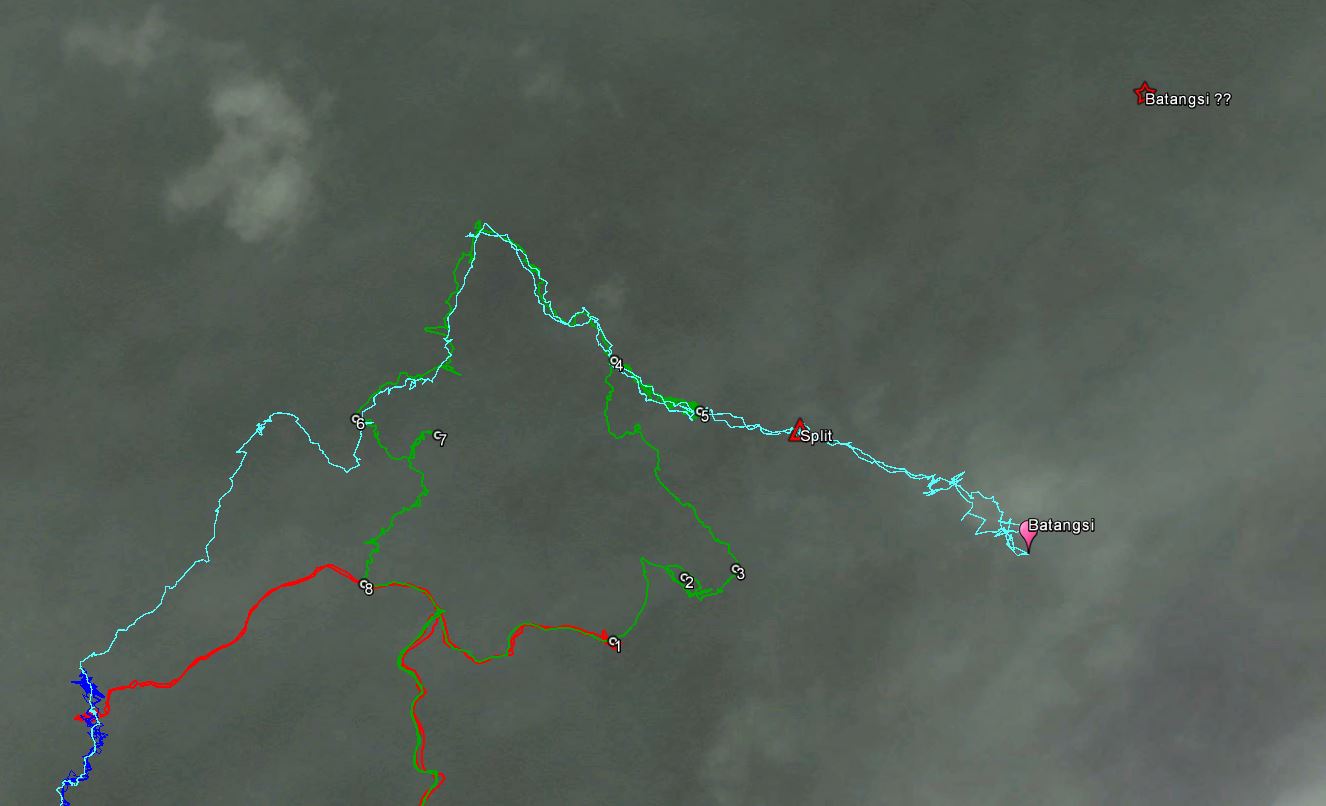
We started our hike from the temple at 9:15 am and were back at 5pm. It was an interesting, tough hike, but we did not reach the waterfall! However, we have now a clear idea how to proceed on our next, and hopefully final hike…:-). Here is our hike (in green) on Google Earth, only the main part is shown  (click to enlarge) and I have numbered a few points of interest. The coloring is a bit different, dark blue is my trip with Aurelius, light blue the hike of Siang Hui and Harry and red our aborted hike.
Our hike

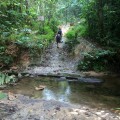
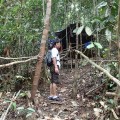
From the temple it took us about one hour plus to reach point (1) where I went back during our last recce. Until there the trail was well kept so we were expecting that from there it would continue. But after another half hour hiking, the trail disappeared (2). We backtracked  to see if we had missed the trail, but it was really gone.

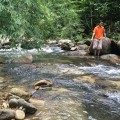
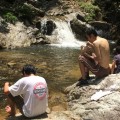
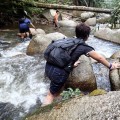
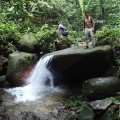
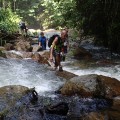
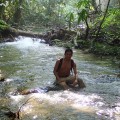
From that point Saing Hui had to do a lot of chopping. After a while we reached a small stream (3) and we decided to follow it back to the Batangsi river. In retrospect that was a mistake, as we were only about 400 meter away from the river split we wanted to reach. After we reached the river (4), we trekked upstream to a small waterfall where we had lunch and a bath (5).

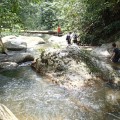
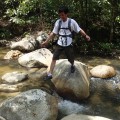
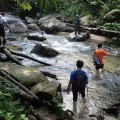
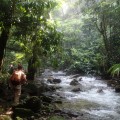
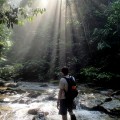
It was already getting late and we decided not to continue, but river trek back. River trekking is fun, but also slow, so when we reached a run-down biker camp (6) near the river, with a trail going uphill, we decided to take that trail.

Also here we lost the trail and it took us quite a long time, after even going in a completely wrong direction (7) for a while, to reach the logging road (8)!

We were very lucky with the weather during this trip. It was only a few hundred meters before reaching the temple that a downpour started. And a real downpour it was…:-)

Siang Hui and Nick had to go back home early, so it was only the four of us who could enjoy a delicious seafood dinner in Semenyih.

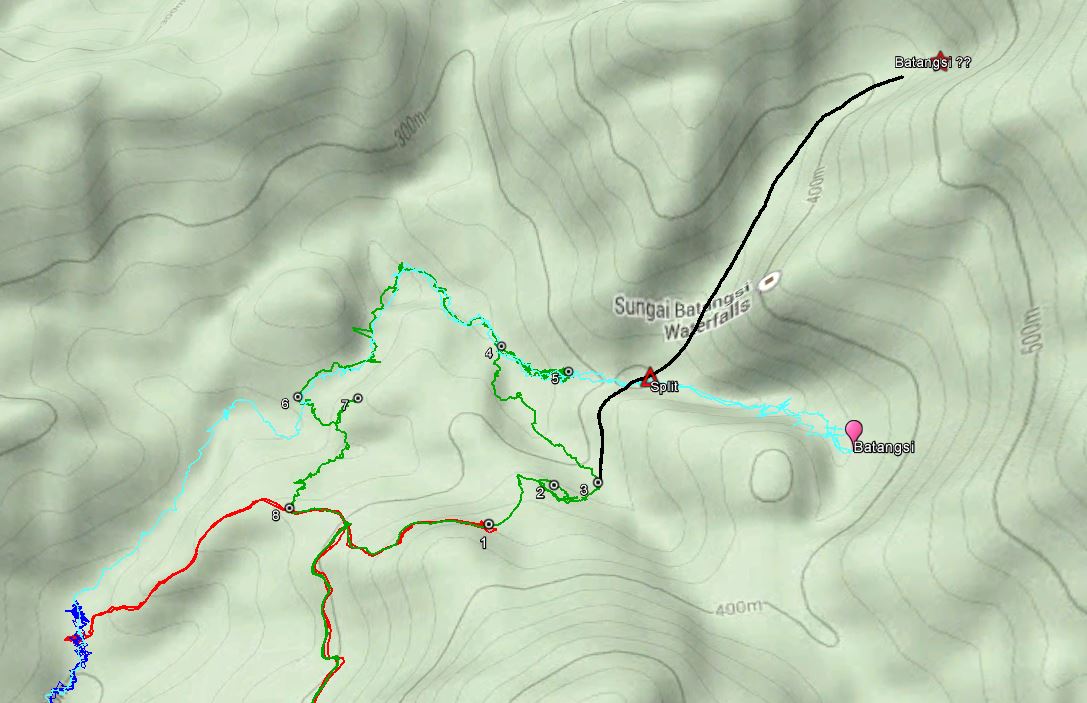
A memorable trip. We are thinking about a (hopefully) final attempt. After reaching the small stream (3) not following it but chopping our way to the confluence. From there river trekking. Then basically the same way back. The black line in the map below.

Next recce

Journal 1-9-2014

Time flies. My last journal was published seven weeks ago, just after I came back to Malaysia. After recovering from jet lag (not so difficult this time), I settled down in my usual routine. A morning walk in Bukit Kiara followed by breakfast (RM 1 only!) at IKEA. Spending a lot of time with my laptop, actually too much, especially now that I have become addicted to acomputer game called  Hay Day  🙁

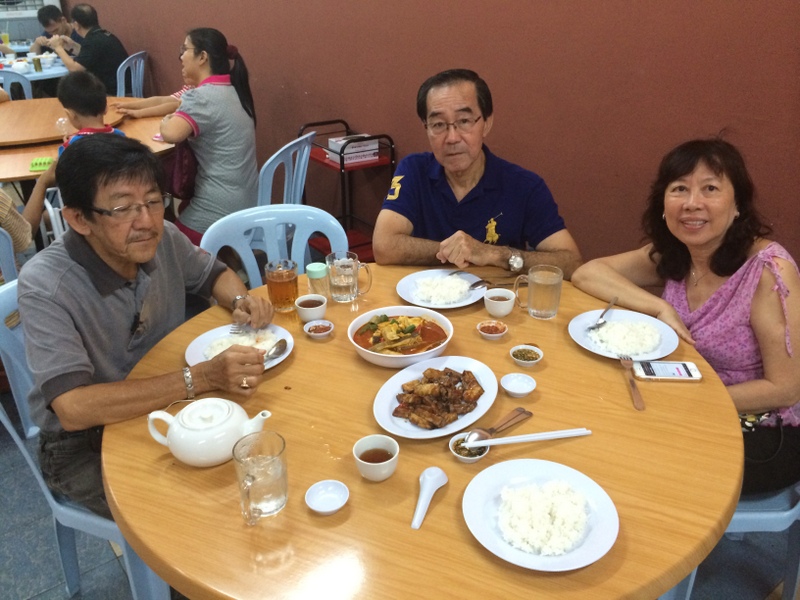
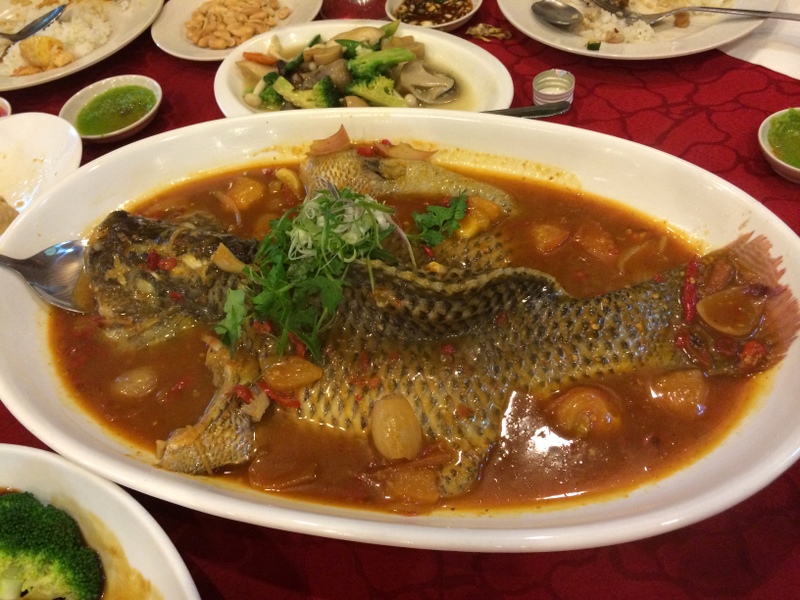
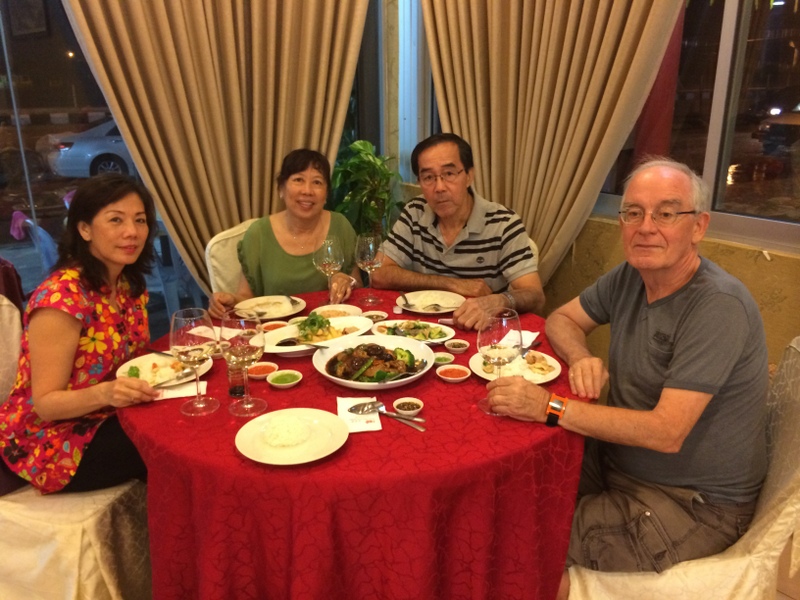
But of course also quite a lot of social activities, like meeting friends and enjoying food. Here is a selection of (food) pictures.

Soon after I was back home and acclimatised, the urge came to visit a waterfall. So I eagerly accepted my friend Siang Hui’s invitation for a recce to a remote waterfall in the Semenyih region. It would be a long hike, we had to leave early. Three of us, my friend Teoh also joined. Maybe because I did not sleep well the night before, but after about one hour on our way, I did not feel well, a tight feeling in my chest. After a discussion with my friends, we decided to go back.

I was worried (and not only I…haha), so I made an appointment with my cardiologist for an echo and a stress test. I could see him only after Hari Raya (the end of Ramadan), so I kept quiet a bit for a while.  Quite relieved when the results were ok!

With Hari Raya we visited Aric’s hometown. It is an old Malay custom to fire impressive coconut palm canons, celebrating the Hari Raya Aidilfitri festival. And impressive it was, I was worried for a while that it might affect my hearing. I wrote a separate blog about it: Boom Boom!!

Hari Raya

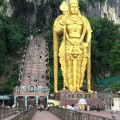
After I had received my clean bill of health, I was looking forward to meet Akke and Pim and show them a few nice places in my 2nd home…-).  Akke is the daughter of friend of mine, who, with her future husband, was traveling in Malaysia. We visited the Kanching waterfalls and the Batu Caves and completed it with a delicious dinner, prepared by Aric.

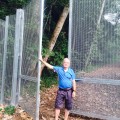
Here are a few recent pictures of Bukit Kiara, where I have my daily exercise. I have written many blog posts about it, you can find them here . I am quite pessimistic about its future, JLN (the National Landscape Department) is trying to transform it into a concentration camp, including barbed wire fencing ..:-(  But still beautiful, along the budding Penchala river I have hidden another of my geocaches.

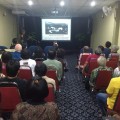
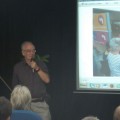
I am a member of the Taiping Heritage Society. I joined them in May on a trip to Lenggong. A few weeks ago they organised a members night and asked me to give short talk about this trip. Here are some pictures. I had prepared too much material for my talk, so I have published this material in a separate blog post  Archaeological Heritage of the Lenggong Valley

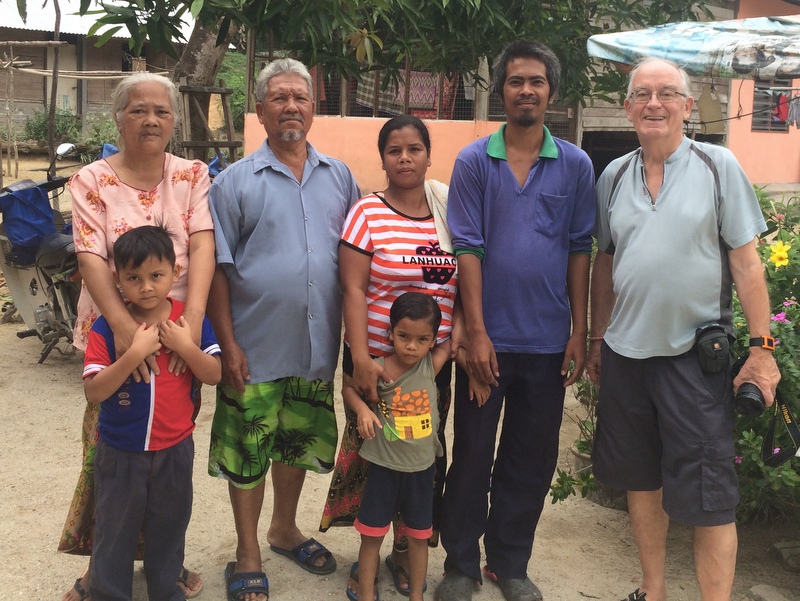
On my way back from Taiping, I decided to stop at Pos Dipang to meet my Orang Asli friend Jinnah and his family. Recently he has been our guide to the spectacular Pos Dipang waterfalls.Very nice people. They belong to the Semai tribe, my Bahasa (Malay language) is bad, but we could communicate quite well in broken English.

Jinnah & family

To end this journal, a few pictures of a trip made with Aric to a Hot Springs near Bentong. I had passed the place before several times, the hot springs were not well maintained. But now some renovation had taken place, itr looked a lot better. The water was not too hot and you could use the mud from the bottom to scrub your skin…:-)


Archaeological Heritage of the Lenggong Valley

In May the Taiping Heritage society has organised a trip to the Lenggong valley, see my blog THS excursion . Last week THS organised a members night and they had asked me to give a talk about the trip. Preparing for my talk, I  collected a lot of information from the Internet, but I had not enough time to present everything in my talk…:-) That is the reason for this post.

In 2012 the Lenggong valley was declared a Unesco world heritage site, because of the many archaeological discoveries made during the last decades. Most notably, the discovery in 1991 of the Perak Man, a well preserved skeleton, dating back to ~ 11.000 BP where BP stands for Before Present and Present is defined as 1-1-1950. In Geology and Archaeology  BP has replaced BC (Before Christ) and the politically correct BCE (Before Common Era)

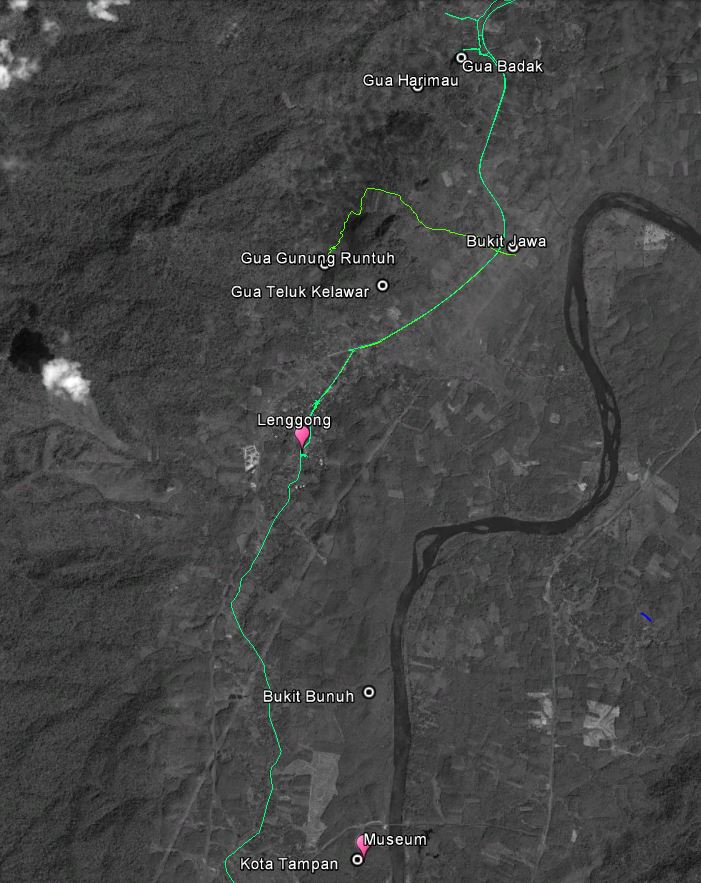
Here is a GE map of the Lenggong region with the location of the various archaeological sites (click to enlarge). The mighty Perak river is clearly visible. The green track is from a trip made in 2007 with my friend Liz Price, Caves and Waterfalls Google Earth Map

Some comments about the various locations.

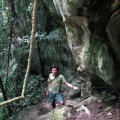
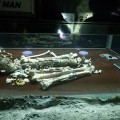
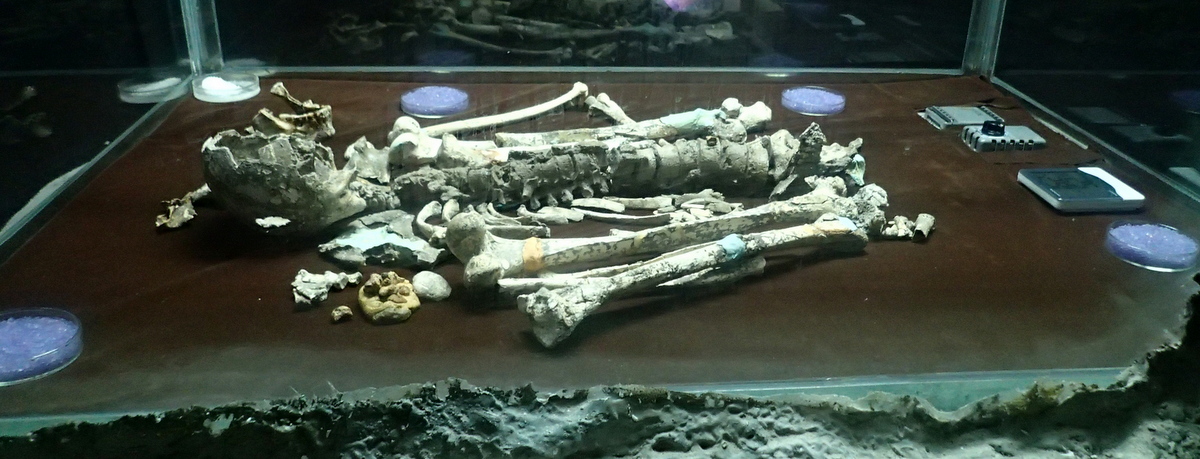
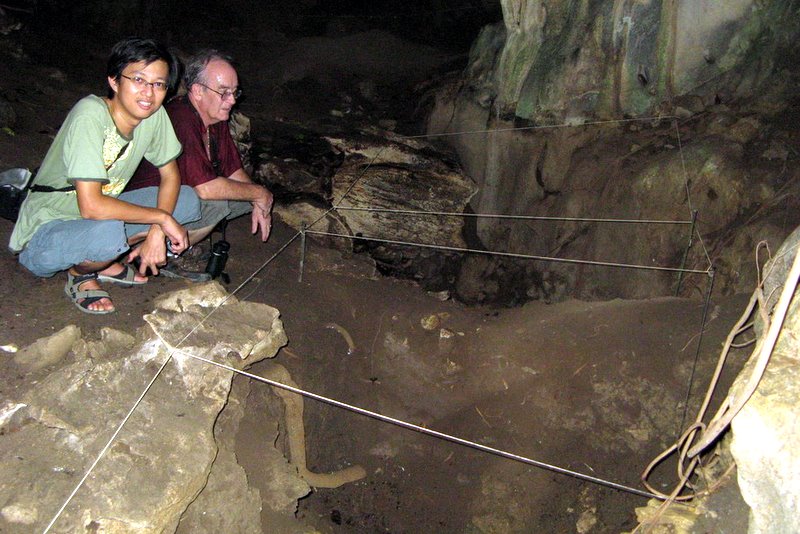
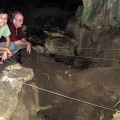
The skeleton of the Perak Man has been found in the Gua Gunung Runtuh. It is now exhibited in the Lenggong Museum. The Gunung Runtuh cave is at the moment closed to the public, but in 2007 we could still enter the cave after a steep climb..:-)  The skeleton was originally surrounded by grave gifts, in the museum now it is surrounded by high-tech gadgets to control humidity, etc!

In 2004 another skeleton has been found in the nearby Gua Teluk Kelawar, now called the Perak Woman, dated ~ 8000 BP. I will not be surprised if more discoveries will be made in the future. Because it is clear that this region around the Perak river has been very suitable for human habitation throughout the ages! Limestone caves for shelter, a river (in the past a lake) nearby, etc

The other archaeological sites in the Lenggong valley have until now only shown evidence of human activity in the form of tools and “tool shops”, where these tools were manufactured.

The oldest of these sites is Bukit Jawa,  a palaeolithic tool workshop site on the shores of an island in a lake now long ago disappeared. About 200.000-300.000 years ago. Who made those tools? This is before our species, Homo Sapiens sapiens, started the emigration out of Africa. We will only know when fossil remains of hominins are found. We visited Bukit Jawa in 2007, there is not much to see.Bukit Jawa Bukit Jawa

The toolshops at Kota Tampan are younger, about 70.000 year old. Also here no fossils of human remains have been found, but it is quite possible that the people making these tools, belonged to our species (see below). Activity in these workshops came to an abrupt end when the Toba volcano erupted, Kota Tampan tools have been found covered wit the thick layers of ash. At the Kota Tampan location the Lenggong Museum has been built.

Next in age are the toolshops at Bukit Bunuh, about 40.000 years old. Followed by the two caves where the Perak Man and Woman were found.

Much younger, about 4000-3000 BP are the graves found in Gua Harimau. And in the nearby Gua Badak, rock paintings have been found, made by the Negrito Orang Asli. Very recent, maybe only 100 year old. But interesting as rock paintings are rare in Malaysia

Altogether an impressive collection of archaeological sites, hopefully they will be preserved well after being declared a World Heritage Site.

Human migration, Out of Sundaland ?

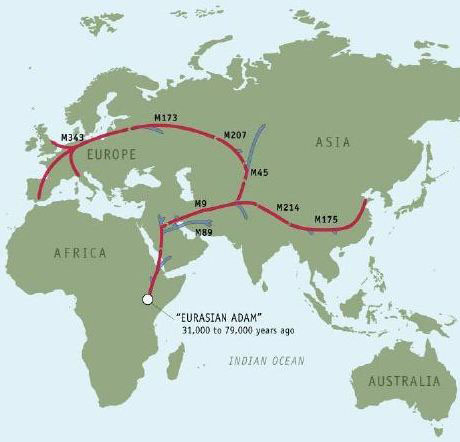
It is about 200.000 years ago that our species, homo sapiens sapiens evolved in Africa. All humans, living these days, have a common ancestor, both in the maternal line (Mitochondrial Eve) and the paternal one (Y-chromosomal Adam). Between 95.000 and 75.000 year ago one of their descendants (Eurasian Adam), started to migrate to Europa and Asia. By analysing the mutations in the DNA of the Y-chromosome of present humans, it is possible to get an idea about the migration route followed by the ancestors.

A few years ago both Aric and I had our DNA analysed (by the Genographic Project). Here is the route followed by our (paternal) ancestor. Our routes split about 35.000 year ago, in what is now called Tajikistan. My line developing into a Caucasian, Aric’s line into a Chinese…:-) See my blog My ancestors for more information about this fascinating topic. Our ancestor

What has this to do with Lenggong, you may ask. Well, the theory of human migration is still a developing theory, with many variations. In the prevalent version, humans migrated to South East Asia from around Taiwan, going south. An alternative option is that  the migrants followed more or less the coastal line, via India, arriving in Sundaland, from there spreading in northern direction

migration

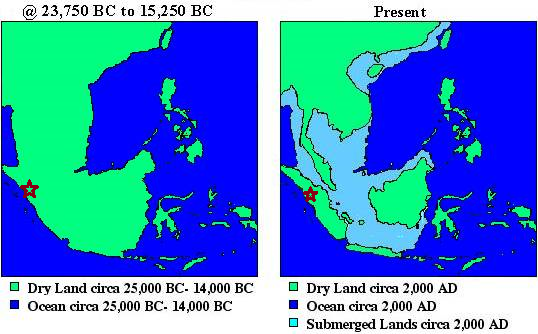
Sundaland? Yes, in the period we are talking about, the world was in what is called the Ice Age. The huge amount of ice covering the Arctic and Antarctic resulted in very low sea levels, more than 100 meter lower than nowadays. Present day Sumatra, Borneo, Malaysia formed one land mass, called Sundaland Sundaland

In the map above, the location of the Toba eruption is indicated. This dismal eruption and the following volcanic winter may have had a dramatic effect on the still very small global homo sapiens population, killing most of them and causing what is called a genetic bottleneck It is estimated that the global population of our species at that time was no more  than 10.000 – 20.000! It certainly stopped the operation of the Kota Tampan tool shops. But the people living there may have survived in small numbers, because the prevailing winds were westwards. Could it be that after the Toba eruption, further migration took place out of Sundaland?

A fascinating, though rather controversial theory, proposed by the British geneticist Stephen Oppenheimer. No surprise that USM, responsible for much of the archealogical research in the Lenggong valley, is quite happy with this theory.  Malaysia as the cradle of humanity!

A meteorite impact at Bukit Bunuh

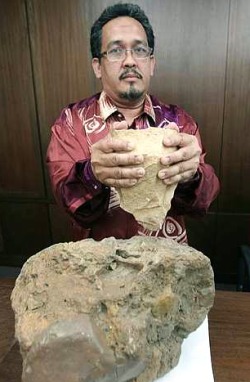
In 2009 USM announced a spectacular discovery at  Bukit Bunuh. At this location many boulders were found of a very special material, called suevite. Suevite can be formed when a meteorite collides with the earth. The ages of these rocks, using fission track dating, has been determined as 1.8 ± 0.6 million year. There are indications of circular craters in the Bukit Bunuh region, so it could well be that between 1.2 and 2.4 million year ago a meteorite has hit here. In itself already an interesting discovery. It became spectacular when in 2007 a hand-axe was found, embedded in a suevite boulder. Meaning that around the time of impact, 1.8 million year ago, hominins were already living at Bukit Bunuh! Here is a newspaper article about the discovery: Early axes found in Perak. The picture shows  Dr Mokhtar Saidin, holding up the axe. Prof Mokhtar

After the jubilant announcement in the media, now already five years ago, it has become disturbingly quiet. I have not been able to find any reference on the Internet to a scientific publication in a peer-reviewed journal. The meteorite impact was supposed to be registered at the Earth Impact Database, but that too has not yet happened. In interviews an age of 1.83 million year is mentioned, without giving the error margin of 0.6 million year, which is scientifically bad practice. Here is a typical example: Interview with Dr. Mokhtar Saidin

Honestly, I have my doubts. Here are a few more links, in case you are interested

Bukit Bunuh, oldest Paleolithic site , quote:  “There should be on-going research to get a true picture of the people who settled in this area since 1.83 million years ago and this can change several theories about the Paleolithic people such as the nomadic theory and movement of prehistoric man.

USM Discovers Concrete Evidence That Can Chance (sic!) The History Of Early Man

Boom Boom !!

The end of Ramadan, the fasting month, is a religious holiday, celebrated by Muslims all over the world. In Malaysia it is called Hari Raya Aidilfitri, often shortened to Hari Raya which is Malay for Celebration Day. Traditionally all Muslims go back to their hometown (“balik kampung”), but as it is a public holiday, also non-Muslims often do the same.

This year we went back to Aric’s hometown, Parit Baru. This part of Selangor is rural and very Malay. It is a tradition that with Hari Raya, the driveways and boundaries of farmhouses are decorated with small oil lamps, very romantic and peaceful.

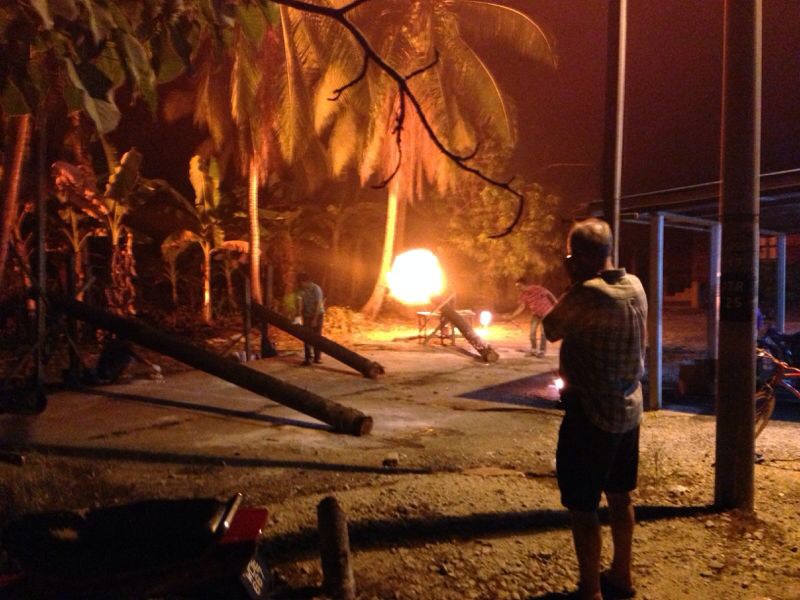
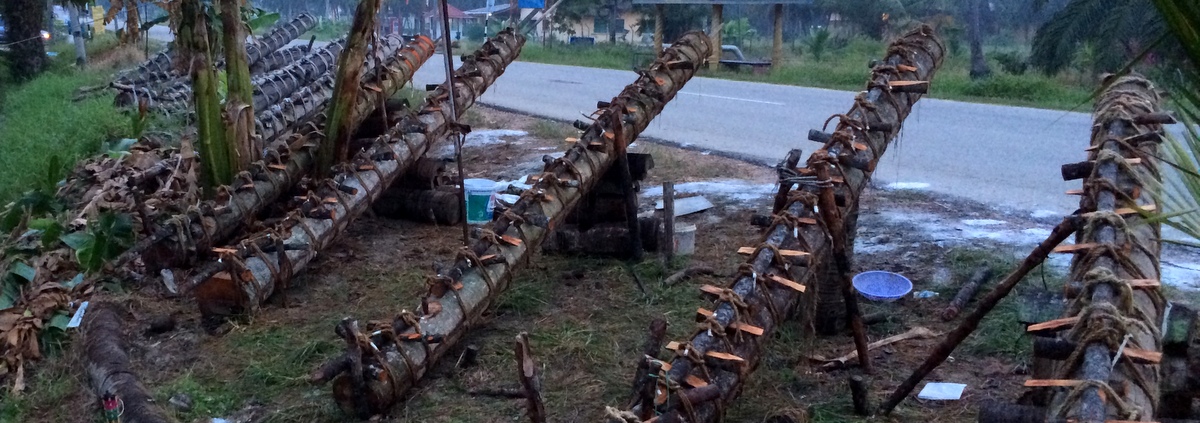
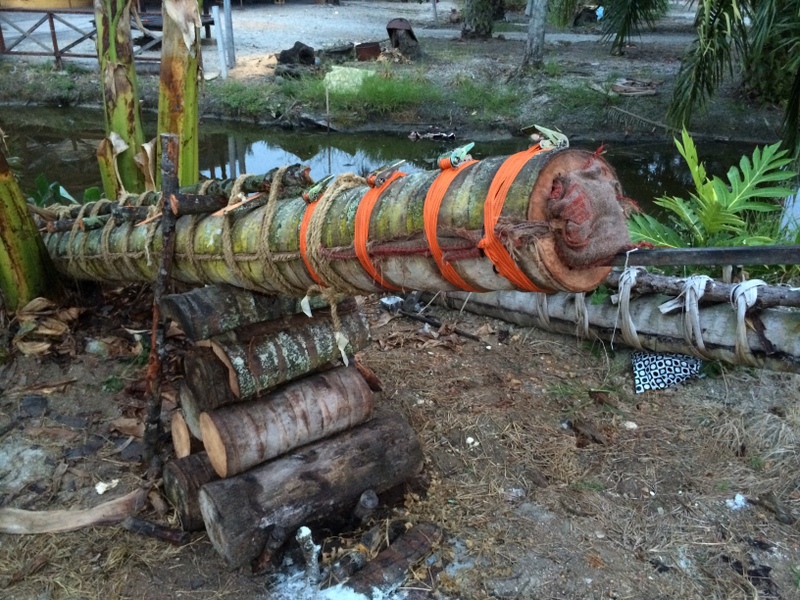
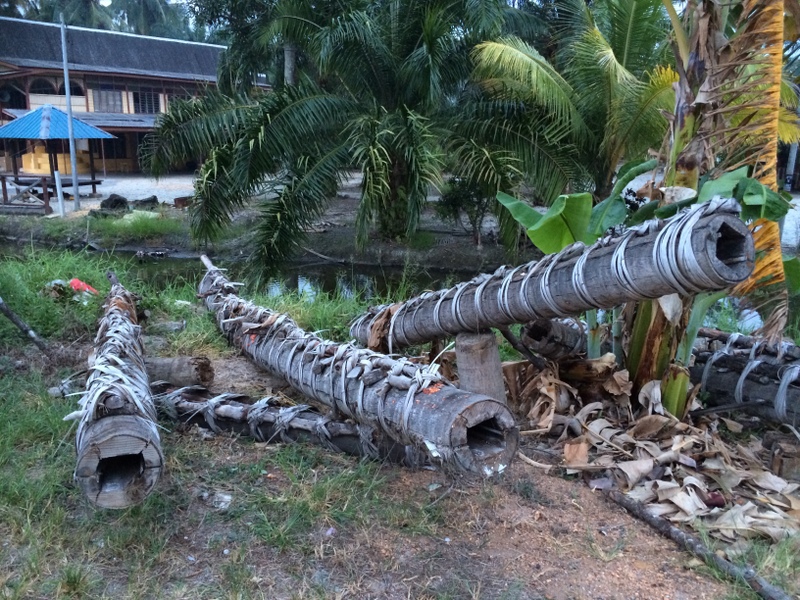
Another tradition, less peaceful, actually extremely noisy, is the firing of the “meriam kelapa”, which translates as”coconut cannon” Before you reach Parit Baru, you will see this, near the mosque: Meriam Kelapa These medieval looking contraptions are made of a coconut tree trunk, sawed in two halves, which are hollowed out and then tied together again. Not an easy job!

The resulting “cannon” is tilted upward, and a mixture of carbid and water is put inside the hollow trunk. Carbid (calcium carbide) reacts with water, forming acetylene which is flammable and highly explosive. The acetylene vapor is heavier than air and fills the hollow trunk. When it is ignited through a small hole at the bottom of the trunk, a major explosion occurs.

In the right picture the remains of old meriams, the left picture shows a new one.

Meriam Kelapa Old meriam

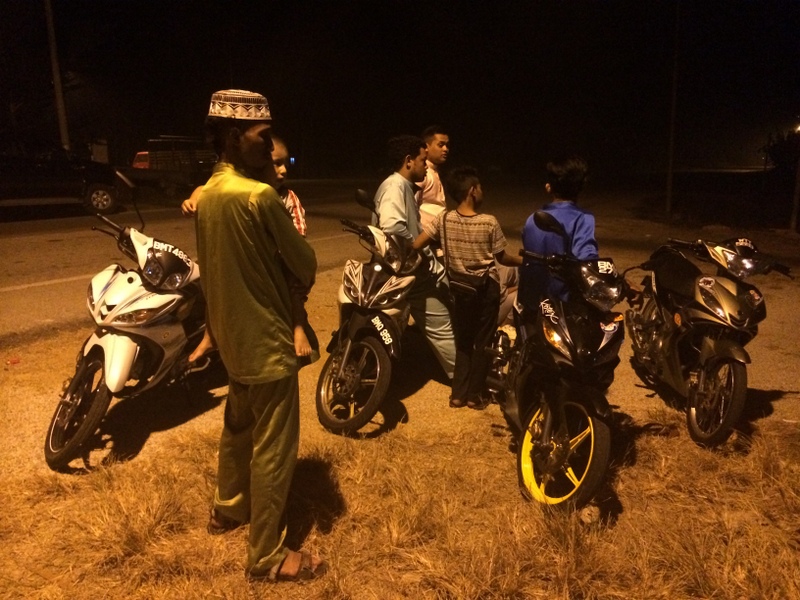
In the night we went out to see them in action. You will find these cannons  all over the place, just follow the direction where the “boom” comes from. Not far from Aric’s house we noticed men preparing three of them.

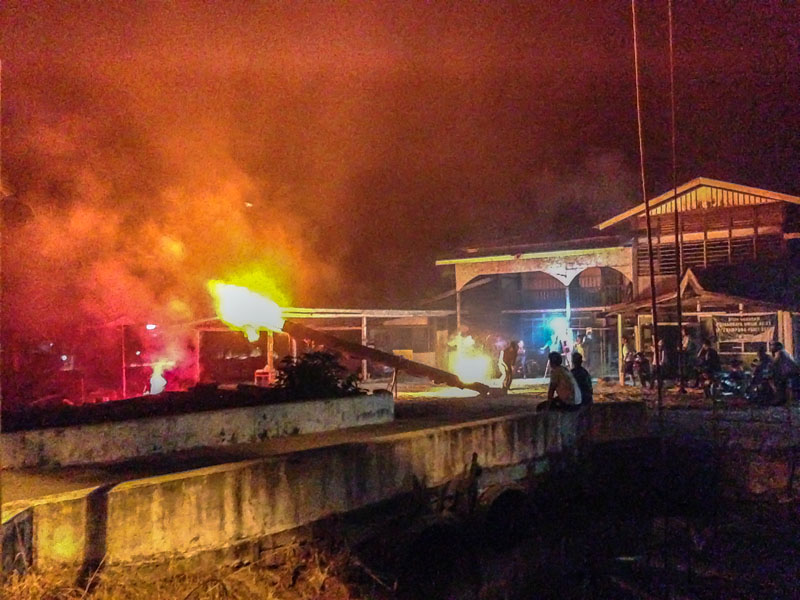
I was taking pictures when the first “shot” was fired. And almost literally shocked. I was standing quite close, the shock wave took away my breath and for some time I was worried that the shock wave had damaged my eardrum. Fortunately that was not the case. With some tissue paper in my ears, I watched the next salvo’s. It was fascinating, but also a bit frightening, like being in a war.

Here is a video, quite dark, but I hope it gives an impression. The next evening we went to another location, where they had only one cannon, but what a monster it was! Officially it is illegal to build and fire these cannons, accidents happen, and even buildings can be damaged by the shock wave. After the first shot, neighbours were complaining loudly, so the direction of the cannon was changed. This time I had put real earplugs in my ears…:-) Spectators meriam

My iPhone has a repeat option, taking pictures every 1/10th of a second. Here is a collage of several pictures (click to enlarge) Fire! What an interesting experience!

Selamat Hari Raya Aidilfitri. Maaf Zahir dan Batin!

Taiping May 2014

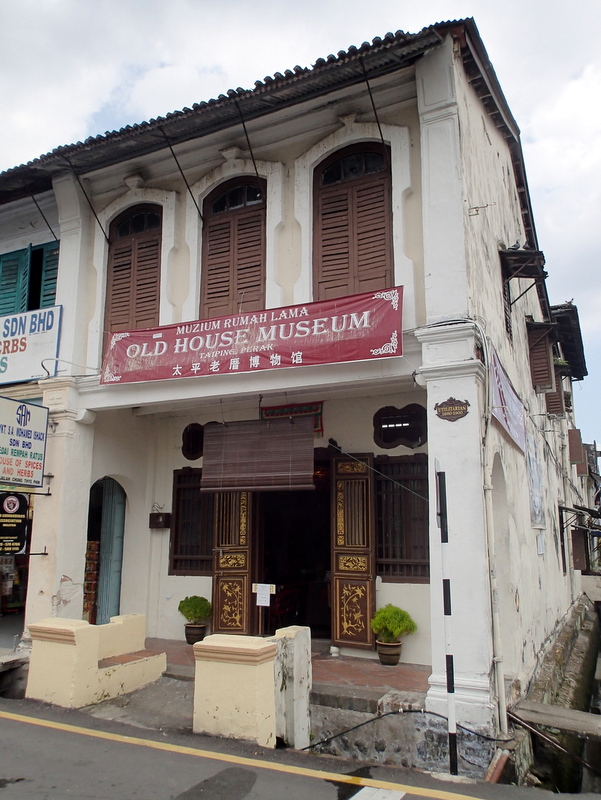
The main reason to visit Taiping was this time the excursion organised by the Taiping Heritage Society. See the separate post THS excursion. But there was more. I also wanted to visit the recently opened “Old House Museum“, located at Market Square. And an old house it certainly is, built ~ 1880 by a Chinese merchant Lim Ji You, after the big fire that destroyed much of Taiping.

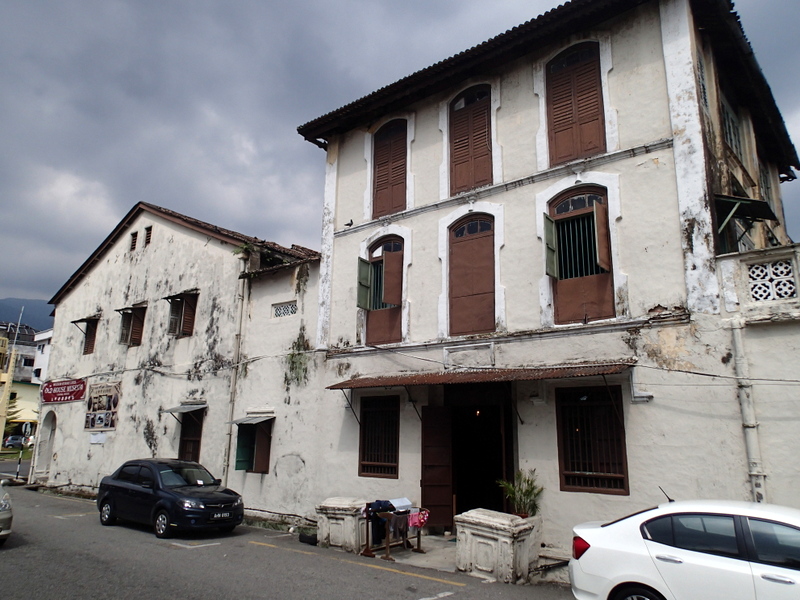
Old House Museum Side view

It is a nice example of Peranakan architecture. Left a frontal view, right a side view. Notice the three storeys of the back house , unusual in those days. Inside the museum you will find a large collection of antiques. The museum is a private one, I really hope they will succeed! Here a collection of pictures

The two nights I stayed in Taiping this time, I had dinner with my friends. It is never a problem to find a suitable place for food, be it a food court, a small stall or a more posh restaurant.

Dinner Dinner Dinner

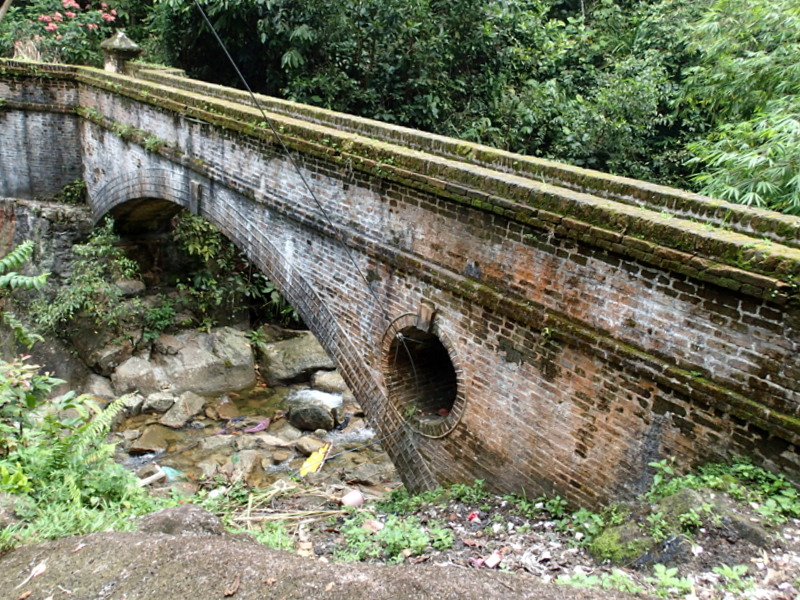
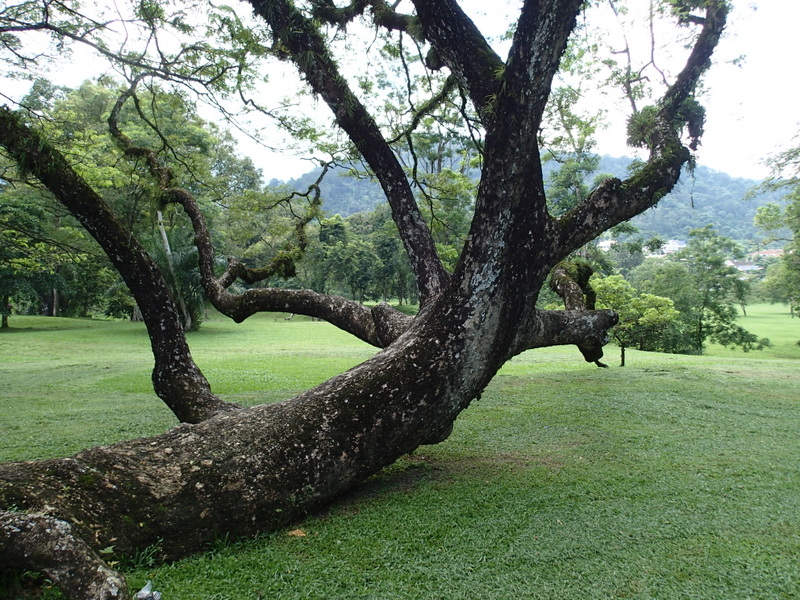
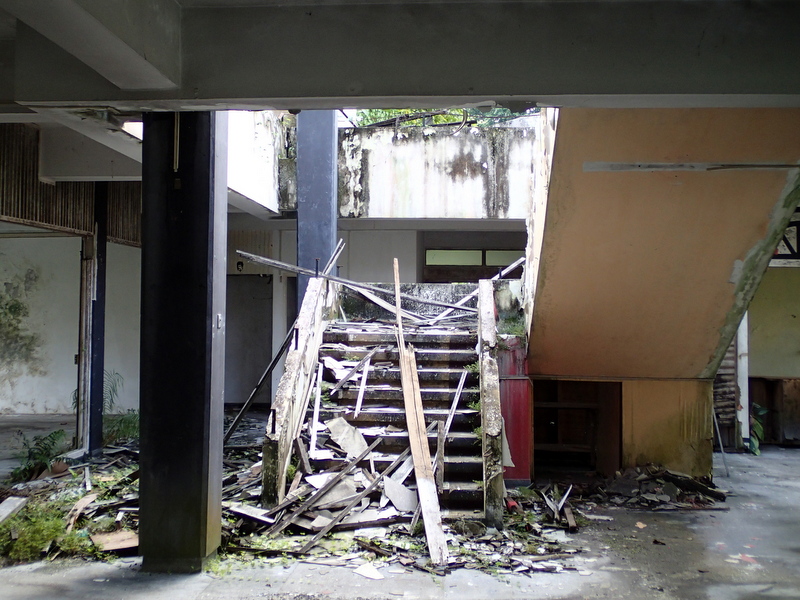
Of course a visit of Taping is not complete without a visit of the Lake Gardens, the most beautiful gardens in Malaysia. The Lake Gardens Here a few more Taiping pictures. One of the old bridge near the Indian temple and the Coronation pool. I am still trying to find out who built this bridge and for what purpose. One picture of a rain tree. And finally a picture of one of the eyesores of Taiping. The remains of the Casuarina inn, on the location of the former British residence. Shameful that this historical place has gone down the drain.

The old bridge Rain tree Ruin of the Casuarina Inn

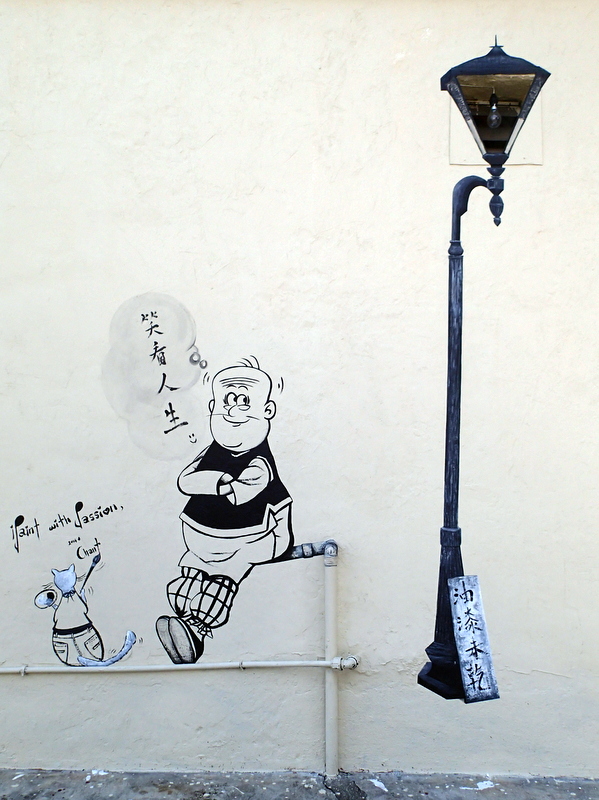
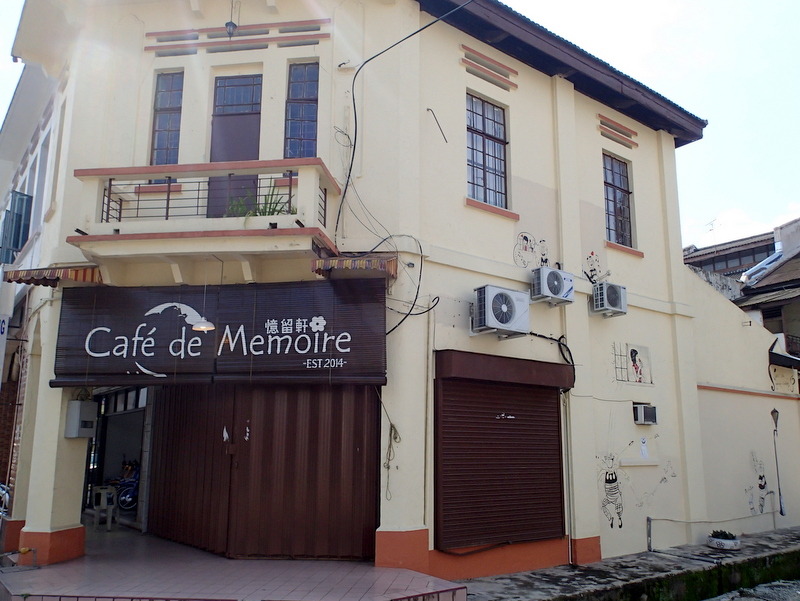
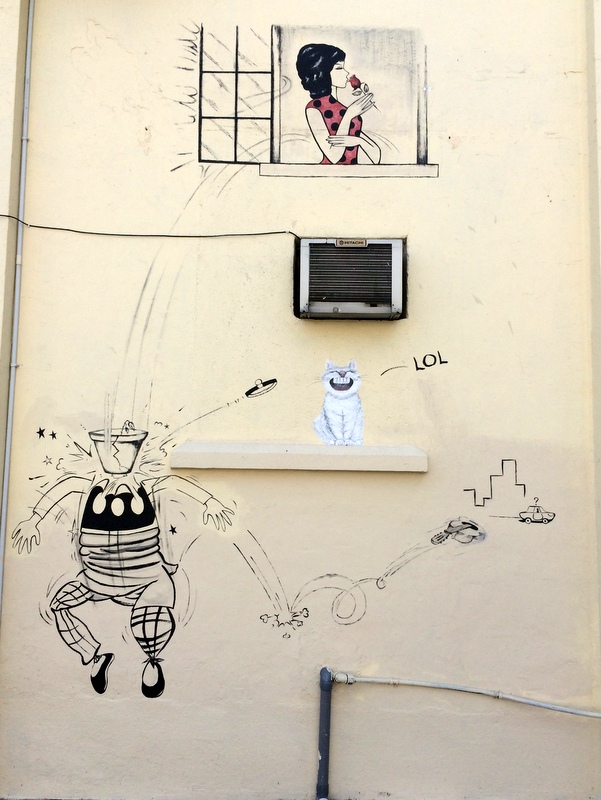
Mural art is becoming a trend in Malaysia these days, after the Lithuanian artist Zacharevitch created the first nice “paintings” in Penang. Here are two examples I found in Taiping. Not that special, copies of Lao Fu Zi cartoons

Street art Street art Street art

More interesting is what is happening in Gopeng, south of Ipoh. In the past a famous tin-mining town, now a sleepy hollow, but with a lot of historical interest. Along the Jalan Pasir and Jalan Tasik, unknown(?) artists have recently created a number of mural paintings and also street art in the style of Zacharevitch. Definitely worth a visit!

THS excursion

When you have been following my Stuif’s adventures, you know that Taiping is my favourite town in Malaysia. So it is not surprising that I am a member of the Taiping Heritage Society (THS). Recently they organised a day trip to the Lenggong region and I decided to join. Actually I had visited most of the attractions on the program already, but it was a good opportunity to get to know more THS members…:-)

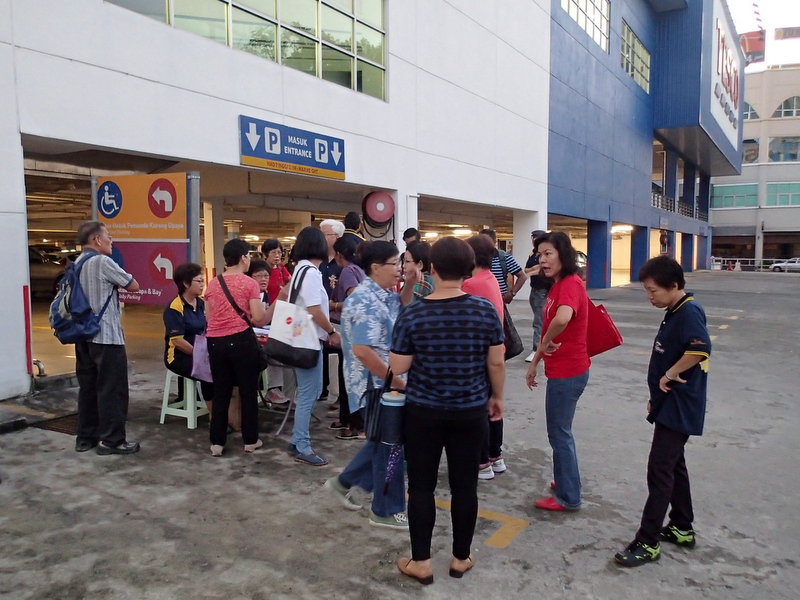
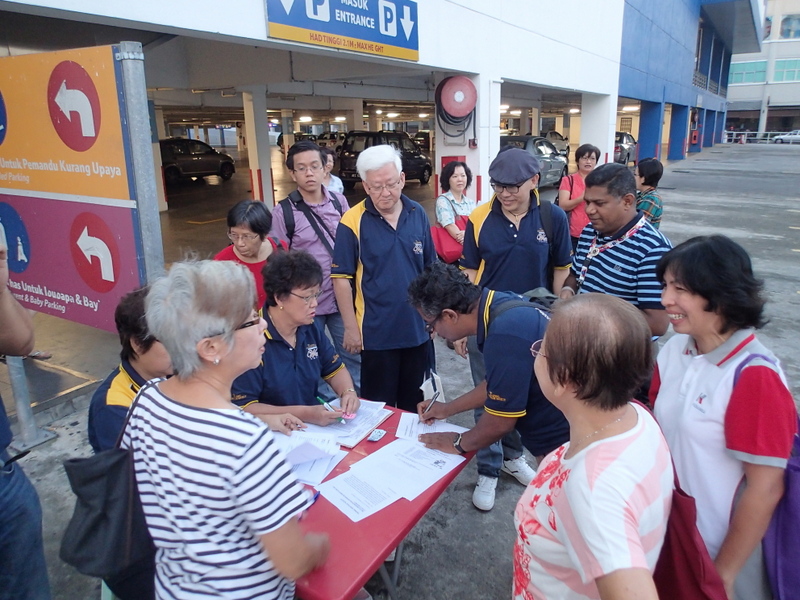
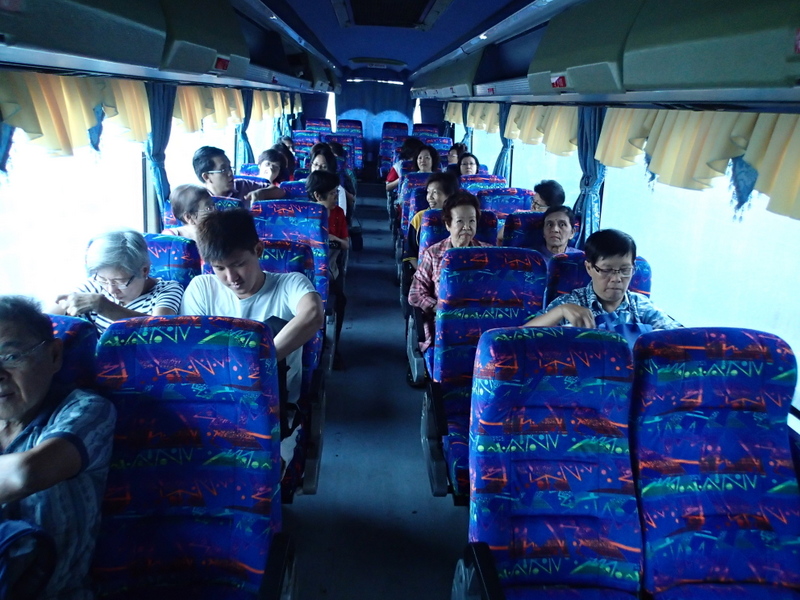
Departure was at 7 am from the Taiping Tesco. About 40 members took part in the trip, so a bus was chartered for the transport. After signing an indemnity form, we received our seat number and off we went. (click on a picture to enlarge it)

Meeting at Tesco

Signing an indemnity form

Ready to go

The first stop was at Lenggong town for a dim sum breakfast. Next we went to the Lenggong Archeological Museum, where we were welcomed by the Assistant Curator, Puan Nuraidah. We watched a nice, well-made documentary about the archaeology of the Lenggong valley, where in 1991 an 11.000 year old skeleton was found in one of the many limestone caves. Now known as the Perak Man. During my earlier visit of the museum, only a copy of the skeleton was shown, but in 2012 the Lenggong Valley was listed by UNESCO as a World Heritage site and just a few months ago, the original skeleton has been brought back to the museum.

When the museum was built, an artificial cave was created for the (copy of the) Perak Man. Now it is still there, but half in the dark, while the original has been placed in the same cave. A rather messy layout, hopefully temporary. When the Perak Man died, his grave will have been decorated by burial gifts. Now his skeleton is surrounded by modern technology. He would have been very surprised if he had known..:-)

The Perak Man

Originally the plan was to visit the Gua Runtuh, where the skeleton was found, but it is out of bounds now, probably will become a tourist attraction. When I visited the caves in 2007, you still could enter freely, although after a stiff climb. Here is a picture from my archive.

Gua Runtuh

Instead we visited another cave, the Gua Tok Giring, near Lenggong. To enter the cave you need proper equipment, so we just had a look at the outside, while our guide Neal was giving information about various aspects of caves.

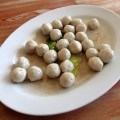
Then it was time for lunch. Lenggong is well-known  for its freshwater fish restaurants and the famous fish balls. THS had booked an eight-course lunch, organiser Sharon had warned us that there were six fish balls for each of us, three fried, three in the soup…:-) Of course we obeyed her! The food was plenty and delicious.

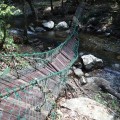
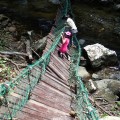
Our next destination was the Kekabu waterfall, between Lenggong and Kuala Kangsar. The experienced bus driver managed to manoeuvre the bus to the parking near the waterfall, from where it was an easy walk to the falls. Unfortunately the hanging bridge crossing the river had collapsed. Only a few daredevils managed to reach the other side.

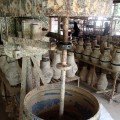
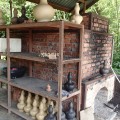
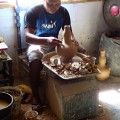
After the waterfall we proceeded to Sayong, a small village near Kuala Kangsar, famous for its pottery, the Labu Sayong. Here too our driver had to prove his expertise, because the factory was located deep in the countryside. We got an interesting demonstration how to decorate the pottery, for many in the group this was the highlight of the trip.

The way the guy was decorating the pot in a free style, was really remarkable.Here is a short video

Then it was time for tea, in a restaurant in Kuala Kangsar. The Ipoh Chee Cheong Fun was delicious, but the coffee….  Never in Malaysia (or even in my life…) I have had lousier coffee…:-)

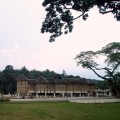
The last item on the program was a visit of Kuala Kangsar, with the beautiful Ubudiah mosque and the Istana Kenangan but everybody was getting tired after a long day, so we had only a look at them from the bus….:-)

We arrived back in Taiping at 6:00 pm.  A well organised trip, looking forward to the next one. Nice group of people. What especially pleased me, as a Kwai Loh, was the racial harmony, nowadays often lacking in Malaysia.


Pos Dipang revisited

In 2009 my friends Siang Hui and Harry (†) discovered beautiful waterfalls in the Dipang river. A few months later I visited these falls myself, here is a report. During this trip I met Jinnah, a friendly Semai from Pos Dipang. He told me that that were more waterfalls upstream. Within a period of a few months, I came back three times. The last time Jinnah took my friend Rani and me to the very remote upper falls. The report can be found in Three times Dipang.

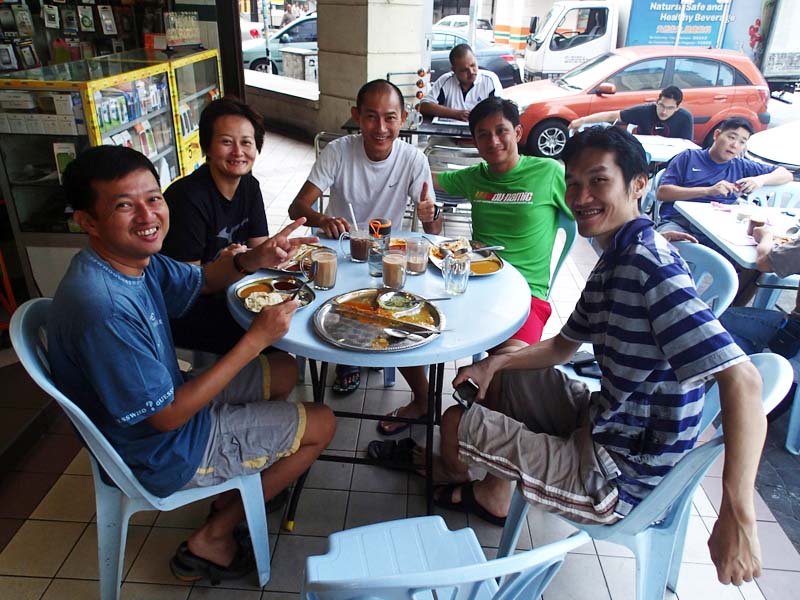
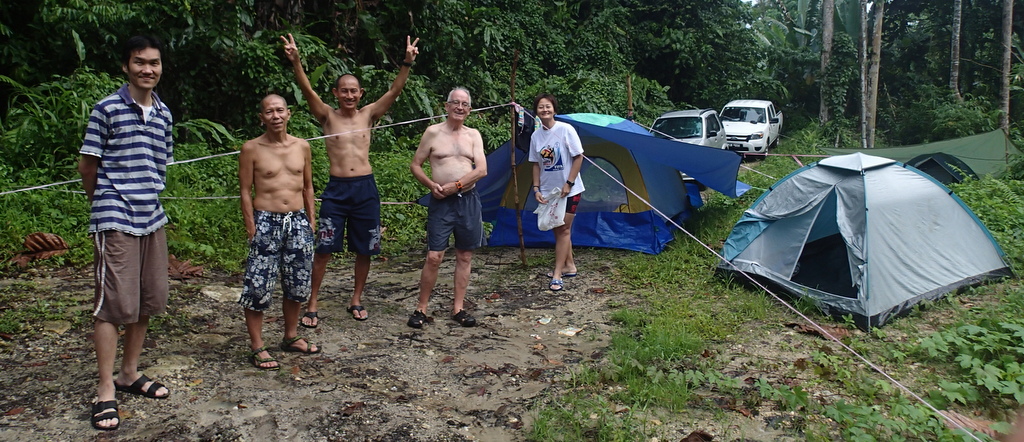
That was four years ago.Time to go back, with a group of friends. A camping weekend. We met as usual at the mamak near my condo for breakfast. From left to right Aric, Janine, Edwin, Teoh and Nick.

Breakfast

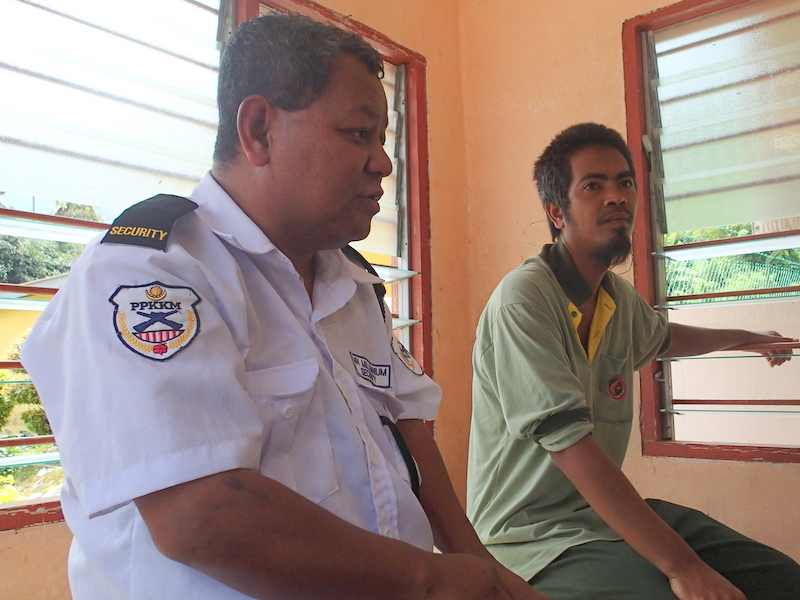
On our way to Pos Dipang we picked up Eddie at Tanjung Malim. After we arrived in the Orang Asli kampung, we asked for Jinnah, as I had not been able to contact him earlier. It was nice to meet him after four years, but at first it did not look good, because somebody had died recently in the kampung and he was not sure if he could guide us into the jungle. We went with him to the penghulu to ask permission to camp.

Meeting the penghulu

That was no problem, but the penghulu asked us to report at the police. While Edwin went to the police station, we went already to the campsite where Rani and I had camped four years ago. At first Jinnah was not happy with the location (too close to the river) and suggested a location a bit further upstream.

Where to camp?

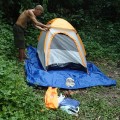
But after some discussion we decided it was better to camp at this spot. Hurriedly we put up our tents, as the sky was darkening.

We had to provide extra rain cover. I had none for the tent borrowed from us byTeoh and Nick. That was not a success, it turned into a swimming pool…:-(

We had planned to explore the nearby falls in the afternoon, but we had to take shelter in our tents. Fortunately the rain stopped around 5 pm, so we had a relaxed evening.

After the rain

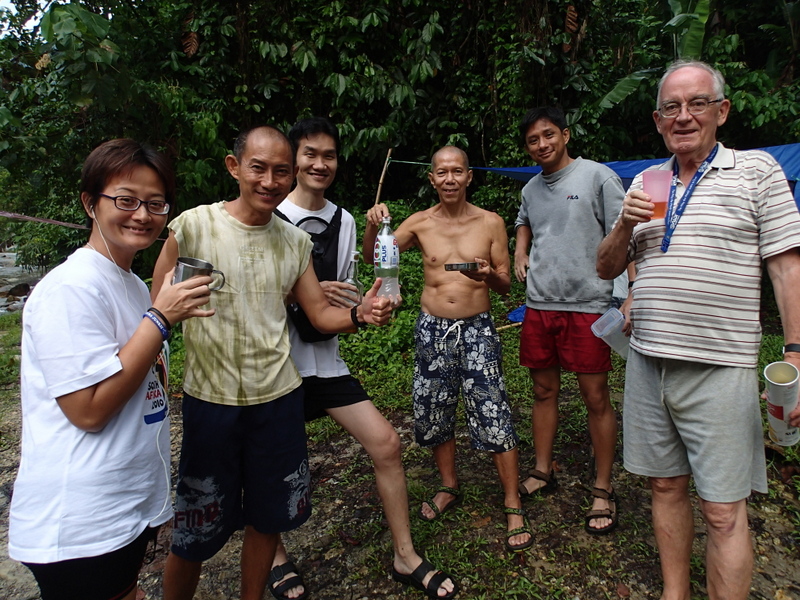
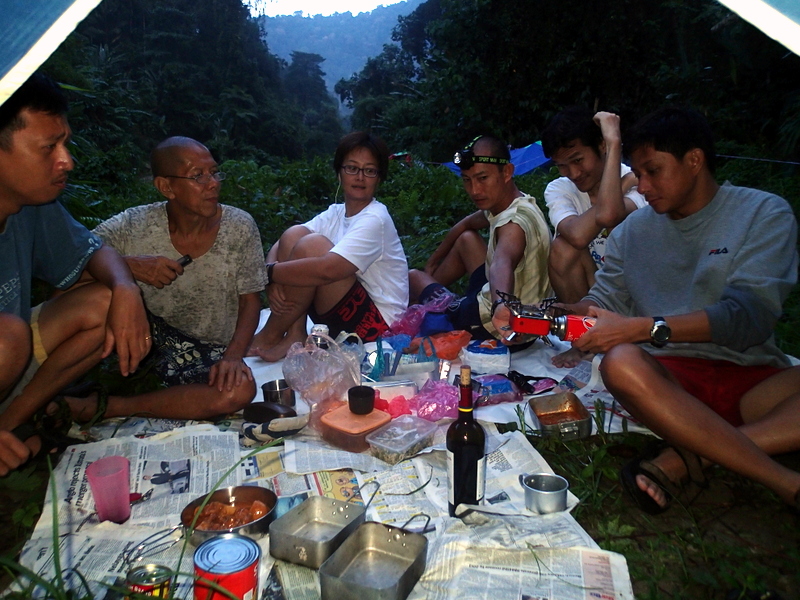
The plan was that everybody would take care of his own food, but on the spot we decided to have a shared meal. With a pre-dinner drink and a glass of wine. That is what I call luxury camping…:-)

Pre-dinner drink

Shared dinner

Jinnah came to tell us that he would guide us to the upper falls. That was good news, I had GPS tracks taken during my visit four years ago, but I expected the trail to be overgrown, as Jinnah told us that almost nobody ever visited these remote falls.

Here we are, the next morning, ready for a long hike…:-)

Ready to go

Jinnah guided us on a different route, because after my last visit a logging road had been opened. A steep climb, but very fast compared with the old route. Nice views of the surrounding jungle.

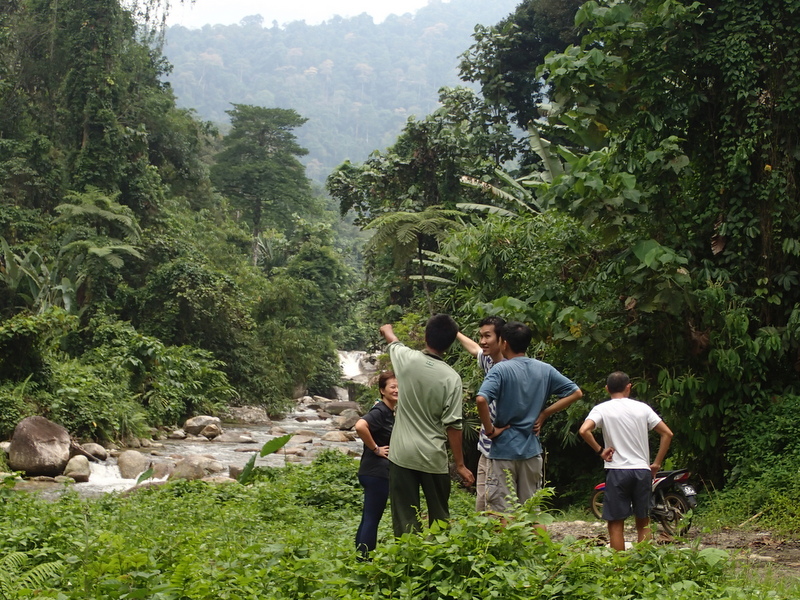
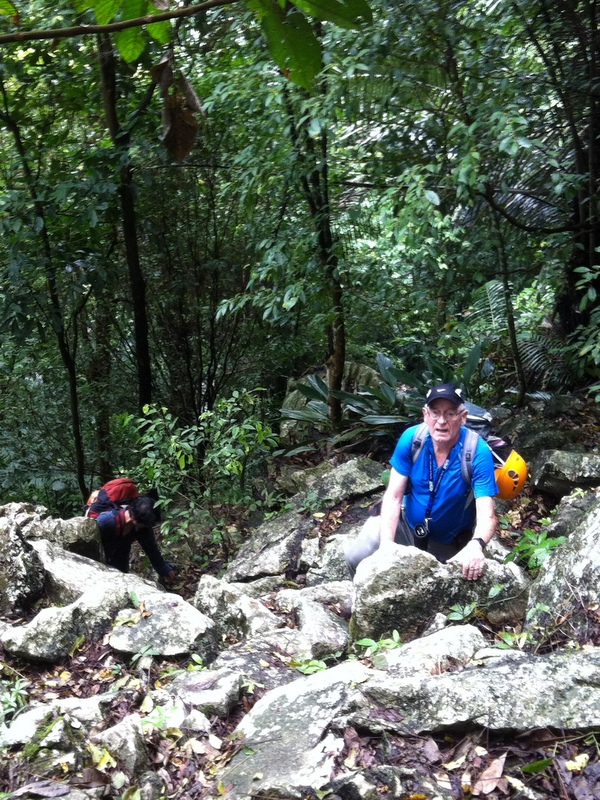
When we entered the jungle, we first followed a rather clear trail to a pettai garden. After that, our two guides had to do a lot of chopping until we reached the river. There were legions of leeches, Jinnah used tobacco as protection. River trekking is fun, but also slow.

After 2.5 hours hiking we reached the bottom of what I had called fall nr 4. The real name is Lata Cheroh. During my 2010 trip I had seen this waterfall only from the top, so this was a new fall for me. Very impressive, but my pleasure was spoiled by the large number of bees…:-( So we took only a few pictures before we continued.

Lata Cheroh

Lata Cheroh, pic by Aric

To reach our final destination, we had to scramble up a really steep slope until we arrived at the top of this waterfall. From there it was an easy, short  river trek to the bottom of Lata Merjur (fall nr 5). Because of the rainy season the water flow was spectacular. What a waterfall!

Lata Merjur, pic by Aric

But also here there the bees were all over the place. Because it was the flowering season, Jinnah explained. Almost everybody in our group was stung one or two times. Instead of frolicking around, I kept myself mostly submerged in the water. Hardly took pictures, here are a few , taken by Aric and Janine

Here is a video of the fall.

Because of the bees we did not stay long at the fall. As the weather was still good, Jinnah decided to go back the same way, river trekking. With (heavy) rain, that would have been too risky. In that case the best way back would have been a jungle trail with a lot of chopping. Now we were back around 3 pm.

We were very lucky with the weather, it became cloudy and a bit threatening, but no rain until we had reached our cars. Beautiful landscape

Dipang jungle

After saying goodbye to Jinnah and the penghulu, we drove back to Kampar for a very late lunch (more like an early dinner). Kampar is famous for its Roti Ayam . During our meal, there was a huge downpour, probably our tents would not have survived the strong winds…:-)

It was a wonderful trip, with a very pleasant group. Pity that there were so many bees. These falls are very remote, if anything happens, you really have a problem. Actually, although I had not noticed it, I must have been stung, as both my left cheek and right foot were swollen when I came out of the jungle.  Maybe it is time for me, at my age, to slow down a bit..:-)

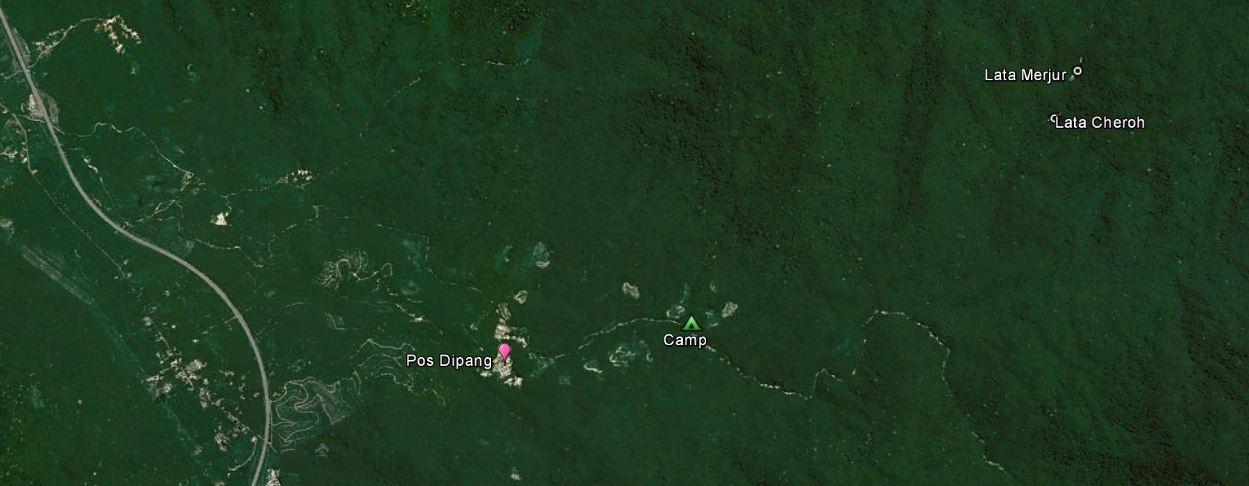
On this GE screenshot you can see how remote the location of the waterfalls is.

GE screenshot

Rock Climbing

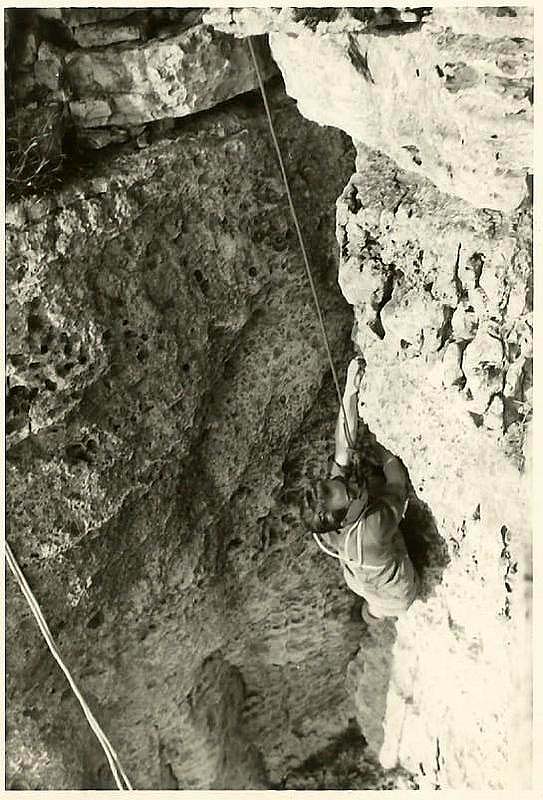
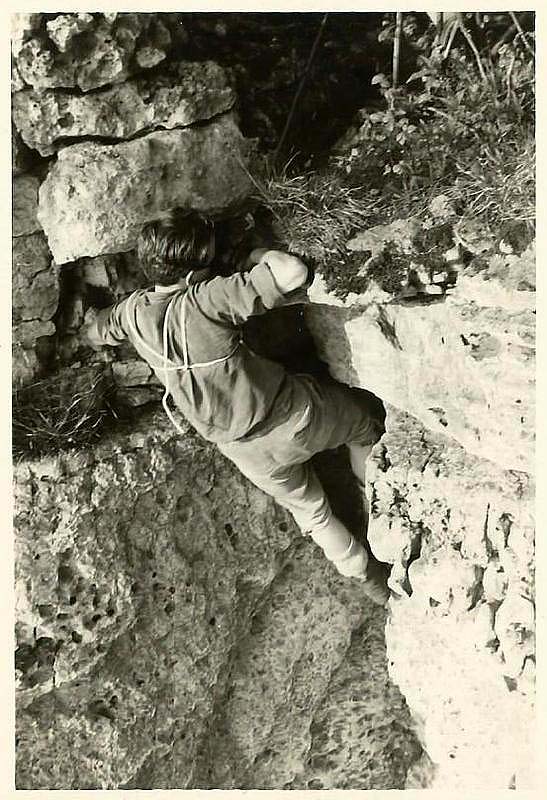
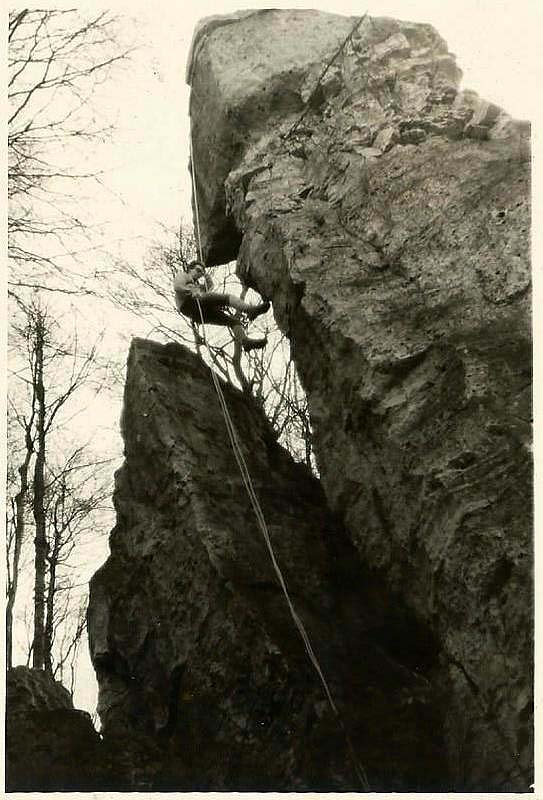
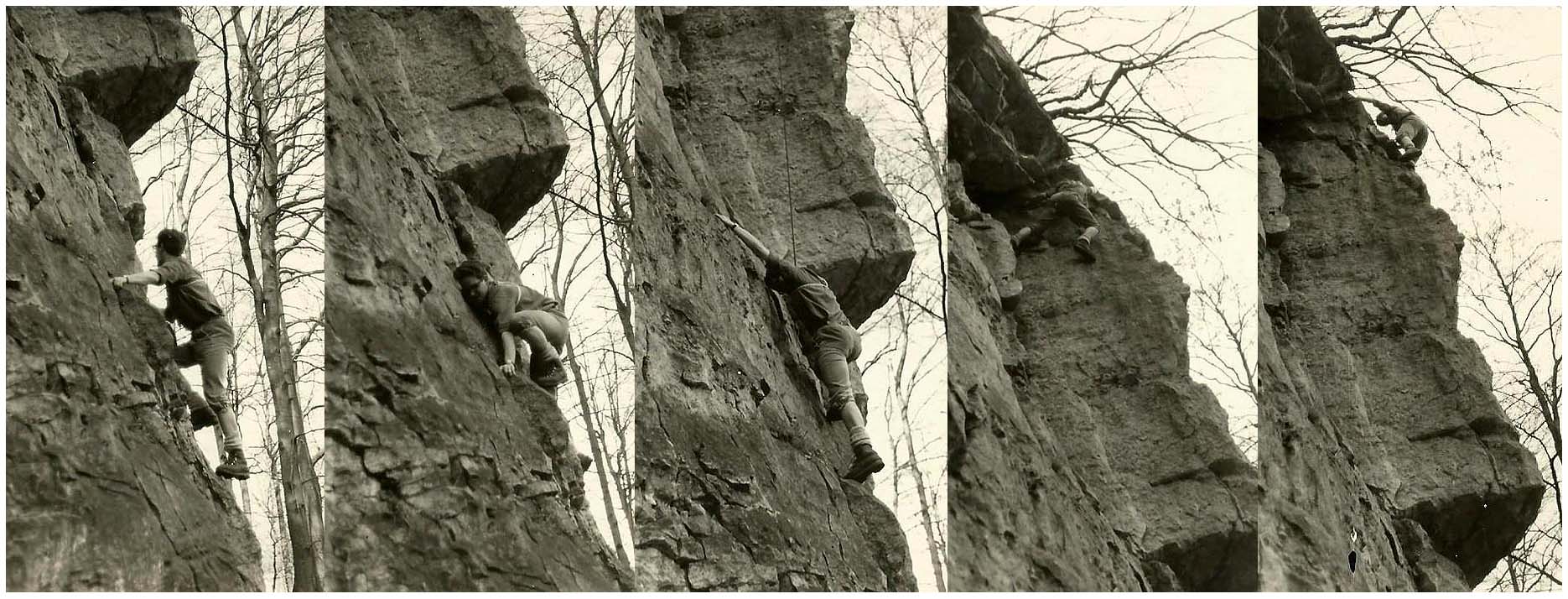
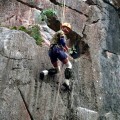
In a recent post, Down Memory Lane , I have written about my mountaineering past. In those days I went during the summer holidays with my friends to Austria. To get additional training we also visited several times, during weekends, a rock climbing site in Germany, the limestone hills of the Kanstein . Here are a few pictures. The two pictures to the left show me (yes, this slender young man is me, lol) climbing a route up the Sudostlicher Buchensluchtfelsen and in the picture to the right I am abseiling from the Liebesnadel (the Love Needle, guess why it was named that way!)

Rock Climbing

Rock Climbing

Abseiling

And here I am climbing the Vogelbeerfels. If you look carefully, you can see that I am secured by a rope, after all I was a beginner. But the rappelling was unsecured, if you would loose your grip, you would just fall down…:-)

climbing

That was fifty years ago.

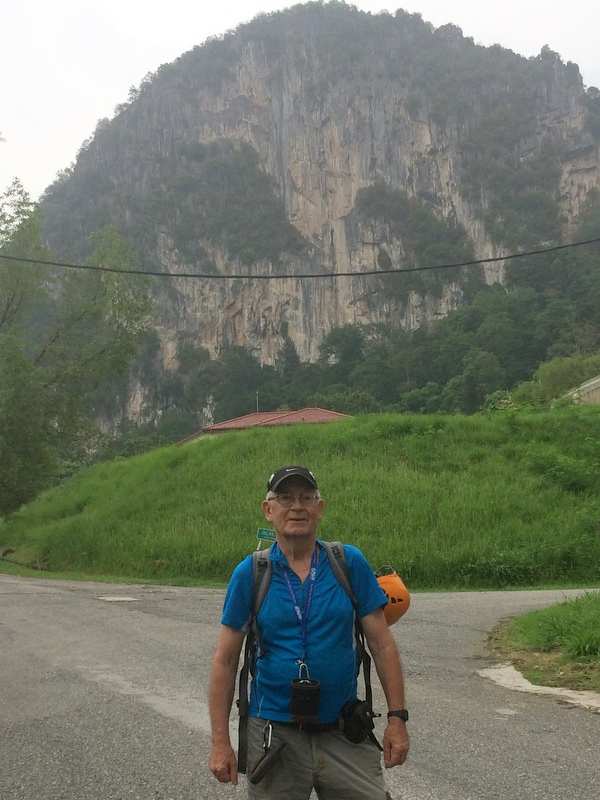
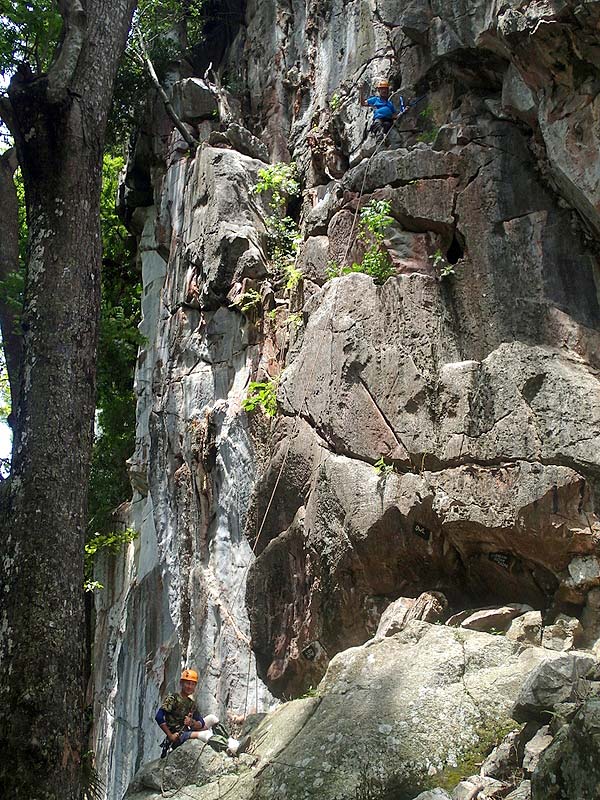
Last week, one day after my seventieth birthday, I went rock climbing again. My friend Chadel had invited a few friends for a climbing practice day at Bukit Takun, a rock climbing site near Templer’s park. After a thorough instruction we would climb up the steep rock face, and then rappel 30 meter down.  It was especially the rappelling that attracted me…:-)

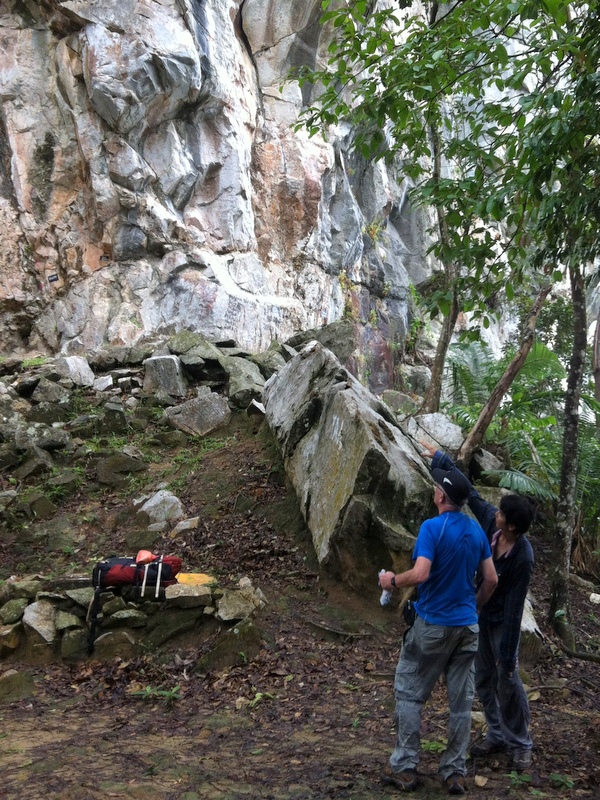
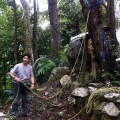
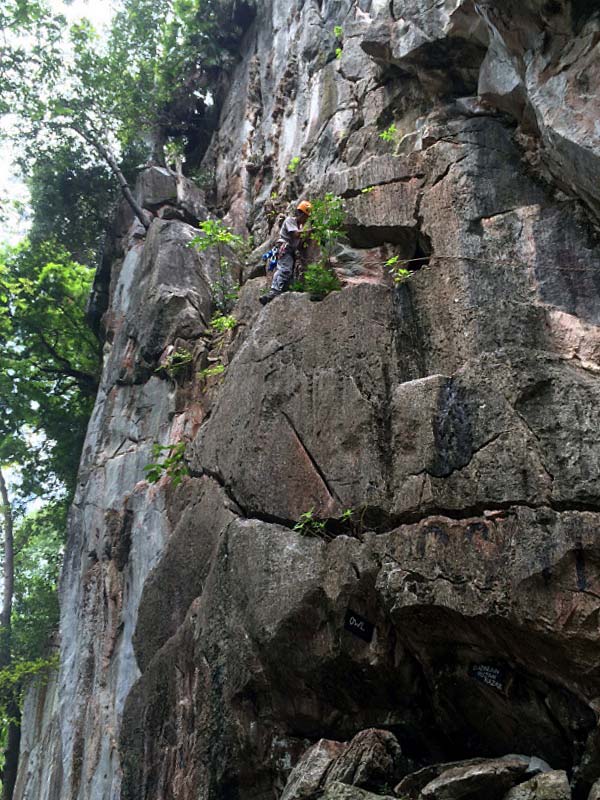
Bukit Takun is a conspicuous rocky hill. To reach the rock face, a steep climb was needed. In the right picture Chadel is pointing out the route we were going to follow. An almost vertical wall, rather overwhelming..:-)

Bukit Takun

Steep access

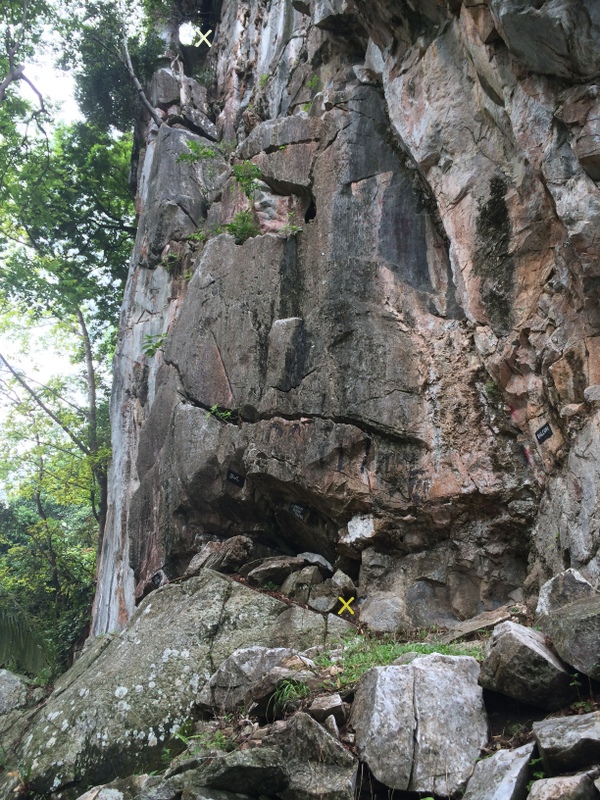
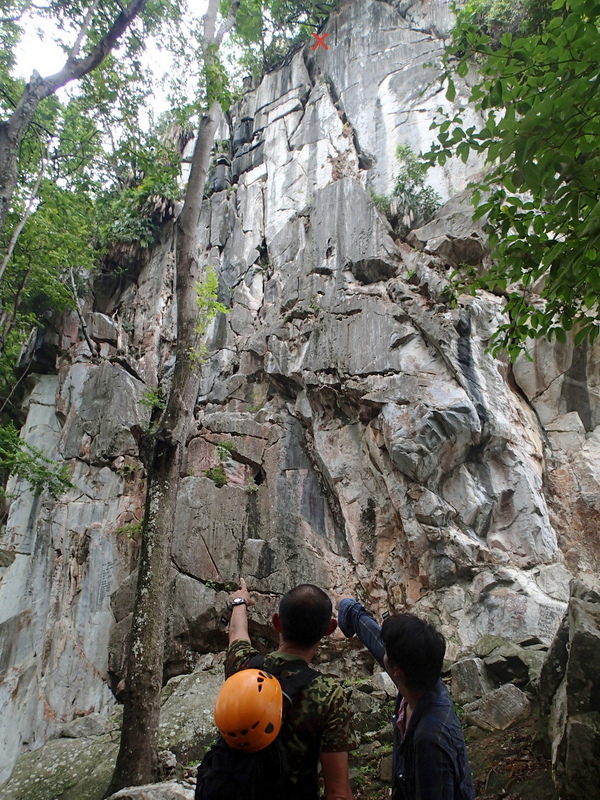
The climbing wall

We would start at the lower yellow cross, first climb halfway, then up through a so-called chimney (second cross). Finally abseiling down from the red cross.Click the pictures to enlarge them

Climbing up

Rappelling down

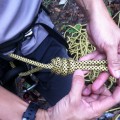
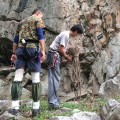
First Chadel explained rope handling, some useful knots and how to secure (belay) a fellow-climber. He is an experienced guide and has brought numerous clients to this hill.

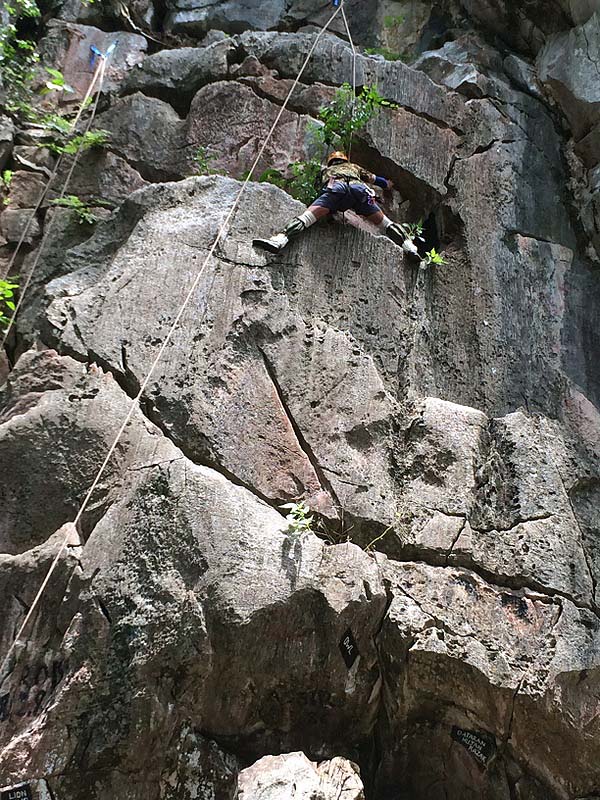
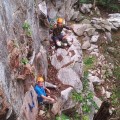
Chadel went up first. In the left picture he has almost reached the ledge, where he will prepare the safety anchor for Edwin and me. In the middle picture it’s me on the ledge and in the third one Edwin. To be honest, I found it not easy and almost gave up, but thanks to Chadel’s pep talk I made it..:-). Click on the picture to enlarge it, so you can see how Edwin is belaying me.

Chadel

Me

Edwin

From the ledge Chadel lowered us down to the base, where we took a rest and had our lunch. Because this was just a practice climb..:-).

The second half (pitch) of our climb was easier but had a “chimney” as a bottleneck. In a chimney you have to use a different climbing technique and here it helped that I had some experience from my mountaineering past.

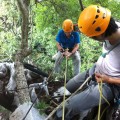
After this second pitch it was an easy scramble up to where we were going to rappel thirty meter down to our starting point. Not taking any risk, Chadel prepared an extra safety rope, in case we would loose our grip on the abseiling rope. The abseiling technique is very different from what I have been doing fifty years ago, Mark the tiny red gadget, that does the trick.

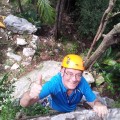
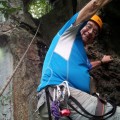
I think from my face it is easy to see how happy I was.

I also took a few videos. Here Chadel is starting the climb, belayed by Edwin.

In this video I have already climbed to the ledge abd I am watching how Edwin is coming up

And here Edwin is abseiling down. Can you hear the funny buzzing sound? There were a lot of annoying sweat flies..:-)

Thanks for a wonderful trip, Chadel!

MH370

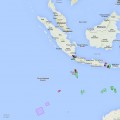
Just now I did a Google News Search for MH370. I got “about 276 million results” That is an amazingly huge number. It reflects the interest of the whole world in the disappearance of Malaysian Airlines flight MH370, now more than one month ago. Here is the plane in better days. MH370 Until now the search for the black boxes of the MH370 has been a lot less successful, with no results at all the last two days. After a lot of confusion during the early days, it has now been generally accepted that MH370 has been diverted deliberately from its original course and finally crashed in the Indian Ocean, about 1000-1500 km west of Australia. Here are some maps of the search area, based on a complicated analysis of satellite data. A bit surprisingly, until now no debris has been found.

These maps are available for everybody and very interesting on this website: Marine Traffic In the top right corner you will find an option “Go to Area” where you can choose MH370 Search Area. The site has many options, just find out for yourself. In the picture to the right, you see the recent tracks of the Ocean Shield, an Australian vessel that has recorded a number of “pings”, possibly coming from the black boxes. But the last few days contact has been lost. Searching the Internet formore  information,

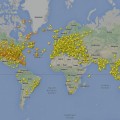
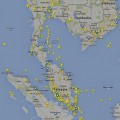
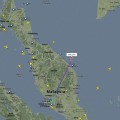
I found another very interesting website, this time not covering the marine traffic, but the air traffic. Flightradar24. Be warned, this site is addictive…! You can follow a flight, from the take off, live, as long as it is wihin reach of the radar. Click on a plane icon and you will get detailed flight information about speed, altitude. This is the information sent by the transponder on  board of the plane.

It is this transponder that was switched off on board of MH370, when the plane was about to cross over from Malaysian to Vietnamese air space. Just after the transponder was disabled, the plane diverted from its course in a western direction, and later turned to the south.

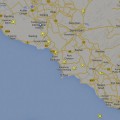
After the disappearance of MH370, MAS has decided to rename the flight from Kuala Lumpur to Beijing from MH370 to MH318. I followed this flight from the start, last night, until it was about to leave Malaysian airspace. It is the last picture below.

After a few days of optimism, when several “pings” were recorded, now there is doubt whether  the black boxes will ever be recovered. In that case it may remain forever a mystery what has happened to MH370…:-(

Bukit Kiara again

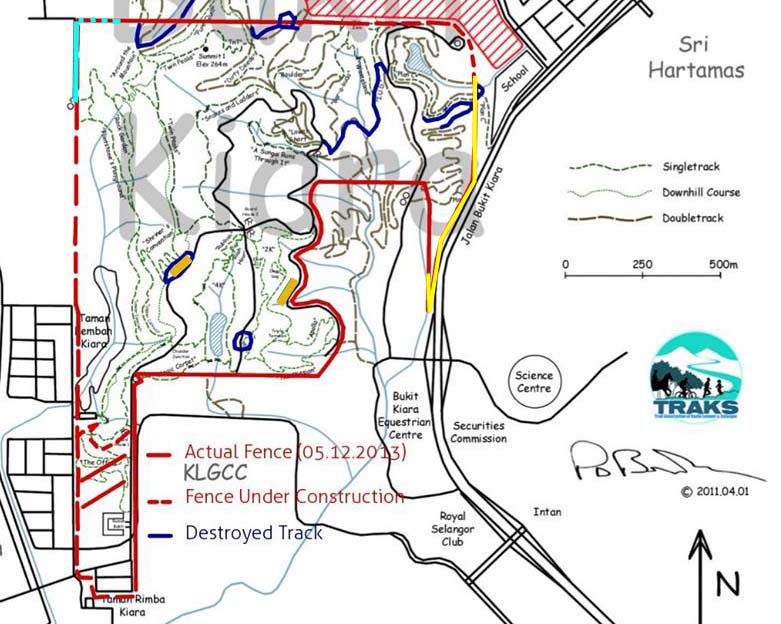
My last post about Bukit Kiara, Bukit Kiara: Not All Is Well, was written end of December and reported that JLN had resumed the fence construction at the eastern border of the proposed Kiara park. It is the yellow line in the TRAKS map below.
Kiara Fence

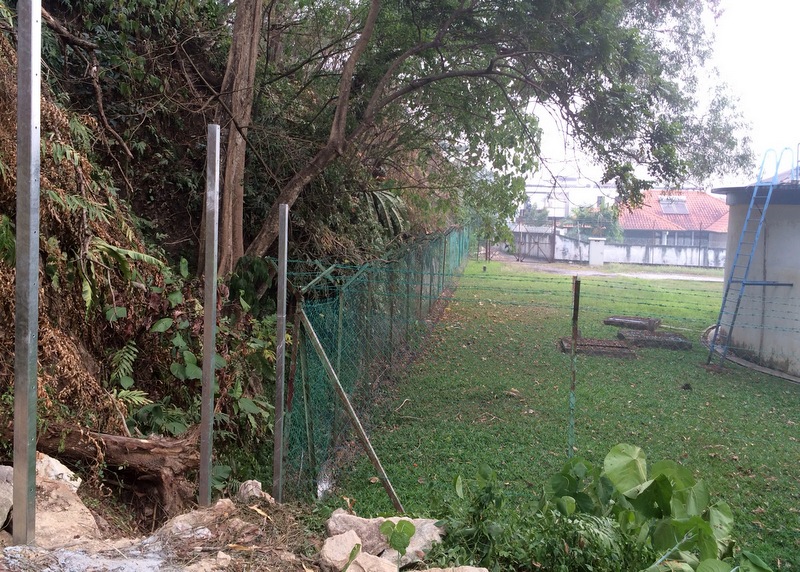
Now they are constructing the fence at the western side, where the park borders TTDI. Indicated in the map by a light blue line. I went there with my friend Pola Singh to have a look.
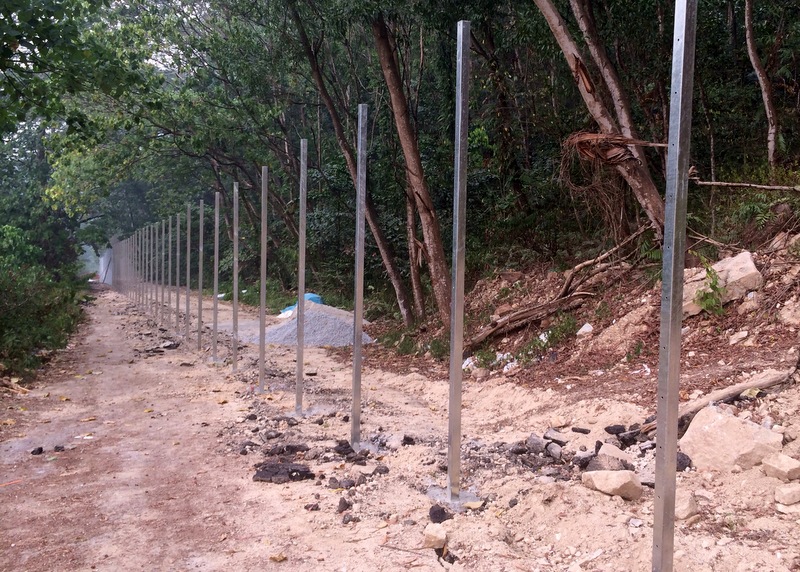
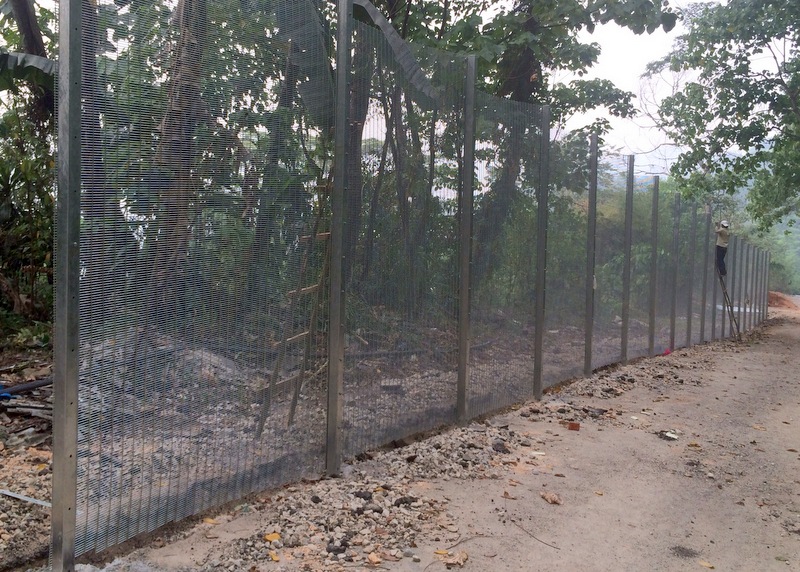
Fence under construction

Fence under construction

A small unpaved road, leading to a water tank, separates here the hill from the Taman Tun area, and it is this road where they are constructing the fence. The pylons have been cemented, now the workers are applying the actual fence. Halfway a gate has been planned. Near the water tank, the “prison” fence will connect to an old “friendly” existing fence.

Location of the gate Old fence and new one

What will they do with this old fence? They will have to replace it, IMHO, otherwise the whole idea of making an unclimbable, high-security prison fence around Bukit Kiara becomes meaningless! Where the fence ends at the northwestern corner, it has  to turn 90 degrees (blue dashed line in the TRAKS map) and then go up a very steep slope to connect with the existing northern fence. That will be a very tough job!

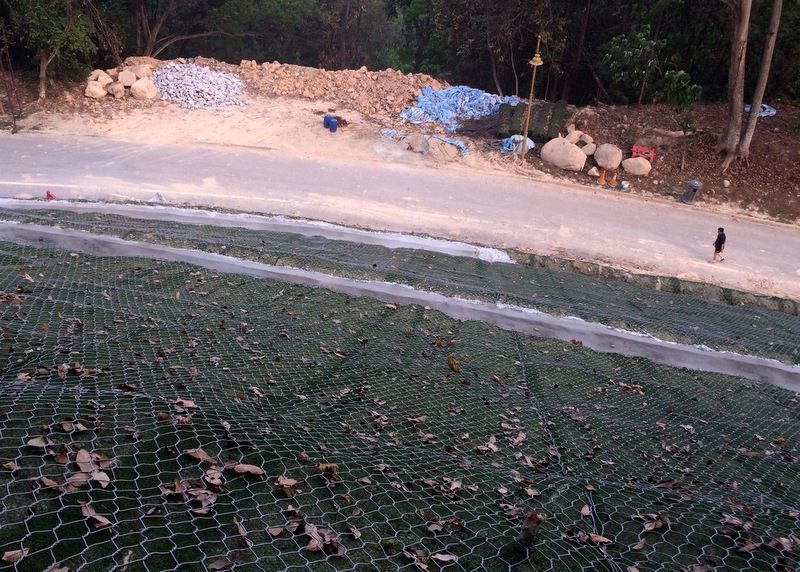
On our way back we climbed to the ridge to have a look at another of JLN’s “achievements”, the slope rectification project (see my aforementioned post)

Slope rectification

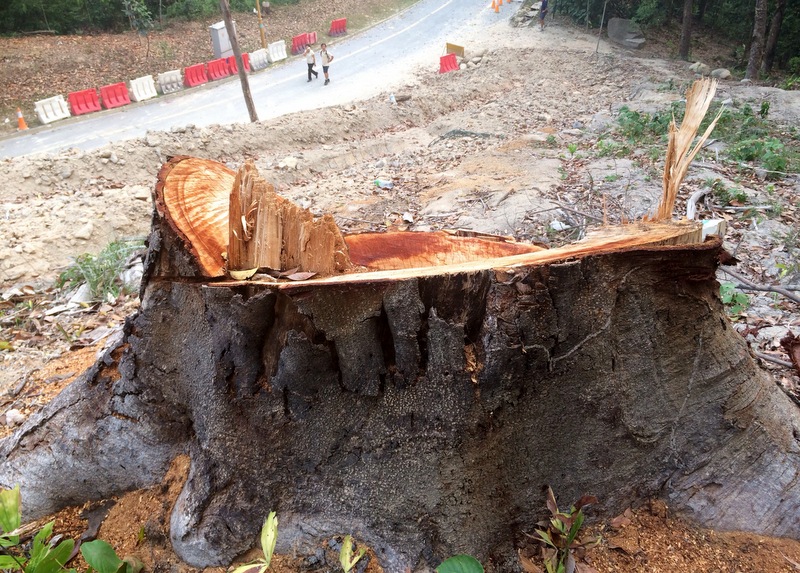
This was a beautiful tree

When it became clear that the soil removed from the slope, was just dumped at the other side of the road, destroying more trees and one of the TRAKS trails, a public outcry followed, and they stopped. But the damage was already done, as so often happens in Malaysia…:-(  In the beginning they had left one majestic tree standing, but that one now has also been cut down.

Here is a Youtube clip, taken while walking this trail (the 4K trail), until blocked by the JLN-made landslide. Pathetic.

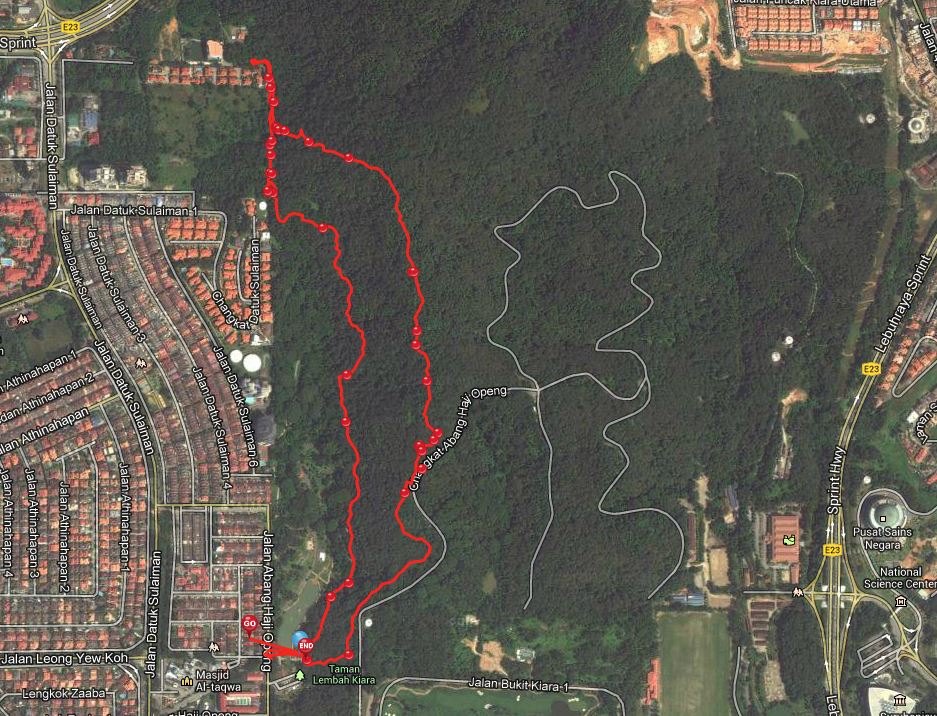
During our hike, I recorded the GPS coordinates and took quite a lot of pictures. It resulted in an EveryTrail report. In the map below you can see our hike, and when you click on it, a slideshow will start.

EveryTrail map