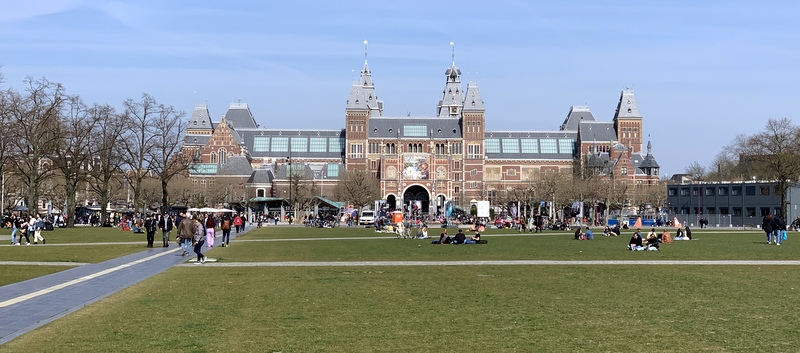
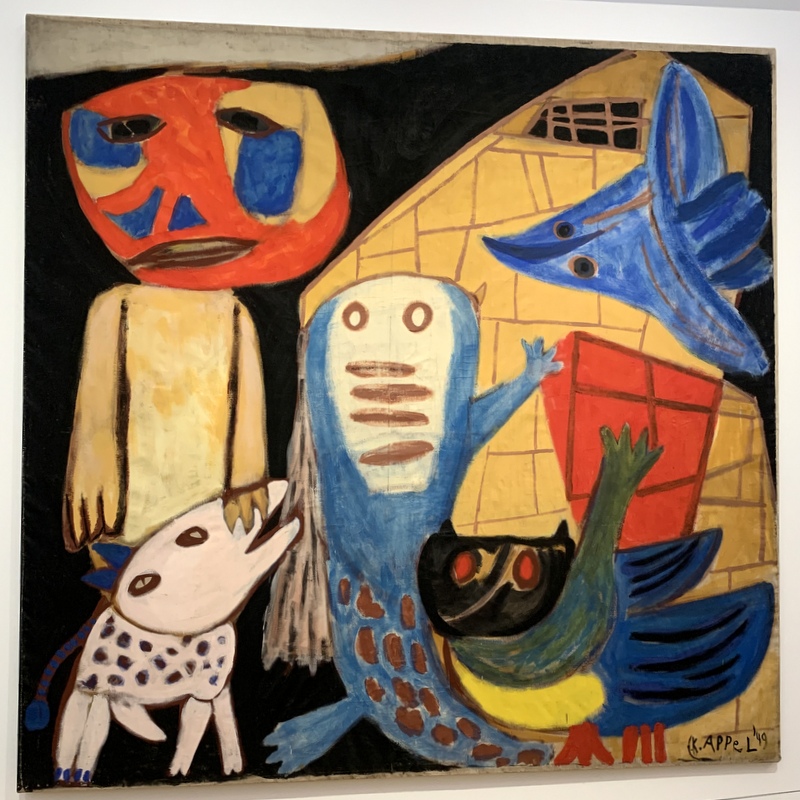
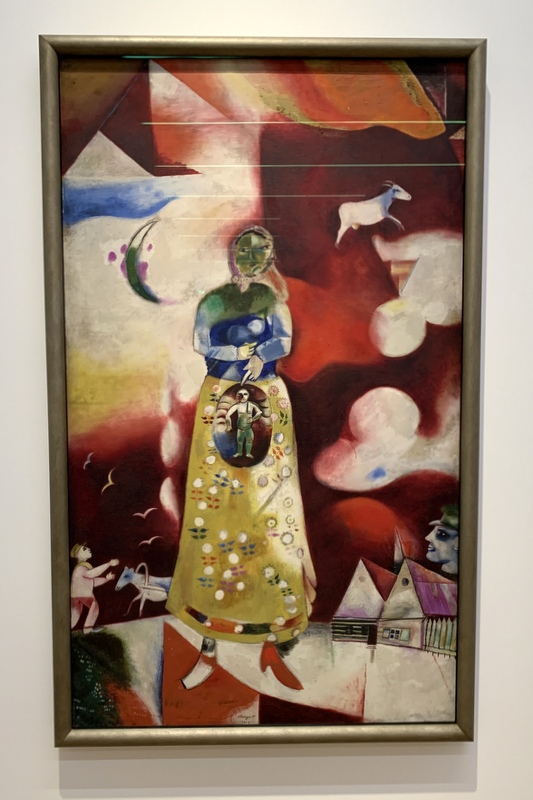
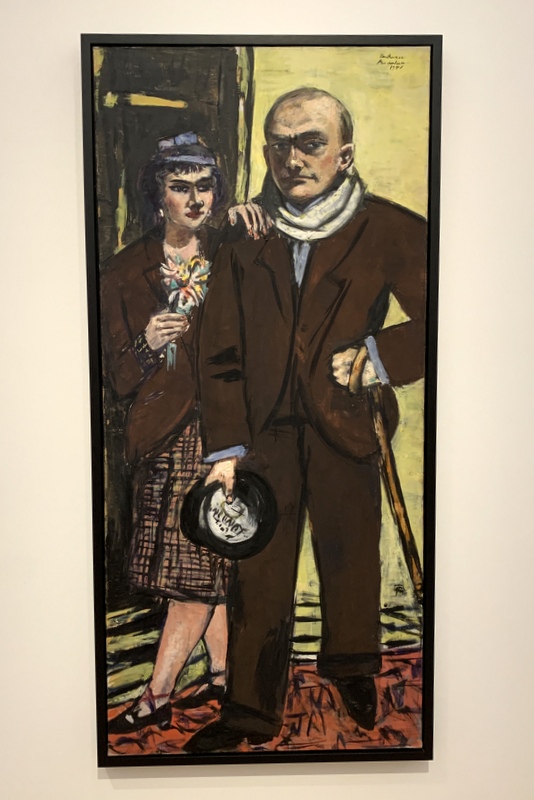
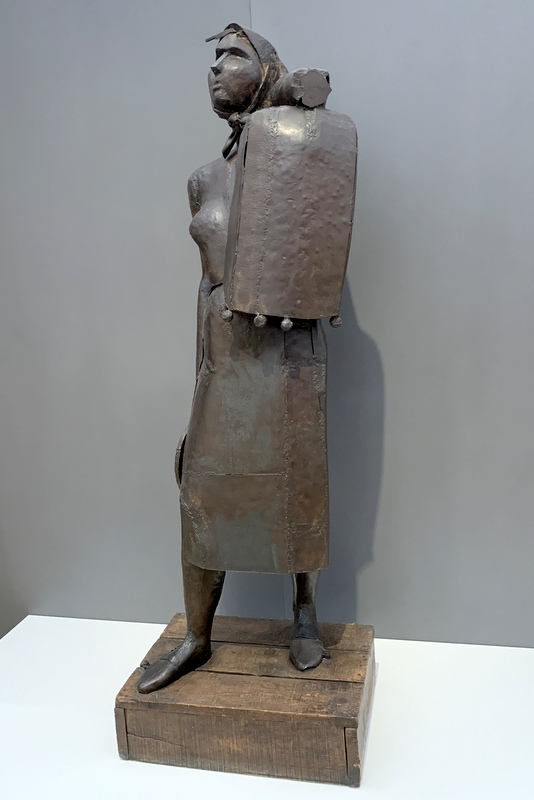
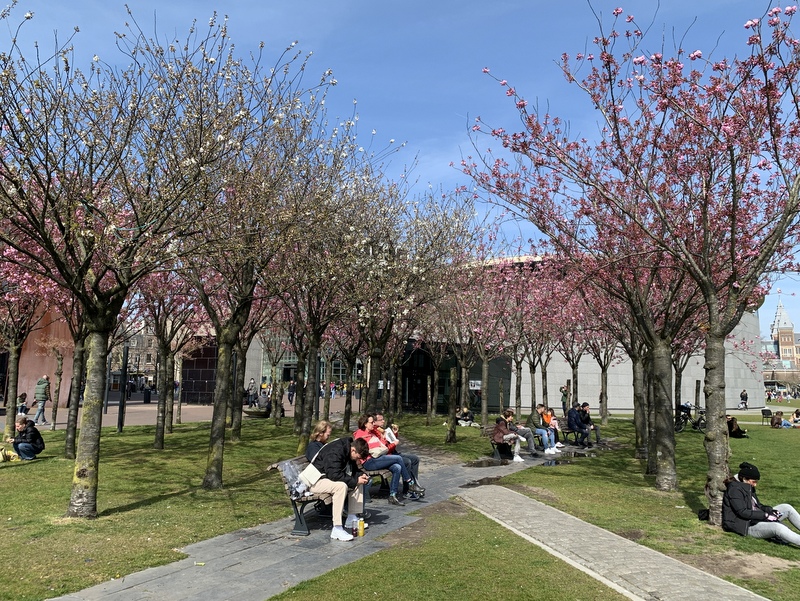
The Stedelijk Museum in Amsterdam is one of my favourite art museums. I visited it on a sunny, but cold Monday morning. It is located on the Museum square, with two other famous museums, the Van Gogh museum and the Rijksmuseum (picture).
The New Wing of the Stedelijk (2012), nicknamed the Badkuip (Bathtub).
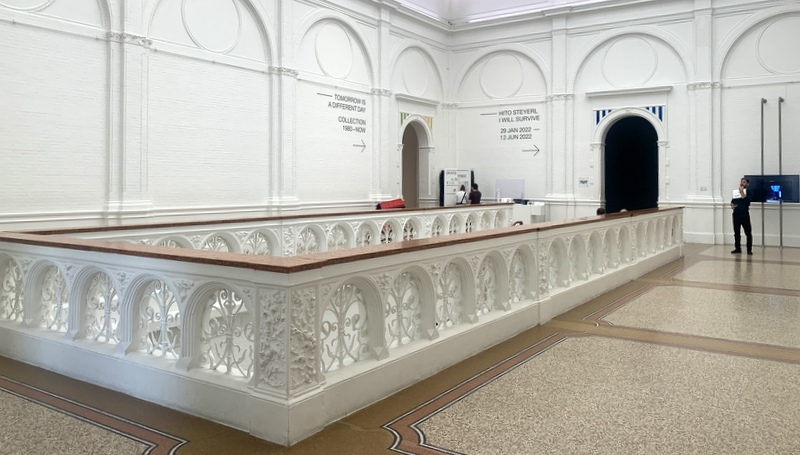
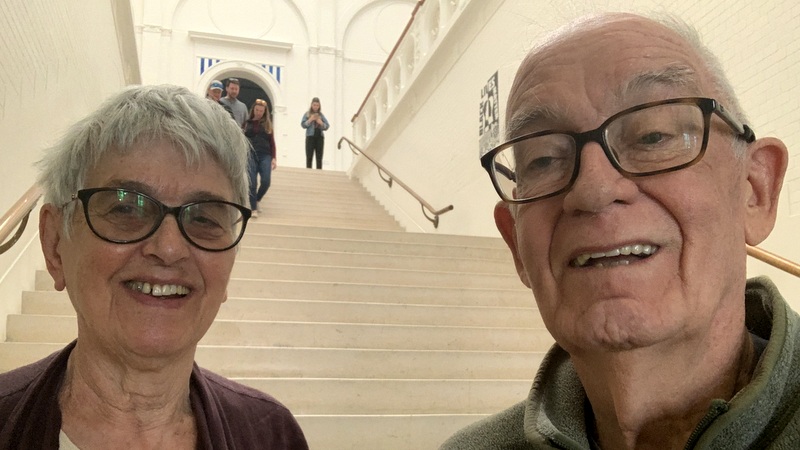
I started with the old building, walking up the monumental stairs to the mail hall, which was barren and very white.
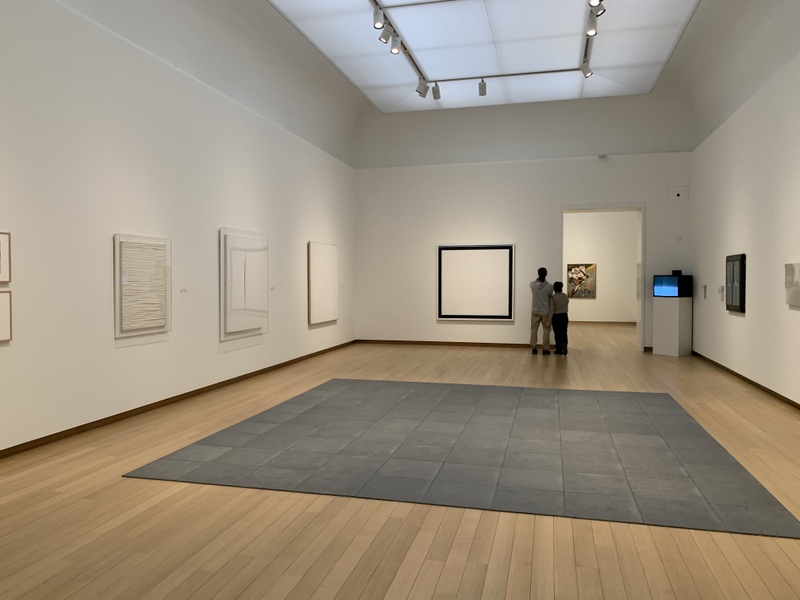
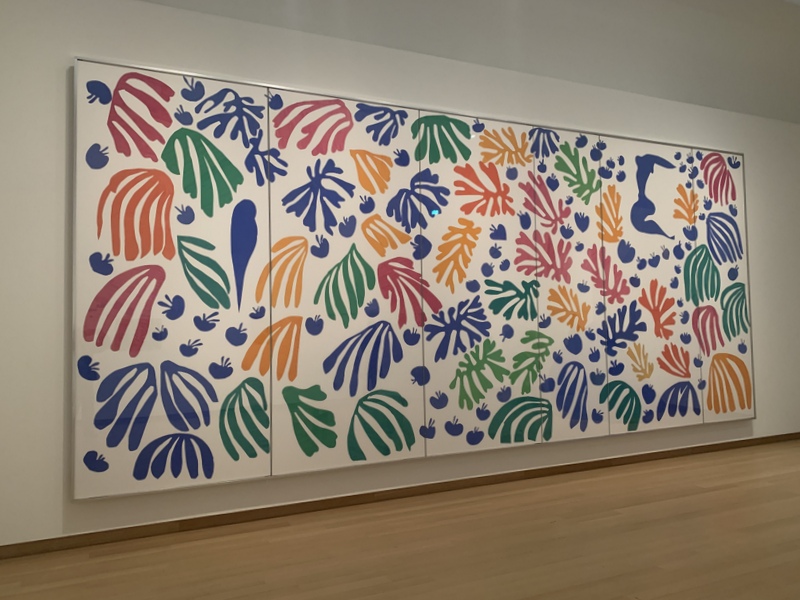
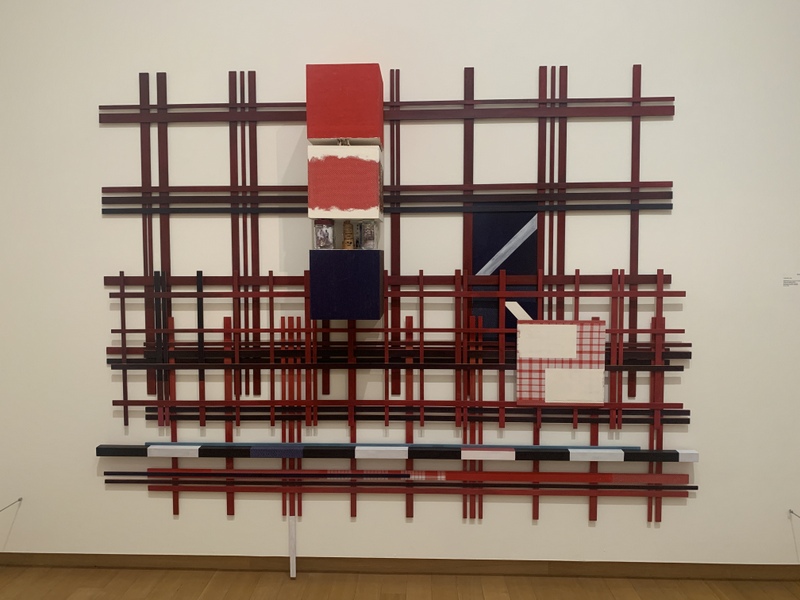
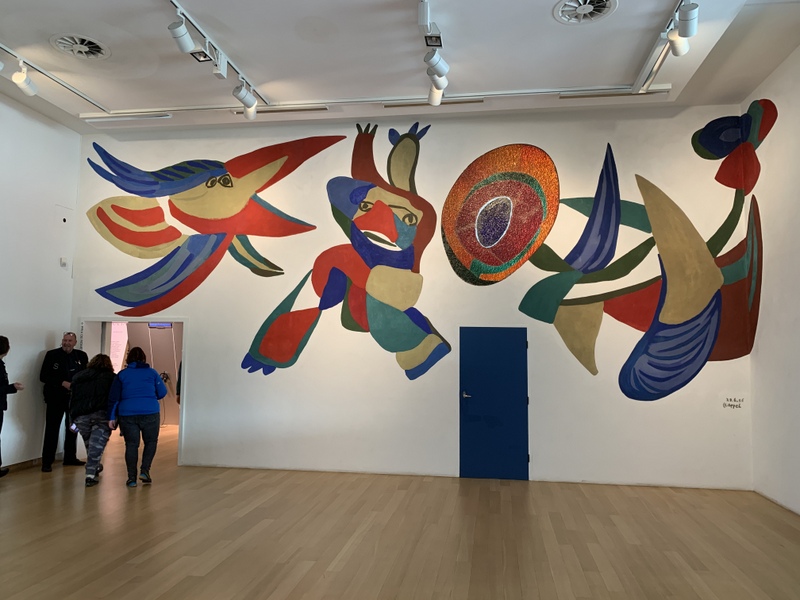
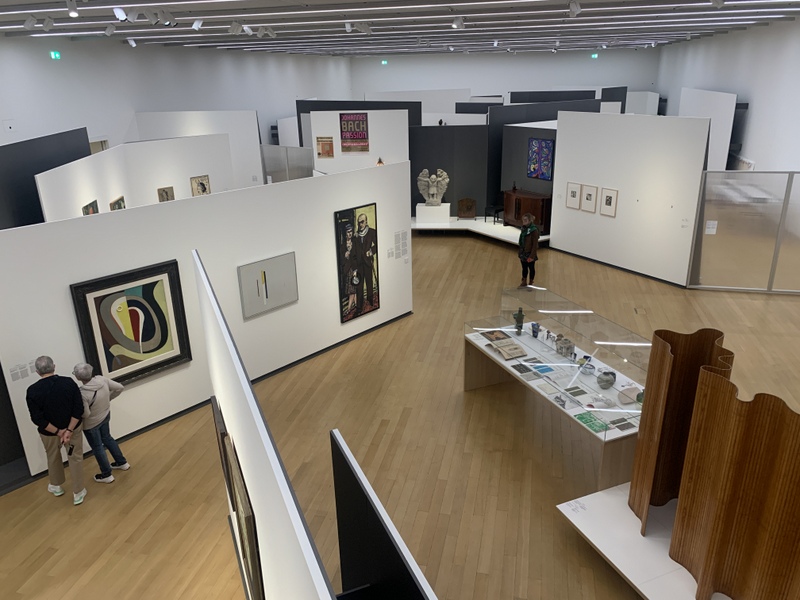
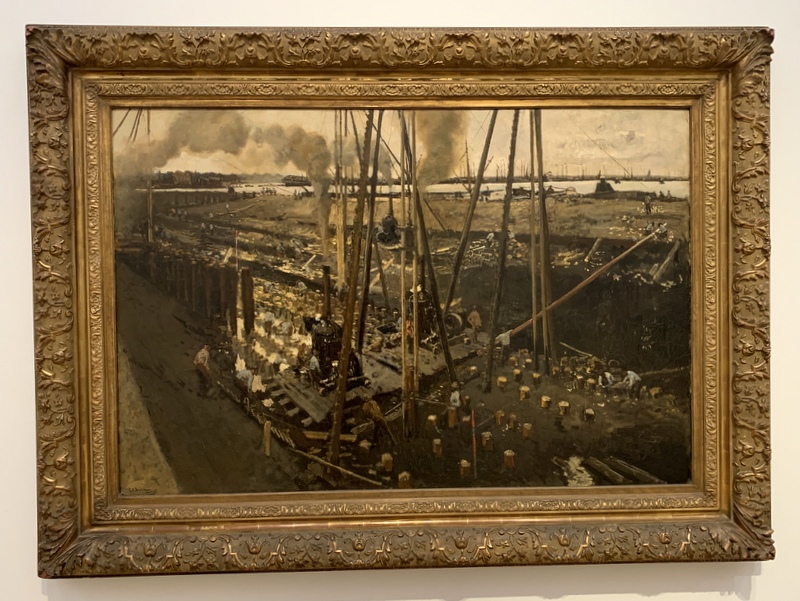
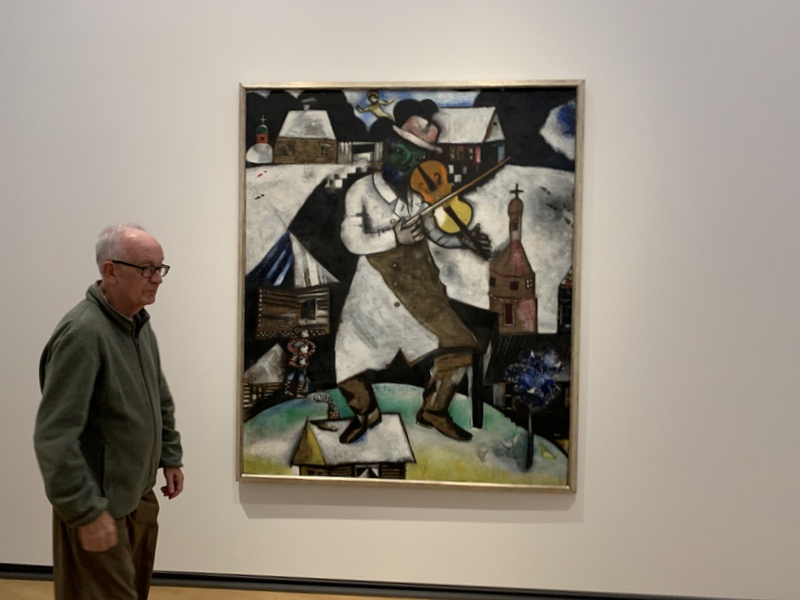
The old building houses the “collection 1980-now”, with the exception of the huge Parakeet and the Mermaid (1952) by Matisse, because this huge work of art needs a big hall. I took a few pictures, but most of the modern works didn’t really impress me. A sign that I am getting old?
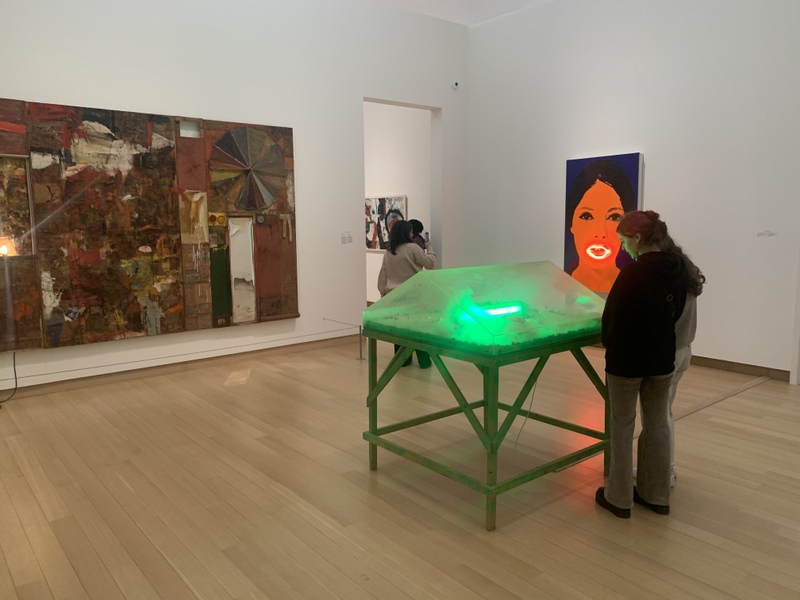
MatisseKoonsAppel
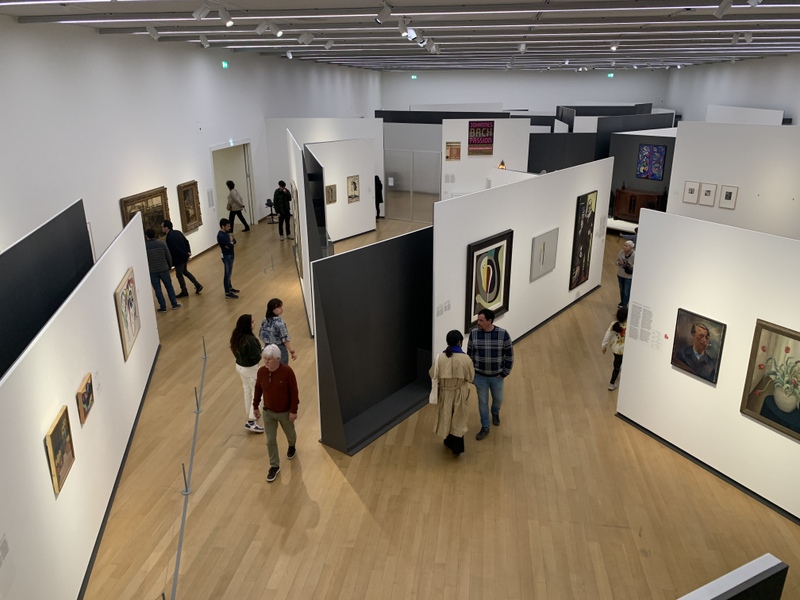
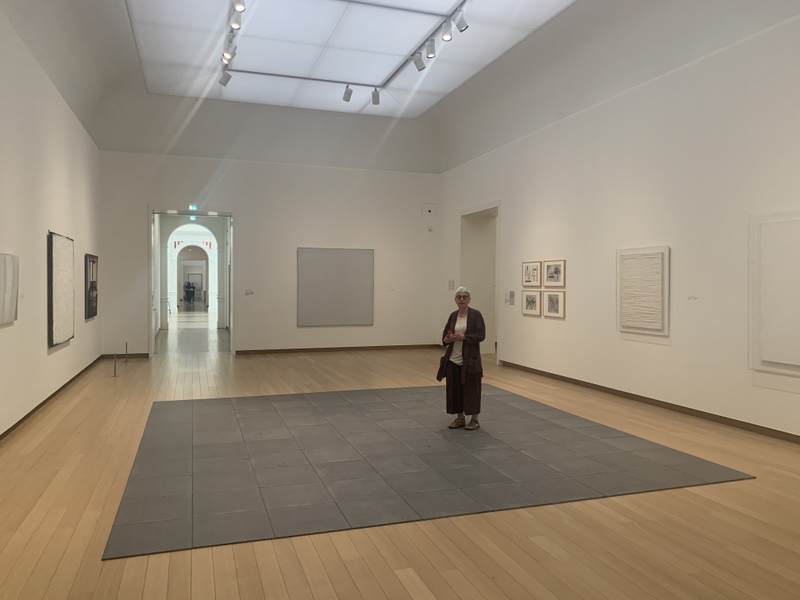
The new wing houses the “old” collection. The way the works of art are exhibited is quite nice.
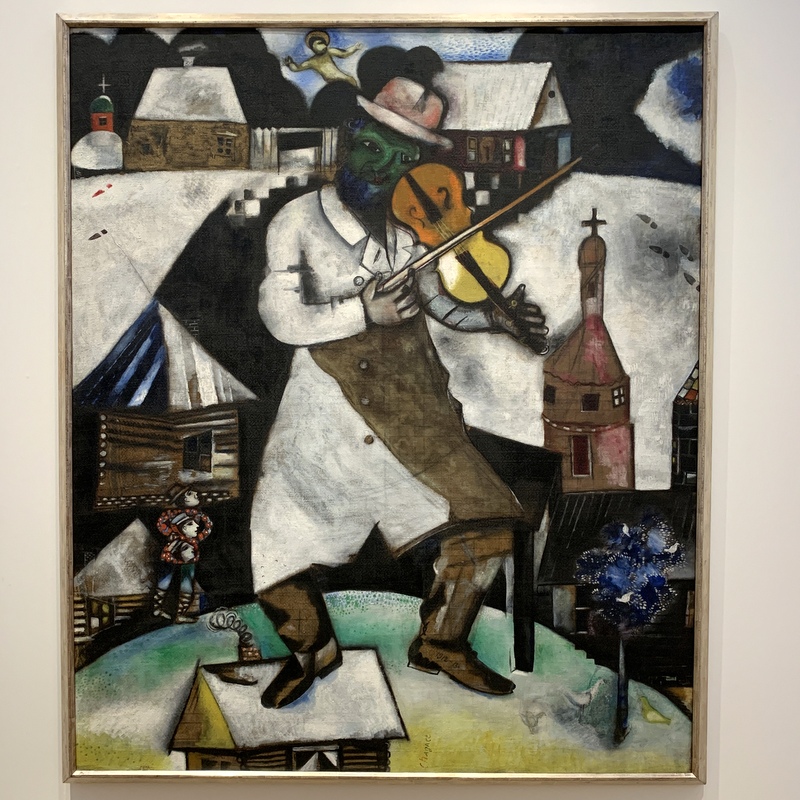
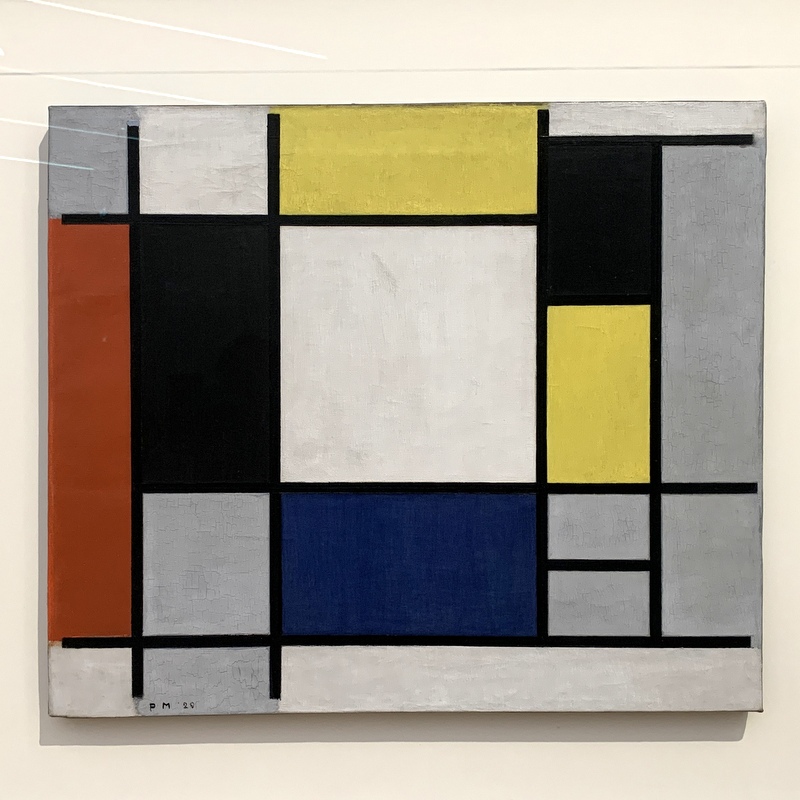
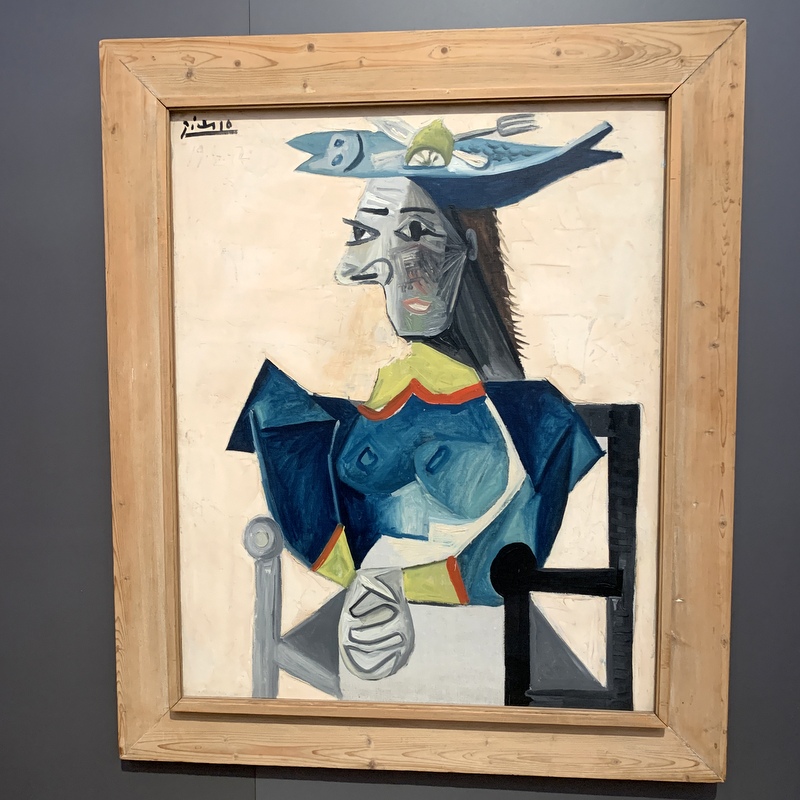
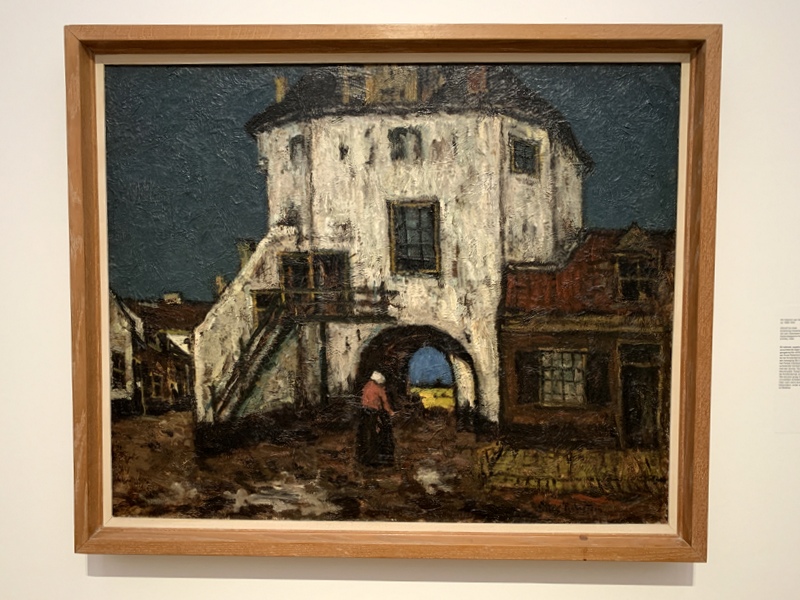
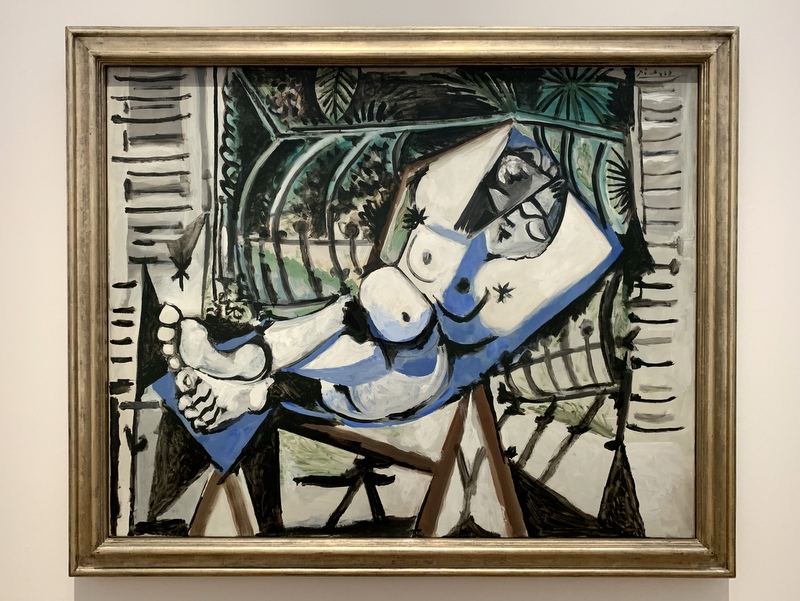
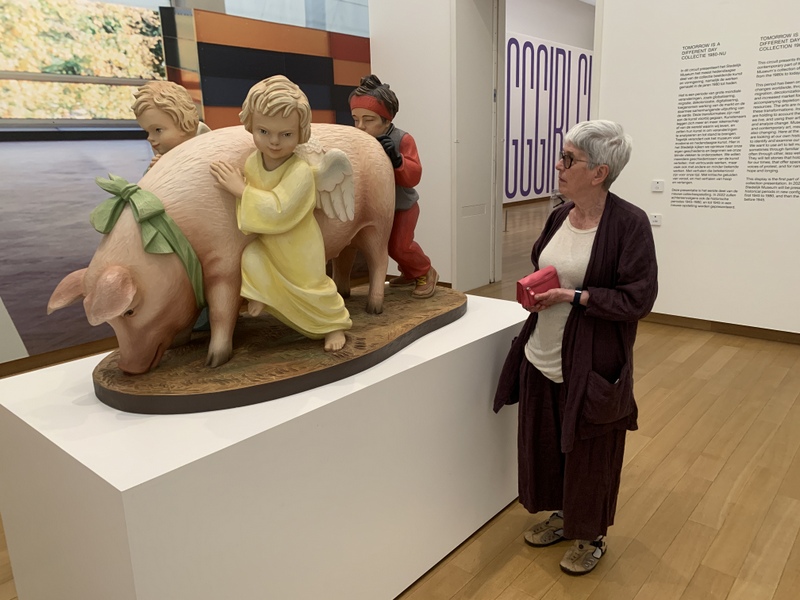
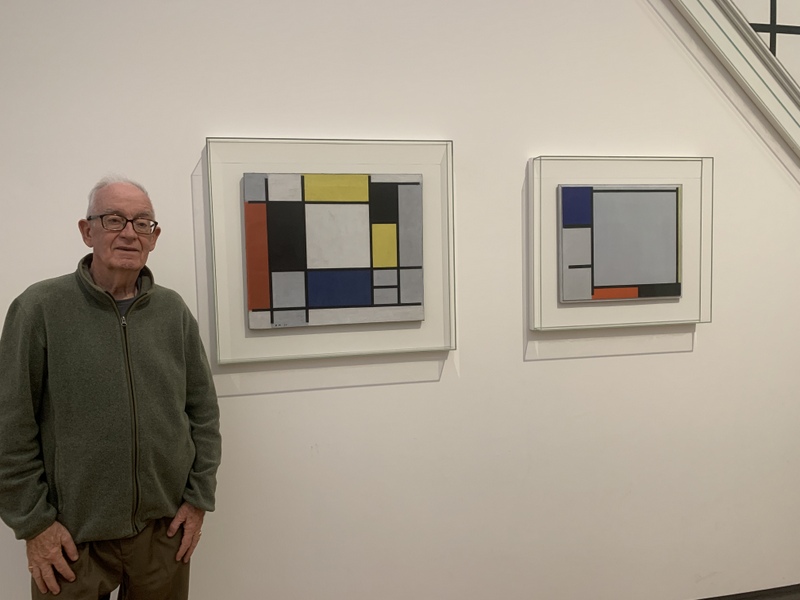
Here is a selection of what appealed to me. It was of course a feast of recognition, I had seen all these works of art many times before.
But something was missing. I was not in the right mood, Strange.. I stayed in the museum less than one hour..
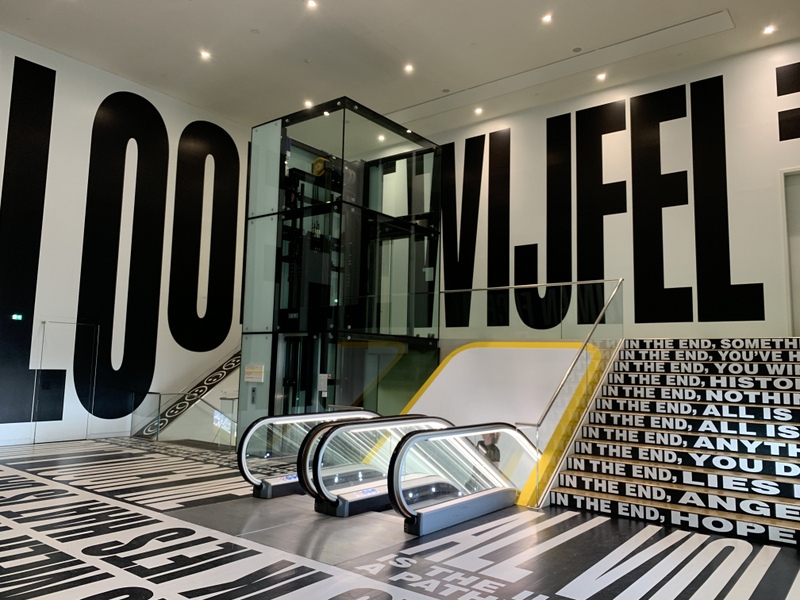
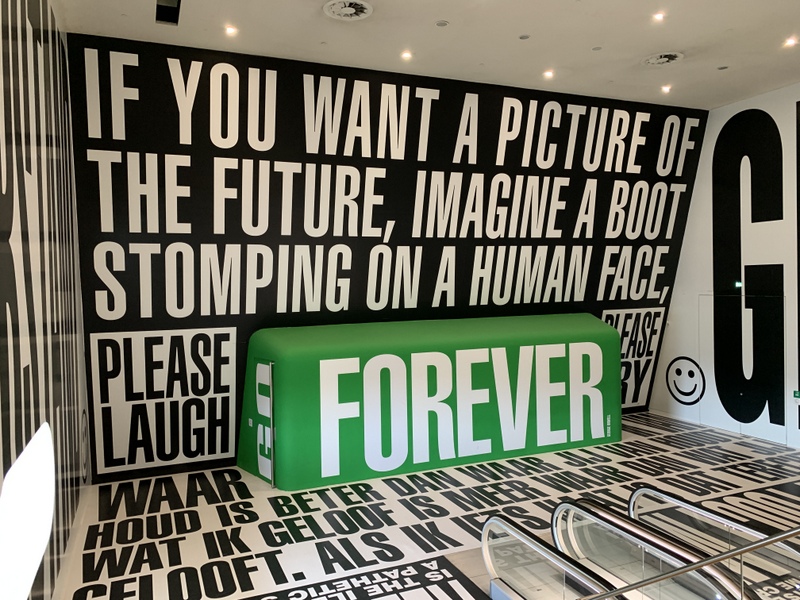
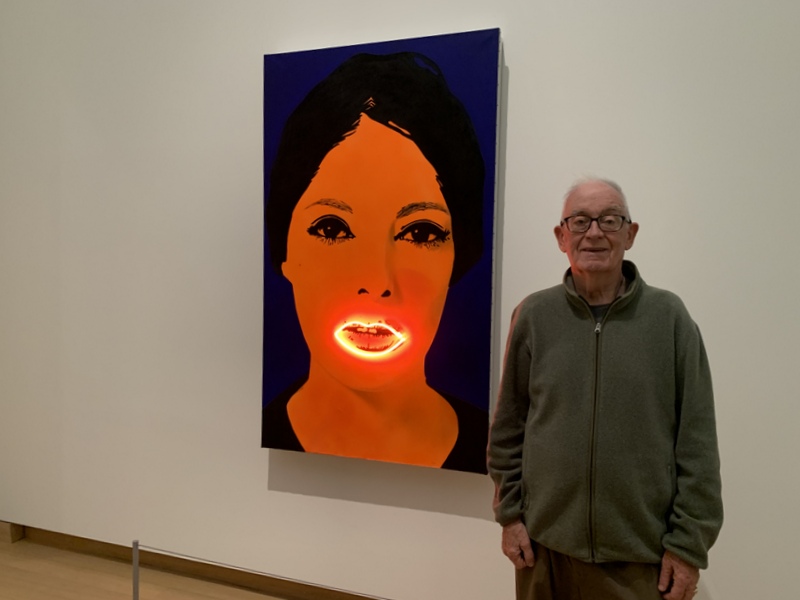
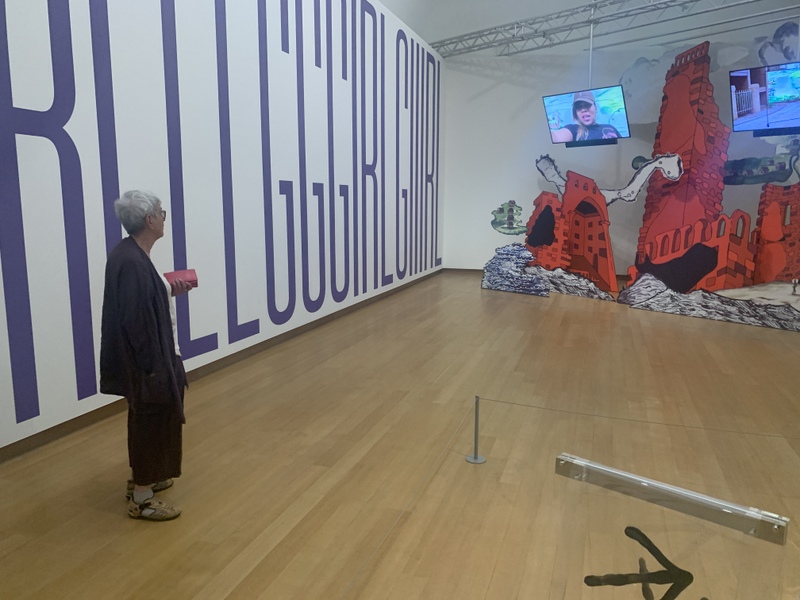
The first floor of the new wing is dominated by this modern artwork of Barbara Kruger,
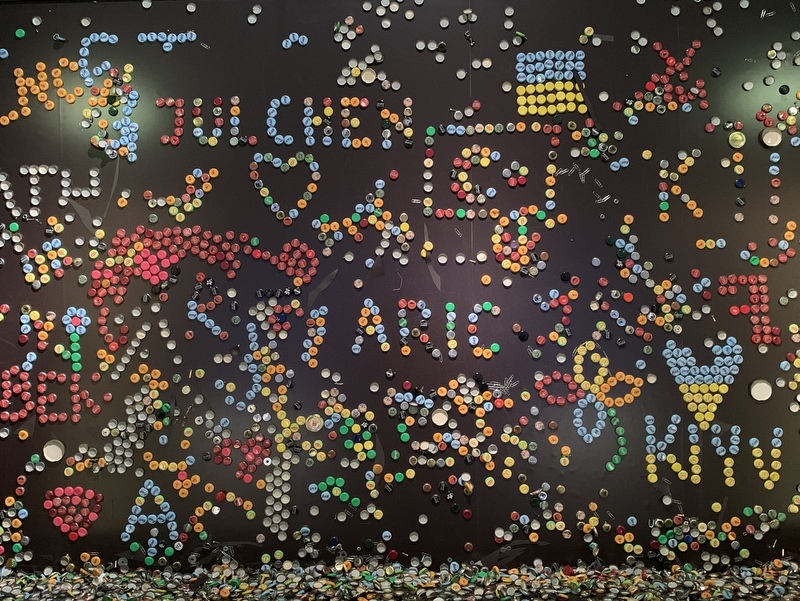
Was I missing Aric? It was good that outside the sun was shining.
One week later I visited the Stedelijk Museum again!
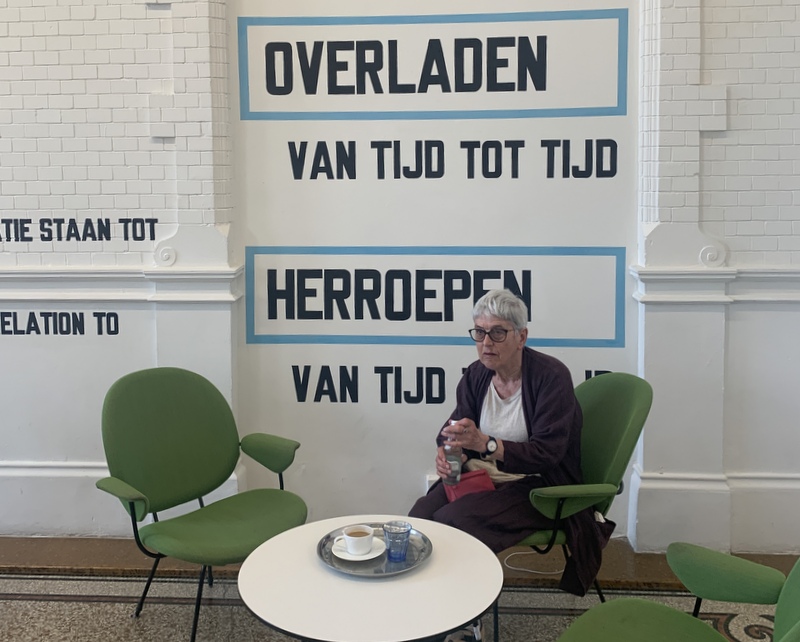
This time not alone, but in the company of Nellie. We first met as freshmen at the Free University in 1961, more than sixty year ago. When I am in the Netherlands we try to meet for a cultural activity. This time we wanted to visit the Cobra Museum in Amstelveen but noticed that it had a timeslot system which was not suitable for us. Instead we decided to visit the Stedelijk. This time I was in a much more positive mood.
During my visits to the Netherlands my friend Inez and I always try to organise an outing. Sometimes a longer trip, like in 2018 to Brugge, this time a day trip, with a mixed destination.
A former colleague of us is now living in Slikkerveer, a small village not far from Rotterdam. Piet and his wife Helma invited us to visit them and suggested that we should combine it with an excursion to the world-famous windmills of Kinderdijk . After lunch they would show us some modern architecture in Rotterdam.
Inez and I met at Amsterdam Central and took the train to Rotterdam. It was tulip season and from the train we saw several flower fields.
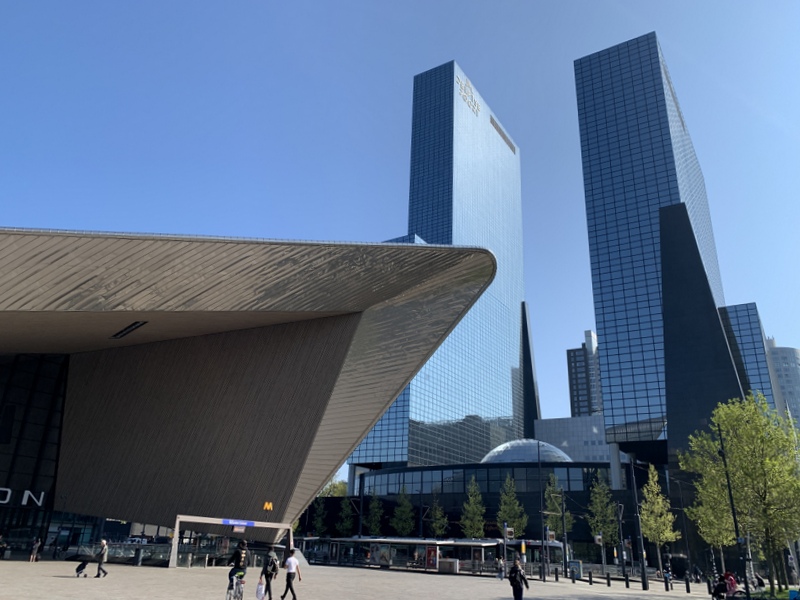
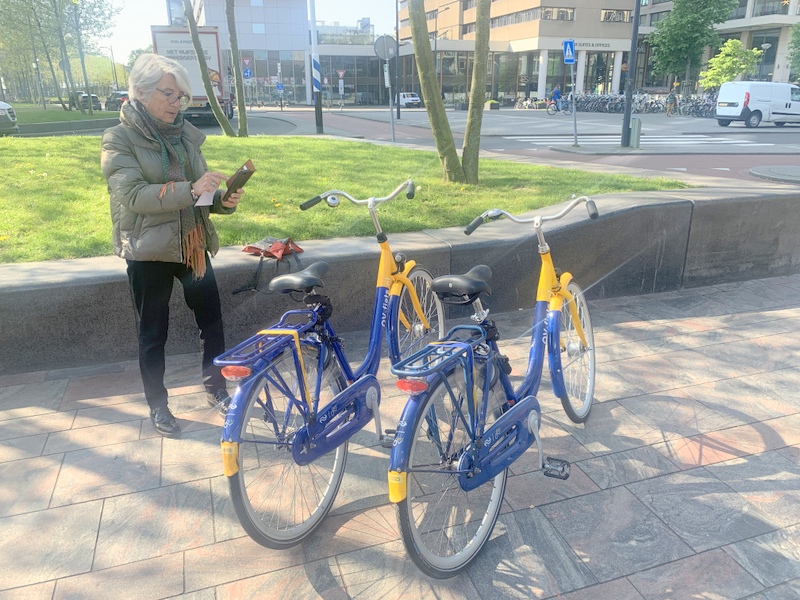
Left picture: The façade of Rotterdam Central Station, an interesting modern building. Almost all railway stations in the Netherlands have rental bicycles, simple sturdy models. Not easy for me, because I am used to hand brakes and these had coaster brakes (terugtraprem in Dutch, I had to Google for the English word).
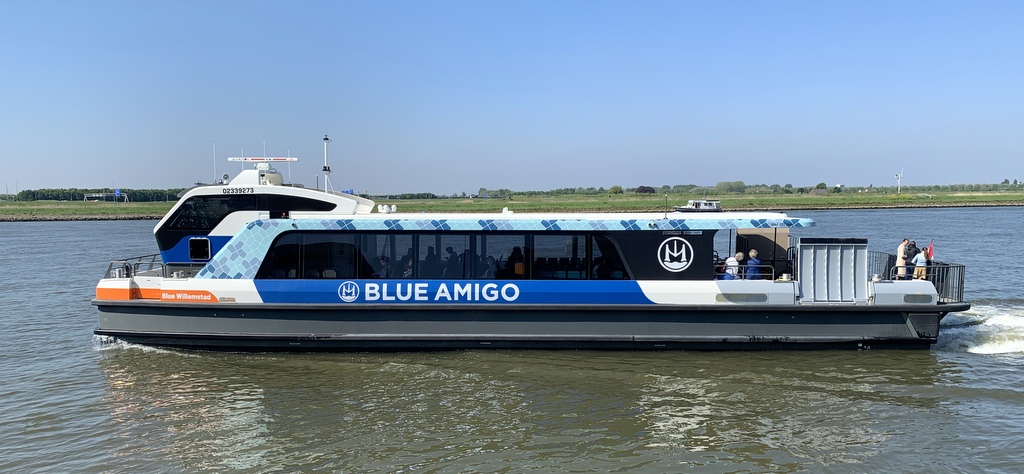
It was beautiful weather, with our bikes we cycled to the river Maas and used the Waterbus to go to Kinderdijk. Here is a picture of the Waterbus, no idea why a Dutch bus should be named Blue Amigo.
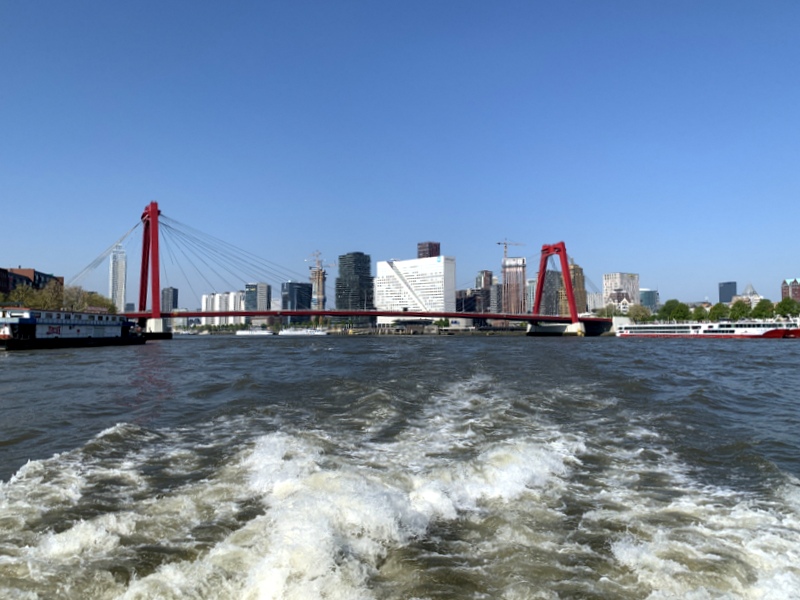
The waterbus is part of the Dutch public transport system and a very nice way of traveling in Rotterdam. Left the iconic Erasmus bridge, right the Willems bridge.
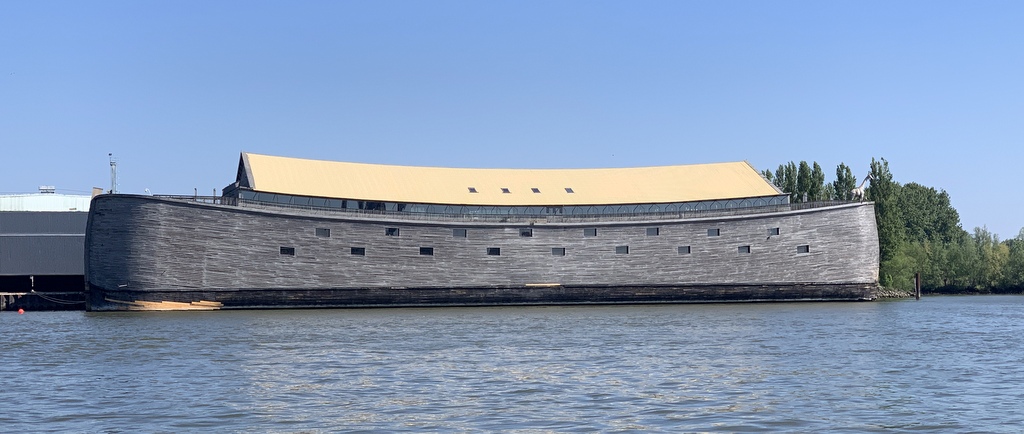
On our way we passed a very unusual ship: Noah’s ark, built by a fundamentalist Christian businessman, who believed in the literal truth of the Bible.. Years ago I visited an exhibition on this ship, an amazing experience. Now temporarily closed, final destination Israel;
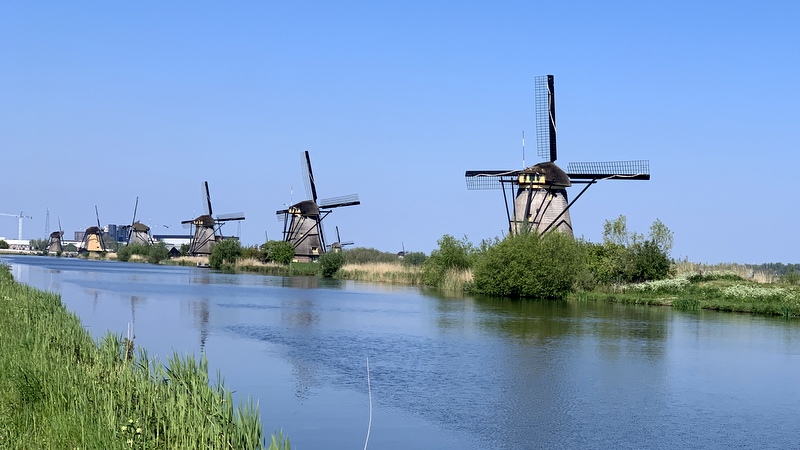
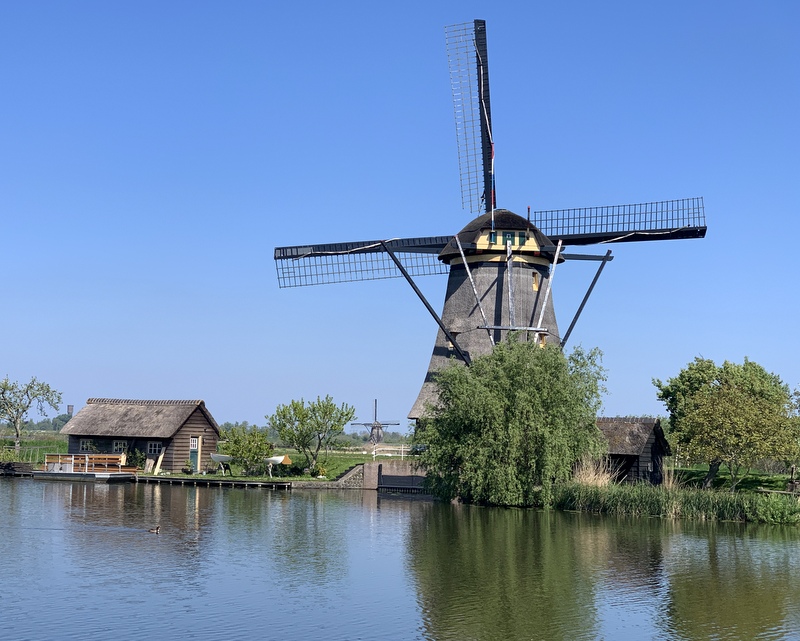
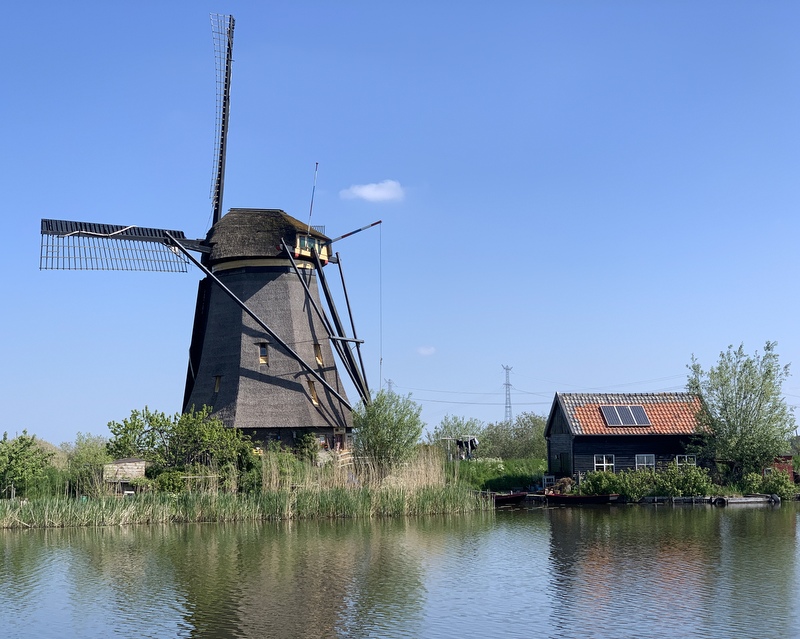
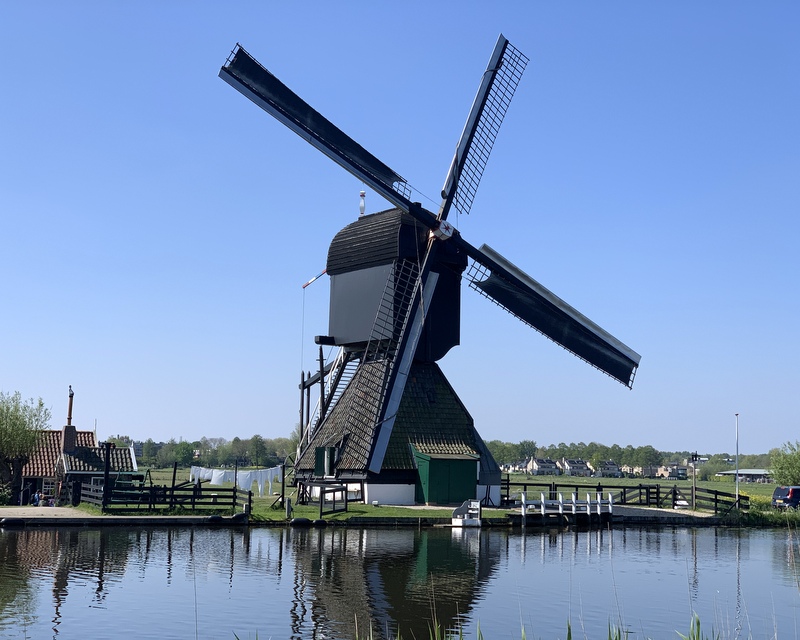
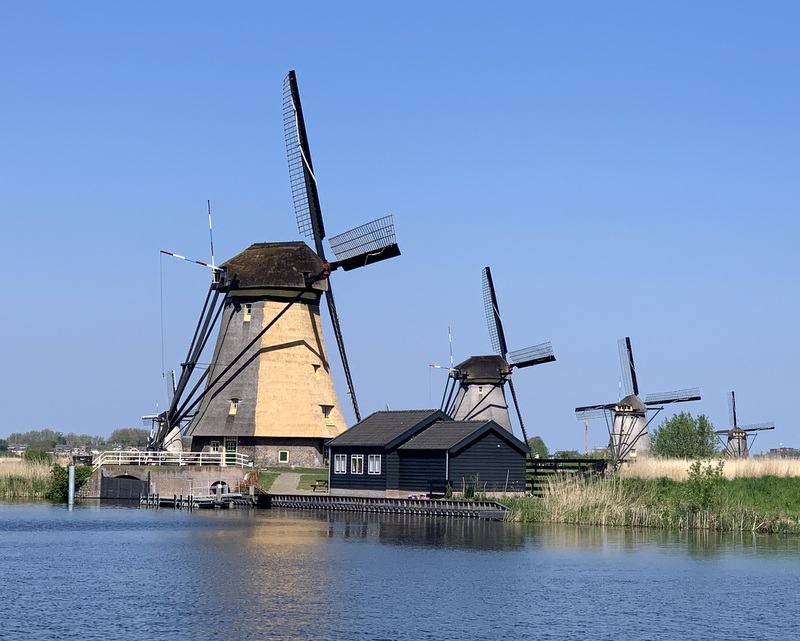
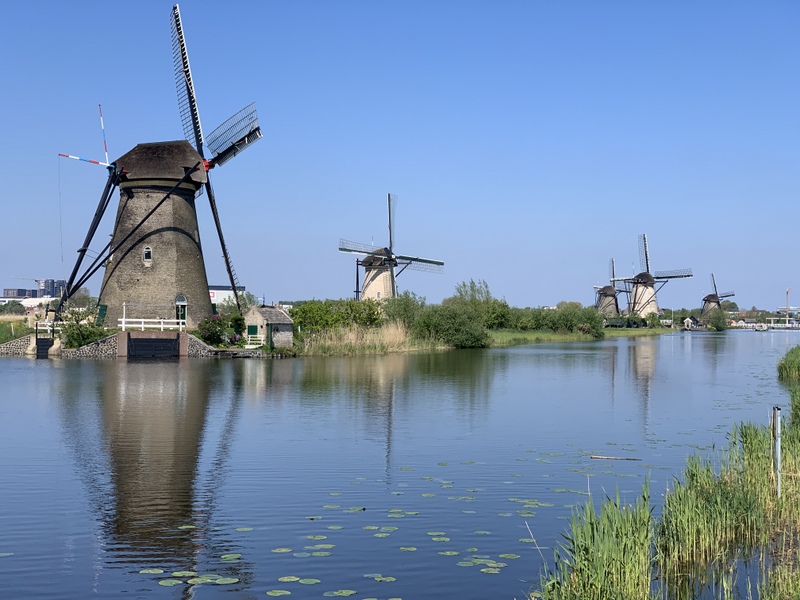
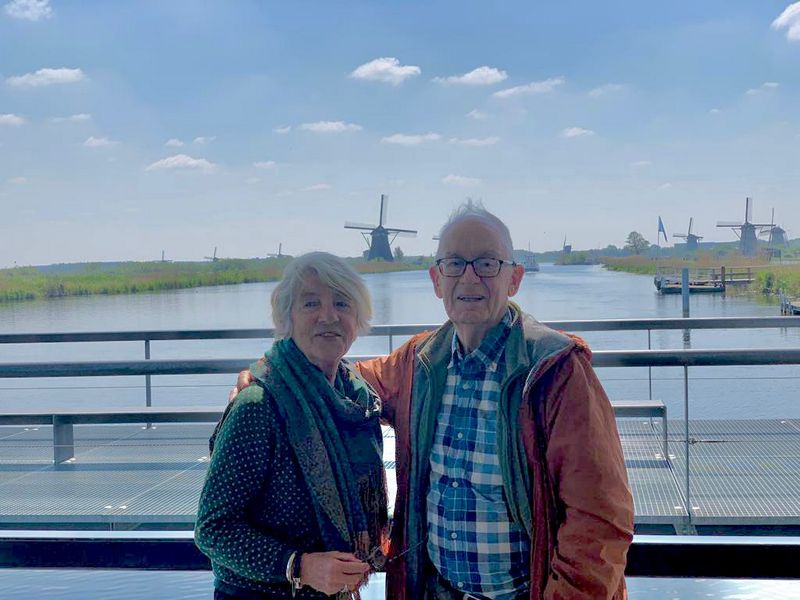
We left the bus in Alblasserdam and soon passed the first windmills of Kinderdijk. There are a total of 19 windmills, built to pump water out the low-lying Alblasserwaard polder into the rivers, World-famous and I had never visited them!
With the blue sky the windmills are a photographer’s delight. Some are still operational, although their work has been taken over by modern diesel pumps.
There is a visitor center where we had coffee.
When I talked about Kinderdijk with family and friends, everybody knew about the famous windmills, but almost nobody had actually visited them! I will go again with Aric on our next Europe trip.
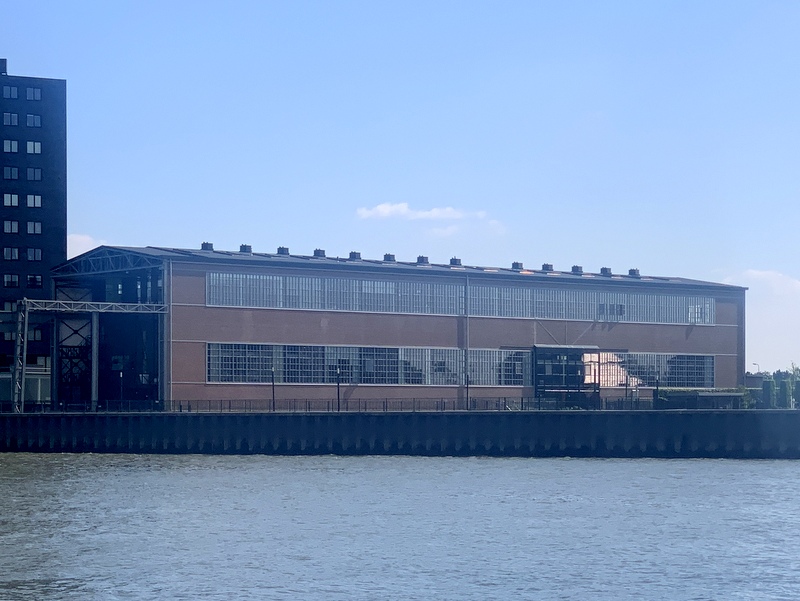
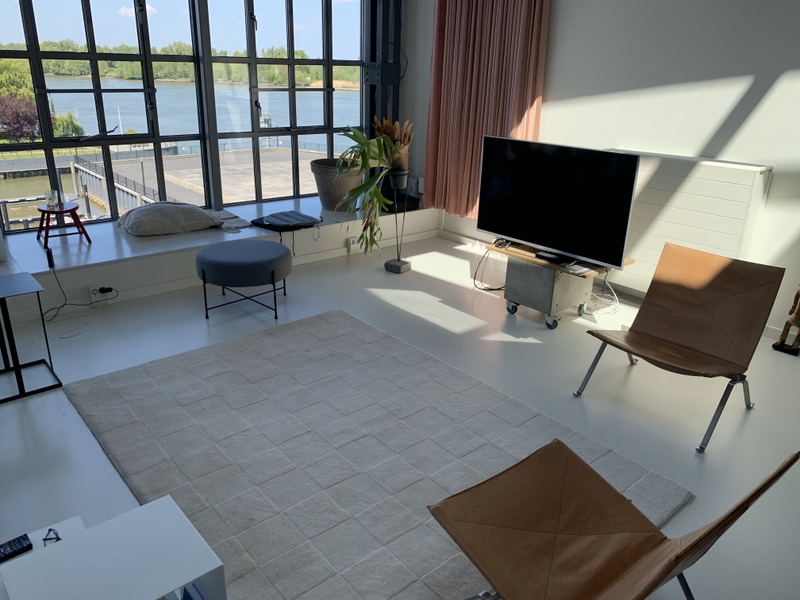
From the visitor center a ferry took us back in a few minutes to Slikkerveer. Piet and Helma are living in a former warehouse of Smit Slikkerveer, now transformed into spacious apartments
We got a hearty welcome, were shown around in their loft and had a nice lunch.
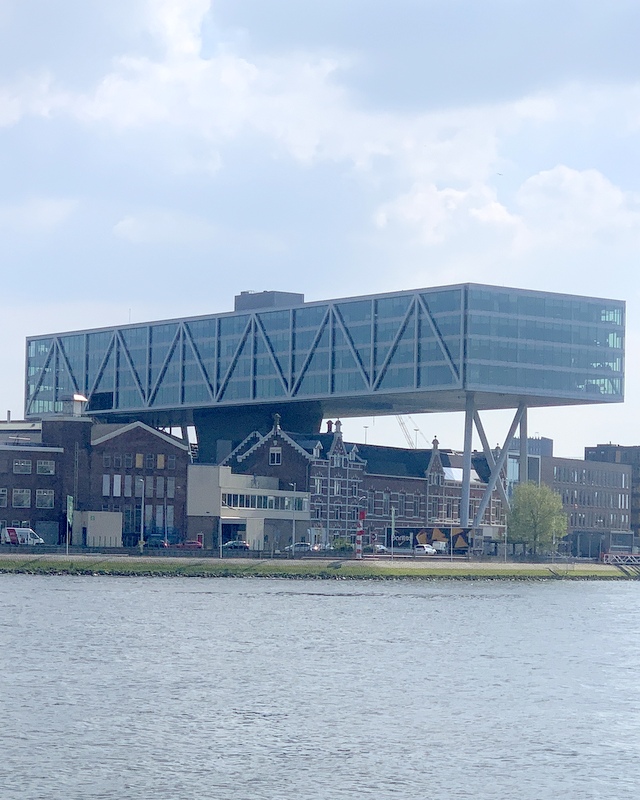
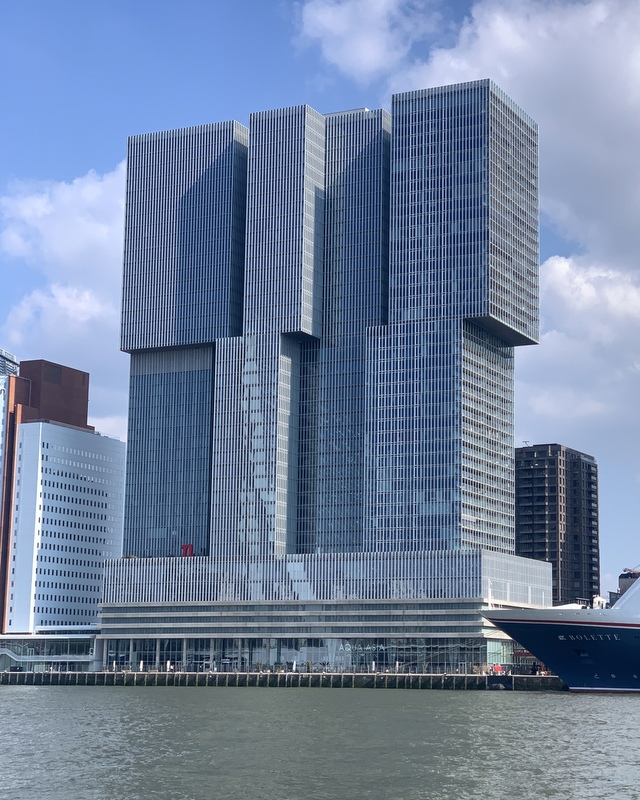
After lunch they joined us with their bikes on the Waterbus back to Rotterdam. We passed many modern buildings on our way. Left the Headquarters of Unilever BV (2007), right the iconic building De Rotterdam (2013).
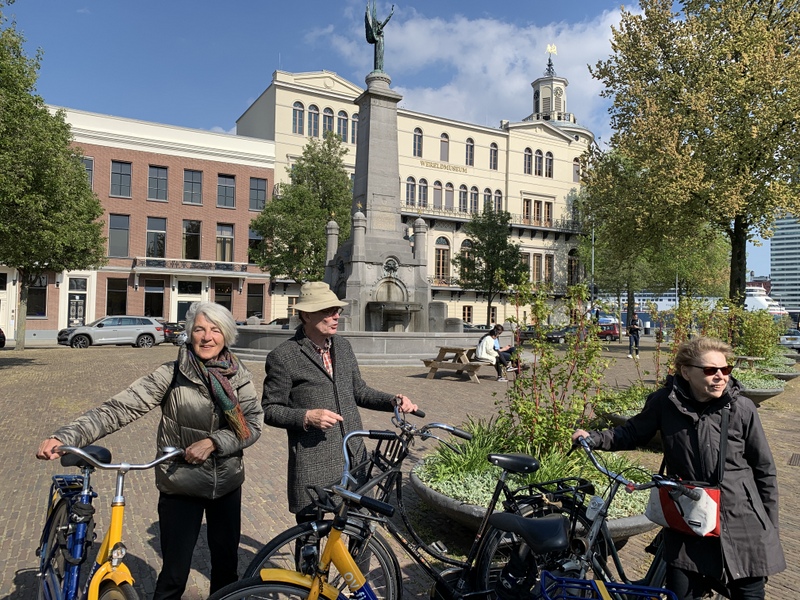
We parked our bikes at the Veerhaven and walked around.
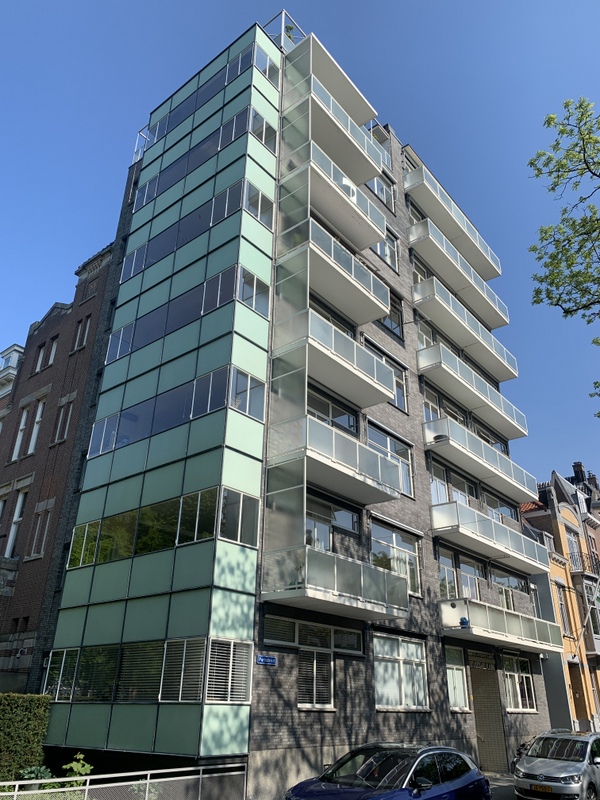
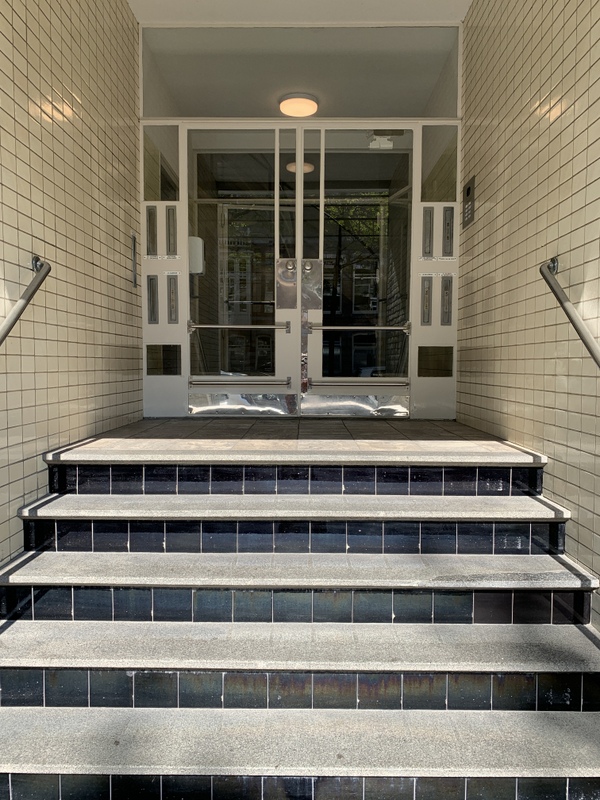
This is the Parklaanflat (1933) one of the earliest examples of a stacked building, with (in this case seven) luxury apartments one above the other.. Now we are used to apartment buildings but then it was a novelty. Right the monumental entrance.
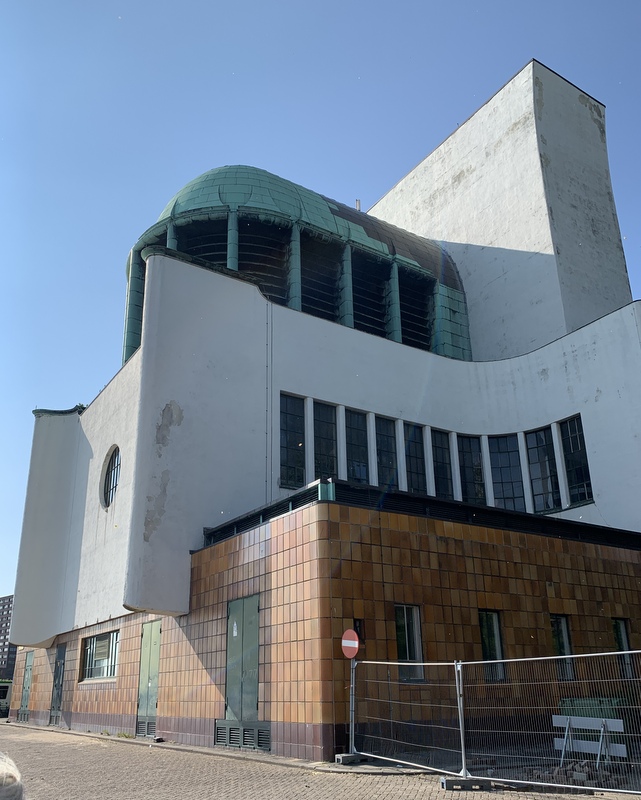
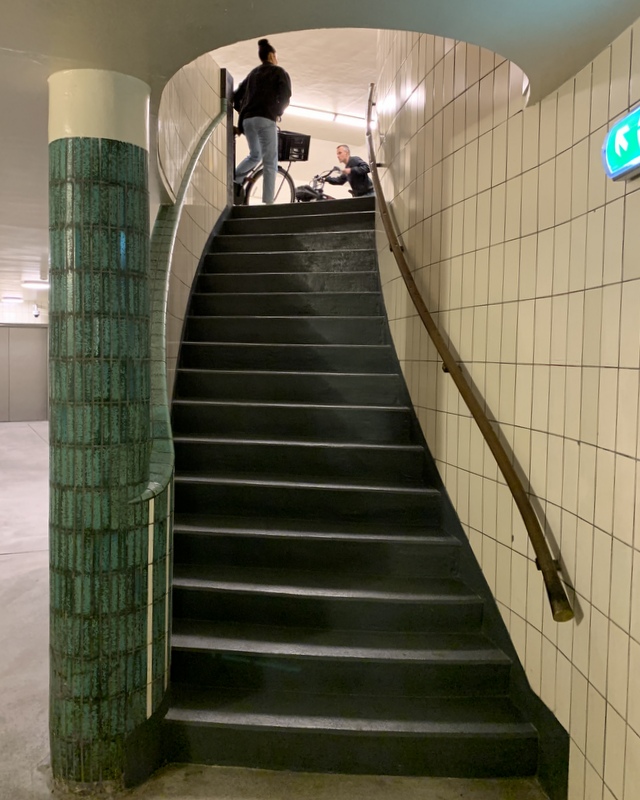
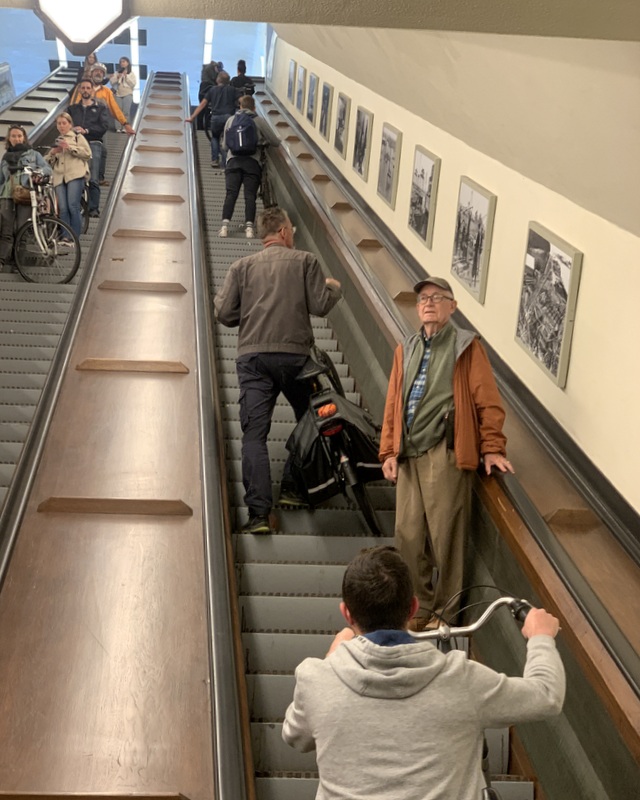
We continued to the entrance of the Maastunnel (1937-1942) . Left one of the ventilation buildings, right the entrance for pedestrians and cyclists. Beautiful expressionist architecture.
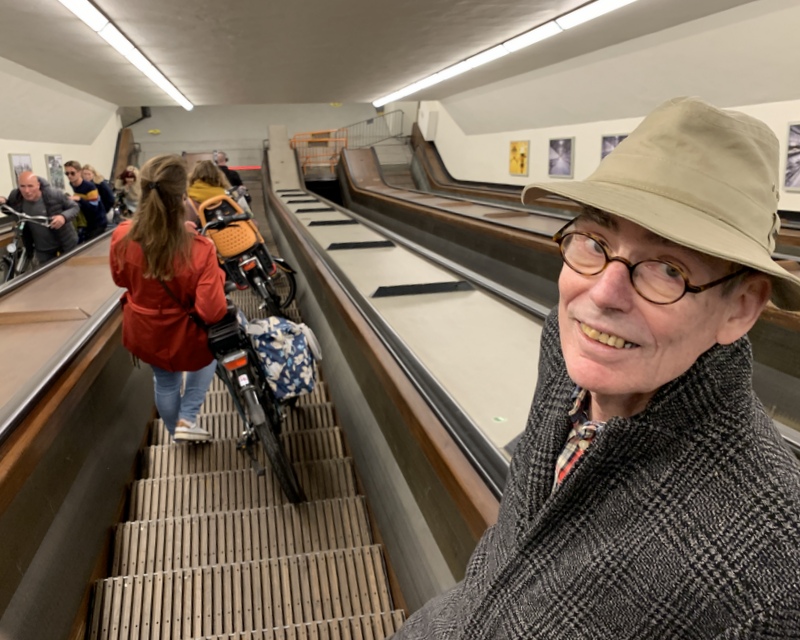
Piet had been using the tunnel often when he was a teenager, and was eager to show me around.
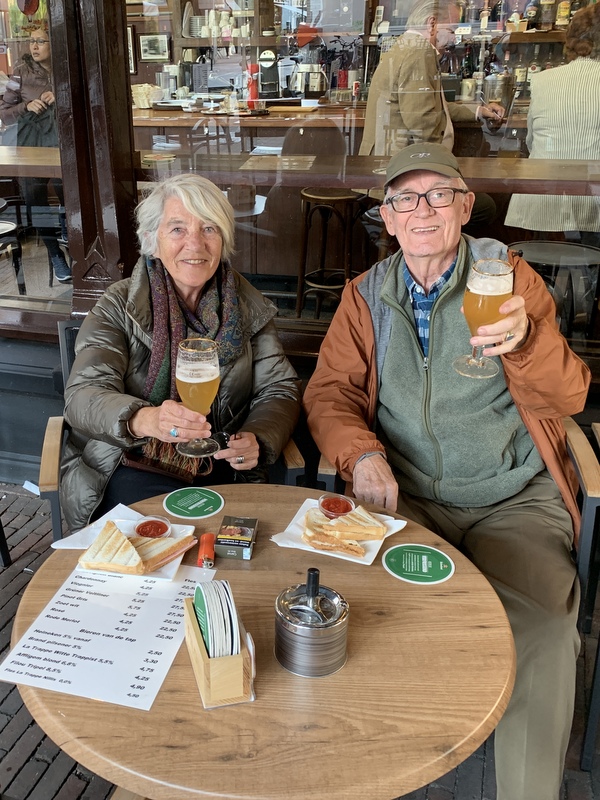
After we had explored the tunnel it was time for a beer.
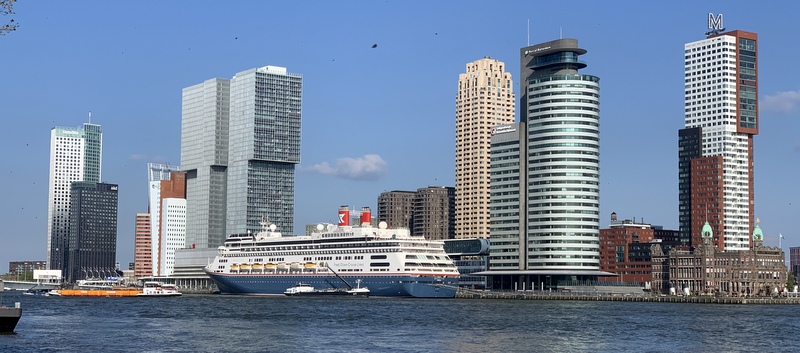
After our beer we decided to call it a day, although Piet and Helma said there was much more to see. We have to come back. Here is a last view of the Rotterdam skyline.
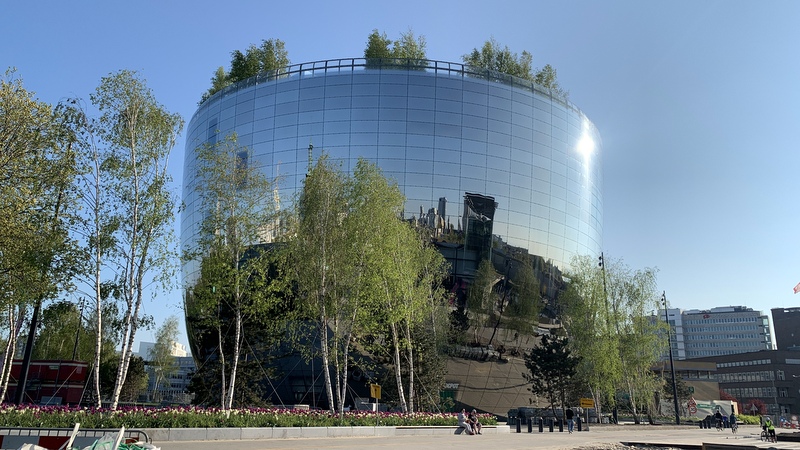
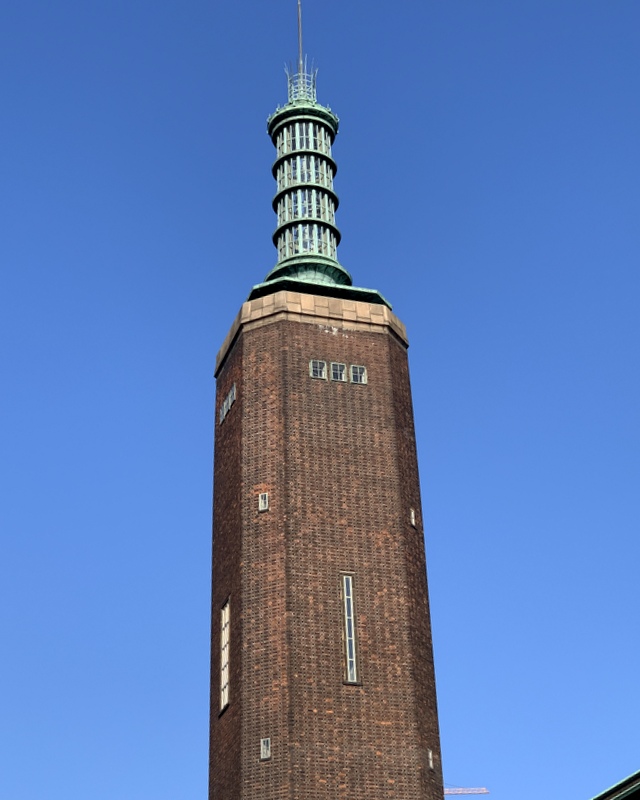
Cycling back to the station we passed the Depot of the Boymans van Beuningen museum. Spectacular with its reflecting walls.
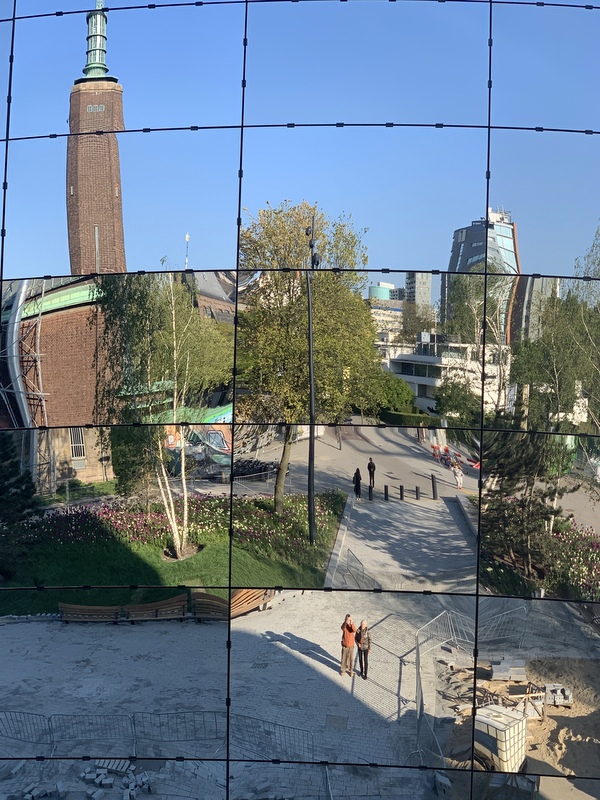
fThe Boymans is closed for renovation, the Depot should be interesting to visit. In the reflection you can see Inez and me in the center 😉
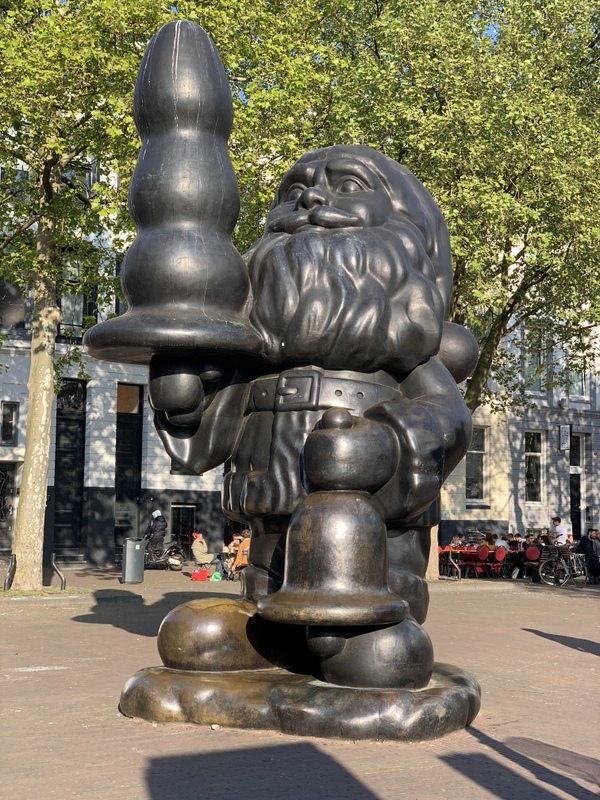
As it was getting a bit late we decided to have a beer with some snack food before taking the train. Near to the pub we saw this controversial work of art, called Santa Clause, but commonly called ……… by Rotterdam people. Find out for yourself.
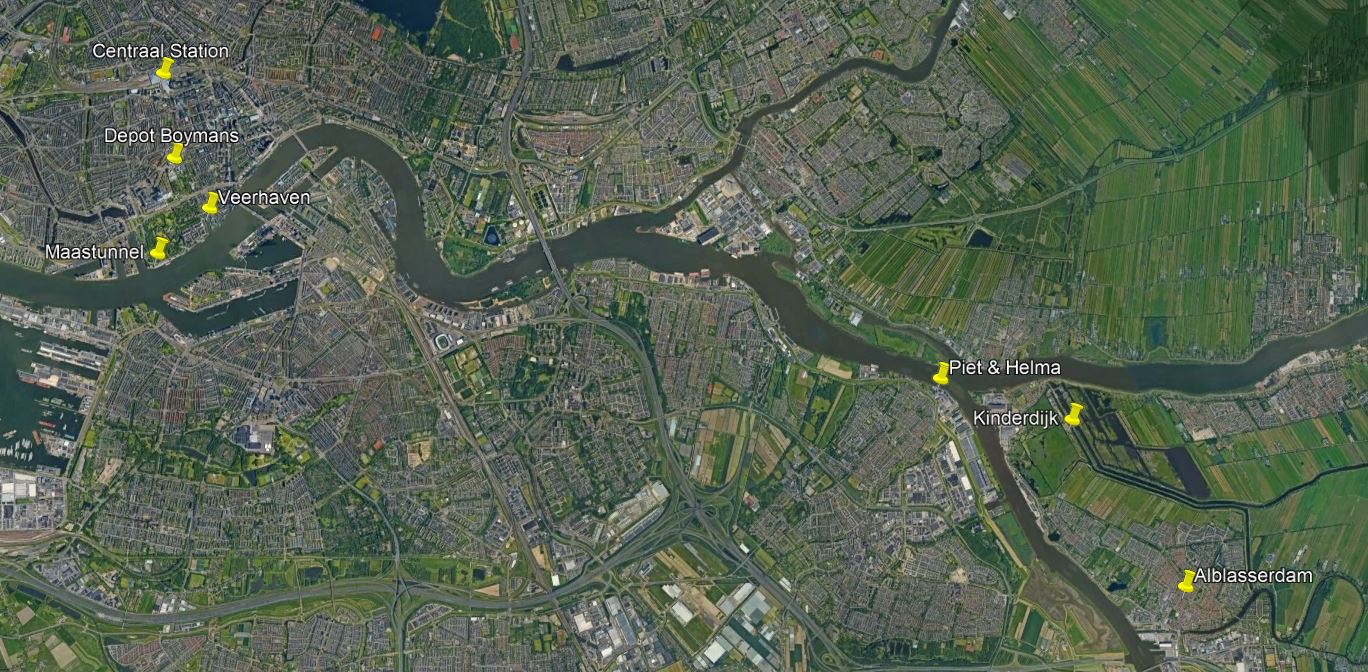
It was a rewarding trip, full of variety. Here is a Google Earth screenshot, where I have marked the various points of interest.
On 30 March I flew from Malaysia to the Netherlands, I wrote a report about it: Perdana View => Backershagen I stayed in the Netherlands six weeks in which I visited family and friends and took more than 1000 photos. It will take time to write posts about the trip, the first one in three years! On 11 May I flew back and I decided to write a (short) post about it, mainly about the rules and regulations related to COVID-19.
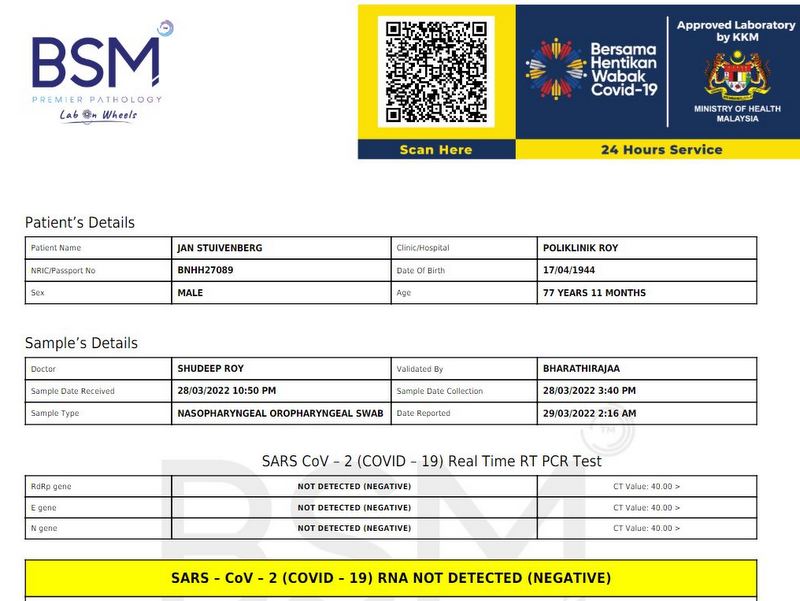
When I booked my trip in February, Malaysia was planning to reopen its borders, which they did on 1 April. The new rules were: a negative PCR test, less than 48 hours before departure, a negative Antigen test within 24 hours after arrival and 5 days in home quarantine. Acceptable for me, although of course I was not happy with the PCR condition, as it meant that I could only be sure that I could fly, one day before departure.
So I was really relieved when the Malaysian government announced that from 1 May, the two tests and the quarantine were no longer needed. Only proof of full vaccination and you needed to have the Mysejathera app installed on your mobile. This app contains all your vaccination details and for my flight I had to create a Traveller Card in the app. Which I did.
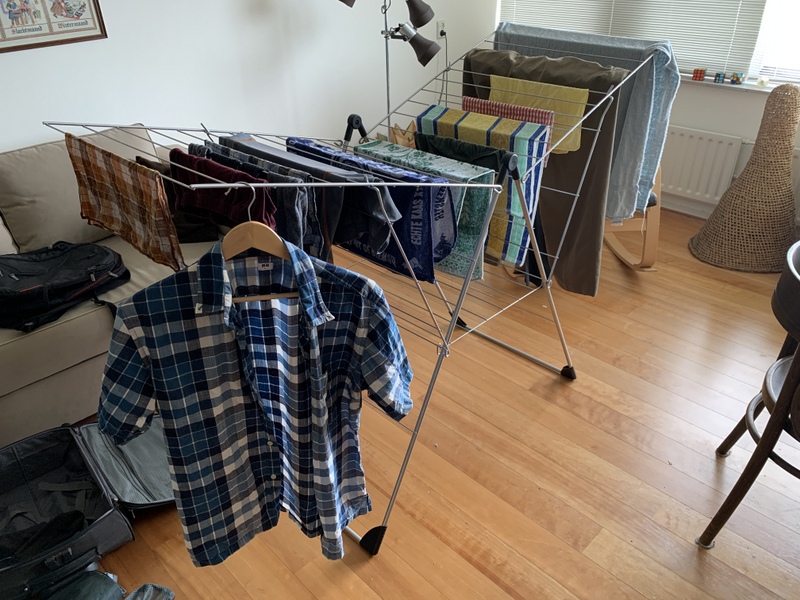
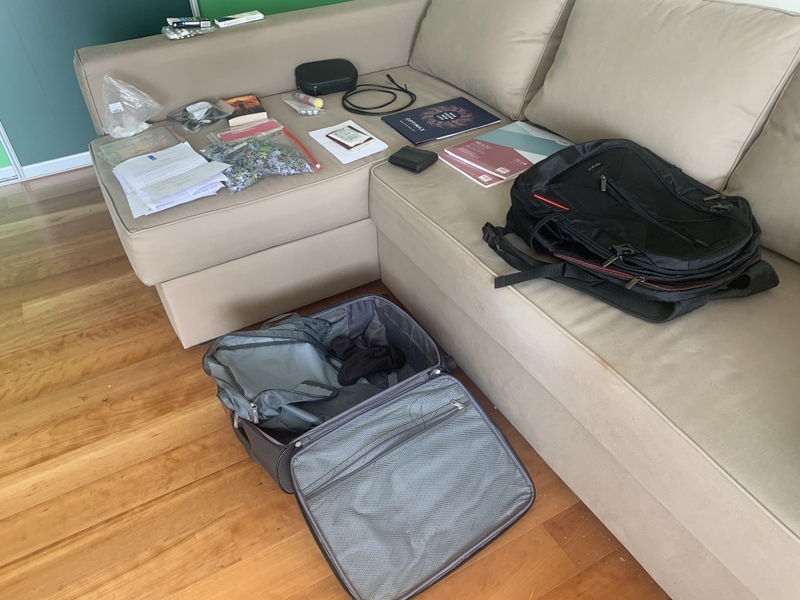
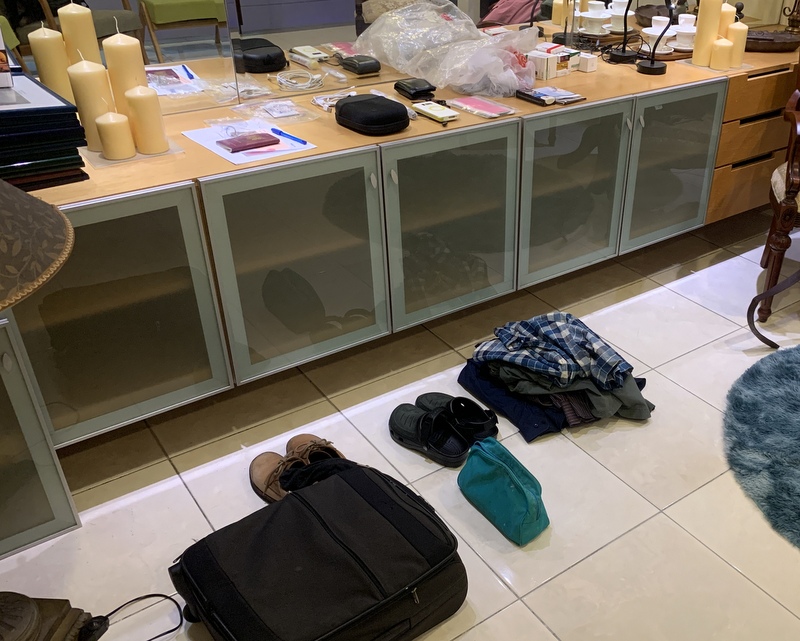
Of course I still had to limit my luggage to less than 12 kg. And I had to clean the flat (and the fridge) in Backershagen, as it would be empty for many months. Left picture, doing the last laundry, right picture, collecting my stuff.
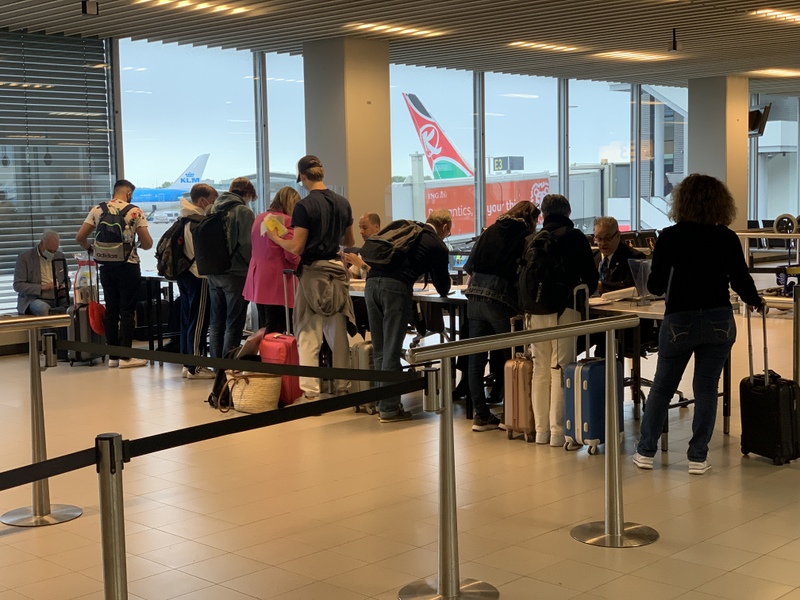
KLM advised to come to the airport at least three hours before departure, because of extra COVID checks. As usual my brother Pim brings me to the airport and after checking in we have coffee and a snack. But not this time. At the check-in counter I was told that I had to proceed through security check and passport control to gate E1 where they would check my Covid documents and issue a sticker. Also they only could give me a boarding pass for the flight to Singapore. There I had to go to a transit counter and get a boarding pass for the connecting flight to KL. Fortunately they were willing, after some discussion, to check in my cabin bag and take it straightaway to KL. Flying is no more what it was before 😉
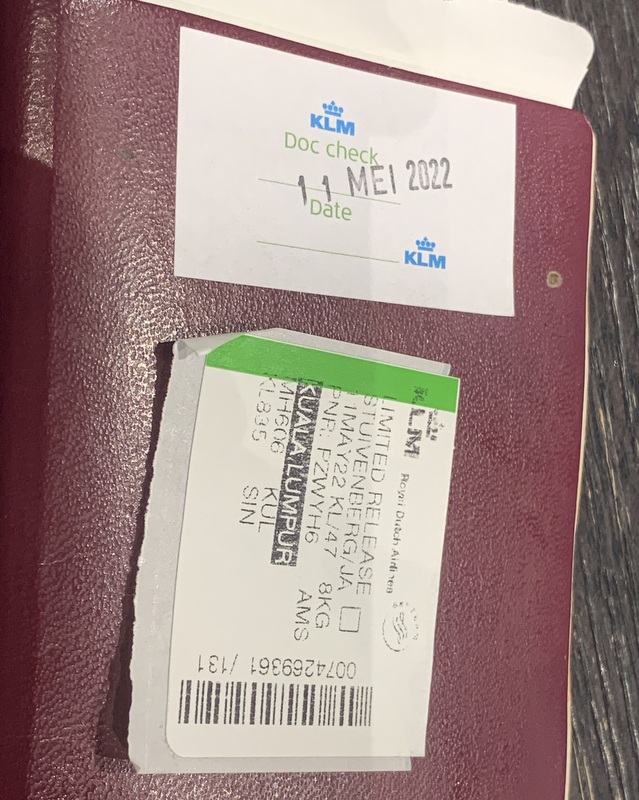
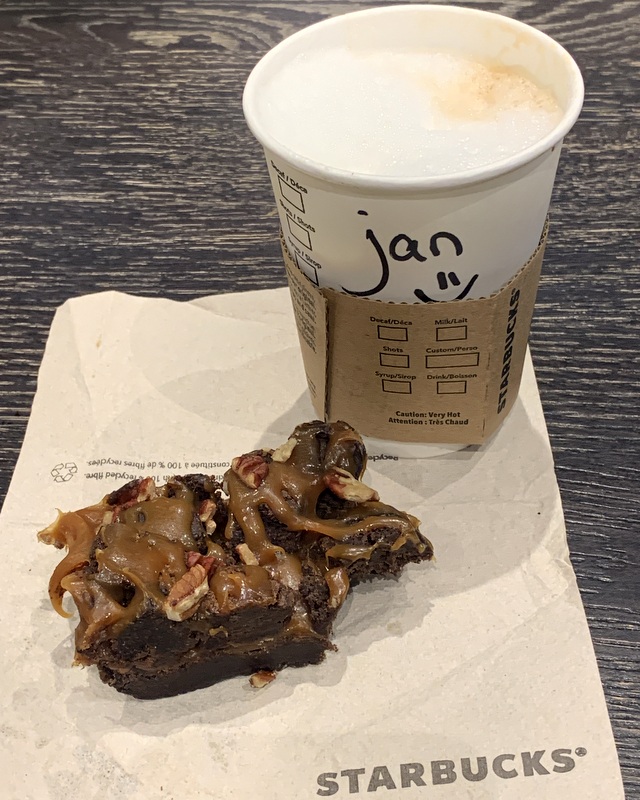
So I had to wave goodbye to Pim from a distance. At the E1 counter officials were checking whether I was fully vaccinated and had a Traveller Card. As I was early, there were only a few people queueing. I got my sticker and they told me the departure gate, E9. Finally I could relax with a Cappuccino and a brownie.
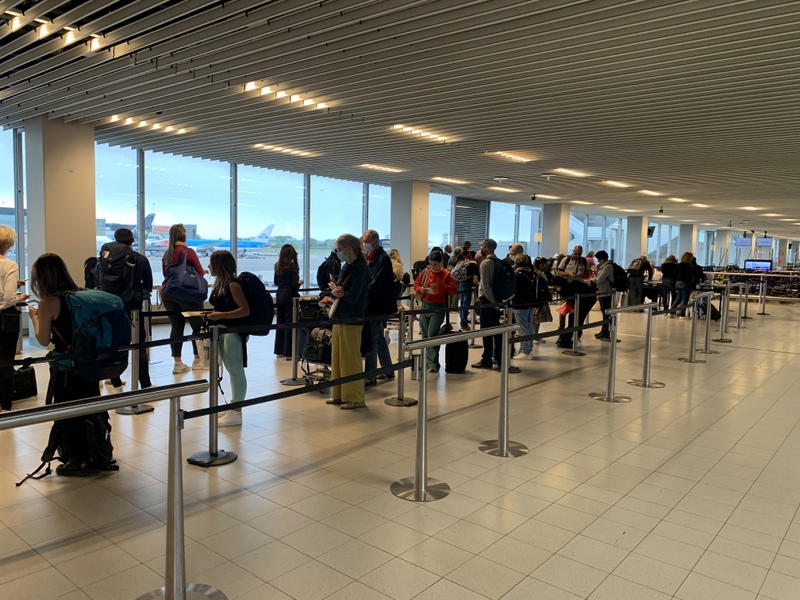
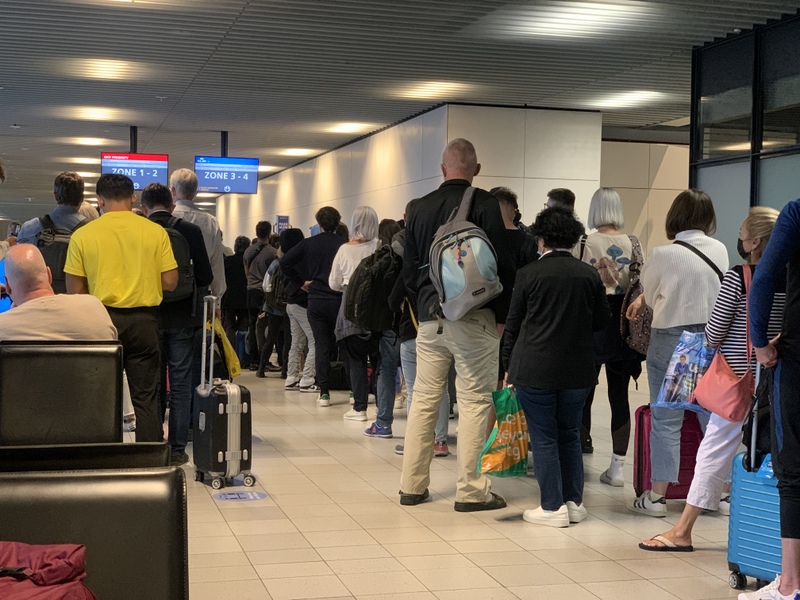
When I passed E1 again on my way to the gate, there was a big queue with slow processing. Good that I had been so early 😉
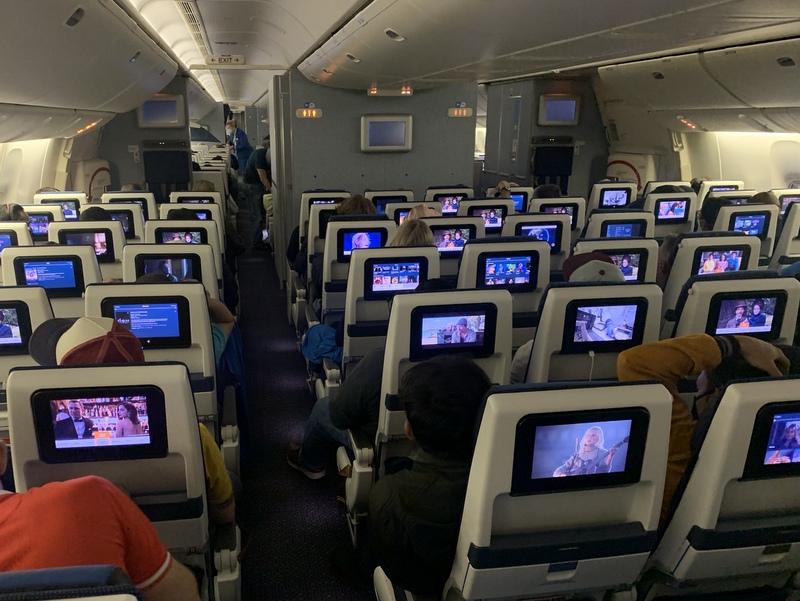
It was a full flight, continuing to Indonesia after Singapore. At the airport and in the plane face masks were still compulsory.
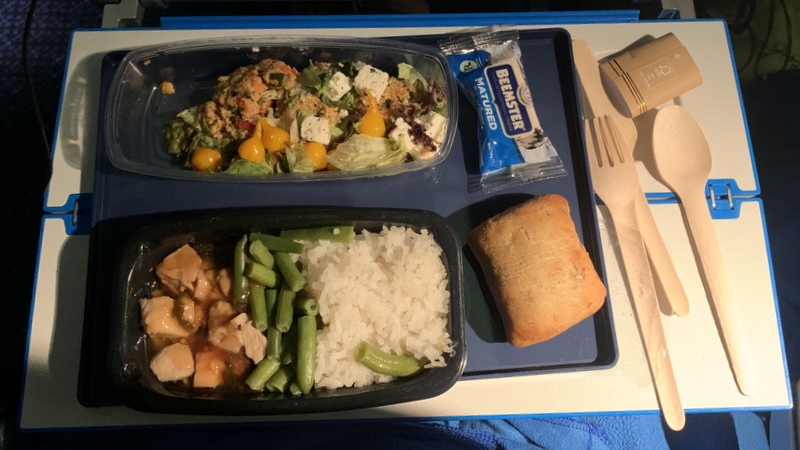
After take off at 9:45 pm, dinner was served. No first round of drinks anymore, and no cognac with the coffee. One ridiculous detail, there was an announcement asking passengers to remove their masks only after everyone in a row had been served.
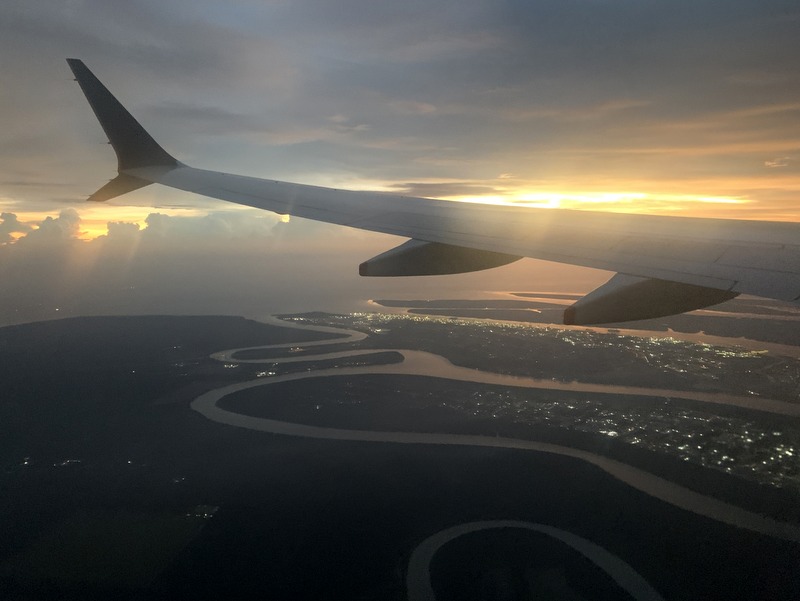
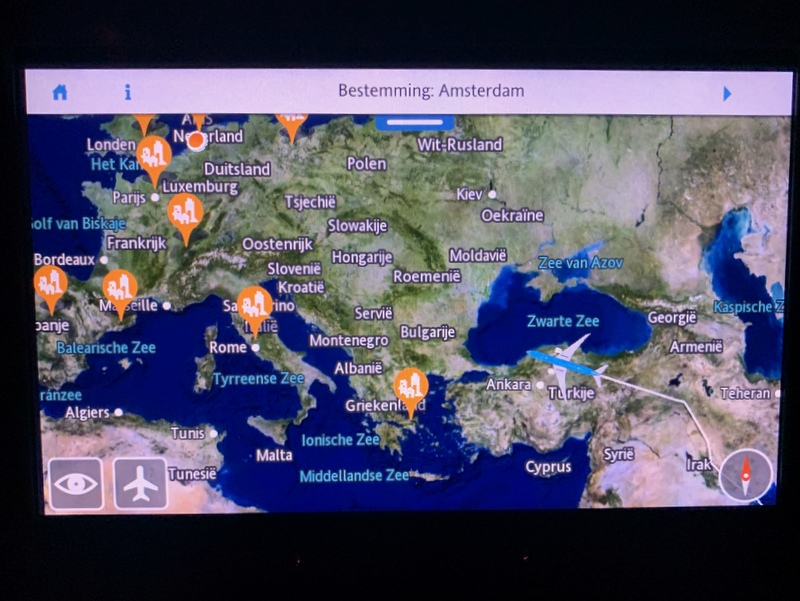
New for me was that passengers had access to WIFI during the flight. Full access for a fee, but one hour texting was free. So I used WhatsApp to text a friend, I am now flying over Rumania!
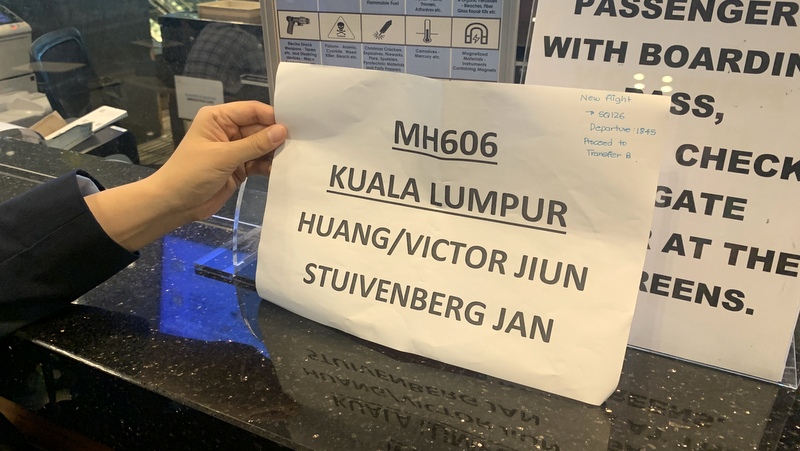
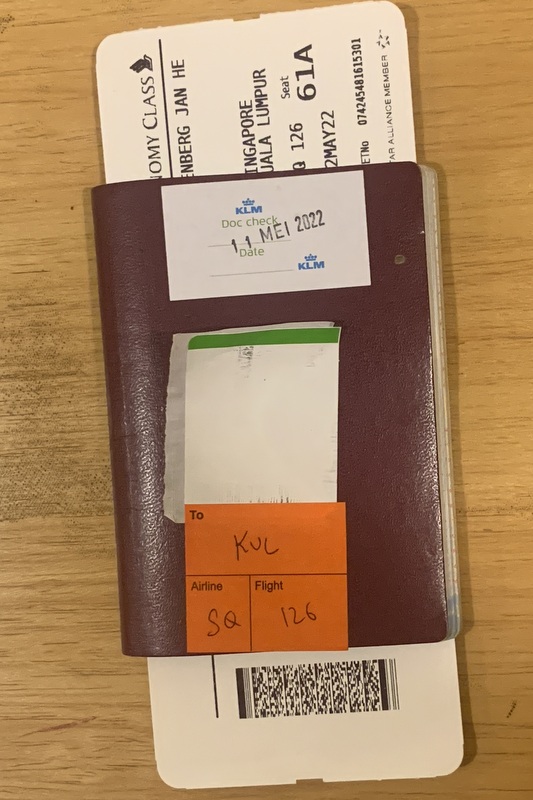
I was worrying a bit how to get the boarding card for the connecting flight. But when we exited the plane in Singapore, a lady was waiting with this paper in her hand. She guided us to the terminal and transit counter where again my documents were checked and a second sticker was put on my passport.
The flight to KL takes only about 45 minutes.
I was wondering what kind of COVID-control Malaysia would have at the KLIA airport. The answer: nothing at all. Apparently the checking in Amsterdam and Singapore, resulting in two sticker, were enough. Surprising.
There were long queues at Immigration, but there was a special counter for Diplomats and MM2H passengers, with only a few people waiting.. And I didn’t have to wait long for my luggage!
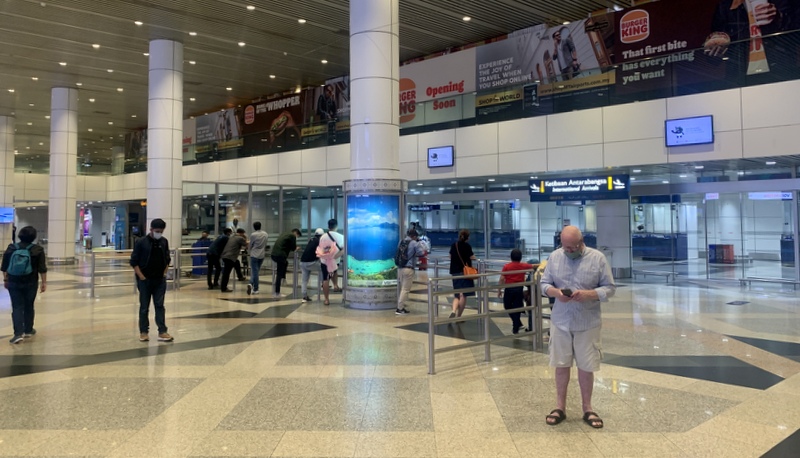
KLIA arrival hall was rather desolate looking.
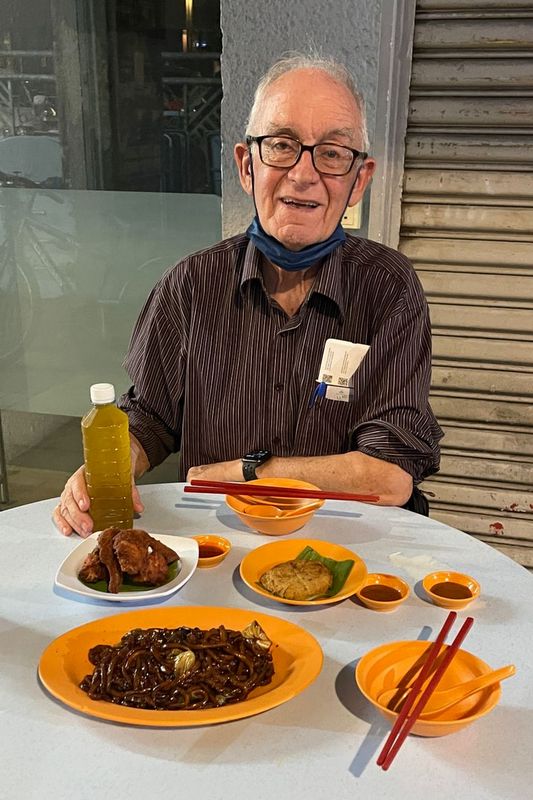
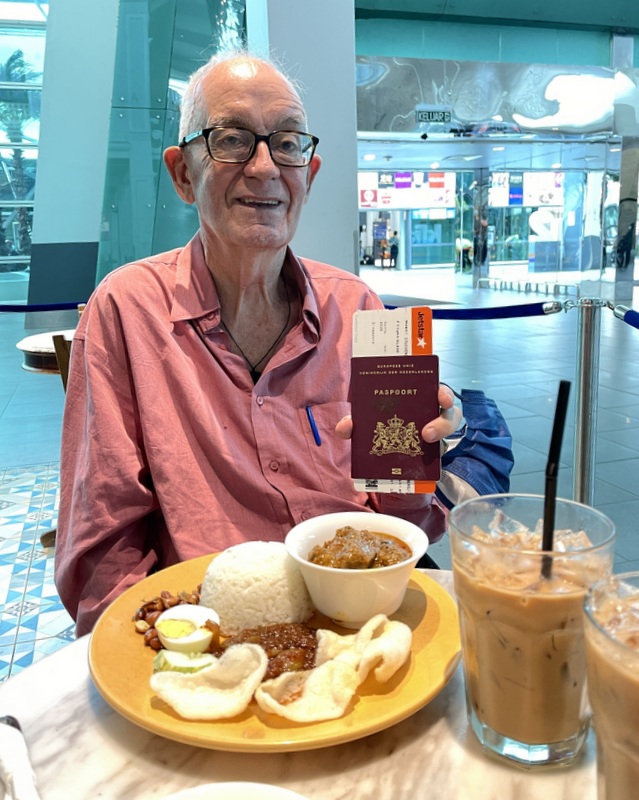
The whole procedure was so fast, that I had to wait a few minutes for Aric. On our way back we stopped for food, my favourite hokkien mee. In the middle my passport wit the two stickers. And to the right a photo that shows me, tired but happy: Back home.
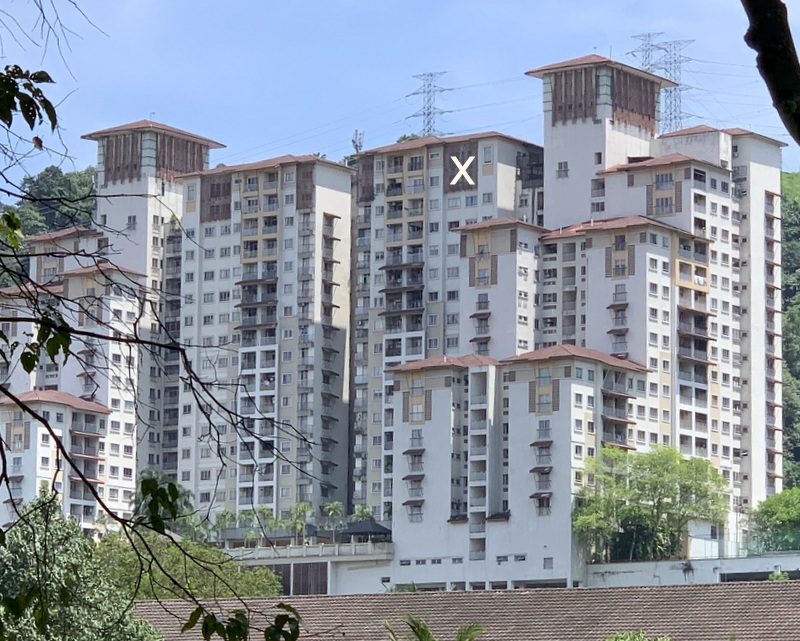
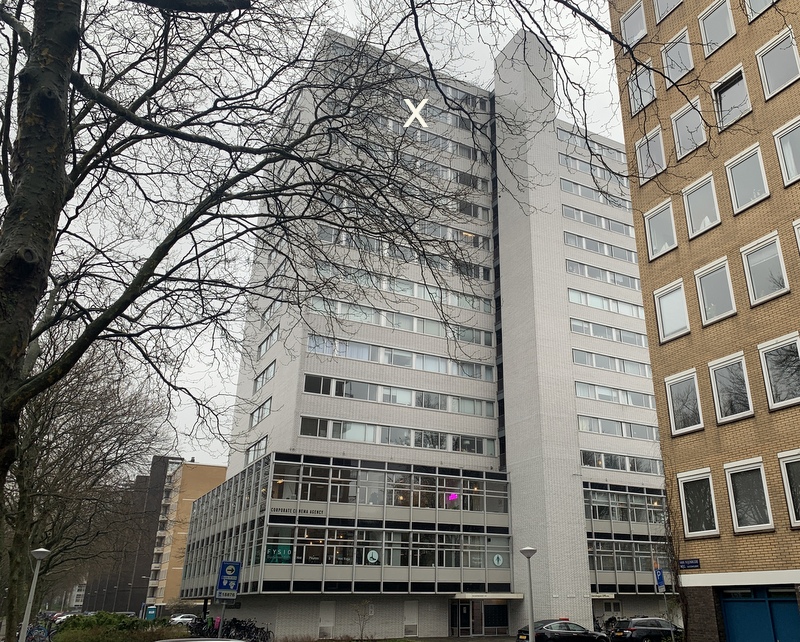
There are two places I call home, Perdana View in Petaling Jaya and Backershagen in Amsterdam. Most of the time I live in Malaysia, once or twice a year I stay for a couple of weeks in the Netherlands. Because of the Covid-19 pandemic it was almost three years ago that I visited the Netherlands. In the picture below the apartments are indicated with an X, left Perdana View, right Backershagen.
In February I decided to book a trip to the Netherlands from 30 March until 11 May. I was fully vaccinated, including a booster shot. The Netherlands were opening their borders and Malaysia was planning to do the same. I only needed a negative PCR-test, taken less than 48 hours before my planned departure.
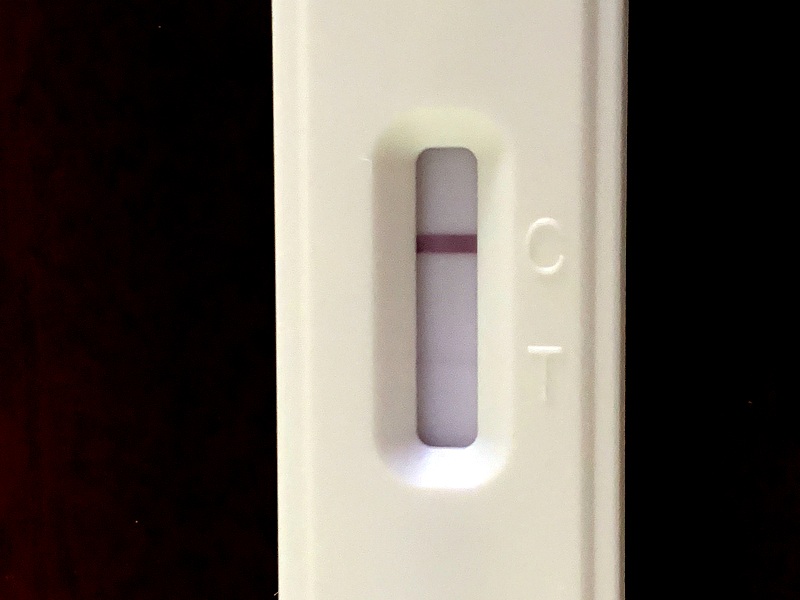
The weekend of 20 March I had visited Taiping, see my report Taiping, March 2022. On the last day of my visit I had been in close contact with a Covid-infected friend and although I should be immune, I was a bit worried, so I did an antigen self test, which was negative. Still I was nervous when on 28 March I went to my GP for the PCR test. Relieved when I received the negative result the next morning. Left the antigen test, right the PCR test
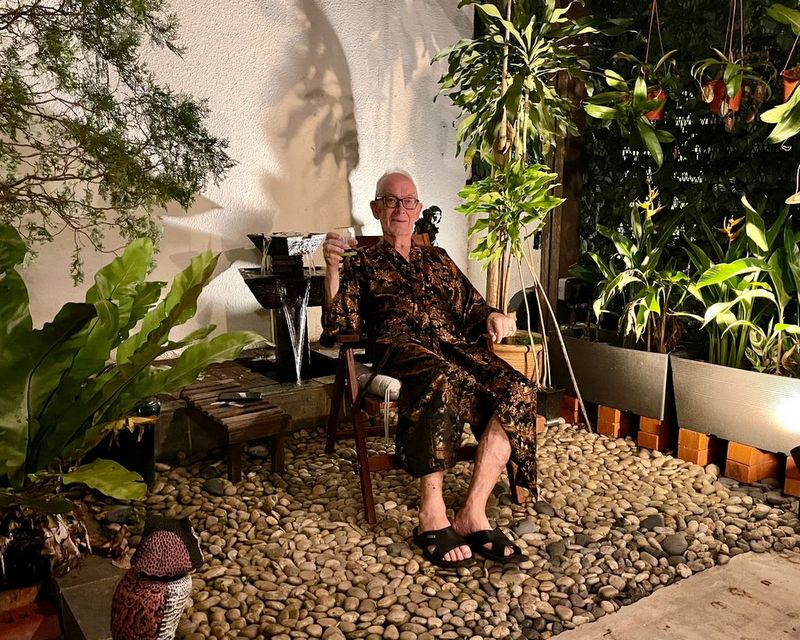
Because of the uncertainty, I only started packing after I received the negative test result, one day before departure! When I booked my ticket, I expected that, being a KLM frequent flyer, I was entitled to one piece of cargo luggage (23 kg) free of charge. But my level was too low, so I could only bring 12 kg cabin luggage. I managed to take only essential stuff, of course I had warm clothes in Amsterdam. The last evening I could relax in our roof garden 😉
In the past KLM had a direct flight from KLIA to Schiphol airport, but nowadays I first had to fly to Singapore. When I booked my ticket, I had a Singapore Airline flight to Singapore (20:40-21:50) with a connecting KLM flight (23:35 – 06:50). Perfect, less than a 2 hour transit in Singapore.
But a few days before departure KLM rescheduled my flight “for operational reasons” Departure from KL at 2pm with Jetstar Asia and from Singapore with KLM at 23:05, resulting in about 8 hours transit in Singapore. How to spend that time? The departure of the KLM flight half an hour earlier was probably the reason, to change the connecting flight from KLIA.
We left Perdana View early at 10 am and that was a good decision because KLM had not notified me that the Jetstar Asia flight would not depart from KLIA but from KLIA2, the former Low Cost Terminal. Nearby KLIA, but still a hassle for us and a bad move of KLM.
I was pleasantly surprised by the service of Jetstar. I think they were not used yet to KLM travelers. They decided to accept my cabin bag as cargo luggage and directly transfer it to Schiphol, so I didn’t have to carry it around in Singapore. I had to show my negative PCR test, that was all. There was time enough for a nasi lemak 😉 Passing Malaysian immigration was smooth.
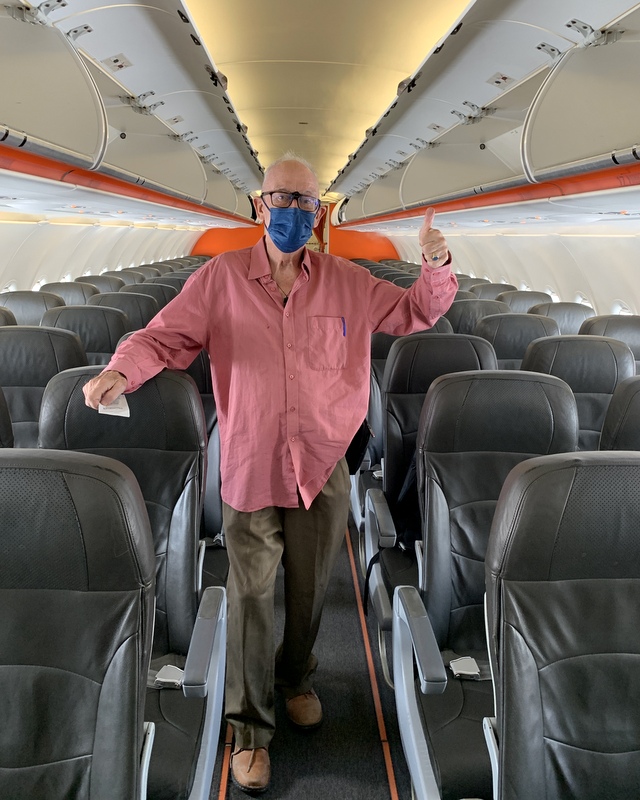
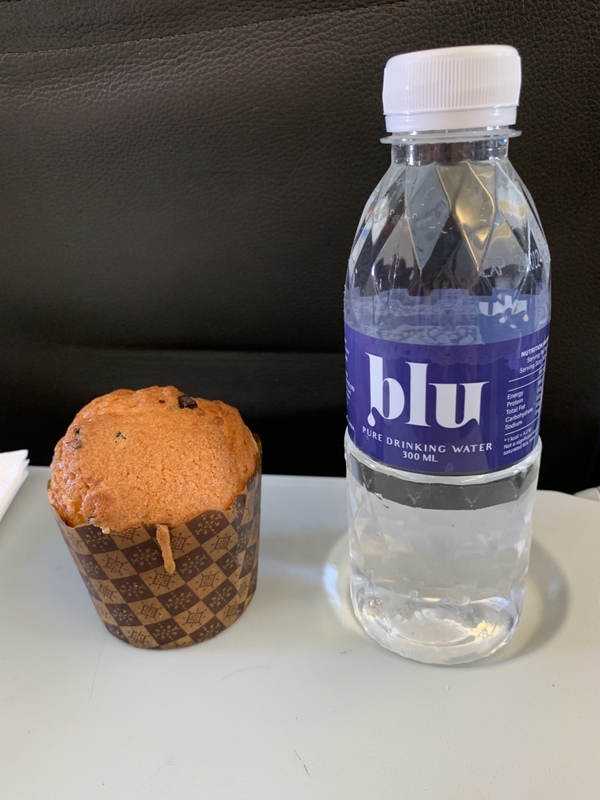
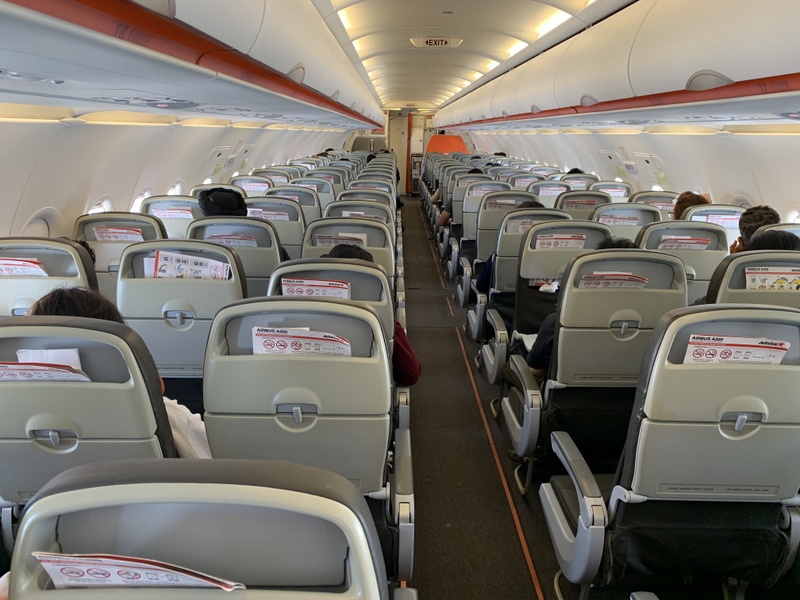
When boarding started, they invited me to came forward first, for the first time in my life I entered an empty plane. And during the short flight (less than one hour) I was one of the few passengers who got a muffin and a bottle of water. Kudos for Jetstar
Thorough fogging of the plane and not a full flight.
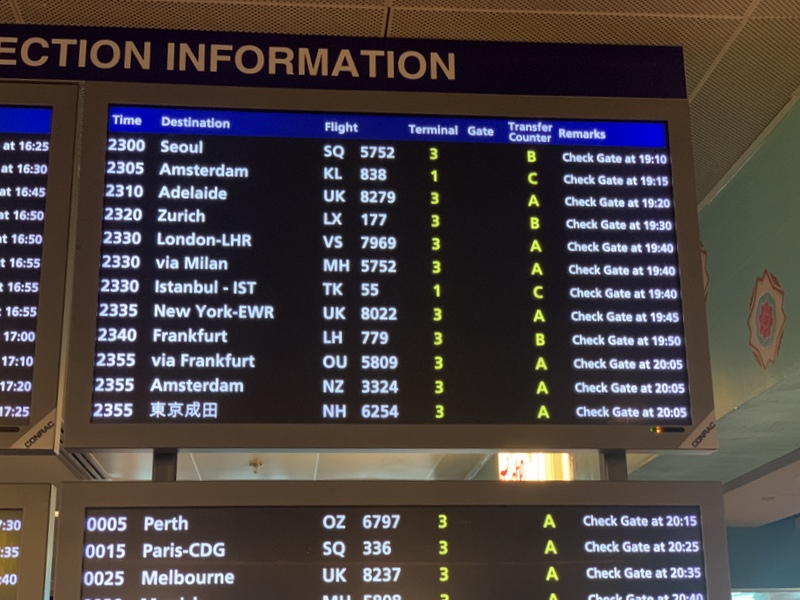
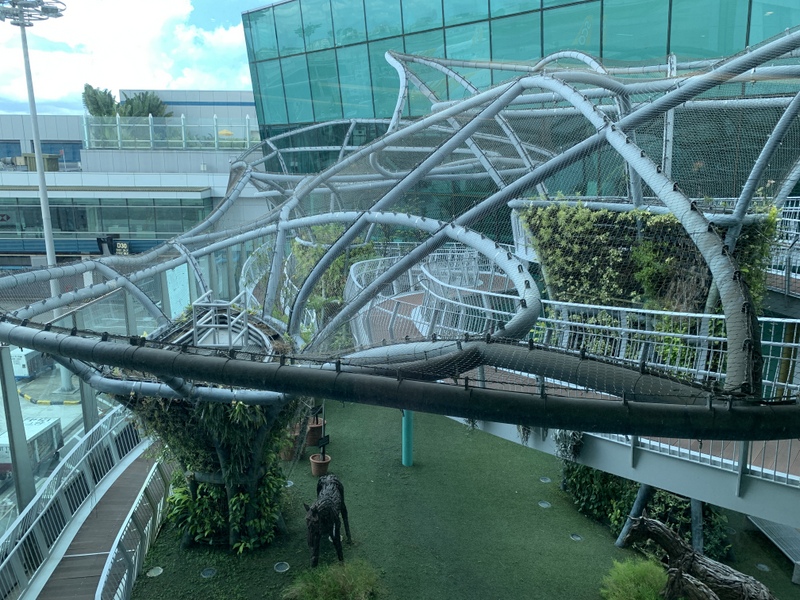
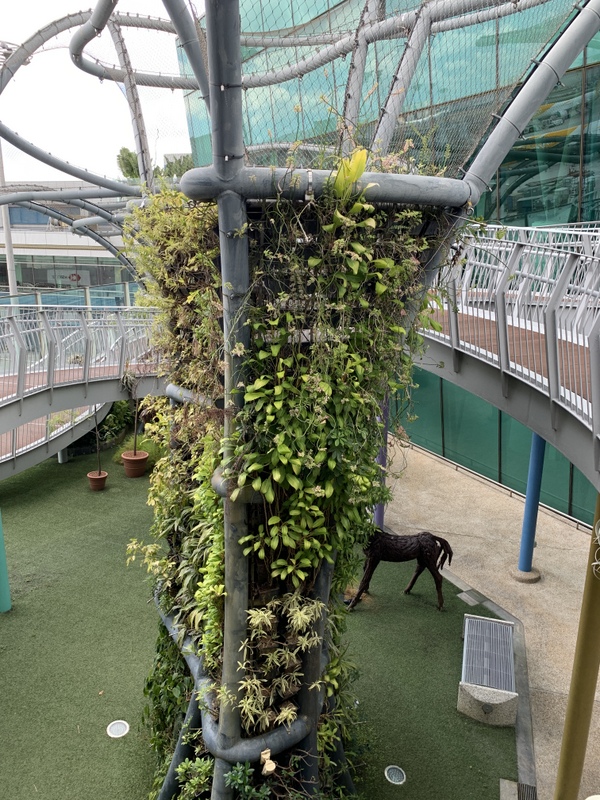
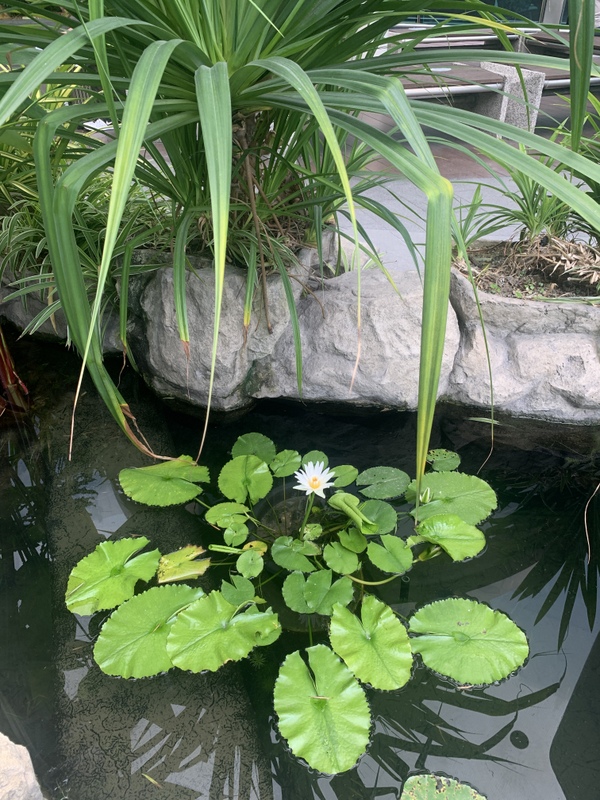
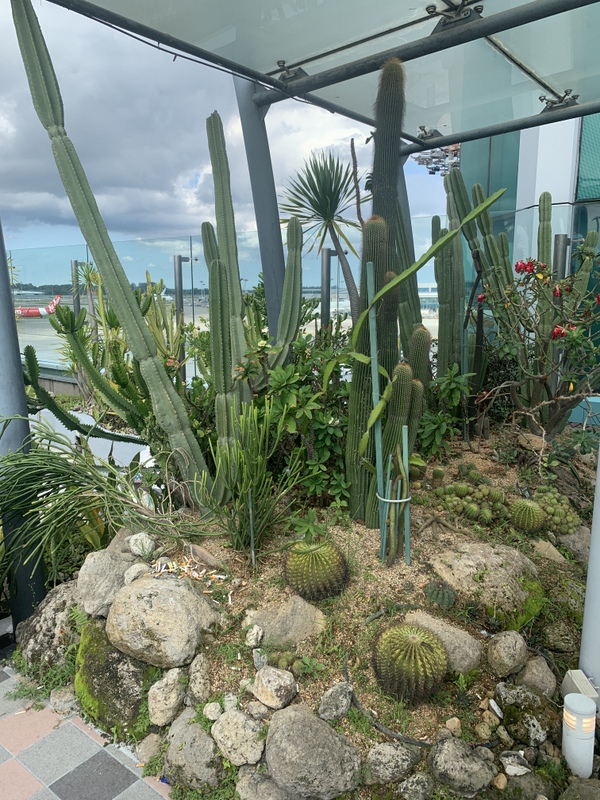
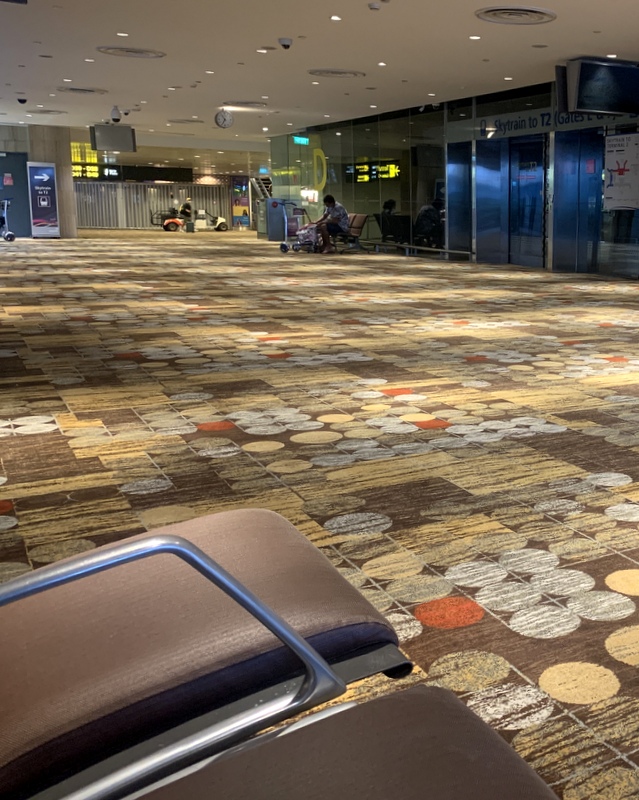
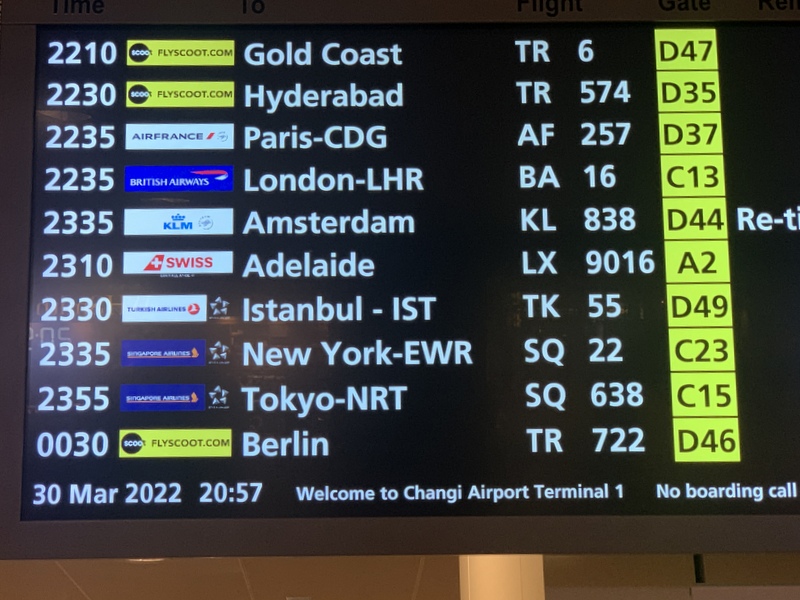
In Changi airport I noticed the departure time of 23:05. Eight hours to spend. I had visited Changi Airport in 2019, admired the famous Jewel, but now I was in transit. However there are an amazing lot of things to do while in transit. You can even make trips to the city while staying in transit! I only visited the gardens in Terminal 1. There are three of them.
From left to right the Artifical Tree garden, the Waterlily garden and the Cactus garden.
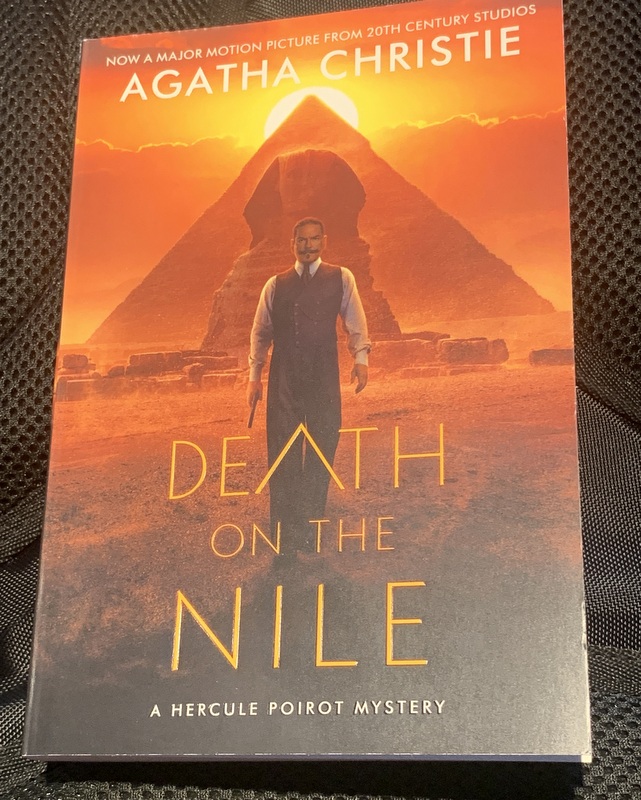
I bought a book and found a quiet place to read.
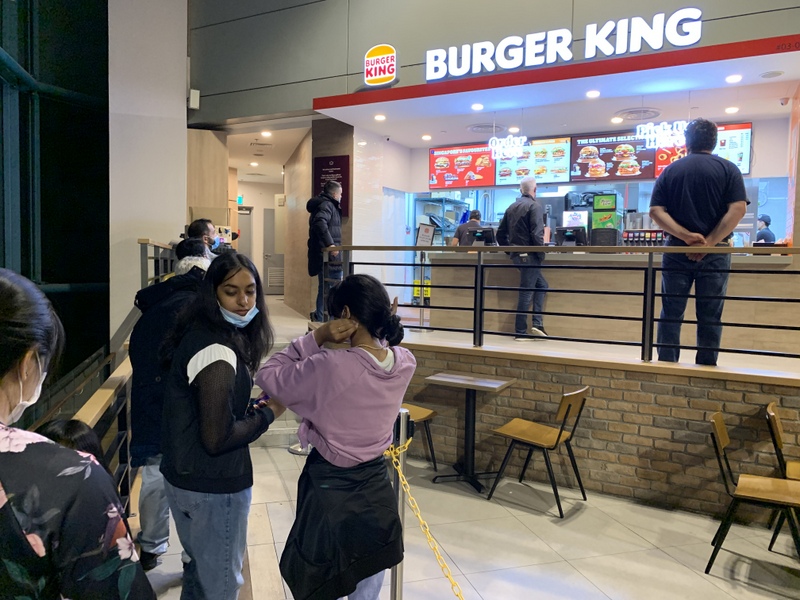
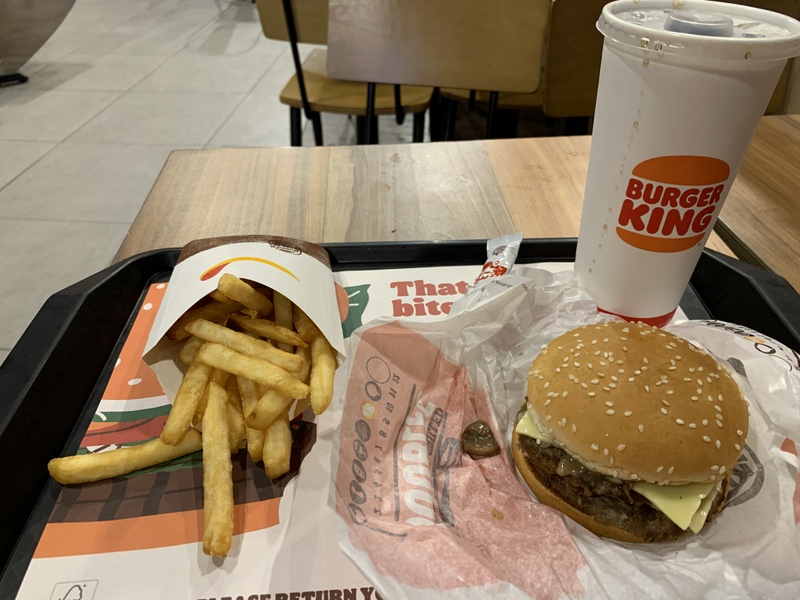
I had dinner at the Burger King, quite good quality.
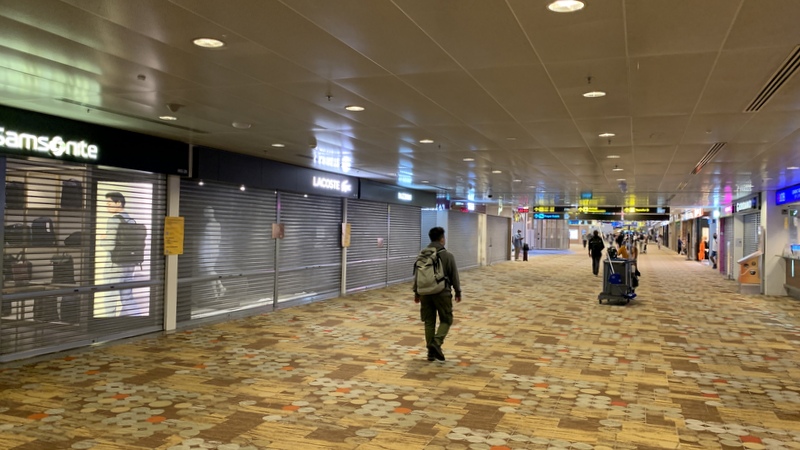
Many shops were still closed
Shock! The KLM flight was retimed to 23:35, the original departure time! So I could have taken the 20:40 SQ flight and saved 8 hours of time. The flight (from Jakarta) was unpleasantly full, but fortunately i had an empty seat next to me.
Usually the KLM flies from KL to the Netherlands over the Ukraine. Of course they did not because of the war in Ukraine, the plane went far south. As usual I could not sleep well. We landed early at 6:05 am, the pilot announced that the temperature was 1° Celsius with a chance of show.
Immigration was surprisingly smooth, no Covid checking at all. Nobody was wearing mouth masks. Because of the cold I considered taking a taxi, but finally decided to go the usual way, a ten minute train to Amsterdam-Zuid and from there a 15 minute walk home. I survived the walk, but it was bitterly cold.
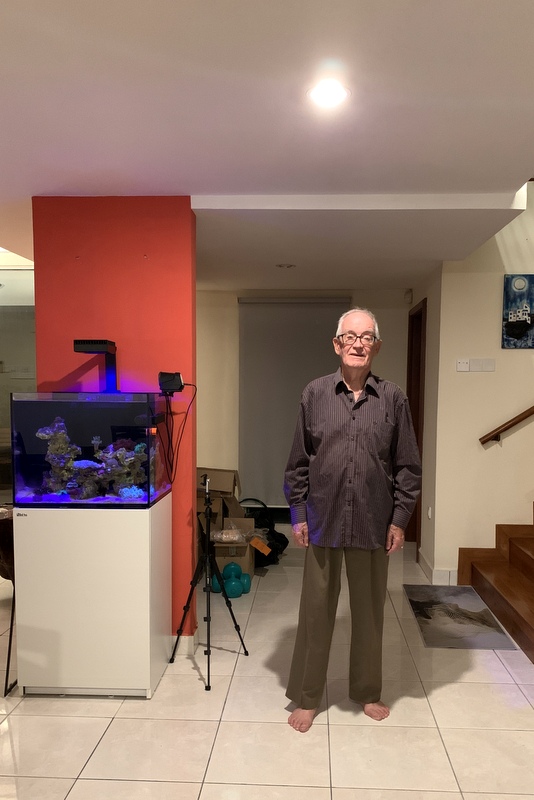
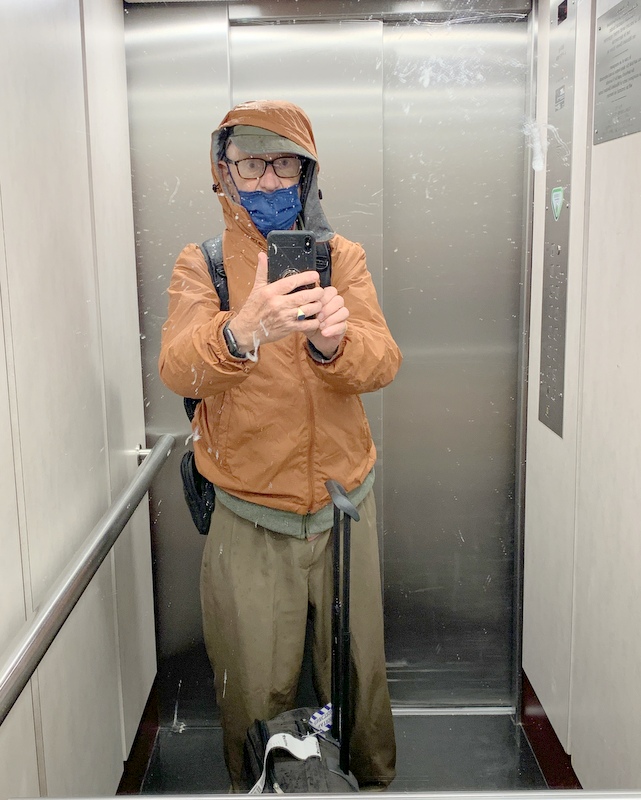
Here I am standing in the lift to my apartment. Yolanda, Paul’s sister who has a key of the apartment, had bought flowers, a nice welcome.
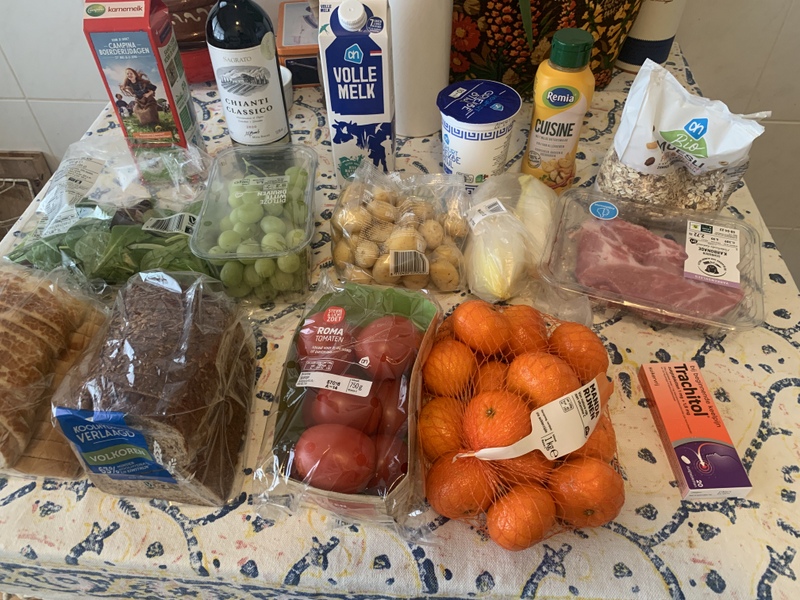
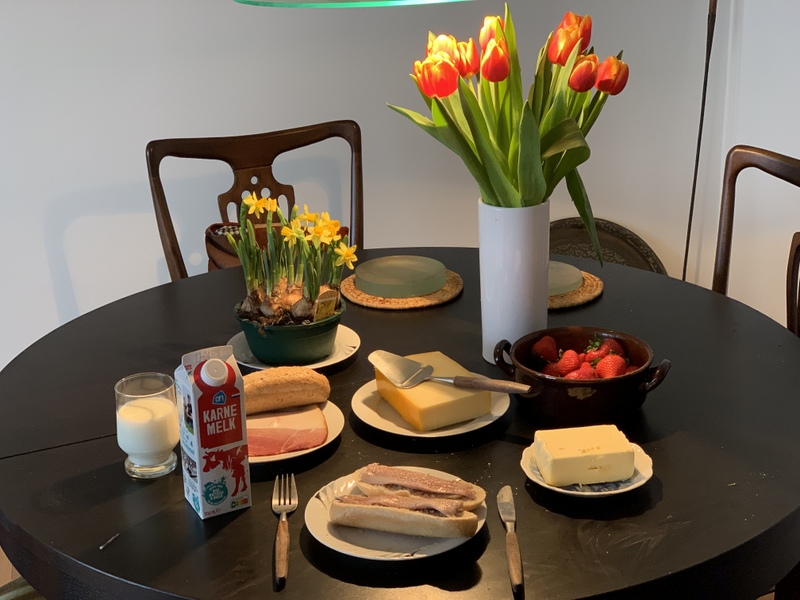
As the apartment had not been inhabited for more than two years, I had to go shopping at the nearby AH. And have my first lunch, with cheese, herring and strawberries, of course.
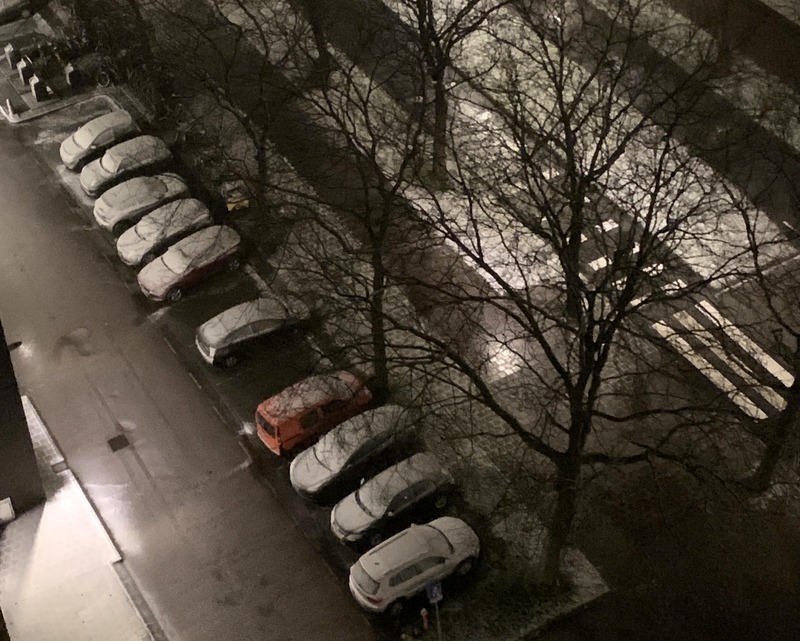
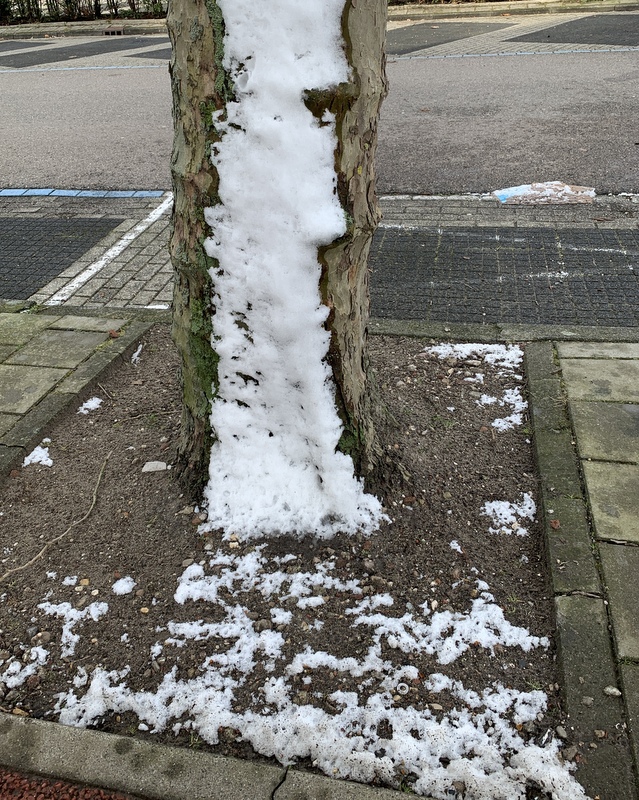
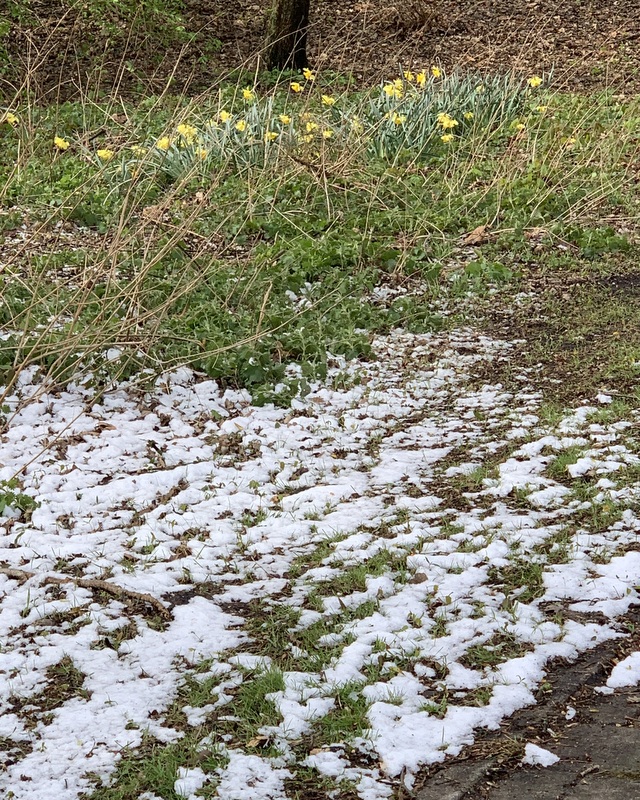
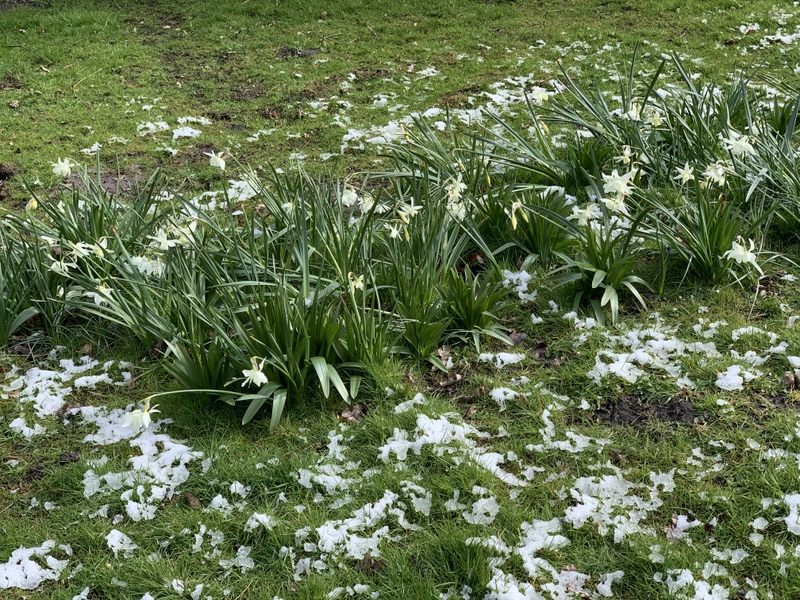
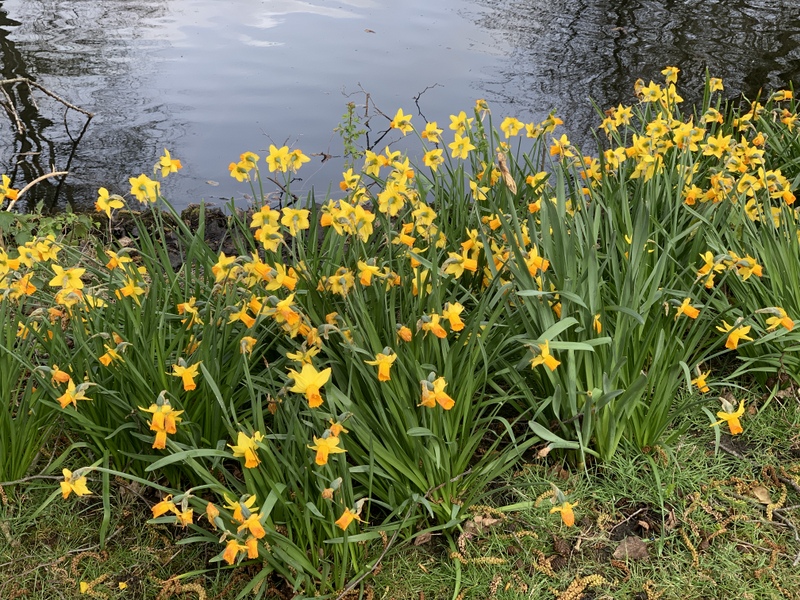
It was a cold night, with snow.
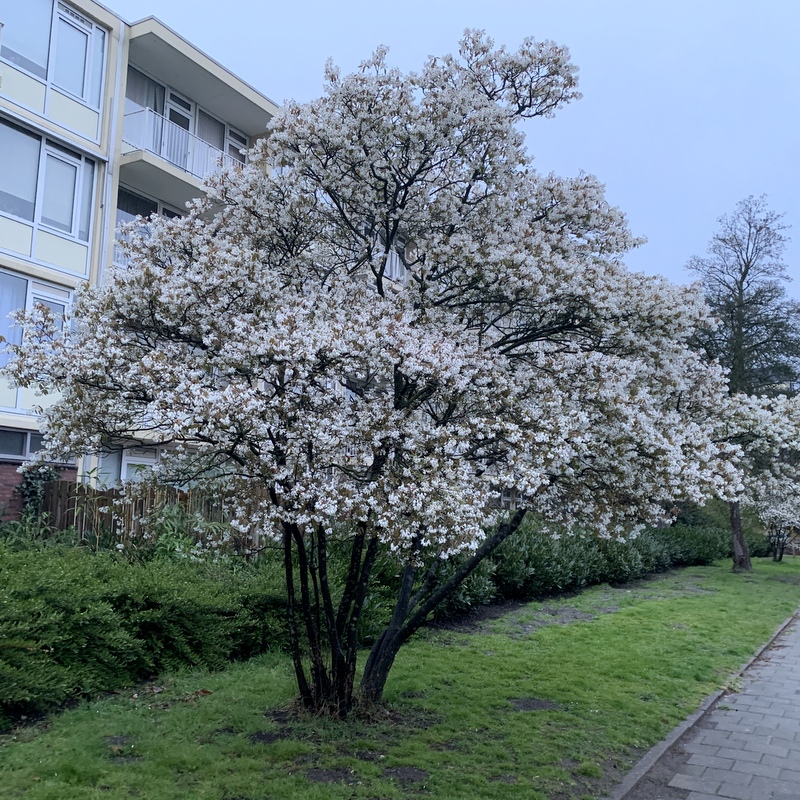
Here are some pictures I took the next day.. Some daffodils were trying to survive. Real winter atmosphere.
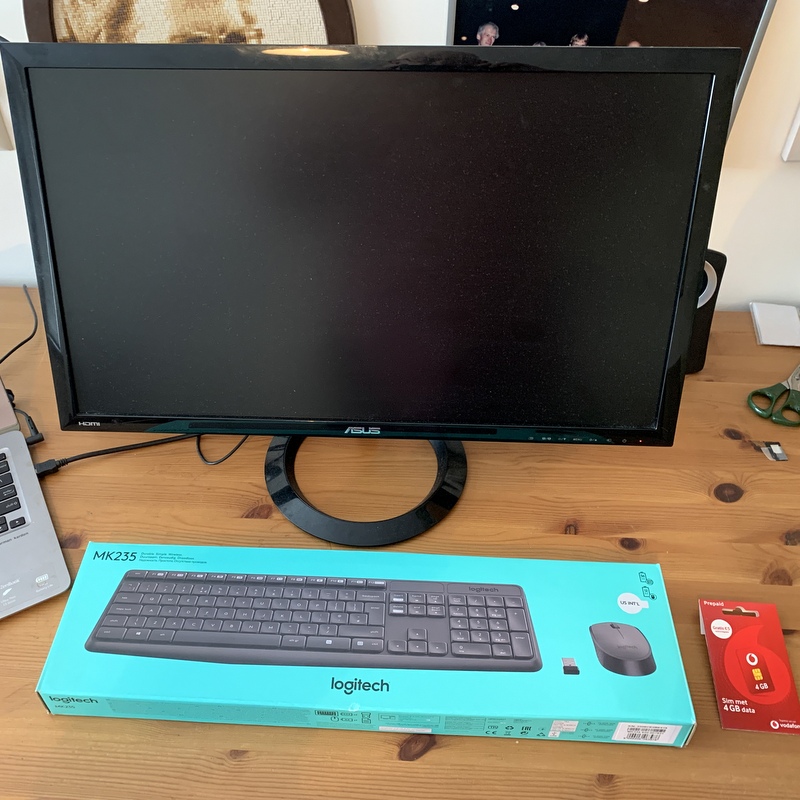
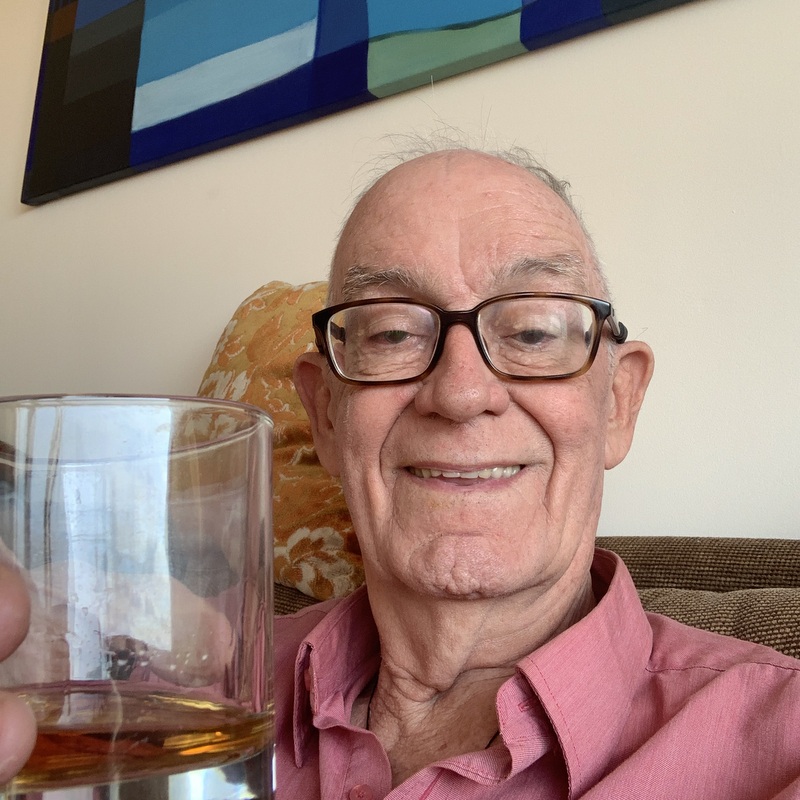
I had to solve several problems that day. The prepaid sim card of my mobile had expired, I needed to buy a new one. My laptop had problems, I had to buy a new keyboard/mouse. And the central heating was not working properly. Not a nice start of my visit. But still I could enjoy a pre-dinner drink
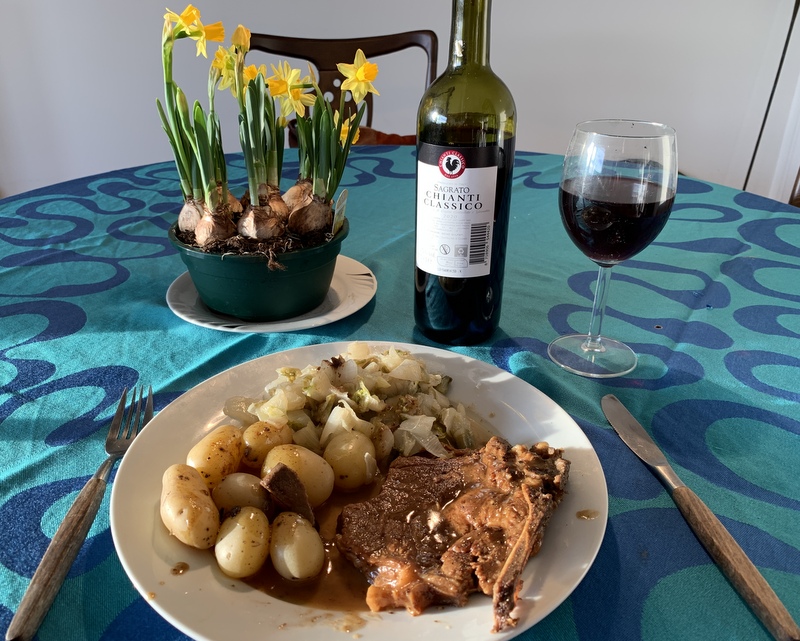
And prepare my first, very Dutch dinner.
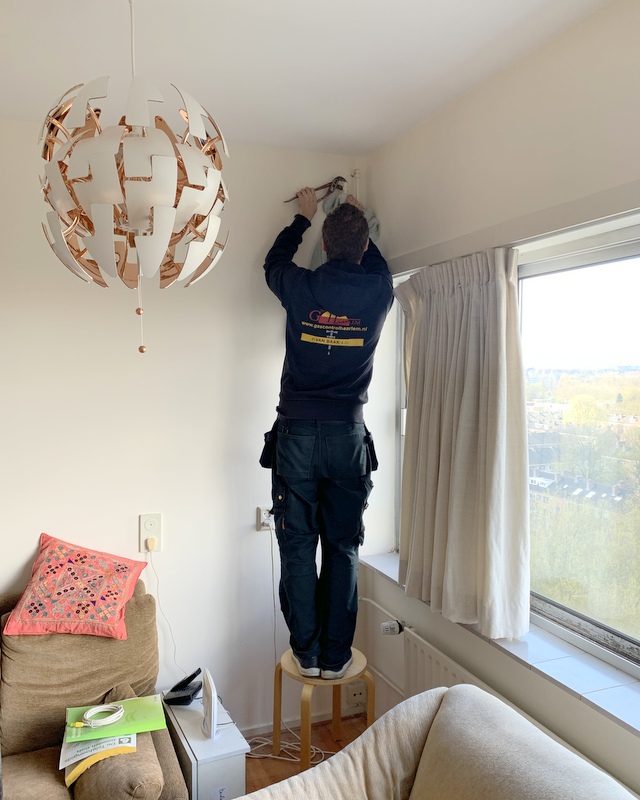
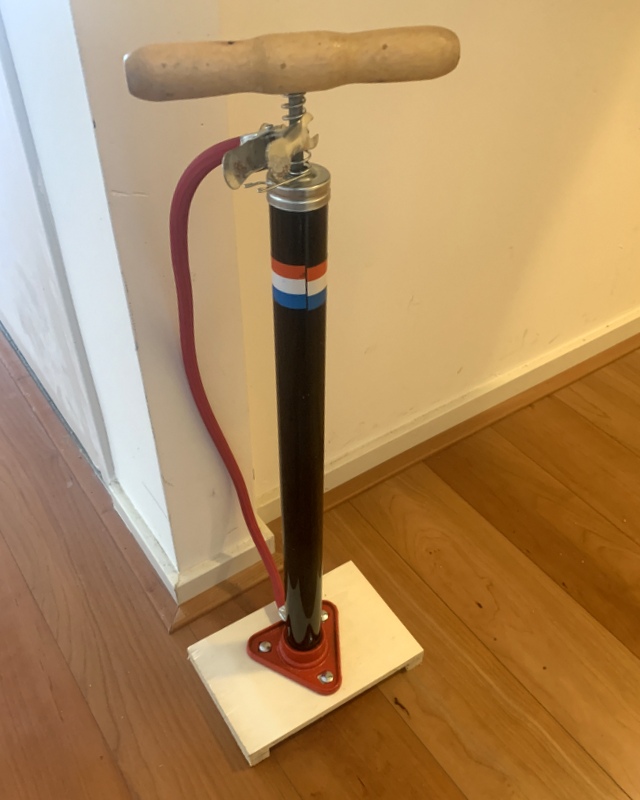
Saturday a guy came to repair the central heating. And a bicycle pump was deliverd after an online order. Because of course the tyres of my bike were completely flat after three years.
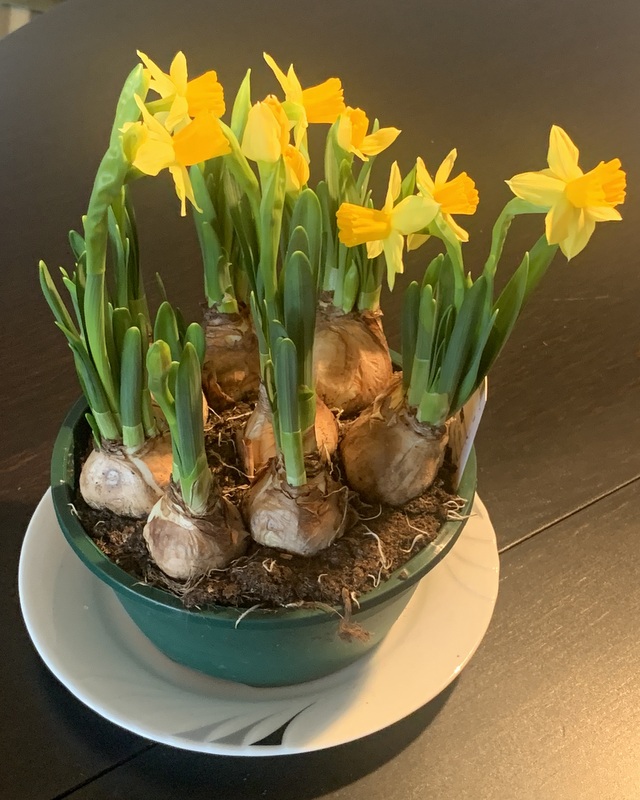
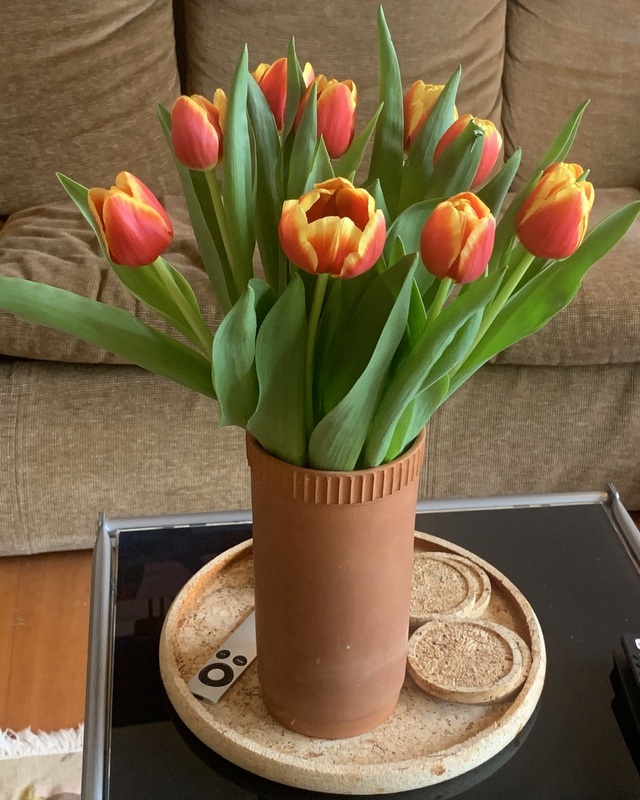
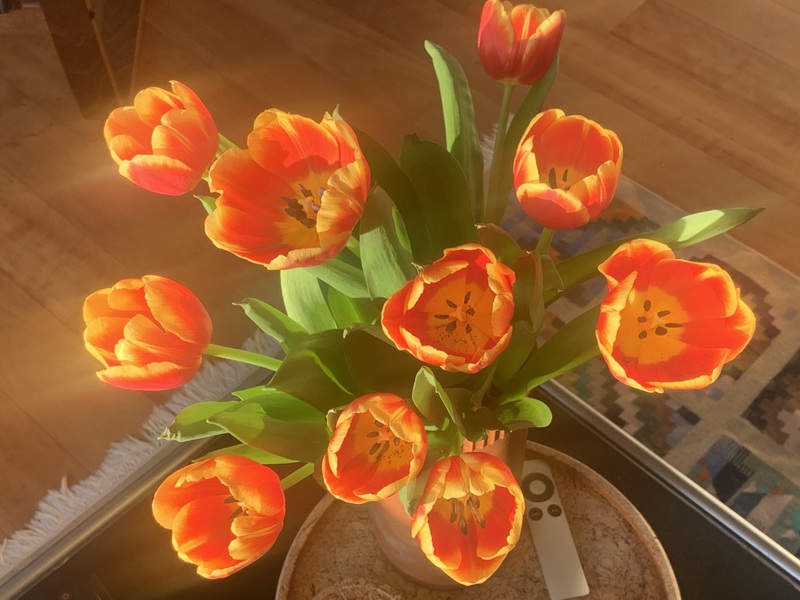
That Saturday evening, three days after coming home, I could finally relax and enjoy the tulips.
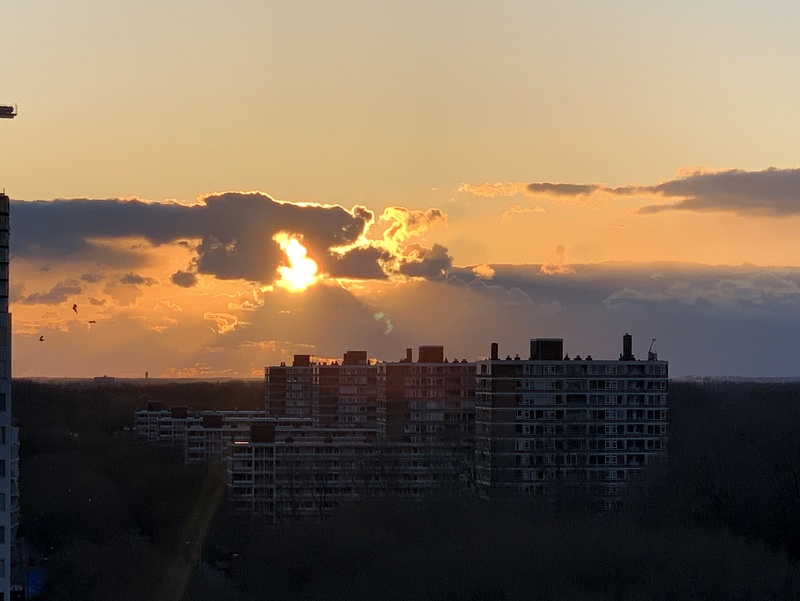
Sunset and view from my apartment Sunday morning. At least a bit of blue sky. But still unpleasantly cold.
More blogs about this trip to the Netherlands will follow
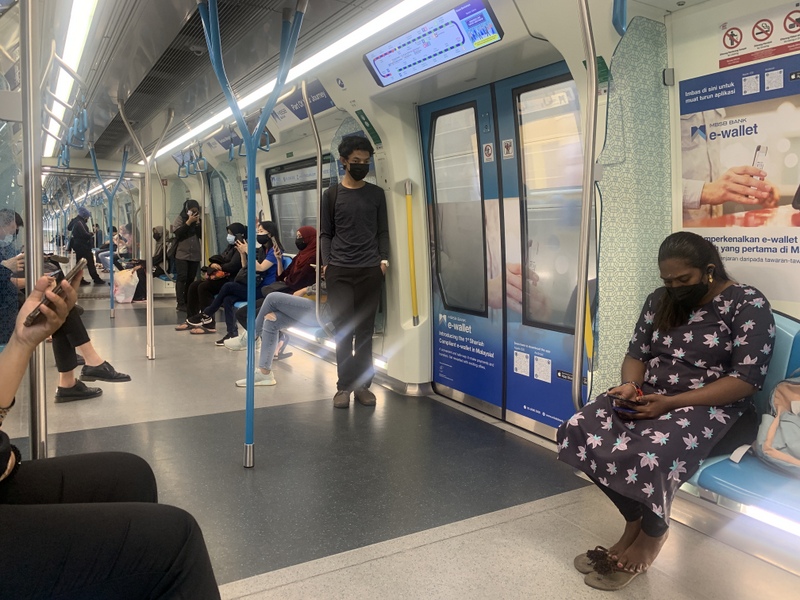
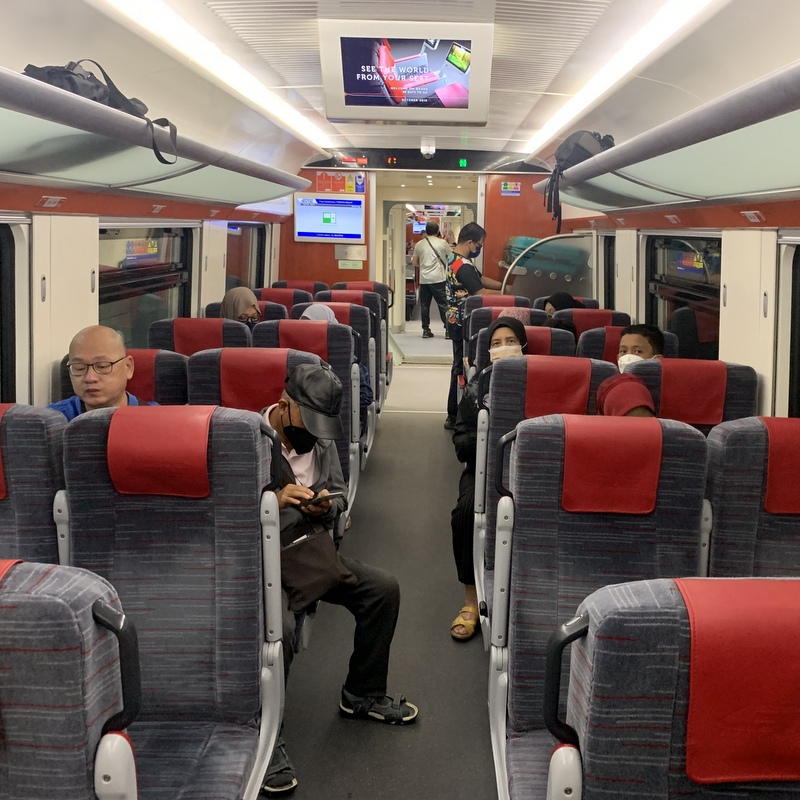
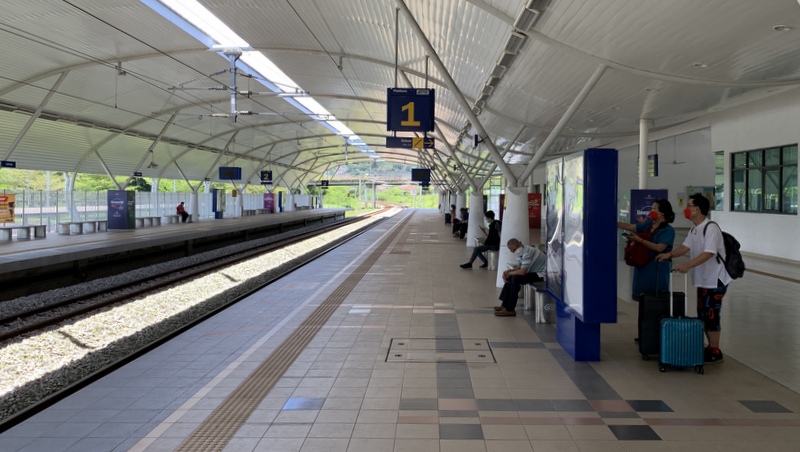
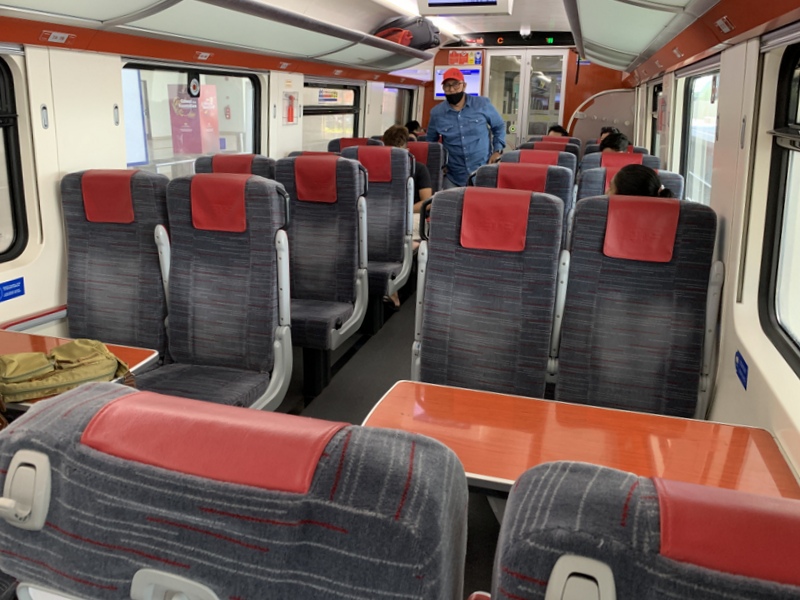
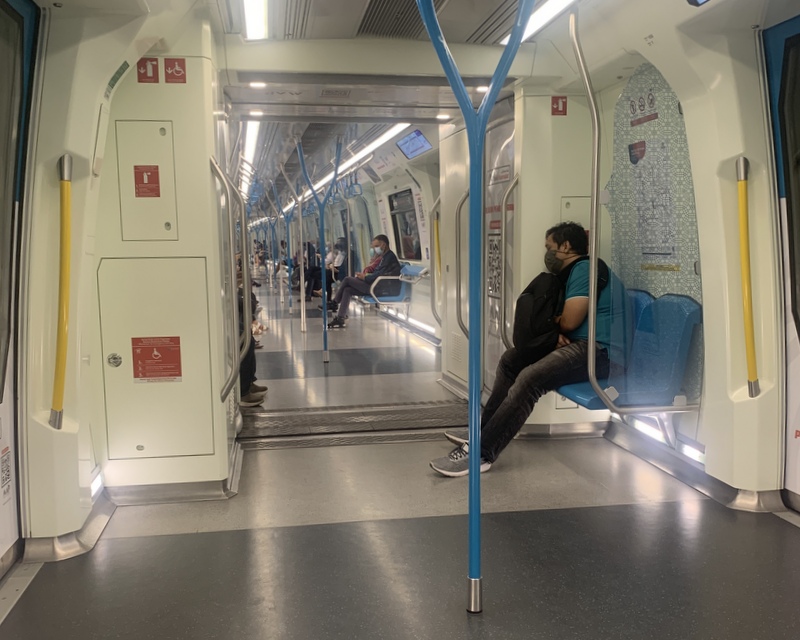
The last time I visited Taiping was in October 2020, one and a half year ago. High time to visit my 2nd hometown again. I used public transport, first the MRT, then the ETS. The MRT was pleasantly quiet and in the ETS waiting lounge people kept distance.
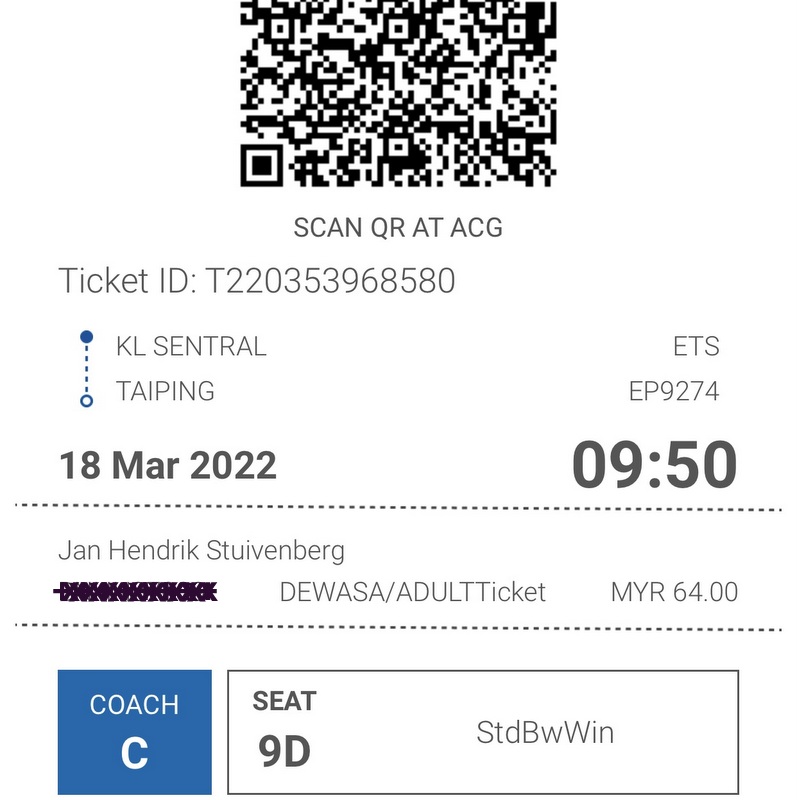
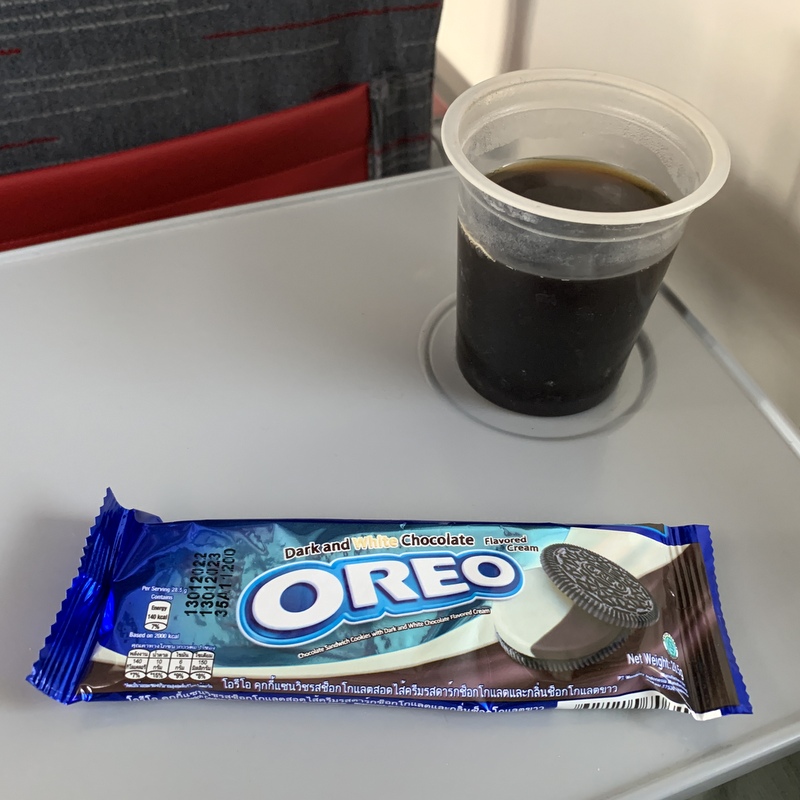
Ticketing and boarding is very modern these days, the train was also not crowded and left punctually on time. There is a canteen on board, but I had prepared coffee and biscuits.
I managed to take two heritage pictures during the trip. Left the interior of the Kuala Lumpur station, one of Hubback’s masterworks, and right the Victoria bridge over the Perak river, near Kuala Kangsar.
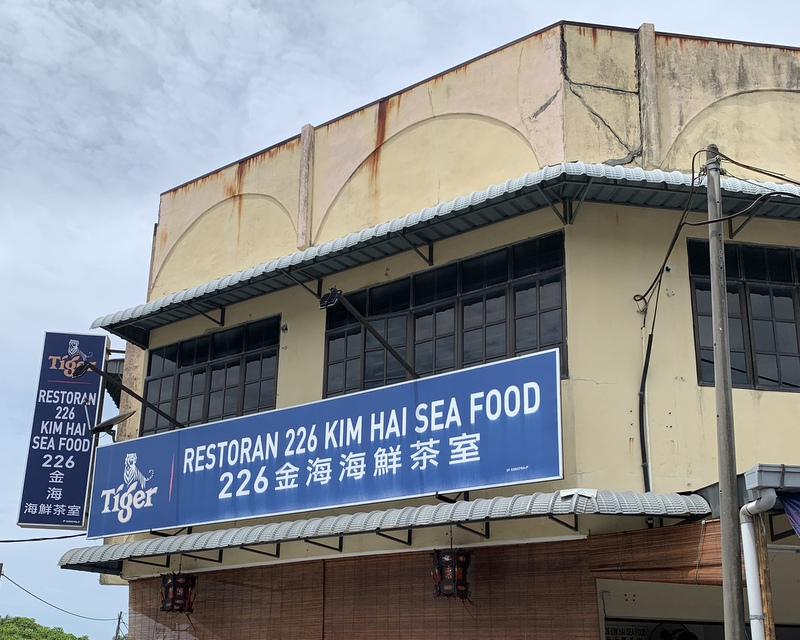
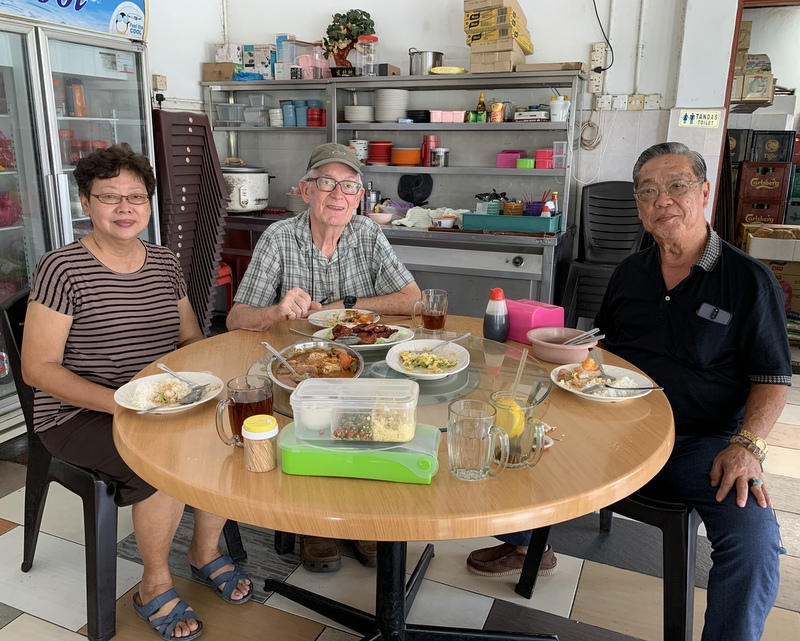
It has become a nice tradition that Tung Lay Chun picks me up from the station and that we have lunch together, this time also with her husband Kar Seng. They suggested the 226 Kim Hai restaurant in Aulong, where they had been several times.
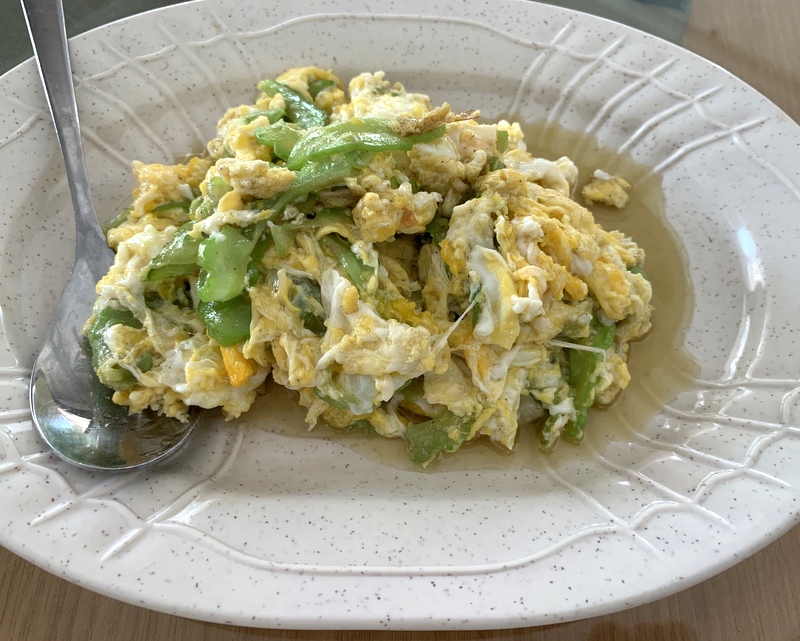
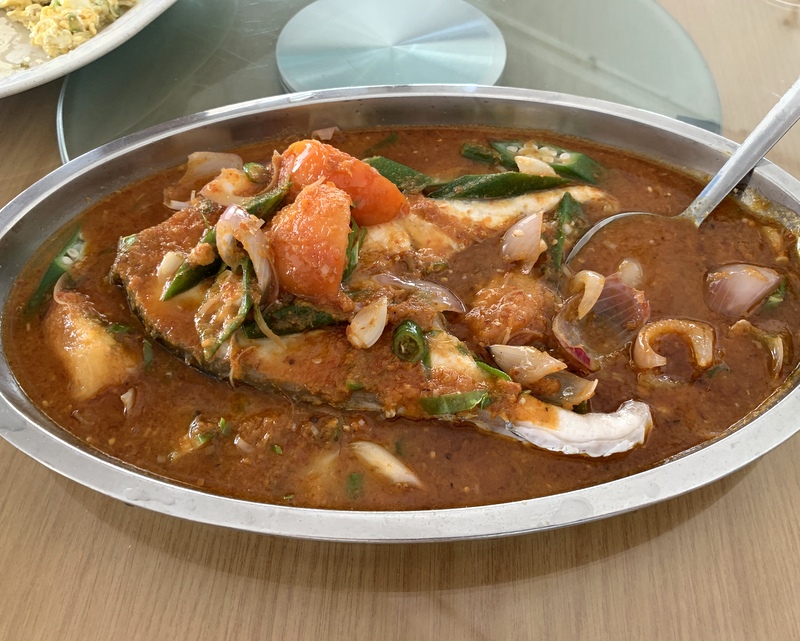
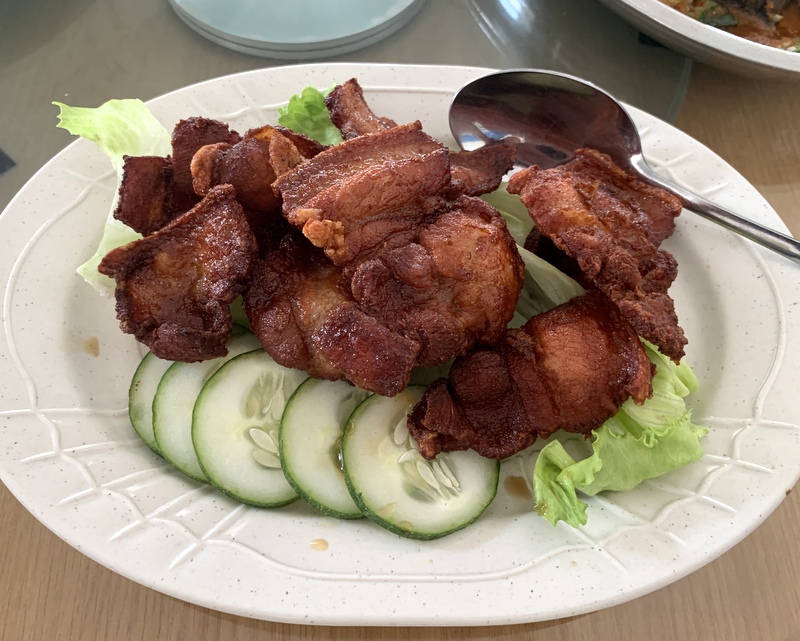
Delicious food, from left to right bitter gourd omelet, asam pedas fish curry and pork fried in fermented bean curd..
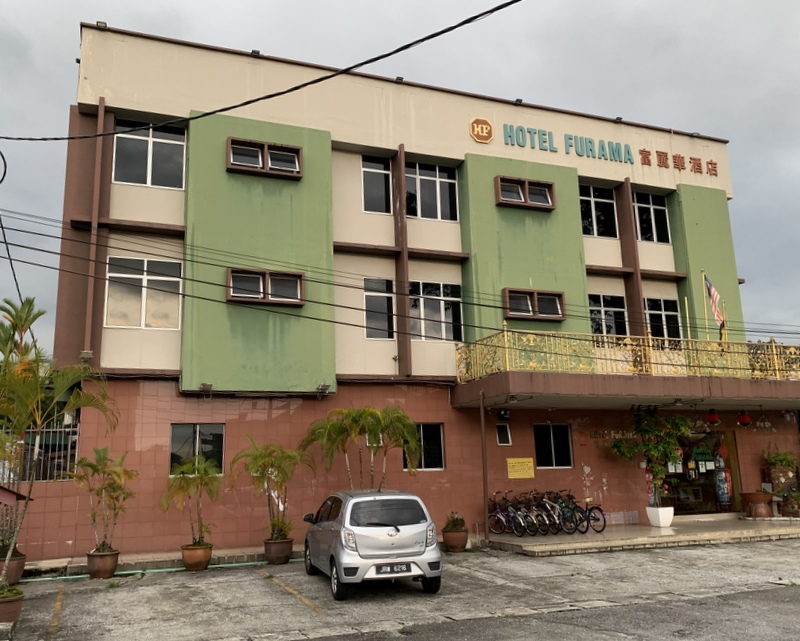
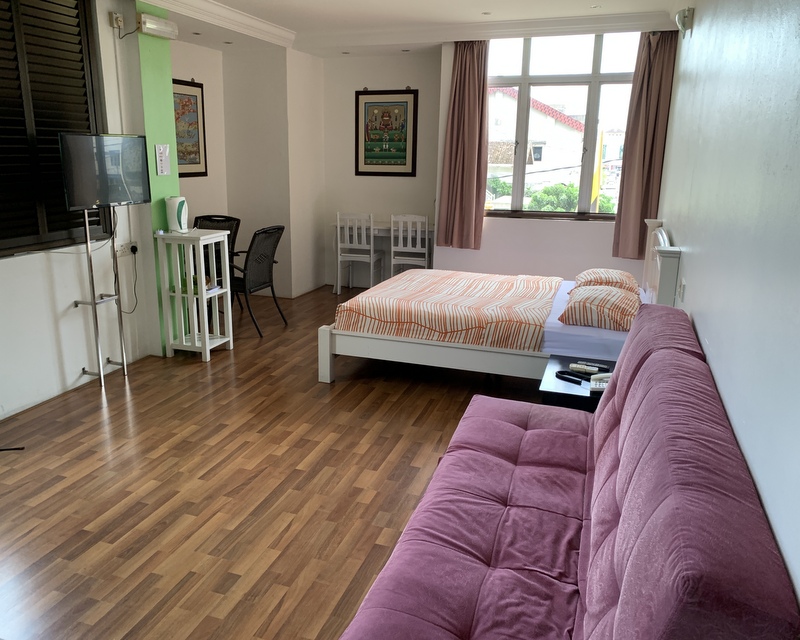
After lunch they dropped me at my usual Furama hotel, where I always have the same room.
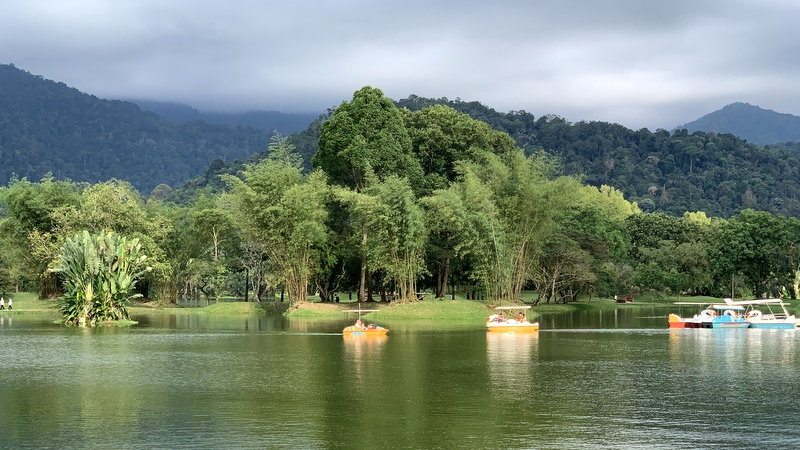
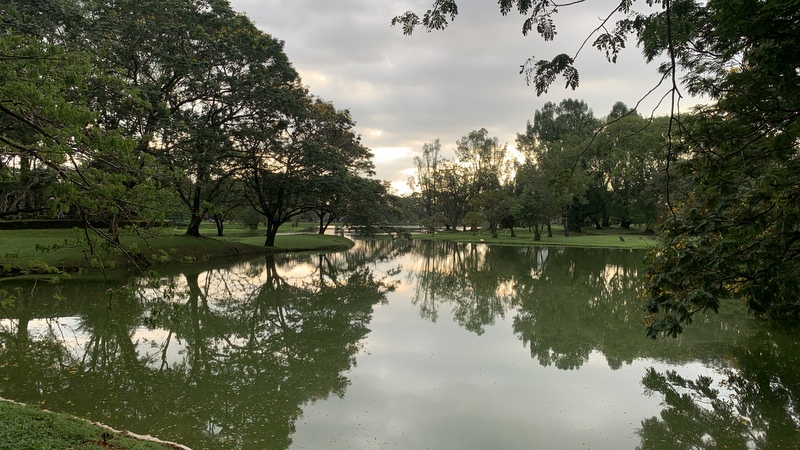
After a long nap, I went out to the Lake Gardens, around the corner from Furama.
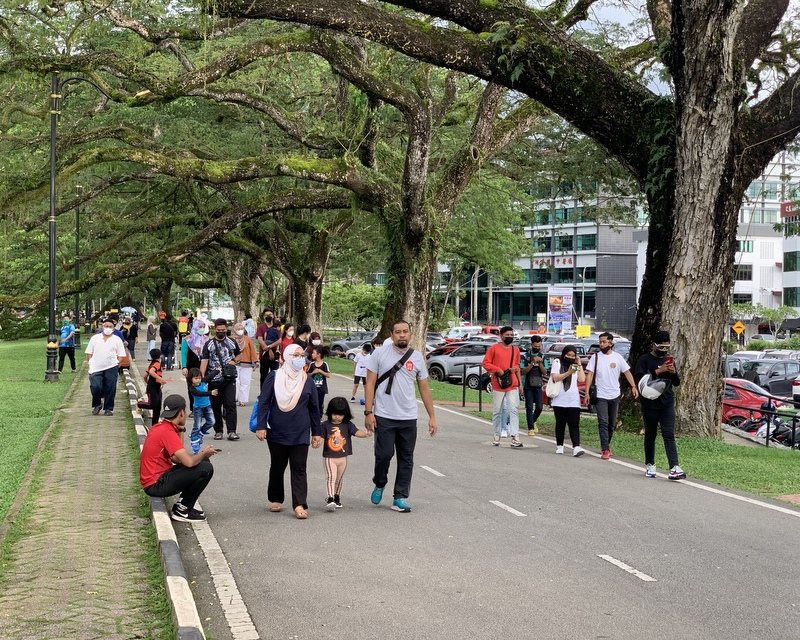
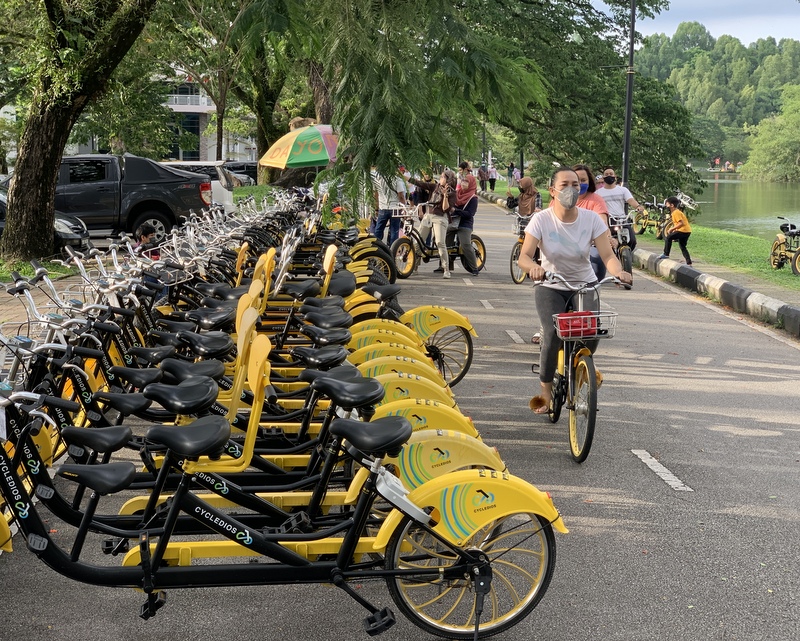
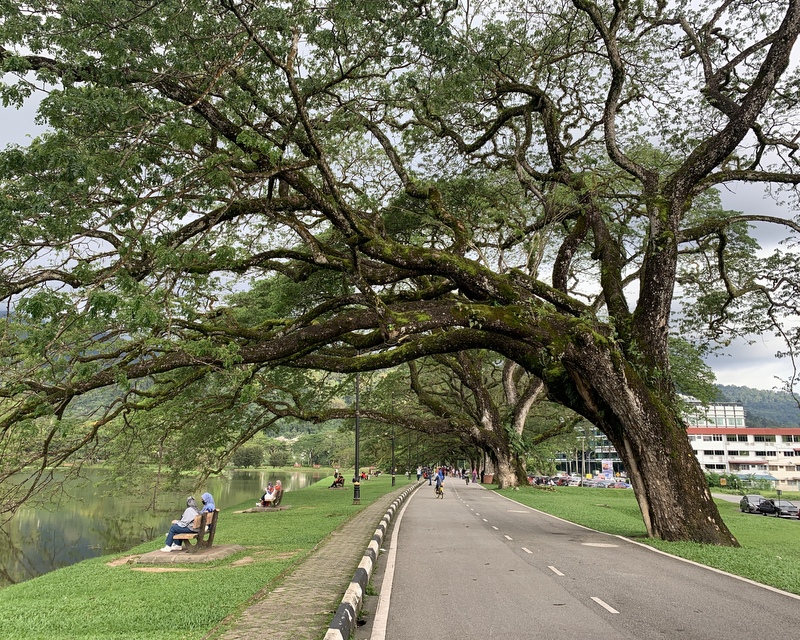
It was a Friday afternoon, no rain, many families and friends were enjoying the Raintree Walk, on foot or on a rented bicycle. Very pleasant atmosphere. I am often critical of MPT (the Taiping town council), but their decision to make a part of the Circular Road a pedestrian area has worked well.
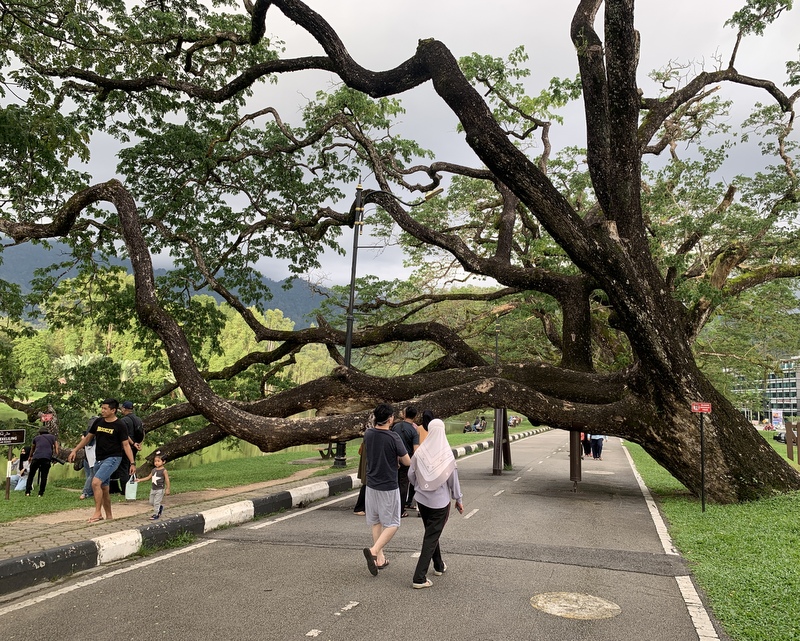
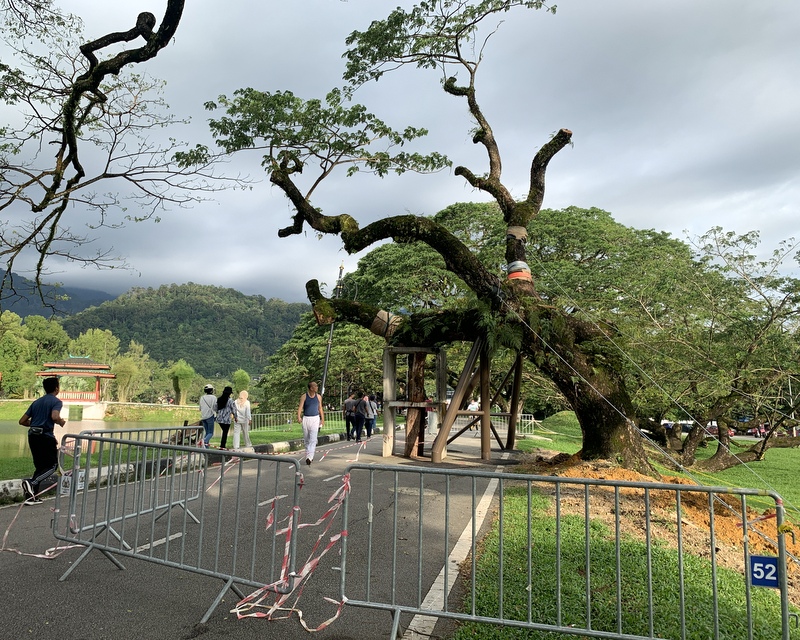
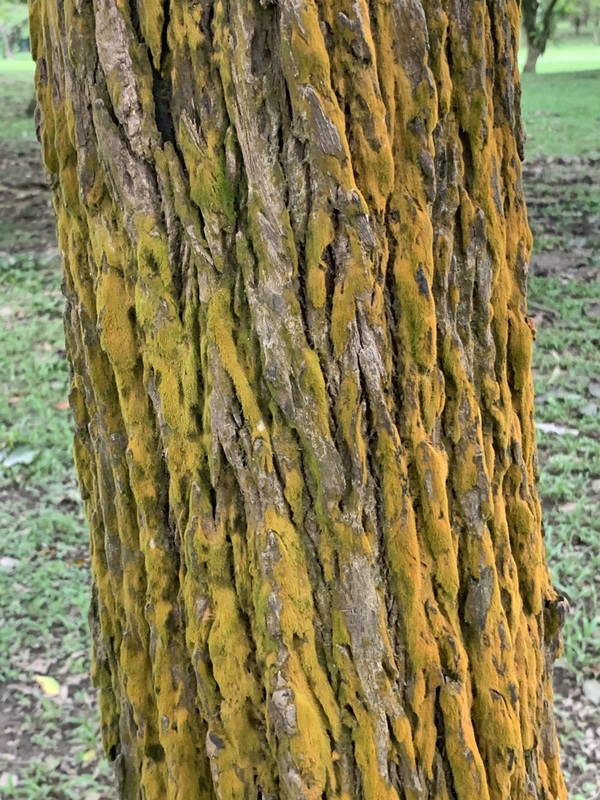
The actual reason to create the Raintree Walk was that one of the magnificent raintrees had fallen down and blocked the road. Instead of removing it, the tree was left there with some support. It became a tourist attraction, but recently it was discovered that the tree trunk was rotting, so a big part had to be removed (left picture). The middle picture shows the second toppled tree. It is still doing well. And a few weeks ago a third raintree fell down (right pic). Here they have erected it again, with a lot of support. Will be interesting to see if it can survive..
The Chinese Pagoda bridge
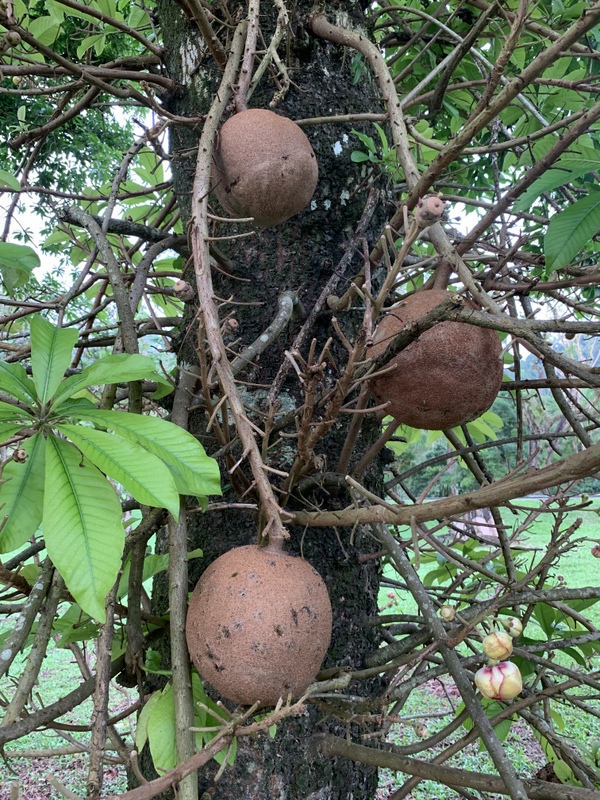
After such a long absence I kept taking pictures. The picture to the right shows the Cannonball Tree, the Lake gardens have a few of these interesting trees. No flowers this time.
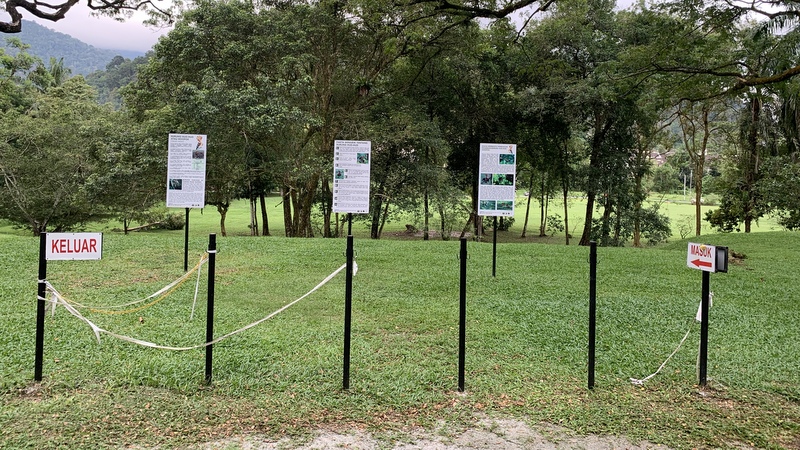
Last year there was a lot of excitement in Taiping because a pair of Hoopoes had landed and nested in the Lake Gardens. To control the stream of visitors, traffic had to be regulated. These signboards remain, hopefully the birds will come again.
Evening is falling, time to return to my hotel.
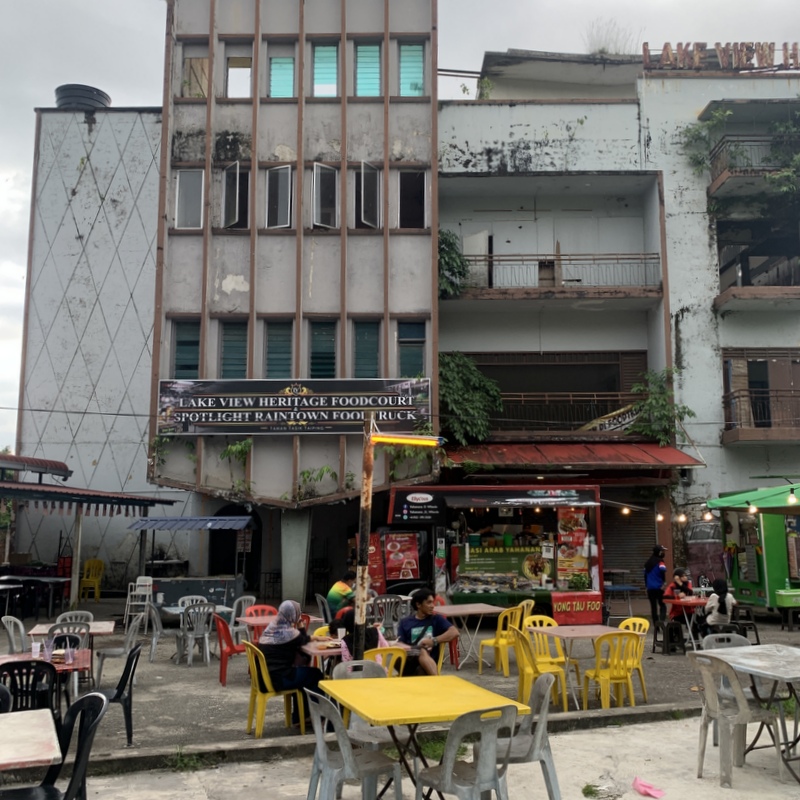
On my way back I passed the remains of the historic Lake View Hotel. A heritage food court has been opened in front of it. And I had a look at the bungalow which I had discovered in February 2020 and visited in August 2020. Then it was empty, now one guy was living there.
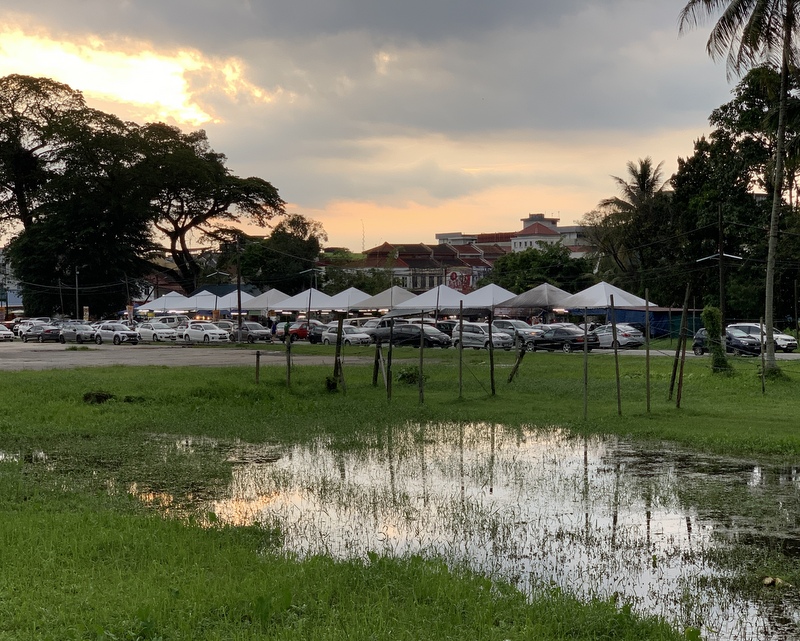
After my sumptuous lunch I didn’t feel hungry, I decided to have a look at the food stalls of Siang Malam, temporarily relocated from the pasar to the dobi line. I had a Chee Cheong Fun, not very special.
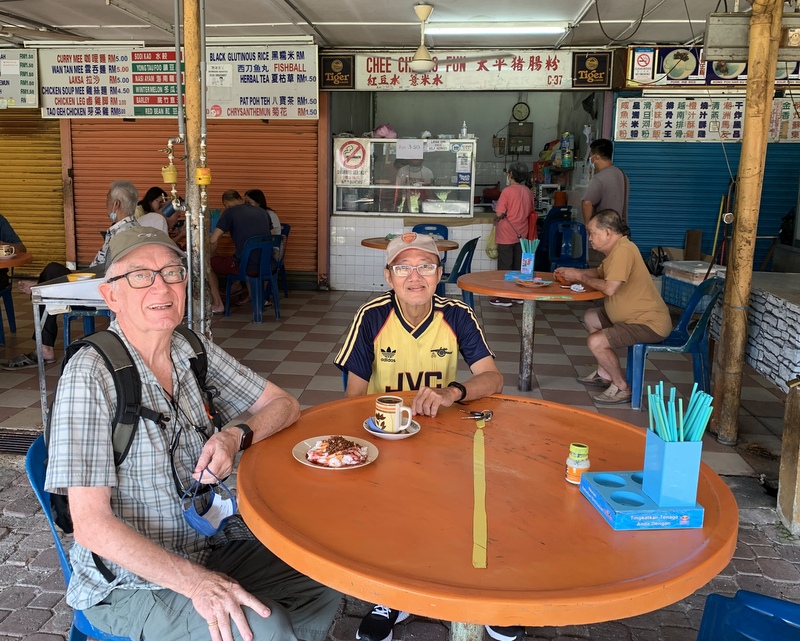
The next morning I had CCF again, now at Mr Tong’s stall, according to many the best in Taiping. While having my breakfast I accidentally met Foo Kok Heng, who used to work in Furama hotel. It was he who told me about the bungalow 😉
My “assignment” for that Saturday was to have a look at many of the heritage buildings in Taiping and see if there had been any changes after my last visit. I used a rental bicycle of the hotel. Be prepared for a mixture of positive and negative observations!
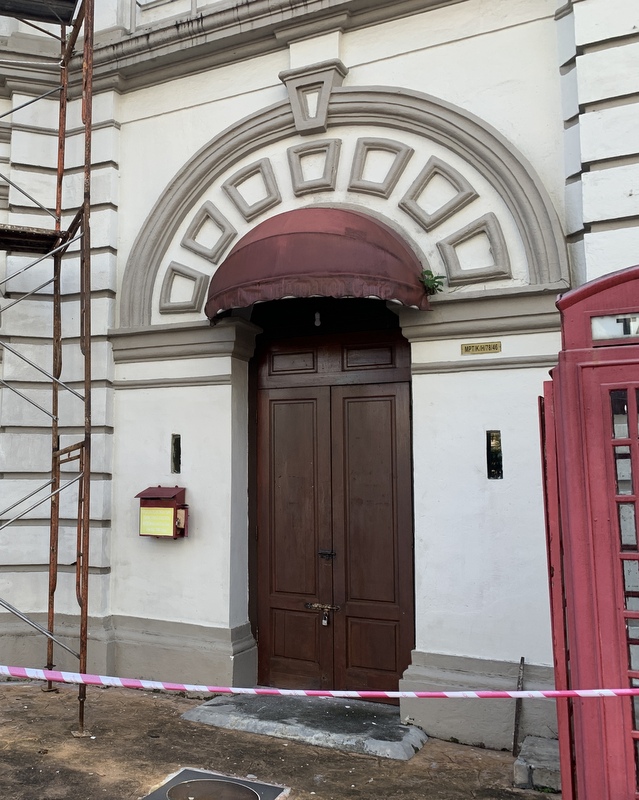
First I had a look at the Taiping Tourist Office. I was not surprised to find it closed, it often was during earlier visits. Now apparently some renovation was going on. My friend Halim told me later that the roof was leaking (already for many years). The Tourism Office in Taiping is run by a NGO, which I find surprising, it should be run by MPT.
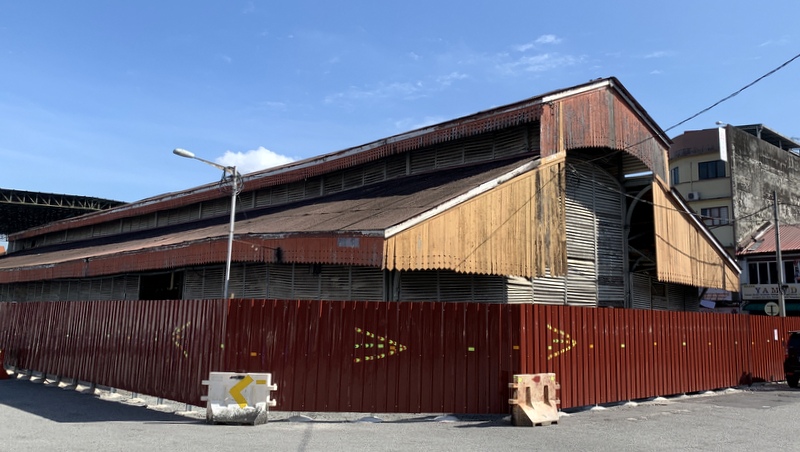
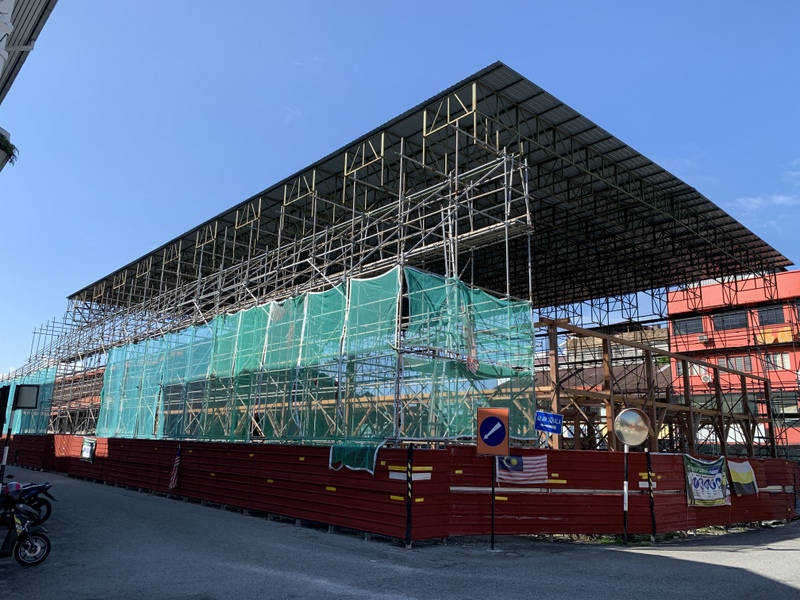
Positive news about the restoration of the famous Pasar. A start has been made, the stall holders have been relocated to a temporary market, the plan is that they will come back after the project is finished. That may take a long time.
At the moment they are working on the reconstruction of Siang Malam, the wet market and a popular eatery. Let’s hope for the best.
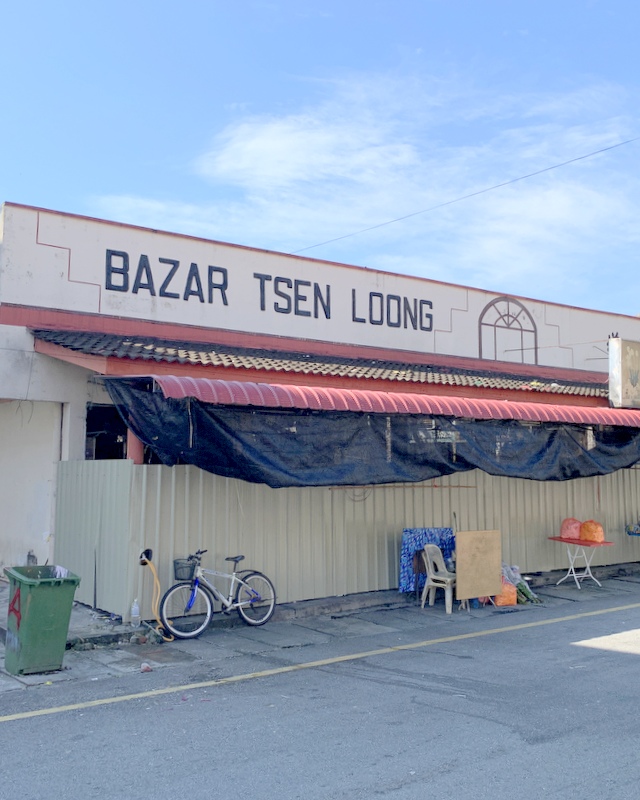
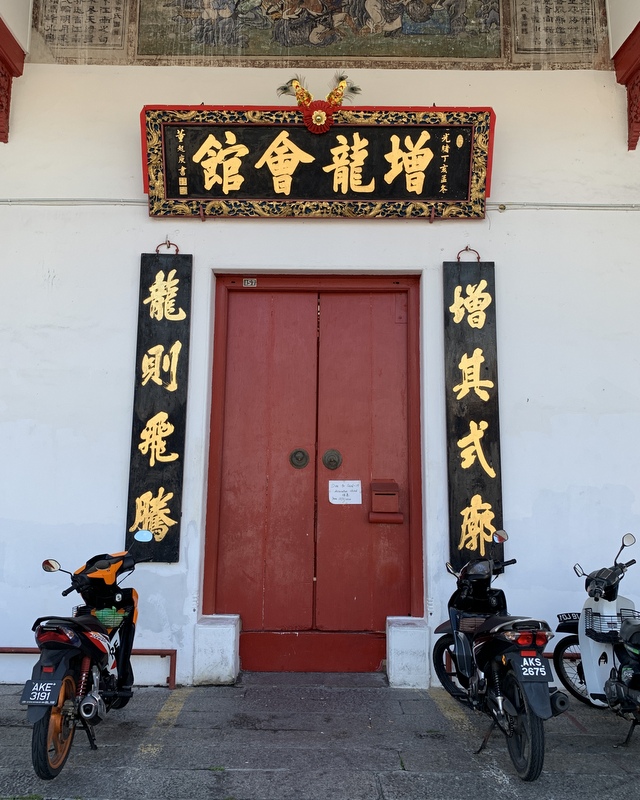
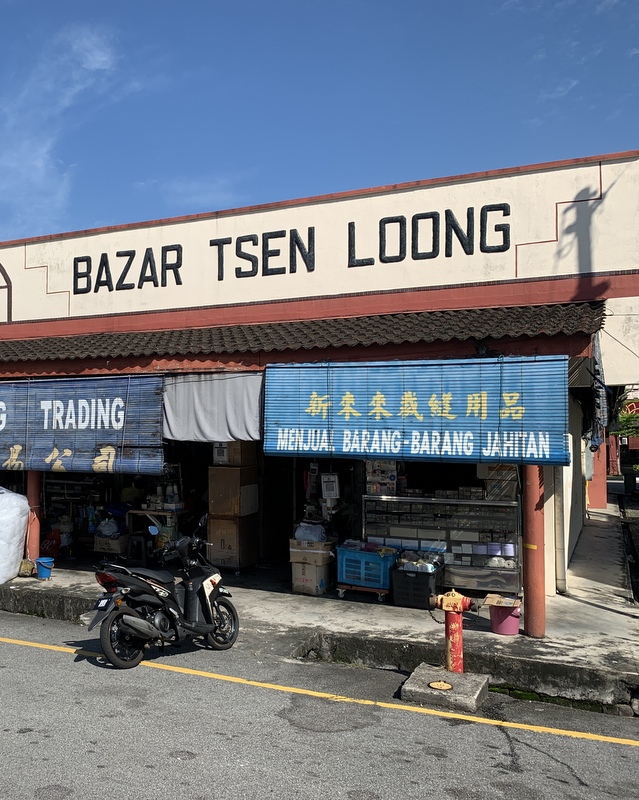
A few weeks ago it was in the news that fire had destroyed part of an old bazar, the Tsen Loong Bazar. I had a look. Fortunately only a few stalls along Main Road had been affected, mostly flower shops. Left picture shows the Main Road façade, right picture the Pasar Road stalls, still operational. The middle picture shows the entrance of the impressive Tsen Loong Hakka Association opposite the bazar on Pasar Road..
Next on my list was the Amelia Earhart mural, commemorating her landing at the Taiping aerodrome on 20 June 1937. A beautiful mural, only a pity that Amelia never landed in Taiping as I convincingly proved in my two blogs about Amelia Earhart and Taiping , part 1 and part 2. Sigh.
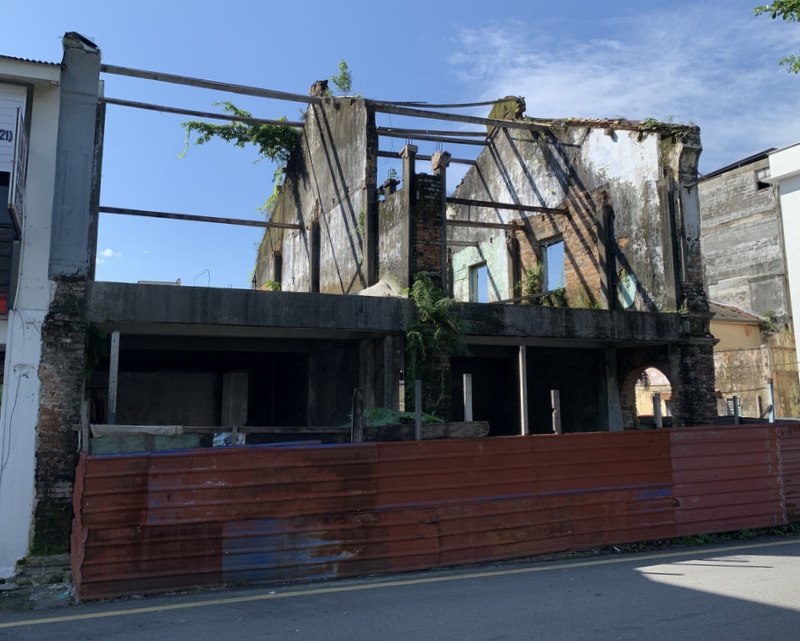
Opposite one of the ruined buildings in Taiping, for years already nothing has happened.
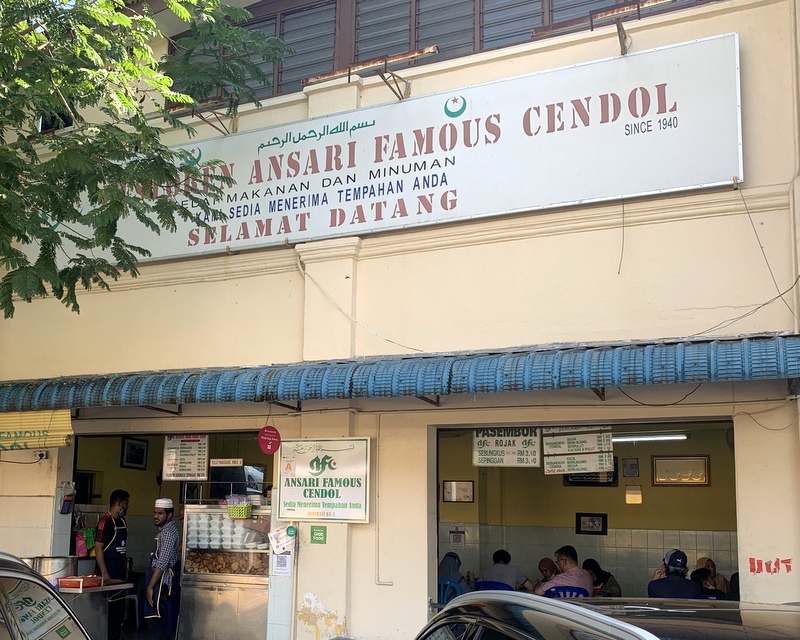
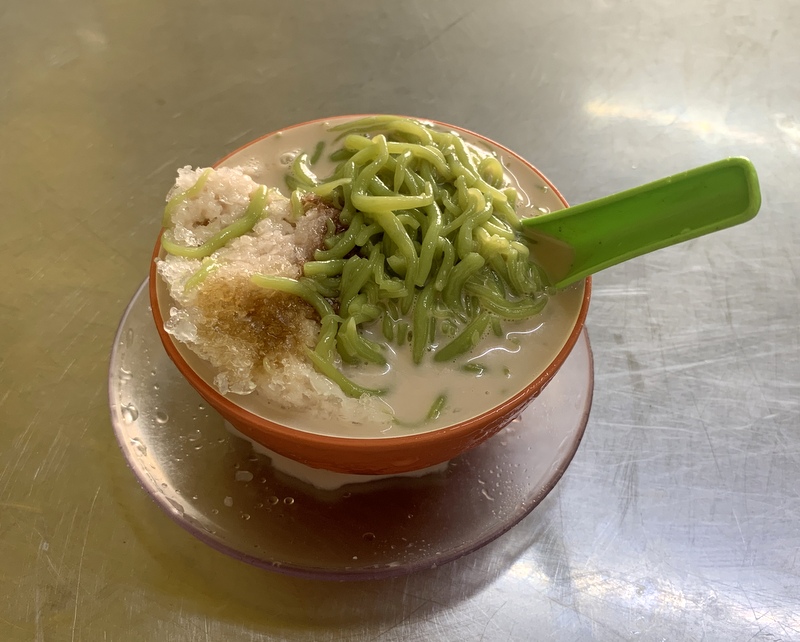
A short break at Ansari’s Famous Chendol. No visit to Taiping is complete without a cendol at this iconic place. I paid RM 2
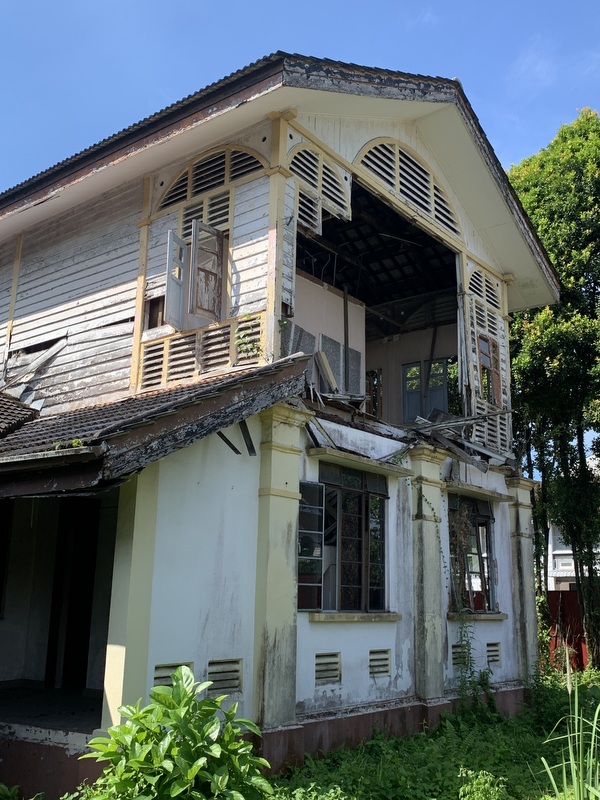
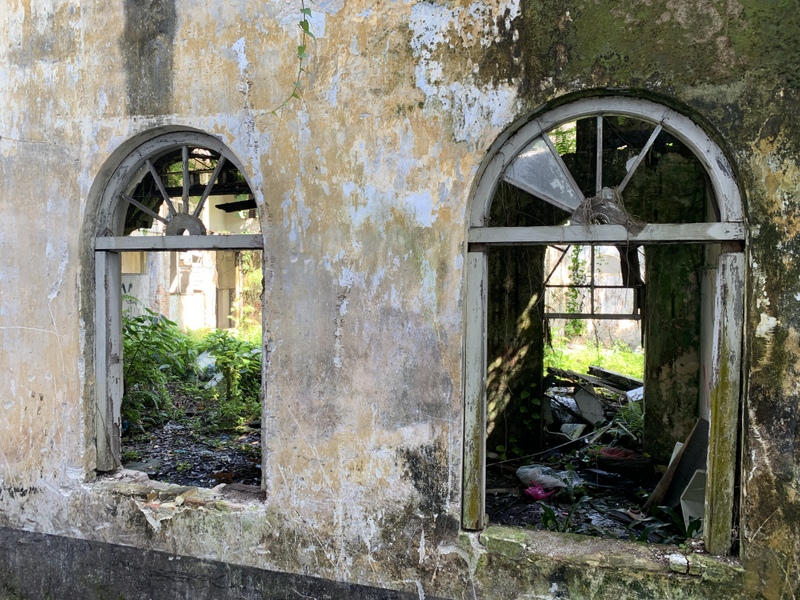
Taiping is a town of contrasts. Nicely restored heritage buildings and pathetic ruins. I don’t want to offend anybody, but for me it is part of Taiping’s charm, compared with vibrant towns like Ipoh and Georgetown.
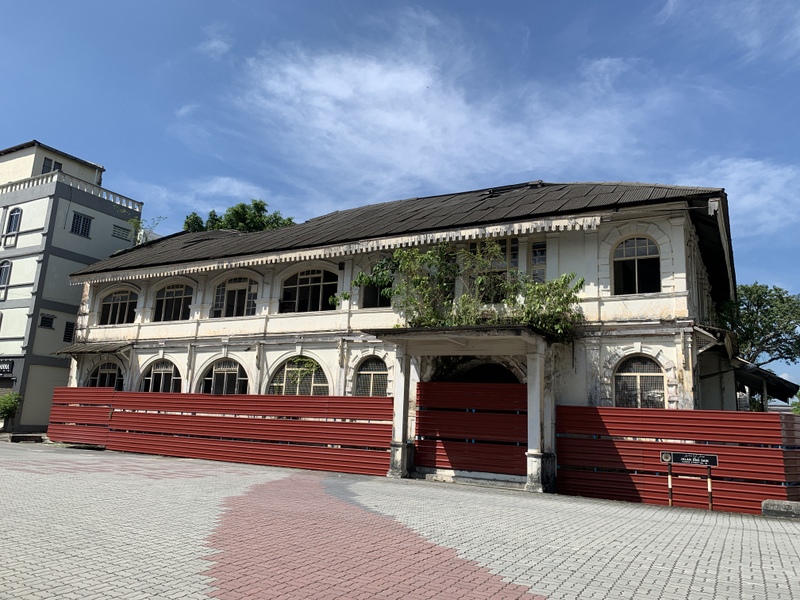
Left the Ceylon Association, beautifully renovated. Right the town Rest House, left to rot.
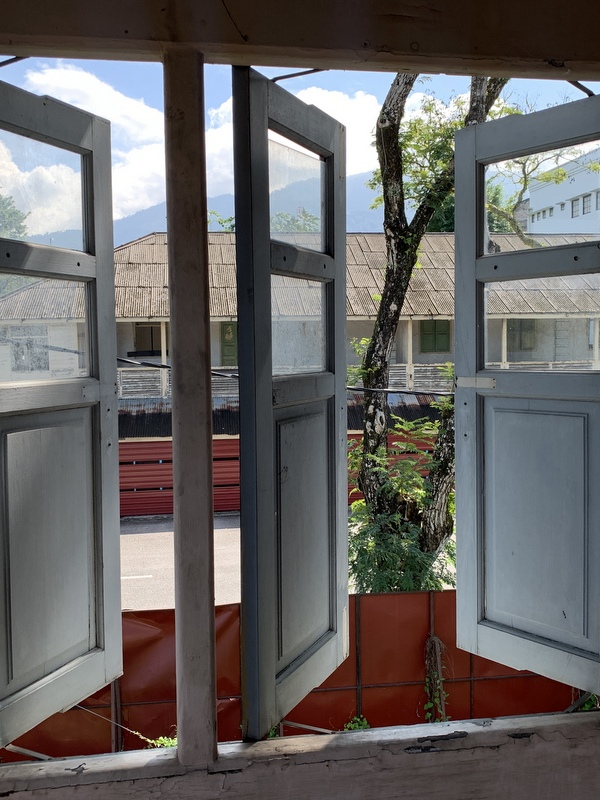
Although the Rest House is fenced off, it is still easy to enter. I walked up to the first floor. The structure is still solid, with immediate action it could still be saved, I think.
The building next to it, the former Perak Railway building, has finally been solidly fenced off, no jalan tikus anymore, But years too late, all valuable stuff has been stolen already, Have a look at my 2019 report Taiping Bandar Warisan
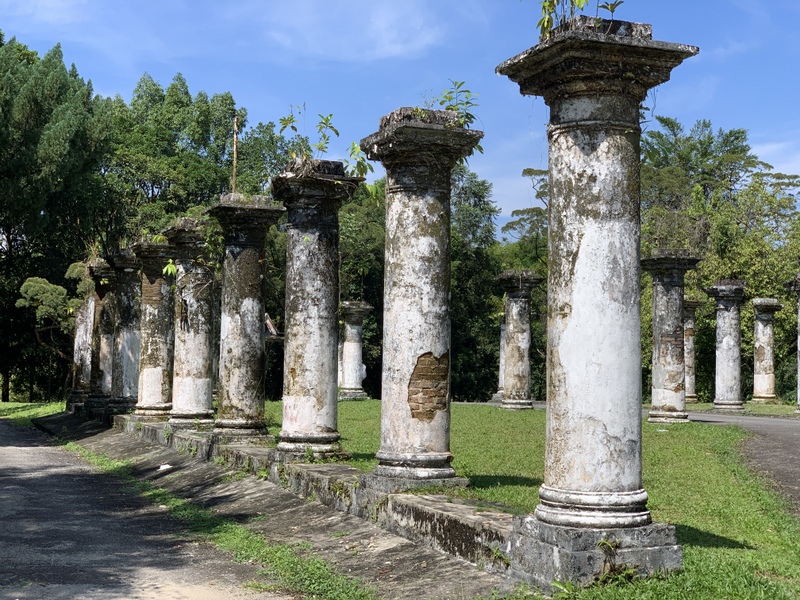
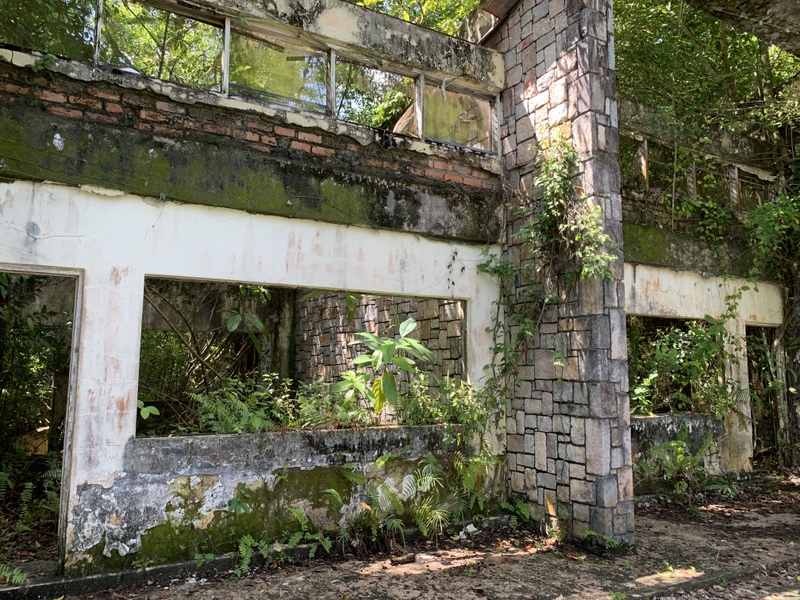
Last stop before going back to Furama were the Pillars of the former Residence. The cleaning operation by THS and other NGO’s was successful. The VIP chalets of the former Casuarina Inn are ruimes, but again, that is the charm of Taiping.
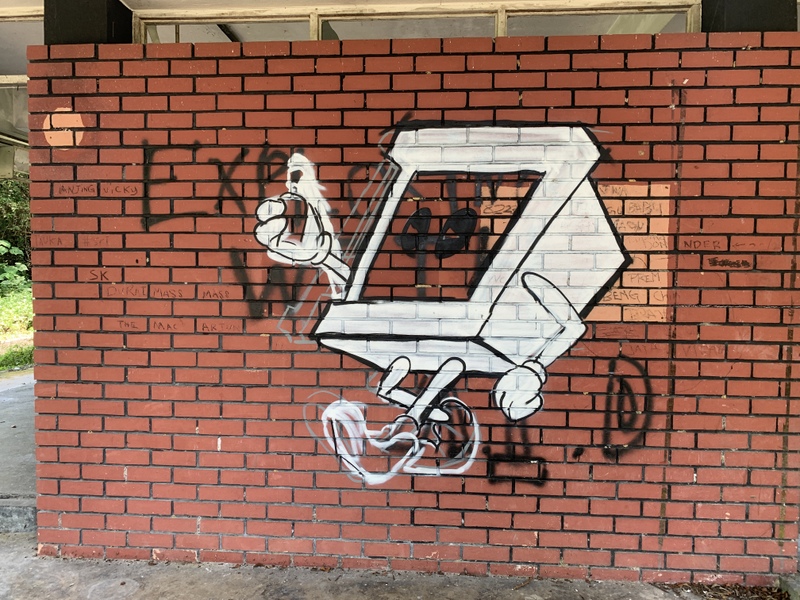
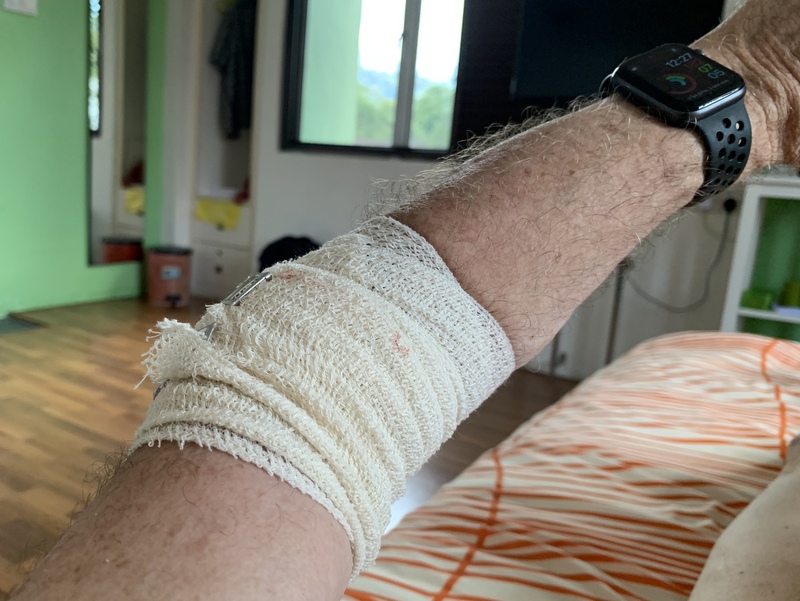
Graffiti at the entrance. On my way back I had an accident with my bike, I overlooked one of the many potholes. I could easily have broken bones, but fortunately I only had some scratches and bruises. The Furama staff was very helpful in applying a bandage.
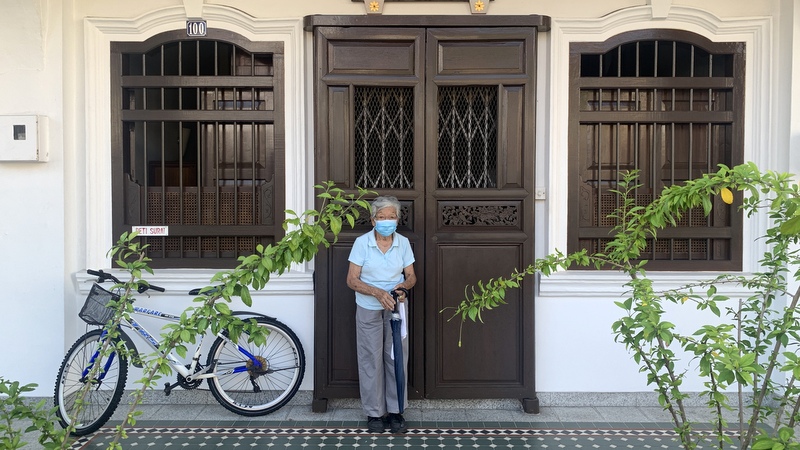
In the afternoon I went out to visit Mrs Long in Barack Road. Another tradition, we had a long chat. I came on my bike, as you can see in the picture, where Mrs Long is standing in front of the beautifully renovated house.
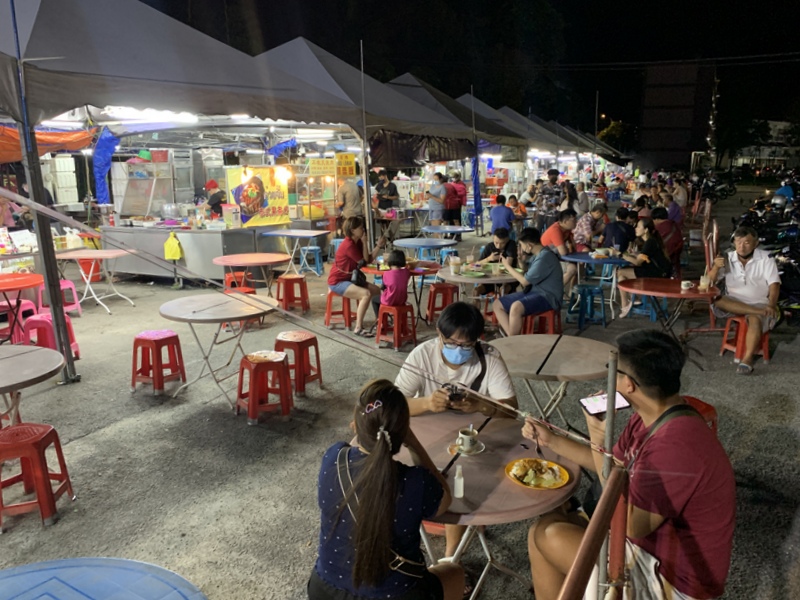
That evening I Had dinner with Anand Pillai in what used to be the Pusat Makanan Taman Tasik, but now has been upgraded to Medan Selera Tai Hu. Nice atmosphere. Just around the corner of Furama, I had food there so many times..
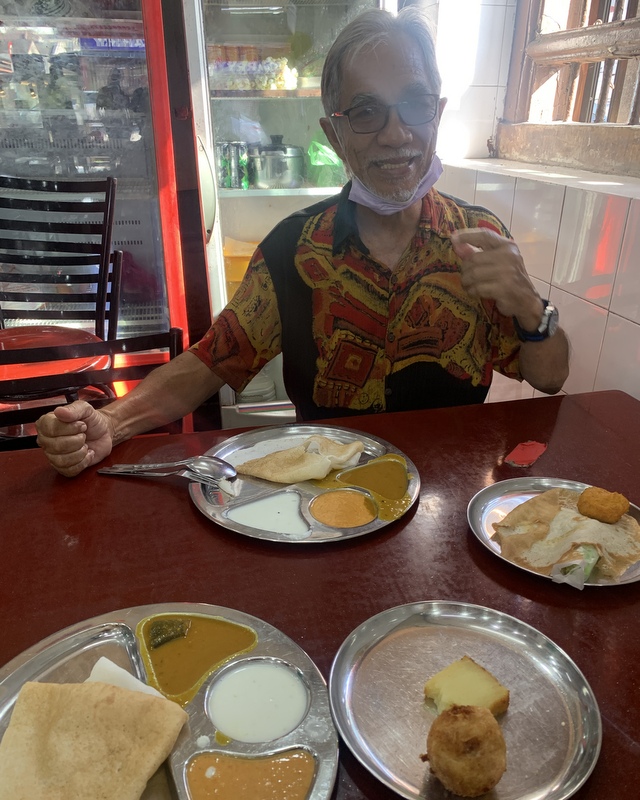
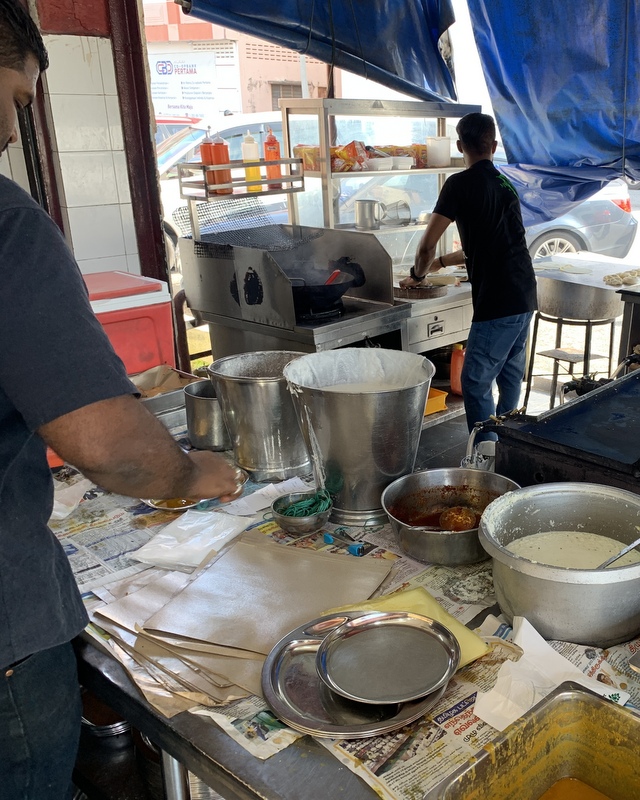
The next day I went out with Halim to explore the region around Matang. We started with a breakfast of thosai. .
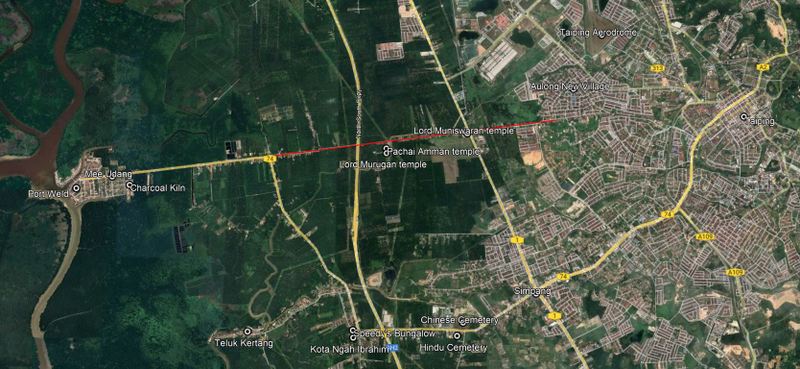
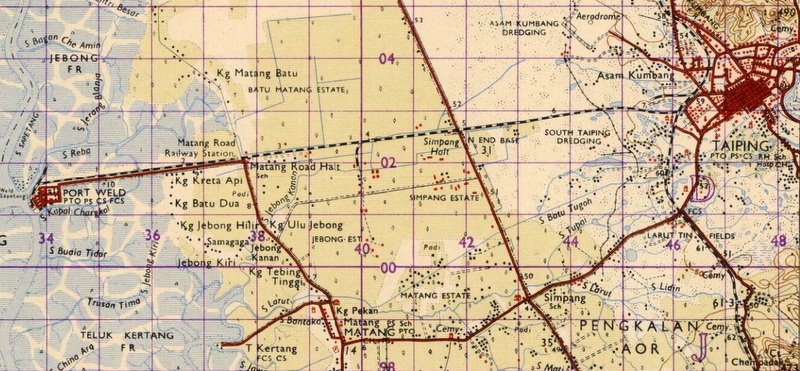
In this Google Earth map I have marked the locations we visited. The other map is a topo map from 1942. It is interesting to compare the two . The Port Weld railway has gone but you can still drive along the tracks, now a minor road (marked in red).
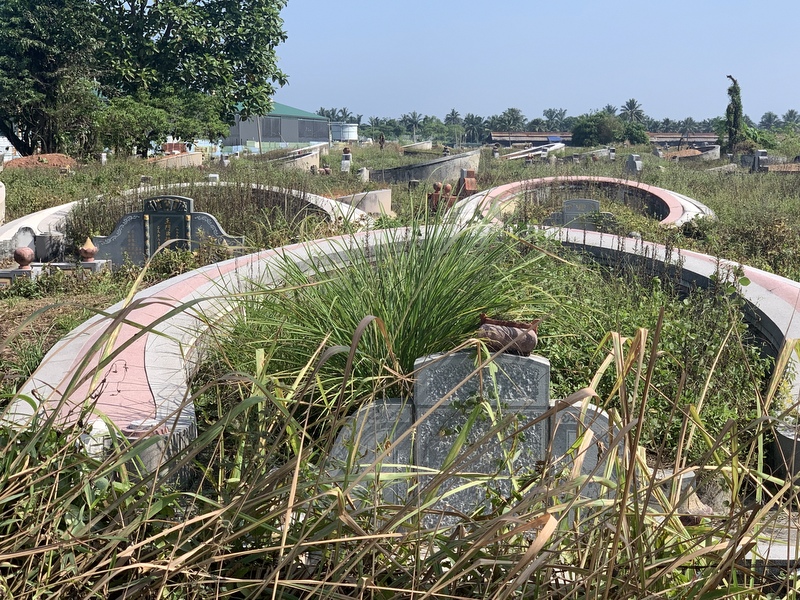
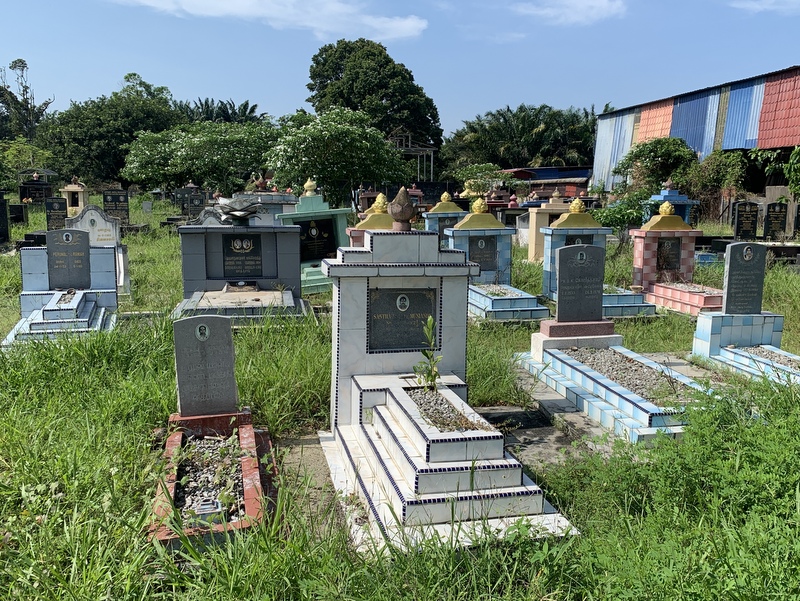
Our first destination was a cemetery, already indicated on the topo map. Just beside the road from Simpang to Port Weld. At one side a huge Chinese cemetery, In a few weeks time it will look much better kept, after Cheng Beng. At the other side there is a Hindu cemetery. Interesting for me, I thought that Hindus usually cremated the bodies and scatter the ashes.
I took several pictures of tombstones.
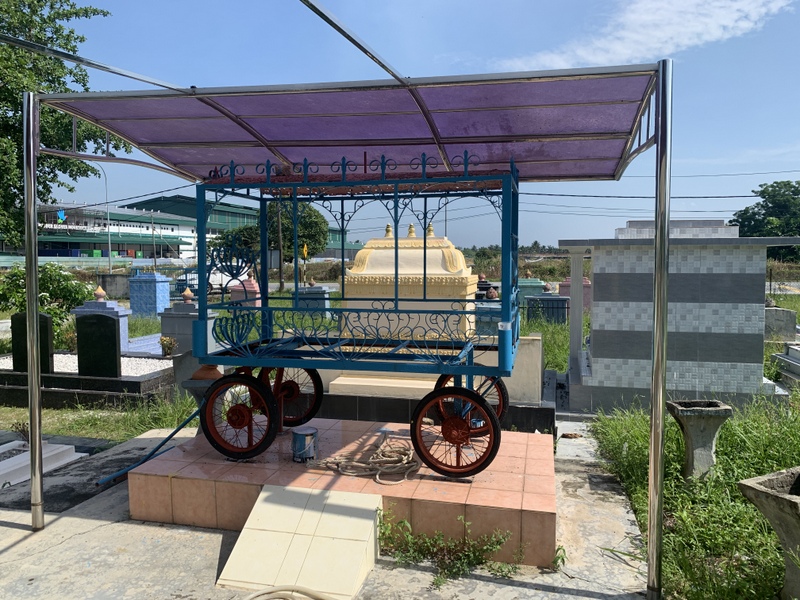
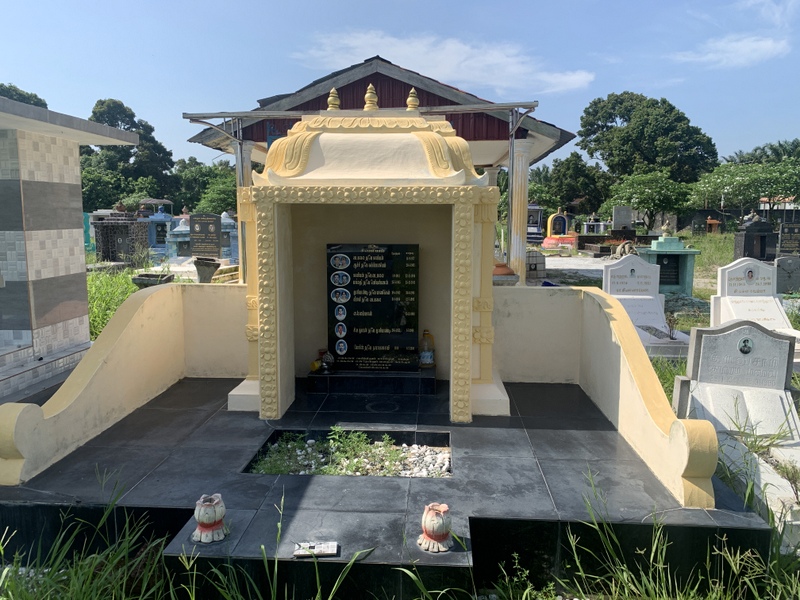
Two more pictures, the left structure one looks very Indian, but the right one looks almost Chinese.
We continued to Kota Ngah Ibrahiim, now renamed Matang Museum. As both of us had visited the (interesting!) museum, we didn’t stop, I just took a picture of Ngah Ibrahim’s tomb. After the murder of Birch in 1875, Ngah Ibrahim was exiled to the Seychelles. In 1887 he died in Singapore and only in 2006 his remains were transferred to the Kota.
Next to the Kota an attractive mansion is called Speedy’s bungalow. Not yet open to the public. In the same grounds a few nice Malay houses.
Our following stop was at Teluk Kertang, where Isabella Bird landed in 1879. I am a fan of her, read my blog Isabella Bird and Taiping for more info about this intrepid British traveler.
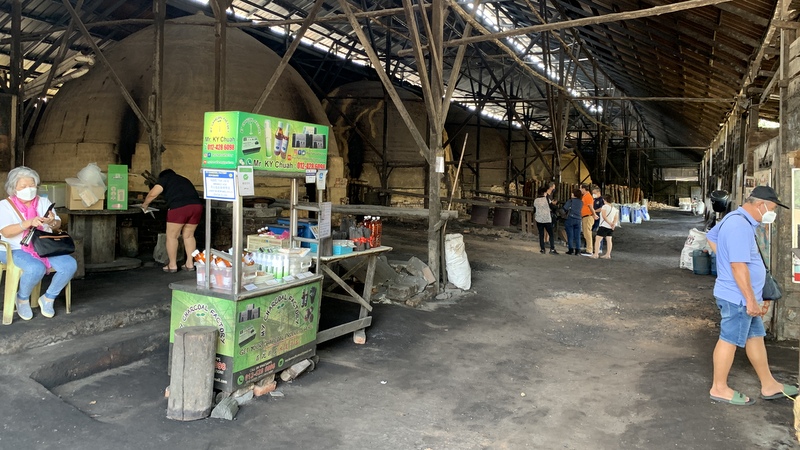
In those days, before Port Weld and the railway was built, Teluk Kertang was the main port of Taiping. The region is famous for its high-quality charcoal, made from mangrove wood.
I have visited the charcoal kilns several times, when they not yet had become a popular tourist attraction. We only had a quick look, to observe that it is quite commercial now..
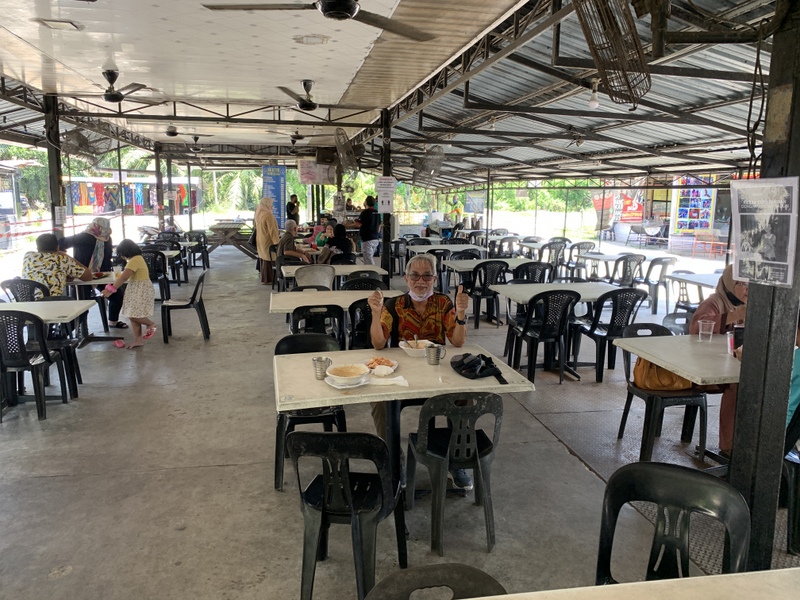
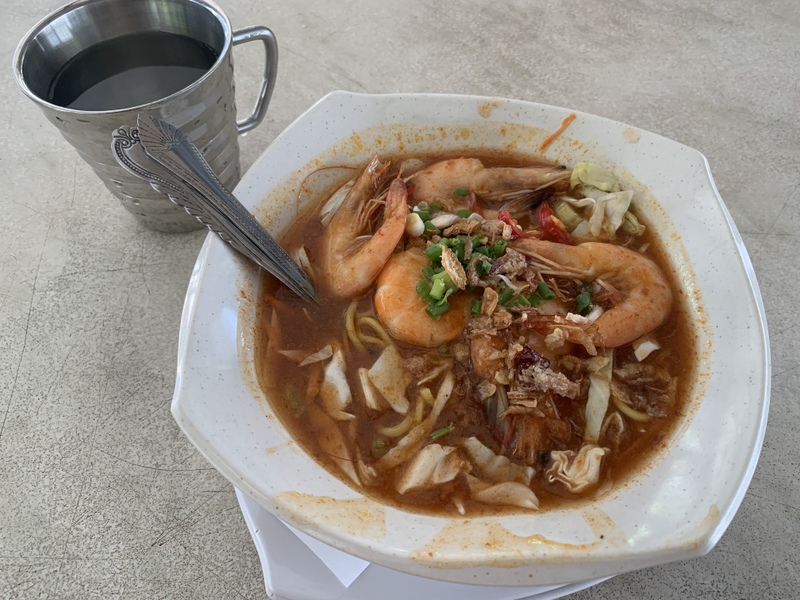
Time for lunch. Halim brought me to a Malay Mee Udang restaurant in Port Weld. Tasty, fresh prawns in a nice gravy.
Then it was time for “new” discoveries. On Google Earth I had found three Indian temples in the region between Matang and Taiping. Two of them, next to each other, can only be reached from the small road that has replaced the former railroad tracks. On the topo map there is a short railroad track, splitting off to where these temples now stand. No idea why.
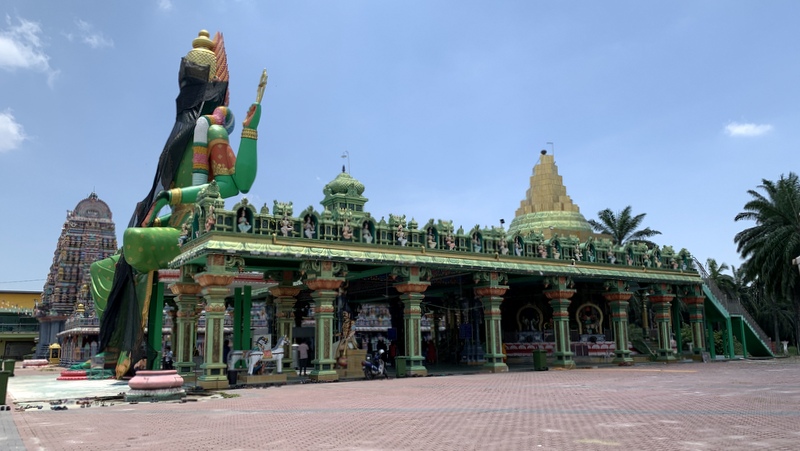
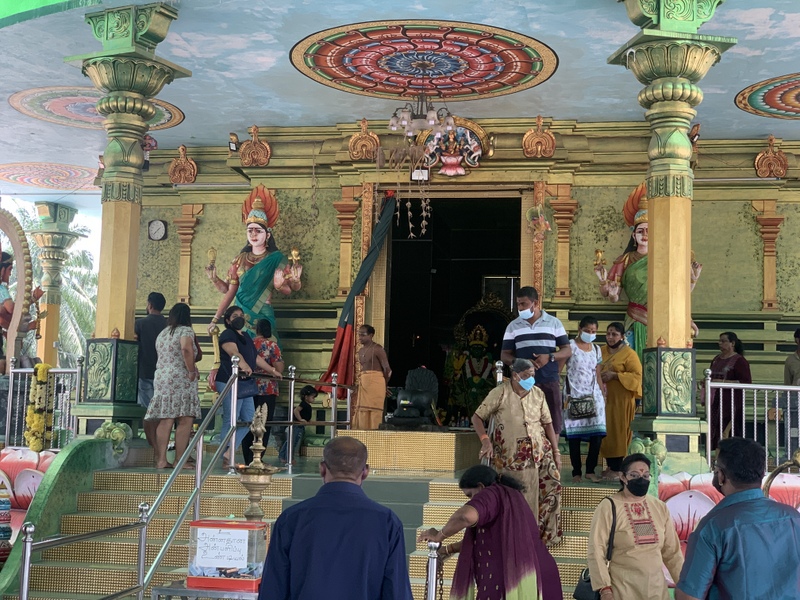
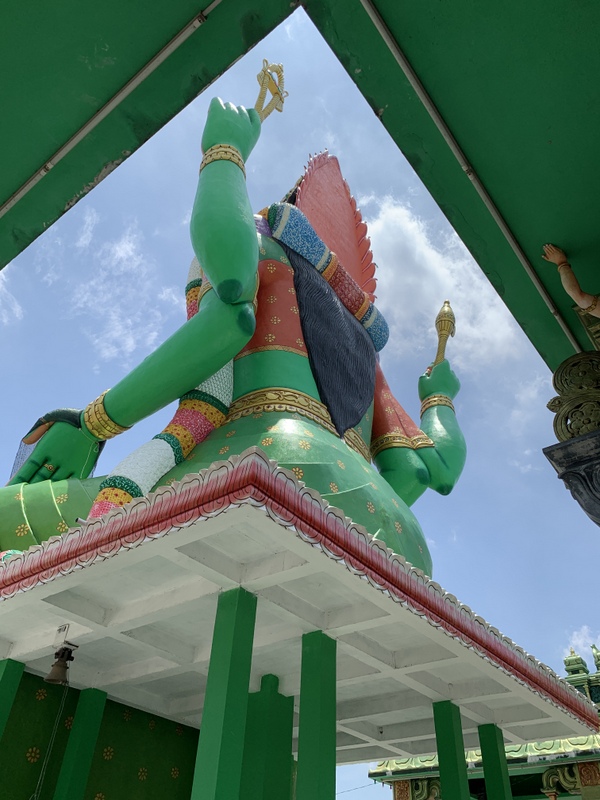
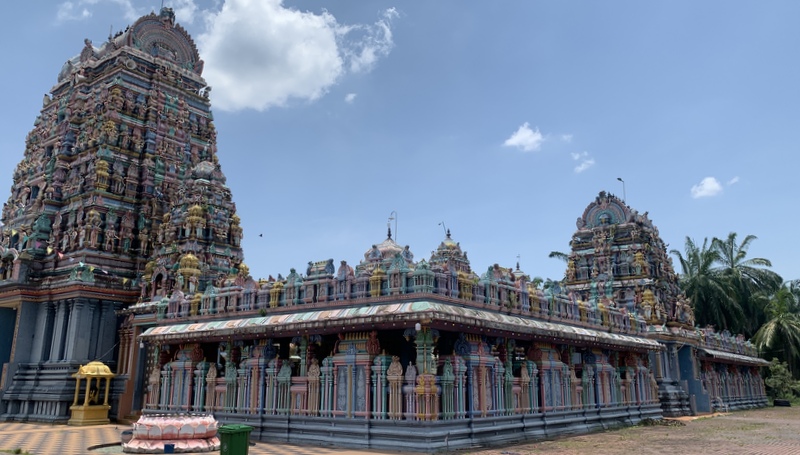
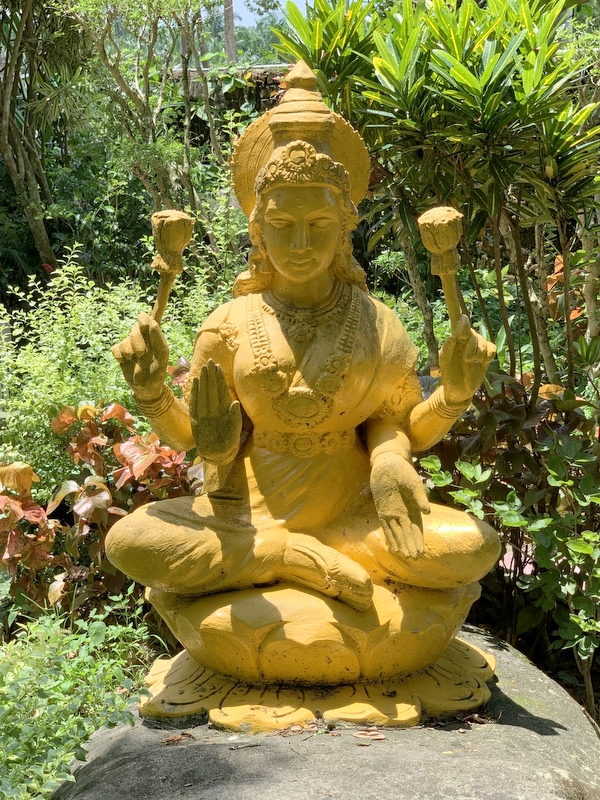
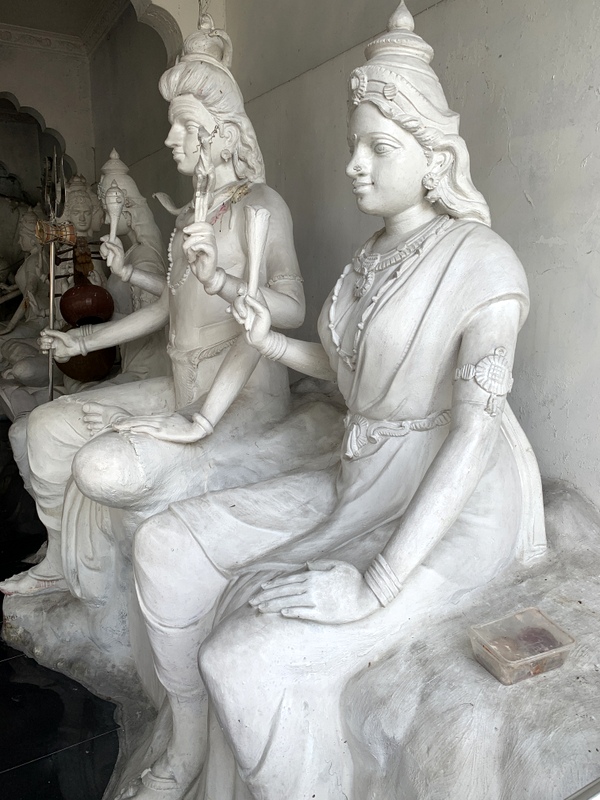
The first temple is dedicated to Puchai Amman, the Green Mother, an incarnation of Parvati, Shiva’s wife, And green the temple is. A grand building, it looks very new.
Quite a crowd of devotees. Nice statues everywhere
The statue of Pachai Amman was covered with a veil. I don’t know much about Hindu religion, so it was not clear to me if this covering had a religious meaning.
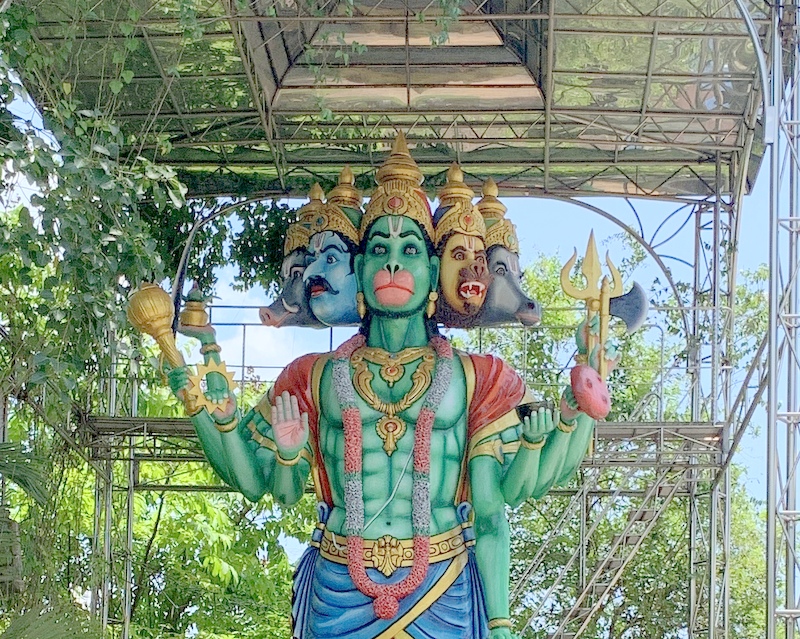
Next to it another huge temple dedicated to Lord Murugan. Full of intricate details. It was a burning hot day, the lighting was not suitable for photography, I will come back another time, with an Indian friend, who can explain more about the religious background.
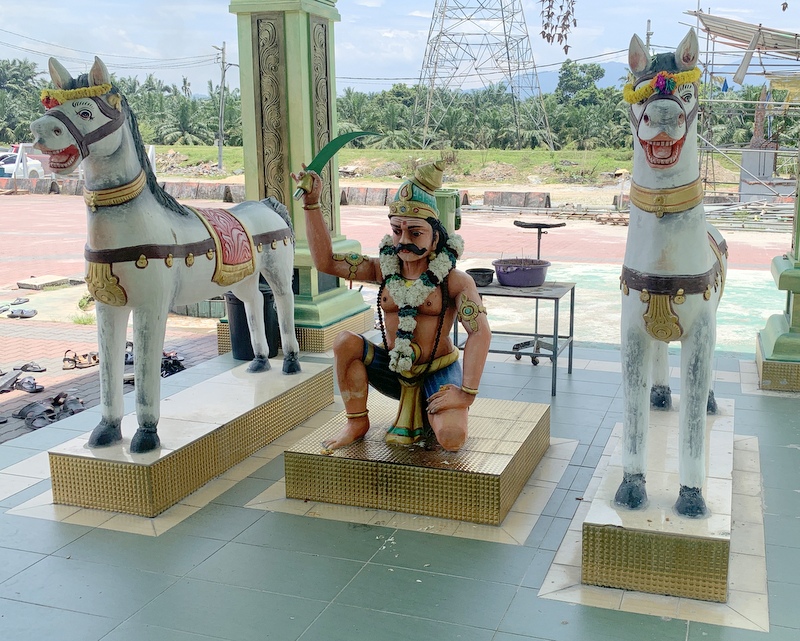
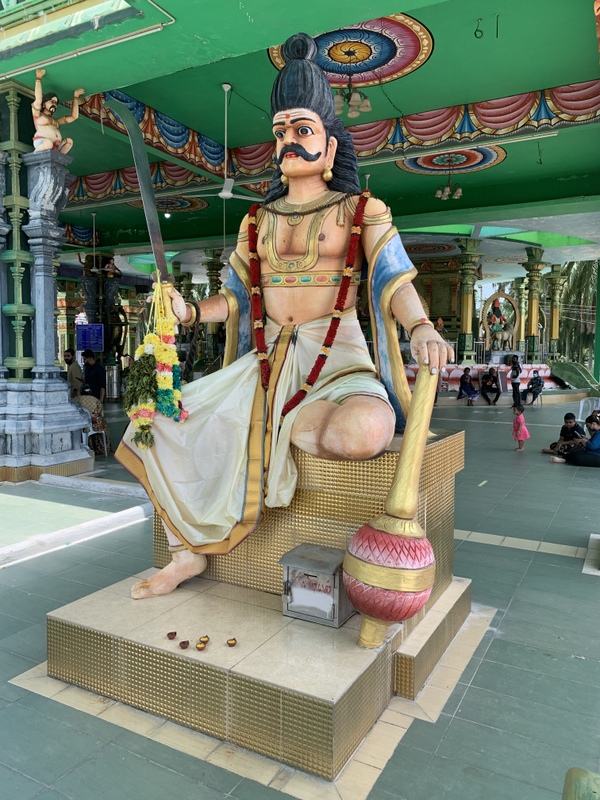
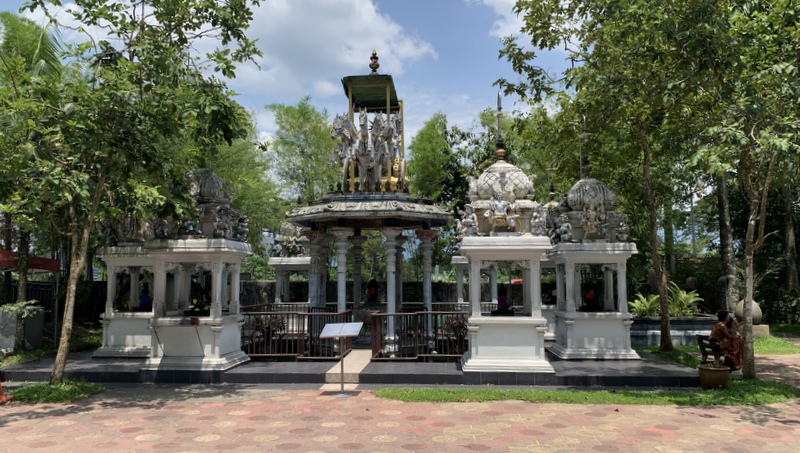
The third temple is just beside the no 1 trunk road, at Simpang Halt. In the past Simpang Halt was a small railway station on the Port Weld line. This temple is dedicated to Lord Muniswaran, a minor Hindu deity.
I have to study more, here is an interesting blog about Muniswaran worship. It was still very hot, with blinding sunlight not easy to take photos
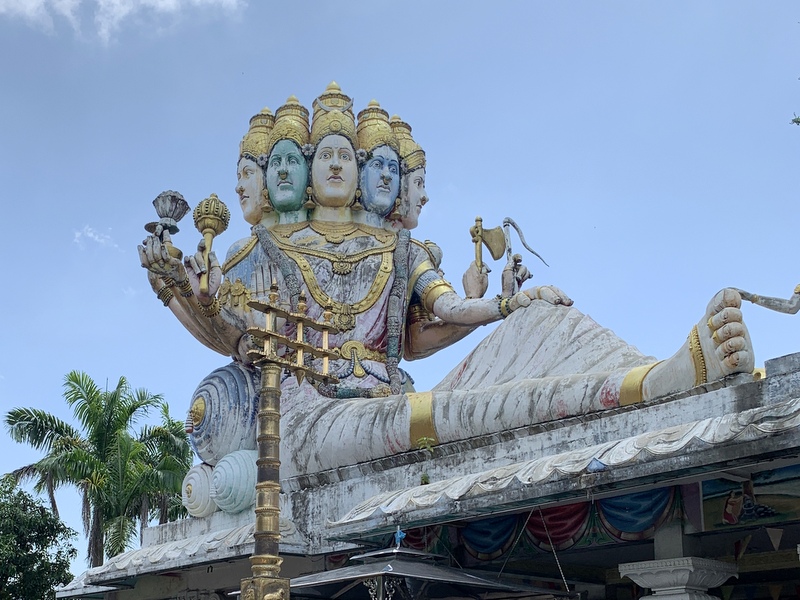
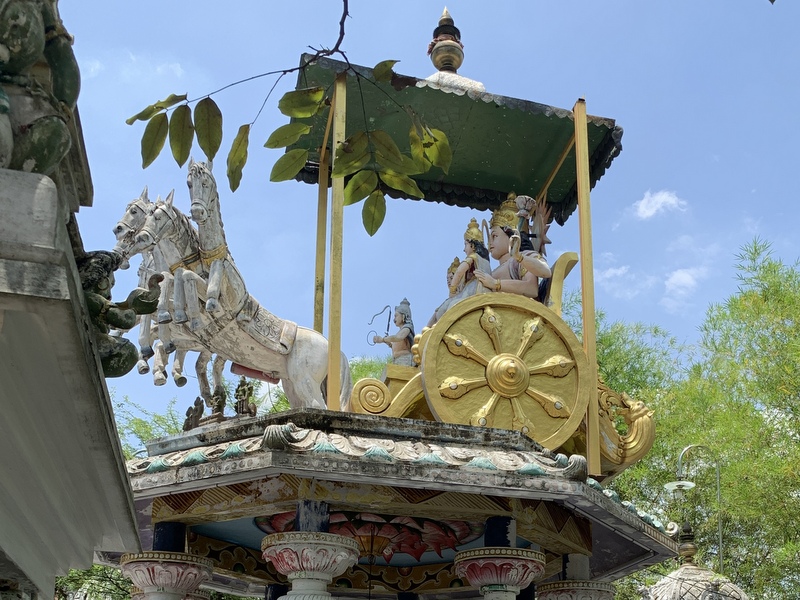
Intriguing statues.
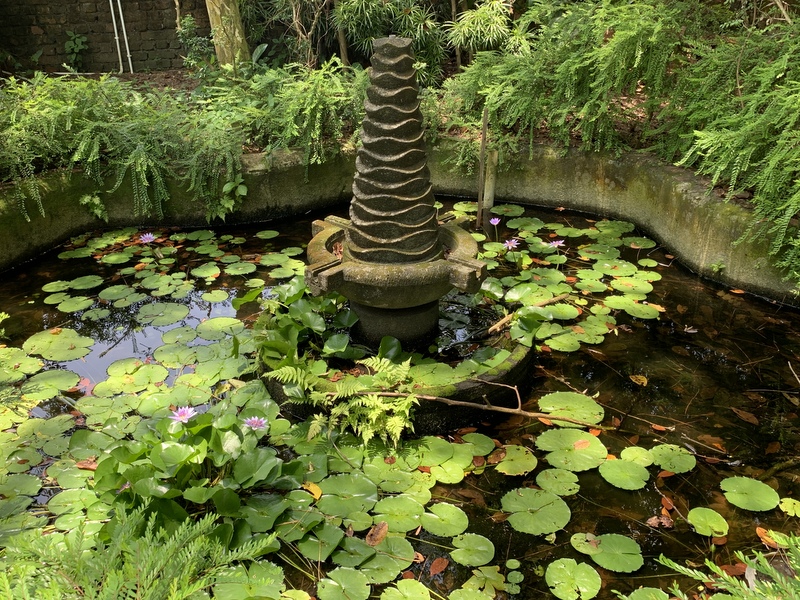
From the three temple we visited, this one is my favourite. Surrounded by a nice garden. Smaller scale than the other two.
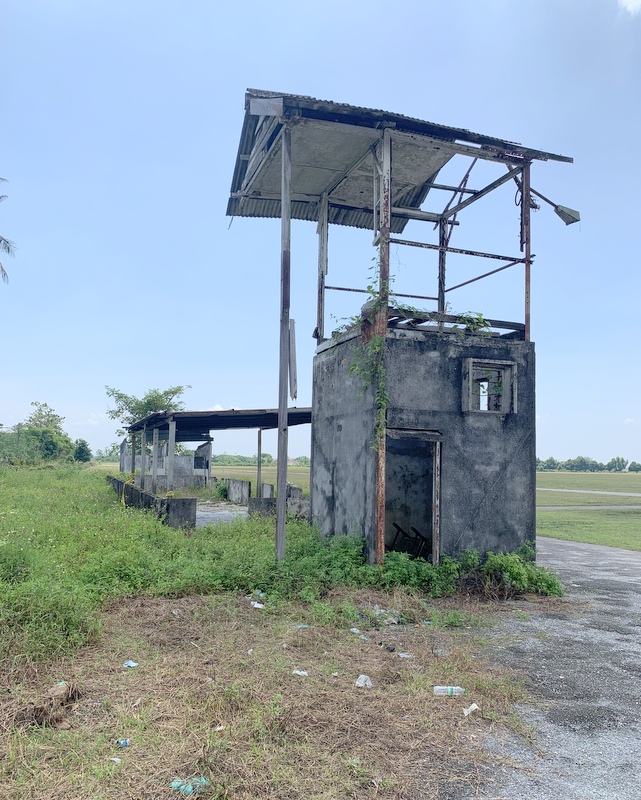
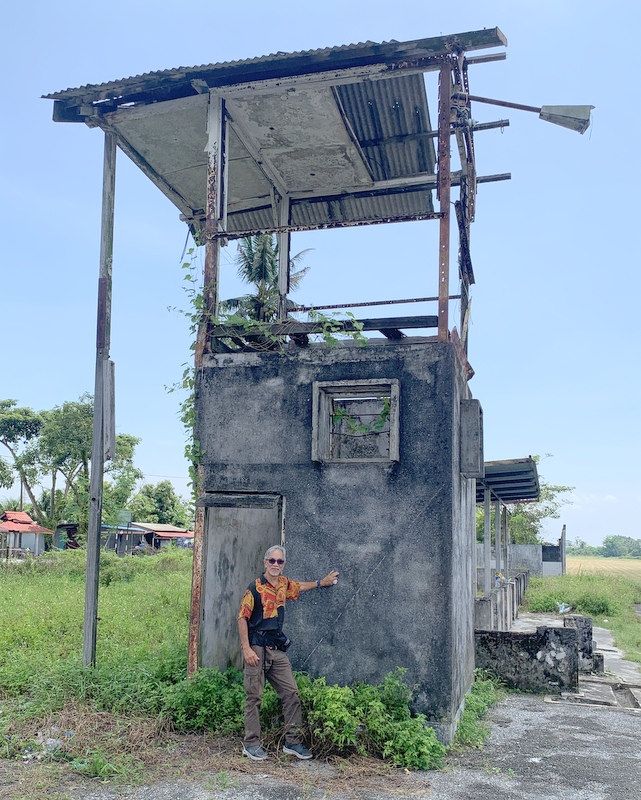
Mission accomplished. On our way back to Taiping we crossed the New Village of Aulong and had a look at the remains of the Taiping Aerodrome. Not much is left of the control tower
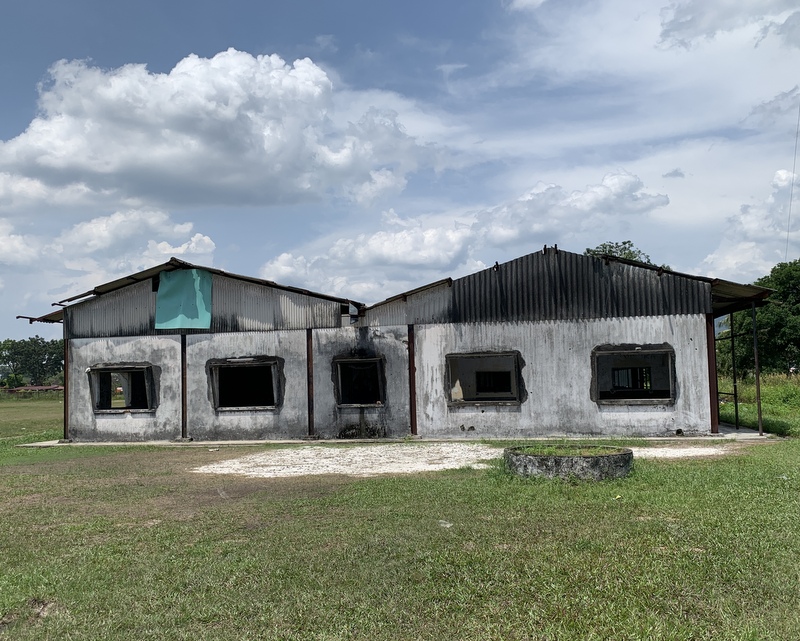
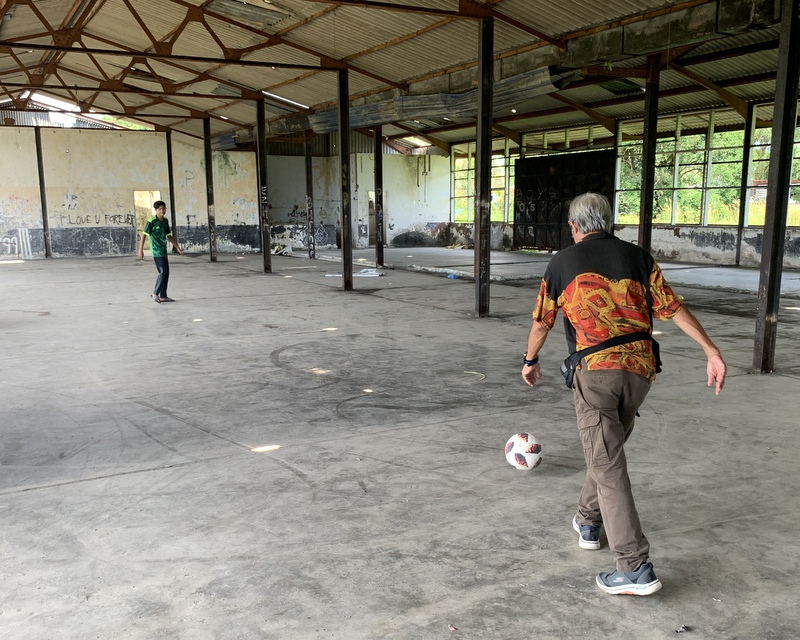
This may have been a hangar. Halim still felts young enough to play some football.
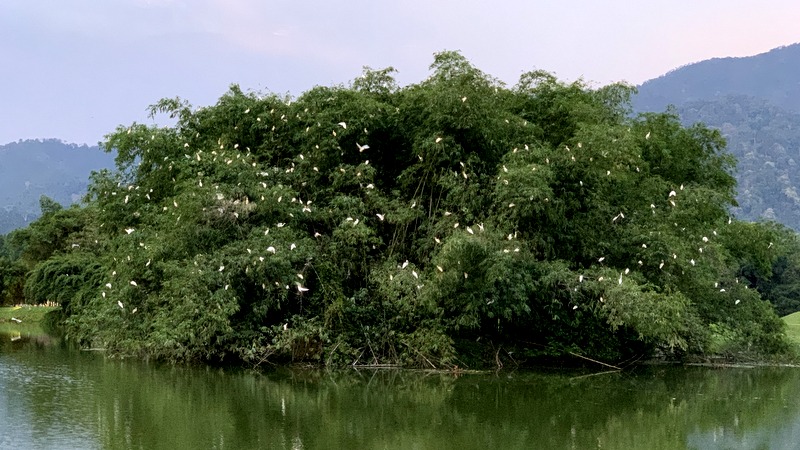
After some rest in Furama I went back to the lake gardens around 7 pm, to watch the roosting of the egrets. Within 15 minutes flight after flight of egrets arrived at the bamboo bushes near the Jubilee jetty. Impressive.
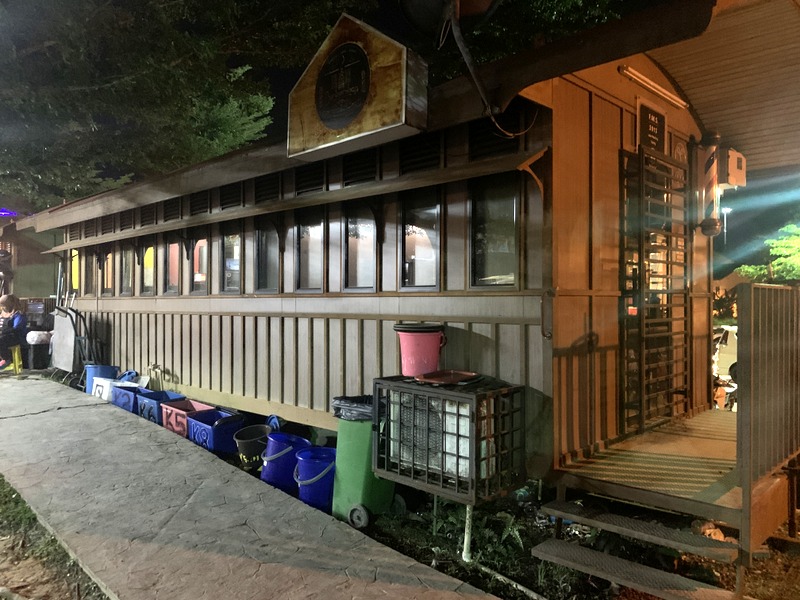
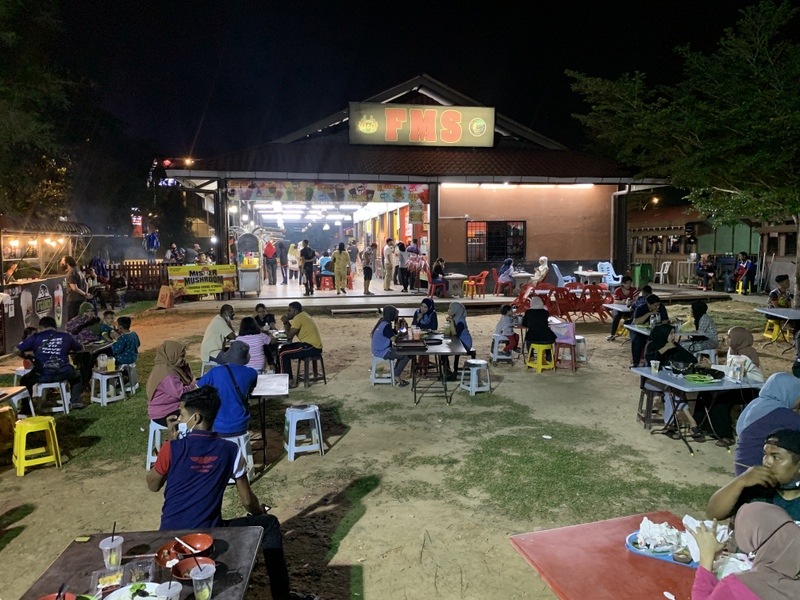
Later Halim picked me up from my hotel for dinner. We went to the FMS restaurant, a new building on the location of the former Raja Rest House. Popular Malay meeting place.
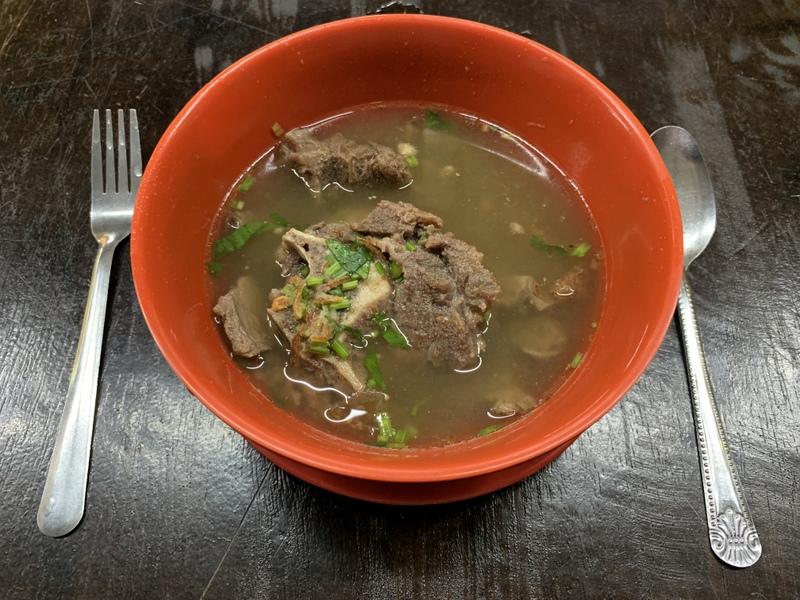
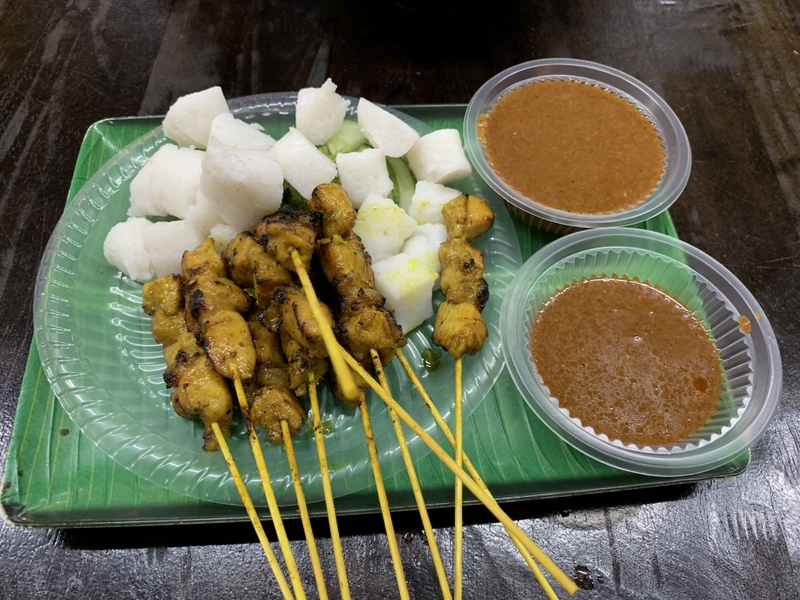
First time I had Sop Tulang. Delicious. The satay was also not bad.
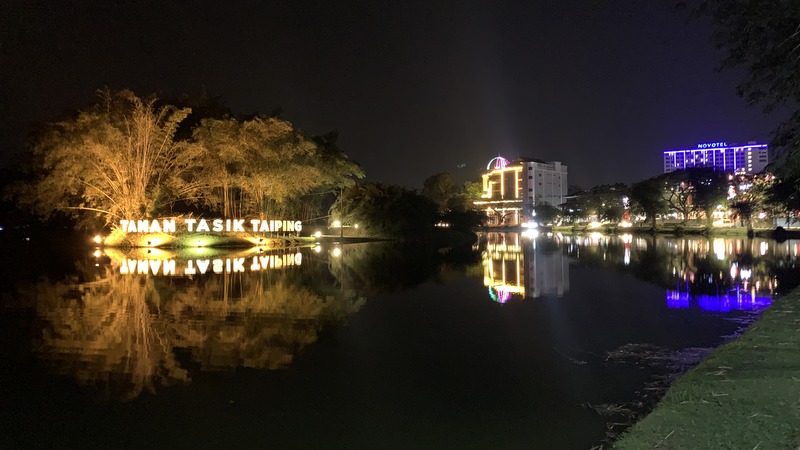
View of the Lake Gardens by night. ON this kind of photo even the monstrous Novotel hotel gets some charm.
It was a rewarding, very pleasant outing.
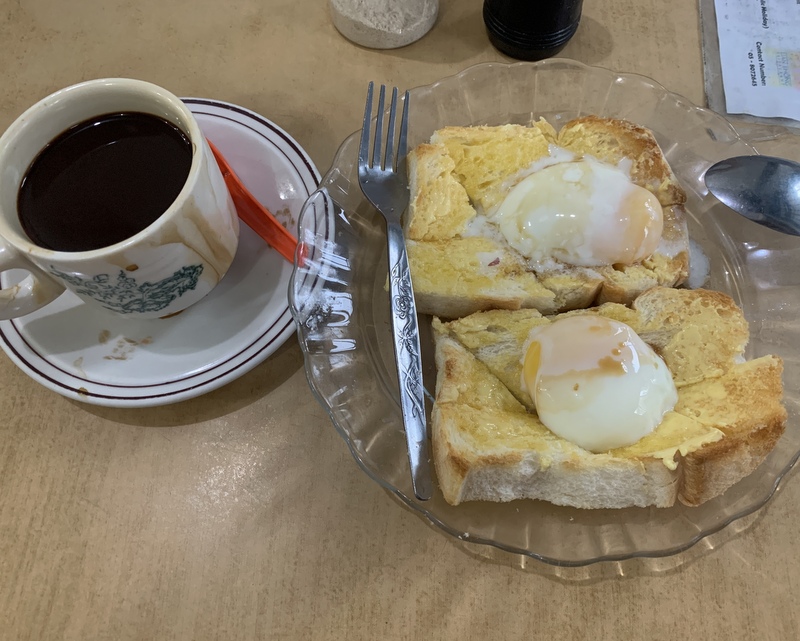
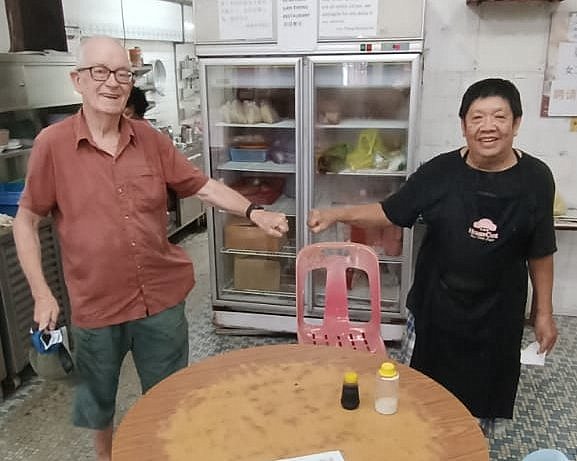
The next day, before going back by ETS, I had breakfast with my friend Yeap in the Lian Thong restaurant, another tradition for me. I love roti goyang (eggs on toast).It was nice to see back Mr Teoh, the owner, after one and a half year ;-).
My train trip back went smooth and was again punctual. Here I am waiting at the station.
Recently I discovered a YouTube channel Baroque and Beyond, created by someone who in the ABOUT section writes: My channel mostly focuses on Baroque operatic music. You may know by now that I am very interested in Baroque Operas, so I immediately subscribed to this channel. It is a real treasure trove.
One playlist of the channel, containing more than 60 videos, is named Who sings it best? Each video has several recordings of the same aria, sung by different singers. Of course “best” must not be taken seriously, they all are professionals, but it is interesting to compare them, and each music lover will have her/his own preference.
What they have in common is that their vocal range is basically the same! The men are countertenors, the women contraltos. Wikipedia gives for both an identical vocal range, two octaves, here marked in green. on a keyboard, the key with a dot is the central C-key.
In Baroque operas, the leading male roles were almost never sung by a tenor or a bass, but generally by a castrato or a contralto in a “trouser role“. As there are no castrati anymore, countertenors have taken their place. That is why in many of the Who Sings It Best videos you can listen to a mixture of countertenors and contraltos.
Here is an example, Who sings Vivaldi’s “Vedrò con mio diletto” best?, sung by two countertenors, two contraltos and one mezzo-soprano. In the opera .Il Giustino (1724) the emperor Anastasius sings this aria as a love song for his wife Ariadne. Wouldn’t you expect a tenor to play this role?
In Handel’s opera Rodelinda (1725) the role of king Bertarido was originally sung by an alto castrato. His famous aria “Dove sei, amato bene” is a love song for his wife Rodelinda. In Who sings Händel’s “Dove sei, amato bene” best? it is sung by five countertenors. If you like contrasts, listen also to this recording by mezzo-soprano Marilyn Horne. Not my favourite 😉
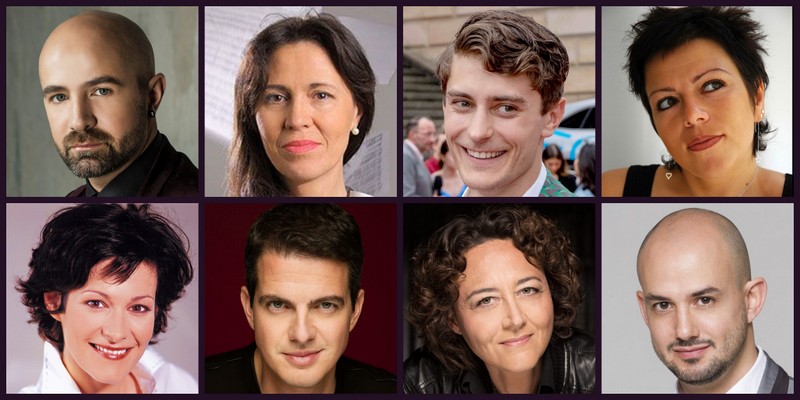
Here is an aria from another Handel opera, Oreste (1734). The opera is a so-called “pasticcio” in which Handel assembled arias from his earlier operas into a new one. In this case the story of Orestes and his sister Iphigeneia. In 1734 Orestes was sung by a famous castrato. In Who sings Händel’s “Agitato da fiere tempeste” best? , the aria is sung by three countertenors and two contraltos, from left to right Orlinski, Mingardo, Stutzmann, Jaroussky and Fagioli.
Finally here is an aria sung by another king in Vivaldi’s opera Farnace (1727) , Farnace, King of Pontus, has been defeated by the Romans and commands his wife to kill their son, so he will not fall in the hands of the victors. No love song, but a tragic aria, originally sung by a contralto en travesti. Here are the lyrics of the aria, in an English translation.
Cold in every vein I feel the blood flow The shadow of the lifeless son I am filled with terror
And for my greater pain I see I was cruel To an innocent soul At the heart of my heart
In Who sings Vivaldi’s “Gelido in ogni vena” best? this beautiful aria is performed by two countertenors, a contralto, a mezzo-sorano, a soprano and even a tenor!. Compare which recording you prefer.
Actually the best recording (in my opinion) is not in this list. Listen to Countertenor Christopher Lowrey. Absolutely breathtaking, it gives me goosebumps.
I will end this blog with a few Who Sings It Best videos that don’t fit in the countertenor/contralto category.. For a variety of reasons.
In Who sings Porpora’s “Torbido intorno al core” best? Two countertenors and a contralto sing an aria from Porpora’s opera Meride e Selinunte (1727) , But here they sing an aria of Ericlea, a female!. In those days the modern concept of gender identity probably was not yet developed ;-). Porpora was famous in his days,, see my blog Countertenors and Castrati, for more info about him..
Then there is Who sings Vivaldi’s “Armatae face et anguibus” best?, The aria is from Vivaldi’s oratorio Juditah Triumphans (1717), performed in this video by sopranos and mezzos, but in the libretto the aria is sung by Vagaus, a eunuch! He sings this furious aria when he discovers that Juditha has murdered his master Holoferenes in his sleep. The Who Sings it Best videos are actually audios. Watch here the fury of Cecilia Bartoli in a real video.
And finally Who sings Vivaldi’s “Cum dederit” best? Vivaldi composed Nisi Dominus between 1703 and 1739. Not an opera and Cum Dederit is not an aria. Sung in the video by four countertenors and two mezzo-sopranos. Surprisingly the best recording (again in my opinion) is left out! Watch here Andreas Scholl
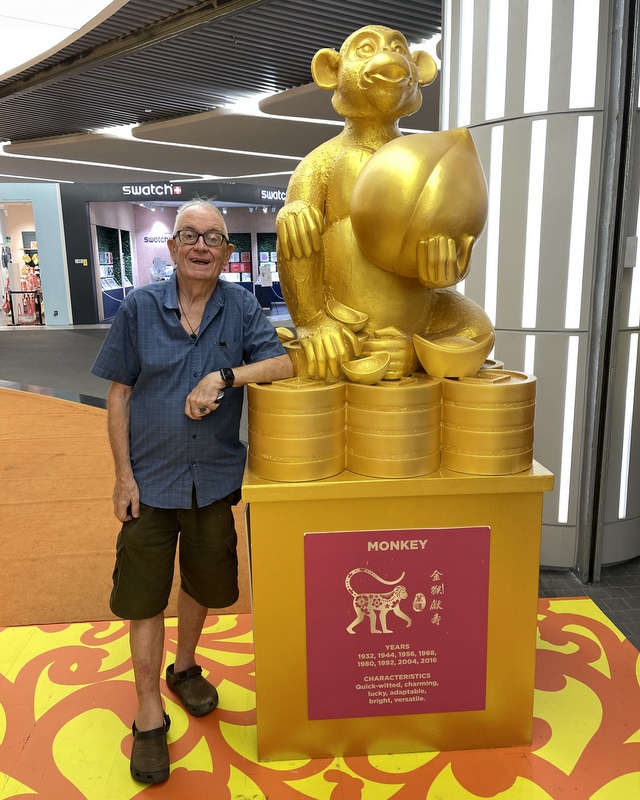
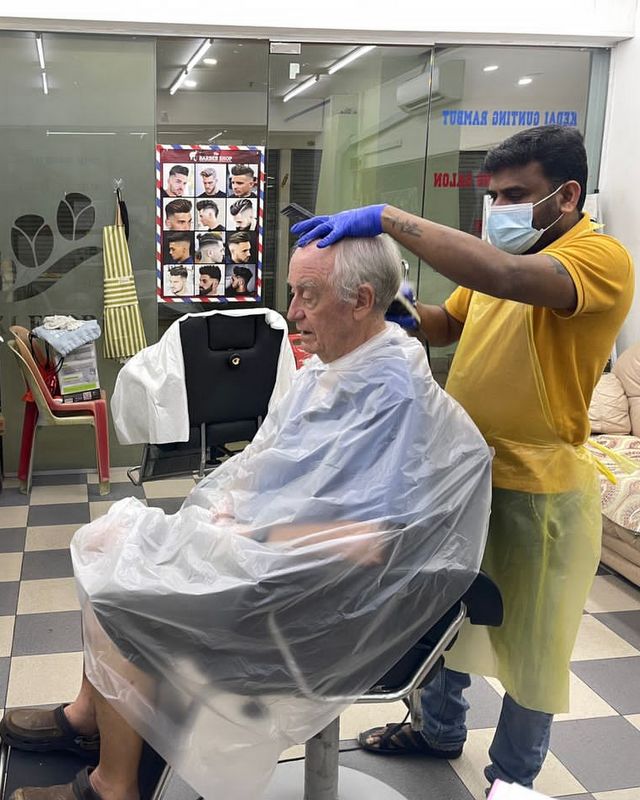
On 1 February the Chinese year of the Tiger started. As a preparation for a New Year, Chinese buy new clothes and have a haircut. We did the same, in the left picture I am standing in a shopping center next to my own zodiac sign.
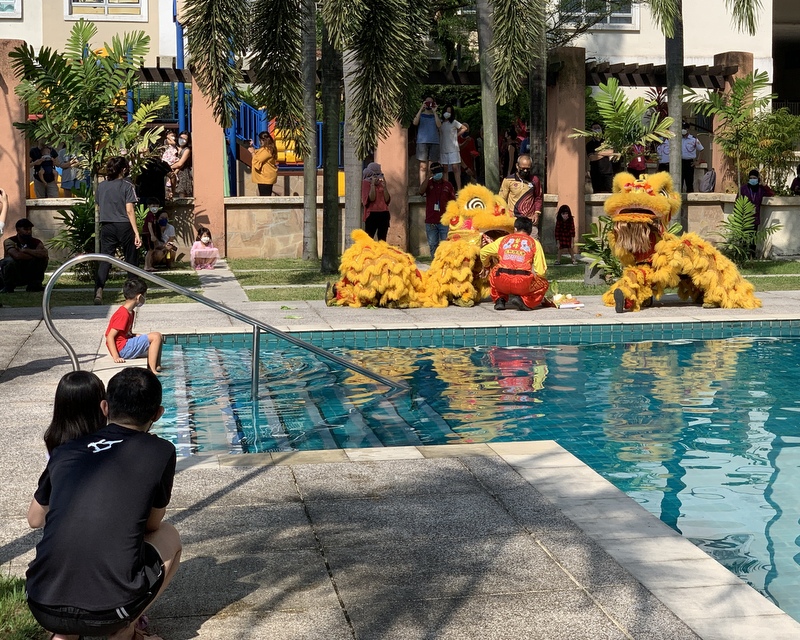
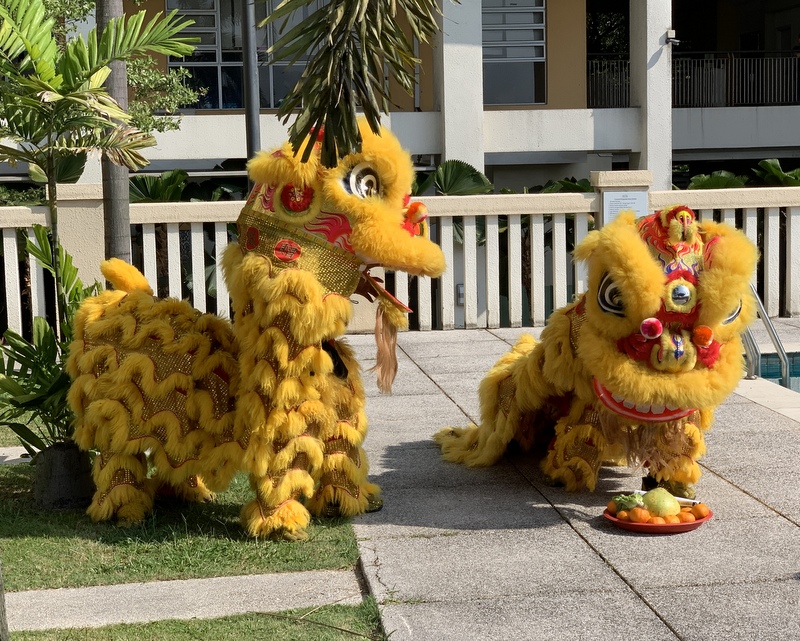
A 29 January the management of our condo had organised a simple Lion Dance.at our swimming pool. Fun for the kids.
The traditional wish for CNY is Gong Xi Fa Cai (in Mandarin, “Congratulations and may you be prosperous”). Here is my CNY wish, from our new penthouse.
On CNY-eve, 31 January, we went back to Parit Baru, Aric’s hometown. That is a yearly tradition, but last year it was impossible because of the Covid 19 pandemic and travel was very limited. Click here for a report about CNY 2020. .
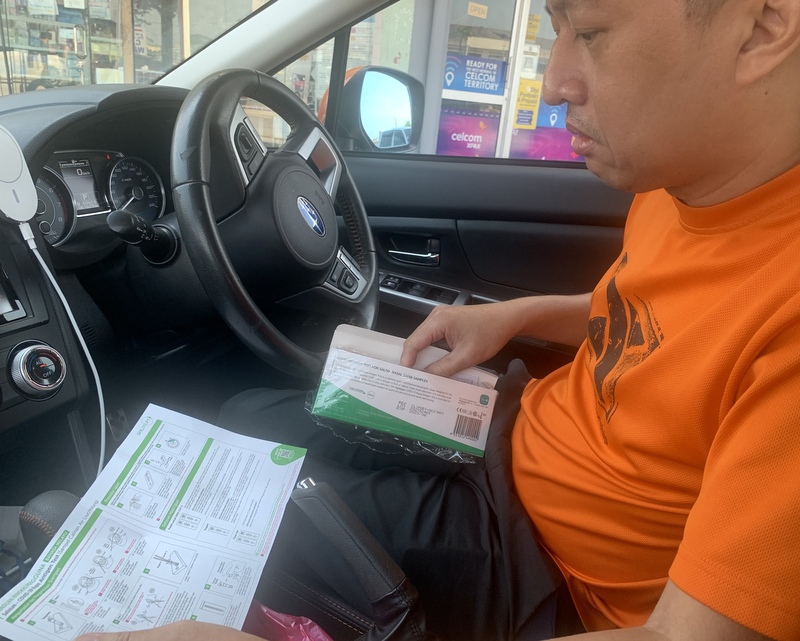
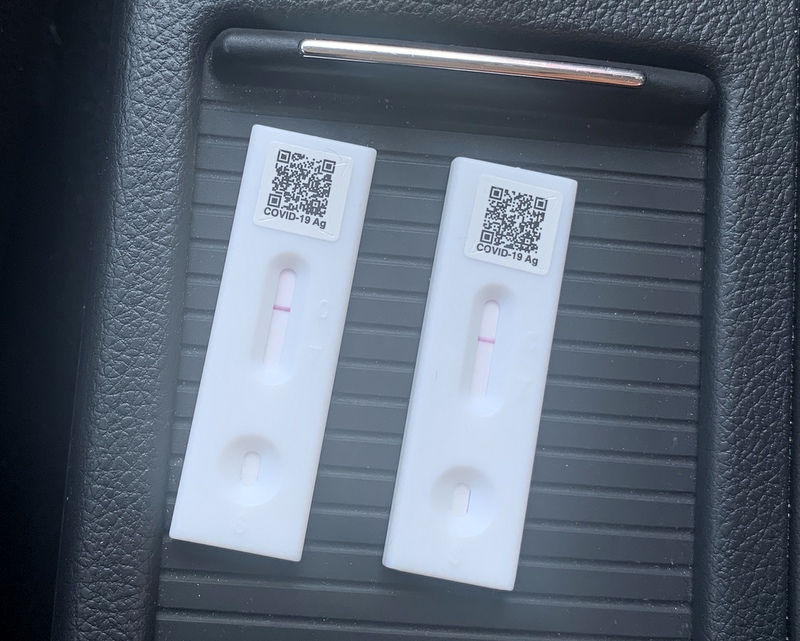
This year travel was allowed again and we were fully vaccinated, but it was still advised anyway to take a Covid antigen test. Already on our way, we heard that one of Aric’s brothers had tested positive, although vaccinated. So we decided also to take a test and started looking for a pharmacy. Many were closed, but we found one in Tanjung Karang. Aric bought two test kits and we took the test in our parked car. ;-). Fortunately we were both negative.
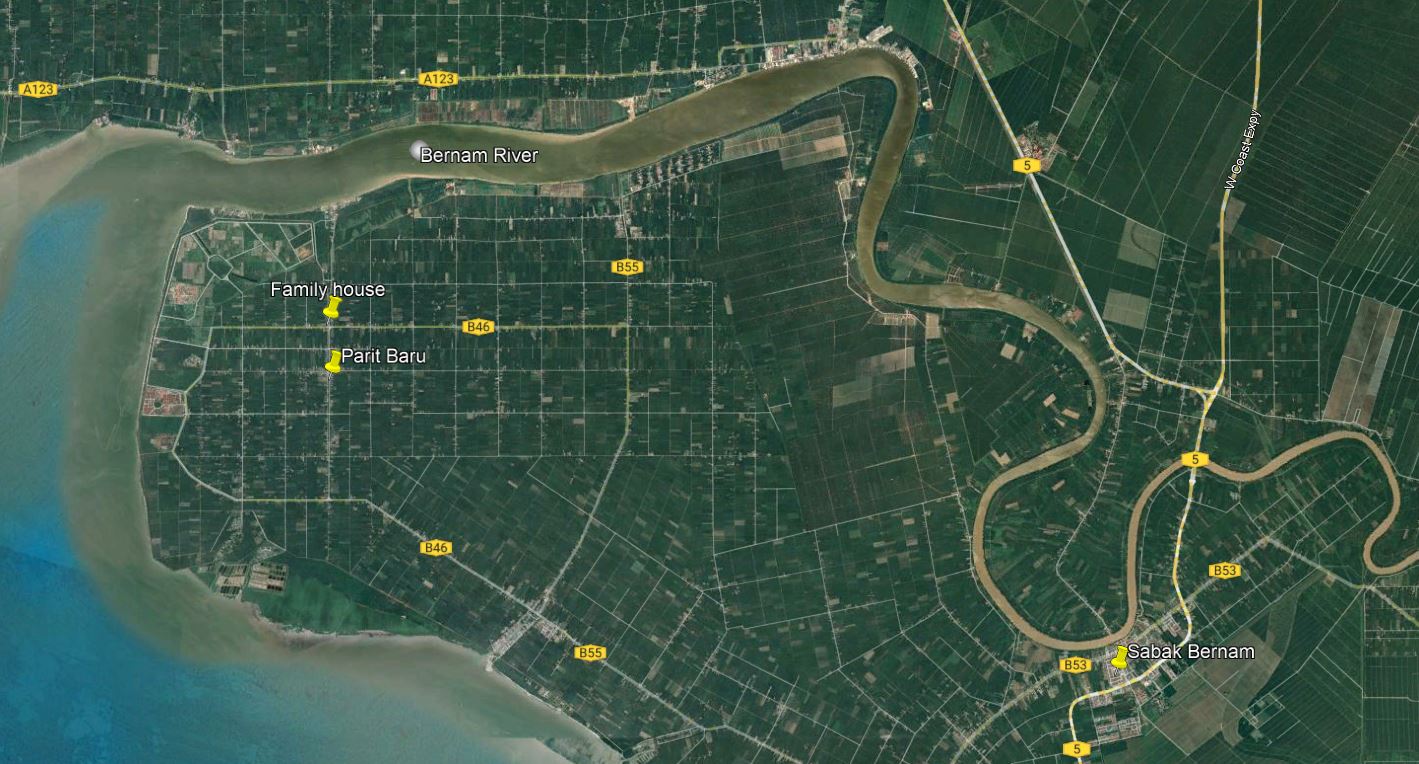
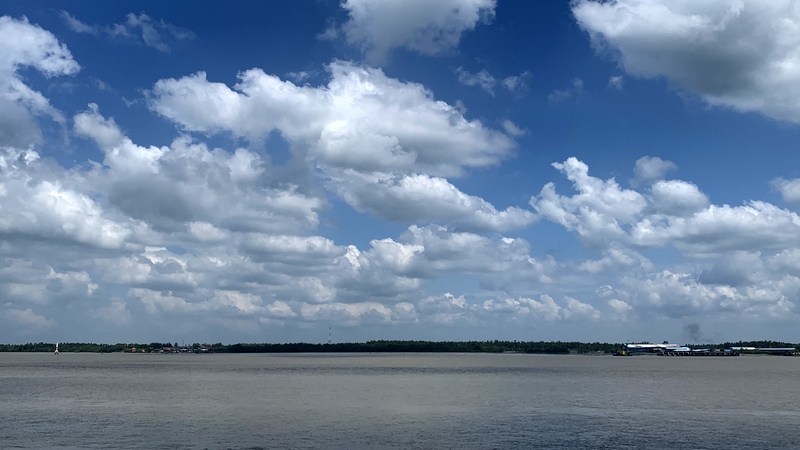
We arrived in Parit Baru in the afternoon.. Here is a Google Earh map of the village and its location in the most northern part of Selangor. . The Bernam River forms the boundary with Perak. Parit Baru is surrounded by fishing villages.
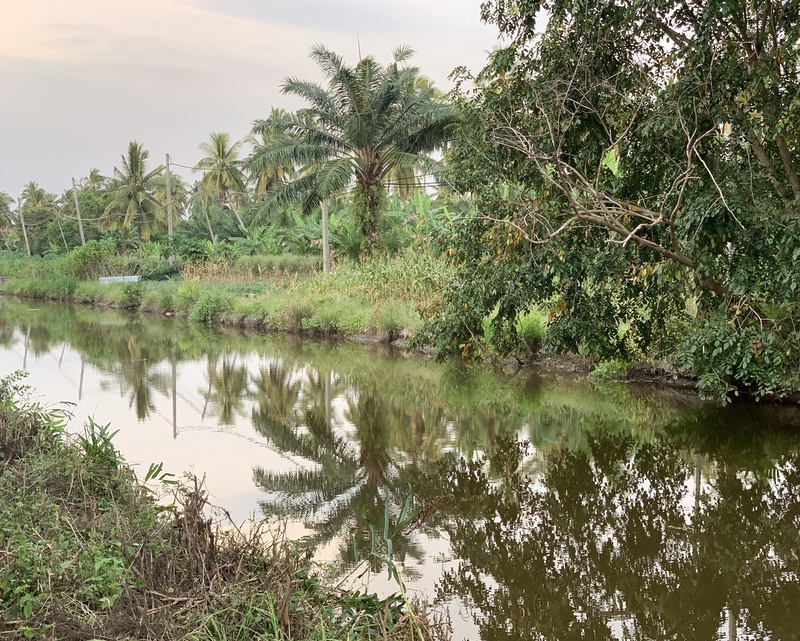
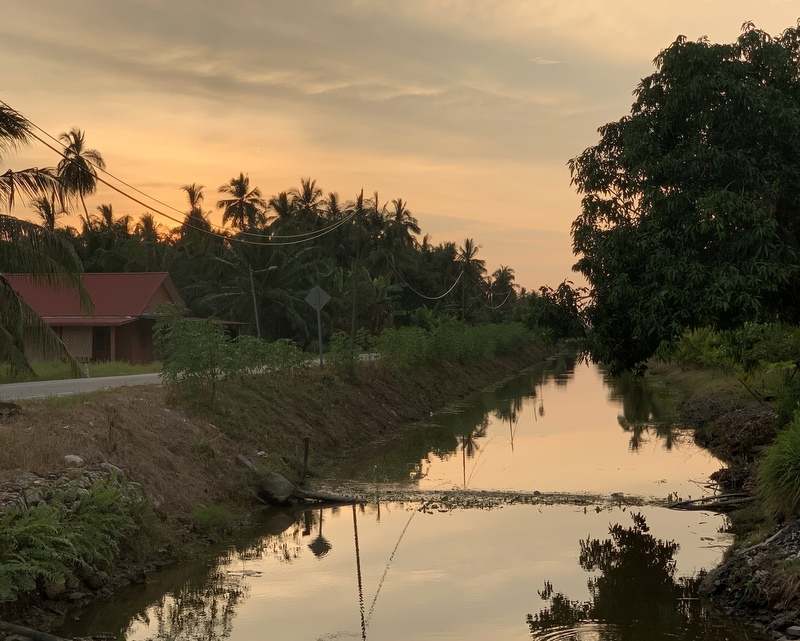
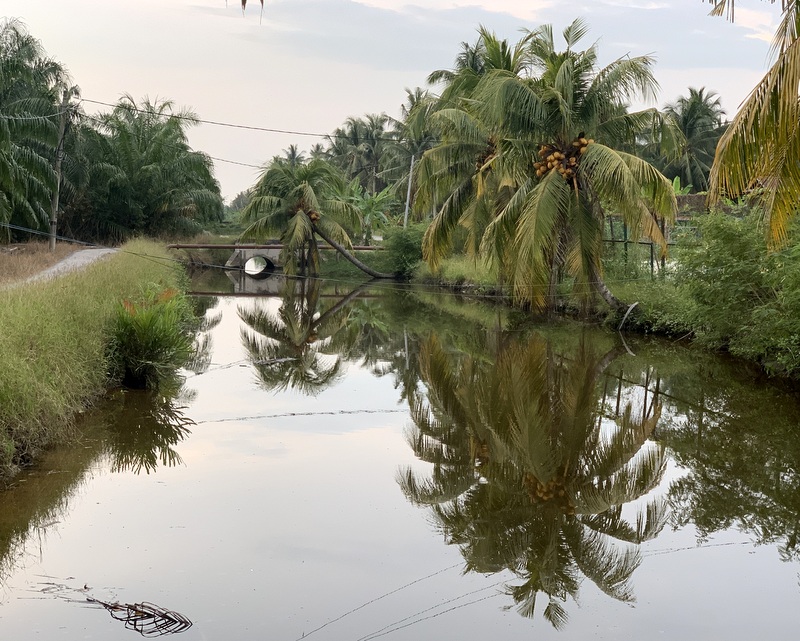
There was time to take some photos of the surroundings. Nothing spectacular, just quiet agricultural countryside.
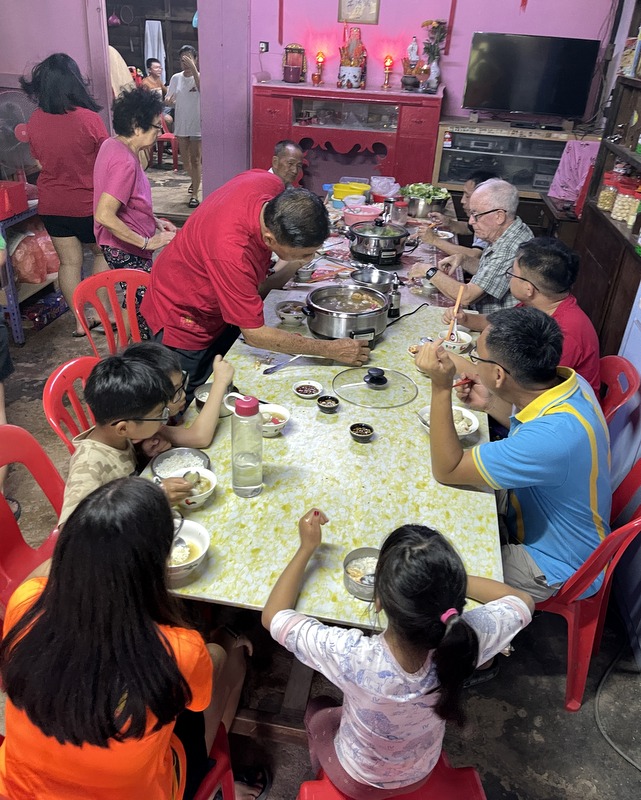
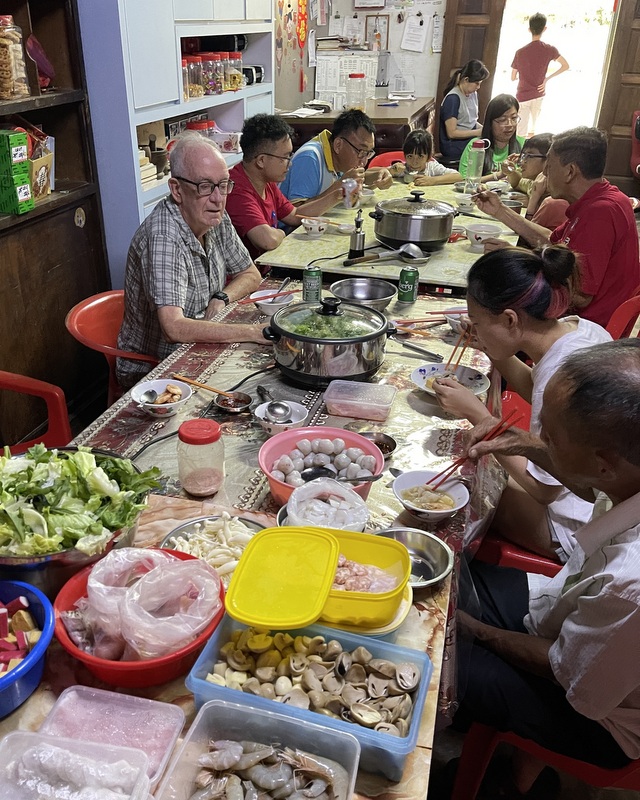
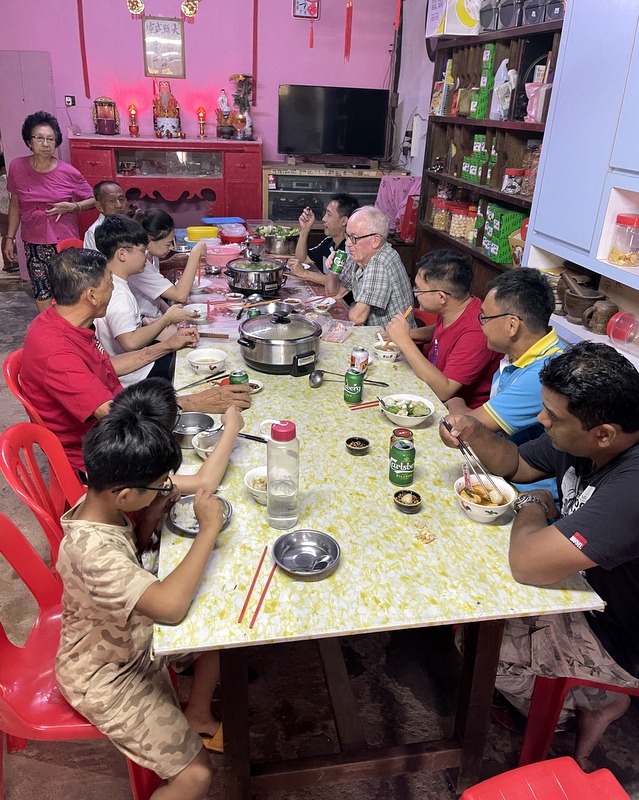
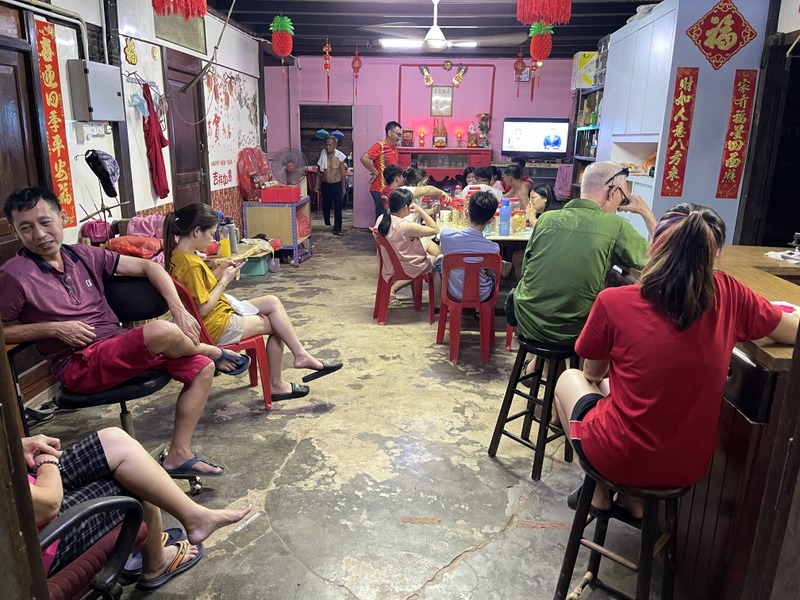
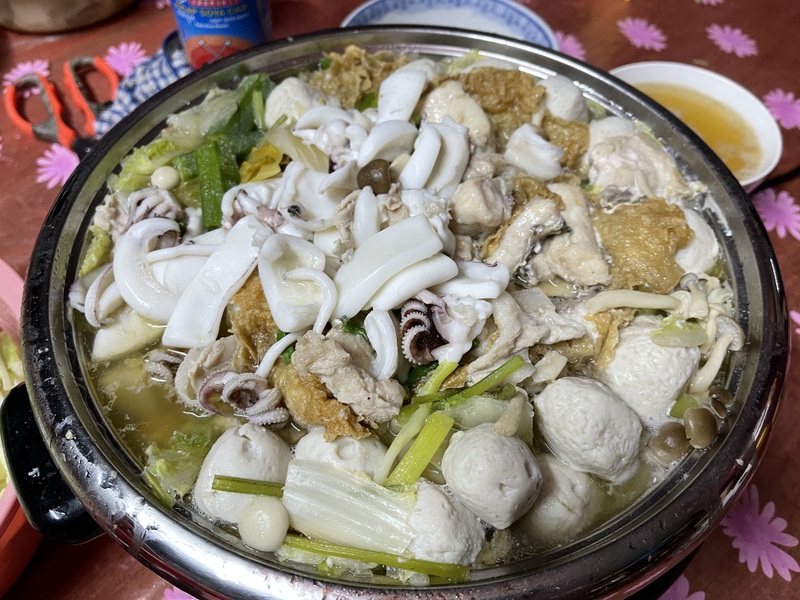
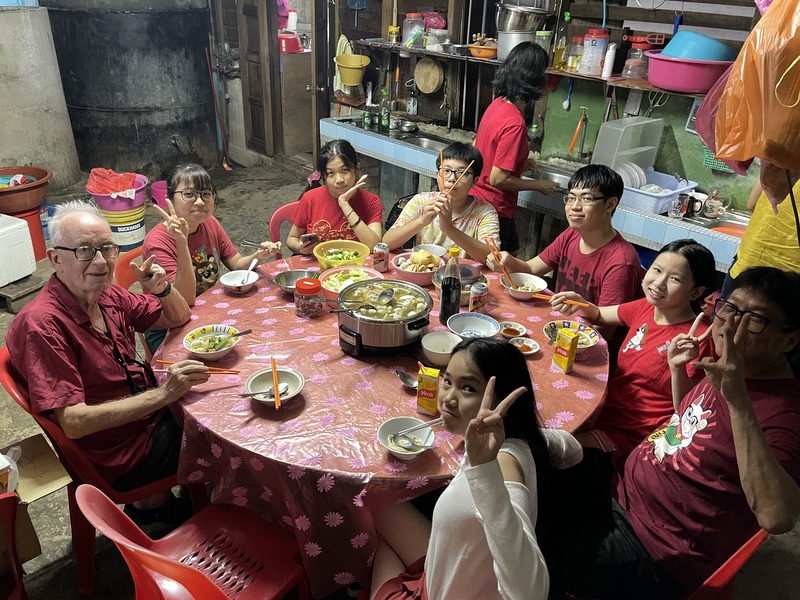
Then it was time for the CNY-eve dinner, traditional steamboat. Three families live in the kampung house, so dinner was in several sessions.
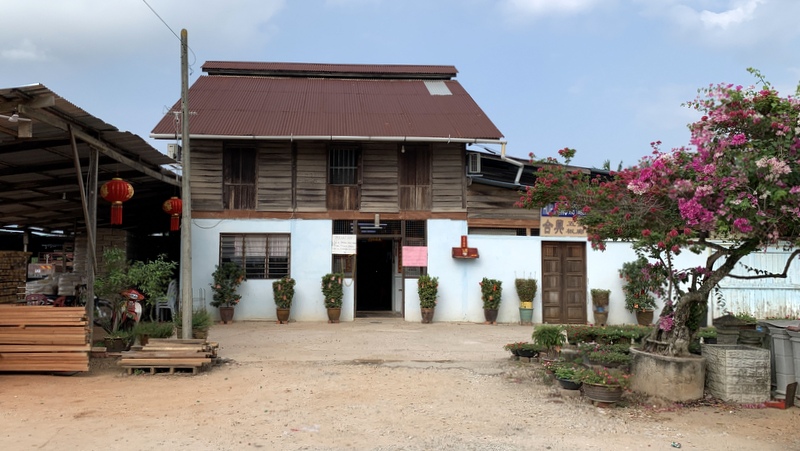
.Here is the kampong house. It may be about 70 years old. The families run a successful hardware and timber store. It is basically a wooden house, only the front façade and a few other parts are in stone.
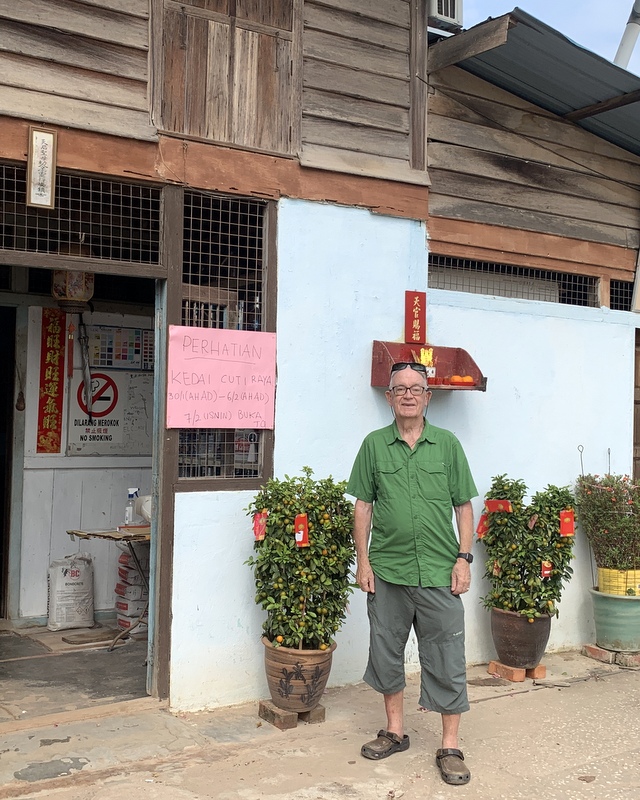
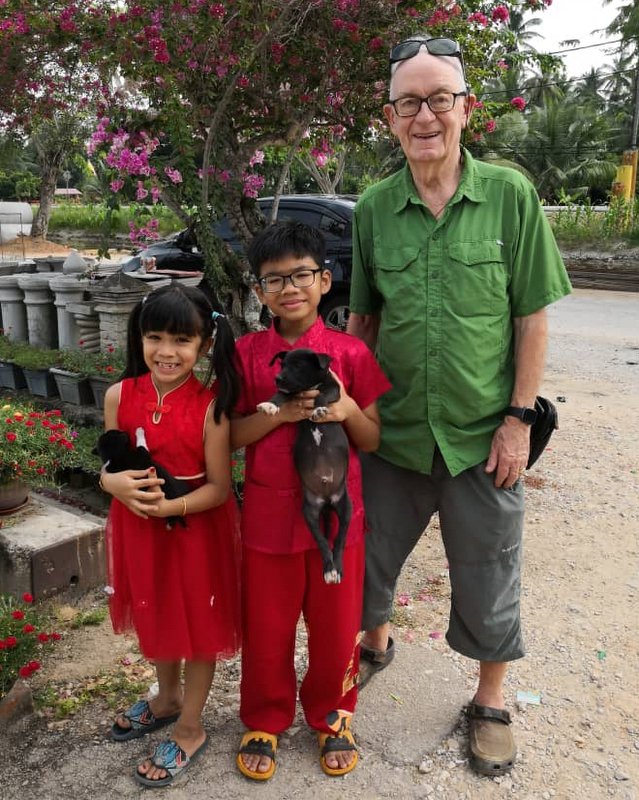
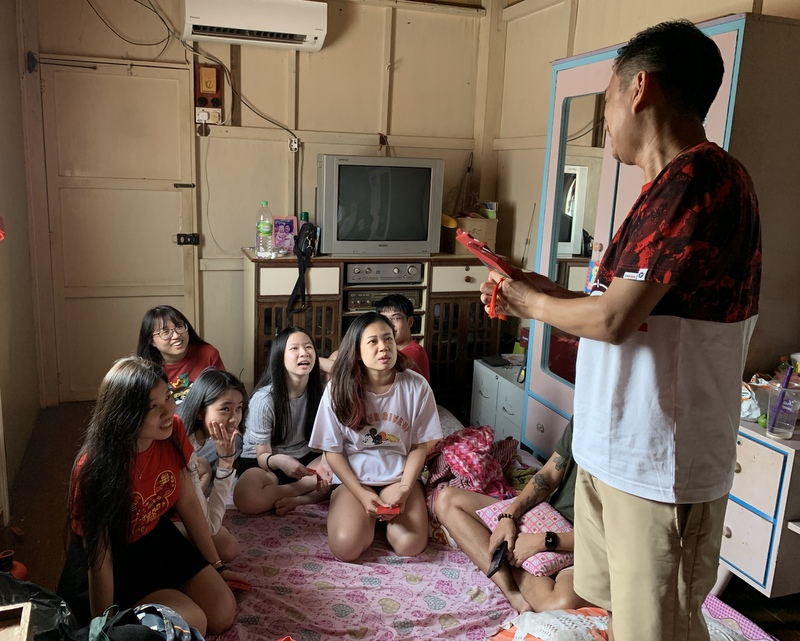
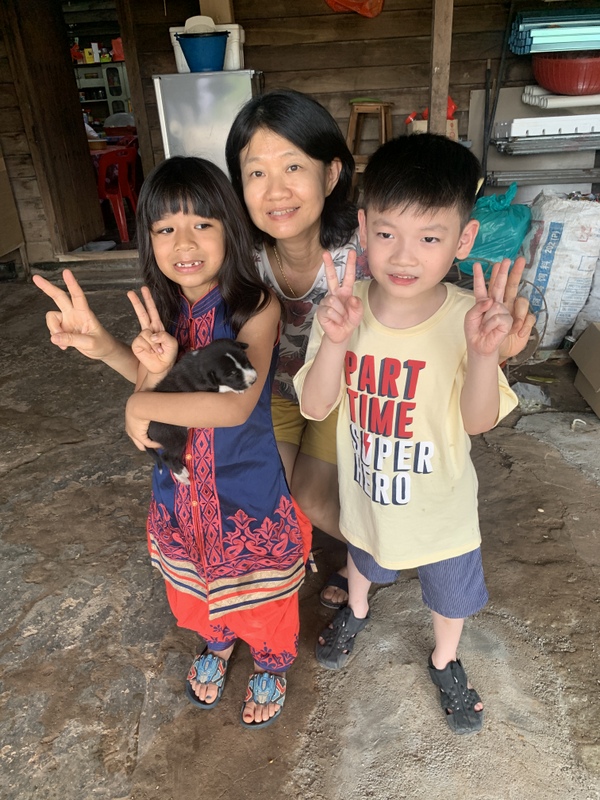
Posing in front of the house. Alone and with the children of one of Aric’s cousins. Notice how they hold puppies, the one held by the girl has just opened it eyes.
The three families have their own rooms, but share the common living room and the kitchen. Even after Aric’s parents passed away, a couple of years ago, the setup is still the same.
Common living roomShared kitchen
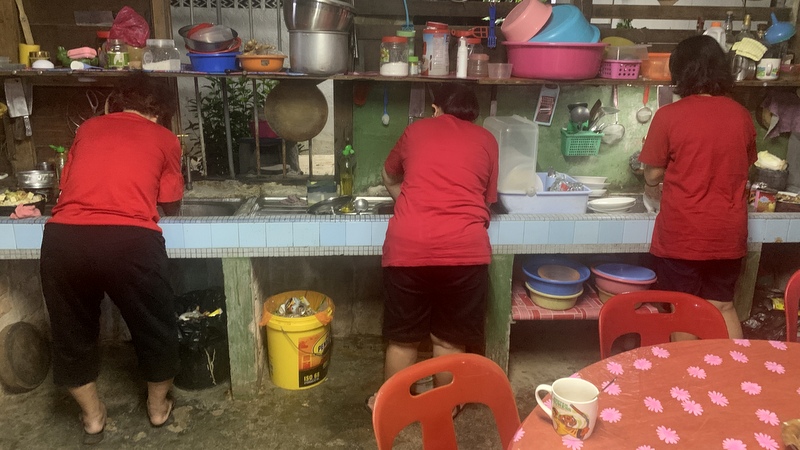
Although the families share the kitchen, they have their own sink, fridge, washing machine. It might be a unique construction. In this photo, Aric’s aunties to the left and Aei Ling, his sister to the right.
The house is surrounded by a big garden, with fruit trees and flower bushes.
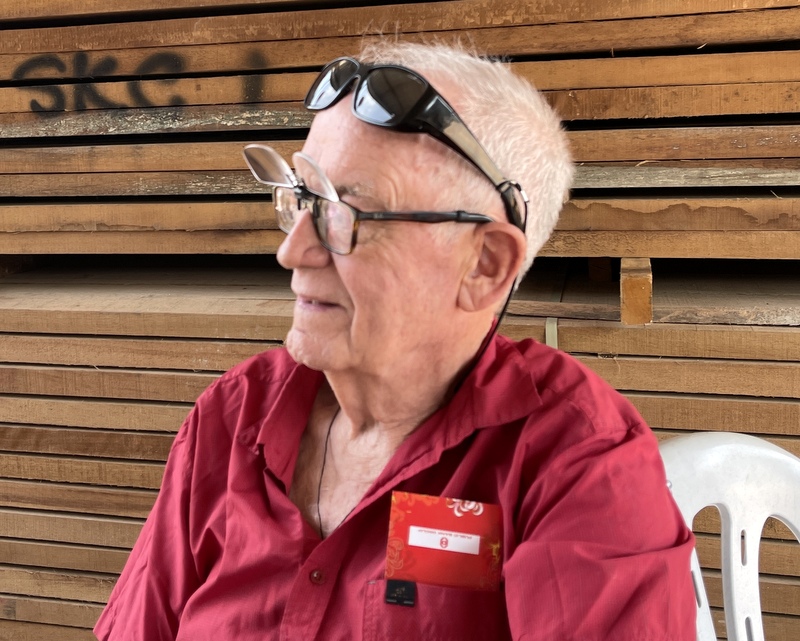
It is a tradition that people give ang pow to relatives and friends. This time we also did it. I received myself several red envelopes with money inside 😉 The picture at the right shows that I am getting old. Sunglasses to protect my eyes and clip-on reading glasses.
In the afternoon we drove around a bit, to take pictures
Another steamboat dinner, this time with Ong (Aric’s brother in law) and nephews and nieces. Seafood can not be more fresh than here!
A curious visitor.
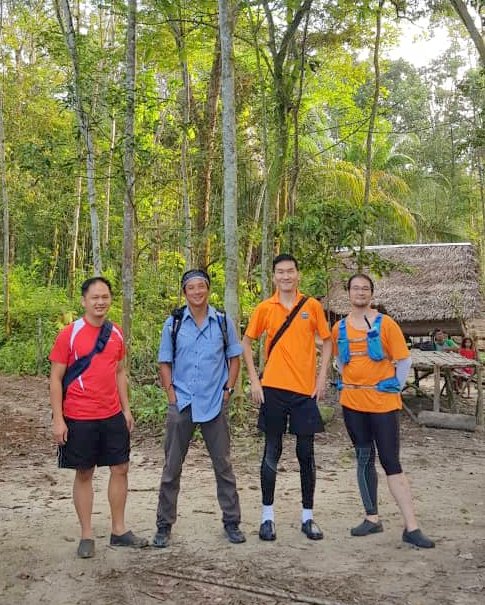
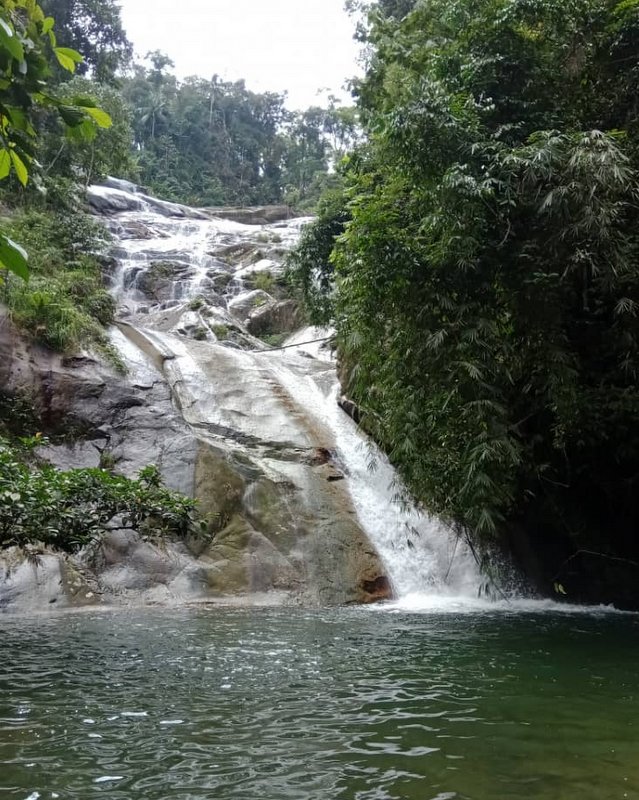
A few of my waterfall friends go back with CNY to their hometown Teluk Intan and several times we have used day three of the CNY to make a trip to a new/remote waterfall in the region. I decided not to join this year, feeling less confident in the jungle nowadays. Our last trip was in 2017 and not successful, here is the report : An unsuccessful waterfall trip so it was decided to give this Lata Jala another try. This time my gang reached the fall.
The first picture shows my “gang”, from left to right Siang Hui, Teoh, Nick and Joshua (a new member). Lata Jala,, in the middle, is an impressive unspoiled waterfall. The right picture shows an aerial photo of the fall, taken by Joshua’s drone.
Aric and I explore a bit more the countryside around Parit Baru. This is the Bernam river. Across the river is Perak.
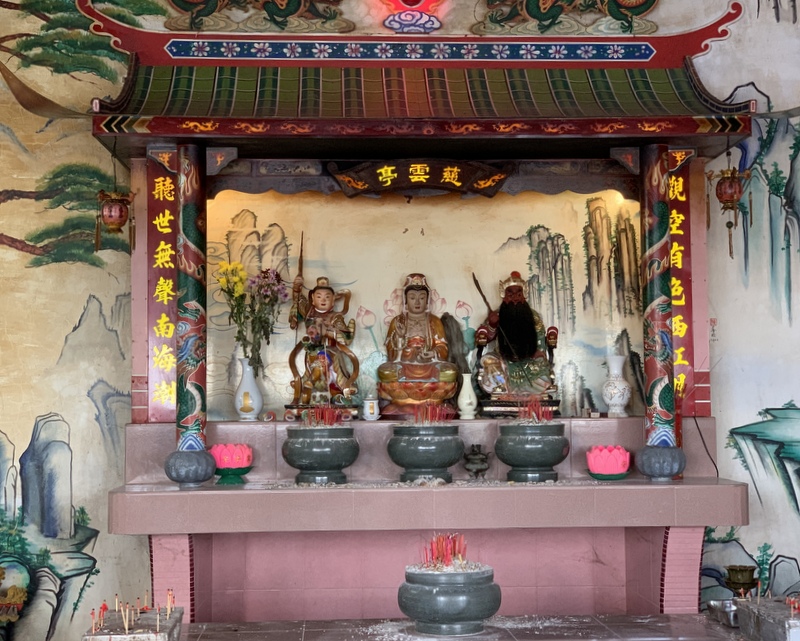
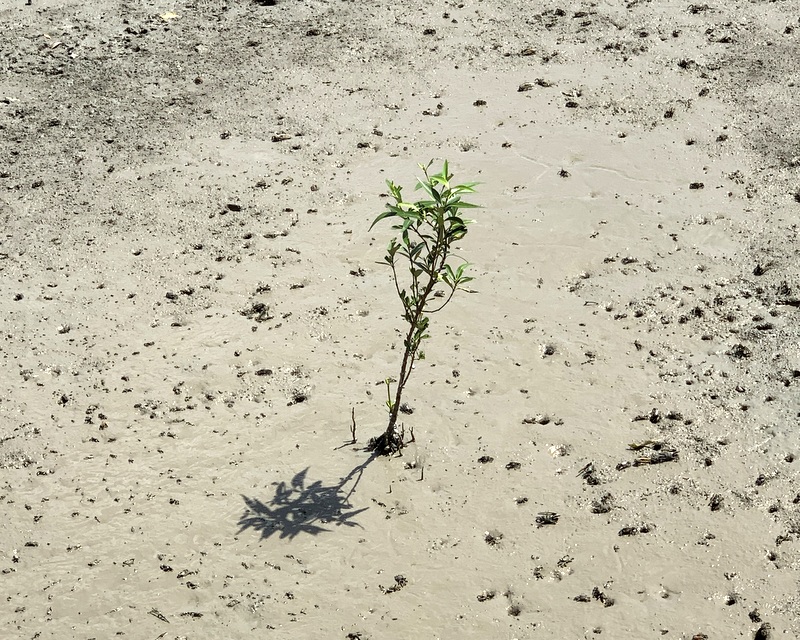
Left a Taoist temple in Sg Lang, one of the Chinese fishing villages. Right a young mangrove seedling, trying to survive. Notice the numerous holes, made by tiny crabs
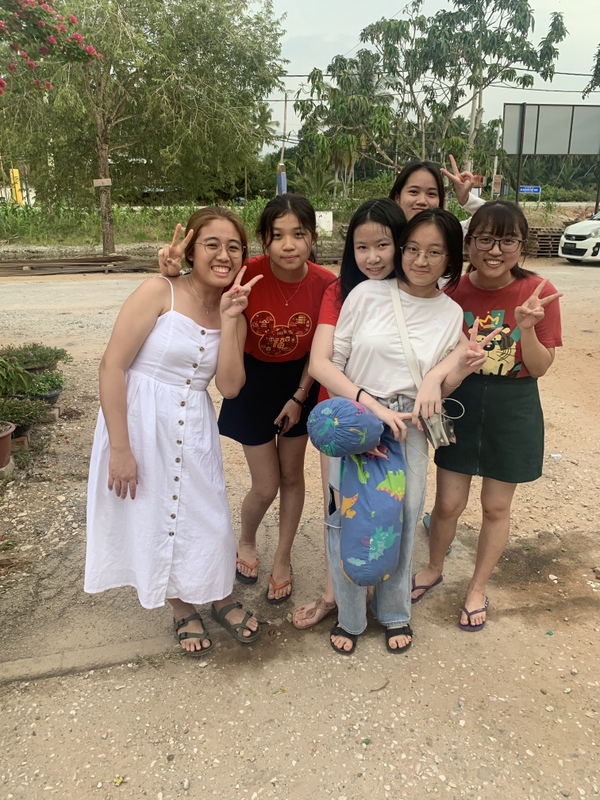
Back in Parit Baru, a few more family photos. A group of young ladies, Aei Ling with two cute young kids and Ong teaching his son how to ride a bike.
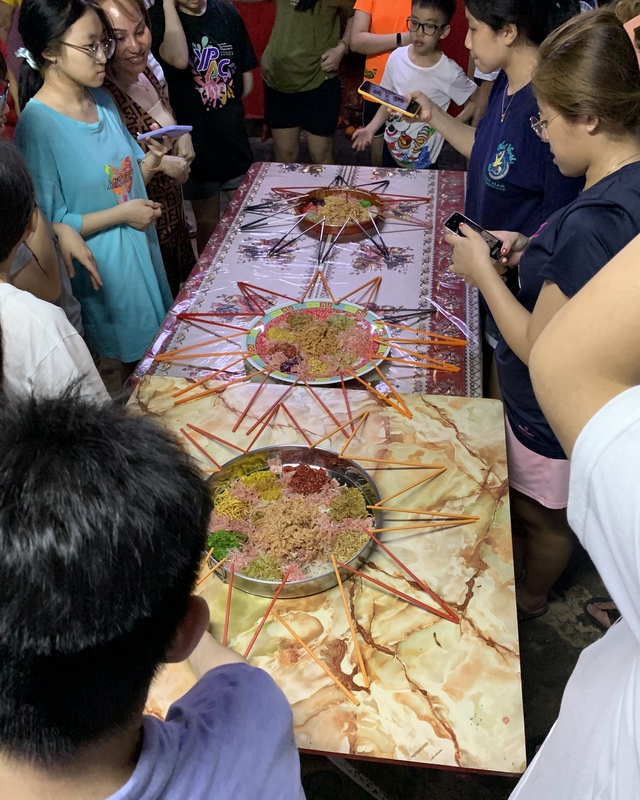
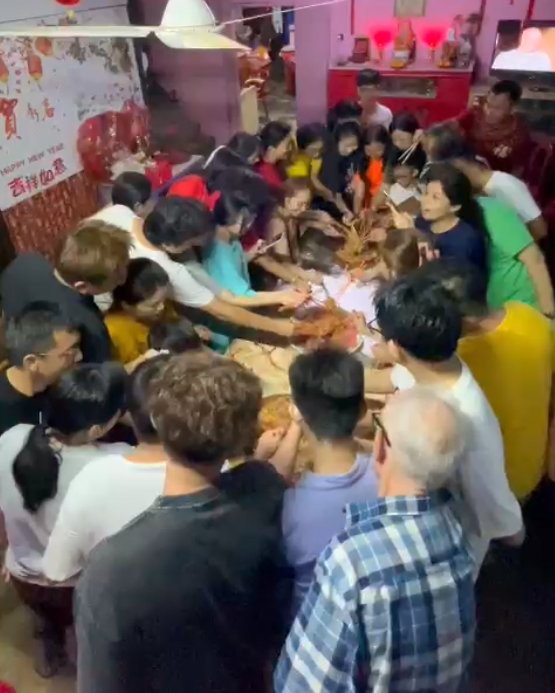
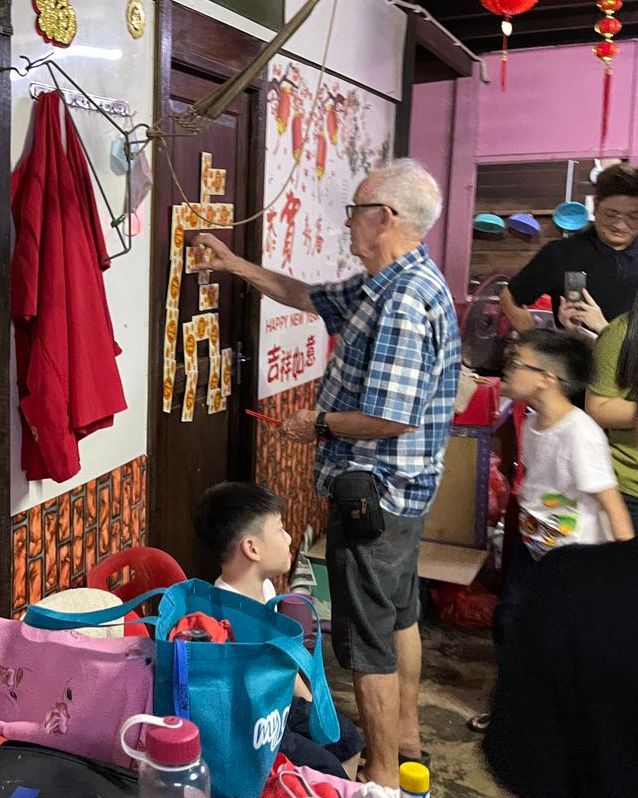
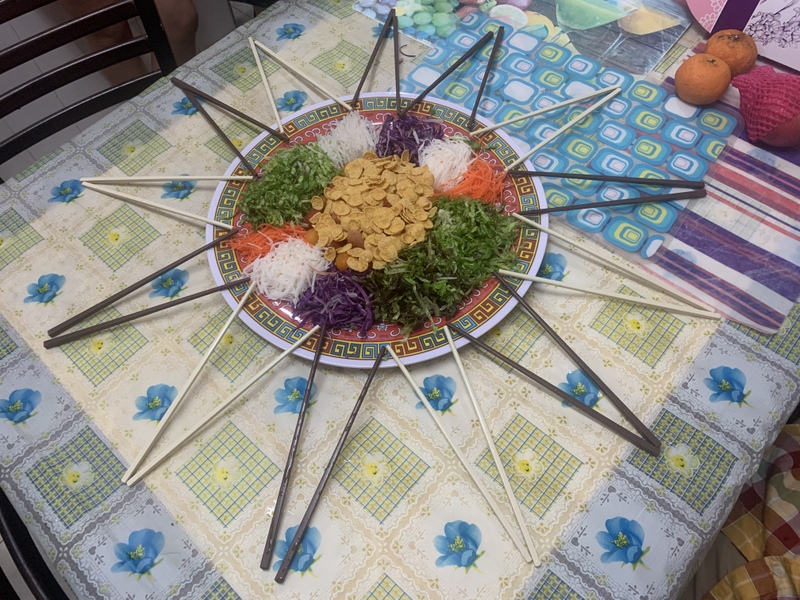
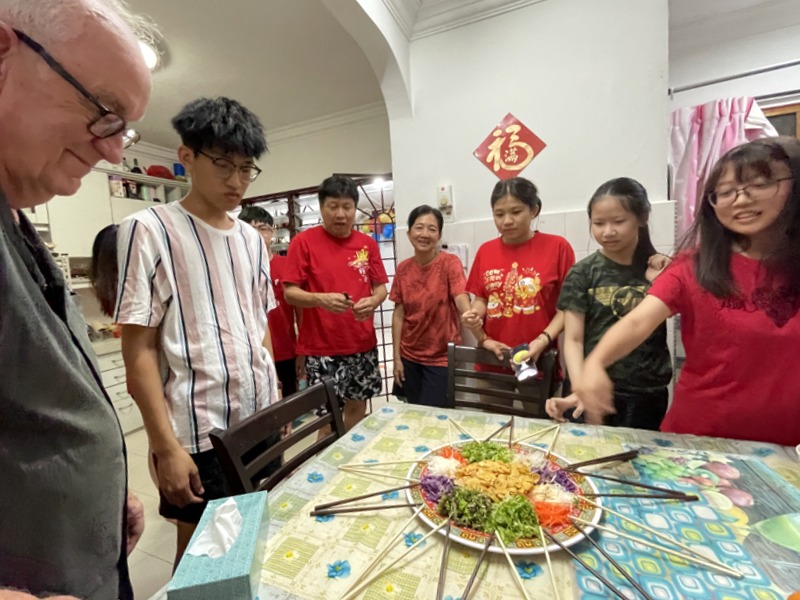
In the evening there was a party with yee sang and a lucky draw,
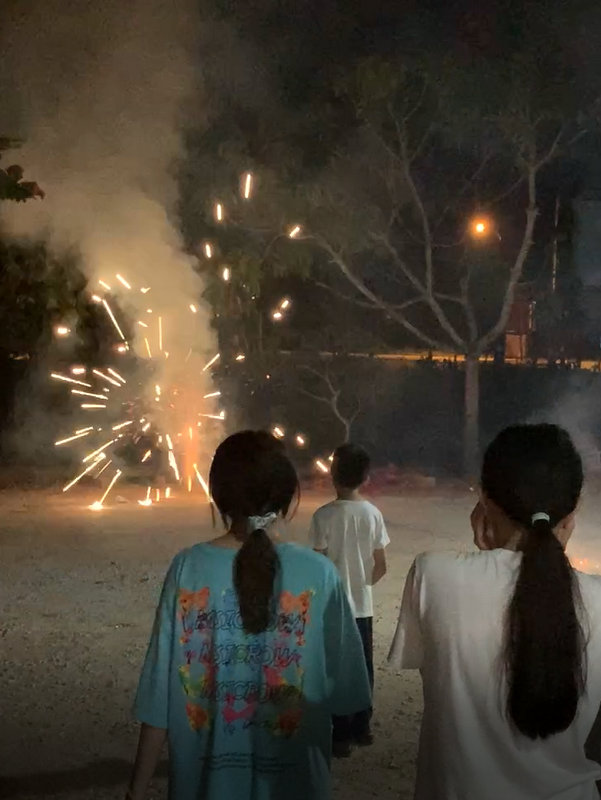
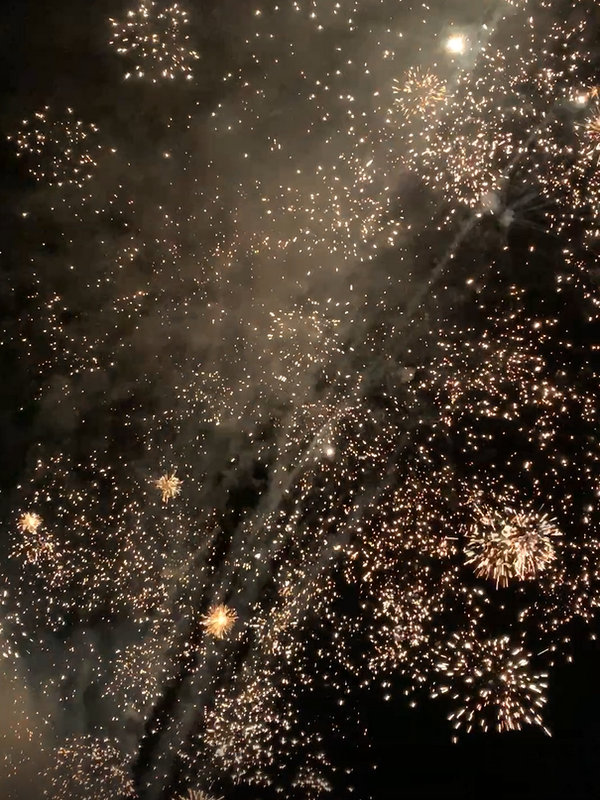
And of course there were lots of firework.
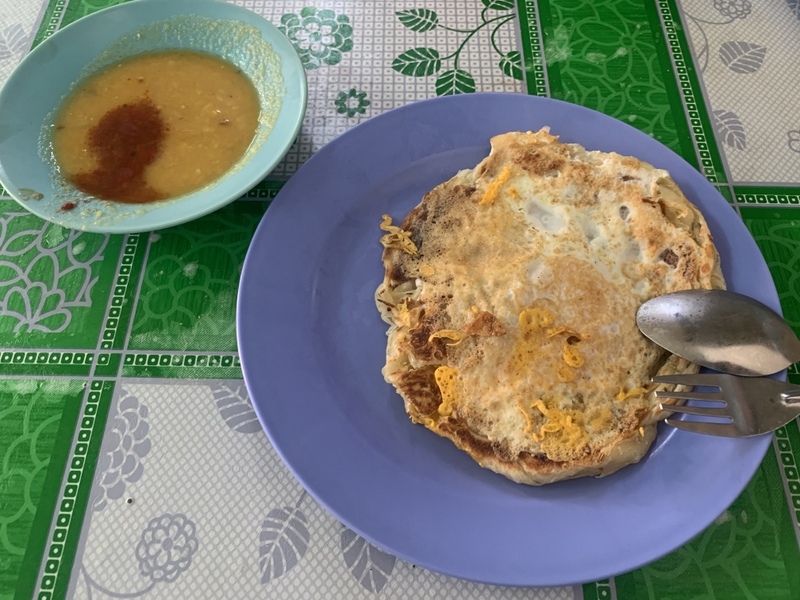
The next morning I went to the village with Ong for breakfast with Roti Tampal. I knew about Roti Telur but this was new for me. Egg on top, not inside
Before we left there was another praying session..
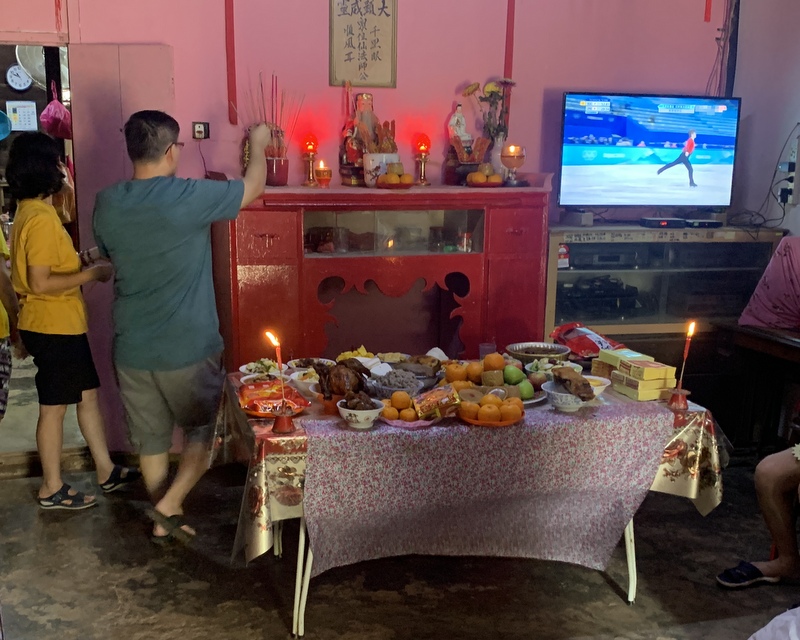
A few days later, there was another celebration, in Puchong with Ong and his family, He is Hokkien and for the Hokkien community day 9 of the CNY is an important date. It is the birthday of the Jade Emperor, the God of Heaven. Again there was yee sang.
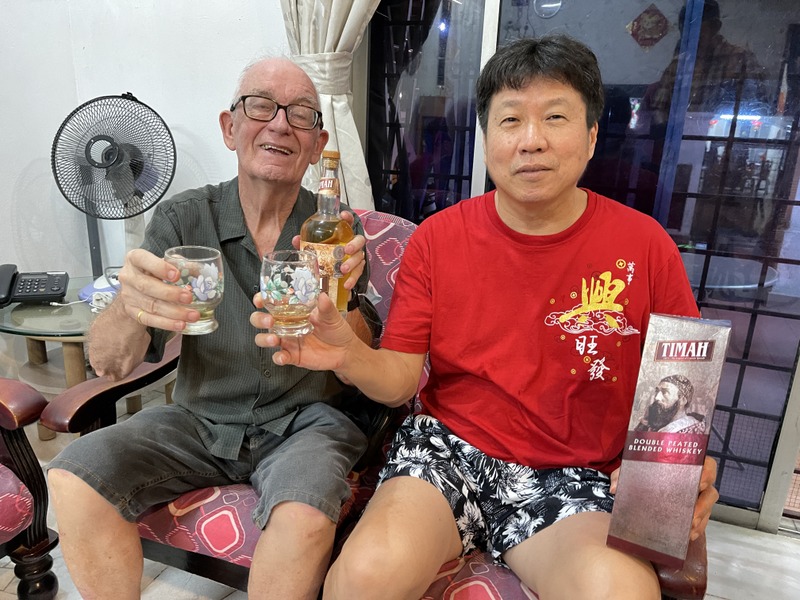
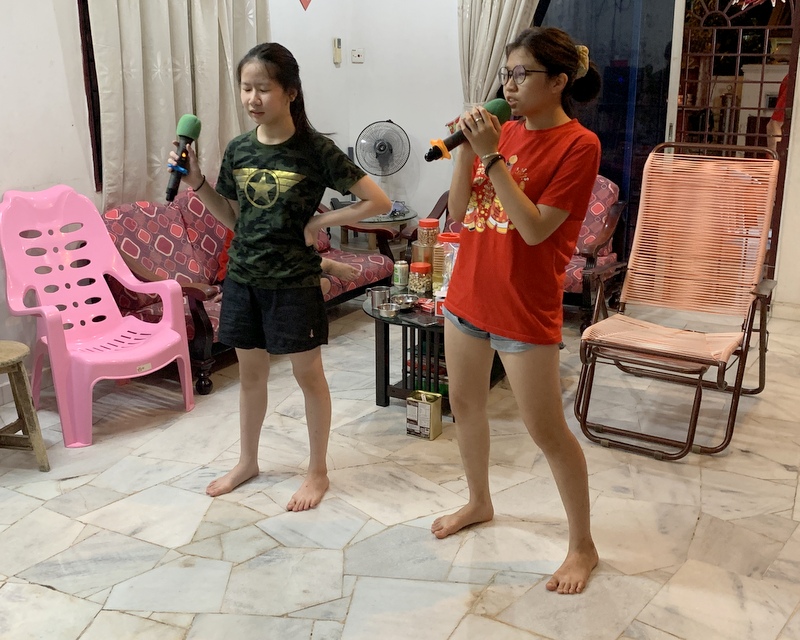
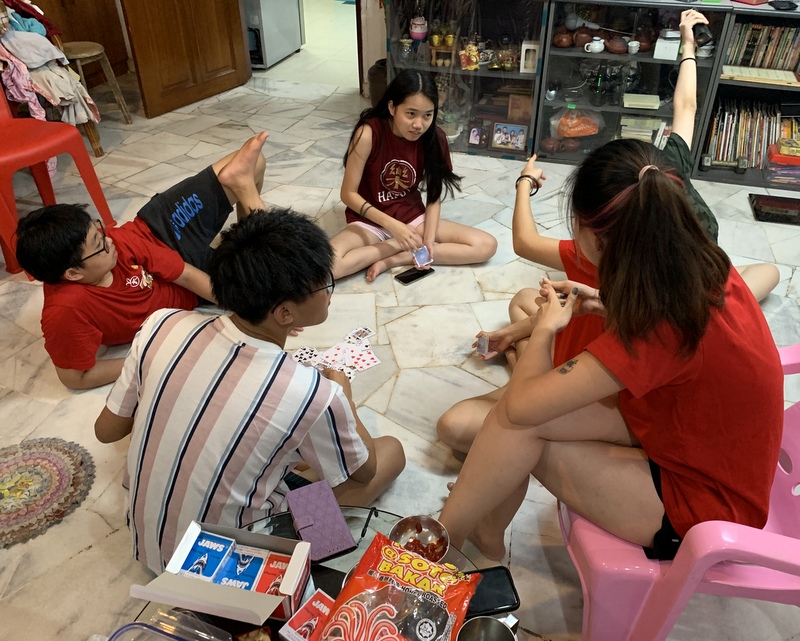
And there were drinks too 😉 Ong and have a drink of the (in)famous Timah whisky and the younger generation shares a bottle of wine. Playing cards, singing karaoke, a very nice evening.
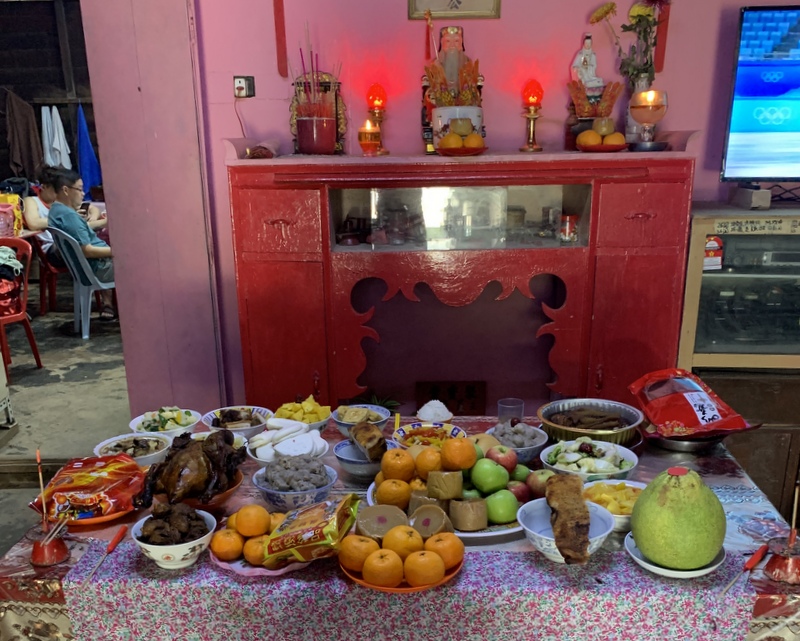
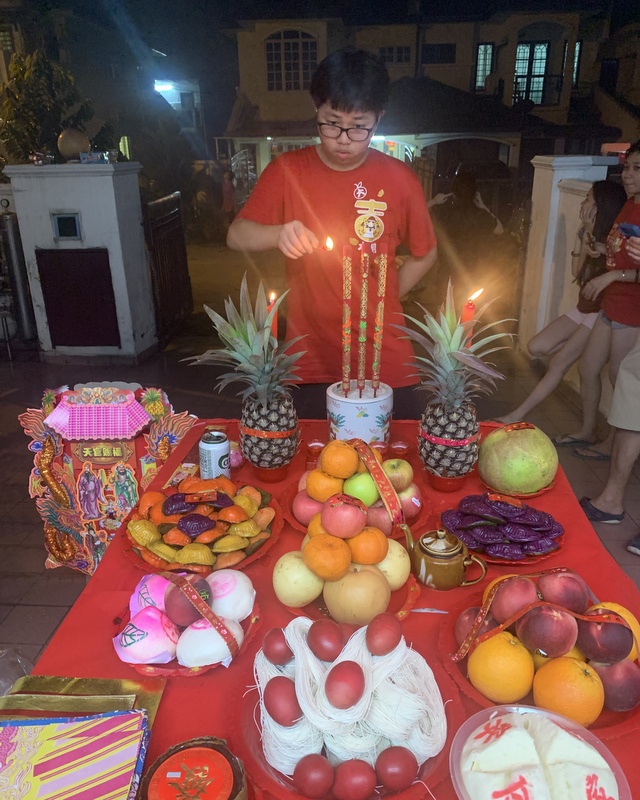
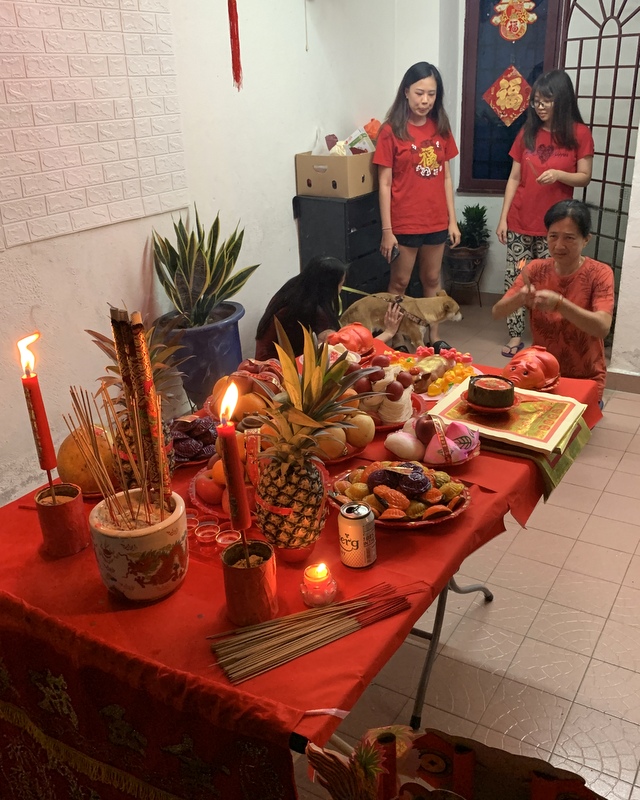
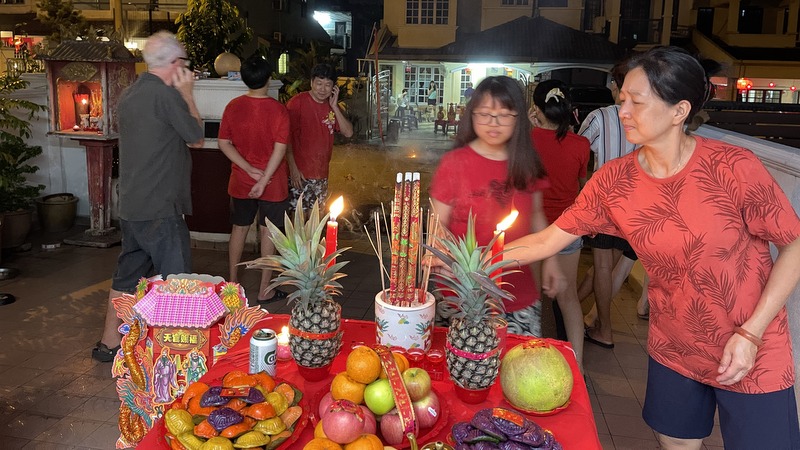
An offering table is prepared for the God of Heaven, and joss sticks are lit.
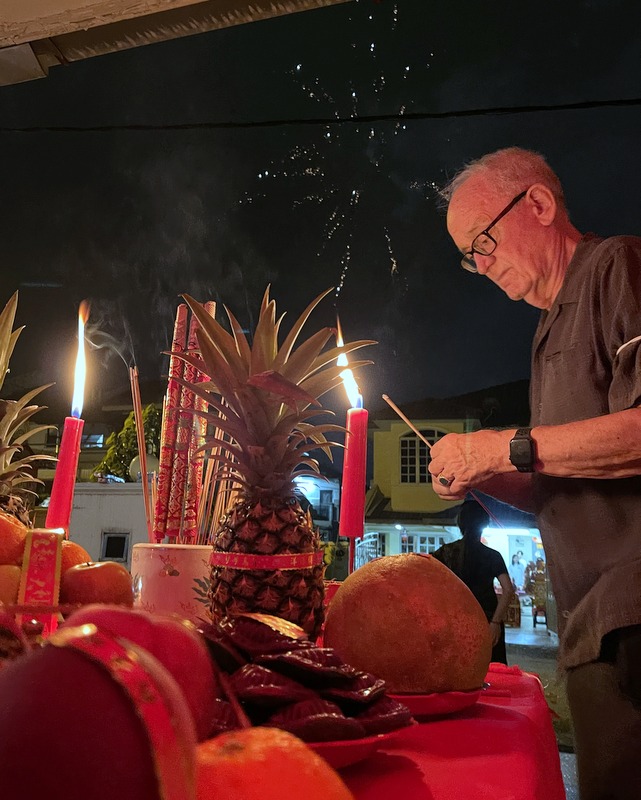
At midnight there is a lot of firework. Note how I am protecting my ears.
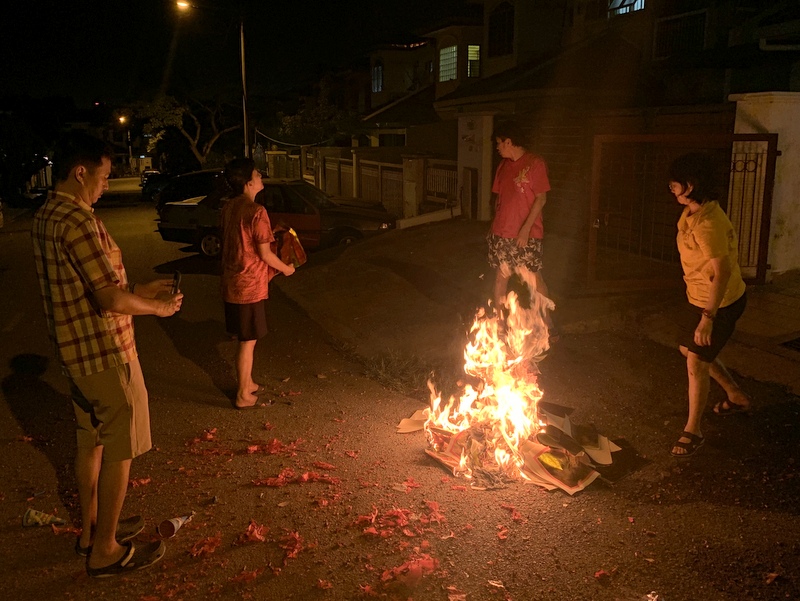
The ceremony ends with the burning of Joss papers.
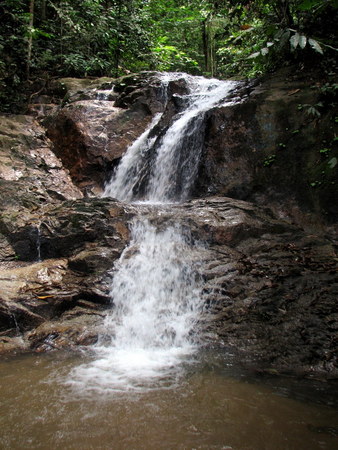
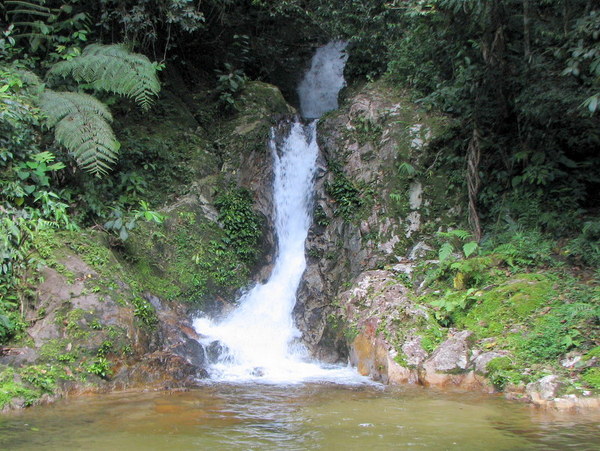
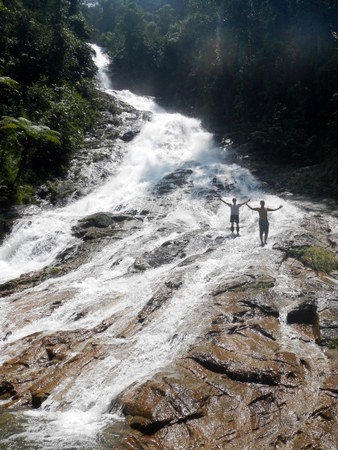
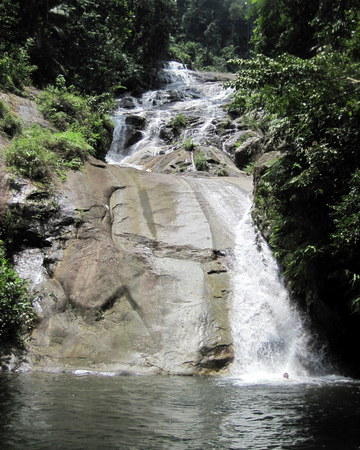
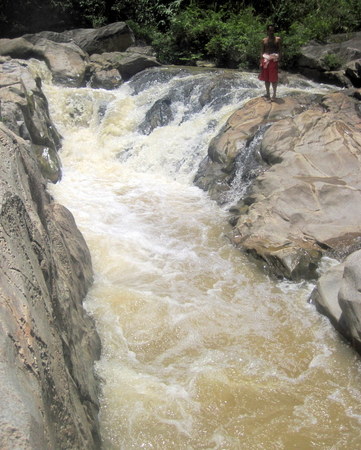
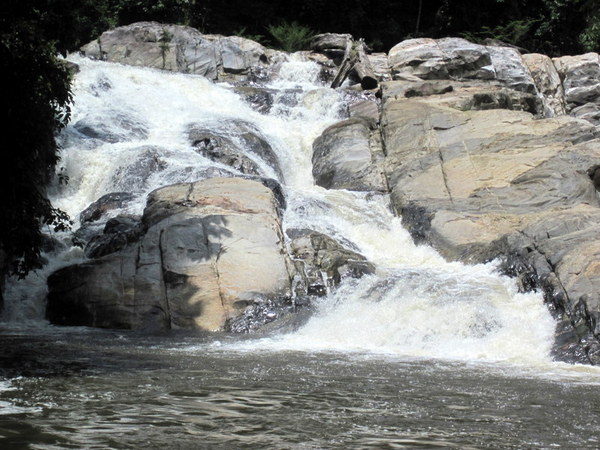
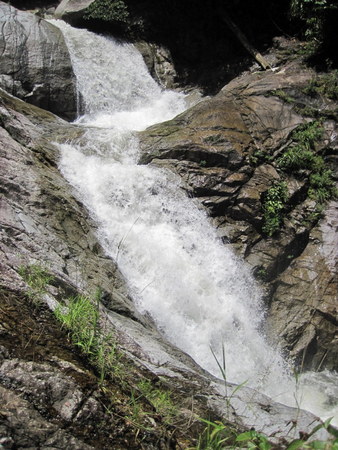
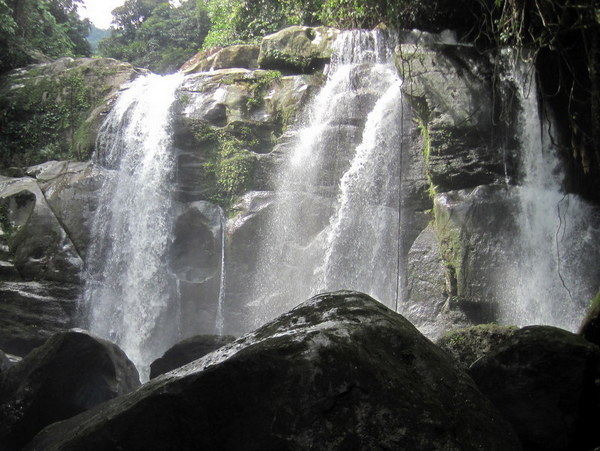
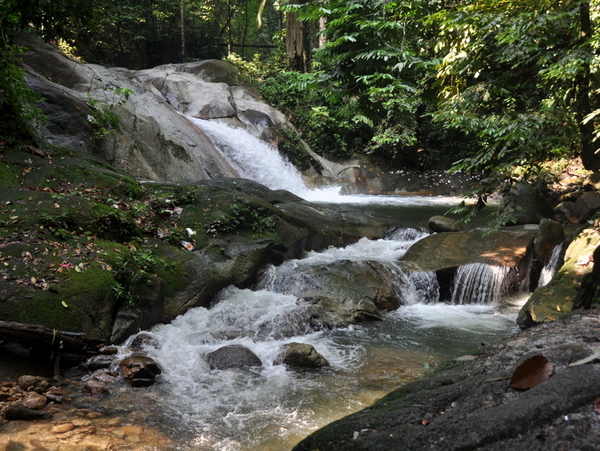
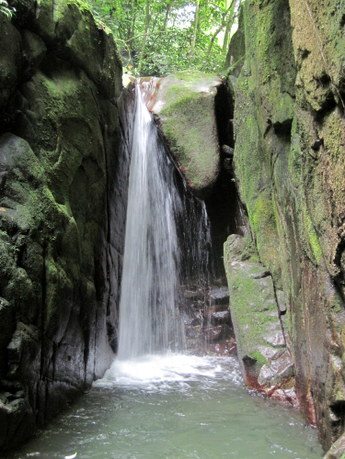
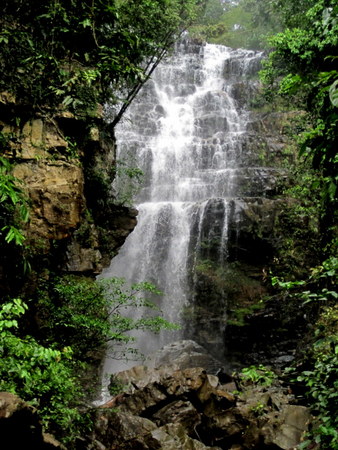
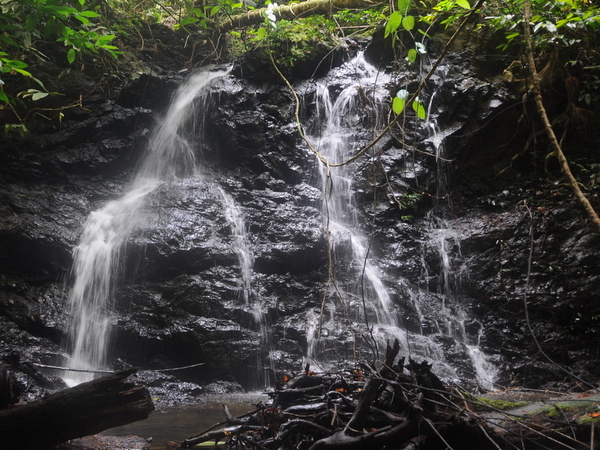
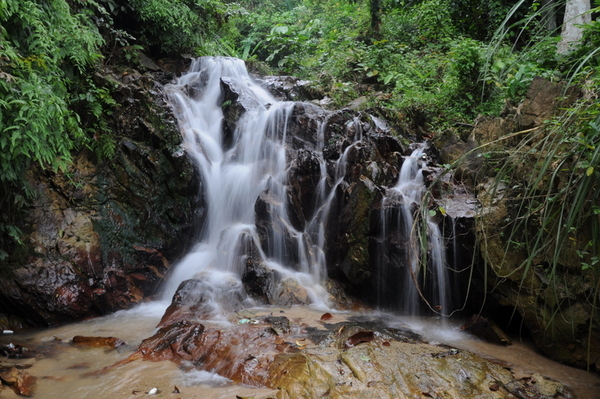
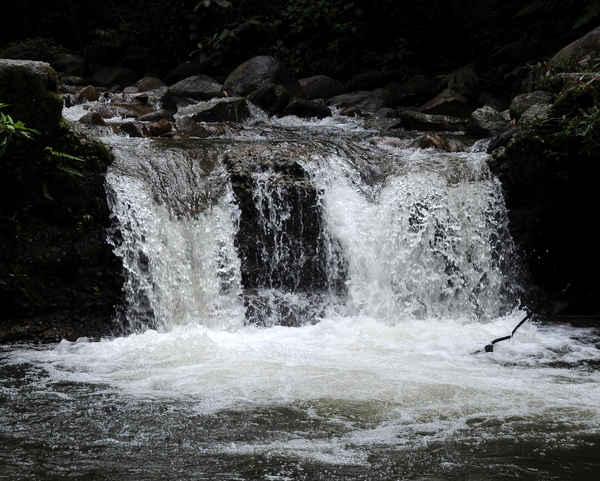
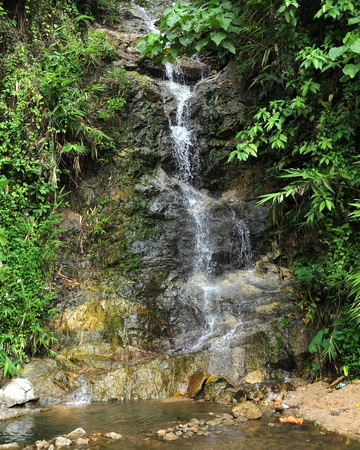
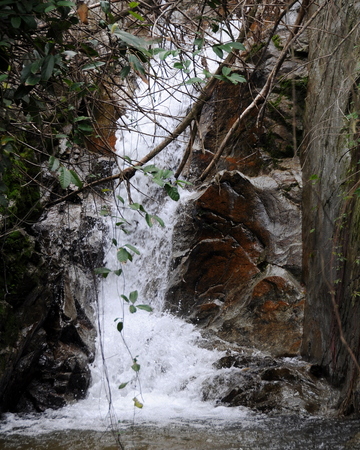
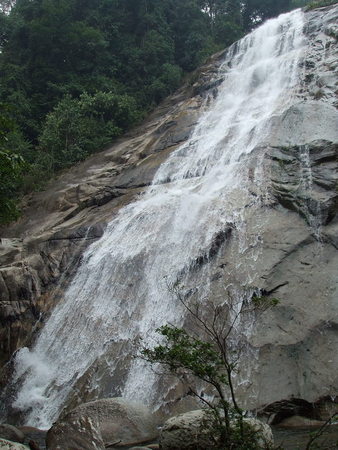
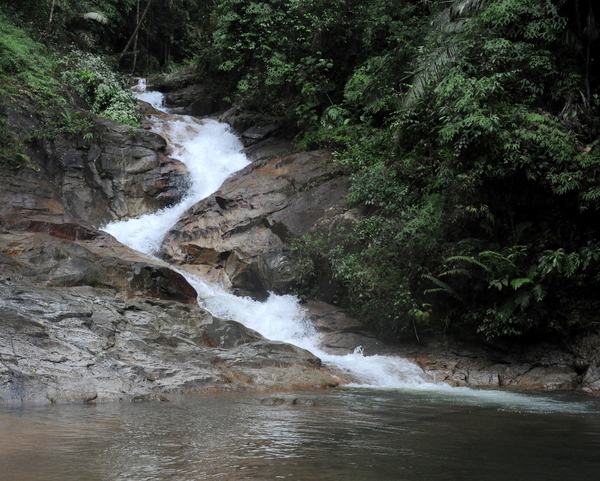
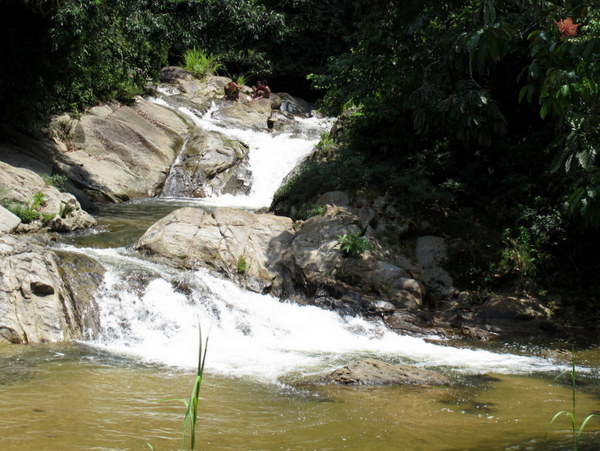
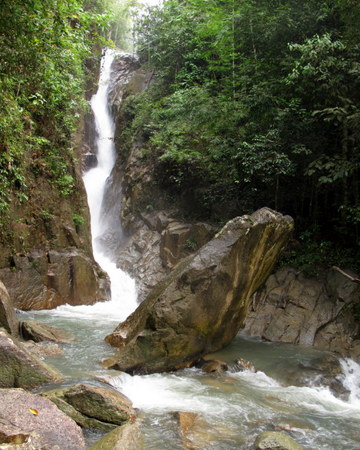
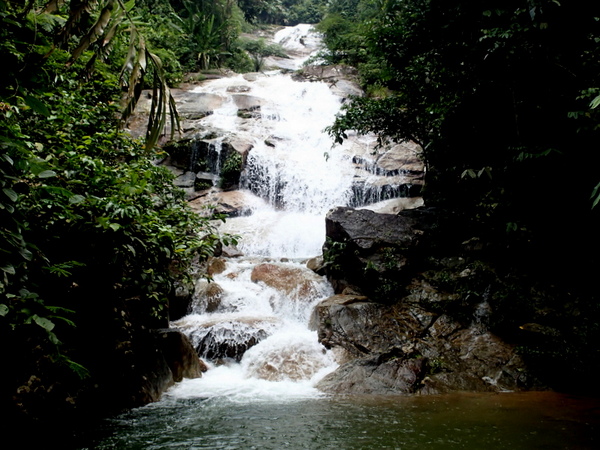
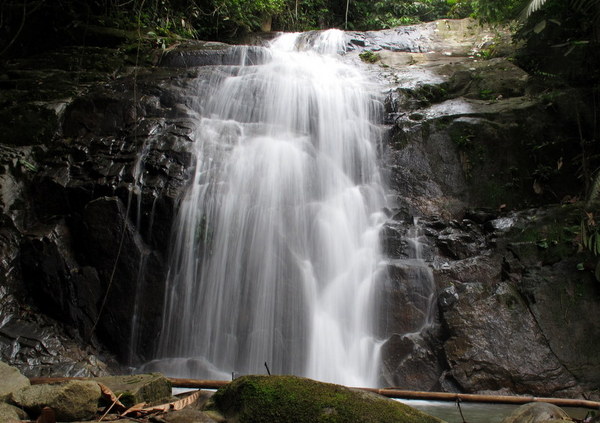
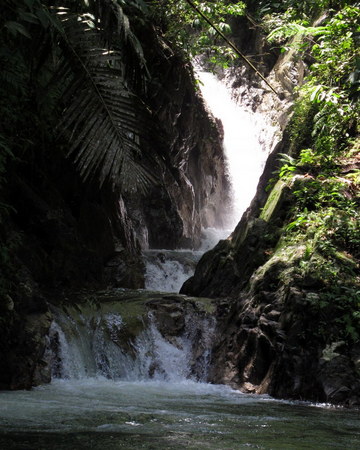
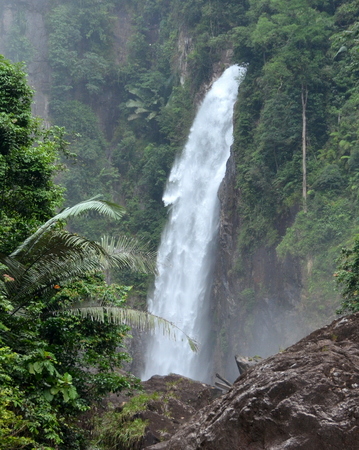
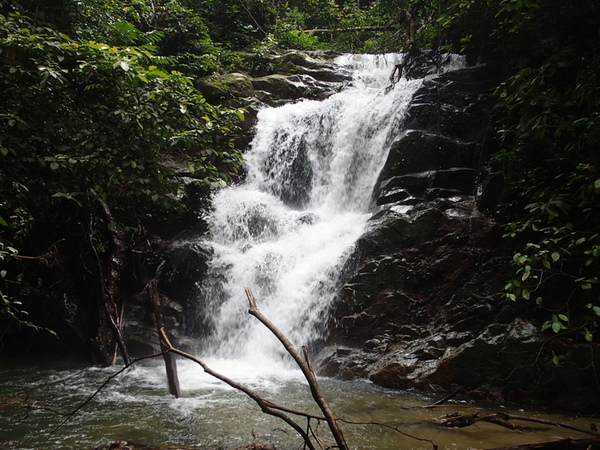
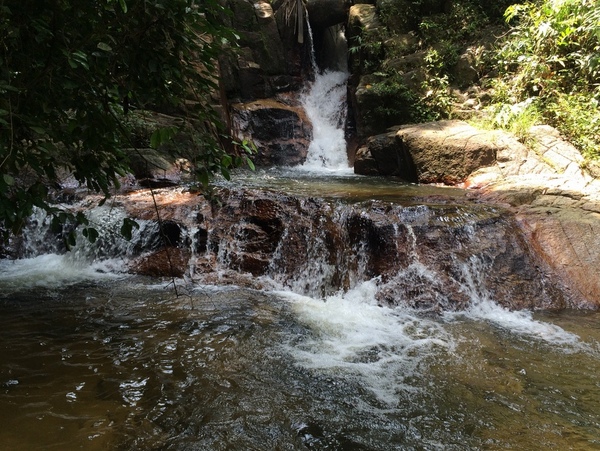
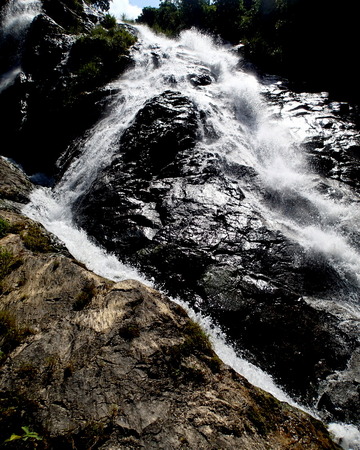
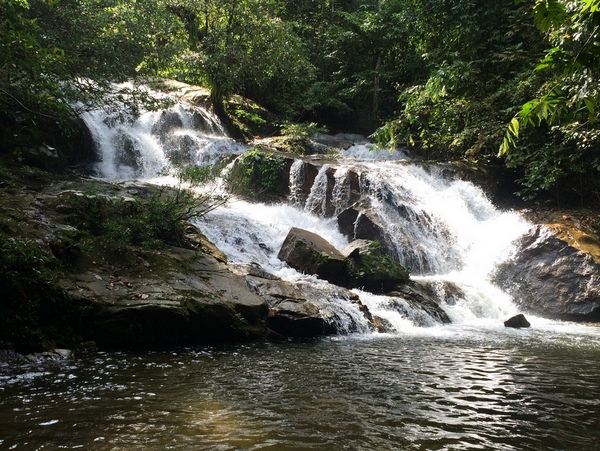
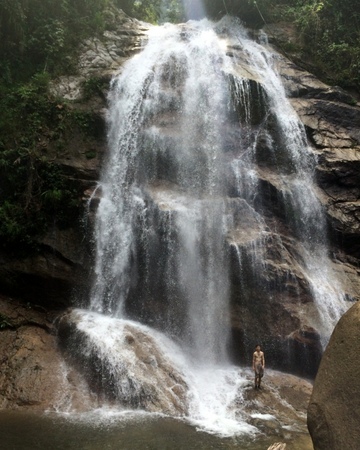
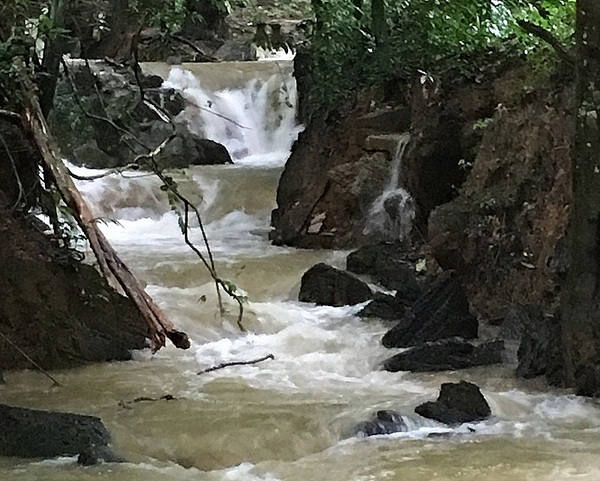
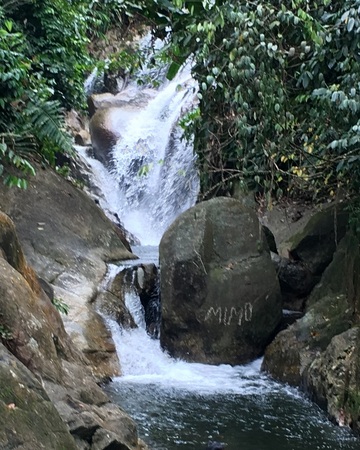
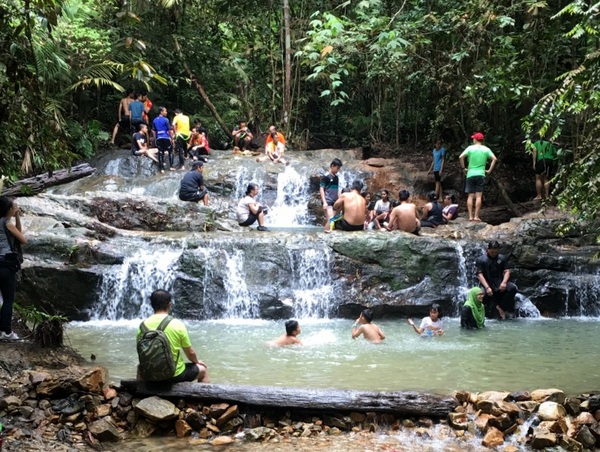
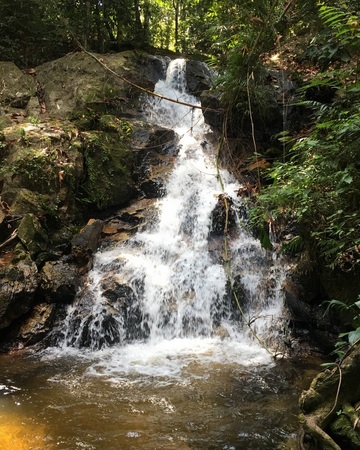
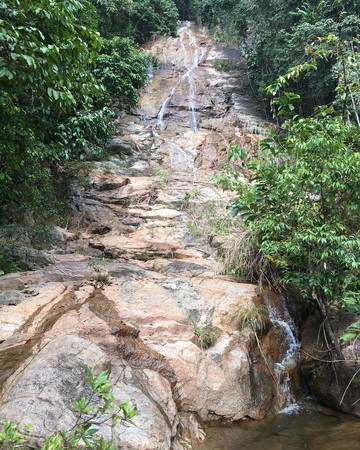
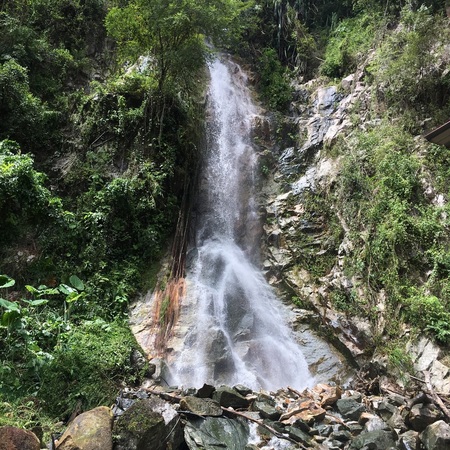
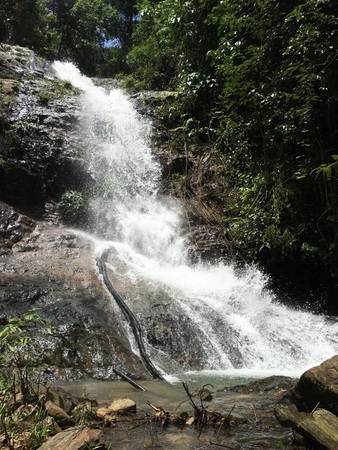
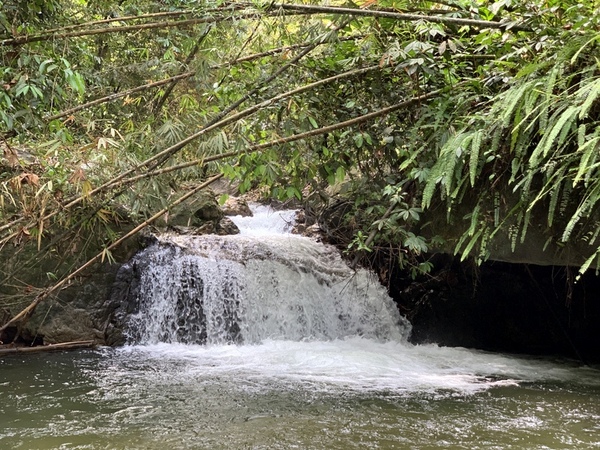
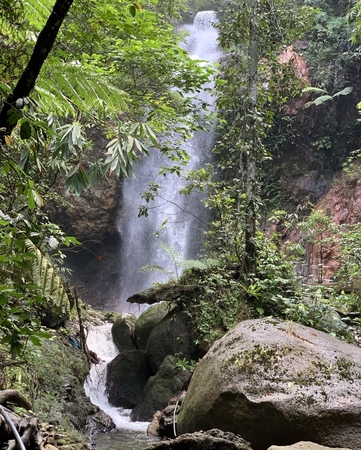
During the past 20 years I have visited over 200 waterfalls in Malaysia. Most of them have been included in my Waterfalls of Malaysia website. But not all of them, for various reasons. Here is a list of those waterfalls. When you click on a picture or on the caption below it, a page will open about that waterfall with more details, with whom I visited the fall, on which date(s), etc.
About the counting of waterfalls, there are 48 pages, but the actual number of waterfalls is larger. When rivers have more than one waterfall, I have in general combined them in one page.
About the title of this blog, of course the waterfalls are not mine, I have not even discovered them. But as MY also stands for Malaysia, I like this playful title.
On 25 December 2021, the James Webb Space Telescope (JWST) was successfully launched. It has now reached its destination at the L2 Lagrange point of the Sun-Earth system. For many years I have considered writing a blog about the five L:agrange points, but I was not sure if I could do that in a relatively simple way.
I am still not sure, but in this blog I will give it a try.
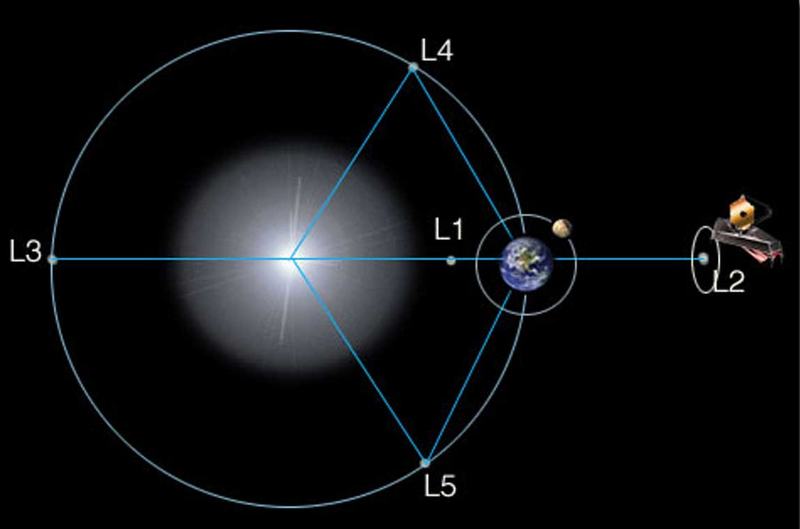
Here is a diagram of the Sun-Earth system (not to scale). The five Lagrange points are marked.
Earth and all other planets orbit the Sun because of the gravitational attraction between a planet and the Sun. Earth orbits the Sun in ~365 days at a distance of 150 million km. The other planets do the same, but at different distances and with different periods. Here is the solar system (not to scale).
It was Kepler who studied the planetary motion. He found a relation between the period and the distance, which is now called Kepler’s Third Law: The square of a planetary period is proportional to the third power of its distance. Let’s take Mars as an example. The distance to the Sun is ~228 million km and a Mars year is ~687 days. The distance is a factor 228/150 = 1.52 larger. The third power of 1.52 is 1.52×1.52×1.52 = 3.512. Kepler’s 3rd law predicts that a Mars year will be √ 3,512 = 1.88 times longer than an Earth year. = 1,88 x 365 = 686 days.
Now let us consider a spacecraft in the Sun-Earth system. It’s mass is so small compared to the mass of Sun and Earth, that it will not influence their motion. But it will feel the gravitational attraction from the Sun and also from the Earth. Is it possible that the combined attraction of Sun and Earth will result in a period of 1 year?
The answer is yes, there are exactly 5 points where this is the case, the 5 Lagrange points!
Here is the explanation for L2. This point lies farther away from the Sun than Earth, so the attraction from the Sun is weaker and would result in a longer period. But Earth also attracts the spacecraft in the same direction as the Sun and in L2 they give together enough attraction to let this point orbit in 1 year. Calculation gives that L2 is located 1.5 million km from Earth, 151.5 million km from the Sun
For L1 the explanation is similar. Here the attraction of the Sun is stronger resulting in a shorter period. But now Earth “pulls back” and together they give the right amount of attraction. The location of L1 is also 1.5 million km from Earth, 148.5 million km from the Sun (the figure above is not to scale).
L3 lies at the opposite side of the Sun, Here the attraction from Earth is minimal, it contributes only little to the attraction of the Sun, so L3 lies only slightly further away than 150 million km from the Sun.
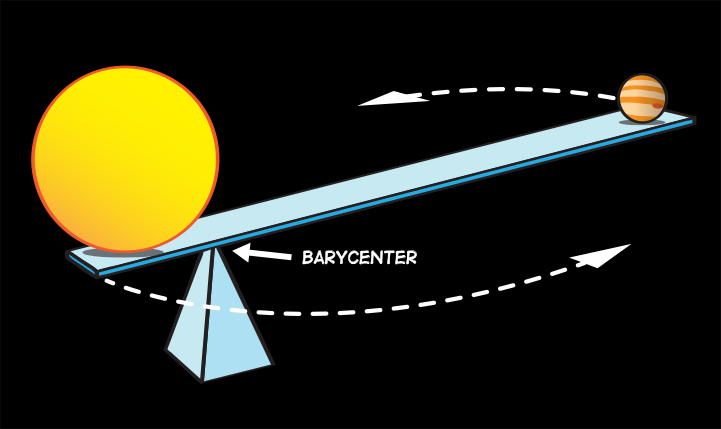
Before we describe the points L4 and L5, we will first look in a bit more detail at the solar system. When we say that the planets orbit the Sun, it suggests that the Sun doesn’t move itself, while the planets orbit around it. And that is not true. The Sun and a planet both orbit around their common center of mass, often called their barycenter. In this image the barycenter is shown for the Sun and Jupiter. Because the Sun is much more massive than Jupiter, their barycenter lies close to the Sun.
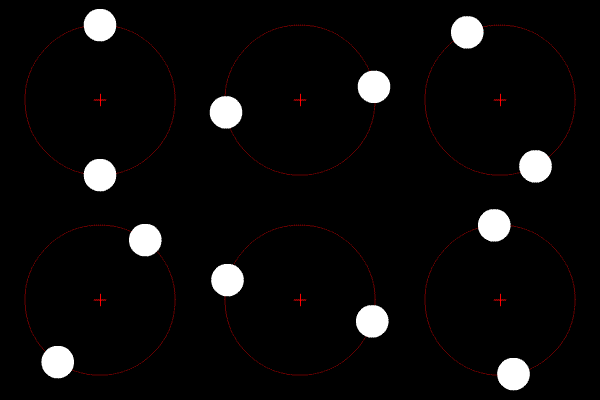
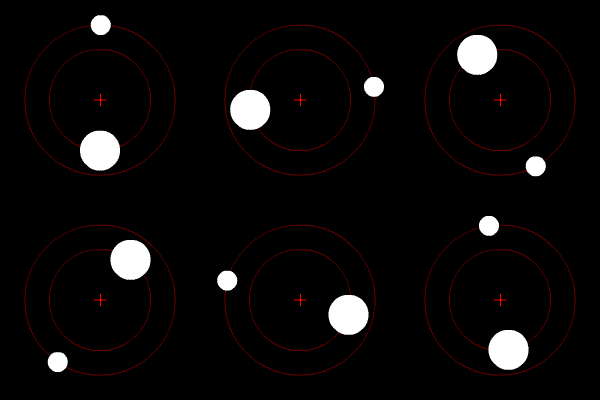
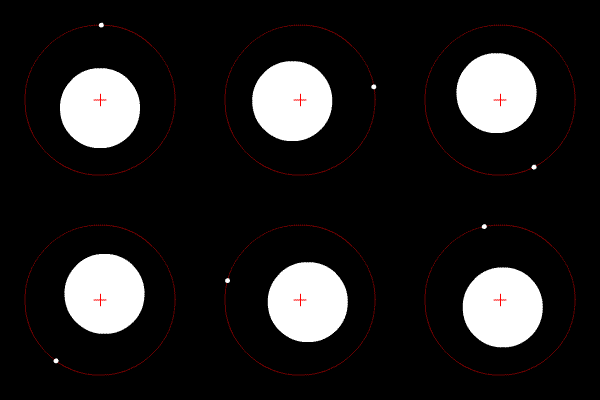
Here are a few animations for different situations, where the barycenter is marked with a red cross. The animations are not to scale. The first image shows the situation of for example two stars of equal mass. The next one shows minor planet Pluto and its large moon Charon. The last image shows Earth and Sun. The mass of Earth is so small that the barycenter lies within the Sun.
Of course the resulting force in the Lagrange points has to be directed to the barycenter and for L1, L2 and L3 this is automatically the case, because these points lie all three on the line connecting Sun and Earth. These points were already found by the famous mathematician Euler in 1720.
In 1772 Lagrange discovered two more “stable” points, where the attraction of Sun and Earth are not in the same direction, but together point to the barycenter. of the Sun-Earth system. .
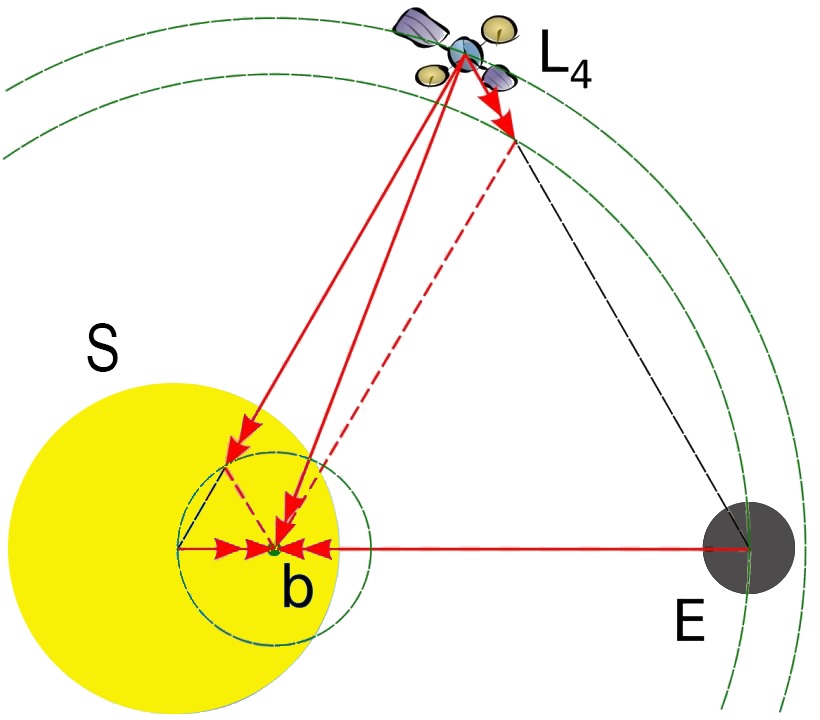
The mathematics is complicated, I will use some hand waving to make the existence of L4 (and L5) plausible. In the diagram below, the masses of Sun and Earth are S and E , the barycenter is indicated as b, it lies within the Sun because the Sun is much more massive than the Earth. The location of b depends on the ratio of the two masses S and E;.
L4 is the top of a triangle with all sides equal to the distance between Earth and Sun. Because L4 has an equal distance to Earth and Sun, the gravitational forces on L4 are in the same ratio of S and E. Therefore the resulting force is directed to b ! Note that L4 lies outside Earth’s orbit. Similar to L1, the two combined forces give L4 a period of 1 year, same as Earth.
Actually the barycenter of the Sun-Earth system lies extremely close to the Sun’s center of mass, The radius of the Sun is 670.000km and b lies about 450 km from its center! In this diagram this distance has been strongly exaggerated to show the process. In the usual diagrams of the Lagrange points, L4 and L5 are located so close to the Earth orbit, that it is not possible to see their separation.
Until now we have described the 5 Lagrange points as points that orbit the Sun in one year, same as the Earth. Another description is often used, a rotating coordinate system. In such a coordinate system, centered in the barycenter and rotating once a year, Sun, Earth and the 5 Lagrange points are stationary. But it comes at a cost. Because such a coordinate system is not an inertial system, fictitious forces have to be introduced, for example the centrifugal force,
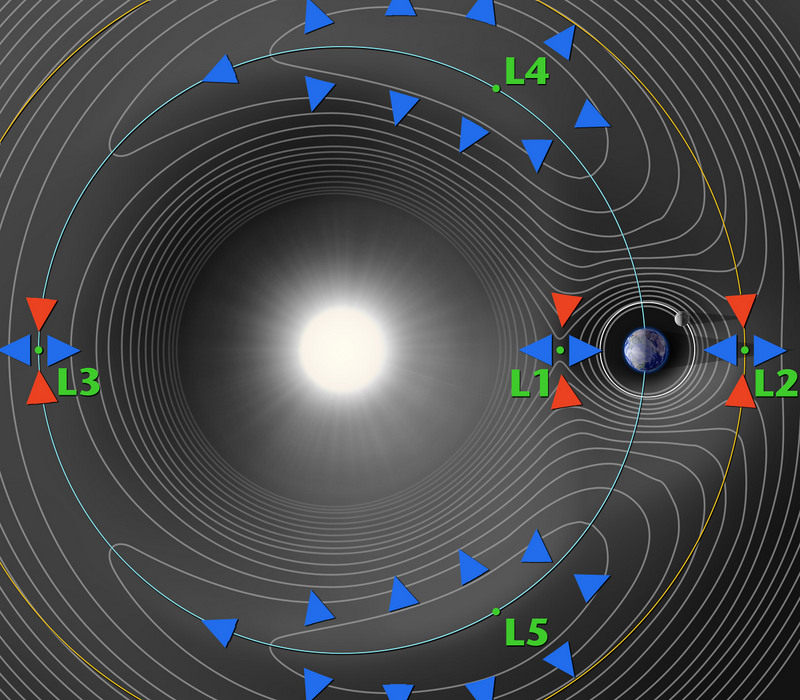
In the diagram below the Lagrange points are indicated, in such a rotating frame. The contour lines give the gravitational field energy. Compare it with the contour lines on a topo map. The blue and red arrows indicate the direction of the force (the direction of the slope in a topo map). In topo map terminology L4 and L5 are located on the top a hill, while the other three are located in so-called saddle points. On first sight it would seem that all Lagrange points are unstable, For the L1-L3 points a small displacement in the x-direction, and for L4 and L5 a small displacement in any direction would be enough to disturb the balance (like a pencil on its tip).
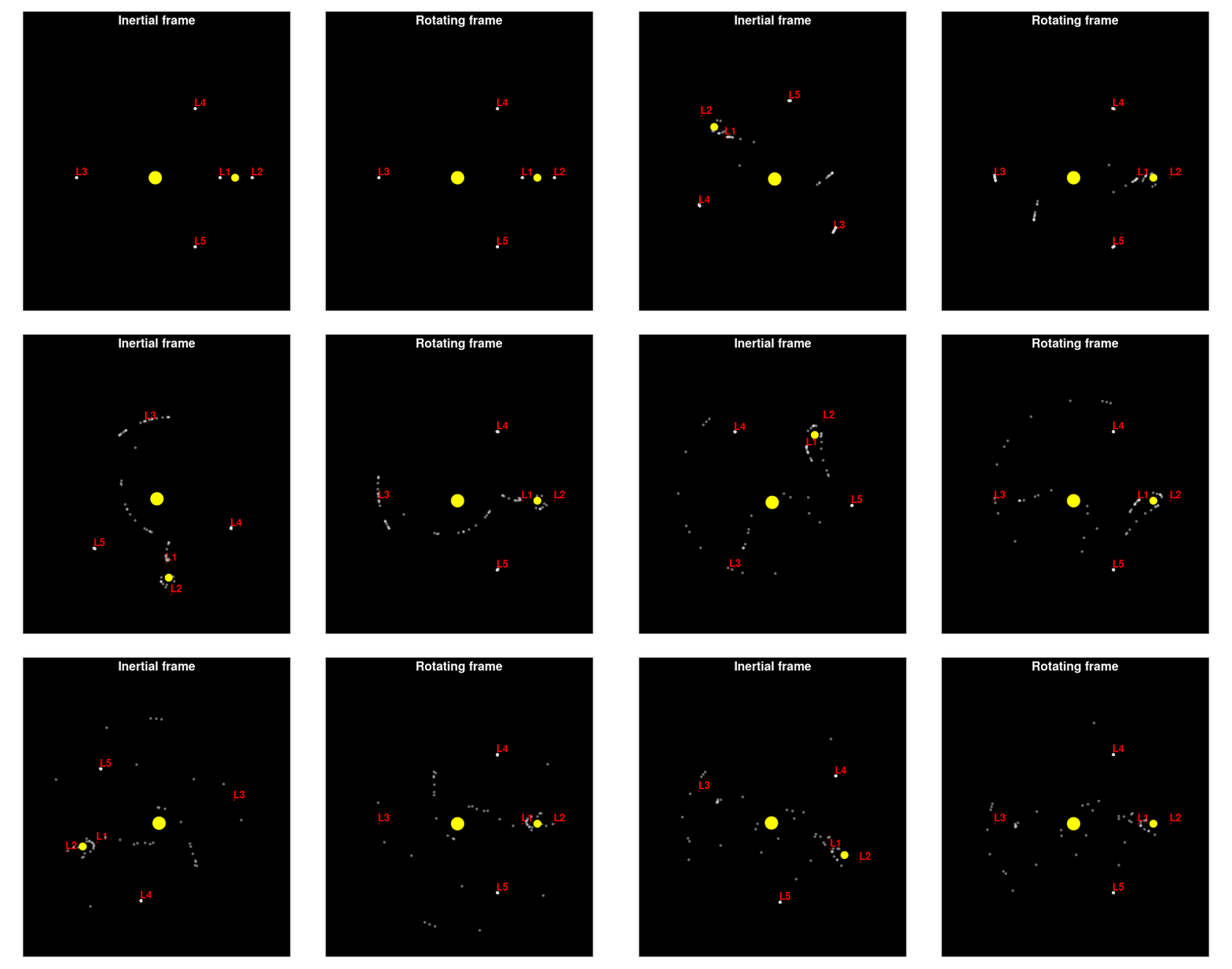
Careful and complicated mathematical analysis (see for example here) leads to a surprising result: the regions around L4 and L5 are actually stable, objects in a large region around these Lagrange points will move in orbits and stay in that region. The regions around the other three Lagrange points are unstable, objects can orbit for a while, but will eventually escape. That is illustrated in the two diagrams below. The left diagram. shows the Sun-Earth system in an inertial frame, the right one in a rotating frame The 5 Lagrange points are marked in red.
Notice the moving tiny points, They are test masses. released near the various Lagrange punts. Look carefully and you will see that the test masses released near L1 and L2 quickly move away. For L3 it takes a bit longer. All these three Lagrange points are unstable. But around L4 and L5 the test masses do not “escape”, these points are stable.
In the introduction of this blog I wrote that the JWST had reached its destination at the L2 Lagrange point of the Sun-Earth system. Actually the space telescope is not positioned in :the Lagrange point itself but orbiting L2. And what an orbit it is! Elliptical, the distance to L2 varies between 250.000 km and 832.000 km. One period takes about 6 months. The orbit is not stable, about every 21 days the thrusters of the JWST must perform minor course corrections.
A more detailed explanation of the WEBB launch and orbit can be found in this brilliant YouTube video: How James Webb Orbits “Nothing”
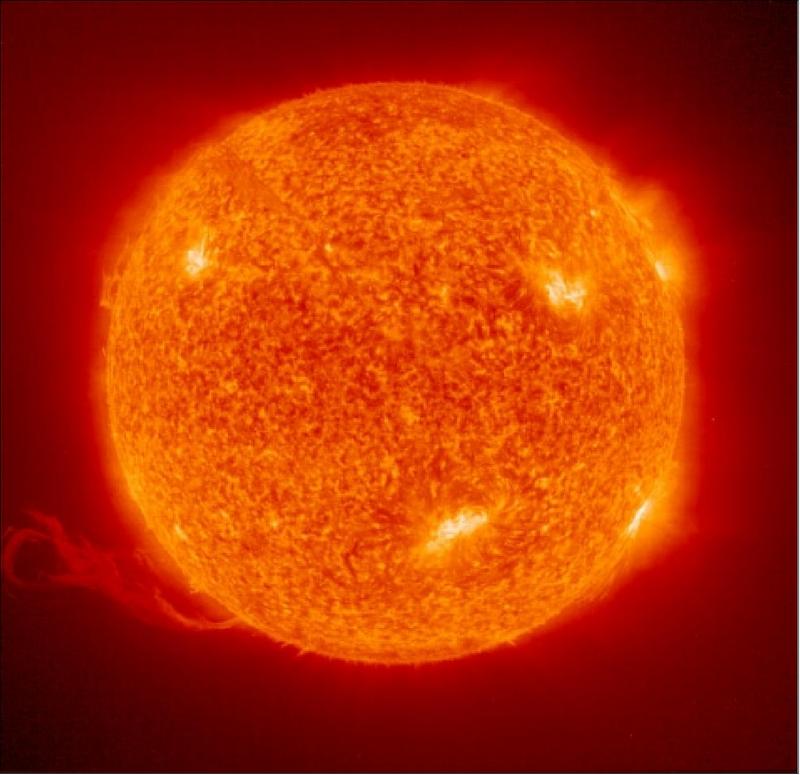
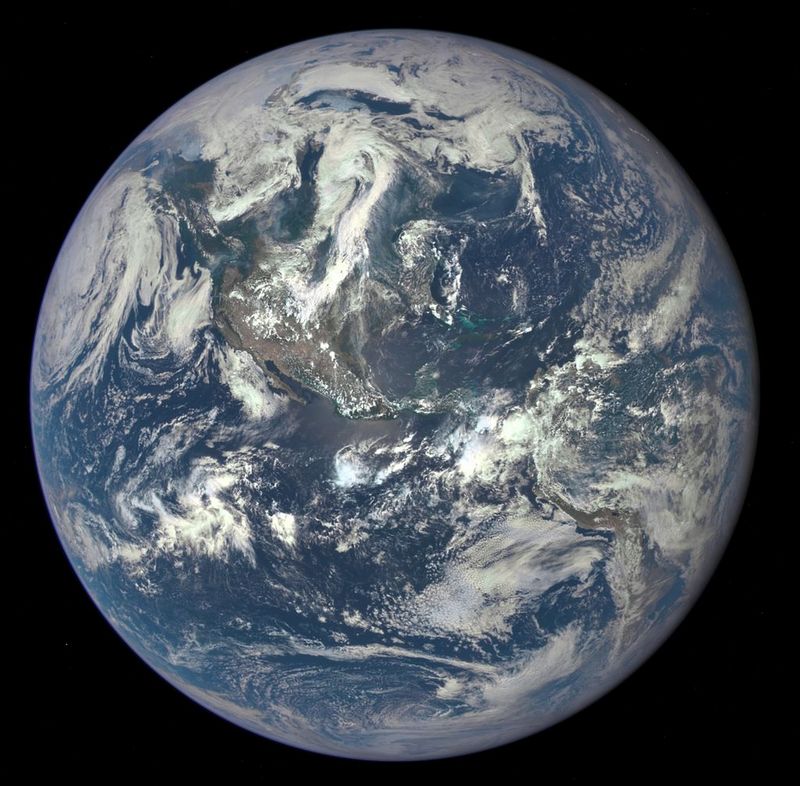
There also satellites orbiting L1. At the moment for example the SOHO satellite to study the Sun and the DSOVR to study the Earth. Here are two pictures taken by these two spacecraft.
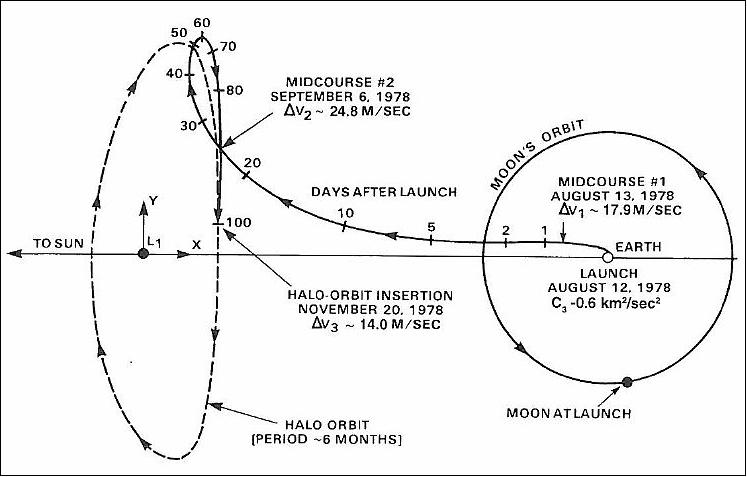
In 1978 the International Sun-Earth Explorer-3 (ISEE-3). was the first spacecraft that went into an orbit around a Lagrange point. It studied the Sun and Earth for 4 years and also here the unstable orbit had to be corrected regularly. Here is a diagram of the launch process.
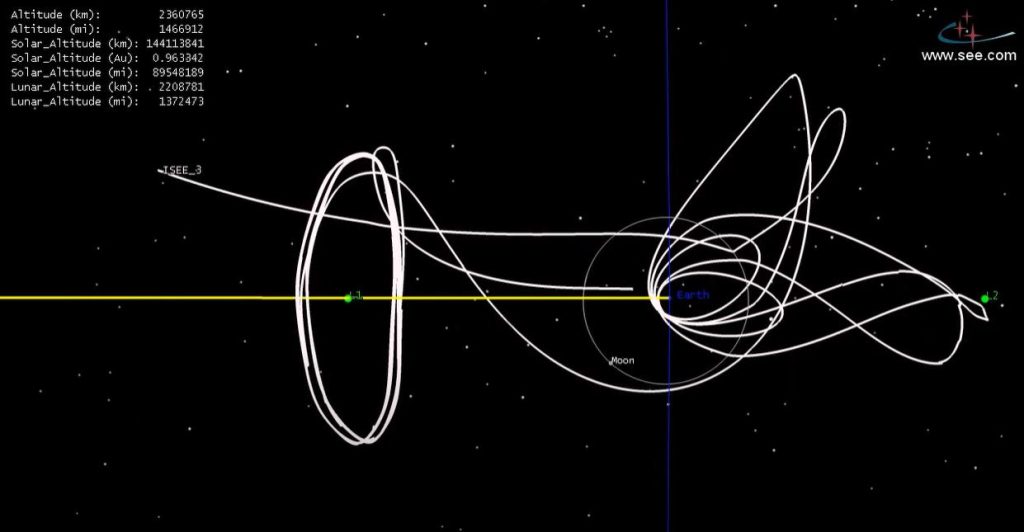
After its mission was completed, the spacecraft got a new target, to study comets! It was renamed International Cometary Explorer, left its orbit and via amazingly complicated manoeuvres went on its way to a comet., Click on the screenshot to see an animation of the mission. Very informative and fascinating..
What about L3? This Lagrange point is permanently behind the Sun, as seen from the Earth. No scientific use, but it has played a role in science fiction. . Here is an example, a science fiction movie Journey to the Far Side of the Sun, released in 1969 (the same year that humans landed on the Moon). Click on the screenshot to watch the movie.
Synopsis of the movie: In 2069 a planet is discovered in L3 and the director of Eurosec (named Jason Webb !) organises a mission to what turns out to be a mirror-earth. Very interesting to watch.
We now know that L3 is unstable, with a “decay time” of about 150 year. It would be a suitable location for alien enemies to hide, while preparing for an attack 😉
L4 and L5 are stable (under certain conditions) but have no use for science. Possibly in the far future, these regions could be used to build human colonies.
Until here we have concentrated on the Lagrange points of the Sun-Earth system, but the Earth-Moon system has also its Lagrange points and so do for example the Sun and Jupiter.
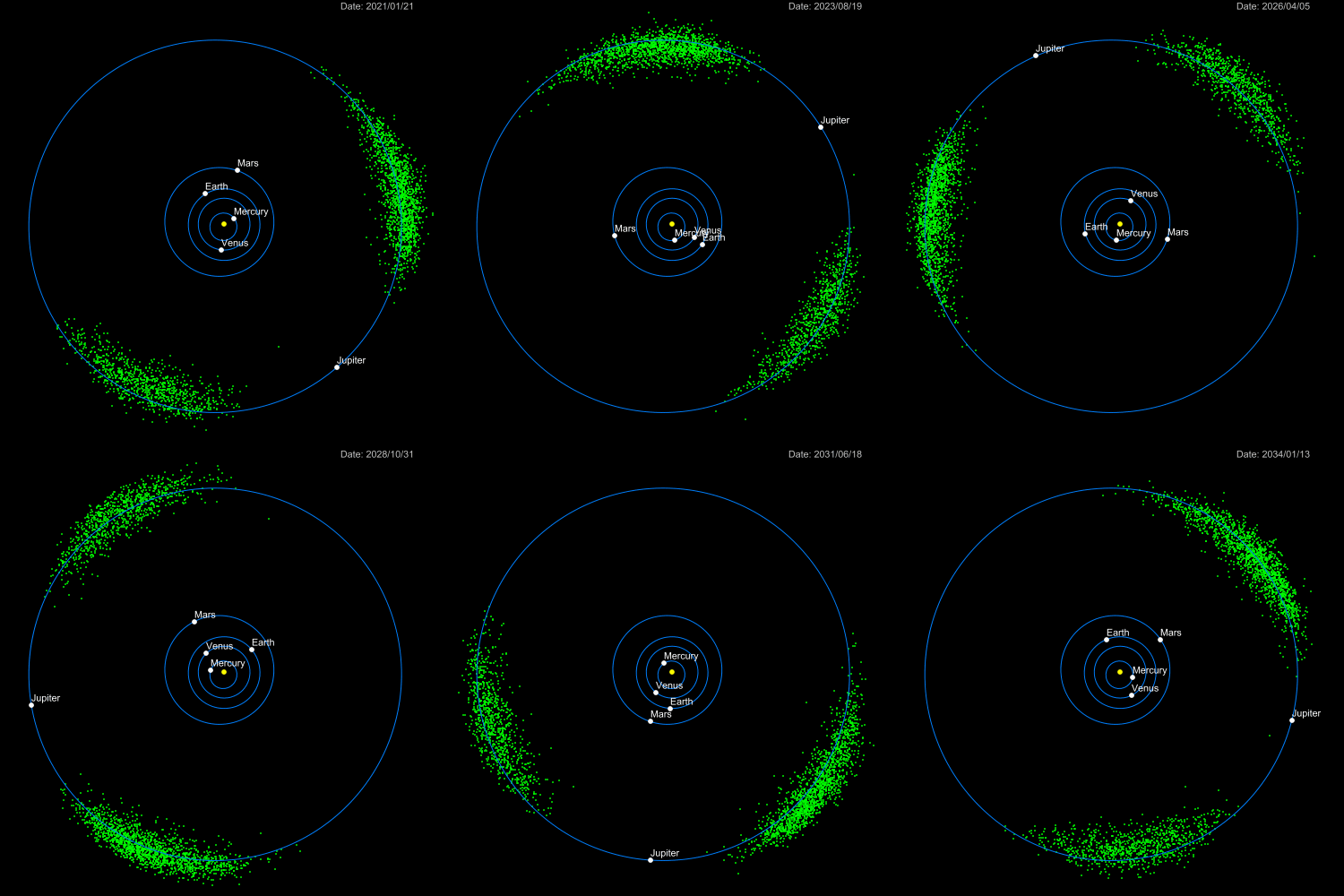
Jupiter has collected thousands of asteroids around its L4 and L5 points. They are called trojans because they are named after heros of the Trojan war. Here is an animation. The asteroids in front of Jupiter are called the Greeks and the ones trailing Jupiter are called the Trojans.
The name trojan is now generally used for objects in the L4 and L5 points of other planets. In the L4 and L5 points of the Earth until now “only” two Earth trojans. have been observed.
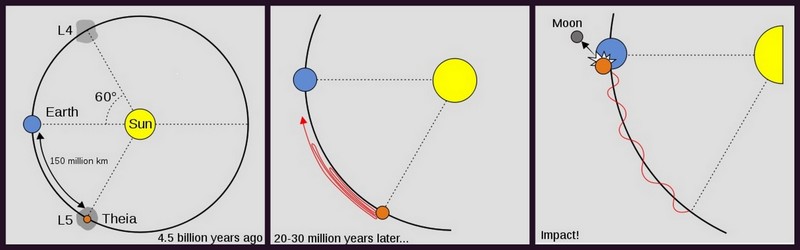
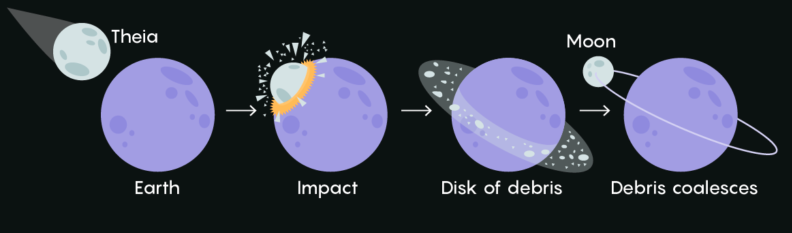
But there may have been one in the early history of Earth!. I will end this blog with a fascinating theory about the origin of the Moon! The theory is called the Giant-Impact Hypothesis. When the Sun and the planets were born, about 4.5 billion year ago, Earth was not alone. It had a Mars-sized sister planet in the L4 (or L5) Lagrange point. About 20-30 million year later, this hypothetical planet, named Theia, possibly disturbed by the other planets, left the L4 region and collided with Earth. It must have been a cataclysmic event From this collision the Moon was born.. Here is the scenario.
In a recent blog, The Gang of Four, I wrote about the fellowship of Khong, Stephen, George and me, and the many trips we made during the past 15 years. At the end of that blog I wrote that we had not organised any activity during the Covid-19 pandemic and that we were hoping to continue the tradition soon.
Although the pandemic is not over, the situation in Malaysia became better during the last months and in November we organised our first outing since 2019. We had planned to visit a colonial mansion in Rasa, but unfortunately it was closed..
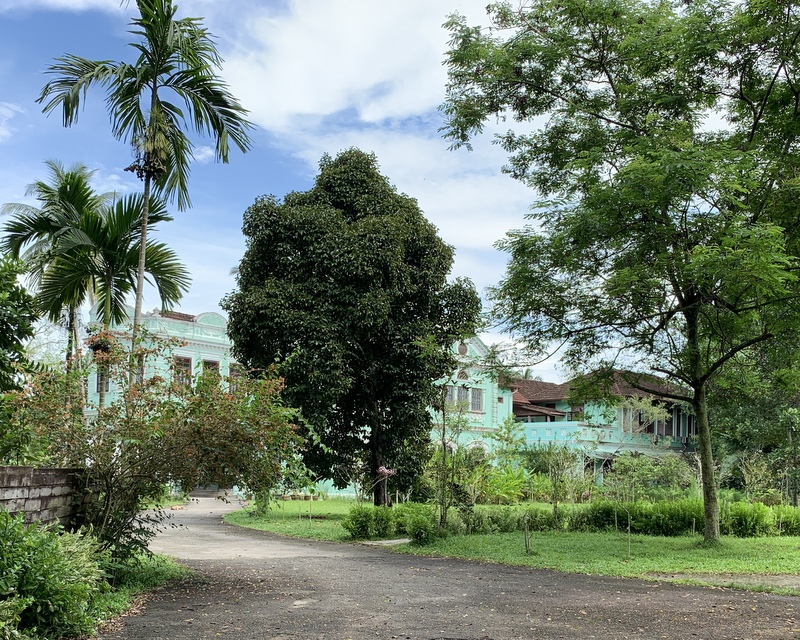
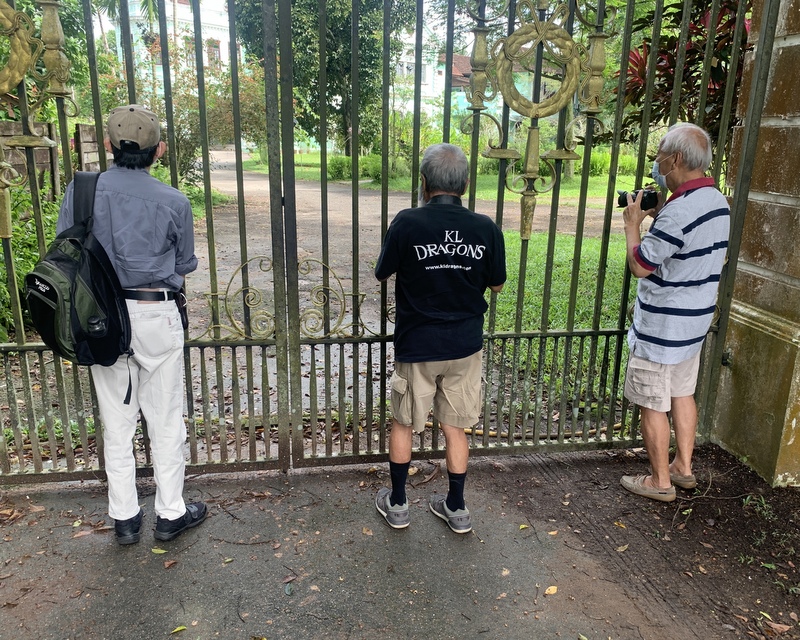
Tan Boon Chia Mansion
Closed
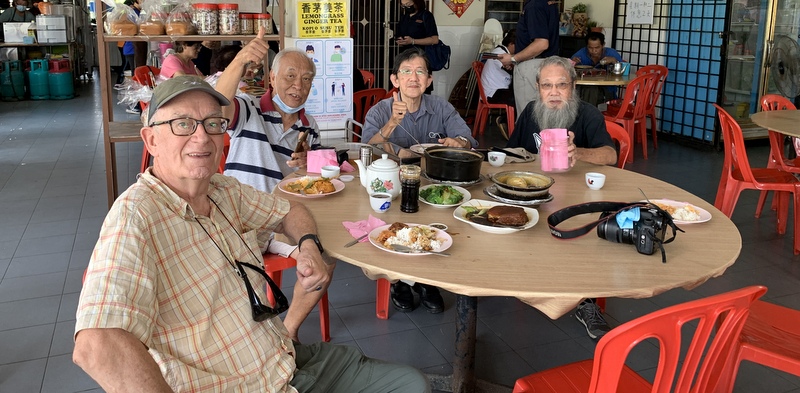
However, we had a sumptuous lunch at the WK restaurant in Ulu Yam.
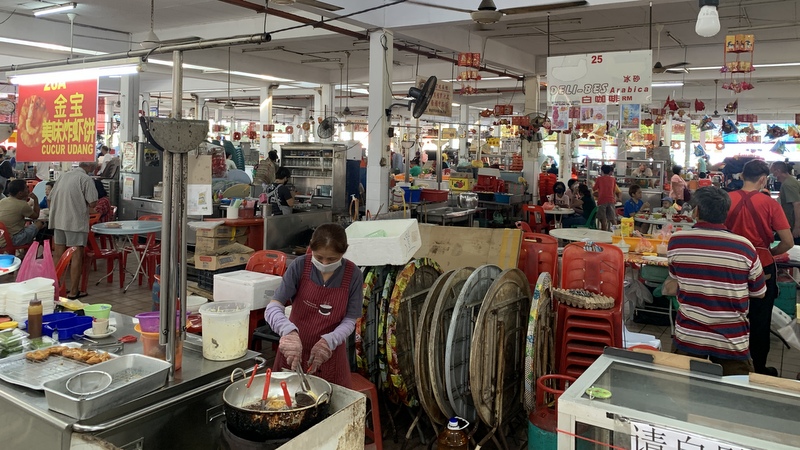
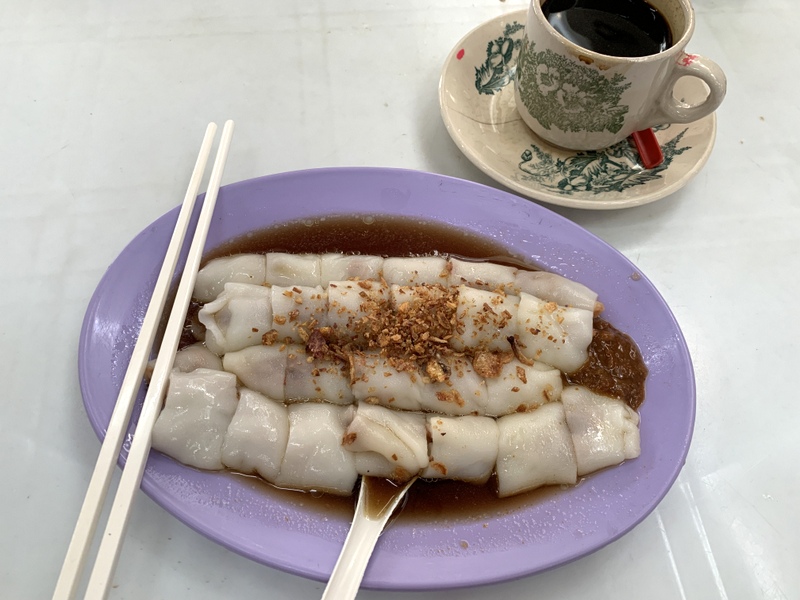
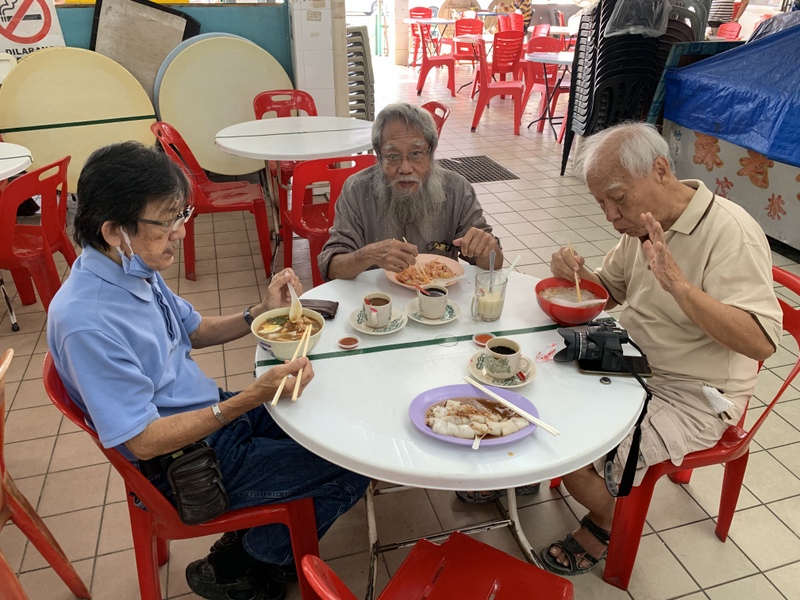
Our next outing was on 20 January and our destination was Kampar. A two hour drive from KL, so we left early . First we had breakfast in the huge Kampar Medan Selera. I had a very tasty Chee Cheong Fun, Hong Kong style.
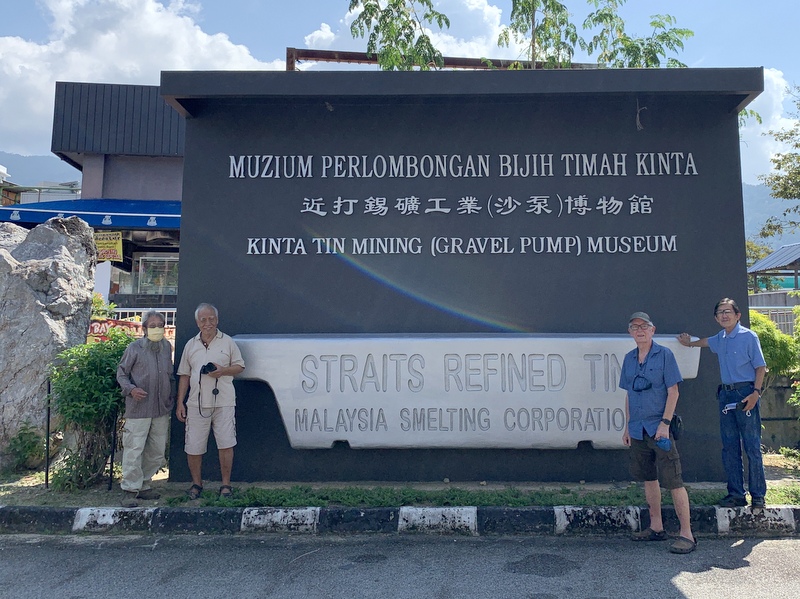
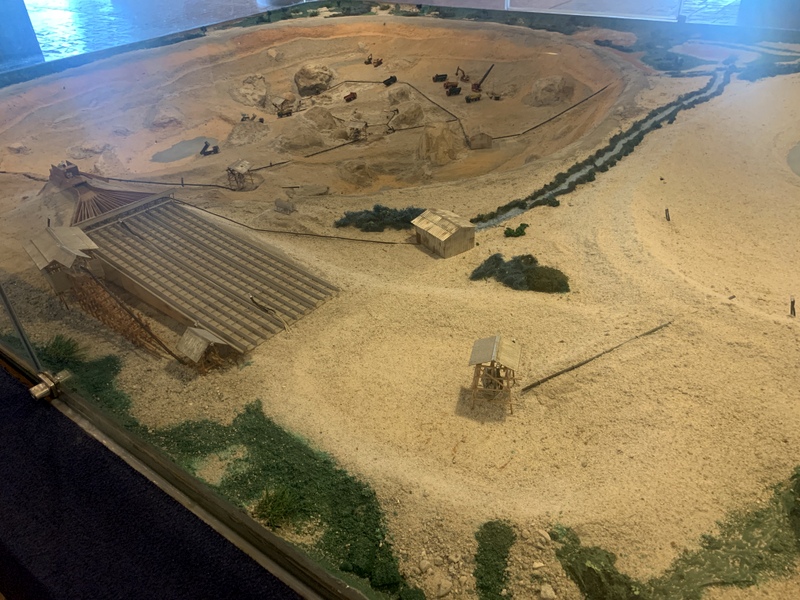
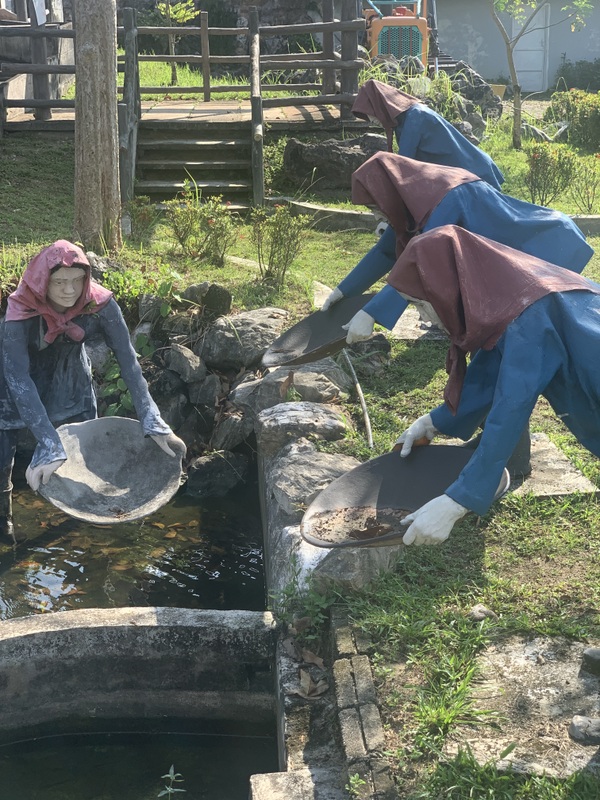
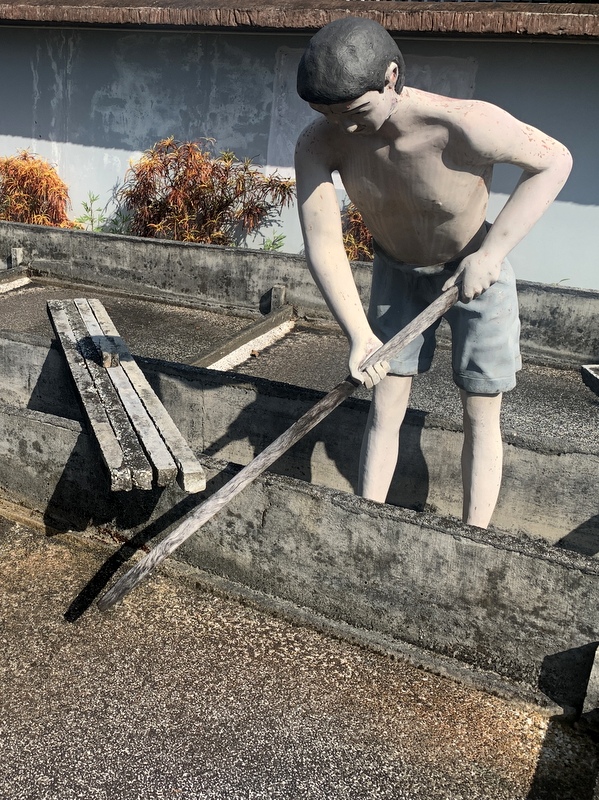
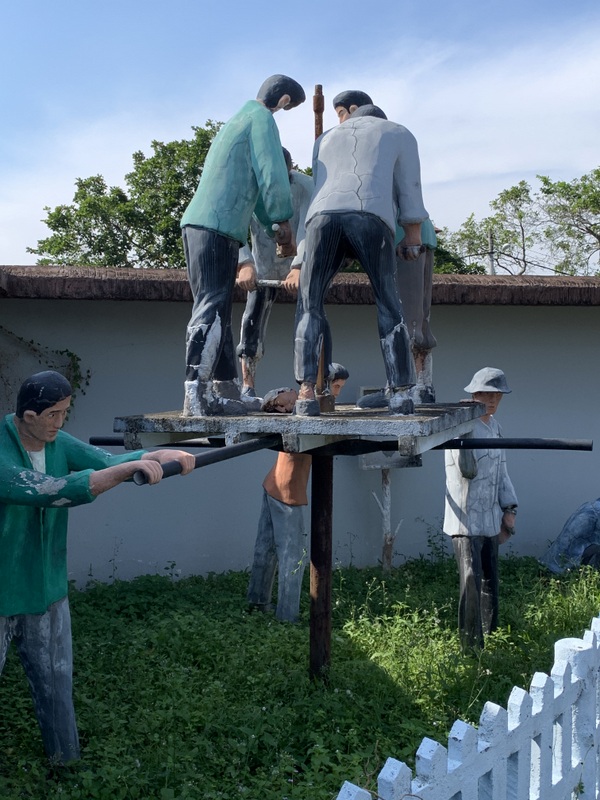
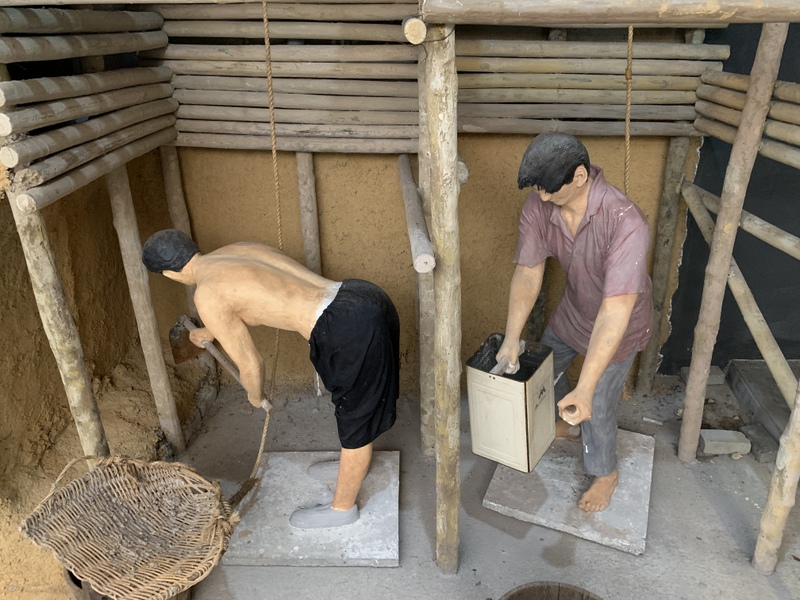
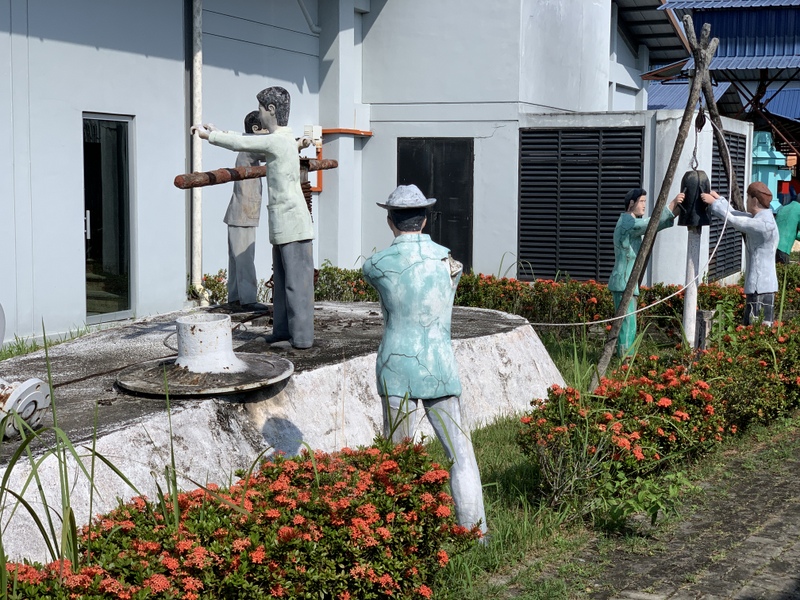
After our breakfast we visited the Kinta Tin Mining Museum. I had visited the museum in 2018, see my album Versatile Perak, for my friends it was new. It is an attractive museum dedicated to open tin mining, using gravel pumps. Lots of old machinery, many dioramas.
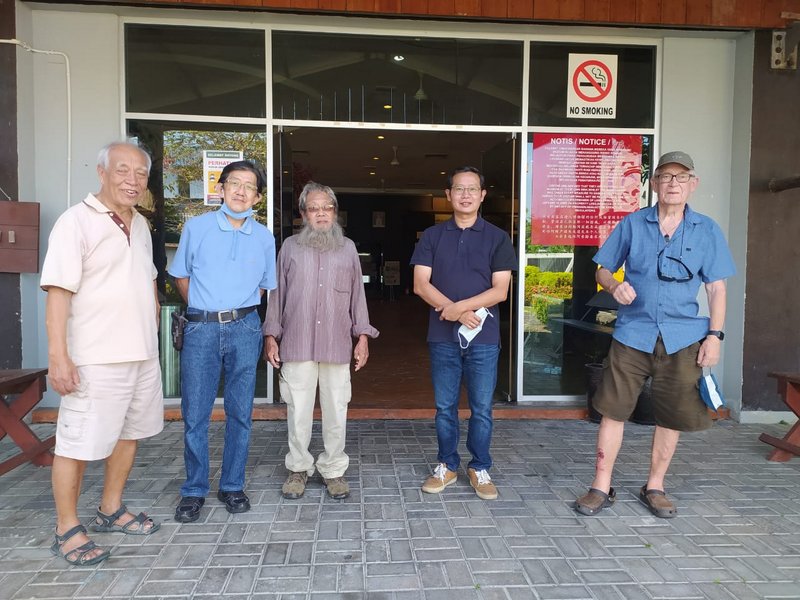
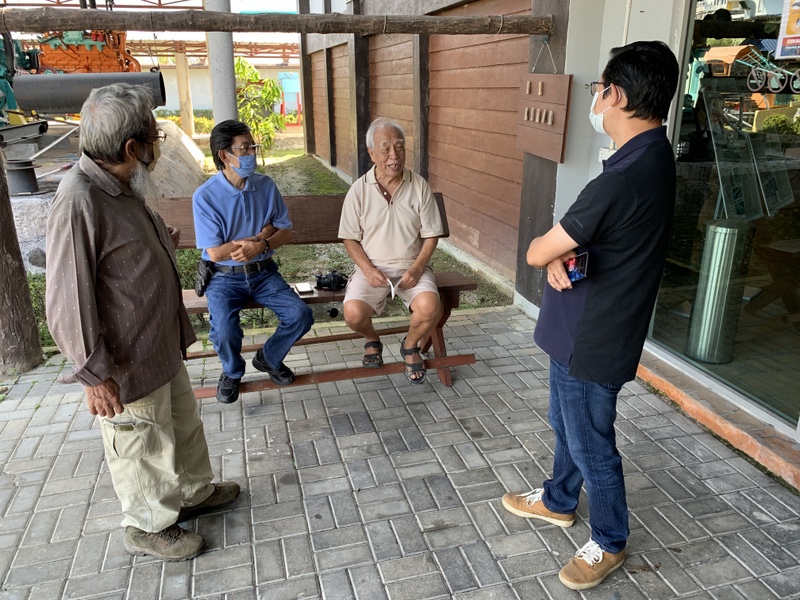
Recently I had come in contact with Jacky Chew, the curator of the museum regarding some heritage issues. It was nice to meet him now in person. He is very knowledgeable about the history of tin mining.
The Gang of Four with Jacky CHew
Talking about tin mining in the past
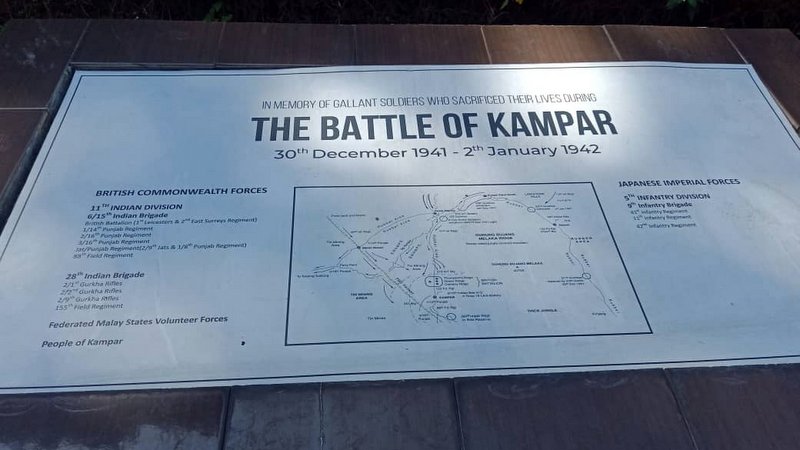
Our next destination was the Battle of Kampar Heritage trail. The Battle of Kampar was a valiant attempt of the British Commonwealth forces to slow down the advance of the Japanese Imperial army in December 1941. Jacky Chew told us that the trail started next to a factory, north of Kampar old town. We found the factory and asked for further directions.
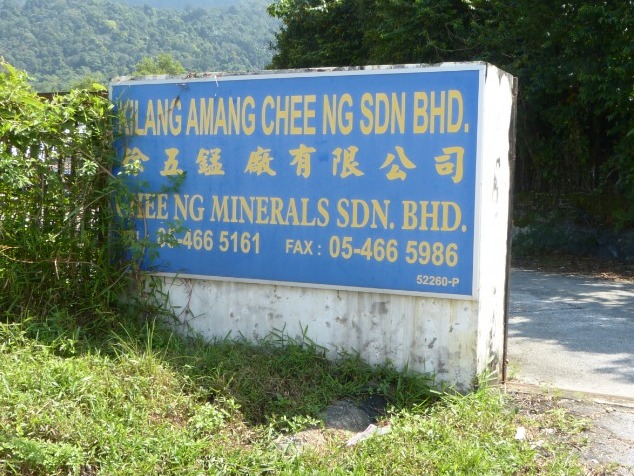
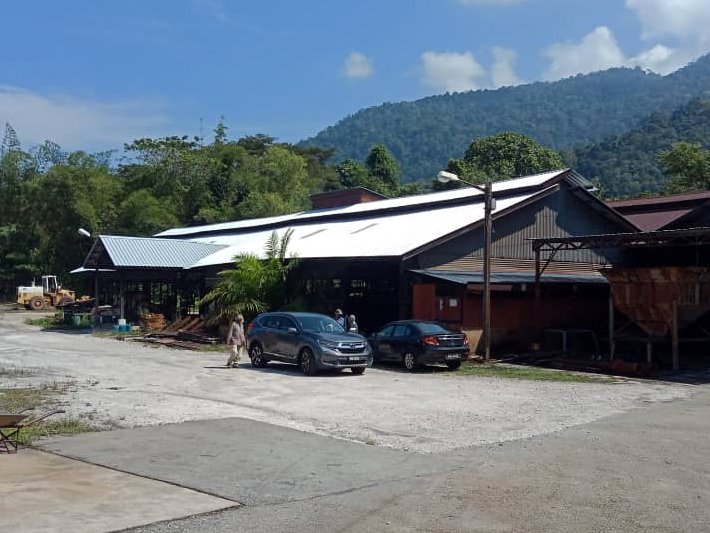
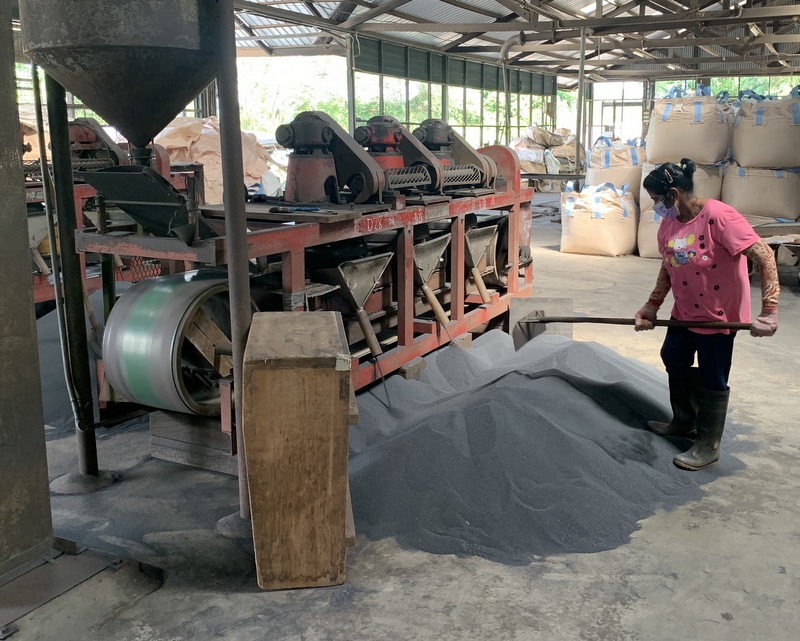
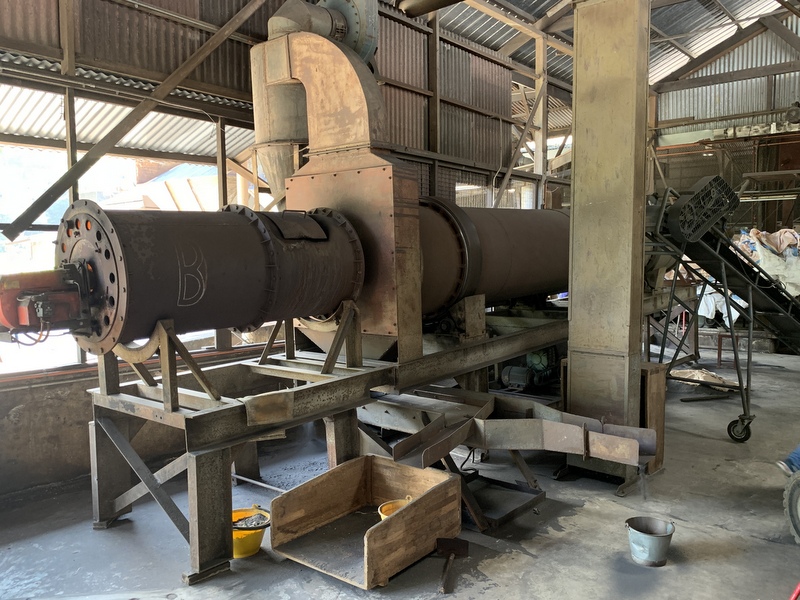
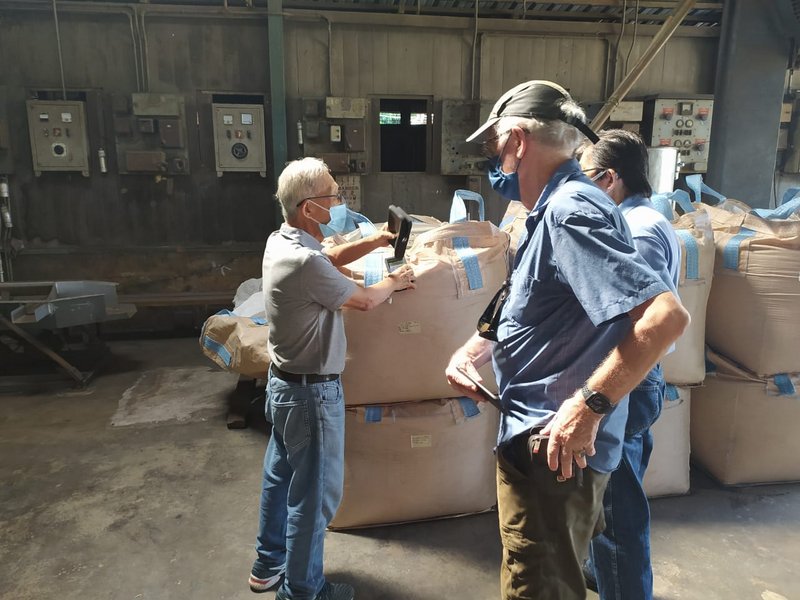
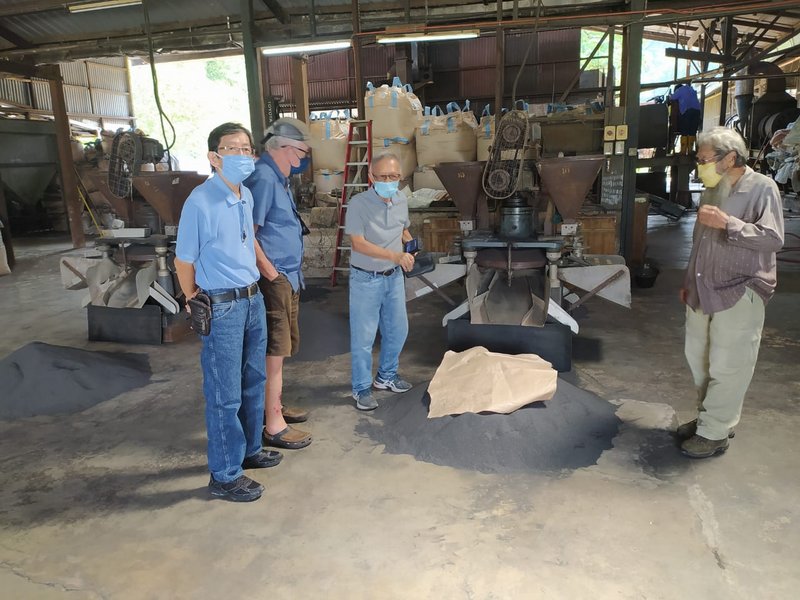
Mr Chee, the owner of the plant, pointed out where the trail started and also explained to us what they were doing in the factory. Basically it is a mineral processing industry. More info here. Very interesting and an unexpected bonus of our trip.
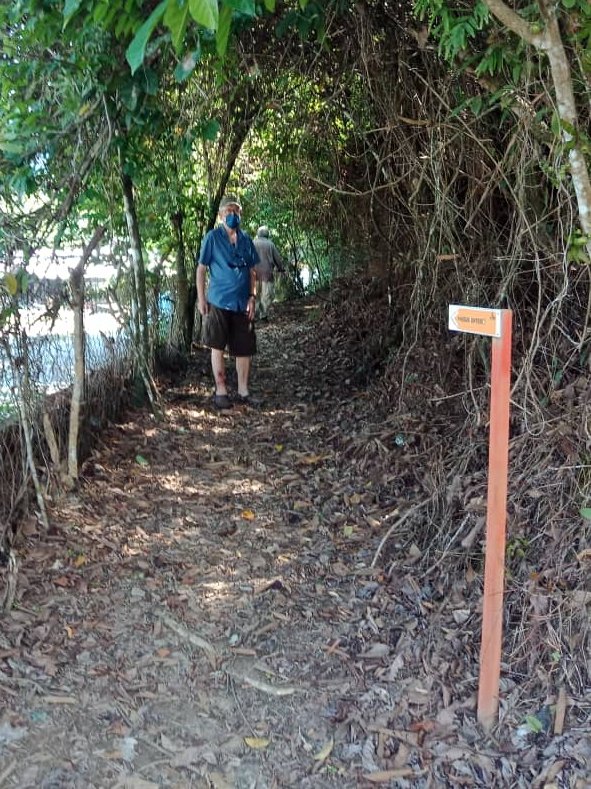
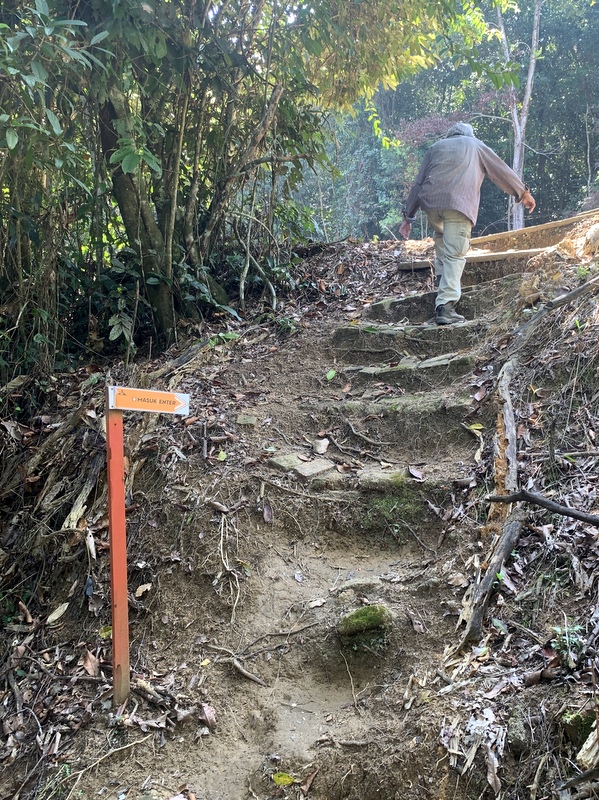
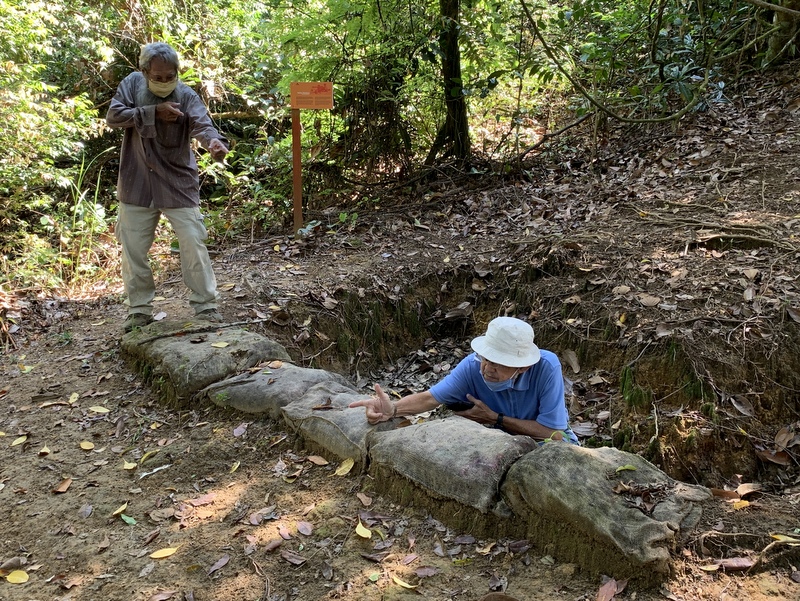
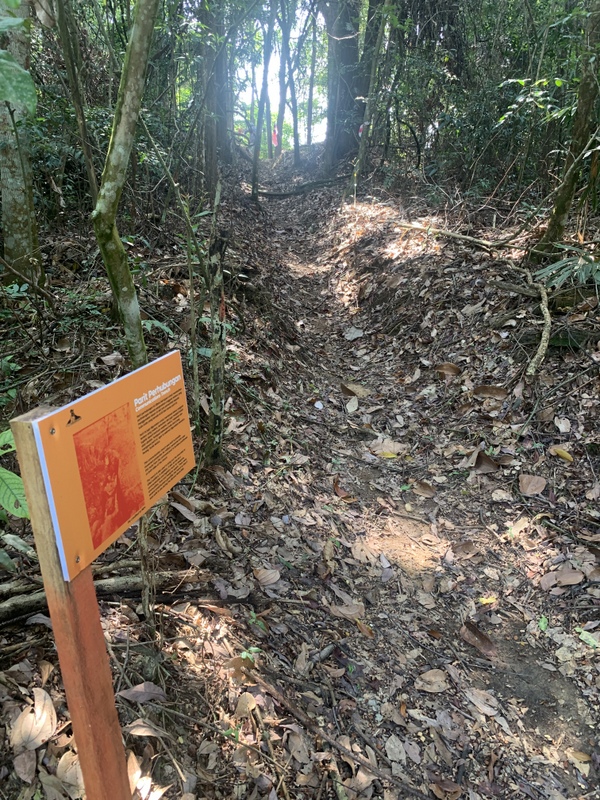
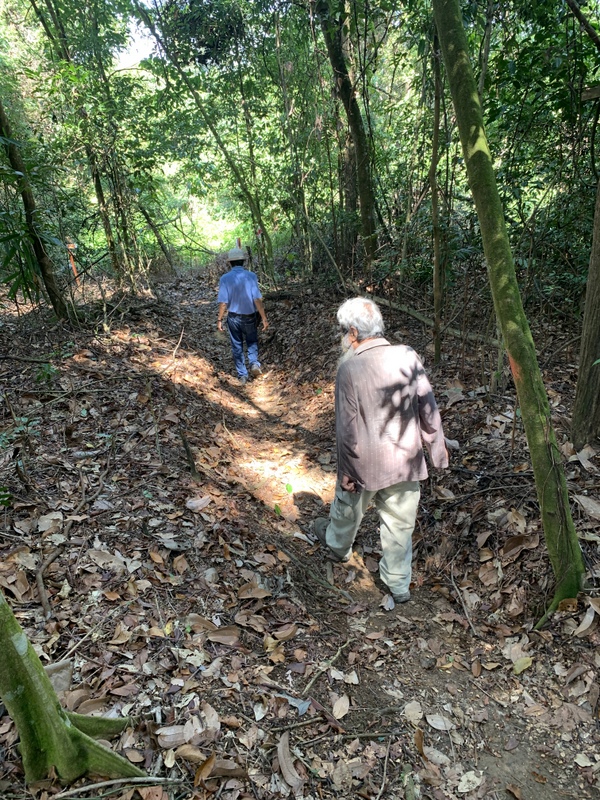
The trail starts next to the factory and was doable for us seniors ;-). Clearly signposted.
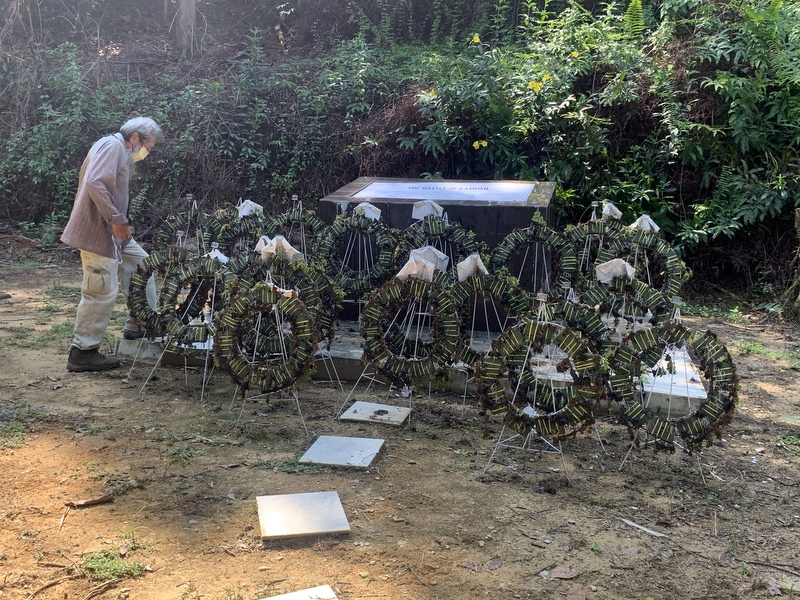
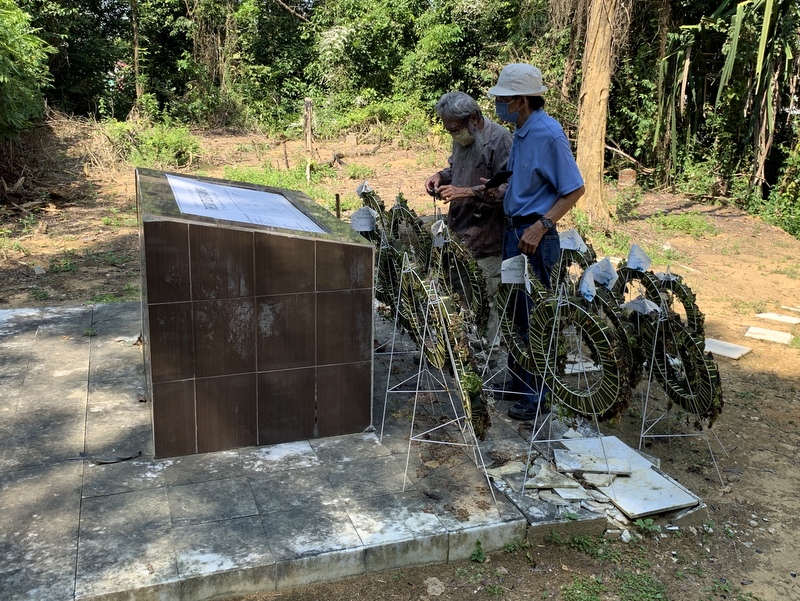
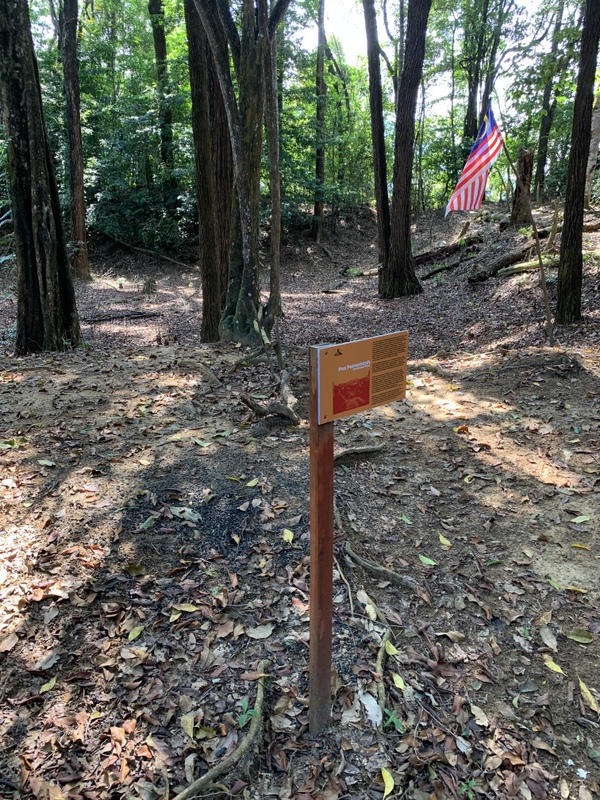
There is a memorial with info about the battle.
The wreaths in front of the memorial were put there a few weeks ago, at the 80th anniversary of the Battle of Kampar.
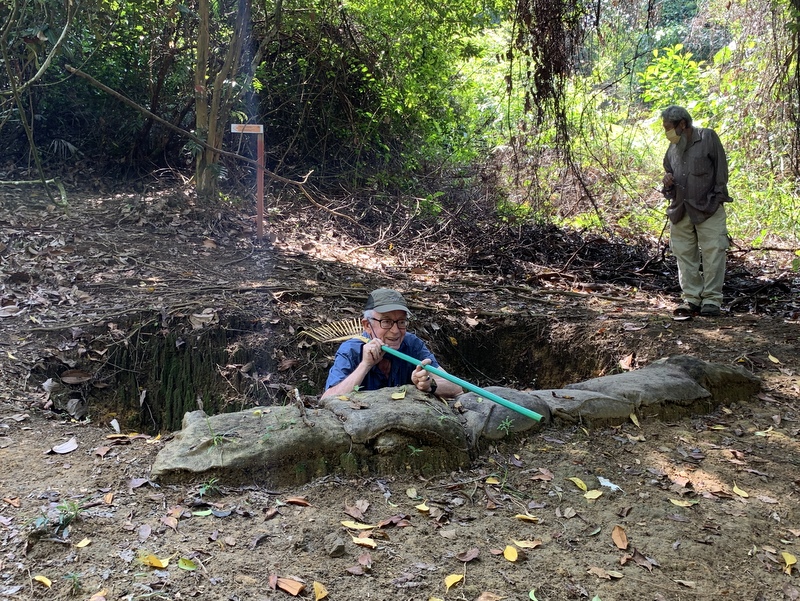
From the memorial a trail leads to a few remains of the battle field, a bunker, a trench and the location of the former command post.
the Vickers Bunker
Communication trench
Command Post
Here is a view from the Green Ridge. Not easy to imagine that this was a battlefield where hundreds of soldiers died, eighty years ago.
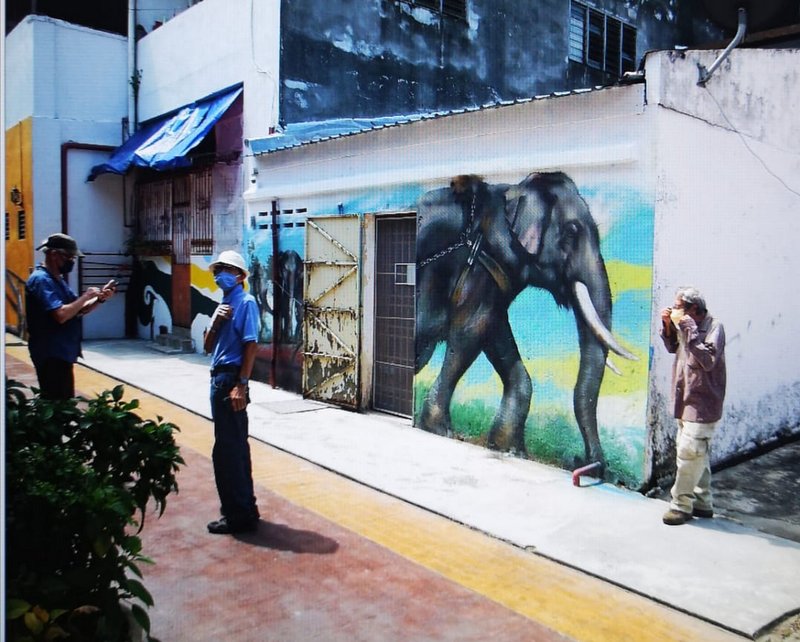
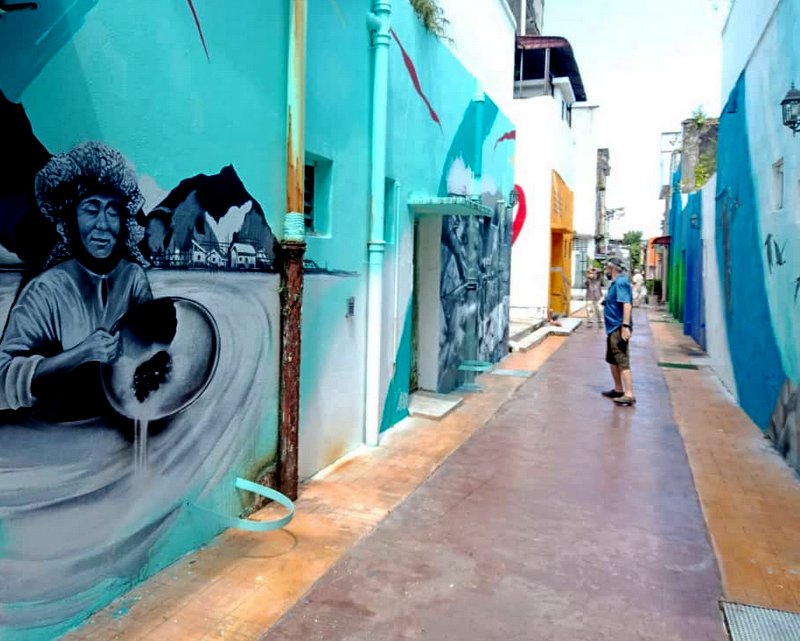
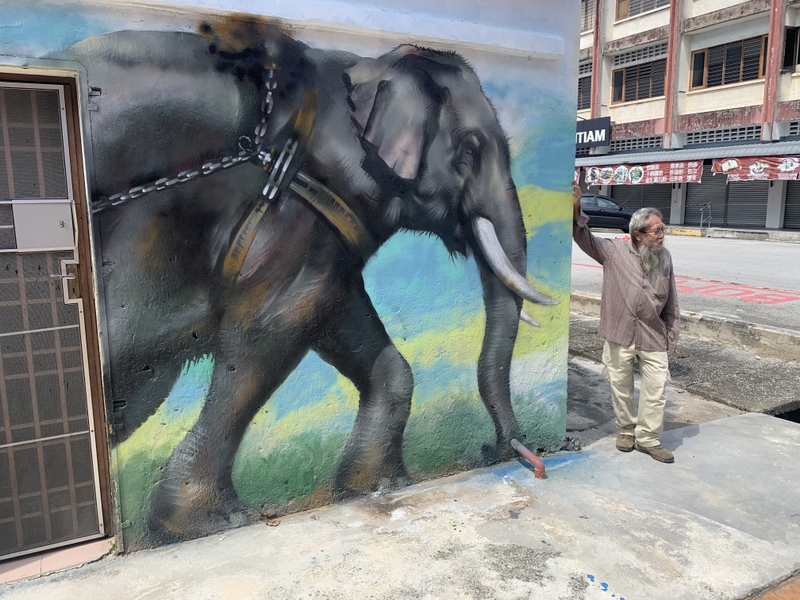
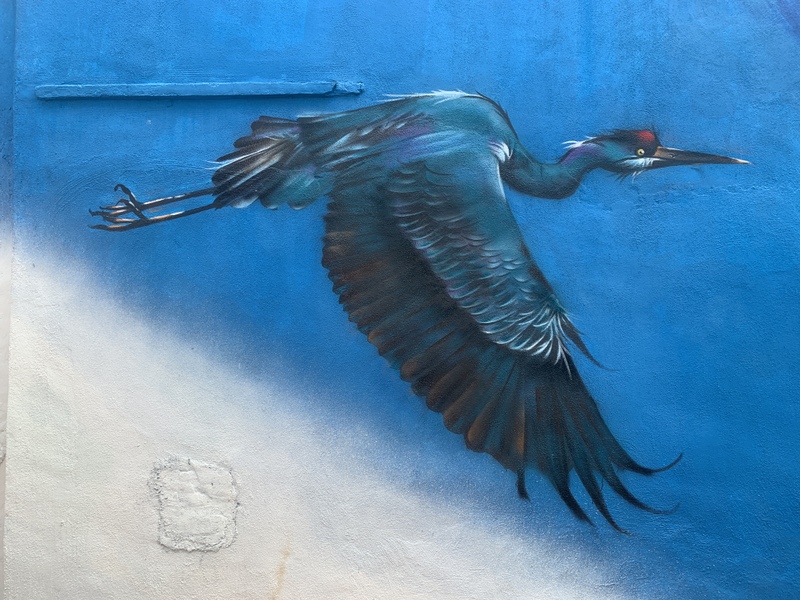
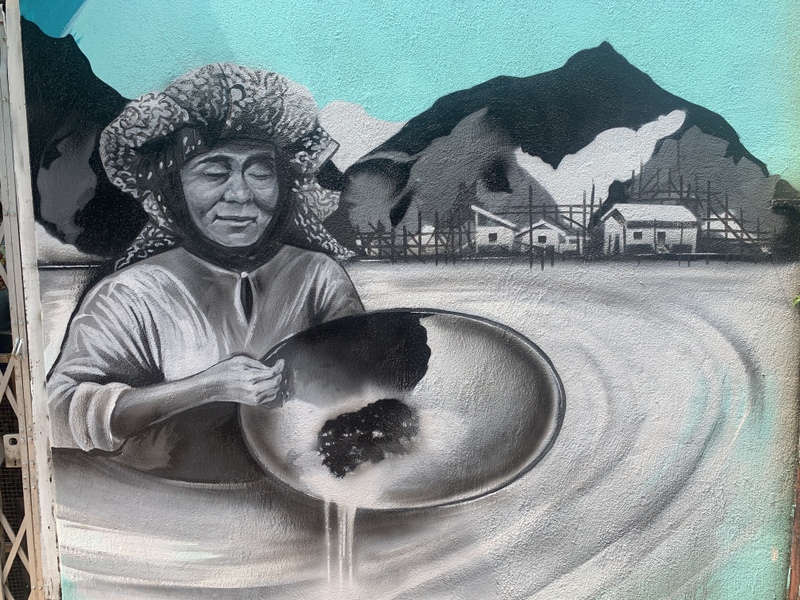
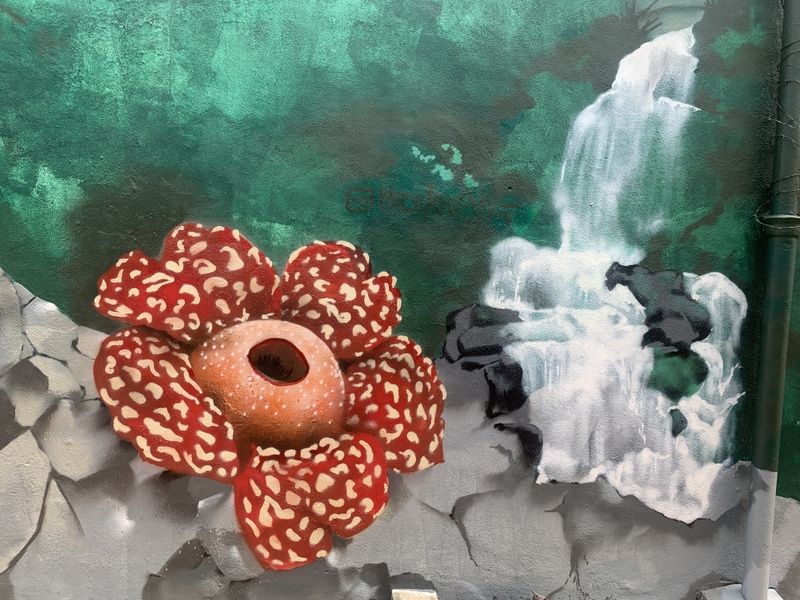
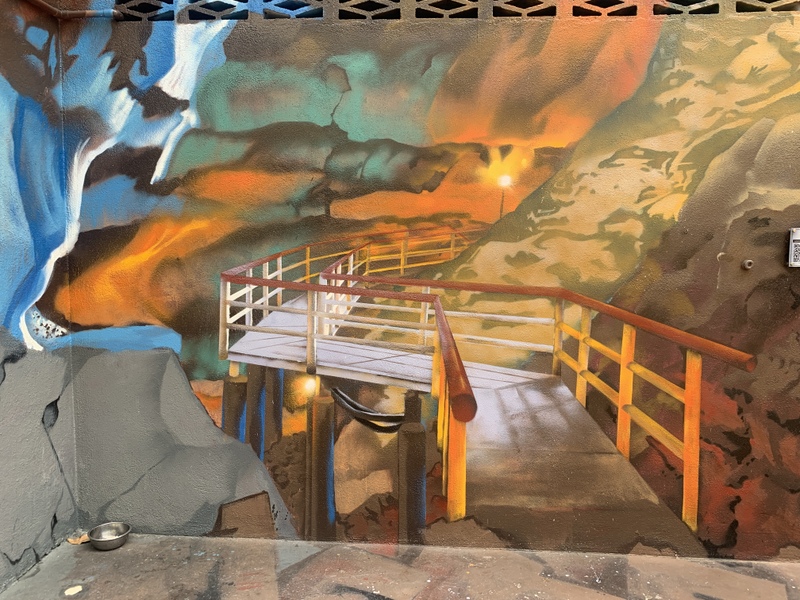
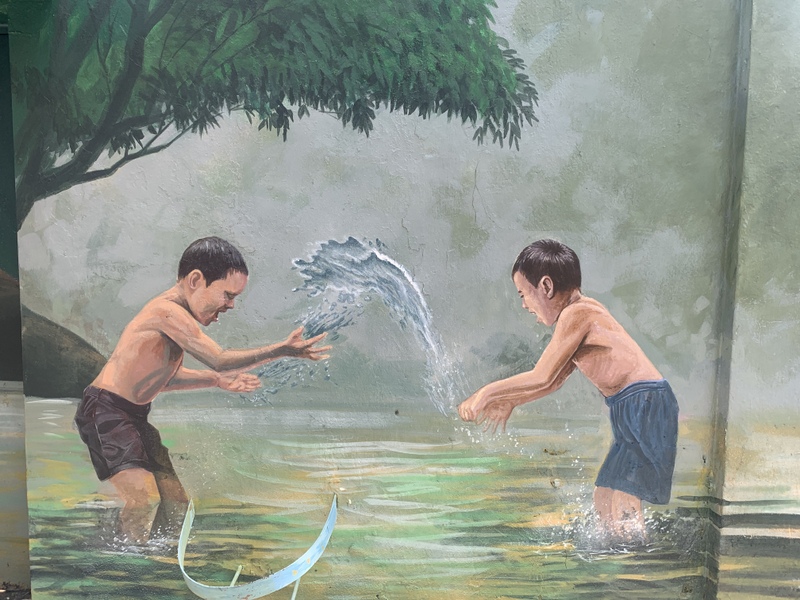
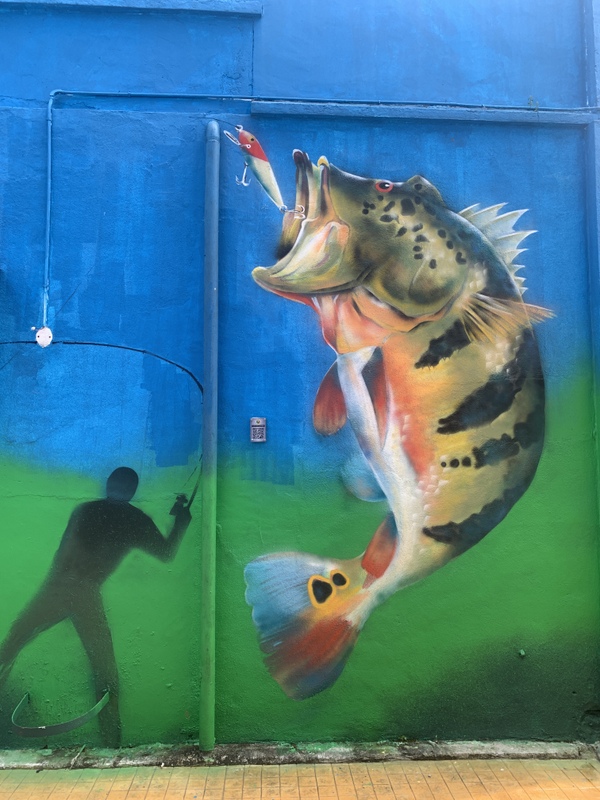
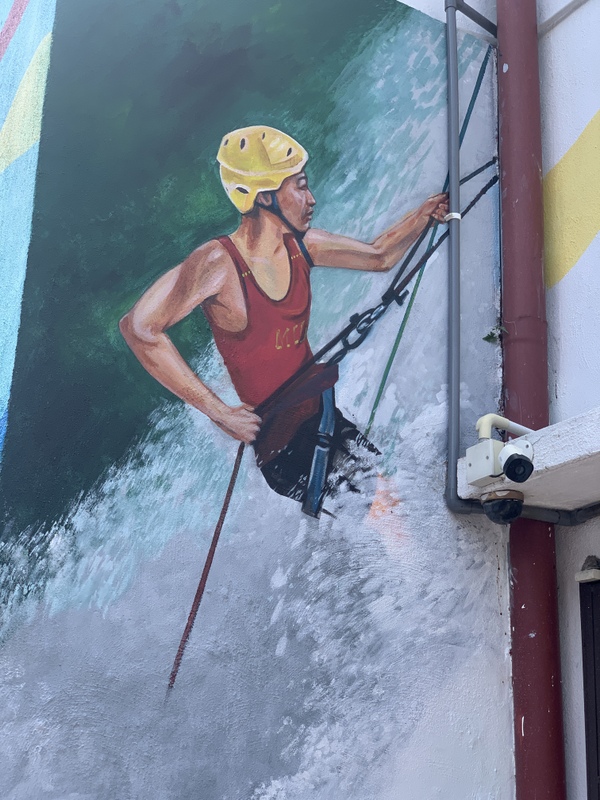
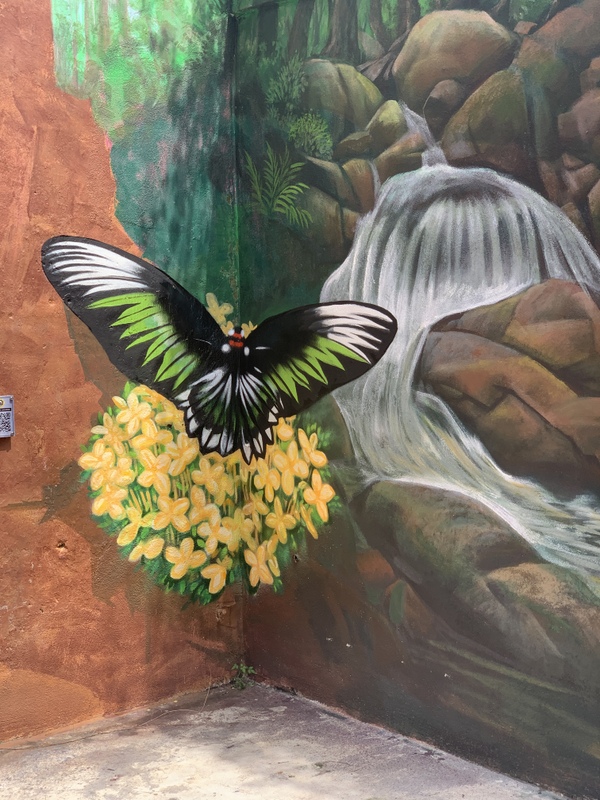
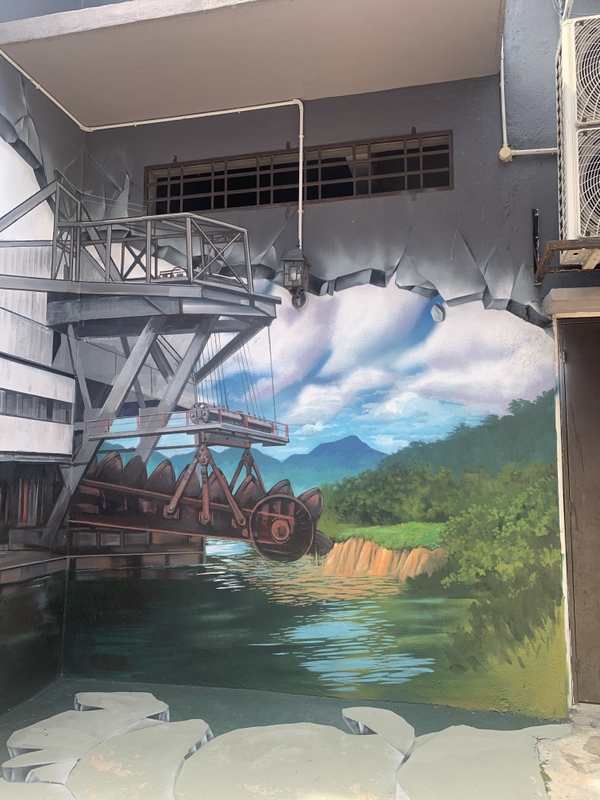
We went back to the old town for our last destination. After the success of the mural art of Zacharevic in Penang, mural art has been mushrooming all over Malaysia. KL, Ipoh, Gopeng to name a few. And now Kampar as well. The works of art are concentrated in a small lorong (alley) between the two main roads of old town. The quality is not always very good, but at least it is colorful.
Here is a collection of pictures.
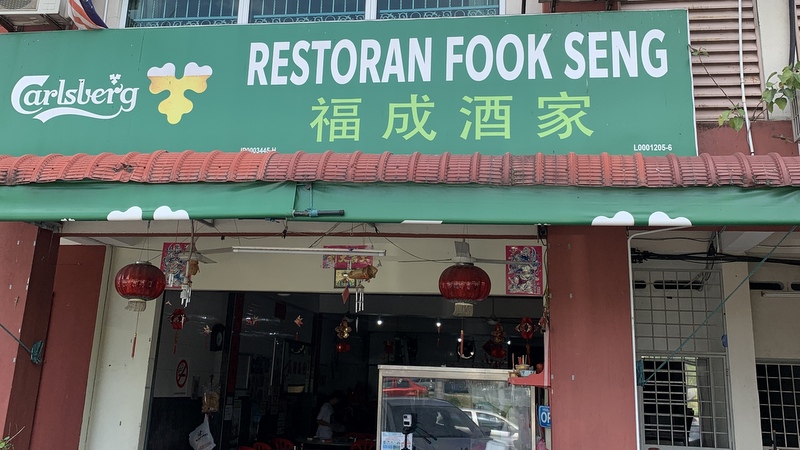
Kampar has also quite a lot of heritage architecture, but there was no time to explore as we were getting hungry. Our plan was to have lunch in Sungkai , at the Choy Kee restaurant, but we found it closed, maybe we were too late. So we continued to Slim River, the Fook Seng restaurant, a favourite of Stephen.
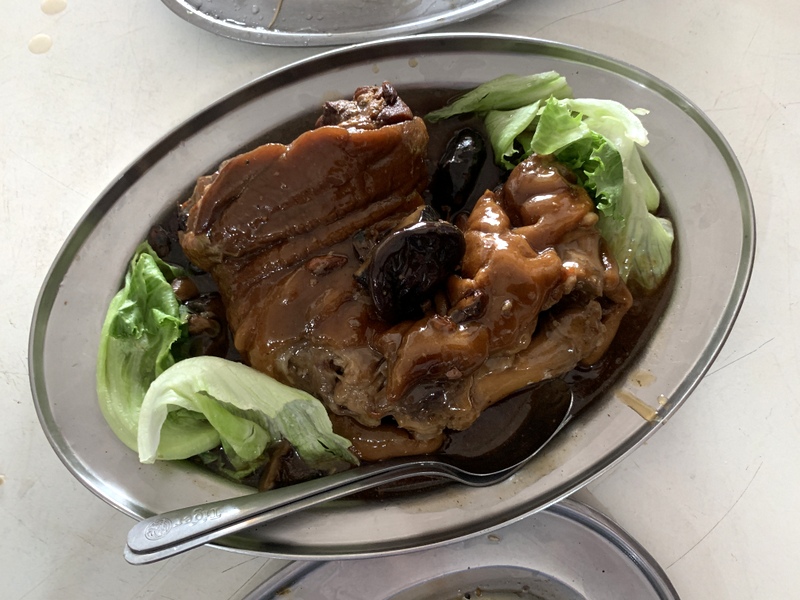
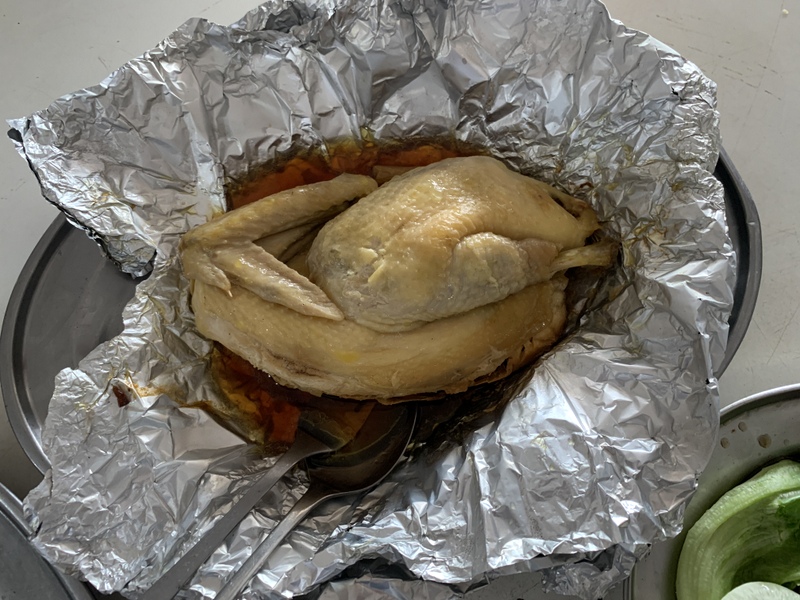
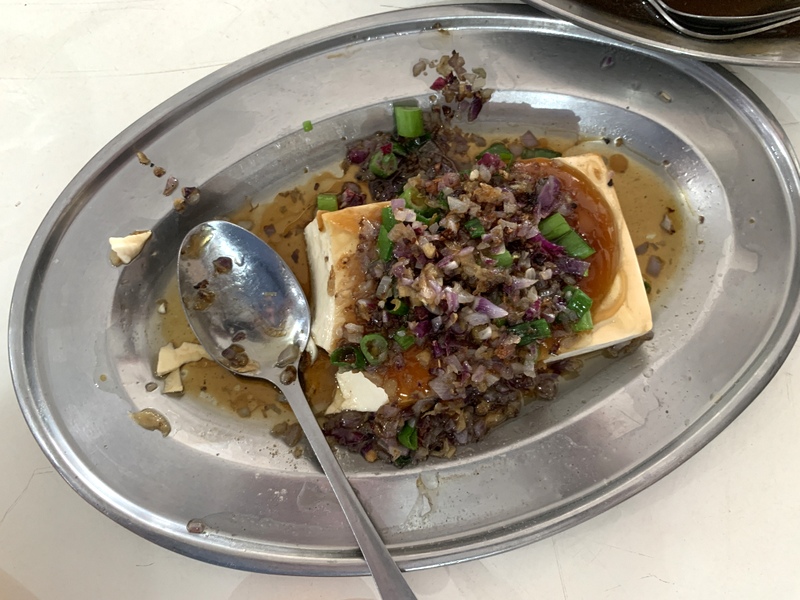
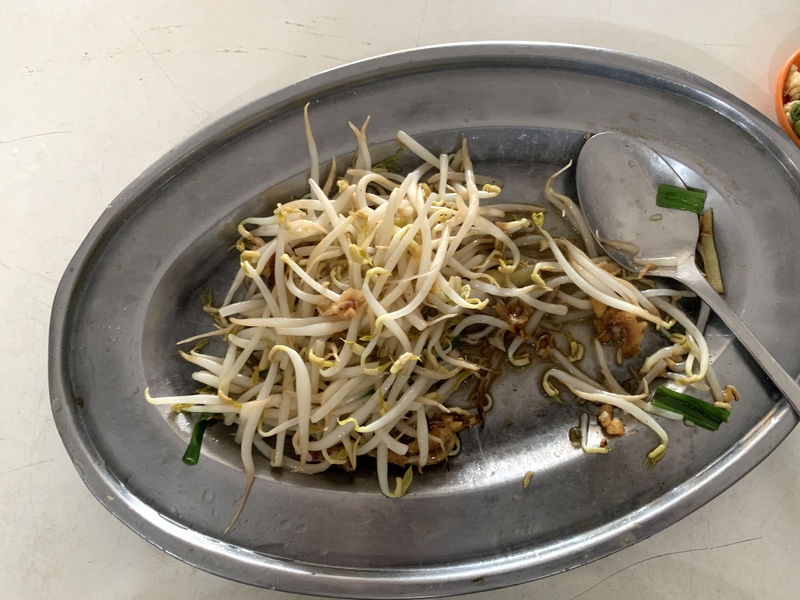
We had pork knuckle, herbal chicken, tofu and bean sprouts. With drinks and rice the bill was RM 102. Value for Money VMF), one of the tenets of the Gang of Four 😉
We are already looking forward to our next outing!